


For manufacturers running plants in Thailand and the wider ASEAN region, 2026 has quietly become a difficult year for the back office. Wages keep climbing, experienced accounting, procurement and trade-documentation staff are hard to replace, and regulatory deadlines in Japan and Vietnam do not wait for headcount plans to catch up. AI-OCR back office automation has become the practical response: rather than hiring against a rising wage curve, plants are shifting transcription, matching and filing work onto software that reads documents closer to the way a person does. This article covers where the technology actually stands in 2026, how the rules differ across Japan, Thailand and Vietnam, which documents repay the investment first, a step-by-step implementation path, the pitfalls that stall projects, and a realistic way to build the business case — written for plant administration, finance, IT and regional managers who have to make the decision.
What Actually Changed in AI-OCR: From Template Matching to LLM-Powered IDP
“We tried OCR years ago and it was useless.” Talk to administration managers at manufacturing sites across Thailand and you will hear some version of this sentence with remarkable consistency. And for the products that existed five or ten years ago, that verdict was largely correct. The problem is that the AI-OCR being discussed in 2026 is built on a different design philosophy from the tools that produced those bad memories. If you do not separate the two, you end up making a 2026 investment decision using evidence from a 2016 failure.
Why Legacy OCR Failed: It Could Read Characters, But Not Documents
Classic OCR was a character-recognition technology. It converted the pixels in an image into character codes, and that was essentially the whole job. To turn those characters into usable fields — invoice number, total amount, due date, tax amount — somebody had to tell the software in advance which coordinates on the page held which field. This is the template approach, and it carried three structural weaknesses.
One template per counterparty. If you buy from 100 suppliers, you build and maintain roughly 100 layout definitions. The setup effort scales linearly with the size of your supplier base, which is exactly the wrong direction for a plant that keeps adding local vendors.
Fragility to layout change. A supplier redesigns its invoice header, or adds one line to its address block, and every field below that point shifts. The engine happily reads the wrong cell and reports high confidence while doing it. Silent errors of this kind are far more dangerous than a clean failure, because nobody is prompted to look.
No tolerance for unstructured documents. Documents without ruled table borders, documents with a variable number of line items, documents that run across several pages — the template model has no good answer for any of these. In factory procurement, that describes a large share of incoming paperwork.
The predictable result was that the effort spent building and maintaining templates consumed the hours the tool was supposed to save. Plenty of sites bought a licence, ran it for a year, and quietly went back to manual entry. That history is why internal scepticism is high, and why any 2026 proposal needs to explain the technical difference explicitly rather than assume the audience will grant it.
LLM-Powered IDP Extracts by Meaning, Not by Coordinates
The defining trend in AI-OCR through 2026 is convergence with large language models. The technology has moved beyond character recognition into a phase where the system interprets the meaning of a field from document context and extracts on that basis (source: IT Select). That shift is the technical reason unstructured, inconsistently formatted documents finally became tractable.
Consider what that means at a plant in Rayong or Bien Hoa. One supplier’s invoice says “Invoice No.” Another writes “INV NO.” A Japanese supplier prints 請求書番号. A local Thai vendor prints Thai and English side by side, and a European supplier uses “Rechnungsnummer” on a form that was never localised. A model that reasons about meaning can recognise that all of these denote the same field. Because extraction is driven by semantics rather than by x-y coordinates, a layout change no longer breaks the pipeline in the same catastrophic way. The core assumption of the old model — that you must hand-build a definition per counterparty — no longer holds, and for a factory back office fed by dozens of inconsistent formats, that is the decisive change.
The broader category that wraps recognition, classification, field extraction, validation and downstream system integration into one pipeline is called IDP, or intelligent document processing. Understanding the relationship helps enormously during product evaluation: AI-OCR is the recognition engine at the core; IDP — intelligent document processing — is the surrounding framework that turns recognised text into a posted transaction. Some vendors market themselves as AI-OCR, others as IDP, and the naming tells you little. What determines the business result is not the raw engine but how far the surrounding pipeline has been built out for your documents and your workflow.
Where Accuracy Stands in 2026: 99%+ on Printed Text, About 95% on Handwriting
Leading OCR solutions in 2026 are reported at over 99% accuracy on printed characters and approximately 95% on handwriting (source: IT Select). For anyone whose mental benchmark was set a decade ago, the handwriting figure in particular represents a genuine step change — it is the reason shop-floor forms are now even worth discussing as automation candidates.
That said, these numbers need careful reading, and misreading them is the single most common cause of disappointment after go-live. Accuracy figures of this kind are character-level or field-level metrics. They are not the probability that a given document can be pushed through with no human review at all.
A simple arithmetic illustration makes the point. Suppose you want to extract 20 fields from one invoice, and suppose each field is read correctly 99% of the time. The probability that all 20 are simultaneously correct is 0.99 to the power of 20, roughly 82%. That is not a measured result from any specific product — it is arithmetic, and real systems behave differently because errors are correlated and because validation rules catch many of them. But it establishes the principle: “99% character accuracy” and “documents can flow through unchecked” are not the same statement, and treating them as equivalent will produce a business case you cannot defend twelve months later.
This is why experienced teams evaluate on two operational metrics instead:
- Straight-through rate — the share of documents finalised with zero human touch.
- Escape rate — the share of documents where an incorrect value passed validation and reached the downstream system undetected.
The second metric matters more than the first, and it is the one vendors almost never volunteer. Whether you write these two into the proof-of-concept design before you start determines whether the post-implementation review is a productive conversation or an argument.
The 50–70% Time Reduction Reports and the Growth of the IDP Market
Organisations that have deployed AI-driven OCR report processing-time reductions of 50–70% compared with manual work (source: scoop.market.us). Taken alongside the market data, the direction is clear: the IDP market is projected at USD 4,382.4 million in 2026, USD 5,485.0 million in 2027 and USD 6,460.9 million in 2028, implying annual growth above 26% (source: Grand View Research). Among extraction technologies, OCR held the leading revenue share in 2026.
By industry, the largest adopting sector is BFSI — banking, financial services and insurance — at 32.7% of the market (source: Grand View Research). That figure carries two implications for manufacturing that are worth stating plainly.
First, the technology has already been stress-tested at scale in an industry with unforgiving accuracy and audit requirements. Manufacturers are adopting proven capability rather than pioneering it.
Second, and less comfortably, it means far fewer off-the-shelf solutions have been tuned for manufacturing-specific documents. Inspection certificates, mill sheets, certificates of analysis, Form D and other preferential certificates of origin are not what the BFSI-focused product roadmaps were optimised for. When you apply a general-purpose engine to a factory back office, the configuration work — mapping your documents, your master data and your exception rules onto a generic pipeline — matters more to the outcome than the engine benchmark does. Budget and staff the configuration phase accordingly.
Why Back Offices at ASEAN Manufacturing Sites Are Under Structural Pressure
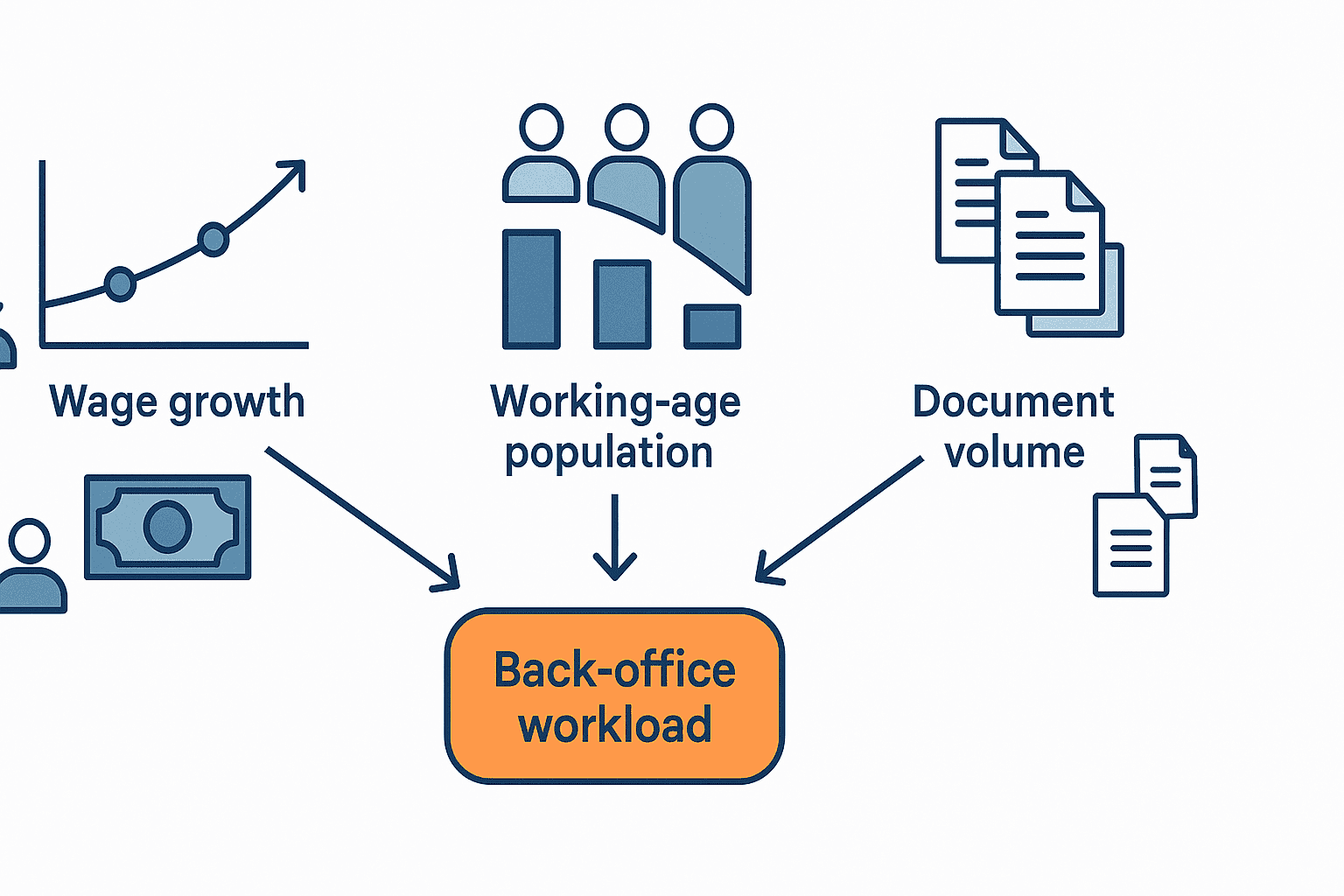
“Can’t we just hire another accounts payable clerk?” is a fair challenge, and it deserves a numerical answer rather than a rhetorical one. Looking at the Thai labour market, the cost of that option is rising every year, and it is rising for reasons that will not reverse with the business cycle.
Thailand’s Wage Growth Is Cost-Push, Not Demand-Driven
Thailand’s working-age population has already entered a period of decline. Because labour supply is contracting, wages continue to rise even without strong economic growth — a cost-push structure rather than a demand-pull one (sources: JETRO; Tokyo Consulting Group Thailand blog).
Wage increases at Japanese-affiliated companies in Thailand ran at 3.8% in 2023, 4.58% in 2024, and 4.64% projected for 2025 (same sources). The variation by job category is wider still, on an annual basis:
| Job category | Annual increase |
|---|---|
| General operators | 3–5% |
| Technical staff and engineers | 5–8% |
| Middle management | 6–10% |
| IT and digital talent | 8–12% |
Minimum wage policy also points upward on a phased basis, and figures around 600 baht have been discussed as a longer-term direction. It is important to be precise here: that is a subject of policy debate and aspiration, not a decided or legislated level, and presenting it otherwise in an internal paper will undermine your credibility when someone checks.
The strategic implication is straightforward. A plan that answers rising back-office volume by adding headcount can work for one budget year, but across a five-year horizon it compounds into a cost base that is very hard to unwind. And note which row of that table is highest: IT and digital talent at 8–12%. The fallback option of “we’ll hire an internal systems person and solve it ourselves” is inflating faster than the clerical work it was meant to replace.
The Double-Work Burden Unique to Multinational Plant Sites
Back offices at foreign-invested plants in Thailand and Vietnam carry a workload that purely domestic companies simply do not have. Three layers of duplication show up again and again.
Language layering. Invoices from local suppliers arrive in Thai, or in bilingual Thai-English. Documents from Japanese or Korean suppliers arrive in their home language. Global-sourced items arrive in English. All three streams land on the desk of the same accounts payable clerk, who has to be functionally trilingual to reconcile them.
Dual accounting and reporting. The same transaction must be processed once for local statutory tax and accounting requirements, and again — often with different classifications, different periods and different consolidation rules — for headquarters group reporting and management accounting. This is not inefficiency to be eliminated; it is an unavoidable consequence of being a subsidiary.
Dual closing calendars. The local month-end close and the headquarters close rarely fall on the same date. The result is two workload peaks per month for the same small team, with the second one landing while the first is still being cleaned up.
None of this can be resolved by “stopping the unnecessary work,” because none of it is unnecessary. What it does mean is that the proportion of judgment-free labour — transcription, matching, filing, re-keying the same figure into a second system — is unusually high at these sites. That is precisely the work machines handle well, and it is why the return on back office DX tends to be more favourable at multinational plant sites than the headline document volumes alone would suggest.
Key-Person Risk Can Matter More Than Labour Cost
There is a risk that rarely appears in the ROI spreadsheet and often matters more than anything in it. At most sites, someone has accumulated undocumented knowledge: the quirks of a particular supplier’s format, the exceptional payment terms agreed three years ago, the reason one customer’s PO always has to be adjusted manually, the workaround for the one item code that never mapped correctly. It lives in that person’s head and nowhere else.
When that person resigns, is reassigned, or rotates back to headquarters, the month-end close stalls — not for a day, but sometimes for a quarter while the replacement reconstructs the rules by trial and error. Implementing AI-OCR alongside a defined workflow does something more valuable than cutting hours: it forces processing rules out of individual memory and into a system where they are visible, reviewable and transferable. This benefit resists clean quantification, but from a business-continuity standpoint it frequently outranks the labour saving. If your site has one irreplaceable person in finance or procurement, say so explicitly in the proposal.
Regulation in Three Countries Is Pushing Back Office Automation Forward
Beyond technology and labour cost, 2026 brought regulatory movement that reinforces the case for digitising documents. But the strength of the obligation differs sharply by country, and conflating them will get your internal briefing wrong in a way that is easy for a tax adviser to catch. Take the three separately.
Japan — Electronic Data Retention Has Been Fully Mandatory Since January 2024
Under Japan’s Electronic Book Preservation Act (電子帳簿保存法), retention of electronic transaction data became fully mandatory in January 2024. The earlier grace period has ended, and by 2026 tax audits are examining compliance with these requirements strictly (sources: CloudSign and others).
The structure of the law is more nuanced than most summaries suggest, and the nuance saves money. What is mandatory is only electronic transaction data retention. Scanner retention — digitising documents originally received on paper — and electronic ledger retention remain optional (same sources). In practice: an invoice PDF received by email or EDI must be retained electronically in a form that satisfies the requirements, while an invoice physically received on paper may still be stored as paper without breaching the law. Teams that misread this as “everything must be scanned” launch a far larger project than the regulation actually demands, and then struggle to justify its cost.
There is also relief for smaller entities: businesses with revenue of 50 million yen or less can use relaxed search requirements, satisfied through a file-naming convention of “date_amount_counterparty_description” plus documented internal procedures (same sources). Looking ahead, integration between Peppol-based electronic invoicing and these retention requirements is expected to progress.
For a subsidiary in Thailand or Vietnam, the Act is not directly applicable — it is Japanese law binding Japanese entities. The connection runs through transactions with the Japanese parent or affiliated Japanese group companies. When your site issues an invoice PDF and the Japanese entity receives it as electronic transaction data, the retention obligation sits on the Japanese side. But the practical burden of meeting it — consistent file naming, consistent issuance, version control when a document is reissued or credited — depends almost entirely on how the issuing site operates. Whether document issuance at the overseas site is digitised and standardised directly determines how much manual effort compliance costs in Japan. That dependency is the real reason regional finance leads should care about a law that does not technically apply to them.
Thailand — e-Tax Invoice Is Voluntary, but the Incentives Were Extended by Two Years
This is where misunderstanding is most common, and where getting it wrong is most visible. Thailand’s e-Tax Invoice and e-Receipt system is voluntary as of July 2026. No legal mandate for B2B electronic invoicing has been enacted, and Thailand is explicitly excluded from the lists of countries scheduled for mandatory e-invoicing in 2026 and 2027 (sources: VATupdate country booklet, July 2026; Fiscal Solutions). If you write an internal approval request premised on “e-invoicing is becoming mandatory in Thailand too,” you are stating something factually incorrect, and the first finance reviewer who checks will discount the rest of your paper.
The Thai system operates on a post-audit model. The business issues the e-invoice directly to the buyer, then transmits the XML data to the Revenue Department by the 15th of the following month (same sources). Because this is not a clearance model requiring real-time approval from the tax authority before an invoice becomes valid, the operational lift is comparatively modest: if you can reliably generate and transmit the data from your existing sales system, you can run it. That architectural difference is worth explaining to colleagues whose reference point is a clearance-model country.
So why are companies adopting a voluntary scheme? Incentives. On 16 June 2026, the Thai Cabinet approved a two-year extension of incentives for adopting electronic tax systems, through 31 December 2027 (source: Mahanakorn Partners). At the time of reporting, formal publication was still pending, so anyone relying on this should verify the current Royal Gazette publication and Revenue Department notifications before committing.
For SMEs, Thailand also allows a 200% deduction on the cost of DEPA-registered digital services — meaning THB 100,000 of qualifying spend is treated as a THB 200,000 reduction in taxable income (same source). Separately, under the BOI’s 2026 scheme, Category 8.1 Digital Technology Business (8.1.1, software and platform development) qualifies for corporate income tax exemption of up to eight years, covering up to 100% of investment excluding land and working capital. Digital transformation is explicitly named among the priority development areas for 2026–2030, which is a useful signal when framing an investment case (source: BOI guide).
Thailand’s 2026 position, then, is this: it is not mandatory, but moving now lets you use tax treatment that has a stated expiry date. Thailand accounting automation projects that are going to happen anyway are better timed inside that window than after it.
Vietnam — Decree 254/2026 Took Effect on 1 July 2026
Vietnam presents the opposite picture: the rules are actively moving. Decree 254/2026/NĐ-CP, which implements Tax Administration Law 108/2025/QH15, took effect on 1 July 2026. It was issued on 30 June 2026 together with the related Circular 91/2026/TT-BTC (sources: KPMG TaxNewsFlash, July 2026; Bizzi; Fiscal Solutions).
The principal changes are:
- The scope of post-reconciliation invoices is expanded to sectors including digital platforms and crypto-assets.
- A consumer reporting and reward mechanism is introduced, targeting sellers who fail to issue e-invoices.
- Conversion of e-invoices to paper is restricted.
- The data receiving authority changes from the General Department of Taxation to the Tax Department.
- As a transitional measure, certain paper documents must be migrated to electronic form by the end of 2026.
For plant operations, the last three carry the most weight. The restriction on paper conversion directly challenges a habit that is near-universal at manufacturing sites: receive electronically, print, file in a binder because that is how the audit folder has always been assembled. That routine now needs review rather than continuation.
The change of receiving authority looks administrative, but it is a concrete task for whoever maintains the interface — transmission endpoints and system-side connection settings need checking and, in some configurations, re-registration. It is exactly the kind of item that is trivially easy to handle in advance and painful to discover during a filing deadline.
And the end-of-2026 migration deadline means that companies with Vietnamese operations have a bounded, and by now short, window in which paper document digitisation can be deferred. Vietnam e-invoice Decree 254 has effectively converted “we’ll digitise when we get around to it” into a dated commitment.
What the Three Jurisdictions Have in Common
Japan requires that what arrives electronically stays electronic. Vietnam restricts converting electronic records back to paper and sets a deadline for migrating paper forms. Thailand does not mandate anything but attaches tax advantages to going digital. The legal force differs by an order of magnitude across the three — but every one of them points the same way.
The practical conclusion for a regional manager is about the useful life of process design. A workflow built on the assumption that paper is the authoritative record is depreciating, in every jurisdiction where you operate, on a schedule you do not control.
This also changes how the project should be positioned internally. If AI-OCR back office automation is framed purely as a discretionary efficiency investment, it will lose the annual capital allocation fight to a machine, a line expansion or a safety upgrade every single time — because those have deadlines and it does not. Reframe it as a single programme covering both compliance and efficiency, and the necessity argument changes character entirely. The documents in scope for compliance and the documents in scope for efficiency overlap heavily; funding them separately means touching the same documents twice.
Which Documents Deliver the Most From Document Digitization in a Factory
AI-OCR is not universally applicable. There is a sharp divide between document types where it pays back quickly and types where it never quite does. Getting this judgment right at the outset determines most of the project outcome, and it is cheap to get right because it requires analysis rather than spend.
Procurement and Accounts Payable: Invoice Processing Automation Comes First
For most plants, the highest-yield starting point is procurement and accounts payable, for three converging reasons: volume is high, formats vary by counterparty in ways that have historically forced manual handling, and the core activity is matching — a mechanical comparison rather than a judgment call.
Concretely, the scope is reading supplier invoices, delivery notes and order acknowledgements, then reconciling them against your own purchase order data and goods receipt records: the classic three-way match. Detecting unit price variances, quantity variances, duplicate billing and unauthorised charges is straightforward to express as rules, and it is also the work that exhausts human reviewers fastest and degrades most predictably under month-end time pressure. Choosing invoice processing automation as the first phase of AI-OCR back office automation is the common choice at ASEAN manufacturing sites, and it is a rational one.
A practical note on scoping: include credit notes and debit notes from day one. Teams frequently scope “invoices,” discover during user acceptance testing that credit notes follow different rules and often different formats, and end up with a manual side-channel that undermines the straight-through rate they promised.
Sales and Accounts Receivable: Customer POs and Shipping Instructions
Purchase orders and shipping instructions arriving from customers are the documents you have the least control over — you cannot dictate the format to the party paying you. A typical plant handles a customer’s mandated form, an English PO from a Western account, a local-format order from a Thai or Vietnamese customer, and receives them through a mix of email attachment, portal download, EDI and, still, fax.
This is where LLM-powered IDP delivers the most incremental value over template-based tools, because format diversity is precisely the failure mode of the older approach. And the benefit does not stop at the finance function: if extracted order data flows into the production management system, the waiting time for order entry disappears from the planning cycle. That shows up as shortened lead time and improved schedule stability, which are numbers your operations director cares about far more than clerical hours.
Quality: Inspection Reports, Mill Sheets and Certificates of Analysis
Inspection reports, mill sheets (material certificates) and certificates of analysis typically arrive as paper or PDF at goods receipt, get filed, and are never touched again unless something goes wrong. Yet the content — lot numbers, measured values, pass/fail determinations — is exactly the structured data that a traceability and quality-analysis capability needs.
For industries subject to lot-level retrospective investigation, digitising these documents changes what is possible during an incident. When a customer complaint arrives referencing a lot shipped fourteen months ago, the difference between a searchable dataset and a filing cabinet is the difference between a two-hour answer and a two-week one. The lot-level tracking design principles set out in our article on food factory traceability systems transfer directly to automotive, electronics and chemicals, even though the regulatory driver differs.
Trade and Customs: Commercial Invoices, Packing Lists, B/L and Certificates of Origin
Manufacturing sites in ASEAN handle a volume of trade documentation that is not comparable to a domestic-only plant. Commercial invoices, packing lists, bills of lading, certificates of origin (Form D, Form AJ, Form E and others), import permits and customs declarations move continuously.
These documents have two useful properties and one difficult one. They are relatively standardised in their field structure, which helps extraction. They are also high-consequence and time-critical: a document error or a late document translates directly into demurrage, detention charges or a stopped production line. The difficulty is that layouts vary by forwarder and by counterparty country, so the standardisation is conceptual rather than visual.
Beyond extraction accuracy, there is a second benefit that teams often overlook: visibility into document arrival status. Knowing which shipment is missing which document, today, is frequently worth more than the keying time saved. The broader design of connecting trade flows with inventory is covered in our analysis of logistics DX in Southeast Asia, and the two projects should be planned with awareness of each other.
Shop Floor: Handwritten Daily Reports, Inspection Sheets and Checklists
Equipment inspection sheets, operator daily reports, mould and die management logs — handwriting persists on the shop floor for good reasons, including gloves, dust, and the speed of a pen next to a machine. With handwriting recognition reported at approximately 95% (source: IT Select), these documents have entered the realistic scope of document digitization for factory operations.
One caution from practice. Shop-floor forms usually carry a second problem that has nothing to do with recognition accuracy: the forms themselves are not standardised. Different lines use different versions, operators write outside the designated boxes when the space runs out, and three different date conventions coexist within one plant. When that is the situation, standardising the form design before introducing AI-OCR is often faster and cheaper overall than asking the model to absorb the inconsistency. Fixing the form is a one-week job; compensating for a bad form in software is permanent.
HR and General Affairs: Expense Receipts, Attendance and Social Insurance
Expense receipt processing is a high-count, low-value-per-item workload — the worst possible ratio for manual handling and a common source of friction between finance and everyone else. It also intersects with statutory retention requirements, which makes the necessity easy to explain to an approver who is unmoved by efficiency arguments alone. For sites where accounts payable is already well controlled, expenses are often the better second phase.
Documents That Are Poor Candidates
Some categories are better left out of the initial scope, and saying so explicitly protects the project’s credibility:
- Low-volume documents. A form that appears five times a month cannot generate meaningful savings regardless of how well it is automated.
- Transactions already integrated via EDI or API. If structured data already exists, adding OCR is a step backwards. Confirm what is already integrated before scoping.
- Documents with strict legal originality requirements, where whether digitisation is permitted at all needs confirmation from a qualified adviser in the relevant jurisdiction.
- Documents where judgment, not reading, is the work. Contract clause review is the clearest example; extracting the text is the trivial part of that job.
A workable prioritisation formula is: annual document count × number of fields to extract × number of destination systems, then discounted by the exception rate. That last discount is what separates a realistic forecast from an optimistic one. A high-volume document type that generates exceptions on a third of instances will underdeliver against a naive volume-based estimate, because every exception costs more handling time than the original manual process did.

Implementation Roadmap: From Document Inventory to ERP Integration and Sustained Operation
Most AI-OCR projects that fail do not fail on technology. They fail on sequencing. What follows is a standard path for a factory back office, with the failure mode attached to each step.
Step 1: Inventory the Current State — Map Workflows, Not Just Documents
The first task is not product comparison. It is understanding what you actually do today. For every candidate document type, capture the following in a single table:
document name; origin (external or internal); arrival channel (post, email, fax, portal, EDI); monthly volume; language(s); fields to be extracted; current destination system(s); responsible person; processing time per document; total monthly hours; and the nature and frequency of exceptions.
Skip this and everything downstream becomes guesswork dressed up as a plan. Pay particular attention to processing time per document — perceived time and measured time diverge substantially, usually in the direction of the person being asked overestimating the routine work and underestimating the exception handling. Where feasible, run an actual one-week measurement. This number becomes the denominator of your ROI calculation, and a soft figure here guarantees a contested post-implementation review.
One addition for multinational sites: record which documents also feed headquarters reporting. Those are the ones where automation benefits two organisations at once, and they are useful for building support beyond the local finance team.
Step 2: Narrow the Scope — Start With One or Two Document Types
From the inventory, select for the intersection of high total monthly hours, structurally extractable fields, and a low exception rate. At most plants this points to supplier invoices or customer POs.
The temptation to include ten document types in phase one is strong, especially when several departments are watching, and it is the single most reliable way to stall a project. Requirements diverge, the proof-of-concept evaluation loses focus, and no stakeholder group gets a result good enough to advocate for. Restricting phase one to one or two types, proving the pattern, and then replicating it gets the whole portfolio automated sooner. Say this out loud in the kickoff, because someone will lobby to expand scope in week three.
Step 3: Proof of Concept — Agree the Metrics Before You See a Demo
What matters in a PoC is your own real data, not the vendor’s demonstration set. Their demo will work; it was selected to.
Prepare roughly three months of actual documents, and deliberately include the messy reality: pages scanned at an angle, documents with handwritten corrections and stamps over the text, multi-page invoices with continuation totals, Thai-language and Vietnamese-language documents, photocopies of photocopies, and anything a supplier has sent that made a clerk sigh. A PoC run only on clean samples measures nothing you need to know.
Agree the evaluation metrics before starting. Four are recommended:
- Field-level extraction accuracy, reported per field, with business-critical fields (amount, date, tax, counterparty code) assessed individually rather than averaged into a headline.
- Straight-through rate — documents finalised with no human touch.
- Escape rate — incorrect values that passed validation. The most important metric, and the one requiring deliberate effort to measure, since you must independently verify a sample against the source.
- Processing time per document, measured end to end including review.
Refusing to conduct the conversation in terms of a single accuracy percentage is what converts a PoC from a sales exercise into decision-grade information.
Step 4: Design Exception Handling and Approval Flow — This Is the Real Project
How you handle fields that could not be read, fields with low confidence scores, and documents that failed reconciliation is not a detail appended to the automation project. It is the automation project, and the share of design effort should reflect that.
Decisions required: the confidence threshold below which a human reviews; who reviews and with what authority; where a rejected document is returned to and through what channel; the service-level expectation for clearing the exception queue; and what escalation occurs when items age past it. Assign a named owner to the exception queue. Queues without owners grow.
Review the approval flow in the same phase. If extraction is automated but approval still involves circulating paper for physical seals or wet signatures, the end-to-end lead time does not move by a single day, and the project will be judged on lead time regardless of what the business case measured. Approval digitisation belongs inside the AI-OCR scope, not in a subsequent phase that may never be funded.
Step 5: Integrate With ERP, Accounting and Production Management Systems
Extracted data needs a destination: journal entries in the accounting system, matching results in procurement, sales orders in the production management system.
The issue that surfaces here, without exception, is master data. Counterparty codes, item codes and chart-of-accounts mappings must be clean enough for extracted values to post automatically. If the same supplier exists three times in the vendor master under slightly different names, no amount of recognition accuracy will produce a clean match.
In most projects, master data remediation consumes more effort than any other single work package — routinely more than the OCR configuration itself. Assess master data condition during the Step 1 inventory (how much deduplication is required, how consistent the coding schemes are across systems, whether the local and headquarters code sets reconcile) and your estimates will hold together far better. Discovering it at integration testing is what turns a six-month project into a twelve-month one.
Step 6: Sustained Operation and KPI Monitoring
After go-live, monitor the straight-through rate, the exception count and — most valuable of all — the breakdown of exception reasons.
That breakdown is where continuous improvement comes from. If one supplier’s documents fail every time, you have concrete options: ask them to adjust their format, apply supplier-specific tuning, or route their documents through a dedicated path. Without the breakdown, you only know that exceptions exist, which supports no action at all.
Also plan for drift. Within a few months of go-live, new suppliers and new formats will arrive; within a year, some existing suppliers will have redesigned their documents. Decide before go-live who owns model and configuration maintenance, how often they review it, and what budget covers it. Where nobody owns it, accuracy degrades quietly, and eighteen months later the organisation concludes that “AI-OCR didn’t work for us” — a verdict about governance being recorded as a verdict about technology.

Eight Pitfalls That Stall AI-OCR Back Office Automation Projects
These are the patterns that recur. Nearly all are avoidable simply by knowing about them in advance.
1. Evaluating recognition accuracy alone. The most frequent failure. As set out above, character accuracy and operational usability are different things. Evaluate straight-through rate and escape rate. Approving a project on the strength of a “99% accuracy” claim reliably produces a go-live state where staff visually check every document anyway, and the promised savings never appear.
2. Omitting exception handling design. If 80% of documents are automated but the remaining 20% have no designed path, the clerk now monitors two workflows instead of one — the automated stream and the exception stream — and the perceived workload can increase even as the measured hours fall. Build the exception process before turning on the automation.
3. Leaving double entry in place. Exporting extracted data to CSV so that someone can paste it into the ERP by hand is a surprisingly common end state. The transcription work is entirely intact; only its location has changed. System integration must sit inside the project scope, not in an optional follow-on phase.
4. Underestimating multilingual, multi-currency and multi-calendar documents. ASEAN sites handle documents in English, Japanese, Thai, Vietnamese, Chinese and Korean, in THB, USD, JPY, VND and EUR, with differing thousands separators and decimal marks, differing date formats (DD/MM/YYYY versus MM/DD/YYYY), and the Thai Buddhist calendar (CE 2026 = BE 2569). Misreading “01/02/2026” as 2 January rather than 1 February moves a payment due date by a month, and it will not be caught by any accuracy metric because the character recognition was perfect. Multilingual capability is not merely a question of the engine’s supported-language list; it is a normalisation rule design problem, and it belongs in the requirements document.
5. Leaving the approval flow on paper. Alongside pitfall 3, this is the most effective way to neutralise the benefit. If data is digital but approval requires physical routing, close lead time is unchanged. At multinational sites the approval chain frequently extends to headquarters, which means the design cannot be completed within the local entity alone — start that conversation early, because it takes longer than the technical work.
6. Deferring master data cleanup. Variations in counterparty naming (“Co., Ltd.”, “CO.,LTD.”, “Company Limited”, with and without punctuation, with and without a branch suffix) and inconsistent item coding stop automatic matching cold. A large share of what gets reported as “the AI-OCR is inaccurate” turns out on inspection to be a master data defect. Diagnose before you escalate to the vendor.
7. Running compliance and automation as separate projects. Japanese electronic retention compliance, Vietnamese paper-to-electronic migration, and Thai e-Tax Invoice evaluation are frequently assigned to different owners with different budgets and different timelines. The document sets in scope overlap substantially, so the same documents get reworked two or three times. A single consolidated document digitisation programme costs less in total and produces a coherent architecture instead of three partial ones.
8. Failing to capture a baseline. Without measured pre-implementation processing time, post-implementation assessment reduces to “it feels faster.” The benefits claimed in the approval request cannot be verified, and the credibility cost lands on the next digital investment you propose — often one that would have had a stronger case.
Why ERP and MES Integration Multiplies the Return
The variable with the largest influence on AI-OCR return on investment is where the extracted data goes.
Take three-way matching seriously and the point becomes obvious: invoice data alone is not sufficient. You need purchase order data (what was ordered, when, at what price, on what terms) and goods receipt data (what quantity actually arrived, whether it passed incoming inspection, whether it was partially rejected). The former lives in the procurement system, the latter in the production management or inventory system. Only when all three are connected does “reading the invoice” become “validating the invoice” — and only then does the clerk’s role shift from transcription to review. That shift is the whole point. Transcription scales with volume; review scales with exceptions.
The same logic applies on the sales side. Extracting a customer PO accomplishes little if the data does not become a sales order in the production management system. Where the integration exists, order entry latency disappears and changes from forecast to firm order propagate faster into the plan. That benefit does not appear as back-office hours saved; it appears as shorter lead times and fewer stockouts, which is a materially stronger story in front of a plant manager.
Push one step further and something more interesting happens. When document data sits on the same platform as production results, inventory and energy consumption, figures that were previously reviewed in separate meetings by separate teams become directly comparable: purchased quantity against actual consumption, manufacturing cost against billed amount, output volume against energy cost per unit. PEGASUS, the production and energy management system TOMAS TECH provides, is designed around handling shop-floor data and administrative data on a common foundation — but the principle is not product-specific. Whatever you select, the question that determines the outcome is whether you can specify which system, which table and which key each extracted field lands in. If nobody on the project can answer that, the integration is not designed yet.
There is also an emerging layer worth watching. Implementations are appearing where exception handling itself is delegated to AI agents: validating extracted results against business rules, retrieving comparable historical cases, drafting the clarification request to the supplier, and escalating to a human only when the situation falls outside known patterns. This is directly relevant, because exception handling is where the residual manual cost concentrates after a successful AI-OCR deployment. We have surveyed the current state of agent adoption in manufacturing in AI agents in manufacturing: 2026 trends. Positioning AI-OCR not as a standalone tool but as the entry point to a broader back-office processing platform changes how the investment should be sized and sequenced.
Cost and ROI Framework for AI-OCR Back Office Automation
Specific figures vary enormously with document types, volumes and integration scope, so what follows is a framework rather than a price list. Any vendor quoting a price before seeing your document inventory is quoting the engine, not the project.
Separate the Cost Structure Before Comparing Vendors
Initial costs comprise requirements definition and document analysis; model tuning and configuration; integration development with existing systems; master data remediation and migration; and testing plus user training.
In practice, the two line items most often underestimated in quotations are integration development and master data remediation. Judging a proposal on the recognition engine licence fee alone is how budgets expand mid-project. Ask each vendor to price integration and master data work explicitly, and treat a refusal to do so as information about how the project will run.
Running costs follow one of two models. Per-document pricing allows a small start but scales linearly with volume. Per-user licensing has a higher floor but flattens as volume grows. Model both against your projected annual volume and identify the crossover point — including the volume you expect in year three, not year one. Add maintenance fees, and add the labour cost of the exception handling that will remain. That last item is frequently omitted, which is how a saving that looked convincing in the approval request comes in materially lower after go-live.
Count the Benefits Beyond Hours Saved
Hours saved × loaded labour rate is the foundation, but on its own it usually produces a business case too thin to win a capital allocation contest. Include these as well:
- The cost of correcting mis-keyed data, reissuing invoices, and late-payment consequences including lost early-settlement discounts and supplier relationship damage.
- The value of an earlier month-end close, expressed as decisions made on current rather than stale figures.
- Audit and tax inspection response effort, particularly document search and retrieval time — which is where digitisation produces its most dramatic and most easily demonstrated improvement.
- Improved business continuity through the removal of key-person dependency.
- Avoided future hiring. Building in Thai wage growth (4.64% projected for 2025; sources: JETRO / Tokyo Consulting Group) produces a far more realistic figure than valuing avoided headcount at today’s rate for the whole evaluation period.
The Payback Picture From a Vendor-Published Case
As a reference point, MRI has published a case in which a manufacturer’s transcription of invoice PDFs — with formats differing by counterparty — took approximately 60 hours per month, and after automation required approximately 8 hours per month for checking only, with implementation costs recovered in roughly 10 months (source: MRI).
This is a single vendor’s published case for one customer. It does not demonstrate that comparable results are available to every company, and outcomes vary with document complexity, volume, master data quality and the state of existing systems. Treat it as an order-of-magnitude reference rather than a forecast. What it does usefully establish for an internal discussion is the shape of the opportunity: when the target document set is properly narrowed, this is an investment where payback in the region of a year is a reasonable thing to test, not an implausible one.
Factor Thai Incentives Into the Model
As covered above, Thailand offers a 200% deduction on DEPA-registered digital service costs (THB 100,000 of spend treated as a THB 200,000 reduction in taxable income), BOI Category 8.1 Digital Technology Business with corporate income tax exemption of up to eight years, and electronic tax system adoption incentives extended through 31 December 2027 (sources: Mahanakorn Partners; BOI guide).
Eligibility conditions and application procedures differ case by case, so where the investment exceeds a modest threshold it is worth consulting a tax adviser or the BOI directly at an early stage — before the procurement structure is fixed, since how a contract is structured can affect eligibility. A change in the effective net cost changes the ROI calculation, sometimes enough to change the decision.
As a decision framework, compare on a three-year TCO basis: initial cost plus three years of running cost as the denominator, three years of benefit as the numerator. Demanding single-year payback almost always leads teams to cut integration and master data work — the exact components that determine whether benefits materialise at all. A project trimmed to fit a twelve-month payback frequently delivers no payback.
A Realistic First 90 Days
For readers who want a concrete starting point rather than a full programme plan, the following sequence has worked well at plant sites and requires no capital commitment until day 60.
Days 1–20: Inventory. Build the document table described in Step 1. Measure processing time for the top three candidate document types over one full week, including a month-end week. Assess master data condition in parallel.
Days 21–35: Scope and metric definition. Select one or two document types. Write down the four PoC metrics and the target values that would justify proceeding. Circulate them to finance, IT and the process owner and get agreement in writing. This document is what protects you later.
Days 36–60: Vendor evaluation on your own data. Give shortlisted vendors the same three-month sample, including the difficult documents, and require results reported against your metrics rather than theirs. Ask explicitly how integration and master data work are priced.
Days 61–90: Design exception handling and integration, then decide. Produce the exception flow, the approval flow and the field-to-table mapping before signing. If a vendor cannot support producing these artefacts during evaluation, that is a meaningful signal about the implementation phase.
Ninety days is enough to reach a well-founded decision on a scope of one or two document types. It is not enough to reach one on a scope of ten, which is another argument for narrowing early.
Frequently Asked Questions
How accurate is AI-OCR in 2026?
Leading OCR solutions are reported at over 99% accuracy on printed text and approximately 95% on handwriting (source: IT Select). However, these are character- and field-level metrics, not the probability that an entire document can be processed without review. The figures that should drive a business decision are the straight-through rate (share of documents finalised with no human touch) and the escape rate (share of incorrect values that passed validation). Run a proof of concept on your own real documents and measure both. Averaged headline accuracy across all fields will hide poor performance on the specific fields — amount, date, tax, counterparty code — where an error costs the most.
Is e-Tax Invoice mandatory in Thailand?
No. As of July 2026 it is voluntary. No legal mandate for B2B electronic invoicing has been enacted, and Thailand is explicitly excluded from the lists of countries with mandates scheduled for 2026 and 2027 (sources: VATupdate; Fiscal Solutions). If you do adopt it, the model is post-audit: you issue the e-invoice directly to the buyer and transmit the XML data to the Revenue Department by the 15th of the following month. There is nonetheless an economic argument for moving early — on 16 June 2026 the Thai Cabinet approved a two-year extension of electronic tax system adoption incentives through 31 December 2027 (source: Mahanakorn Partners), with formal publication pending at the time of reporting, so verify current status before relying on it.
What does AI-OCR back office automation cost?
Costs vary substantially with the number of document types, monthly volumes and the number of destination systems, so quoting a single market rate would be misleading. Estimate in two parts: initial cost (requirements definition, configuration and tuning, integration development, master data remediation, testing and training) and running cost (per-document or per-user licensing, maintenance, and the labour for residual exception handling). As a reference point, MRI has published a vendor case in which invoice transcription fell from approximately 60 hours to 8 hours per month with implementation costs recovered in roughly 10 months (source: MRI) — a single customer case, not a general expectation. Compare options on three-year TCO rather than first-year payback.
Does Japan’s Electronic Book Preservation Act affect our Thai or Vietnamese subsidiary?
Not directly. It is Japanese law and applies to Japanese entities. The connection runs through transactions with the Japanese parent or Japanese group companies: when your site issues an invoice PDF and the Japanese entity receives it as electronic transaction data, the retention obligation sits with the Japanese entity. But the practical effort of meeting it — file naming, consistency of issuance, version control on reissued documents — depends on how the issuing site operates, so standardising document issuance at the overseas site materially reduces the compliance burden in Japan. Note that electronic transaction data retention became fully mandatory in Japan in January 2024 and the grace period has ended (sources: CloudSign and others).
What changed under Vietnam’s Decree 254/2026?
Decree 254/2026/NĐ-CP, implementing Tax Administration Law 108/2025/QH15, took effect on 1 July 2026, issued on 30 June 2026 together with Circular 91/2026/TT-BTC. It expands post-reconciliation invoicing to sectors including digital platforms and crypto-assets, introduces a consumer reporting and reward mechanism targeting sellers who do not issue e-invoices, restricts conversion of e-invoices to paper, and moves the data receiving authority from the General Department of Taxation to the Tax Department. As a transitional measure, certain paper documents must be migrated to electronic form by the end of 2026 (sources: KPMG TaxNewsFlash; Bizzi; Fiscal Solutions). For Vietnamese plant operations, the practical issue is reviewing workflows that assume printing electronic records for filing.
Can handwritten shop-floor forms really be digitised?
Handwriting recognition is reported at approximately 95% (source: IT Select), so inspection sheets and operator daily reports are legitimate candidates. But recognition accuracy is not the only obstacle. Shop-floor forms frequently suffer from inconsistent layouts across lines and shifts, insufficient space causing entries to be written in margins, and mixed date and unit conventions. Where that is the case, standardising the form design before deploying AI-OCR is usually faster and cheaper than tuning software to absorb the variation — and it produces cleaner data permanently rather than probabilistically.
Can AI-OCR handle Thai and Vietnamese documents?
An increasing number of products claim multilingual support, but the supported-language list is the wrong thing to evaluate on. What determines the operational outcome is post-extraction normalisation: currency determination, thousands separator and decimal mark conventions, date format disambiguation (DD/MM/YYYY versus MM/DD/YYYY), conversion from the Thai Buddhist calendar (CE 2026 = BE 2569) to the Gregorian calendar, and absorption of counterparty name variations. Insist on running actual Thai- and Vietnamese-language documents from your own files during the proof of concept, and inspect normalised output rather than raw recognition output.
Do we need ERP integration, or is CSV export enough?
CSV export delivers some value as a data-entry aid. But as long as a person is pasting exported data into the ERP by hand, the transcription work remains — it has simply moved to a different screen. To maximise the reduction in effort, aim for a state where extracted data posts automatically into accounting, procurement and production management. That requires clean counterparty and item master data as a precondition, so plan integration design and master data remediation together rather than sequentially.
Is there a case for a small site with low document volume?
Where volumes are low, an argument built solely on hours saved is difficult to win, and it is better not to make it. Evaluate instead on the removal of key-person dependency (so operations continue when a staff member resigns or is reassigned), compliance requirements (Vietnam’s end-of-2026 paper migration deadline, headquarters electronic retention needs), and avoided future hiring. Thai wages at Japanese-affiliated companies were projected to rise 4.64% in 2025 (sources: JETRO / Tokyo Consulting Group), so evaluating at today’s labour rates understates the benefit over any realistic system lifetime.
How long does implementation take?
It depends on scope, but a useful planning heuristic is that a first phase covering one or two document types with integration into one or two destination systems is a matter of months rather than weeks, and that master data remediation and integration development — not OCR configuration — will dominate the schedule. Projects that miss their timeline usually do so because master data condition was assessed at integration testing rather than during the initial inventory. Assess it in week one.
Who should own the project internally?
Successful projects generally have three named roles: a business owner in finance or procurement who owns the target metrics, an IT owner responsible for integration and master data, and a designated owner of the exception queue after go-live. The third role is the one most often left unassigned, and its absence is a leading indicator of gradual accuracy degradation. Name all three before selecting a vendor.
Conclusion
AI-OCR in 2026 has moved past the constraints of template matching. Through convergence with large language models, systems now interpret the meaning of fields and extract on that basis (source: IT Select). Accuracy of over 99% on printed text and approximately 95% on handwriting, reported processing-time reductions of 50–70% (source: scoop.market.us), and an IDP market growing at over 26% annually toward USD 6,460.9 million by 2028 (source: Grand View Research) all indicate a technology that has reached practical maturity rather than one still proving itself.
At the same time, wages at Japanese-affiliated companies in Thailand continue rising in the 4% range annually, under sustained cost-push pressure from a declining working-age population (sources: JETRO / Tokyo Consulting Group). On the regulatory side, Japan’s electronic transaction data retention became fully mandatory in January 2024, Vietnam’s Decree 254/2026 took effect on 1 July 2026, and Thailand — while imposing no mandate — extended its electronic tax system adoption incentives through the end of 2027. Technology, cost and regulation are pointing in the same direction, which is not a coincidence and is unlikely to reverse.
But the determinant of success is not the recognition engine. It is the narrowing of target documents, the design of exception handling and approval flow, the integration into core systems, and the unglamorous work of master data remediation. How much attention those design activities receive is what separates projects that deliver from projects that get quietly shelved after eighteen months.
TOMAS TECH CO., LTD. is a Bangkok-based factory IT integrator serving manufacturers across Thailand and ASEAN. Through PEGASUS, our production and energy management system, and through wider integration work, we help plants handle shop-floor data and administrative data on a common foundation. If you are considering how far document digitisation in your back office can be connected to production management and core systems, we are happy to start from the document inventory stage rather than from a product demonstration. Get in touch via tomastc.com.
References
- Grand View Research, “Intelligent Document Processing Market Report” — https://www.grandviewresearch.com/industry-analysis/intelligent-document-processing-market-report
- scoop.market.us, “Intelligent Document Processing Statistics” — https://scoop.market.us/intelligent-document-processing-statistics/
- IT Select (ITmedia), AI-OCR coverage — https://www.itmedia.co.jp/itselect/ai-ocr/article/7650/
- MRI, “Invoice processing automation with AI-OCR” (vendor-published case) — https://chiba-ai.m-ri.co.jp/blog/ai-ocr-invoice-automation.html
- VATupdate, “Thailand E-Invoicing / E-Reporting Country Booklet” (July 2026) — https://www.vatupdate.com/2026/07/09/thailand-e-invoicing-e-reporting-country-booklet/
- Fiscal Solutions, e-invoicing news — https://www.fiscal-requirements.com/news/5729
- Mahanakorn Partners, “Thailand Approves Two-Year Extension of Electronic Tax System Incentives” — https://mahanakornpartners.com/thailand-approves-two-year-extension-of-electronic-tax-system-incentives/
- Pertama Partners, “Thailand BOI Complete Guide” — https://www.pertamapartners.com/funding/thailand-boi-complete-guide
- KPMG TaxNewsFlash, “Vietnam: Electronic invoices and documents” (July 2026) — https://kpmg.com/us/en/taxnewsflash/news/2026/07/vietnam-electronic-invoices-documents.html
- Bizzi, “Summary of 6 New Points in Decree 254/2026/NĐ-CP” — https://bizzi.vn/en/summary-of-6-new-points-in-decree-254-2026-nd-cp/
- CloudSign, guide to Japan’s Electronic Book Preservation Act — https://www.cloudsign.jp/media/electronic-books-maintenance-act/
- Kuno CPA Office / Tokyo Consulting Group, Thailand business blog — https://kuno-cpa.co.jp/thailand_blog/
- JETRO, “Personnel shortage and minimum wage trends (Thailand)” — https://www.jetro.go.jp/biz/areareports/special/2024/0303/f5b4d6344434b2a9.html
*Regulatory statements in this article are based on information publicly available as of July 2026. Legislation and incentive eligibility are subject to change; please verify against the current Royal Gazette, tax authority notifications and qualified professional advice before acting on any of it.*


