


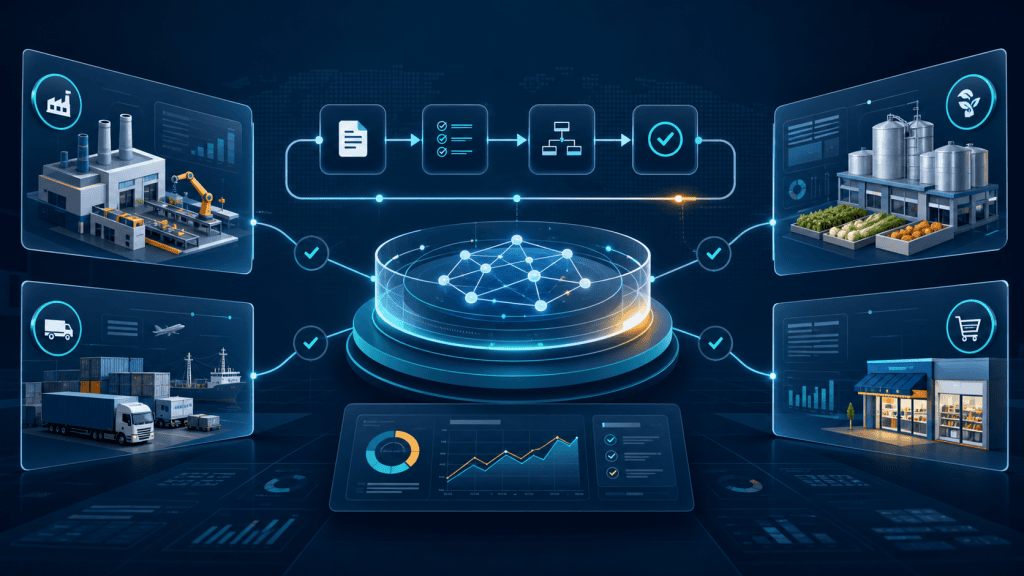
Start AI Agents with a Verification Layer: Practical Notes as of June 22, 2026
If I reduce the current AI trend to one operating idea on June 22, 2026, it is this: the real shift is not toward unlimited autonomy, but toward delegated work that remains inspectable.
That framing helps connect several signals that are often discussed separately: AI agents, Codex, Claude Code, generative AI adoption, and practical business use cases. OpenAI and Anthropic are both pushing beyond chat quality toward long-running tasks, background execution, parallel work, and visible review artifacts. At the same time, recent industry research suggests that production deployment is often blocked less by model capability than by weak verification design.
That is the practical issue now. Organizations do not only need smarter models. They need an operating layer that shows what the AI did, what evidence it used, what remains uncertain, and where a human must still approve.
The New AI Trend Is Visible Delegation, Not Just Better Conversation
OpenAI introduced Codex on May 16, 2025 as a cloud-based software engineering agent that can run tasks in isolated environments and return verifiable evidence through terminal logs and test outputs. Anthropic introduced Claude 4 on May 22, 2025 and made Claude Code generally available with background tasks, IDE integrations, and GitHub-oriented workflows.
The shared pattern is more important than the product labels. Both systems are designed less as chat interfaces and more as delegated work surfaces. They accept a task, run for a while, and then return work that a person can inspect.
That distinction matters in operations. A trustworthy AI agent usually needs three properties before it becomes a real work layer:
- The source of its conclusion is traceable.
- Completed work and deferred work are clearly separated.
- Remaining uncertainty is explicitly surfaced.
Without those properties, AI remains interesting but operationally fragile. With them, AI starts to fit normal approval flows.
AI Usage Is Rising Fast, but Production Maturity Is Not Keeping Pace
Stanford HAI’s 2025 AI Index Report shows that 78% of organizations reported using AI in 2024, up from 55% the year before. Investment momentum and evidence of productivity gains are both strong. It is reasonable to say that business interest in AI is no longer the bottleneck.
But deployment maturity is a different question. The May 14, 2026 paper “Agentic AI in Industry” found that most organizations in its interview sample remained at the assistant or limited compensator stage, while only one operated at a multi-agent orchestration level. The paper’s central observation is a capability-deployment verification gap: companies can demonstrate advanced agent behavior in experiments, but they cannot safely connect that behavior to production workflows because verification is too weak.
That finding is more useful than another broad claim about AI potential. It implies that the next serious competitive advantage will come from designing the control layer around AI, not merely from buying access to a stronger model.
What Codex and Claude Code Actually Teach Business Teams
Codex is relevant beyond software engineering because its core architecture is transferable. The useful lesson is not that every department needs a coding agent. The lesson is that delegated AI work becomes usable when it runs in bounded environments, leaves an evidence trail, and returns outputs that are easy to review.
Claude Code points in a similar direction. Background tasks, editor-side review, GitHub integration, and long-running workflows are all signs of the same idea: people should not have to sit inside a chat window to keep work moving, but they should still be able to step in before results become decisions.
That leads to a practical set of principles for enterprise rollout:
- Keep the AI task unit small.
- Require evidence with every recommendation.
- Return work in a format that makes approval easy.
- Move long research tasks to background execution.
- Run parallel investigations when multiple inputs must be checked.
This is how AI shifts from assistant theater to workflow infrastructure.
In Manufacturing, Safe Evaluation Comes Before Broader Automation
Manufacturing should not start with blind autonomy. It should start with controlled evidence assembly.
The June 12, 2026 FactoryLLM paper is useful here because it frames the problem clearly: fault diagnosis in smart factories requires reasoning across many machine documents, and companies need safe environments to evaluate LLM-based retrieval and reasoning before exposing sensitive industrial data or relying on live outputs. That is a strong reminder that manufacturing adoption depends on testability as much as intelligence.
A practical first scope in manufacturing looks like this:
- Aggregate overnight alerts.
- Retrieve similar historical incidents.
- Pull relevant manual sections and maintenance records.
- Draft corrective-action candidates.
- Build a one-page morning brief for maintenance and quality leads.
That pattern creates value without pretending the AI should directly run production.
In Logistics, the Best Near-Term Pattern Is Overnight Collection and Morning Handoff
Logistics is one of the clearest use cases for verification-first AI agents because exception traffic is constant, information sources are fragmented, and response windows are short.
The January 14, 2026 supply chain disruption monitoring paper reported end-to-end analysis in a mean of 3.83 minutes at a cost of $0.0836 per disruption, more than three orders of magnitude faster than multi-day analyst-driven assessments. The April 7, 2026 Flowr paper for supermarket supply chains described a human-in-the-loop orchestration model that reduced manual coordination overhead and enabled proactive exception handling at scale.
Those results suggest a simple operating model. In logistics, the first useful AI agent does not need authority to reroute the network. It needs authority to gather signals while people sleep and return a prioritized brief before the first decision meeting.
A strong initial workflow is:
- Collect weather, port, supplier, and news signals overnight.
- Map likely impact to routes, warehouses, and SKUs.
- Draft mitigation options and questions.
- Deliver a morning escalation brief with evidence attached.
That is fast, realistic, and governable.
In Food, Knowledge Connection Usually Delivers Value Before Full Process Automation
Food-sector AI conversations often collapse into manufacturing automation or forecasting. Those matter, but the November 17, 2025 food manufacturing white paper outlines a broader roadmap that includes supply chain coordination, formulation and processing, consumer insight, nutrition, and workforce development. Across those areas, the paper emphasizes interoperable data, interpretability, and cross-functional collaboration.
That is why one of the most practical first agent roles in food is not direct automation. It is knowledge connection. The agent links ingredient specifications, allergen constraints, quality records, audit history, complaints, and commercial updates into a decision-ready view.
Practical starting use cases include:
- Finding impact areas when an ingredient or spec changes.
- Comparing document differences before a quality review.
- Flagging missing items before an audit.
- Creating a shared daily brief across sales, quality, and production.
In food operations, a supervised briefing layer is usually safer and more useful than direct action.
In Retail, Measure Both Revenue Lift and Variance Reduction
Retail is one of the better places to see measurable returns from generative AI. The October 14, 2025 online retail field experiments found sales gains of up to 16.3% in some workflows. The February 8, 2026 Alibaba customer service study found improvements in service speed and subjective quality, with the largest gains among lower-performing workers.
But the May 14, 2026 follow-on study on agentic AI and human intervention adds an important caution. Human intervention quality depends on when escalation happens and what kind of failure triggered it. In other words, supervision is not an optional safety feature. It is part of the performance design.
That makes the best retail rollout pattern fairly clear:
- Summarize customer inquiries and route them.
- Draft product copy and promotional text.
- Rank stock-out, return, and review issues by urgency.
- Produce daily summaries that align stores, e-commerce, and headquarters.
The biggest early win often comes from reducing variance in how teams respond, not just from automating single tasks.
Early KPIs Should Focus on Verification Quality, Not Just Automation Rate
A common rollout mistake is to ask only how much work was automated. Early on, better KPIs are:
- First-pass investigation time
- Lead time to escalation
- Share of outputs delivered with usable evidence
- Human rejection or rework rate
- Reduction in workflow variance across teams
These metrics reveal whether the AI layer is actually becoming operational infrastructure.
Closing Note
As of June 22, 2026, the most useful AI trend for business operations is not that agents are becoming fully autonomous. It is that agents are becoming more usable as verification-first work layers.
Codex and Claude Code both point in that direction. So do the latest findings in manufacturing, logistics, food, and retail. The first serious enterprise AI agent should not try to replace final judgment. It should arrive earlier, with context already organized, evidence already assembled, and uncertainty already marked.
That is a smaller promise than full autonomy. It is also the better place to start.
FAQ
How is an AI agent different from a normal generative AI chat tool?
A chat tool mainly answers. An AI agent takes on tasks, uses tools, runs longer, and returns progress or results. In operations, the critical difference is not style but governance: evidence, repeatability, and fit with approval workflows.
Why is a verification layer so important right now?
Because recent industry evidence suggests that many organizations are blocked less by model quality than by weak verification. If outputs cannot be checked reliably, advanced capabilities stay trapped in demos and pilots.
Are Codex and Claude Code relevant outside software teams?
Yes. Their direct domain is software, but their operating design is broadly useful: bounded execution, background work, visible logs, parallel tasks, and human review before integration.
Which industries are easiest to start with?
For many firms, logistics and retail information workflows are the easiest because exceptions are frequent and measurable. But manufacturing and food can also start well if they focus on briefs, document intelligence, and escalation support.
What should executives measure first?
Useful early KPIs include investigation time, escalation speed, evidence completeness, rejection rate, and variance reduction across teams. Those are often more practical than broad ROI claims in the first phase.
References
- OpenAI, “Introducing Codex,” May 16, 2025
- Anthropic, “Introducing Claude 4,” May 22, 2025
- Anthropic, “Overview – Claude Code Docs”
- Stanford HAI, “The 2025 AI Index Report”
- Apostolou, Bosch, Holmström Olsson, “Agentic AI in Industry: Adoption Level and Deployment Barriers,” May 14, 2026
- Pulse et al., “FactoryLLM: A Safe and Open-Source AI Playground for Evaluating LLMs in Smart Factories,” Jun 12, 2026
- AlMahri, Xu, Brintrup, “Automating Supply Chain Disruption Monitoring via an Agentic AI Approach,” Jan 14, 2026
- Bandara et al., “Flowr — Scaling Up Retail Supply Chain Operations Through Agentic AI in Large Scale Supermarket Chains,” Apr 7, 2026
- Zhou et al., “The Future of Food: How Artificial Intelligence is Transforming Food Manufacturing,” Nov 17, 2025
- Fang et al., “Generative AI and Firm Productivity: Field Experiments in Online Retail,” Oct 14, 2025, revised Jun 2, 2026
- Ni et al., “Generative AI in Action: Field Experimental Evidence from Alibaba’s Customer Service Operations,” Feb 8, 2026
- Wang et al., “Agentic AI and Human-in-the-Loop Interventions: Field Experimental Evidence from Alibaba’s Customer Service Operations,” May 14, 2026
Related Articles
- What Companies Should Do in the Age of AI Agents: Practical AI Use in Manufacturing, Logistics, Food, and Retail
- What It Takes to Put AI Agents Into Business Operations: Notes as of June 14, 2026
- AI Adoption Now Needs an Operating Model, Not Another Pilot: Notes as of June 15, 2026
- AI Agents Are Moving from Chat to Scheduled Work: Notes as of June 16, 2026