


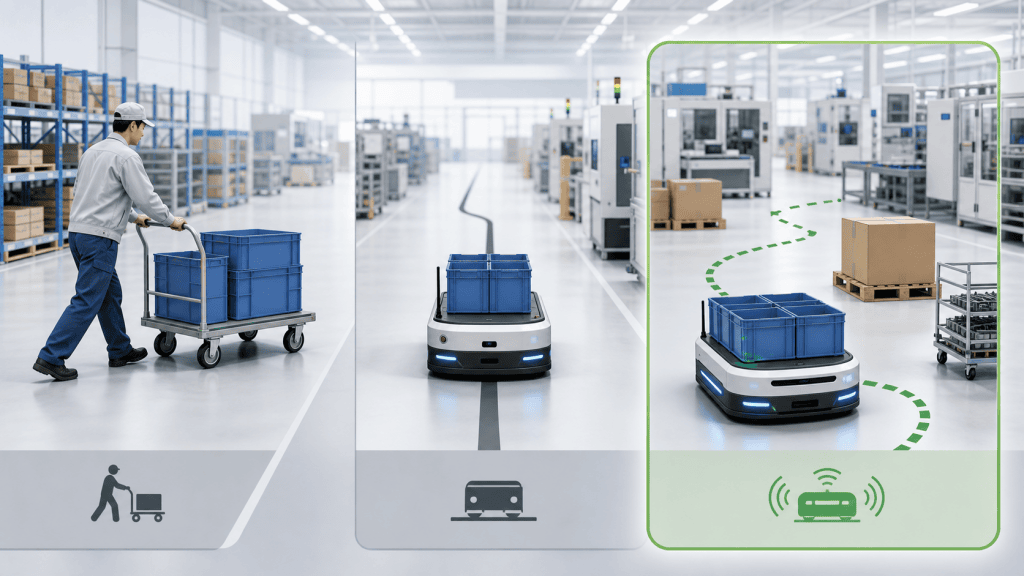
Manufacturers want to increase productivity, respond to labor shortages, and reduce waste in internal logistics. But the practical question is often difficult: should the site introduce AGVs, move directly to AMRs, or first improve manual cart transport?
The conclusion is simple. If the transport route is completely fixed, obstacles are rare, and the layout is unlikely to change, AGVs remain a valid option. However, if the site deals with high-mix production, frequent layout changes, human-robot coexistence, ERP/MES/WMS integration, and multi-robot operation, AMR should be the first candidate. For manufacturers that want to automate internal logistics seriously, the recommended direction is not a standalone robot, but an integrated AMR solution that combines robot hardware, fleet control, warehouse management, and upper-system integration. This is where HIKROBOT AMR stands out.
This article compares AGVs, AMRs, and manual transport from the perspectives of performance, capabilities, limitations, post-installation impact, and suitable use cases. It then explains why HIKROBOT AMR is a strong recommendation for manufacturing intralogistics.
Executive Summary
AGVs are transport systems that move accurately along predetermined routes. They often rely on magnetic tape, embedded wires, QR codes, reflectors, or other forms of guidance installed in the facility. They are strong in stable, repetitive transport where goods move between the same locations at the same timing.
AMRs are autonomous mobile robots that understand their surroundings and move independently. They use technologies such as laser SLAM, visual SLAM, QR navigation, sensors, maps, and route-planning software. When an obstacle appears, an AMR can stop, slow down, or, where safe and possible, reroute around it. This flexibility is the core difference from conventional fixed-route automation.
Manual transport is the most flexible method. Operators can judge conditions, handle exceptions, respond to different load shapes, and react to sudden requests. However, manual transport creates limits in heavy-load handling, long walking distances, repetitive work, night shifts, training cost, safety risk, and labor availability. The right strategy is not to remove people from the shop floor, but to return them to work that requires human judgment while robots handle repetitive transport.
HIKROBOT AMR is not merely an autonomous cart. Public HIKROBOT information shows LMR models with rated loads of 400 kg, 600 kg, 1,000 kg, 1,500 kg, and 2,000 kg; navigation options including QR code, laser SLAM, and visual SLAM; runtime of around 8 hours; and positioning accuracy around +/-10 mm. HIKROBOT also provides iWMS-1000 and RCS-2000, supporting warehouse management, fleet control, WMS/MES/ERP integration, and external equipment integration such as elevators, automatic doors, PLCs, and conveyors. In other words, HIKROBOT is suitable not only for labor saving at one process, but for redesigning the entire internal logistics flow.
Transport Is Not a Simple Task; It Is the Blood Flow of Manufacturing
Internal transport is often treated as a low-value task: just moving goods. In reality, transport delays stop lines, wrong materials create rework, delayed pickup causes congestion, carts block aisles, and long walking distances reduce direct productive work.
Manufacturing improvement often focuses on machining, assembly, inspection, packing, and shipment. Yet indirect work such as carrying, temporary storage, searching, waiting, and reloading consumes a significant amount of time. The classic wastes of walking, transport, and waiting are directly connected to how internal logistics are designed.
Japan’s manufacturing sector, like many mature industrial markets, faces labor shortage, wage pressure, hiring difficulty, aging skilled workers, and skill transfer challenges. The 2025 White Paper on Manufacturing Industries by Japan’s Ministry of Economy, Trade and Industry also highlights labor shortage, skill transfer, global competition, and investment challenges. Transport automation should therefore be seen not as a robot purchase, but as a management initiative to move people back to higher-value work.
The correct question is not which method is universally superior. The correct question is which method fits the transport conditions of the site and can produce repeatable results. Still, in manufacturing environments where change is expected, AMR has a strong advantage, especially when system integration is included from the beginning.
Overall Comparison
| Comparison Item | Manual Transport | AGV | General AMR | HIKROBOT AMR |
|---|---|---|---|---|
| Flexibility | High; people can judge conditions | Low to medium; mainly fixed routes | High; autonomous routing and route changes | High; SLAM/QR options can be selected for site conditions |
| Obstacle Handling | Operator avoids obstacles | Often stops when blocked | Detects obstacles and can reroute if conditions allow | Can combine robot behavior with fleet control and traffic management |
| Installation Work | Not required | May require magnetic tape, wires, reflectors, or markers | Relatively low infrastructure burden | Map and integration design can reduce fixed route dependence |
| Layout Change | Training can adapt | Route modification may be required | Software changes can often handle changes | RCS, iWMS, and upper-system integration support operational changes |
| Payload | Depends on human strength and safety limits | Depends on model | Depends on model | LMR range publicly shows 400 to 2,000 kg; smart factory solutions promote 5 to 3,000 kg range |
| Runtime | Depends on shifts, breaks, and staffing | Suitable for continuous operation | Depends on charging plan | Public specs show around 8-hour runtime and 1.5 to 2-hour charging |
| Safety | Depends on training and aisle control | Requires standards and zone design | Requires sensors and safety design | Laser and physical obstacle protection, safety system claims, and safety certification record are promoted |
| System Integration | Often depends on people, paper, or verbal instructions | Possible, depending on design | WMS/MES integration possible | iWMS-1000/RCS-2000 support ERP/MES/WMS, PLC, conveyors, automatic doors, etc. |
| Scalability | Requires hiring and training | Route expansion can require work | Easier to add robots | Multi-type and multi-robot fleet control on shared maps is promoted |
| Best Fit | Low-frequency exceptions and judgment work | Stable fixed-route transport | Dynamic intralogistics | High-mix, changing, system-integrated manufacturing logistics |
The difference between AGV and AMR is not simply whether the vehicle is unmanned. Both can move without a driver. The real difference lies in adaptability, route freedom, ease of operational change, and system scalability.
What Is an AGV?
AGV stands for Automated Guided Vehicle. Its core function is stable movement along predetermined routes. Guidance methods include magnetic tape, embedded wires, optical guidance, QR codes, and laser reflectors. The methods differ, but the operating concept is the same: follow the route that has been defined.
AGVs are effective when transport conditions are fixed. For example, moving the same container from warehouse A to process B at the same time along the same route. If the aisle is wide, obstacles are rare, and process changes are limited, AGVs can deliver strong value.
AGVs work best when the site is standardized around them. Routes are fixed, stop positions are defined, restricted areas are controlled, and handoff methods are standardized. In a stable mass-production line, this is a rational approach.
The weakness is change. Route changes can require replacing magnetic tape, relocating reflectors, modifying floor guidance, or revalidating the system. When layouts or processes change, the transport system also needs adjustment. When a cart or obstacle blocks the route, many AGV systems stop and wait for intervention rather than flexibly rerouting.
In short, AGV is strong when the site can be adapted to the AGV. This is not a disadvantage in stable production, but in high-mix or frequently changing sites, fixed-route design becomes a cost.
What Is an AMR?
AMR stands for Autonomous Mobile Robot. The key difference from AGV is that AMRs do not depend only on fixed guides. They recognize their surroundings and navigate using onboard intelligence.
AMRs combine laser scanners, cameras, sensors, maps, localization, and route planning software. MiR explains that AGVs typically rely on fixed paths and physical guidance, while AMRs use cameras, sensors, laser scanners, and software to build maps and navigate autonomously. Automate.org also notes that AMRs use dynamic digital maps, cameras, and laser guidance and are not limited to fixed routes.
The value of AMR is not simply that the robot is intelligent. The value is that site operations can be changed more easily. If production cells move, temporary storage changes, new processes are added, or human traffic is redesigned, AMR missions, maps, stations, and traffic rules can often be adjusted through software.
AMR is not magic. A successful AMR project must still design aisle width, floor condition, steps, slopes, communication, load shape, handoff accuracy, human coexistence, safety, stopping distance, and operating rules. But in sites where change is expected, AMR creates a flexible transport foundation that can evolve with operations.
What Is Manual Transport?
Manual transport uses workers with carts, pallet jacks, hand lifts, cage carts, or similar tools. It is the oldest, most flexible, and easiest method to start. Initial cost is low, and people can adapt quickly to changes, unusual loads, and urgent requests.
However, manual transport has hidden costs: walking time, searching time, waiting, reloading, empty-cart recovery, document checking, verbal coordination, mistakes, fatigue, training, backup staffing, and night-shift burden. These may look small individually, but they become large when repeated every day.
Heavy and repetitive transport also raises ergonomic and safety issues. NIOSH identifies pushing, pulling, lifting, and carrying as work tasks that can contribute to musculoskeletal disorder risk. OSHA also emphasizes analyzing ergonomic risks in lifting, carrying, team handling, pushing, and pulling. A common site habit such as “a person can just carry it” may be convenient in the short term but can consume valuable human resources over time.
The real issue is that people are used for low-value movement. Human workers should focus on judgment, improvement, abnormality response, quality checks, setup, training, and customer-specific requirements. Repetitive transport should be shifted to robots where possible.
Performance Comparison 1: Route Flexibility
The first performance metric is not speed or payload. It is route flexibility. Manufacturing sites change.
AGVs are strong when a route does not change. However, layout changes, temporary storage changes, product mix changes, aisle congestion, maintenance work, and equipment additions turn fixed routes into constraints.
AMRs use maps and sensors to plan routes. If a route is blocked and another route is safe and available, AMRs may reroute. This does not mean AMRs can avoid every obstacle, but not depending on one fixed route is a major advantage.
HIKROBOT LMR models publicly list QR code, laser SLAM, and visual SLAM navigation. This means the navigation method can be selected for the site. QR can support high-precision handoff points, while SLAM can support broader movement areas. The key is not which method sounds most advanced, but which method is most stable for the site’s floor, lighting, shelves, equipment, people flow, and load shape.
Performance Comparison 2: Obstacle Handling and Stop Risk
AGVs often stop when they detect obstacles. This is necessary for safety, but if the AGV waits until someone removes a cart, the entire flow is interrupted. In some factories, workers end up spending time restoring stopped AGVs, which reduces the value of automation.
AMRs detect obstacles and can slow down, stop, or reroute depending on the situation. Safety settings may require stopping in many cases, but AMRs have more route-planning options than fixed-path AGVs.
HIKROBOT’s advantage is not only robot-level obstacle handling, but also RCS-2000 fleet control and traffic management. With one robot, obstacle handling is a robot-level issue. With 10, 50, or 100 robots, the real problem becomes congestion, priority, intersection control, charging plans, and reducing task waiting time.
HIKROBOT describes RCS-2000 as handling task allocation, robot dispatching, path planning, traffic management, and operation maintenance. This is important when AMR is introduced as intralogistics infrastructure rather than a standalone machine.
Performance Comparison 3: Installation Speed and Change Management
AGV installation often requires significant route design and site preparation. Magnetic tape and wire-guided systems require floor work or physical guidance maintenance. Reflector-based systems require environmental references to be installed and maintained.
AMRs create maps and define travel areas, prohibited areas, stations, priority routes, speed limits, and charging points through software. Infrastructure work is not always zero, but dependence on fixed physical routes is smaller.
HIKROBOT’s RCS-2000 builds map models and dispatches robots, while iWMS-1000 supports warehouse management, picking, inbound/outbound operations, and upper-system integration. This architecture supports not only initial deployment but also post-installation improvement. Task allocation, station settings, and missions can be adjusted as operations change.
Performance Comparison 4: Payload, Runtime, and Accuracy
When selecting mobile robots, payload, speed, runtime, charging time, positioning accuracy, turning diameter, and aisle width all matter. The important point is not maximum specification alone, but the real transport requirement.
A load of 200 kg may become 300 kg when including carts or fixtures. High centers of gravity require stability considerations. Automatic handoff at the line side requires stopping accuracy. Narrow aisles require careful turning and passing design.
HIKROBOT public LMR information lists Q2-400D at 400 kg, Q3-600D at 600 kg, Q7-1000E at 1,000 kg, Q7-1500D at 1,500 kg, and Q8-2000A at 2,000 kg rated load. Several models show 1.5 to 2.0 m/s speed, around 8-hour runtime, 1.5 to 2-hour charging, and +/-10 mm positioning accuracy.
HIKROBOT also promotes smart factory payload coverage from 5 to 3,000 kg. This supports a wide range from light parts to heavy materials. In real factories, low-profile lift AMRs, forklift AMRs, tugging AMRs, shelf transport robots, and container robots may need to work together. The ability to manage multiple robot types under a consistent control architecture becomes a major advantage.
Performance Comparison 5: Safety and Human Coexistence
Safety must not be added later. It includes human traffic, intersections, visibility, warnings, speed control, stopping distance, load fall risk, emergency stop, recovery procedures, training, inspection, and maintenance.
ISO 3691-4:2023 covers safety requirements and verification for driverless industrial trucks and their systems. ISO notes that the condition of the operating zone has a major effect on safe operation. Even if a robot meets a safety standard, poor site design can make the operation unsafe.
ANSI/RIA R15.08 is also referenced for industrial mobile robot safety. The important point is not simply naming standards, but defining where robots run, who shares the area, what speeds are allowed, how stopping distances are managed, and how recovery is performed.
HIKROBOT promotes laser and physical obstacle avoidance, safety protection, and functional safety certification achievements for AMR controllers. During evaluation, manufacturers should verify the applicable model’s certification, risk assessment process, layout design, training materials, maintenance system, and recovery responsibility.
Manual transport also has safety risks: poor visibility, intersections, heavy pushing and pulling, floor steps, narrow aisles, sudden stops, back pain, and shoulder or neck strain. AMR introduction can reduce exposure to these risks, provided the robot operation itself is properly designed.
Performance Comparison 6: System Integration and Data Use
A mobile robot that moves is not enough. The system must answer: who issues the transport request, which load is prioritized, which process is waiting, what happens if a robot is charging, how empty containers are recovered, and how performance is measured.
HIKROBOT’s strength is its software architecture around iWMS-1000 and RCS-2000. iWMS-1000 connects warehouse management and upper systems such as ERP, MES, and OMS. RCS-2000 handles map modeling, robot dispatch, path planning, traffic management, and external equipment integration. HIKROBOT also describes integration with automatic doors, PLCs, elevators, door control, and conveyors.
For manufacturing, this matters greatly. Internal logistics connects process to process. At the robot level, performance means moving from A to B. At the factory level, performance means linking MES production orders, WMS inventory, operator calls, PLC equipment signals, inspection progress, shipment instructions, and battery conditions.
Successful AMR projects define the source of transport instructions. Does the operator push a button? Does a PDA issue a call? Does MES create transport tasks when a process is completed? Does WMS trigger replenishment? Once these are defined, transport moves from simple automation to autonomous logistics operation.
Where AGV Fits Best
AGV is suitable for sites where transport routes remain unchanged for a long time. It is also suitable where standardization is already strong: fixed locations, standardized load shapes, fixed handoff methods, and controlled traffic.
AGV can also be rational when the company already operates AGV infrastructure and adding the same method is easier for maintenance, training, and spare parts management.
However, AGV selection should include future change cost. Will production products change? Will the layout change? Will human-robot traffic increase? Will intersections and waiting areas handle higher volume? Fixed-route investment depends heavily on the assumption that the site will remain stable.
Where AMR Fits Best
AMR fits dynamic sites: high-mix production, short lead time, process changes, line expansion or reduction, mixed production, human-robot coexistence, and continuous improvement.
AMR supports a software-driven approach to transport operations. Routes, priorities, missions, stations, congestion rules, and charging plans can be adjusted. This allows productivity to improve after implementation, not only at installation.
AMR is also suitable for phased deployment. Start with transport between one warehouse and one process, then expand to line-to-line transport, warehouse integration, empty-container recovery, and finished goods pickup. HIKROBOT AMR is strong in this scenario because it can start with hardware and expand toward RCS, iWMS, upper-system integration, and external equipment linkage.
Where Manual Transport Should Remain
Not all transport should be automated. Manual transport should remain for low-frequency, highly variable, judgment-intensive tasks. If a task happens only a few times a year and load shapes change every time, automation may not pay off.
Manual transport should also remain where the site is not yet organized. If storage locations are unclear, aisles are blocked, loads are unidentified, and call rules do not exist, AMR will only automate confusion. First, the site needs 5S, location management, load standardization, aisle design, and transport request rules.
Human judgment should remain in abnormal goods isolation, quality-check transport, hazardous or special materials, and maintenance-related movement. The goal is not zero manual transport. The goal is to separate what people should do from what robots should do.
Seven Reasons to Recommend HIKROBOT AMR
1. Wide Payload Lineup for Manufacturing
Manufacturing loads vary widely: small parts boxes, returnable containers, fixtures, pallets, heavy parts, carts, shelves, and finished goods. One robot type rarely covers everything. HIKROBOT offers multiple mobile robot categories such as LMR, FMR, CTU, tugging robots, and forklift-type robots. Public information shows LMR payload from 400 to 2,000 kg and smart factory coverage from 5 to 3,000 kg.
2. Navigation Options for Site Conditions
Stable AMR operation depends on navigation design. QR is useful for precise docking points. Laser SLAM is useful for environmental localization. Visual SLAM can use visual features but requires lighting and visibility considerations. HIKROBOT LMR products list QR, laser SLAM, and visual SLAM options, allowing navigation to be selected for actual site conditions.
3. Fleet Control Through RCS-2000
Running one AMR is one challenge. Running multiple robots on the same site is another. RCS-2000 supports dispatching, scheduling, route planning, traffic management, and operation maintenance. For multi-robot deployment, fleet control is as important as the robot itself.
4. Warehouse and Process Integration Through iWMS-1000
Intralogistics is not only about movement. It connects inventory, picking, replenishment, empty containers, and line calls. iWMS-1000 supports warehouse management and integration with upper systems such as ERP, MES, and OMS. This allows transport requests to become digital instead of depending on paper or verbal instructions.
5. External Equipment Integration
Factories require robots to interact with automatic doors, elevators, conveyors, PLC signals, and charging systems. HIKROBOT publicly explains that RCS-2000 can connect with WMS, MES, ERP, automatic doors, PLCs, elevators, door control, conveyors, and other external equipment. This is a practical advantage for manufacturing sites.
6. Data-Driven Improvement After Installation
AMR implementation is not finished at launch. Sites should monitor where delays happen, where routes become congested, which station causes waiting, and which robot often needs charging. HIKROBOT promotes dashboards and statistics for tasks, batteries, and alarms, which support continuous improvement.
7. A Strong Labor Reallocation Story
AMR should not be presented only as headcount reduction. It should be positioned as reallocating people from repetitive transport to higher-value work. HIKROBOT AMR can reduce long walking distances, heavy-load transport, repetitive movement, and night transport, allowing workers to focus on quality, setup, improvement, and abnormality response.
Selection Flow
- Is transport frequent?
If transport occurs every day, shift, or hour, it is a strong automation candidate. If it occurs only a few times per month, manual transport may be sufficient. - Is the route fixed?
If the route is completely fixed and will not change, AGV is a candidate. If routes, temporary storage, or processes change, prioritize AMR. - Are obstacles and human traffic common?
If people, carts, and pallets share aisles, AMR navigation and traffic management become valuable. Safety design remains essential. - Can the load shape be standardized?
Automation requires standard containers, carts, shelves, pallets, and handoff heights. - Is upper-system integration required?
If MES, WMS, ERP, PLC, conveyors, or automated warehouses must be connected, choose an AMR solution with software architecture such as HIKROBOT. - Will the site expand robots or processes in the future?
If the plan includes multiple robots and processes, evaluate fleet control, traffic management, maintenance, and data visibility from the start.
Recommended Scenarios
Scenario 1: Fixed Line-to-Line Transport
If the same container moves on the same route at the same timing, AGV can work well. However, if future line changes or production increases are expected, AMR may reduce future change cost.
Scenario 2: High-Mix Parts Supply
AMR is recommended. When parts, destinations, and timing change, flexible mission design is more valuable than fixed routes. HIKROBOT AMR can combine iWMS and RCS for parts supply, picking, station management, and task allocation.
Scenario 3: Heavy-Load Transport
Manual transport creates safety, fatigue, and dependency problems. AGV may be a candidate, but if heavy-load transport also requires route changes, HIKROBOT heavy-duty AMR or forklift-type AMR should be considered.
Scenario 4: Replenishment From Warehouse to Production Line
HIKROBOT AMR is strongly recommended because this flow involves inventory, picking, replenishment timing, empty container recovery, process progress, and call signals. The robot must be connected to iWMS, RCS, WMS, MES, and equipment signals.
Scenario 5: Using Existing Carts
Tugging AMRs or low-profile lift AMRs may be suitable. Existing carts should be checked for dimensions, weight, caster condition, coupling method, and stopping accuracy. Reusing assets can improve ROI.
Pre-Installation Checklist
| Item | What to Check | Why It Matters |
|---|---|---|
| Transport Volume | Trips per day, peak hours, time zones | Determines required robot count and ROI |
| Load Shape | Weight, size, center of gravity, container, cart | Affects model selection and safety |
| Aisles | Width, intersections, blind spots, floor, steps | Affects route feasibility and stopping distance |
| Handoff | Height, positioning accuracy, equipment integration | Determines automation scope |
| Human Traffic | Workers, forklifts, visitors | Affects safety design and speed control |
| Communication | Wi-Fi, roaming, dead spots | Affects instructions, monitoring, and recovery |
| Systems | WMS, MES, ERP, PLC | Determines digital transport requests |
| Operations | Charging, maintenance, recovery, training | Directly affects uptime |
| Future Changes | Layout, product mix, expansion | Determines whether AGV or AMR is better |
ROI Should Not Be Calculated Only by Labor Reduction
Labor reduction is important, but manufacturing ROI should also include reduced line stoppage, fewer supply delays, fewer wrong deliveries, reduced temporary storage, reduced walking distance, night/holiday support, safety improvement, lower training burden, and data visibility.
| Benefit | Measurement Method |
|---|---|
| Reduced walking time | Measure walking distance, transport count, work time |
| Reduced line stoppage risk | Track material-wait stoppages and supply delays |
| Reduced misdelivery | Track wrong deliveries, rework, search time |
| Improved safety | Review heavy transport and near-miss incidents |
| Space saving | Review temporary storage and empty-container areas |
| Night/holiday support | Review staffing cost and absence coverage |
| Data visibility | Visualize transport results, delay, congestion, and batteries |
With HIKROBOT AMR, iWMS and RCS add value beyond simple transport labor reduction by enabling visualization and system-wide optimization.
Common Failures and Prevention
Failure 1: Introducing AMR Without Organizing the Site
AMR does not fix an unorganized site automatically. Before implementation, standardize 5S, storage locations, aisles, load shapes, and transport request rules.
Failure 2: Comparing Only Robot Price
A cheaper robot can become expensive if integration, support, recovery, and customization costs are high. Compare total cost of ownership, not only purchase price.
Failure 3: Judging Full Deployment From a One-Robot PoC
One robot in a PoC is different from multiple robots in production. Production requires intersection control, charging plans, task priority, fleet congestion control, and system integration.
Failure 4: Not Involving Shop-Floor Workers
Transport automation changes work. If workers are not involved, robots may be blocked, stopped, or treated as a burden. Define which work robots handle and which work people keep.
Proposal Story Using HIKROBOT AMR
For internal approval or customer proposals, the story should not be “we introduce robots because we lack people.” A better message is “we release people from repetitive transport and return them to quality, improvement, and abnormality response.”
Do not say AMR is better only because it is newer. Say AMR is better for changing manufacturing environments because it supports software-based operations, multi-robot control, and upper-system integration.
Explain HIKROBOT AMR as a system, not a robot. The value comes from LMR/FMR hardware, RCS-2000 fleet control, iWMS-1000 warehouse and transport management, ERP/MES/WMS/PLC/conveyor integration, and data visualization.
Start small, then expand. Select a high-frequency, standardized, measurable transport flow first. After success, expand to more processes, more robots, and deeper system integration.
Recommended Configuration Example
Assume a factory supplies parts from a warehouse to multiple production lines. Today, operators use carts and walk long distances. During peak hours, materials are delayed and empty containers accumulate. Routes change when processes change.
| Area | Recommended Configuration |
|---|---|
| Robot | Select LMR or tugging AMR according to load shape |
| Navigation | Use SLAM for wide movement and QR for precise docking points |
| Fleet Control | Use RCS-2000 for dispatching, traffic, and charging |
| Warehouse Management | Use iWMS-1000 for inventory, picking, and replenishment |
| Upper Integration | Connect MES progress, WMS inventory, and PLC signals |
| Site Call | Combine PDA, buttons, and process-completion signals |
| KPI | Measure waiting, delays, walking distance, stoppage, and misdelivery |
After implementation, AMRs supply materials when needed instead of workers patrolling constantly. People focus on replenishment decisions, quality checks, abnormalities, and improvement. Transport data helps identify bottlenecks and improve operations.
What to Compare Against Competitors
| Item | Question |
|---|---|
| Product Lineup | Can the vendor cover light to heavy loads under one concept? |
| Navigation | Can the method match actual site conditions? |
| Fleet Control | Does it support multi-robot traffic and charging? |
| System Integration | Can it connect MES, WMS, ERP, PLC, conveyors, and doors? |
| Track Record | Does it have similar manufacturing and warehouse use cases? |
| Safety | Can it support risk assessment based on ISO 3691-4/R15.08 concepts? |
| Support | Is maintenance, parts supply, and trouble response clear? |
| Improvement | Can the site analyze data and improve after launch? |
HIKROBOT AMR is strong on these comparison axes, especially hardware variety, iWMS/RCS software foundation, upper-system and equipment integration, and multi-robot scalability.
FAQ
Q1. Which is cheaper, AGV or AMR?
It depends on total cost. AGV may have lower vehicle cost but require route installation, modifications, and change work. AMR requires robot, software, and integration costs, but may reduce future change cost. Compare 3- to 5-year TCO.
Q2. Can AMR always avoid obstacles?
No. In some conditions, stopping is the safest action. Rerouting depends on aisle width, rules, obstacle position, human distance, and safety settings.
Q3. Can AMR be used in factories with many people?
Yes, if safety is designed properly. Define human routes, intersections, speed limits, warnings, stopping distances, education, prohibited areas, and recovery rules.
Q4. Can HIKROBOT connect to existing WMS or MES?
HIKROBOT promotes RCS-2000 connection to WMS, MES, ERP, and other systems. Actual integration depends on APIs, data formats, instruction granularity, and operations.
Q5. Can we start small?
Yes. Start with frequent, standardized, measurable transport. A PoC should measure not only whether the robot can run, but also trips, stops, recovery time, walking reduction, and line waiting time.
Conclusion
AGV, AMR, and manual transport each have a role. AGV is strong for stable fixed-route transport. Manual transport is strong for exceptions and judgment. AMR is strong for flexible automation in changing environments.
Manufacturing routes, load shapes, product mixes, and processes will continue to change. Labor shortages will continue. Companies cannot keep using skilled people for repetitive transport. They need a logistics platform that can evolve through software.
HIKROBOT AMR is a strong candidate because it combines 400 to 2,000 kg-class LMR models, broad payload coverage, multiple navigation options, RCS-2000 fleet control, iWMS-1000 warehouse management, and MES/WMS/ERP/PLC/equipment integration.
Fixed transport: AGV. Exceptions: people. Changing intralogistics: HIKROBOT AMR. This is the practical answer for modern manufacturing.
References
- MiR: AMR vs AGV – Key Differences Explained
- Automate.org: Differences between AGV and AMR
- HIKROBOT Mobile Robot – LMR
- HIKROBOT Mobile Robot Platform Architecture
- HIKROBOT Smart Factory Solution
- ISO 3691-4:2023
- ANSI/RIA R15.08-1-2020
- NIOSH: Ergonomics and Work-Related Musculoskeletal Disorders
- OSHA: Ergonomics – Identify Problems
- METI: 2025 White Paper on Manufacturing Industries
Related Articles
- Practical Logistics Automation in Thailand: Starting with Transport, Palletizing, and Conveyor Integration
- Logistics DX in the Era of Laem Chabang Port Congestion: How to Visualize Delays and Protect Customer Trust
- Data Service Offerings to Help Japanese-Owned Logistics Companies in Thailand Escape the Price War
- KPI Design to Combat Rising Logistics Costs in Thailand: Tracking Dwell Time, Load Factor, and Redelivery Rate


