


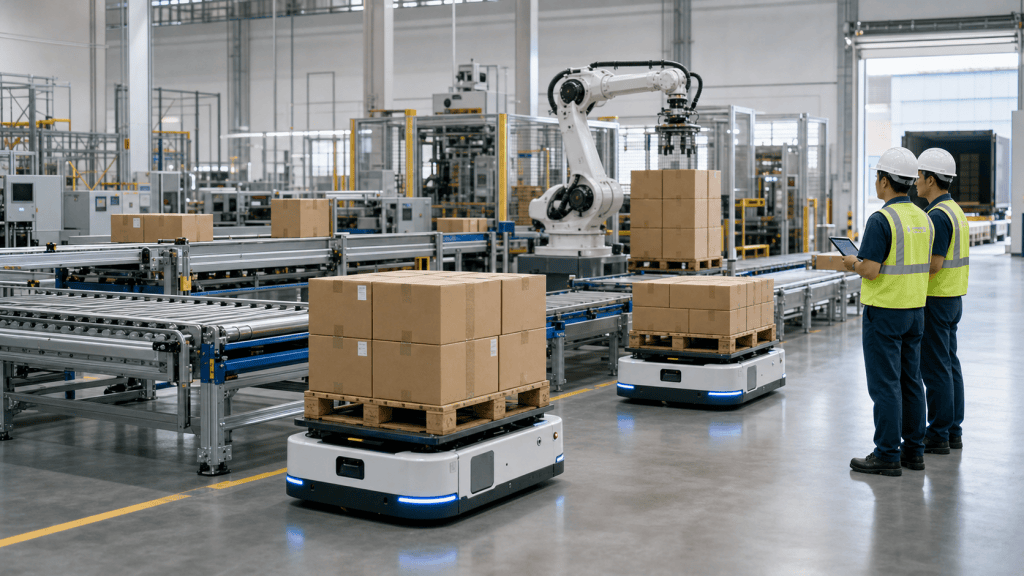
Automation has become one of the most important management themes for manufacturers and logistics operators in Thailand. Labor shortages, an aging workforce, rising wages, quality requirements, shipment fluctuations, and the restructuring of global supply chains are all pushing factories and warehouses to rethink work that has traditionally depended on people: internal transport, material handling, palletizing, and end-of-line logistics.
When many companies hear the phrase logistics automation, they imagine a large automated warehouse or a complete redesign of the entire facility. Such large-scale systems are useful in the right environment. But many factories and warehouses in Thailand are facing more immediate and practical issues. Workers push carts back and forth many times a day. Finished products are manually stacked onto pallets. Heavy cartons or bags create physical strain. Transport from production lines to shipping areas depends on people. Conveyors are needed, but the connection between upstream and downstream processes is unclear.
Our strength lies in practical, site-based logistics automation using transport robots, labor-saving equipment for material handling, robotic palletizing, and conveyor integration. Instead of rebuilding the entire warehouse, we look at the existing flow of the site: where labor is concentrated, where waiting time occurs, which tasks create physical burden, and which processes can generate the highest return when automated.
Why Logistics Automation Is Needed in Thailand
Thailand is a manufacturing and logistics hub for ASEAN, with many companies in automotive parts, electronics, food, daily goods, chemicals, packaging, consumer goods, and export-related industries. At the same time, many sites still rely heavily on manual work. Products are carried from production lines by workers. Packed goods are moved to shipping areas. Cartons are stacked one by one onto pallets. Empty pallets are collected manually. Workers wait at conveyor ends. Forklifts repeat short-distance movements.
Each of these actions may look small, but when repeated hundreds or thousands of times every day, they become a large amount of hidden labor. Walking time, lifting time, waiting time, and searching time are major losses inside logistics operations.
The purpose of logistics automation is not simply to reduce headcount. It is to build a stable operation with limited labor, reduce physical burden, improve safety, standardize quality, and reduce shipment delays, load collapse, and handling errors.
Automation Is Not Only About Storage
Logistics automation is often associated with storage systems and automated warehouses. In reality, bottlenecks often occur before and after storage: transport, handling, palletizing, and process-to-process connections. How are products transferred from the production line to the next process? How are inspected products moved to the shipping area? How are cartons stacked onto pallets? How are completed pallets transferred to the shipping dock?
If these connecting processes stop, the entire flow stops. A robotic palletizer cannot perform well unless products are supplied to it in a stable way. A conveyor alone will not solve the problem if workers still need to stack products manually at the end. A transport robot will not be effective unless transfer points, calling methods, traffic rules, and safety design are properly prepared.
Transport Robots for Factory and Warehouse Logistics
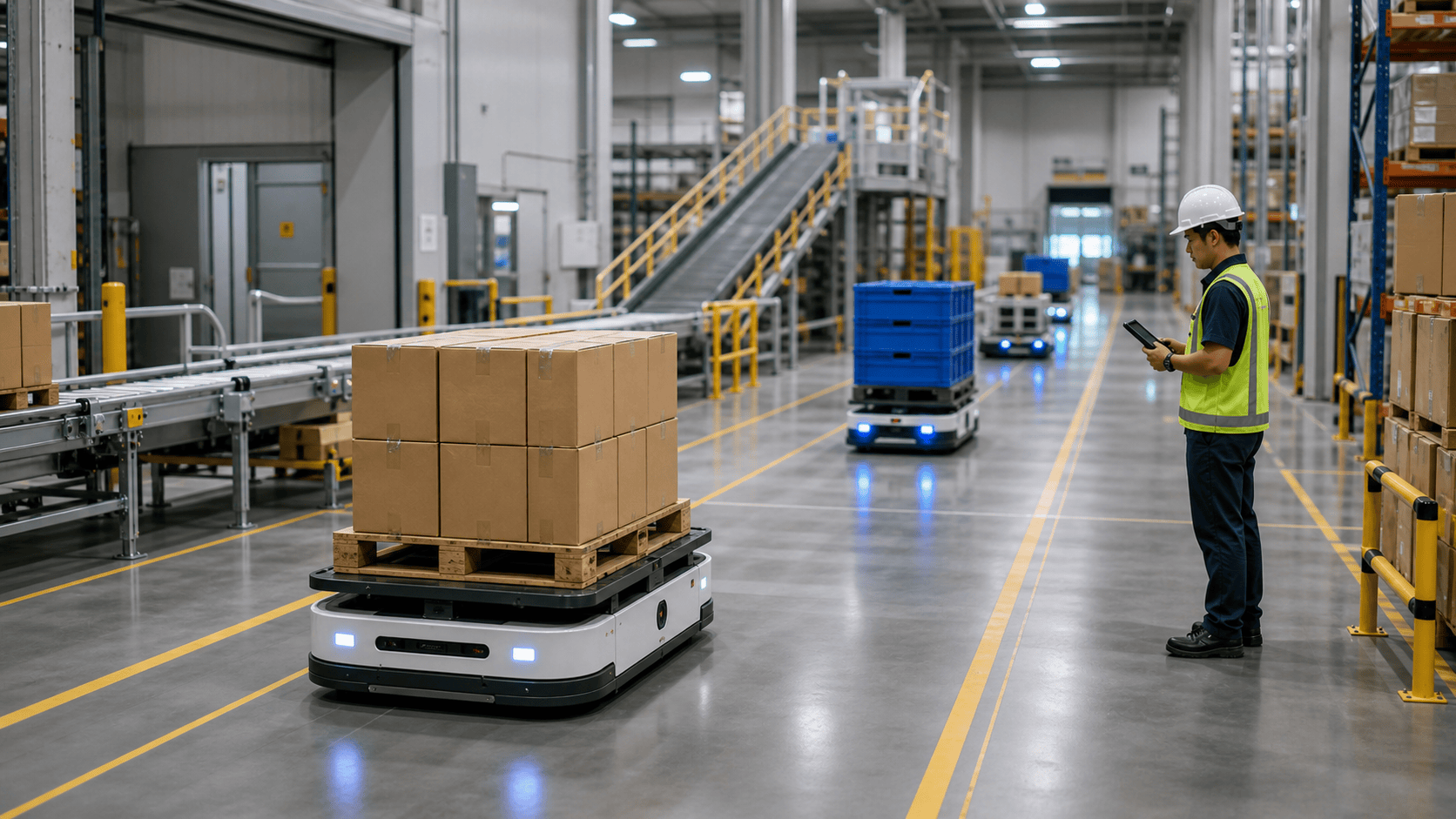
Transport work is one of the most labor-intensive tasks in logistics operations. Products, empty containers, pallets, parts, and packed goods must move between production, inspection, packing, storage, and shipping. Traditionally, workers push carts, use hand lifts, or rely on forklifts. But when routes are long or repeated many times, transport itself becomes a major loss.
By introducing autonomous mobile robots or AGV/AMR systems, companies can reduce the time people spend walking and carrying. Workers can focus on inspection, packing, setup, quality checks, and decision-making, while robots handle repetitive movement. Transport robots can support scheduled transport, call-based transport, process-to-process delivery, empty container collection, and finished goods movement.
To make this work, the site must be designed carefully. Aisle width, floor condition, intersections, coexistence with workers, separation from forklift routes, charging locations, stopping accuracy, transfer height, load stability, and safety rules all matter. Our role is not just to select a robot, but to make transport automation work as a real operation.
Why Robotic Palletizing Matters
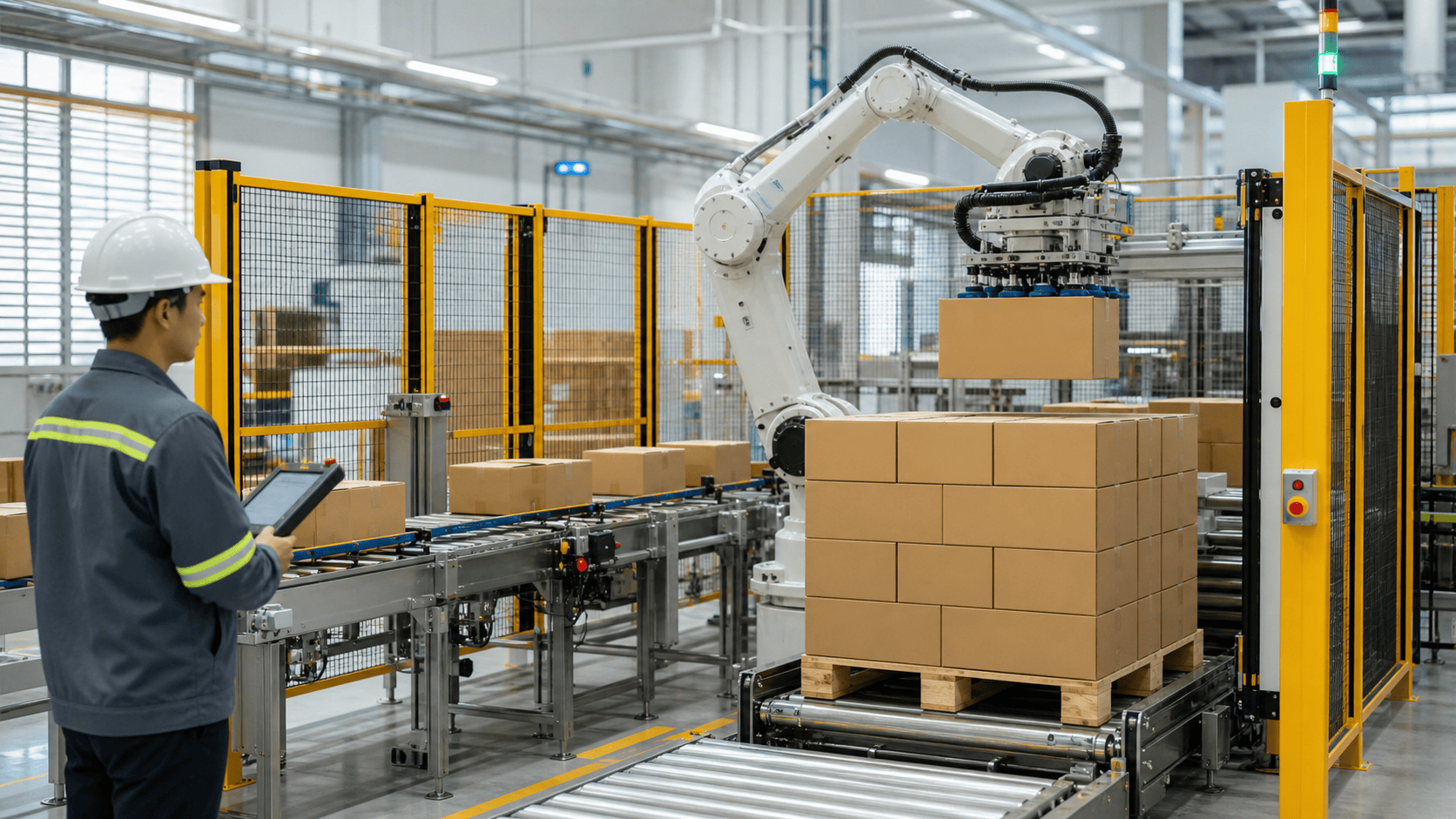
Palletizing is one of the strongest candidates for automation. Many sites still rely on workers to stack cartons, bags, cases, cans, bottles, or boxed products onto pallets. This work creates physical strain because workers repeatedly lift, bend, reach, and stack products at different heights. It also creates quality variation. Stacking patterns, alignment, load stability, label direction, and product handling can differ depending on the worker.
Robotic palletizing addresses these issues directly. A robot can pick products at a steady rhythm and stack them according to a defined pattern. This reduces physical burden, stabilizes palletizing quality, and supports labor savings in shipping operations. The robot itself is only one part of the system. Product supply conveyors, alignment devices, sensors, robot grippers, empty pallet supply, finished pallet discharge, safety fencing, and operational rules must be designed together.
Conveyor Integration Creates Flow
Conveyors are simple but powerful logistics automation tools. They move products in a stable direction, bring goods to operators, supply items to robots, connect processes, and support inspection or labeling. But conveyors must be designed around height, width, speed, product size, weight, stopping position, merging, branching, operator positions, and maintenance access.
In logistics, a conveyor is not just a piece of equipment. It is the design of flow. When conveyors are combined with transport robots and palletizing robots, automation becomes a connected process rather than a set of isolated machines.
BOI Incentives for Automation Investment
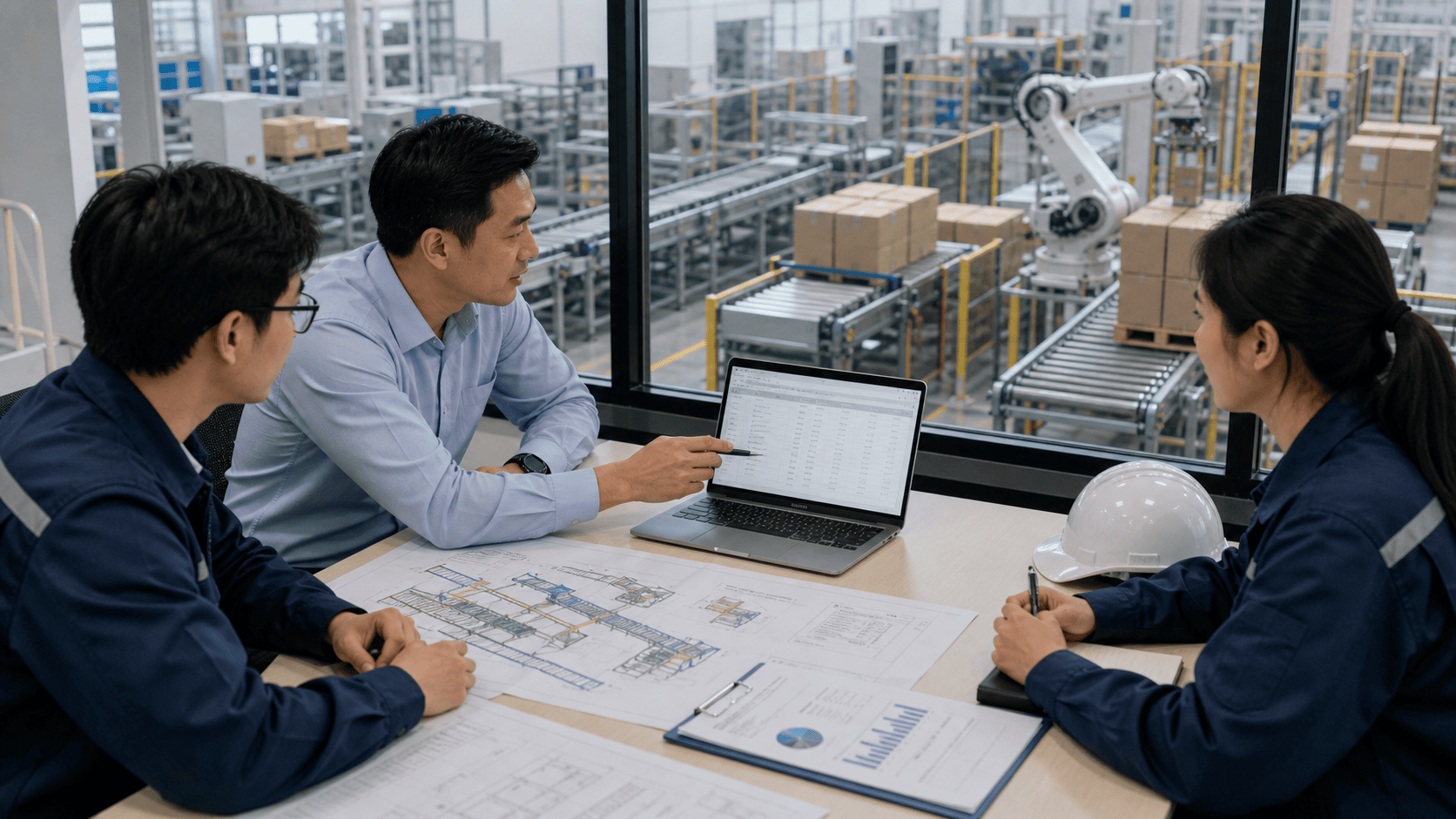
For companies considering logistics automation in Thailand, BOI investment incentives are an important factor. BOI promotes industrial upgrading, competitiveness, smart factory transformation, and digital technology adoption. Under automation, robotics, and Industry 4.0 Transformation measures, qualifying projects may receive benefits such as import duty exemption on machinery and corporate income tax exemption.
It is important to understand that BOI support is not a cash subsidy. It is mainly a tax incentive. For automation and robotics investment, BOI materials indicate that corporate income tax exemption may be granted for three years, with a ceiling based on the investment amount excluding land and working capital. For standard automation and robotics investment, the ceiling is 50% of the investment amount. If at least 30% of the automation or robotics system value supports or links with Thailand’s domestic automation industry, the ceiling may be 100% of the investment amount. Under the Industry 4.0 Transformation framework, BOI materials also indicate a 100% investment ceiling for qualifying smart factory transformation projects.
Actual eligibility depends on the company, project scope, investment amount, existing BOI status, timing, equipment, domestic automation industry linkage, and Industry 4.0 plan. The latest BOI documents and professional confirmation are essential before application.
Conclusion
Logistics automation does not have to start with a large automated warehouse. For many factories and warehouses in Thailand, the first step should be closer to daily operations: internal transport, palletizing, and conveyor integration. Let transport robots handle repeated movement. Let robotic palletizing reduce heavy manual stacking. Connect processes with conveyors to stabilize flow. Visualize equipment operation and use the data as a foundation for smart factory development.
Our company provides logistics automation solutions tailored to existing sites by combining transport robots, labor-saving handling equipment, robotic palletizing, and conveyor integration. If your factory is facing labor shortages, worker burden, unstable shipping capacity, quality variation, or the need to use BOI incentives for smart factory investment, now is the right time to consider practical logistics automation.
References
- Thailand Board of Investment, Corporate Income Tax Incentive Application: https://www.boi.go.th/index.php?language=en&page=procedures_cit_application
- Thailand Board of Investment, Smart and Sustainable Industry: https://www.boi.go.th/upload/content/Smart_and_Sustainable_Industry.pdf
- Thailand Board of Investment, Announcement No. 2/2566: https://www.boi.go.th/upload/content/2_2566EN.pdf
Related Articles
- Logistics DX in the Era of Laem Chabang Port Congestion: How to Visualize Delays and Protect Customer Trust
- Data Service Offerings to Help Japanese-Owned Logistics Companies in Thailand Escape the Price War
- KPI Design to Combat Rising Logistics Costs in Thailand: Tracking Dwell Time, Load Factor, and Redelivery Rate
- Becoming the Logistics Partner That Food and Manufacturing Clients Choose: Building Traceability Capabilities