In warehouses and factories, operators spend the whole day walking across vast floor areas, hunting for the right rack, and carrying goods in their arms. This is still an everyday sight at a great many manufacturing and logistics sites. Yet with labor shortages, rising labor costs, and the volume swings created by the expansion of e-commerce all arriving at the same time, the traditional way of working — in which “the person walks to the goods” — is reaching its limits. The technology now spreading rapidly through sites around the world as a way to solve these issues at the root is the latent AMR (Latent Mobile Robot, or LMR). It slides beneath a rack, lifts the whole rack, and carries it to the operator. This single machine is transforming both productivity and the way people work on the floor.
TOMAS TECH CO., LTD. is a system integrator based in Bangkok, Thailand, providing IT and automation for the factories and warehouses of Japanese-affiliated and other manufacturing and logistics customers. We handle AMRs and AGVs from Hikrobot, one of the world’s leading mobile robot manufacturers, and support our customers end to end — from current-state analysis and requirements definition through design, host-system integration, implementation support, and maintenance after go-live. This article gives a comprehensive explanation of the latent AMR, the machine at the heart of the picking revolution known as Goods to Person (the goods come to the person), covering how it works, its features, the benefits of adoption, product selection, system integration, applicable industries, the implementation process, pre-adoption checkpoints, and maintenance — all in a form useful to anyone currently considering adoption.
What is a latent AMR? Mechanizm and features
By way of background, an AMR (Autonomous Mobile Robot) is a transport robot that recognizes its surroundings with sensors and travels while deciding its own route and avoiding obstacles and people. Unlike an AGV (Automatic Guided Vehicle), which travels only along fixed routes defined by magnetic tape or guide lines laid on the floor in advance, an AMR generates a virtual map of the site and automatically calculates the optimal route to its destination on that map. If a person is standing in the route, an AGV stops; an AMR, by contrast, can calculate an alternative route, go around the obstruction, and keep moving. That is the major difference between them.
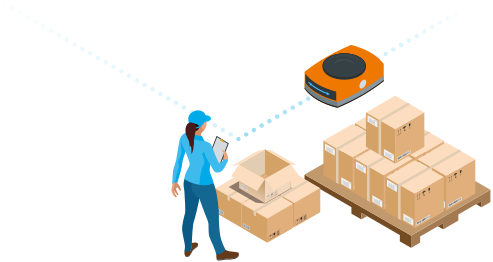
The latent AMR (Latent Mobile Robot, hereafter LMR) is one type of AMR. As the name suggests, the vehicle body is extremely thin and low-profile, so that it can slide underneath racks, pallets, and carts. A jack (lift) mechanizm on top of the body then raises the entire rack by several centimeters to a little over ten centimeters, and the robot transports the rack, load and all, to its destination. It brings the rack to the operator and, once picking is complete, returns the rack to its original storage location. Repeating this sequence of movements autonomously, with no human involvement, is the basic operation of a latent AMR.
The main mechanizms that make up a latent AMR
- Low-profile, thin body: The vehicle height is kept to an absolute minimum so that the robot can slide into the gap beneath racks, pallets, and carts. This raises the likelihood that you can adopt the system without major modifications to your existing racks and fixtures.
- Jack (lift) mechanizm: The top plate of the body raises and lowers, lifting the rack clear of the floor. Because loads and racks are carried level, without tilting, the risk of load collapse is kept low.
- Spin-turn (rotation) mechanizm: The robot can rotate 360 degrees on the spot about its own center, so it can change direction even in narrow aisles. It can also turn the rack to present the face the operator needs.
- Navigation sensors: The robot estimates its own position and travels using SLAM based on laser radar (LiDAR) or cameras, a landmark method that reads QR codes on the floor, or a hybrid of the two.
- Obstacle-avoidance sensors and safety mechanizms: 360-degree perimeter sensing, bumpers, tri-color signal lights, and similar features allow safe travel even in environments where people and equipment are mixed together.
- Lithium batteries and automatic charging: When the remaining battery level falls below a set threshold, the robot returns autonomously to a charging station and resumes its tasks after charging. This makes it possible to aim for close to 24-hour continuous operation.
Combining these mechanizms allows the latent AMR to remove human labor from the core logistics motion of “take a rack out of storage, bring it to a person, and put it back.” Whereas a forklift AMR lifts pallets and heavy loads with its forks, the latent type is fundamentally different in that it lifts and moves “the rack itself.” Being able to move an entire rack means being able to deliver the many SKUs (item types) stored on that rack to the operator all at once — and this is the foundation of the Goods to Person concept described below.
Within Hikrobot’s product classification, latent AMRs are positioned as the LMR series. Hikrobot’s own solution comparison likewise summarizes the LMR as supporting “pallets, roll cages, and single- or multi-level racks,” with “high speed” and “high storage density” as its strengths, while noting prerequisites such as “requires racks or a platform raised off the floor” and “involves a certain level of cost.” In other words, the latent AMR is a method particularly suited to industries such as e-commerce, retail, 3C, lithium batteries, solar, and automotive, where you want both high-density rack storage and high-speed transport. (Note that if avoiding suspended or protruding objects, handling racks of various heights, and adapting to a wide variety of pallets are your priorities, the forklift AMR described later may be a better fit.)
What is Goods to Person? From “person to goods” to “goods to person”
An essential concept for understanding the value of the latent AMR is Goods to Person (GtP). It refers to a system in which the goods come to the person, and it is a way of thinking that inverts the conventional wisdom of picking work.
The conventional (Person to Goods) workflow
Conventional picking followed a Person to Goods model, in which the person goes to the goods. Holding a picking list, the operator walks up and down the aisles of a huge warehouse, locates the rack holding the target item, takes the product out, places it on a cart, and moves on to the next rack — over and over again. The larger the warehouse and the greater the number of item types, the longer the operator walks and the more time is consumed by searching. It is generally said that most of the working time in picking operations is spent on walking and searching, and that the actual “picking” — physically taking hold of the product — accounts for only a fraction of it. In other words, the conventional model absorbed a great deal of human resource into movement and searching that generate no added value.
The Goods to Person workflow
With Goods to Person, this relationship is reversed. The operator stays at a designated picking station and does not move. Instead, latent AMRs retrieve the racks holding the required items from the storage area and bring them, one after another, to the operator. All the operator has to do is take the specified product from the rack that has arrived in front of them. Once picking is finished, the robot returns the rack to storage and brings the next rack that is needed. The operator neither walks nor searches, and can concentrate on the work at hand.
The effects gained from this shift can be summarized as follows.
- “Searching and carrying” disappears: Operators are freed from the effort of hunting for racks and the burden of carrying loads.
- Higher productivity through reduced walking distance: Travel time becomes essentially zero, and that time can be redirected to picking, the value-adding activity.
- Standardized transport capacity: Because robots do not tire and maintain a constant pace, work capacity is leveled out, and peaks and troughs in volume can be absorbed flexibly by increasing or decreasing the number of units.
- Labor savings and reduced burden: The warehouse operates with fewer people while the physical burden on operators is reduced, which also contributes to a better working environment and higher retention.
Goods to Person is more than simply automating transport. It is an initiative that reassigns operators from “the labor of walking and searching” to “judgment and value-adding work,” changing the design philosophy of the entire operation. The latent AMR is becoming the global standard solution because it realizes this philosophy at the lowest cost and with the greatest flexibility.
The challenges sites face: why latent AMRs, and why now
Behind any decision to consider a latent AMR lie several deep-rooted problems that sites tend to share. Here we look at the most representative ones in concrete terms.
1. Ballooning time spent searching and carrying
The larger the warehouse floor area and the greater the number of SKUs, the more time operators spend looking for the rack they need. In e-commerce warehouses handling thousands to tens of thousands of item types, it is not unusual to walk several hundred meters inside the warehouse to pick a single order. Depending on the delivery point, transport time grows longer, and the number of orders one person can process hits a ceiling. Although this time spent searching and carrying creates no direct added value, it continues to be booked as a labor cost.
2. The burden of walking and physical fatigue
Walking long distances while carrying loads places a heavy strain on the operator’s body. Chronic fatigue leads to reduced concentration, which in turn causes picking errors and mis-shipments. When dissatisfaction with the workload and conditions accumulates, it leads to turnover, and the site falls into a vicious circle of chronic labor shortage.
3. Dependence on individuals and human error
When knowledge of “which product is on which rack” depends on the memory and intuition of veteran operators, productivity drops sharply whenever those people are absent. Variation in how work is performed leads to variation in quality, and training costs rise as well. Manual work inevitably brings human error with it, and discrepancies between physical stock and data (inventory variance) tend to occur.
4. Difficulty coping with volume fluctuations
Daily volumes fluctuate widely under the influence of e-commerce growth, sales campaigns, and peak seasons. Staffing for the peak creates surplus labor in slow periods; staffing lean means processing cannot keep up at the peak, causing shipping delays. A site that depends on manual labor is structurally unable to scale capacity up and down flexibly in response to these swings.
5. Rising labor costs and difficulty in recruiting
In Thailand and the other ASEAN countries, labor costs are rising year by year along with economic growth. At the same time, more and more workers are avoiding simple manual tasks, making it increasingly difficult to recruit and retain warehouse staff. If work that is simple yet expensive can be replaced by automation, the business can be run at a lower cost.
The latent AMR addresses these challenges head-on by eliminating walking and searching, standardizing work, adjusting capacity through the number of units deployed, and reducing headcount requirements. In the next section we look in detail at the specific benefits adoption brings.
Benefits of adoption: labor savings, productivity, inventory accuracy, and safety
Labor savings and reduced personnel costs
The greatest effect of Goods to Person with latent AMRs is a reduction in the number of people required for picking. Because operators no longer walk around, the number of orders handled per person rises substantially, and the same volume can be processed with fewer people. Replacing work that is simple but costly with robots — particularly in regions with high labor costs — can be expected to deliver major cost savings in both the short and the long term. In fact, an automotive parts plant that deployed Hikrobot forklift AMRs at scale reported reducing headcount by more than 60 workers across the whole factory. (That is a different robot type from the latent AMR, but it is one example of the labor-saving effect of AMR adoption.)
Shorter walking distances and higher productivity
With Goods to Person, operator walking becomes almost unnecessary. The travel time that previously accounted for a considerable share of picking time is eliminated and can be redirected to actual picking work, so productivity rises dramatically. Robots do not tire as humans do and maintain constant performance, so variation in productivity by time of day or by an individual’s condition also disappears. Because they recognize the environment through sensors and software and execute programmed tasks autonomously and accurately, fast and highly accurate logistics operations become a reality.
Improved inventory accuracy
Latent AMRs operate in conjunction with the host systems described later (RCS and iWMS/WMS). Because a digital record is kept of where every rack is and when each rack was moved, the location and quantity of inventory can be grasped in real time. Not having to rely on manual rack searching or handwritten records reduces inventory variance and lightens the burden of stocktaking. This helps prevent stockouts and excess inventory, and ultimately improves cash flow.
Higher storage density and better use of space
Latent AMRs are well suited to high-density storage in which racks are placed close together. Conventionally, aisles had to be wide enough for forklifts or people to pass through, but when a robot slides under the rack to move it, aisles for human access can be kept to a minimum and more space can be devoted to storage. Because limited floor area is used to the fullest, it may even be possible to avoid expanding or relocating the warehouse. In one case combining AMRs with a high-bay warehouse, more than 5,000 square meters of storage area was reportedly eliminated.
Improved safety and working environment
Latent AMRs are equipped with safety mechanizms such as 360-degree perimeter sensing, obstacle-avoidance lasers, bumpers, and tri-color signal lights, allowing safe travel even where people and equipment are mixed. Leaving the movement of heavy loads to robots reduces the occasions on which operators must carry heavy items, lowering the risk of occupational injuries such as back strain and falls. A lighter workload improves job satisfaction, health, and safety, which in turn helps retain staff. The frequency of human error can also be reduced dramatically compared with manual logistics operations.
Flexibility in coping with volume swings
Capacity can be controlled flexibly in response to rising and falling volumes by adjusting the number of robots in operation and the number of stations. More units at peak times, fewer in slow periods — the ability to respond nimbly to changes in demand without the friction of hiring and letting people go is a major advantage from a management perspective as well.
Product lineup and how to approach selection
When selecting a latent AMR (LMR series), it is important to choose the model according to your own site environment, the racks and loads you handle, and the throughput you require. Requirements are organized from the following perspectives.
Key selection criteria
- Load capacity (rated load): Confirm that the robot can handle the combined weight of the rack to be moved and the goods stored on it. Model selection must match the load, from lightweight racks for small parts through to heavy racks.
- Number of rack levels and rack height: Whether the rack is single-level or multi-level, and how tall it is, changes the requirements for body stability and the lifting mechanizm. Because the latent type presupposes “racks or a platform raised off the floor,” you also need to confirm that the structure allows the robot to slide underneath.
- Fit between rack dimensions and robot dimensions: Confirm that the body can slide into the space between the rack legs or the gap underneath, and that rack and robot do not interfere with each other during lifting. Whether existing racks can be reused or dedicated racks are required is another point to examine.
- Aisle width: Can you secure the aisle width the robot needs to travel and turn? The latent type is easy to operate even in narrow aisles, but the minimum space required for an on-the-spot rotation differs by model.
- Travel speed: Work backward from the throughput you require (picks per hour) to determine the necessary transport speed and number of units. The latent type is capable of relatively high-speed transport.
- Operating time and batteries: Check continuous operating time, charging time, and the operational design for automatic charging. Lithium batteries and a BMS (battery management system) deliver multi-layered safety protection and stable operation.
- Load format and transport target: Confirm compatibility with what you need to move — pallets, roll cages, single-level or multi-level racks, and so on.
Alongside latent AMRs (the LMR series), Hikrobot’s solution portfolio also includes forklift AMRs (the FMR series) and omnidirectional models (the QF series). If you want to lift pallets or heavy loads directly off the ground with forks, the FMR series may be appropriate; if omnidirectional movement in narrow aisles is the priority, the QF series may suit better. Which method is optimal depends on the process you want to automate, the work involved, the goods to be moved, and the site environment. TOMAS TECH takes all of this into account when proposing the optimal fleet configuration. In real-world sites, combining several methods (coordinated operation) is also effective — for example, having latent AMRs handle high-speed transport along the main aisles while forklift AMRs handle pallet-level put-away and retrieval.
Guidance and navigation methods: SLAM, QR, and hybrid
How does a latent AMR know where it is and travel accurately to the target rack? The key lies in the navigation (guidance) method. The main options are as follows.
SLAM (laser guidance)
SLAM (Simultaneous Localization and Mapping) is a technology that enables autonomous travel by having the vehicle estimate its own position and build a map of the environment at the same time. Using laser radar (LiDAR) as its primary sensor, the robot reads the shapes of surrounding walls, columns, and fixtures in real time, builds a map from them, and identifies its own position on that map. The greatest advantage of SLAM is that there is no need to lay physical guides or markers such as magnetic tape or QR codes on the floor. As a result, the robot can travel autonomously even in complex layouts and changing environments, and can adapt flexibly to layout changes. There are methods using a single-line laser and methods using multi-line lasers, chosen according to site conditions.
QR / landmark guidance
In this method, landmarks such as QR codes are affixed to the floor at fixed intervals, and a camera on the underside of the robot reads them to determine position. Because the landmarks serve as clear reference points, positional accuracy is high, making this method especially suitable for precise positioning in high-density storage areas where large numbers of racks stand in neat rows. Since it uses physical markers, it offers relatively high freedom and copes better with complex route configurations and the addition of new tasks than conventional fixed-route methods.
Hybrid guidance
In practice, there are many cases where hybrid operation combining SLAM and QR is effective. For example, the robot can travel at high speed using the freedom of SLAM along wide, open main aisles, and switch to QR codes or line guidance for high-precision positioning in storage zones where racks are packed closely together. This delivers both flexibility in travel and accuracy in positioning. The design can be tailored to the characteristics of the site: weight SLAM more heavily where layout changes are frequent, and QR more heavily where positional accuracy is the top priority.
When selecting a navigation method, it is important to weigh the site environment, travel routes, the frequency of layout changes, and implementation cost as a whole. At sites where sudden layout changes or an increase in obstacles are anticipated, the flexibility of SLAM, which does not depend on physical guides, is a powerful advantage. TOMAS TECH carefully reviews the situation at your site and then proposes the optimal guidance method and map design.
Host system integration: RCS, WMS/iWMS, and WCS
A latent AMR does not work as a standalone unit; it delivers its true value only when integrated with host systems that control and optimize large numbers of robots as a whole. Here we explain the core systems involved.
RCS (robot control system / fleet control)
The RCS (Robot Control System — RCS-2000 in Hikrobot’s product line) is the brain that handles task allocation, scheduling, and operations management for every robot. It uses a variety of scheduling algorithms to allocate tasks optimally, and through multi-robot path planning and traffic control it ensures that robots cooperate efficiently without interfering with one another. The RCS also supports transport that spans different scenes, such as between a warehouse and a production line. Hikrobot’s fleet control is designed for large-scale projects as well, capable of managing large numbers of AMRs in a single project (up to several hundred to 1,000 units). The essence of fleet control is extracting maximum operating efficiency without traffic jams or deadlocks even as the number of units grows.
WMS / iWMS (warehouse management system)
A WMS (Warehouse Management System) manages warehouse operations as a whole — receiving, storage, picking, and shipping — with inventory management at its core. Hikrobot’s iWMS (iWMS-1000) builds on inventory management by integrating various data-mining and AI technologies, and its low-code development components allow flexible configuration and rapid response to changes in operations. In addition to task management such as inbound codes, inventory checks, recommended storage locations, and line supply, it offers advanced business algorithms including put-away strategies, movement strategies, wave strategies, and replenishment strategies, as well as put-away recommendations, smart wave management, heat (activity frequency) management, and inventory placement algorithms. Industry-specific editions are available: iWMS-AUTO for the automotive industry, iWMS-3C for the 3C industry, and iWMS-Logistics for the logistics industry, covering e-commerce, supermarkets, apparel, pharmaceuticals, and more.
WCS (warehouse control system) and the overall architecture
A WCS (Warehouse Control System) is the control layer that connects robots with peripheral equipment such as conveyors, automatic doors, elevators, and AS/RS (automated storage and retrieval systems). The overall architecture is structured in layers — a business layer, a management layer, and an execution layer — with the RCS converting the orders, production instructions, and inbound/outbound information received from higher-level ERP, MES, WMS, and OMS into concrete tasks for the robots to execute. The low-code foundation of the iData series (iDataBus, iDataView, iDataFlow, iDataClient, and others) integrates diverse data sources and allows business data to be visualized and reports and dashboards to be customized. Visualization of operating status through a digital twin (Robo Mirror) is also supported.
Designing the Goods to Person station
For Goods to Person to work, the design of the picking station where the operator waits is critical. Where the rack brought by the robot should stop, which face the operator takes products from, how the display (projection display, monitor, put-to-light, and so on) indicates which product to take and how many, and at what timing the next rack is called — these station flows and interfaces are designed while balancing throughput against operator workload. The number and placement of stations, the number of robots, and the layout of racks are all interrelated, so pursuing overall optimization through simulation is the key to success. TOMAS TECH provides end-to-end support, from integration design with host systems through to station design.
Applicable industries and scenarios
Latent AMRs are used across a wide range of industries that combine high-density rack storage with picking of many different item types. Here we introduce representative scenarios by industry.
E-commerce and retail
Latent AMRs show their power most clearly in the distribution warehouses of e-commerce and retail businesses. Enormous numbers of SKUs, few items per order, and a wide variety of order types — in this kind of high-frequency picking of many item types in small quantities, operator walking and searching become the bottleneck on productivity. By fixing operators at stations and having robots bring the required racks, Goods to Person can dramatically increase the number of orders processed. Sudden volume surges during sales campaigns and peak seasons can also be absorbed flexibly by adjusting the number of units. The same approach can be applied to replenishing store inventory and managing back-of-house stock.
3C (computers, communications, consumer electronics)
The 3C industry — smartphones, PCs, semiconductors, panels, and home appliances — involves large numbers of parts, short product life cycles, and a requirement for clean, standardized environments. Latent AMRs transport racks of materials accurately between lines and storage areas, keeping pace with changes in production. Combined with an industry-specific system such as iWMS-3C, they enable optimization of in-plant logistics as a whole.
Lithium batteries, new energy, and solar
New energy fields such as lithium batteries and solar power are among the industries investing most actively in automation in recent years. Where high-density storage using multi-level racks and high-frequency transport between processes are required, the latent AMR’s characteristics of high-speed transport and high storage density come into their own. At sites where safety management is a major concern, standardized unmanned transport contributes to both quality and safety.
Pharmaceuticals and healthcare
Pharmaceutical logistics demands traceability, accurate inventory management, and a clean, controlled environment. Through integration between latent AMRs and host systems, every rack movement is recorded with its timestamp, enabling strict inventory control linked to lot management and expiry-date management. Minimizing human entry into the area also helps reduce the risk of contamination.
Apparel, food, and other industries
The apparel industry is highly seasonal, carries large numbers of SKUs, and sees many returns, so the flexible picking and inventory management enabled by Goods to Person is a good fit. In the food industry, operations can be built around inventory turnover that observes FIFO (first in, first out) and combined with storage management by temperature zone. Beyond these, AMR solutions including the latent type have been deployed across every industry where transport and storage take place at rack or pallet level — printing, automotive parts, tobacco, beverages, home appliances, and more.
Implementation process and indicative timeline
TOMAS TECH supports latent AMR implementation through an integrated process running from current-state analysis to go-live and maintenance. The standard flow and indicative durations are as follows.
1. Current-state analysis
First, we carefully interview you about your current business flows and the systems in use (WMS, ERP, MES, and so on), and confirm the process you want to automate, the work involved, the goods to be moved, the site environment, and travel routes. Based on the results of this analysis, we prepare the direction of the requirements and a quotation. This is where the framework of “which process should be automated, and by which method” is settled. It is also important to recognize correctly at this stage that a certain number of processes will be difficult to automate.
2. Requirements definition
Based on the results of the current-state analysis, we finalize detailed requirements so that the system can be realized in a way that fits actual operations. Throughput targets, the number of robots, the number of stations, the layout, and the scope of integration with host systems are all specified concretely.
3. Design
Through a series of project meetings, we advance basic design, detailed design, and migration preparation. This includes layout and map design, finalizing the navigation method, designing the placement of charging stations and WiFi, and designing the interfaces for host-system integration.
4. Manufacturing and testing
We manufacture and procure the robots themselves and build the system, then verify that it fits your operations before entering testing. To ensure a smooth rollout, we examine the method of migration from your existing operations. In a standard project, detailed design takes about 1 month and standard manufacturing takes about 2 months.
5. Implementation support
While running in parallel with your current systems and operations, we hold operator training sessions so that you can confirm how the system feels in actual use. After hardware installation, robot commissioning, and system commissioning, you carry out final acceptance testing. Implementation typically takes roughly 1.5 to 2 months.
6. Go-live
Now operations begin in earnest. Immediately after start-up we allow about 1 month as a ramp-up period, guiding the system toward stable operation. After that, operational maintenance support, a help desk, information provision, and revised releases support safe and comfortable system operation over the long term. The overall schedule varies with the scale of the project and shipping conditions, but for a standard project you should expect roughly several months to about six months from contract to go-live. Where overseas shipping is involved, additional time needs to be allowed for it.
Checkpoints before implementation
To keep latent AMRs running stably, there are items in the site environment that should be checked before implementation. Checking them in advance prevents trouble after go-live.
Floor condition
Because AMRs travel on the floor, floor flatness determines the quality of operation. As a general standard, unevenness of the travel surface (the difference between the highest and lowest points within one square meter) must be within the allowable value, the floor gradient must be kept small, and steps and grooves must not exceed specified values. In particular, stopping positions where precise positioning is performed must be free of steps and grooves. It is also important that the floor be clean, free of particles and debris, and not slippery. Before implementation, we measure and check the floor condition and carry out repairs where necessary.
Operating environment
Use is premised on flat, indoor locations. We confirm in advance that ambient temperature and humidity are within the specified ranges (generally a temperature of around 0 to 45 degrees Celsius and a humidity environment free of condensation), that there is no dust, flammable gas, explosive gas, or corrosive gas, and that strong electromagnetic waves, stray light, ultrasound, or electrostatic noise will not affect robot operation. Transparent and highly reflective objects such as glass and stainless steel affect sensor recognition performance, so countermeasures appropriate to the environment are considered.
Communications and WiFi environment
Because robots communicate with host systems over a wireless network, a stable WiFi environment is essential. Sufficient signal strength must be secured throughout the robot operating area (a common guideline is stronger than -65 dBm), and channels must be planned so that adjacent access points do not interfere with each other. AP placement also has to account for signal attenuation caused by walls and other obstructions. To prevent communication dropouts, redundancy for the AC (wireless controller) and the use of a UPS (uninterruptible power supply) are recommended.
Charging equipment and power supply
Locations for charging stations and sufficient power capacity must be secured. Charging stations require a power circuit suited to the model (a common guideline is 2000 W or more per unit), together with conditions such as appropriate ambient temperature and humidity, good ventilation, and the absence of corrosive or explosive dust. We design the required number and placement of charging stations from the number of robots in operation and the task volume. On the server side, we also consider installing a UPS against sudden power outages and, where necessary, a hot-standby configuration.
Safety design
Safety design is indispensable at sites where people and robots work together. Segregation of travel areas from work areas, operating rules for emergency stops, how to handle racks and loads that protrude or shift out of position, and how to treat loads that exceed size limits are all agreed in advance. Robot stopping accuracy is especially important where robots are interlocked with other robots or with equipment. TOMAS TECH confirms these checkpoints through a site survey and then proposes a design that delivers safe and stable operation.
Maintenance and support
With an automation system, implementation is not the end of the story: the real value comes from keeping it running stably over the long term. TOMAS TECH provides continuous maintenance and support after go-live.
Operational support and recovery assistance
We set up a support desk and provide operational support by telephone and email. When a software fault occurs, we provide recovery assistance to keep the impact on site operations to a minimum. We follow up continuously, not only during the ramp-up period immediately after start-up but also once operations have stabilized.
Provision of upgraded software versions
When we make functional improvements to the software, we provide the upgraded version. Because we supply the latest software compatible with the latest operating systems, there is no need to purchase the software again when servers are replaced, which lowers your lifecycle costs. The system can be kept up to date and secure at all times.
Hardware maintenance and re-setup
If a hardware failure occurs in a server or robot, we or the hardware manufacturer carry out on-site repair including parts replacement (optional). If software needs to be set up again after a repair, we perform the restoration work. We protect the availability of the system as a whole from both the hardware and the software side. At sites operating a large number of units, we also propose keeping spare machines on hand and planning periodic inspections.
Frequently asked questions (FAQ)
Q1. What is the difference between a latent AMR and a forklift AMR?
A. The latent type (LMR) slides beneath a rack or cart and transports the rack by lifting it as a whole. Because it can carry an entire rack holding many item types, it suits multi-item picking with Goods to Person and high-density storage. The forklift type (FMR), by contrast, lifts pallets and heavy loads directly off the ground with forks, which suits pallet-level put-away and retrieval and storage on tall racks. The optimal method differs according to the load format and process, so selection appropriate to your site is important.
Q2. Can we use our existing racks and warehouse as they are?
A. It depends on the rack dimensions and floor condition at your site. Because the latent type is structured to slide beneath racks, conditions such as the space between rack legs, the gap underneath, and rack strength must be satisfied. In some cases existing racks can be reused; in others, replacement with dedicated racks is preferable. We start by reviewing your site during the current-state analysis and then propose the best approach.
Q3. Can the system handle layout changes?
A. Yes. If SLAM is adopted, there is no need to lay physical guides on the floor, so the system can follow layout changes flexibly. Updating the map allows it to handle rearranged racks and changed traffic flows. At sites where layout changes are frequent, we propose a design centered on SLAM.
Q4. How many units do we need to start with? Can we start small?
A. We design the number of units according to the scale of your site and your target throughput. A small start is also possible, in which you deploy on a small scale first, verify the benefits, and then increase the number of units in stages. Because fleet control by the RCS supports expansion in unit numbers, the design can anticipate future additions. We recommend an approach in which you first narrow down the process you want to automate, then expand while confirming return on investment.
Q5. Can the system integrate with our existing WMS or ERP?
A. Yes. RCS-2000 connects to host systems such as WMS, ERP, MES, and OMS through standard interfaces, converting order and inbound/outbound information into robot tasks for execution. We propose an integration design that makes the most of your existing systems. Alternatively, combining Hikrobot’s own iWMS allows everything from inventory management to transport instructions to be operated as a single unified whole.
Q6. What about operating time and charging?
A. When the remaining battery level falls below a set threshold, the robot returns autonomously to a charging station and resumes its tasks after charging. By designing the number of units and the placement of charging stations appropriately, effectively near-continuous operation is possible. Multi-layered safety protection provided by lithium batteries and a BMS (battery management system) ensures stable operation.
Q7. How much does implementation cost?
A. Cost varies widely with the number and model of robots, the configuration of host systems, the number of stations, ancillary works including WiFi and charging equipment, and the scope of systems to be integrated. We prepare an individual quotation based on your site requirements, including software, accessories, options, and additional costs beyond the robots themselves. Please start by contacting us about a current-state analysis.
Q8. How long does implementation take?
A. It depends on the scale of the project and shipping conditions, but for a standard project the guideline from contract through detailed design, manufacturing, shipping, implementation, and ramp-up to go-live is roughly several months to about six months. Where overseas shipping or customization is involved, additional time is allowed for it. We present the implementation plan as a concrete schedule at the current-state analysis stage.
Conclusion: shaping the future of your operations with latent AMRs
The latent AMR (LMR) is a core solution for transforming operations, turning conventional logistics in which “the person walks to the goods” into Goods to Person, in which the goods come to the person. Sliding beneath a rack, lifting the whole rack, and carrying it to the operator — this simple motion eliminates the non-value-adding labor of walking and searching, and delivers answers to every challenge sites face: labor savings, higher productivity, better inventory accuracy, higher storage density, improved safety, and flexibility in handling volume swings.
Its true value emerges only when flexible navigation with SLAM and QR, large-scale fleet control by the RCS, host-system integration with iWMS, WMS, and WCS, and meticulous station design all come together. Across a wide range of industries that combine high-density rack storage with multi-item picking — e-commerce and retail, 3C, lithium batteries and new energy, pharmaceuticals, apparel, and food — the latent AMR is already becoming the standard on the floor.
TOMAS TECH provides manufacturing and logistics customers in Thailand and ASEAN with automation solutions built on Hikrobot AMRs, delivered end to end from current-state analysis and requirements definition through design, system integration, implementation support, and long-term maintenance. “Which process, by which method, and how far should we automate?” — the best answer differs for every site. That is precisely why we start by analyzing your site carefully.
Whether you are already considering a latent AMR or are still at the stage of wanting to know whether it would be effective at your own site, please feel free to get in touch. Our specializts will provide attentive support, from organizing the issues at your site to proposing the optimal solution, drawing up an implementation plan, and preparing an individual quotation. Pricing is quoted individually according to your site requirements. Please contact us using the inquiry form below.
Contact us here: https://tomastc.com/en/contact/