In Thailand’s manufacturing and logistics operations, where the shift to high-mix, low-volume production is advancing rapidly, warehouse picking still depends heavily on manual labor and walking time. The expansion of e-commerce, the increase in small-lot deliveries to stores, and the explosion in SKU counts in the 3C (computers, communications and consumer electronics), pharmaceutical and apparel sectors have exposed the limits of the conventional approach in which people walk to the racks to collect goods, while the difficulty of securing workers and rising labor costs make the problem more serious still. The solution now attracting attention as a way to change this situation at its root is the CTU case-picking robot, which delivers automated picking based on Tote to Person. TOMAS TECH is an IT integrator serving manufacturers and logistics companies from its base in Thailand, and combines Hikrobot CTU robots with the higher-level software that supports them to provide warehouse automation solutions optimized for each customer’s site. This article explains in depth, from the viewpoint of the people who run these operations, what a CTU is, how it works, the product line-up, how to read the specifications, the benefits of deployment, software integration, target industries, comparisons with other approaches, and the implementation process and maintenance.
What is a CTU (Carton Transfer Unit)?
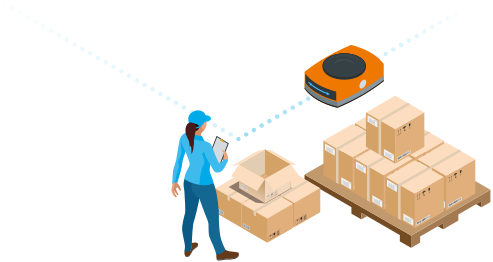
CTU is an abbreviation of “Carton Transfer Unit”, an autonomous mobile picking and transport robot that can also be described as a case (tote) transfer unit. A CTU is made up of three main elements – a chassis (the traveling base), shelf layers (onboard storage) and a pick-up mechanizm – and it retrieves totes (returnable containers) from storage racks entirely unattended, loading several totes at once and carrying them to a workstation. Rather than having people walk to the storage rack to collect goods as before, the robot delivers the tote containing the goods to the person. That reversal of thinking is the essence of the Tote to Person method that the CTU makes possible.
The term Tote to Person means that the leading role in picking work shifts from “the movement of people” to “the movement of goods”. Operators remain at a designated picking station and simply take the items they need from the totes that the robots bring to them one after another. Because walking, an activity that generates no added value, is eliminated, the number of picks per unit of time – that is, throughput – improves dramatically. At the same time, because a CTU allows storage racks to be configured at high density in the vertical direction, another major feature is that storage capacity can be maximized within a limited floor area.
A CTU travels autonomously along the aisles between racks on its own, and once it reaches the target rack position it extends the pick-up mechanizm fitted to the vehicle, draws out the tote and stores it in the onboard storage shelf. Because several totes can be handled in a single task, one robot can process multiple orders and SKUs together on a single round trip, and this high transport efficiency is the CTU’s fundamental strength. CTU products fall broadly into three types – the telescopic frame type, the single frame type, and simplex bin robots – and the optimal model is selected according to the site’s ceiling height, storage density and the tote standards being handled.
The three elements that make up a CTU
To understand the structure of a CTU more concretely, let us break it down into its three main components. The first element is the chassis. The chassis is the base that carries out the robot’s travel, and it houses the drive system, the battery, the electrical controls and the various sensors. Chassis widths range widely from 680mm to 1385mm depending on the model, and are selected according to aisle-width constraints and the size of the totes handled. In addition to differential drive, omnidirectional chassis are also available, covering sites that require narrow aisles or flexible route design.
The second element is the shelf layers (onboard storage bins). These are temporary tote storage shelves built into the robot body, and they come in variations such as standard storage bins and combing (transfer) storage bins. Loading several totes onto these shelf layers at the same time is what delivers multi tote concurrency handling, in which several boxes are transported in a single trip. The number of shelf levels and the way their heights are designed are an important factor that determines the balance between storage efficiency and picking efficiency.
The third element is the pick-up mechanizm. This is the mechanizm that transfers totes between the storage rack and the robot body, and its character differs greatly according to the method used. The most representative is the clamp method, which grips both sides of the tote and draws it out. Another is the telescopic-fork method, which inserts forks under the tote and lifts it. Customization to vacuum-suction, grabbing-hook, roller and belt methods is also supported, so the optimal mechanizm can be chosen to match the characteristics of the objects handled. The telescopic-fork method suits objects that are not well suited to being pushed and pulled, and a high-payload telescopic-fork method suits heavy items, so the mechanizm can be selected according to the load format.
The challenges of conventional picking
To understand why CTUs are needed in today’s logistics operations, we first need to set out the structural challenges of conventional picking work. These challenges, which have become apparent across the e-commerce, retail and manufacturing sectors alike, go beyond mere “inefficient work” and have developed into management issues that threaten the scalability of the business and its very cost structure.
Work made more complex by high product variety and high SKU counts
As consumer needs diversify and e-commerce advances, the number of SKUs (stock keeping units) handled by warehouses increases year after year. Even within the same item category, sizes, colors and variations are subdivided ever more finely, and it has become normal for sites to have to store a huge number of item types in small quantities each. The more SKUs there are, the harder it becomes for operators to find the item they are looking for, and the higher the probability of picking errors. The greater the proportion of high-mix, low-volume orders, the longer the walking distance per order becomes and the more productivity falls.
Walking time: labor hours that create no added value
In conventional picking where people go to the racks (Person to Goods), it is said that most of an operator’s working hours are in fact spent walking. Workers cover kilometres a day inside vast warehouses, searching for items in front of racks, taking them out, then moving on to the next rack. Within this sequence of movements, the time actually spent with the item in hand is very small, and most of the rest is consumed by travel and searching. Although walking creates no added value, it drains operators’ stamina and leads to fatigue-related errors and falling productivity. With labor shortages becoming more severe, continuing to devote limited personnel to this inefficient walking represents a major opportunity loss.
The trade-off between storage density and work efficiency
Conventional manual picking requires aisles wide enough for operators to move safely and efficiently, and because goods can only be stored within arm’s reach, rack height is also limited. As a result, it becomes difficult to raise the storage capacity per unit of floor area – that is, the storage density. If you narrow the aisles or raise the racks in an attempt to increase storage density, work efficiency and safety are sacrificed instead. This trade-off between storage density and work efficiency is precisely the dilemma that conventional warehouses have faced for many years. In regions such as Thailand, where rents and land costs are trending upward, how effectively a limited floor area is used has a direct bearing on profitability.
The scalability ceiling created by dependence on manual labor
In e-commerce and retail operations, where volumes swell several-fold in peak season, the workforce has to be scaled up and down in line with demand fluctuations. However, securing and training skilled picking operators in a short space of time is far from easy, and staffing for peak season is becoming harder every year. Because work quality depends on individual skill levels, the more new recruits there are, the more errors occur and the higher training costs climb. Staffing cannot keep pace with business growth, or efficiency plateaus even as headcount increases. This kind of scalability ceiling becomes a serious bottleneck for growing companies.
How a CTU works and the flow of operation
Let us now look concretely at how a CTU actually operates and solves these challenges, following the flow of the work. Picking with a CTU consists of a cycle that begins with an instruction from the higher-level system and continues through tote retrieval, simultaneous transport of multiple totes, picking at the workstation, and finally return of the totes to storage.
Retrieving the tote
When a picking order arises, the storage position of the tote containing the required item is passed from the higher-level WMS (warehouse management system) or inventory management system to the robot control system. The CTU travels autonomously to the target rack position and uses secondary positioning to correct the relative position of rack and robot to the millimetre. Once the position is fixed, it extends the pick-up mechanizm towards the rack; with the clamp method it grips the sides of the tote, and with the telescopic-fork method it inserts forks under the tote, and so draws the target tote out of the storage rack. The retrieved tote is then stored directly in the onboard storage bin on the vehicle.
During this retrieval operation, the tote protrusion detection function is active: if there is any abnormality in the stored position, it raises an alarm and stops operation immediately. In addition, high-level telescopic frame models are equipped with vision correction (3D position correction / 2D beacon code correction), which recognizes the tote from an image and corrects its position, delivering highly reliable transfer even in situations where markers cannot be applied to the totes. Adaptive control that automatically adjusts the loading and unloading speed according to height provides both stability at height and high speed at low levels.
Simultaneous transport of multiple totes
The CTU’s most distinctive capability is multi-tote concurrent transport, in which several totes are handled at the same time within a single task. The robot visits the target racks one after another, loading several totes onto the shelf layers of its body. As a result, one robot can process multiple orders and SKUs together on a single round trip, maximizing transport efficiency while minimizing the number of trips. In configurations that use a dedicated transfer station (flash station), 6 to 8 boxes are handled in a single task, delivering high throughput of up to 500 totes/hour for inbound/outbound efficiency, and 500 to 800 totes/hour for the flash station on its own.
Being able to carry several totes at once does not merely reduce the number of transport trips; it also enables advanced picking strategies such as multi-order picking, in which several orders are processed in parallel, and wave picking, in which shipping peaks are processed in batches. As the higher-level software bundles orders optimally and streamlines the robots’ travel paths, throughput across the whole site is raised further still.
Picking at the workstation
Having loaded the totes, the CTU heads for the workstation. At the station the operator waits in a fixed position and, following the instructions shown on screen, takes the required quantity of the required items from the totes the robot has delivered, placing them into a shipping carton or another tote. Because the operator has no need to walk around and simply picks items from the totes that arrive in front of them, they can concentrate on the picking work itself and fatigue is greatly reduced. Configurations that handle both inbound and outbound processing at the same station are also possible, and by using a transfer mechanizm such as a flash station, which has a small footprint and a simple structure, high processing capacity can be achieved even in limited space.
Once picking is complete, the tote is returned by the CTU to its original storage rack or to a designated storage position. This put-back operation is also performed automatically, and inventory information is synchronized with the higher-level system in real time. By repeating this cycle without interruption, the warehouse can maintain stable processing capacity day and night.
CTU product types and their characteristics
CTUs come in several product types that can be selected according to site requirements. Here we divide them broadly into three – the telescopic frame type, the single frame type (multi-box, clamp type) and the simplex bin type – and explain the characteristics of each. When selecting a model, it is important to make an overall judgement balancing the picking height required, the tote standards handled, aisle width, storage density and budget.
Telescopic frame type
The telescopic frame type has a structure in which the frame (lifting mast) itself extends and retracts, and it is the top-of-the-range type covering ultra-high-bay storage. The representative model, the F0-50DCH(T), is based on a 950mm chassis and achieves an extremely high picking height of up to 10m. Telescopic frames are available in three standard sizes – 6.5m, 8m and 10m – and the design philosophy is normally to reuse these rather than carry out individual customization. Typical applications include irregular warehouses where the robot must pass beneath fire doors or pipework, ultra-high-bay warehouses with high ceilings, high-bay distribution warehouses such as cross-border e-commerce warehouses and footwear or apparel warehouses, and small-parts inventory in the automotive industry.
High-level telescopic frame models (8m/10m) come as standard with functions that raise the reliability and safety of work at height, including a traffic recorder, vision correction of totes, millimetre-level lateral translation of the component, a damping buffer at the lifting point of the telescopic frame, tote protrusion detection, a high-speed lifting module of up to 1m/s, and adaptive control of loading and unloading speed according to working height. In practice, a “high and low combination” configuration is often recommended: for example, in a warehouse that requires a picking height of 8m, combining 6m single frame machines with 8m telescopic frame machines can in some cases cut costs substantially and shorten lead times compared with using telescopic frame machines throughout. Customization that allows high and low CTUs to connect to the same flash station is also supported.
Single frame type (multi-box, clamp type)
The single frame type is the standard type with a one-piece, non-telescopic frame, and it offers a wide line-up centred on multi-box (multiple tote loading) clamp-method machines. There are several variations with different chassis widths and picking heights, allowing fine-grained selection according to site requirements. Examples include the F0-50DCN with a 700mm chassis, 850mm aisle width and maximum picking height of 3m; the F0-50DC with an 850mm narrow chassis and a maximum of 4m; the F0-50DCH with a 950mm standard chassis and a maximum of 6m (with a 30kg load); and the F0-50DCW with a 1150mm chassis, which handles large totes of up to 630 x 800mm. A key strength is the ability to handle a wide variety of tote standards, from European standard small parts boxes (300 x 400) to large parts boxes (500 x 700), European standard large boxes (600 x 800), and non-standard totes and cartons.
The clamp-method series also supports customization such as adjustable width and double deep (handling two rows in the depth of the rack). However, the more tote-standard variations a product has to cover, the more customization elements are involved, so standardizing tote specifications as far as possible is recommended from the standpoint of overall system stability and cost efficiency. The frame structure and clamp mechanizm have been improved over successive generations: the latest generation reduces the invalid storage height (the vertical dead space in which totes cannot be placed) to raise storage efficiency, improves maintainability through structural simplification, and reduces chassis length and turning diameter to improve adaptability to cramped sites.
Simplex bin / single box type
The single box type is a compact type that handles one box at a time, and it suits applications in limited space such as direct connection to production lines and transfer ports at differing heights (mid-air handover). The representative model, the MR-F0-50SC, is compact at 956 x 680 x 2000mm with an aisle width of 830mm; it handles totes of 600 x 400 x 340mm, with a picking height of 1.5m at a 50kg load and 2m at a 30kg load. In addition to the standard single-deep clamp mechanizm, customization to bidirectional travel, single-deep telescopic fork, roller and roller clamp is also supported.
Typical applications for the single box type include supplying materials into the tight spaces of production lines such as SMT (surface mount technology) lines, and mid-air handover applications between transfer ports at varying heights. Whereas the multi-box type takes on high-volume picking in the warehouse, the single box type excels at “line supply” – delivering the required materials at the required time right at the edge of the production line. Within in-plant logistics, it is an important piece that connects the warehouse and the production line seamlessly.
Multi-box telescopic fork type
Whereas the clamp method grips the object from the sides, the telescopic fork method inserts forks underneath and lifts, which makes it suitable for objects unsuited to being pushed and pulled, for cases where there are so many different tote standards that an adjustable-width clamp cannot easily cope, and for handling heavy items. Multi-box telescopic fork models include the F0-50DTN with a 700mm chassis (50kg payload, typical SKU size W300 x L400), the F0-50DT with an 850mm chassis (50kg payload, W490 x L600), and the F0-50DTH with a 950mm chassis (50kg/100kg payload, W520 x L690 and others). The F0-50DTH in particular can handle heavy items of up to 100kg and offers a choice of two component types. At sites with tight constraints on load format or where heavy items are handled, the telescopic fork type is a strong option.
How to read the key specifications
When selecting a CTU, it is essential to interpret the specification figures in the catalogue correctly. Here we explain the meaning of the main specification items that form the basis for model selection, along with the practical points to watch when choosing. By understanding the operational implications behind the numbers, you will be able to select the model that genuinely fits your own site.
Chassis width and aisle width
Chassis width is the most basic specification, as it governs the aisle width the robot needs in order to travel. CTU chassis widths range widely from 680mm to 1385mm depending on the model; with a 700mm chassis, for example, an aisle width of around 850mm is the guideline. The narrower the chassis, the more tightly aisles can be packed and the higher the storage density, but there are correspondingly greater constraints on the tote sizes and payload that can be handled. Conversely, models that handle large totes require a wider chassis and wider aisles. When designing the site layout, the required aisle width is calculated back from the chassis width, and the model that gives the best balance between storage density and workability is selected. Choosing an omnidirectional chassis also makes it possible to cope with even narrower aisles and more flexible route design.
Picking height (up to 10m)
Picking height indicates how high a rack position the robot can retrieve totes from, and it is an extremely important indicator because it directly determines storage capacity. CTU picking heights are set per model in the baseline version (for example 300-2085mm or 300-4000mm), and customization extends this to a maximum of 2m, 3m, 4m or 6m, and up to 10m with the telescopic frame type. In a warehouse with a high ceiling, choosing a high-bay machine can increase storage capacity several-fold within the same floor area. However, the higher the picking height, the larger and more costly the machine becomes, and loading and unloading at height demands correspondingly sophisticated control technology. As noted above, where the required height is moderate, an approach that combines high and low machines to optimize overall cost and lead time is effective. Note also that on some models the achievable picking height falls as payload increases (for example 6m support at a 30kg load and 5m support at a 50kg load), so the balance with weight should also be checked.
Inbound/outbound efficiency (up to 500 totes/hour)
Inbound/outbound efficiency indicates the number of totes that can be processed per unit of time, and it is the most practical indicator for measuring system throughput. CTU inbound/outbound efficiency reaches up to 500 totes/hour, and 500 to 800 totes/hour in configurations that use a dedicated flash station. These figures are underpinned by the multi-tote concurrent transport capability that handles 6 to 8 boxes at once in a single task. Actual throughput depends on the design of the system as a whole, including the number of robots, the length of the travel paths, how orders are bundled, the number of stations, and the optimization algorithms in the higher-level software. It is therefore important to design a configuration that meets the required processing capacity through simulation based on your own actual order characteristics, rather than relying on peak catalogue figures alone. TOMAS TECH supports optimal fleet-size and layout design based on your volume data.
Payload and tote standards
Payload is the upper limit of the load that can be placed in a single tote: the standard is 30kg or 50kg, while some telescopic fork models support up to 100kg. The model must be selected according to the weight of the goods handled. As for tote standards, the supported sizes are defined for each model, from European standard small parts boxes (300 x 400) to large parts boxes (500 x 700) and large boxes (600 x 800, 630 x 800). Standardizing tote specifications as far as possible is extremely important in order to widen the freedom of model selection, improve system stability and secure future expandability. Where totes of mixed sizes are used, and particularly where materials with large size differences are handled, an automatic transfer mechanizm such as a flash station may not be suitable, so careful evaluation in advance is required.
The benefits of introducing a CTU
Introducing a CTU brings multifaceted improvements to logistics in warehouses and factories. Here we set out the concrete benefits of deployment from four perspectives: throughput, storage density, labor savings and accuracy. These benefits are interrelated and, taken together, substantially raise the productivity and profitability of warehouse operations.
A dramatic increase in throughput
The greatest benefit of introducing a CTU is the dramatic increase in picking throughput. Because operator walking is eliminated and transport efficiency per robot is maximized through simultaneous transport of multiple totes, the number of transactions processed per unit of time far exceeds conventional manual picking. Inbound/outbound efficiency reaches up to 500 totes/hour, and up to 800 totes/hour in a flash station configuration, providing stable processing capacity that does not degrade in quality even under continuous 24-hour operation. Sudden increases in peak-season volume can also be absorbed flexibly by extending robot operating hours or adding units, securing scalability in line with business growth.
Maximizing storage density
Because a CTU makes use of the vertical dimension to configure storage racks at high density, storage capacity can be maximized within a limited floor area. Using the telescopic frame type enables high-bay storage of up to 10m, accommodating several times the inventory of a conventional warehouse on the same floor area. Furthermore, the wide aisles required for manual work are no longer necessary, and packing aisles down to the minimum width a robot needs to pass raises storage efficiency per unit of floor area still further. On the latest generation of machines, reducing the invalid storage height also minimizes vertical dead space, refining the pursuit of storage density even further. In the Thai market, where land and rental costs continue to rise, this improvement in storage density translates directly into better profitability.
Labor savings and a better working environment
With robots taking over transport, the headcount required for picking can be reduced substantially. Operators no longer need to walk around and can concentrate on higher value-added work at the station, which improves productivity per person. In comparable AMR deployments there have been cases where more than 60 workers were reduced across an entire plant, so the labor-saving effect is extremely large. With labor shortages becoming more severe, the ability to process greater volumes with fewer people also carries great significance for business continuity. In addition, easing the physical burden of carrying heavy loads over long distances improves the working environment, which in turn helps improve worker retention and strengthen recruitment competitiveness.
Improved picking accuracy
By linking the CTU with higher-level systems, picking work is carried out in accordance with system instructions, so work that used to depend on individual experience and intuition becomes standardized and picking errors are greatly reduced. The robot delivers exactly the specified tote and the operator takes items out following on-screen instructions, so the probability of errors such as mis-shipments and shortages falls. Because inventory information is synchronized with the higher-level system in real time, inventory visibility improves and stocktaking accuracy also rises. Fewer errors translate directly into lower costs for returns handling and re-shipment, and into higher customer satisfaction.
Software integration: the brains that make the CTU work intelligently
What draws out the full capability of the CTU hardware is the suite of software that controls it in an integrated way. For dozens of robots to cooperate in the same space without interfering with one another and to process enormous numbers of orders optimally, a layered software architecture is indispensable. Here we explain the main software components – iWMS, RCS and WCS – and their integration with higher-level WMS/ERP systems.
iWMS: an operations management system built around inventory management
iWMS (intelligent Warehouse Management System) is an operations management system built around inventory management at its core. By integrating data mining and AI technology and making use of a set of low-code development components, it enables flexible configuration and rapid response to custom requirements. iWMS manages operational tasks such as inbound, outbound, stock movement and stocktaking, and provides advanced operational algorithms including storage recommendation, smart wave management, heat (allocation frequency) management and inventory allocation algorithms. This means it does more than simply move robots: it delivers intelligent optimization of warehouse operations, deciding which goods to store where and how to bundle and process which orders. Industry-specific editions of iWMS are available, such as iWMS-AUTO for the automotive industry, iWMS-3C for the 3C industry and iWMS-Logistics for the logistics industry, each adapted to the commercial practices and workflows of its sector.
RCS: the control system that commands the robot fleet
RCS (Robot Control System) is the control system responsible for task allocation, scheduling, and operation and maintenance for all robots. It uses a variety of scheduling algorithms to allocate tasks optimally, and through multi-robot path planning and traffic control it directs the robots so that they cooperate efficiently without interfering with one another. RCS also supports transport between different scenes, such as between the warehouse and the production line, and has large-scale scheduling capability that scales to fleets of thousands of AMRs and sites of a million square meters. It can control up to 1,100 AMRs in a single project, and grouping several RCS instances together supports even larger-scale operations. RCS is made up of modules such as task allocation (TAS), robot control (RCS), alarm management (AMS), centralized management (CMS) and equipment management (WCS), delivering hierarchical and robust control.
WCS and integration with higher-level WMS/ERP
WCS (Warehouse Control System) handles communication with and control of peripheral equipment such as conveyors, lifters, automatic doors and flash stations, mediating the interaction between robots and fixed equipment. This software suite connects through standard interfaces to the customer’s existing higher-level systems, namely WMS (warehouse management), ERP (enterprise resource planning), MES (manufacturing execution) and OMS (order management). Business information such as purchase orders, production orders, inbound and outbound instructions and sales orders flows down from the higher-level systems; the CTU system executes the physical transport accordingly and feeds the results back upward in real time. There are also many cases in which RCS-2000 has been connected seamlessly to the customer’s WMS to deliver digital management of storage information, and a major strength is that warehouse automation can be advanced step by step while making use of existing systems. In addition, visualization in a virtual space via a digital twin (Robo Mirror) and process visualization dashboards make it possible to grasp and analyze site operating status in real time.
Target industries and scenarios
Thanks to its flexibility and high throughput, the CTU is used across a wide range of industries. Here we introduce representative industries and their specific scenarios. Referring to cases close to your own line of business will help you form a more concrete picture of what deployment would look like.
E-commerce and retail
E-commerce and retail is one of the fields in which the CTU shows its power most clearly. In this industry, where large numbers of high-mix, low-volume orders arise and shipping volumes fluctuate heavily, the inefficiency of manual picking is particularly evident. Tote to Person picking with a CTU eliminates operator walking to raise throughput and responds flexibly to sudden volume increases in peak season. In the high-bay warehouses of cross-border e-commerce, high-density storage with the telescopic frame type compresses storage costs significantly. iWMS-Logistics, which provides an end-to-end warehouse solution from inbound to outbound, supports these sites across e-commerce, retail, supermarkets, apparel, pharmaceuticals and more.
3C (computers, communications and consumer electronics)
The 3C industry (computers, smartphones, semiconductors, panels, home appliances and consumer electronics) is a field with an enormous variety of parts and demanding requirements for cleanliness and careful handling. CTUs cover the diverse needs of 3C, from the single box type suited to supplying materials to SMT lines through to the multi-box type that handles large numbers of SKUs. The flash station has obtained SEMI certification, which is essential in the semiconductor industry, so it can be introduced with confidence at semiconductor and panel manufacturing sites. iWMS-3C, optimized for the 3C industry, manages in-plant logistics for sectors such as computers, smartphones, semiconductors and home appliances in an integrated way.
Pharmaceuticals and apparel
The pharmaceutical industry demands accurate traceability and rigorous inventory management. Linking CTUs with iWMS digitises inbound and outbound records, making it possible to meet pharmaceutical-specific requirements such as lot management, expiry date management and FIFO (first in, first out). In the apparel industry, SKUs multiply explosively because of size and color variations, and the CTU’s high-density storage and high-speed picking respond precisely to this high-mix, low-volume challenge. In apparel, where seasonal demand fluctuations are large, being able to secure scalability for peak season is also a major advantage.
Line supply and in-plant logistics in manufacturing
In manufacturing, supplying materials from the warehouse to the production line – so-called line supply – is an important application for CTUs. Single box CTUs can enter tight spaces such as SMT lines and supply the required materials at the required time. By covering every step of in-plant logistics with CTUs and related AMRs – from raw material storage in the warehouse through quality inspection, packing, sorting and delivery to finished goods storage – logistics across the entire plant can be made unmanned and efficient. There are also reported cases in which connecting RCS-2000 to the customer’s WMS delivered seamless changeover across the whole production line together with digital management of storage information.
Comparison with other approaches
There are various approaches to warehouse automation besides the CTU. Each has its strengths and weaknesses, and the optimal choice differs according to site requirements. Here we compare the CTU with grid-type automated storage (the AutoStore-style approach), shuttle-type automated storage and conventional manual rack picking, to clarify the kinds of sites for which the CTU is best suited.
Comparison with grid-type automated storage (the AutoStore-style approach)
Grid-type automated storage is an approach in which robots travel across the top of bins stacked in a lattice and retrieve bins by digging down from above. While it can achieve extremely high storage density, it requires a dedicated grid structure, involves large up-front investment and offers little layout flexibility. Moreover, because it works by digging down, accessing a bin in a lower layer entails “digging” work in which upper bins are temporarily moved aside, so efficiency varies when frequently accessed and rarely accessed items are mixed together. The CTU, by contrast, can use ordinary rack shelving as it is, offers a high degree of layout freedom, and is easy to introduce and expand in stages. Vertical storage can also be designed flexibly within the scope of the racking, making it well suited to retrofitting into existing warehouses.
Comparison with shuttle-type automated storage
Shuttle-type automated storage is an approach in which shuttle carts travel on rails laid along each level of the racking to put totes in and take them out. It delivers fast, high-density storage, but investment in fixed equipment such as rails and lifters is large, and once built, the layout is difficult to change. Because shuttles can essentially only move within a set level and row, the flexibility of the system is bound by its structure. A CTU, on the other hand, is an autonomous mobile robot: it requires no fixed rails, can travel freely wherever there is floor, and processing capacity can be increased flexibly in peak season simply by adding more robots. For sites that want to hold down the initial burden of capital investment while expanding the system in stages as the business grows, the CTU is the better fit.
Comparison with conventional manual rack picking
Conventional manual rack picking has the advantages of the smallest initial investment and a high degree of freedom to change the layout. At sites with small volumes and low frequency, or where extremely irregular goods are handled, manual picking may still be the rational choice. However, as volumes grow, SKUs proliferate and it becomes harder to secure labor, the inefficiency and scalability ceiling of manual picking become apparent. Although the initial investment is larger than for the manual approach, the CTU far surpasses it in throughput, storage density, labor savings and accuracy, and recovers the investment over the medium to long term through lower labor costs and higher productivity. The more a site expects volume growth and faces labor shortages as a management issue, the greater the benefits of moving to a CTU.
The implementation process and timeline
A CTU deployment proceeds in stages based on careful planning. Here we introduce the standard implementation process and rough guideline durations for each phase. Actual durations vary with the scale of the project and the degree of customization, but understanding the overall picture allows you to build a realiztic implementation plan.
From contract to detailed design
The project begins with the conclusion of the contract and purchase order (PO). Detailed engineering then takes about 1 month. In this phase, the layout and design are finalised, the project kick-off is held and the blueprint is prepared. Based on your volume data, the tote standards handled and the constraints of the existing warehouse, we design the optimal number of robots, the layout, the station arrangement and the software configuration. The precision of this upstream work is the single most important step in determining the success or failure of the whole project. As an integrator thoroughly familiar with conditions on Thai sites, TOMAS TECH supports this design phase with great care.
Manufacturing, shipping and on-site implementation
Once the detailed design is fixed, the robots and peripheral equipment are manufactured over a standard production period of about 2 months. Where customization is required, an additional 2 to 4 weeks or so are needed. The manufactured equipment is shipped by sea from the factory in China via port, clears customs and is delivered to your local site. Allow about 2 months for shipping. Once the equipment arrives, on-site implementation takes about 1.5 to 2 months, covering hardware installation, robot commissioning and system tuning. At this stage, detailed adjustment and verification are repeated so that the robots operate correctly in the actual site environment.
Go-live and ramp-up
When implementation and verification are complete, the project moves to go-live at last. After go-live, about 1 month is set aside as a start-up and ramp-up period, during which the system is guided to stable operation within real-world use and processing capacity is raised in stages to the planned level. Overall, from contract to go-live, roughly 7 to 8 months is a reasonable guideline for a standard configuration. Since this may be longer or shorter depending on project scale and the degree of customization, TOMAS TECH draws up an implementation plan with clear milestones for each phase and drives the project forward in close cooperation with you.
Pre-deployment checklist
To deploy a CTU smoothly and keep it running stably, there are several important points about the site environment that should be checked in advance. Here we set out the items to check before deployment from the perspectives of racking and tote standards, flooring, communications, charging and safety. Knowing these in advance prevents trouble after deployment and enables a smooth start-up.
Racking and tote standards
The first thing to check is the specification of the racking and the totes. Confirm whether the size of the totes handled falls within the range supported by the model and whether tote standards are standardized. As noted above, the more tote-standard variations there are, the more customization is required and the greater the system complexity and cost, so unifying standards as far as possible is desirable. For the racking, verify whether the clearance the robot needs to put totes in and take them out (the gap between shelf levels) is available, and whether the rack structure suits the robot’s transfer motion. Where totes of mixed sizes are used, and particularly where materials with large size differences are handled, the suitability of an automatic transfer mechanizm must be evaluated in advance.
Floor flatness
The condition of the floor is extremely important for stable operation of autonomous mobile robots. Floor unevenness (the difference between the highest and lowest points within one square meter) must be kept within the permissible value, and 2mm or less is generally the guideline. Floor conditions such as the gradient of the travel path, steps (normally 5mm or less, with no steps permitted at parking positions) and groove widths (normally 8mm or less, with no grooves permitted at parking positions) affect the robot’s ability to travel at rated speed and to position itself accurately. The floor must be clean, free of particles and dirt, and not slippery. When deploying into an existing warehouse, measuring the floor condition in advance and carrying out repairs or preparation as necessary is a prerequisite for stable operation.
The communications environment (wireless network)
Because robots communicate constantly with the control system over a wireless network, building a stable wireless environment is essential. In the robot operating area, a signal strength of -65dBm or better is desirable, and wireless access points (APs) should be positioned at an appropriate height and angle under a channel design that avoids mutual interference. Signal attenuation caused by physical obstacles such as walls must also be taken into account, and the entire operating area needs to be covered evenly. Network redundancy (a dual AC configuration) and the introduction of a UPS (uninterruptible power supply) to guard against power failure are also recommended in order to prevent operational stoppages caused by loss of communication. TOMAS TECH supports the design and construction of the wireless environment, including on-site radio surveys.
Charging and power supply
Because CTUs charge automatically at charging stations, you need to secure locations for the charging stations and the necessary power supply. The charging station power circuit requires a certain minimum capacity, and a stable 220V AC supply is a prerequisite. Robots operate under threshold management: when the remaining battery level falls below a lower limit they automatically head for charging, and they finish charging once they recover to the upper limit. By designing the appropriate number of charging stations according to the number of robots and their operating hours, you can prevent the drop in utilization that waiting for charging would cause. Lithium batteries are used, and safety is ensured by a battery management system (BMS) with multi-layered protection functions.
Safety measures
In environments where people and robots work in the same space, safety measures take top priority. CTUs come as standard with multiple layers of safety mechanizms, including emergency stop buttons at the front, rear, left and right, protective anti-collision strips (contact-detection bumpers) at the front and rear, laser-based obstacle detection at the front and rear, and tote protrusion detection. In situations with high human and machine safety requirements, safety grating (a safety light curtain) can be added to the flash station as an option. The required operating environment is an indoor, level floor, an ambient temperature of 0 to 45 degrees C, humidity of 15 to 95% (non-condensing), and clean air free of dust and of flammable, explosive or corrosive gases. Confirming these safety requirements and environmental conditions before deployment, and taking the necessary measures, forms the foundation of safe and stable operation.
Maintenance and support
A CTU system is not something you install and then forget: continuous maintenance and support are needed throughout its operating life. By carrying out planned maintenance on the robot hardware, the batteries, the charging stations and the control software, the system can be kept running stably over the long term. The latest generation of machines offers improved maintainability through structural simplification via die moulding and commonisation of components (a high parts-compatibility rate), lightening the maintenance burden.
On the software side, an operating-data visualization dashboard makes it possible to grasp system operating status, task execution rates and trends in abnormalities in real time. A traffic recorder logs the entire process, and abnormalities at height can be checked and dealt with from a staff member’s mobile device, so the mechanizms that support remote maintenance and operation are in place as well. Servers can be prepared for unforeseen faults and power outages through a redundant active/standby configuration, the use of hot-standby software and power backup via UPS. As an integrator based in Thailand, TOMAS TECH provides end-to-end support covering local maintenance response, parts supply, software updates and proposals for operational improvement, walking alongside you so that your system continues to deliver value commensurate with the investment over the long term.
Frequently asked questions (FAQ)
Q1. Can a CTU be retrofitted into an existing warehouse?
Yes, it can. A CTU is an autonomous mobile robot: it requires no dedicated grid structure or fixed rails and can use ordinary rack shelving as it is. It is therefore well suited to retrofitting into existing warehouses and to phased deployment. However, you do need to confirm in advance that conditions such as floor flatness, aisle width, tote standards and the wireless environment meet the requirements of the model. TOMAS TECH will carry out a site survey and propose the optimal deployment plan taking account of the constraints of your existing warehouse.
Q2. How high can it pick?
This differs by model. A standard single frame type reaches around 6m maximum, while the telescopic frame type F0-50DCH(T) supports up to 10m. In a warehouse with a high ceiling, a high-bay machine can greatly increase storage density, but where the required height is moderate, combining high and low machines can in some cases optimize cost and lead time. In making the actual selection, we take an overall view of the warehouse ceiling height, the weight of the totes handled and the storage capacity required.
Q3. How much can it process per hour?
CTU inbound/outbound efficiency reaches up to 500 totes/hour, and 500 to 800 totes/hour in configurations that use a dedicated flash station. However, actual throughput depends on the design of the system as a whole, including the number of robots, the travel paths, how orders are bundled, the number of stations and software optimization. TOMAS TECH runs simulations based on your actual volume data and designs the fleet size and layout needed to meet the required processing capacity.
Q4. Can it integrate with our existing WMS or ERP?
Yes, it can. The RCS and iWMS that control the CTU can connect through standard interfaces to your existing higher-level systems such as WMS, ERP, MES and OMS. They receive business information on purchasing, production, inbound and outbound movements and sales from the higher-level system, execute the physical transport and feed the results back in real time. A major strength is that warehouse automation can be advanced in stages while making use of your existing systems.
Q5. How long does deployment take?
For a standard configuration, roughly 7 to 8 months from contract to go-live is the guideline. The breakdown is about 1 month for detailed engineering, about 2 months for production, about 2 months for shipping, about 1.5 to 2 months for on-site implementation and about 1 month for start-up. Where customization is required, an additional 2 to 4 weeks or so are needed. As this varies with project scale and the degree of customization, please contact us for details.
Q6. Can it be used with mixed tote sizes?
Some clamp-method models support adjustable width and can handle a certain degree of size variation. Where objects are unsuited to being pushed and pulled, or where there are many different tote standards, the telescopic fork method is suitable. However, where totes with large size differences are mixed together, an automatic transfer mechanizm such as a flash station may not be suitable, so careful evaluation in advance is necessary. Standardizing tote specifications as far as possible is recommended from the standpoint of system stability and cost efficiency.
Q7. Is it safe?
CTUs come as standard with multiple layers of safety mechanizms, including emergency stop buttons at the front, rear, left and right, contact-detection bumpers, laser-based obstacle detection and tote protrusion detection. In situations with high human and machine safety requirements, a safety light curtain can be added as an option. In addition, some models have obtained CE certification and SEMI certification, conforming to international safety standards. They are designed to be operated safely even in environments where people and robots work together.
Q8. What are the benefits of working with TOMAS TECH?
TOMAS TECH is an IT integrator for manufacturers and logistics companies based in Thailand, and in addition to handling Hikrobot CTUs we provide end-to-end support covering integration with higher-level software, integration with existing systems, and local deployment and maintenance. We are thoroughly familiar with conditions and business practices in Thailand and can work in Japanese, Thai and English, so Japanese-affiliated companies can entrust their projects to us with confidence. Our value lies not in merely selling equipment, but in designing the optimal solution around your operational challenges and walking alongside you over the long term.
Conclusion: next-generation warehouse automation with the CTU
Against the structural challenges faced by today’s logistics operations – growing product variety and SKU counts, labor shortages and the limits of storage density – the CTU case-picking robot offers a fundamental solution through the change of thinking embodied in Tote to Person. It eliminates operator walking to raise throughput dramatically, uses the vertical dimension to maximize storage density, and delivers labor savings and improved accuracy at the same time. Through the combination of diverse product types – telescopic frame, single frame and single box – with a powerful software suite of iWMS, RCS and WCS, the CTU adapts to a wide range of sites, from e-commerce, retail, 3C, pharmaceuticals and apparel to line supply in manufacturing.
Compared with grid-type and shuttle-type automated storage, the CTU requires no large up-front investment in fixed equipment and offers the flexibility to be deployed and expanded in stages while making use of existing rack shelving. The more a site expects volume growth and faces labor shortages as a management issue, the greater the benefits that a move to CTUs will bring. And in order to turn this advanced technology into reliable results on Thai sites, a partner able to take responsibility for hardware, software, existing-system integration and local maintenance as a single package is indispensable.
As an IT integrator that works closely with manufacturing and logistics customers in Thailand, TOMAS TECH provides warehouse automation solutions built around the CTU case-picking robot on an end-to-end basis, from planning and design through deployment and maintenance. From questions such as “Is a CTU right for our warehouse?”, “What level of benefit can we expect?” and “Can it integrate with our existing systems?” through to concrete deployment simulations, our experienced specializts will respond carefully to your needs. If you are interested in improving productivity and reducing labor requirements in your warehouse or factory, please do not hesitate to get in touch.
Please send your inquiries via our contact form. We will be pleased to propose the solution best suited to your site, covering the CTU and warehouse automation more broadly.