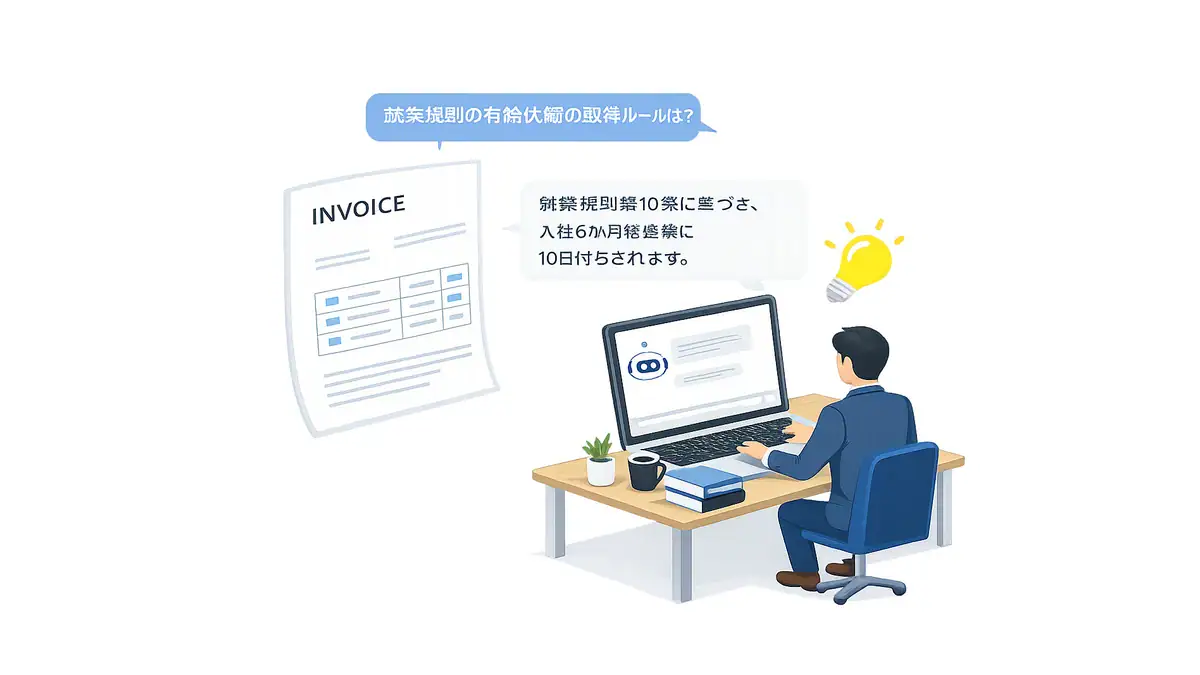
The general affairs and HR departments of Japanese-affiliated companies operating in Thailand field the same questions almost every day. “How many days of annual leave do I have left?” “Where do I submit a request for compassionate leave?” “When is the cut-off date for expense claims?” “How do the rules treat taking a company PC off-site for personal use?” The answers are written clearly in the work rules and internal policies, yet employees have no idea where to look in a thick policy manual, so in the end they ask a general affairs or HR staff member verbally or over chat. Each time, that staff member opens the policy manual or the intranet, checks, and replies. Repeated day after day, this quietly but steadily consumes the time of an administrative department that is run by only a handful of people. On top of that, a multilingual environment mixing Japanese, Thai and English is the norm in Thailand, adding the burden of explaining the very same question again in another language. As an IT integrator that understands the factory and logistics floor, TOMAS TECH develops and deploys “Internal Policy Inquiry AI” — an AI that answers questions about work rules, internal policies and HR/general affairs FAQs instantly — built to order around each customer’s specific operational challenges. This article gives a structured, practice-oriented explanation of what Internal Policy Inquiry AI is, the problems it solves, how it works using RAG (Retrieval-Augmented Generation), multilingual support, permissions, confidentiality and access control, the operating routine for reflecting policy revisions, the benefits of adoption, the implementation process, and frequently asked questions.
What Internal Policy Inquiry AI is — an AI that answers by referring to your own policy documents
Internal Policy Inquiry AI is a system in which AI answers questions about work rules, internal policies and various HR/general affairs FAQs instantly, in a natural conversational format, while referring to your company’s own policy documents. Employees simply type a question into a chat screen in their everyday words — “Can I carry over my annual leave?” or “What is the daily allowance for business trips?” — and receive an answer grounded in the relevant passage of the policy that serves as its basis. Answers are available around the clock, in a language the employee understands, without going through a staff member. That is the most immediately understandable value it delivers.
What matters here is the difference from a general-purpose generative AI chat. General-purpose generative AI answers on the basis of a vast body of general knowledge, but it does not know the contents of your work rules, your company’s unique leave scheme, or the monetary thresholds in your expense policy. Internal Policy Inquiry AI uses a mechanizm that has the AI refer to the very policy documents your company actually operates under (the RAG approach described below), so it returns “an answer based on your company’s rules” rather than a generality. In other words, if general-purpose AI is a knowledgeable outsider, Internal Policy Inquiry AI is closer to an in-house guide who has read your policy manual from cover to cover.
Another feature that makes it fit for real business use is that it does not merely return an answer: it can also present the clause or document name that the answer was based on as a “source”. Employees do not have to take the answer at face value — they can check the original policy and verify it — and staff can later trace why a particular answer was given. Precisely because HR and labor affairs is a domain that demands a high degree of accuracy, presenting sources is an indispensable design principle.
The challenges — the “same old questions” and the language barrier that burden administrative departments
Behind the need for Internal Policy Inquiry AI lie several structural challenges shared by the administrative departments of Japanese-affiliated companies in Thailand. The main ones are set out below.
Questions concentrate on general affairs and HR
Even when something is clearly stated in the policies, employees end up asking a staff member because they do not know where it is written or find the wording hard to interpret. And most of these are recurring, routine questions about annual leave, other types of leave, expenses and various application procedures. For an administrative department run by a small team, handling these inquiries squeezes out the high-value work it should be concentrating on, such as recruitment, scheme design and labor management. The time spent giving the same answer to the same question over and over is far from trivial once it accumulates.
Answers become person-dependent and inconsistent
A situation where “if you ask that person, they will know” may look efficient, but it in fact carries considerable risk. The accurate practice exists only in the head of a veteran staff member, so when that person is away, answers stall. Or interpretations differ subtly from one staff member to another, so the answers employees receive vary. When HR and labor answers change depending on who gives them, it can breed a sense of unfairness among employees and become the seed of trouble. In a domain where the policies are supposed to be the “single source of truth”, having answers depend on individuals is hardly a desirable state.
The burden of a multilingual environment
At Japanese-affiliated companies in Thailand, it is not unusual for Japanese expatriates, Thai local staff and staff from third countries to work in the same workplace. Work rules and internal policies are often maintained in Japanese, Thai and English, but when it comes to answering questions, staff bear a heavy translation-like burden: re-explaining in Thai something that was asked in Japanese, or verbally paraphrasing an English policy into plain Japanese. The language barrier creates not only extra work but also the risk of misunderstanding and information being lost in the process of communication.
The particular complexity of Thai labor law and work rules
As long as you do business in Thailand, work rules are established and operated in light of Thai labor-related legislation. There are leave schemes and approaches to allowances that differ from Japanese assumptions, so if an expatriate answers based on their own judgment, the reply may conflict with the actual policy and practice. Of course, interpreting the law itself is the domain of specializts, and AI should not hand down definitive legal judgments. That is exactly why it is important to design the AI to stick to conveying the facts — “this is what your company’s policy says” — and to hand off to a person for cases that involve delicate judgment or individual circumstances. This principle is discussed in more detail in the second half of this article.
Main applications — what kinds of questions can it answer?
What Internal Policy Inquiry AI does best is the routine FAQs whose answers are explicitly written in the policy documents. Below are typical examples of use. The actual scope covered is designed to match the content of your policies and your operating principles.
- Work rules in general: questions about basic rules such as working hours, breaks, the treatment of overtime, and codes of conduct
- Leave schemes: granting, carrying over and applying for annual leave, plus the conditions for taking compassionate leave, sick leave, special leave and so on
- Salary and allowances: general guidance on wages, such as pay dates, the eligibility conditions for various allowances, and how deductions are handled
- Expenses and reimbursement: the cut-off date for expense claims, the application flow, and the criteria in the daily allowance and travel expense policies for business trips
- Internal procedures: procedures accompanying joining and leaving the company, where to submit each application form, approval flows, and how to request the issue of certificates
- IT and information security policies: rules on the use of PCs and information devices, password management, the treatment of personal devices, and provisions on taking data off-site
Every one of these is a classic case of “it must be written in the policies somewhere, but I do not know where to look”. Internal Policy Inquiry AI takes on the first-line handling of such inquiries, leaving only the exceptional cases requiring judgment to be handled individually by staff, which greatly reduces the load on the administrative department.
How it works — sourced answers via RAG and countermeasures against hallucination
At the core of Internal Policy Inquiry AI is a technology called RAG (Retrieval-Augmented Generation). The following explains how it works from a practical standpoint, without leaning too heavily on technical jargon.
Putting policy documents into a form that can be referenced
First, documents such as your work rules, internal policies and various FAQs are ingested and organized into a form that is easy for AI to search. Specifically, the policies are divided into appropriate units (clauses or topics) and turned into a database in which the content of each unit can be searched semantically. This makes it possible to quickly locate the passage of the policies most relevant to a question when an employee asks one. Because the search works on closeness of meaning rather than word matching alone, a colloquial question such as “I want to carry my days off over” can still surface the clause on “carrying over annual paid leave”.
Generating an answer based on the retrieved policies
When a question is entered, the AI first searches for and retrieves the relevant passages of the policies, then composes an answer using their content as its basis. The key point is that the AI is designed to answer within the scope of what is written in the retrieved policies of your company, rather than answering on its own general knowledge. This is the essence of RAG and the decisive difference from general-purpose AI. By attaching the clause name or document name used as the basis as a source, both employees and staff can go back to the original policy and verify it.
Countermeasures against hallucination (plausible-sounding wrong answers)
It is generally known that generative AI has a tendency to produce content that sounds plausible but differs from the facts — a phenomenon called “hallucination”. In a domain such as HR and labor affairs, where accuracy is required, this is a risk that cannot be overlooked. In Internal Policy Inquiry AI, the RAG mechanizm itself — grounding answers in the content of the policy documents — serves as the first line of defense against hallucination. Combining this with further design choices — for questions where no corresponding description can be found in the policies, not forcing an answer but honestly replying “No corresponding description was found in the policies. Please check with the responsible staff member”, and encouraging verification of answers by presenting sources — generally reduces the risk of an incorrect answer taking on a life of its own.
Escalation to a human — hand off to a person when in doubt
No matter how carefully the system is designed, there will always be questions that AI should not answer: labor consultations that involve individual circumstances, grey-area judgments not spelled out in the policies, and sensitive matters such as harassment or mental health. Internal Policy Inquiry AI provides a path for smooth escalation to a human when it detects such cases or when an employee expresses a wish to speak with a staff member. AI handles only first-line response and the automation of routine questions, while people take charge of areas that require judgment or empathy — this division of roles is precisely what makes an AI safe to use in day-to-day operations.
Multilingual support — in Japanese, Thai and English, each in the user’s own language
For Japanese-affiliated companies in Thailand, multilingual support is not a “nice-to-have feature” but an essential requirement without which the system will never take root on the floor. Internal Policy Inquiry AI supports questions and answers in Japanese, Thai and English, and is designed with the emphasis on letting employees use it naturally in their own native language.
Ask in Thai and the answer comes back in Thai; ask in Japanese and it comes back in Japanese. Local staff can therefore resolve their own questions without waiting for an interpreter or a translation. This is not merely convenient: it means that inquiries which previously had to go through a staff member because of the language barrier can now be completed by employees themselves. The “translation-like burden” on staff is reduced, and local staff are freed from the feeling that questions are hard to ask.
Note that even where the policy documents themselves are maintained in only one language, it is technically possible for AI to explain the content in the language of the person asking. However, as the basis for a formal labor decision or an official reply, it is preferable to refer to the authorised policies maintained in each language, so we recommend an operating approach that positions the AI’s multilingual answers as “guidance to aid understanding”. How far to entrust matters to machine-translated guidance and from what point to go back to the authorised documents is designed to match your company’s policy.
Permissions, confidentiality, access control and auditing
Work rules and internal policies include information that is open to all employees as well as information disclosed only to managers or specific departments — the details of salary tables, policies relating to personnel evaluation, confidential information concerning management, and so on. In running Internal Policy Inquiry AI in a business setting, permissions, confidentiality and access control are design elements that cannot be avoided.
Differentiating answers according to viewing permissions
What may be answered to whom varies with the role and permissions of the person asking. Internal Policy Inquiry AI can incorporate access control such that general employees receive answers referring only to company-wide public policies, while managers and HR staff have more detailed information referenced according to their permissions. This makes it possible to deliver the information that authorised people need while limiting the risk of confidential information being mistakenly disclosed to employees without permission. Where to draw the line on which documents are disclosed to whom is designed in line with your company’s information management policy.
Handling and storage of confidential data
Policy documents and inquiry exchanges contain information that should not leave the company. TOMAS TECH designs the configuration — where data is stored, the access routes, and the extent to which external services are used — in light of your security requirements and data governance principles. Making clear where data resides, who can access it, and how far it is transmitted externally is the foundation that supports trust in the use of AI. The specific configuration is proposed individually according to each customer’s environment and requirements.
Logging and auditing of inquiry history
Recording an inquiry history of “when, who asked what, and how it was answered” is valuable in two senses. First, from the standpoint of auditing and incident response, the basis and course of an answer can be traced afterwards. Second, analyzing the accumulated question data makes visible what employees are struggling with and which policies are hard to understand, which can feed into improvements to the policies, the FAQs, and even the schemes themselves. Logs are not a mere record but a valuable asset that supports operational improvement in the administrative department.
Reflecting policy revisions — so that “outdated answers” are never given
Work rules and internal policies are revised as legislation changes and schemes are updated. The thing most to be avoided with Internal Policy Inquiry AI is answering on the basis of an outdated, pre-revision policy. A state in which “the policy has changed but the AI keeps giving the old answer” only creates confusion. That is why the operational design for reflecting policy revisions determines the system’s reliability over the long term.
With Internal Policy Inquiry AI, we put in place a mechanizm to reflect new content into the database the AI refers to whenever a policy document is updated. Replace the revised document, and from that point onward the AI answers based on the new policy. The timing and procedure for reflecting updates are designed to match your policy revision cycle and approval flow, and it is important to make clear the operating rules for who updates which documents at what point.
In addition, operational refinements such as including the document version and update date in the source attached to an answer, and using past inquiry trends when a revision occurs to publicise changes with a large impact, make it easier to maintain “answers always based on the latest policies”. Introducing AI does not end with a one-off build; it presupposes an operating routine in which the system grows together with the policies. TOMAS TECH provides continuous support for the update routine and improvements after go-live as well.
Benefits — reduced workload, consistent answers and a better employee experience
The value gained by introducing Internal Policy Inquiry AI can be organized into three broad directions.
Reduced workload for general affairs and HR
Because AI takes on the first-line handling of the routine questions that arrive again and again, the time staff spent responding to inquiries can be reduced. The freed-up time can be redirected to the work they should really be focusing on, such as recruitment, scheme design and labor management. For example, if the “quick questions” that used to interrupt a staff member many times a day are replaced by AI, that person can work on tasks with sustained concentration in uninterrupted blocks of time. The size of the effect varies with the volume and nature of inquiries, but the benefit tends to be greater at the start and end of the month, when questions cluster, and around the time schemes change.
Consistent answers and stable quality
Because the AI answers on the basis of the policies as the single source of truth, the same question gets the same answer no matter who asks or when. Variation in interpretation between staff members and wobble in answers depending on the circumstances of the day disappear, and answer quality becomes stable. Breaking out of the person-dependent state where “only that person knows” and making the organization’s answer standard explicit also carries considerable significance from the standpoint of employees’ sense of fairness.
A better employee experience
From the employee’s point of view, an answer is available on the spot, in their own native language, the moment a question arises — with no waiting for a staff member to become free. The psychological hurdle of “should I really be asking something this trivial?” disappears, and an environment is created in which people can access the information they need by themselves. For local staff who have felt the language barrier in particular, being able to ask questions freely in their own language is of no small value. It contributes to building an environment where employees understand the policies correctly and can work with peace of mind.
Implementation process — from initial interviews to adoption support
TOMAS TECH provides Internal Policy Inquiry AI not as an off-the-shelf product pushed on you, but as a made-to-order solution matched to your operational challenges. Implementation generally proceeds in the following steps.
- Interviews: we ask in detail about the current reality of your inquiry handling, the range of questions you want to cover, the state of your policy documentation, multilingual needs, security requirements and so on.
- Proposal: we propose an approach to applying AI to the challenges, the scope covered, the permission design, and the likely configuration and rough cost. Where to draw the line between “what to entrust to AI and where people take over” is also sorted out at this stage.
- Preparation and design: we organize the policy documents into a referenceable form and design and build the handling of permissions and confidentiality, the paths for presenting sources and escalating to a human, multilingual support and so on.
- Deployment and validation: we deploy into your environment and validate the accuracy of the answers and the usability of the workflow using actual questions. We check and adjust whether the expected answers are returned, whether the sources are appropriate, and whether escalation works.
- Adoption support: after go-live we continue to support the routine for reflecting policy revisions, improvements based on analysis of inquiry data, and expansion of the range of questions covered.
Rather than covering the whole company and all policies from the outset, an effective approach is to start small with the areas that generate the most inquiries and widen the scope while confirming the effect. Growing the system with a small start, while earning the confidence of the people on the floor, allows it to take root without strain.
Frequently asked questions
Q. Can we implement this even if our policies are not yet digitized, or are not fully documented?
Even if your policies exist only on paper or the documents are inconsistent in format, we can advise you starting from digitization and organization. In fact, it is not uncommon for gaps or outdated wording in the policies to come to light during the preparation for implementation, leading to a review of the policies themselves. Please consult us once, as things stand. We will propose the scope to cover and how to proceed.
Q. We are worried the AI might give wrong answers.
By combining the RAG mechanizm that grounds answers in your policy documents with the presentation of sources, a design that avoids forcing an answer when no corresponding passage is found, and escalation to a human, we generally reduce the risk of an incorrect answer taking on a life of its own. We check accuracy using actual questions during validation at implementation, and continue to improve after go-live. As a basic principle, we design on the premise that AI provides only the first-line response and that the final judgment rests with people.
Q. Will it also make legal judgments regarding Thai labor law?
Internal Policy Inquiry AI is a tool for conveying “what your company’s policies say”; it does not make definitive interpretations of legislation or legal judgments. For cases that require labor decisions involving individual circumstances or legal interpretation, we recommend a design that connects the user to a staff member or a specializt through escalation to a human. Clearly separating the roles of AI and people lets you operate the system with confidence.
Q. Can it support languages other than Japanese, Thai and English?
Support centers on Japanese, Thai and English, but you are welcome to consult us about other languages according to your needs. We design the supported languages and the positioning of the answers (an official reply, or guidance to aid understanding) to match your employee mix and operating principles.
Q. We are concerned that confidential information might leak outside.
Where data is stored, the access routes and the extent to which external services are used are designed in light of your security requirements and data governance principles. Differentiating answers according to viewing permissions, and logging and auditing of inquiry history, can also be built in. The specific configuration is proposed individually according to your environment and requirements, so please feel free to consult us, including about any concerns you have.
Q. Is updating the system troublesome when the policies are revised?
We put in place a mechanizm that reflects new content into the database the AI refers to once you update the policy documents. The timing and procedure for reflecting updates are designed to match your revision cycle, and the operating rules are made clear. We also provide continuous support for the update routine after go-live, taking care to ensure that each revision does not impose a heavy burden.
Q. Can we start small?
Yes. We recommend an approach of starting small by narrowing the scope to the areas that generate the most inquiries or to specific policies, then widening the scope in stages while confirming the effect. This lets the system take root without strain, while earning the confidence of the people on the floor.
Summary — turning policies from something you search for into something you can ask
Work rules and internal policies are inherently the “single source of truth” in which every answer is written. And yet, because they are thick, hard to search, multilingual and technical, many companies fail to make full use of their value. Employees ask a staff member instead of reading the policies, staff answer the same question over and over, answers become person-dependent, and the language barrier amplifies the burden — Internal Policy Inquiry AI changes this structure, which burdens the administrative departments of Japanese-affiliated companies in Thailand, at its root. By turning the policies from “a hard-to-search document somewhere” into “someone you can ask at any time in your own language”, it reduces the administrative department’s workload, makes answers consistent, and improves the employee experience.
What must not be forgotten is the division of roles: AI takes on only first-line response and the automation of routine questions, while people take charge of areas requiring judgment, empathy or legal interpretation. Sourced answers via RAG, countermeasures against hallucination, management of permissions and confidentiality, the routine for reflecting policy revisions, and escalation to a human — only by designing all of these carefully does an AI become something you can use with confidence in the sensitive domain of HR and labor affairs. As an IT integrator that understands the factory and logistics floor, TOMAS TECH designs and develops Internal Policy Inquiry AI to order around your operational challenges, and supports you end to end from implementation through to full adoption.
We also welcome inquiries at the stage of “could AI do something about this inquiry handling of ours?” To begin with, please tell us about your current challenges. We will propose the form that best suits your company. Feel free to get in touch via https://tomastc.com/en/contact/.