“We want to use AI to make our operations more efficient.” When that thought first arises, most companies begin by looking at off-the-shelf AI services or packaged software. Yet once implementation actually gets under way, they frequently run into obstacles: “It doesn’t really fit the way we work,” “Our forms have an unusual layout and can’t be read,” “Thai and Japanese are mixed together, so it is unusable.” Operations differ from company to company, from site to site, and from shop floor to shop floor. That is precisely why custom AI development — designing and building a system tailored exactly to the work in question — is the shortest route to AI that delivers results.
TOMAS TECH provides AI development services to Japanese-affiliated companies in Thailand, primarily in manufacturing and logistics, as an IT integrator that understands the realities of the factory and the warehouse. Our AI development starts with listening carefully to your operational challenges, and covers everything from clarifying those challenges through designing and developing the AI system to implementation and adoption support — all under one roof. Even if you are still at the stage of “we don’t know what AI can do for us,” we will propose ways of applying AI that genuinely work in your operations. This article explains in detail what custom AI development is, what kinds of challenges it can solve, how the implementation process works, and the value that comes from being based locally in Thailand.
What is custom AI development
Custom AI development refers to the approach of designing and building a dedicated AI system from the ground up for operational challenges that are specific to a single company — challenges that packaged software or ready-to-use cloud services cannot fully address. TOMAS TECH’s AI development is a solution that begins by listening to your operational challenges and resolves them through AI. We handle the entire process consistently, from clarifying the challenge through designing and developing the AI system to delivery and implementation, building a made-to-order AI system for the operation-specific issues that off-the-shelf products cannot cover.
How it differs from off-the-shelf products
Off-the-shelf AI tools are designed on the premise of providing general-purpose functions that are common to many companies. This makes them easy to adopt and quick to start using. On the other hand, precisely because they are general-purpose, limitations tend to appear: “it doesn’t match our form layouts,” “it doesn’t understand our industry terminology,” “it can’t connect to our existing core systems.” Anything that falls outside the standard functions ultimately has to be covered manually, and there are cases where the efficiency gains fall short of expectations.
Custom AI development, by contrast, designs the AI around your actual workflows, the forms actually in use, the languages actually being exchanged, and the way your staff actually operate on site. Because we build “an AI for that company and that operation alone,” it fits the shop floor and can be kept in use comfortably after go-live. Filling in the “last mile” that general-purpose tools could never bridge is the role of custom development.
The technologies behind custom AI
In custom AI development, several technologies are combined according to the nature of the challenge. Each technology has its own strengths, and it is important to select and integrate them in the way that best suits the operational challenge. Here are the main technology components.
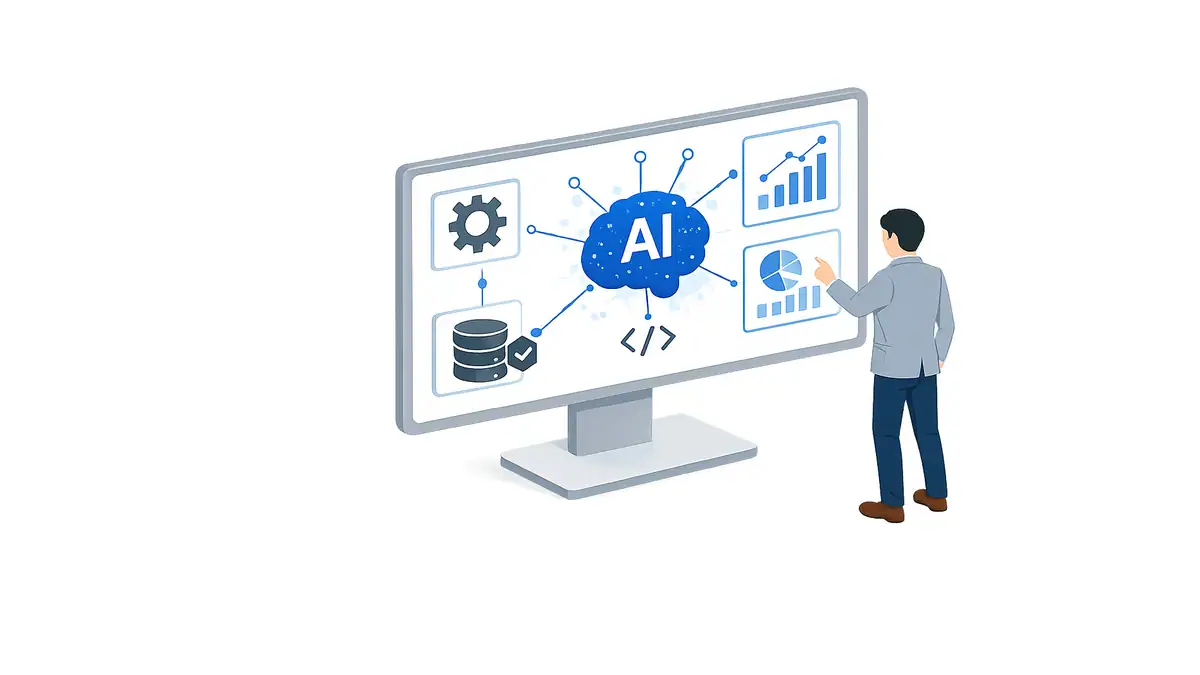
- Generative AI (large language models): technology that excels at generating natural text, summarizing, translating, and answering questions. It can be applied broadly to automating language-based work, such as responding automatically to inquiries, assisting with document creation, and answering questions about internal regulations.
- AI-OCR (character recognition): technology in which AI reads the characters contained in paper documents, PDF files, and images and converts them into data. It handles handwriting and non-standard forms — which were difficult for conventional OCR — far more readily, automating the reading and keying of invoices, delivery notes, and similar documents.
- Machine learning: technology that learns patterns from past data in order to classify, predict, and make determinations. Accumulated operational data can be put to work to identify trends and to support decision-making.
- Chatbots and conversational systems: mechanizms that provide the information a user needs, or respond to inquiries, through dialogue. Combined with generative AI, they can hold far more flexible and natural exchanges.
- Integration with existing systems: rather than letting AI stand alone, we connect it to the core systems, databases, and business applications already in use inside the company, linking the value of AI to day-to-day practice on site.
These technologies are sometimes used individually, and sometimes combined into a single operational system. What matters is not “which technology to use” but “which operational challenge to solve, and how.” At TOMAS TECH we start from the challenge rather than from the technology, and propose the optimal combination on that basis.
Do any of these challenges sound familiar
Custom AI development resolves the various forms of inefficiency and over-reliance on individuals that lurk in everyday operations. If any of the following challenges ring true, there is a strong chance that applying AI could bring significant improvement.
Repetitive inquiries are eating up your time
Many of the inquiries that arrive from inside and outside the company are, in fact, the same content repeated over and over. Checking work rules, asking how to complete an internal procedure, basic questions about products or services — there are plenty of situations in which the person in charge repeats the same explanation again and again. It is common to see staff time consumed by this kind of routine inquiry handling, leaving no capacity for the work they should really be focusing on.
Work depends on one specific person (over-reliance on individuals)
“Only that person understands this job.” “When they take a day off, the work stops.” This kind of over-reliance on individuals is a worry for many companies. It is particularly pronounced in work that involves interpreting internal regulations or making complex judgments, where knowledge accumulates in the head of an experienced staff member and becomes hard for anyone else to take on. There is also the risk that operational know-how is lost when that person transfers or leaves the company.
Working in multiple languages takes too much effort
At Japanese-affiliated companies operating in Thailand, communication routinely takes place in Japanese and Thai, and sometimes in English as well. Every time information passes between Japanese expatriates and local staff, translation is required, and each round of translation costs time and effort. In more than a few situations, the language barrier is affecting the speed and accuracy of the work itself.
You are buried in data entry from paper and PDF files
Documents such as invoices, delivery notes, and purchase and sales orders are still frequently exchanged on paper or as PDF files, which then have to be keyed into a system by hand. This entry work is simple and repetitive, yet the volume is high and mistakes are easy to make. Data entry consumes staff time, and once the effort of checking and correcting is included, the cost is greater than most people imagine.
All of these challenges share a common structure: routine repetitive work, knowledge and know-how locked up in individuals, language barriers, and manual data entry. Custom AI development is an approach designed precisely to solve challenges of this kind.
What we provide and the areas we develop
TOMAS TECH’s AI development builds AI systems across a range of areas, according to your operational challenges. Below is an overview of representative development examples and development areas. In practice, we take these individually or in combination and shape them into the form that best fits your challenge.
Building chatbots
We build chatbots that respond automatically to inquiries from inside and outside the company. Automating responses to frequently asked questions lightens the load on the people in charge, while the person asking receives an answer without having to wait. A distinctive feature of chatbots built on generative AI is that they are not limited to pre-written canned answers; they can respond flexibly by grasping the intent behind the question. The range of applications is wide — internal help desks, first-line customer response, a search window onto in-house knowledge, and more.
Transcription and data-entry automation with AI-OCR
We develop systems that read invoices and other business forms with AI-OCR and automate data-entry work. Among TOMAS TECH’s development examples is an invoice transcription AI system, a mechanizm that reads invoices with AI-OCR and automates the data-entry work. AI reads the contents of documents arriving on paper or as PDF files, extracts the required fields, and converts them into data, dramatically reducing manual keying effort and errors. If the extracted data is then passed to your existing systems, the whole flow from receiving a document to entering it can be streamlined.
AI systems for inquiries about internal regulations and work rules
We build systems in which AI answers employee questions about work rules and internal regulations on the spot. Among TOMAS TECH’s development examples is an HR work-rules inquiry AI system, which provides a mechanizm for AI to answer employee questions immediately. Questions that land on HR and general affairs staff — “How do I apply for annual leave?”, “What allowance applies in this case?” — are answered by AI on the basis of the regulations themselves. The people in charge are freed from repetitive inquiry handling, and employees can get answers whenever they need them. It also has the effect of turning regulatory knowledge, which tends to become locked up in individuals, into something everyone can access.
Automating work with generative AI
We use generative AI to automate and streamline routine language-based work such as document creation, summarizing, translation, and drafting reports. Producing daily and periodic reports, pulling together meeting minutes, composing emails, and translating between Japanese and Thai are all areas in which generative AI excels. Building these in on a made-to-order basis can greatly reduce the “writing, translating, summarizing” burden within everyday operations.
Support for data analysis and utilization
We use AI to put the data accumulated inside your company into a form that is easier to analyze and use. Reading trends out of data that has not been fully exploited until now, and obtaining material for decision-making, helps raise the quality of your operations. Data analysis delivers its value in a far more practical way when it is combined with other AI systems.
Beyond the above, we will advise on and propose the most suitable AI system for your particular operational challenge. We also welcome inquiries at the stage of “could AI do something about this job?” Simply tell us the challenge, and we will work through what form of AI would be effective together with you.
Benefits of implementation
Companies gain a variety of benefits by adopting custom AI development. Here are the benefits that TOMAS TECH places particular emphasis on, together with concrete examples.
Automating routine work
By handing repetitive work such as inquiry handling and data entry to AI, staff can concentrate on higher value-added work. For example, if AI takes on the regulation-related inquiries that HR staff have been fielding, those staff can devote their time to more strategic HR initiatives and to consultations that genuinely require individual attention. If AI-OCR takes over invoice entry, accounting staff can focus on work that requires judgment, such as checking and analyzing the figures. Releasing people from simple tasks and creating an environment in which they can put their energy into work only people can do is one of the great values of adopting AI.
Stabilizing the quality of work
When people handle work, some variation is inevitable. It cannot be avoided that the content and quality of answers differ from one person to another, or that keying errors increase depending on how someone feels or how busy they are. Because AI responds consistently on the basis of defined criteria, it reduces this variation and these errors and stabilizes the quality of the work. When every inquiry receives an answer of the same quality and the accuracy of data entry is maintained, the reliability of your operations as a whole improves.
Made-to-order optimization around your operational challenge
The greatest strength of custom development is the ability to build an AI system in exactly the right form for challenges specific to your company that off-the-shelf systems cannot solve. Because it is built around your form layouts, your operating rules, and the languages your people use, it can be used comfortably on site and leads reliably to results. Rather than forcing a general-purpose tool onto your operations, you fit the AI to the operations — and that shift in thinking is what turns AI from something you “implement and forget” into something you keep using.
Use cases and examples by industry
Custom AI development can be applied broadly, regardless of industry or the nature of the work. Here we outline the kinds of use cases we see, focusing on the industries in which TOMAS TECH works with the greatest number of clients.
Applications in manufacturing
Manufacturing sites generate all kinds of forms and reports every day. Converting information handled on paper or as PDF files — daily reports, work reports, quality records, purchase and sales documents — into data with AI-OCR can greatly reduce the effort of recording and keying. In addition, having AI field inquiries about internal regulations and work procedures gives shop-floor staff immediate access to the information they need. Precisely because we are an IT integrator that knows the factory floor, we can propose AI applications that stay close to the realities of manufacturing work.
Applications in logistics
Logistics companies handle large volumes of slips and transport-related documents. Automating the reading and entry of these documents with AI reduces the administrative burden and enables more accurate data management. Automated inquiry handling and support for multilingual communication are also especially effective in logistics, where cross-border exchanges are frequent.
Applications in retail
In retail, handling customer inquiries and managing product and inventory information are key parts of the business. First-line inquiry handling by chatbot, together with the analysis and use of accumulated data, can improve both operational efficiency and service quality. With AI taking on the routine responses, staff can concentrate on higher value-added work such as serving customers and selling.
Applications at Japanese-affiliated companies in Thailand
Regardless of industry, one challenge shared by Japanese-affiliated companies operating in Thailand is a working environment in which Japanese and Thai are mixed together. With communication with the Japanese head office in Japanese and communication with local staff in Thai, a great deal of effort goes into translation and information sharing. Building an AI system that supports multiple languages makes it possible to run operations smoothly across that language barrier. Proposals grounded in an understanding of the realities faced by Japanese-affiliated companies are one of TOMAS TECH’s strengths.
The value of being based in Thailand
The custom AI development that TOMAS TECH provides in Thailand offers value that is only possible because we are rooted locally. What sets us apart is that we do not simply supply technology; we can support you in a way that reflects the realities of running a Japanese-affiliated business in Thailand.
Support for both Japanese and Thai
At Japanese-affiliated companies in Thailand, Japanese expatriates and local staff work side by side. If an AI system supports only Japanese, or only Thai, it will end up being used by only part of the organization. TOMAS TECH designs on the premise of AI usage that supports both Japanese and Thai. Because the system can be used by Japanese and Thai staff alike, it spreads throughout the workplace and delivers genuine efficiency gains.
Design that anticipates use by local staff
An AI system is not finished the moment it is implemented. The people who actually use it every day are the staff on site. TOMAS TECH places importance on local staff being able to use the system comfortably, and on making it easy to operate and well matched to how the work is really carried out. By delivering it in a form that communicates in people’s own language, the system becomes something that stays in use on site.
Localisation for the work and the culture
Even for the same task, there are aspects of how it is carried out and of commercial practice that differ between Thailand and Japan. Localising the AI to local realities — document formats, ways of communicating, the flow of the work — produces a system that is far better suited to actual practice. Rather than importing the Japanese way of doing things unchanged, you optimize it for the Thai workplace, and that perspective is indispensable to AI that delivers results locally.
The implementation process
TOMAS TECH’s AI development covers everything under one roof, from clarifying the challenge through designing and developing the AI system, implementation, and adoption support afterwards. Here we explain the actual implementation process stage by stage.
Step 1: Requirements interview
First, we ask in detail about your operational challenges and how things are currently run. This is the stage of carefully working through “what work is causing difficulty,” “how the work is carried out at present,” and “what you want to achieve.” This initial interview has an enormous influence on the quality of the proposal and the development that follow. It is entirely fine to be at the stage of “we don’t know what AI can do.” In fact, being consulted from that kind of vague sense of a problem and working through it together is exactly what we do best. Capturing the challenge correctly is the starting point for AI that delivers results.
Step 2: Proposal
For the challenges clarified in the interview, we propose an approach to applying AI, a system configuration, and a budgetary estimate. We set out concretely “which work will be solved, with which AI technology, and how.” At this stage we make the expected effects and a picture of the implementation clear, and align our understanding with yours. We take care to explain even technically difficult content in an accessible way. Once you are satisfied with the proposal, we move on to the development phase.
Step 3: Development
Based on the content of the proposal, we design and develop the AI system. This is the stage of building a dedicated AI system around your actual forms, operational data, and business rules. Because it is made to order, we can meet the fine-grained requirements that general-purpose tools cannot accommodate. During development we check back with you as necessary, pursuing a form that will genuinely work on site.
Step 4: Implementation
We deploy the completed AI system into your environment. Rather than simply delivering the system, we also provide careful hands-on instruction for the people who will use it. However excellent a system may be, it is meaningless if it cannot be used on site. We deliver the explanation in Japanese and in Thai, so that everyone, including local staff, is ready to start using it.
Step 5: Adoption support
After go-live, we continue to support operations and improvements. Once people start actually using the system, new needs emerge: “we would like it to do a bit more of this,” “we would like to extend it to another area of the business.” TOMAS TECH places importance on post-implementation follow-up, supporting adoption on site and continuous improvement. Instead of treating AI as a one-off implementation, we work with you to build something that can be nurtured within your operations and kept delivering value.
Our approach to technology, security, and data handling
An AI system handles all kinds of information relating to your business. That is exactly why technical reliability and a sound attitude towards data handling matter so much. TOMAS TECH selects the appropriate technology for each operational challenge and builds the system in a form suited to the nature of that particular work. We place importance on choosing the means best suited to solving the problem, rather than sticking rigidly to any one technology.
As for data handling, we proceed with a full understanding of its importance, as a partner entrusted with your information. We design while checking carefully with you during development what data will be handled and how. Precisely because an AI system handles business-related information, we place importance on your being able to use it with confidence, and we align on the handling policy in advance. If you have specific security requirements or requests concerning data handling, please tell us at the interview stage. We will propose an appropriate approach based on your situation.
How pricing works
The price of custom AI development varies with the content and scale of the system to be developed and the scope of the operations covered. Unlike a general-purpose packaged product, there is no single fixed price; we prepare an individual quotation according to your challenges and requirements.
“Which operations will be automated, and to what extent?” “Which technologies will be combined?” “How much post-implementation support is included?” Conditions such as these change the content of the development considerably. That is why we first clarify the challenges and requirements through an interview, and then present an appropriate proposal and quotation to match. It is perfectly fine to be at the stage of “we just want a rough figure first.” Please feel free to get in touch.
Frequently asked questions (FAQ)
Q. Can we consult you while we still don’t know what AI can do?
Absolutely. In fact, we welcome inquiries from exactly that stage. Even starting from a vague sense that “could AI do something about this job?”, we will work through it with you in an interview and propose the possibilities for applying AI. There is no need to have concrete requirements settled from the outset.
Q. Which is better, an off-the-shelf AI tool or custom development?
The right choice depends on the nature of the work. For general-purpose uses, an off-the-shelf tool is sometimes sufficient; but where there are challenges that off-the-shelf products cannot fully handle — company-specific forms, business rules, multilingual support — custom development is effective. Through an interview, we will propose the form that is optimal for you.
Q. Can you support both Japanese and Thai?
Yes, we can. TOMAS TECH works primarily with Japanese-affiliated companies in Thailand, and we design on the premise of AI usage that supports both Japanese and Thai. We place importance on building systems in a form that Japanese expatriates and local staff can both use.
Q. Is there support after implementation?
Yes. TOMAS TECH’s AI development does not end at go-live; it includes adoption support, with continuous assistance for operations and improvement after implementation. We work together with you on embedding the system on site and on ongoing operational improvement.
Q. Can you handle any industry?
We work with a wide range of industries, centred on manufacturing and logistics. Drawing on our knowledge as an IT integrator that understands the factory and warehouse floor, we can also make proposals for challenges in other industries, including retail, according to the nature of the work. Please start by telling us your challenge.
Q. How long does development take?
It varies with the content and scale of the system to be developed. The duration changes according to the scope of the operations covered and the technologies to be combined. At the interview and proposal stages we will also set out the anticipated schedule. Get in touch and we will give you a concrete outlook.
Q. How is the price determined?
Because the price varies with the content and scale of the system to be developed and the scope of the operations covered, we prepare an individual quotation. Rather than a fixed price list, we present a proposal and quotation appropriate to your challenges and requirements, so please feel free to contact us first.
Summary and contact
Custom AI development is an approach that solves company-specific operational challenges — the ones off-the-shelf products cannot fully address — with an AI system designed and developed for that work alone. From chatbots, data-entry automation with AI-OCR, and AI for internal regulation inquiries through to generative AI and data analysis, we answer your challenges across a wide range of areas. Automating routine work, stabilizing the quality of your operations, and made-to-order optimization that fits your work exactly: these benefits turn AI from something you “implement and forget” into results you keep achieving on site.
As an IT integrator that knows the factory and warehouse floor, TOMAS TECH faces the operational challenges of Japanese-affiliated companies in Thailand head-on. We support both Japanese and Thai, localise to local realities, and provide end-to-end support from the requirements interview through development, implementation, and adoption. We also welcome inquiries at the stage of “could AI do something about this job?” We will advise and propose according to your operational challenge, so please feel free to contact us first.
Inquiries and consultations are accepted via our contact page. We look forward to hearing from you about AI at whatever stage you are at.