“We keep answering the same question over and over.” “Every time someone asks where the work rules or an internal manual can be found, our own work stops.” “In a workplace where Thai, Japanese and English are all in use, inquiry handling ends up concentrated on a few specific people.” At Japanese-affiliated manufacturing and logistics sites in Thailand, this burden of handling inquiries quietly eats away at the time available for core work. The more people you have, the more questions arrive from inside and outside the company, and many of them are things that have been answered before. As part of our AI development solutions, TOMAS TECH builds AI chatbots that respond automatically to these internal and external inquiries. In this article we explain, from a shop-floor perspective, what an AI chatbot is, how rule-based and generative AI approaches differ, how RAG works when referencing internal documents, multilingual support across Japanese, Thai and English, integration with LINE and internal portals, and how to go about implementation.
What is an AI chatbot: rule-based versus generative AI/RAG
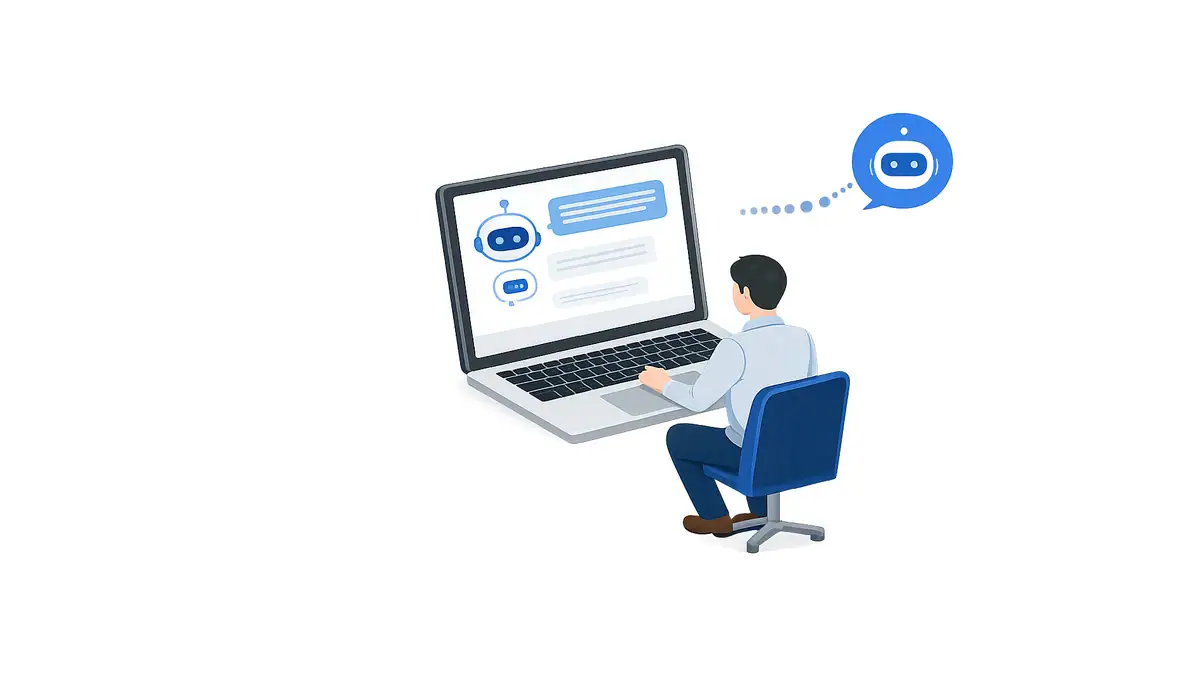
A chatbot is a program that answers questions in a chat format in place of a human. Although we use a single word, chatbots fall broadly into two generations. One is the long-established “rule-based” type; the other is the “generative AI” type, which has moved rapidly into practical use in recent years. The two may look similar on the surface, but the range of questions they can answer and how easy they are to operate are completely different. Understanding this distinction is the first step toward an implementation that does not fail.
Rule-based chatbots
In the rule-based approach, a person registers scenarios one by one in advance: “when this question is asked, answer like this.” Formats where the user clicks through a set of buttons, or where a fixed reply is returned in response to a specific keyword, fall into this category. The mechanizm is simple, and it has the advantage of reliably returning the correct answer to questions that were anticipated. On the other hand, it has weaknesses: if the user phrases the question in a way that was not registered, it replies “I don’t know”; every time the variety of questions grows, someone has to build out more scenarios by hand; and it copes poorly with variations in wording (in Japanese, for example, the several different words used for “paid leave”). It is still effective where the types of inquiries are few and the content is fixed, but it has always had limits when it comes to covering the diverse questions that fly around a real workplace.
Generative AI chatbots
A generative AI chatbot is built on a large language model (LLM). It understands text written by a human and generates a natural-language answer that takes the context into account. Its greatest characteristic is that, unlike the rule-based type, there is no need to register every possible phrasing one by one: even if the wording differs somewhat, it grasps the intent of the question and answers it. Different phrasings such as “How many days of annual leave can I carry over?” and “Tell me the number of paid leave days that can be carried forward” can be handled as the same question with the same intent. Furthermore, by combining it with a mechanizm called RAG (retrieval-augmented generation), described below, it becomes able to answer based on your own internal documents such as work rules, manuals and product materials. The chatbots TOMAS TECH proposes are centred on this generative AI type, designed in a form that genuinely works for your operations.
To sum up the difference in a sentence: the rule-based type “answers reliably, but only the questions that have been registered,” while the generative AI type “answers flexibly, based on your documents, even to phrasings that were never registered.” In practice it is not unusual to combine the two in a hybrid configuration, using rules for the fixed responses where certainty is required and generative AI for the broad range of inquiries.
The real problems behind inquiry handling
To understand the value of a chatbot, you first need to look again at just how much time and energy the work of “handling inquiries” takes from your operations. The following are the issues we hear most often at Japanese-affiliated companies in Thailand.
Growing workload that squeezes out core work
Departments such as general affairs, HR, information systems and customer support receive all kinds of inquiries every day. “When is the cut-off date for expense claims?” “I can’t connect to the VPN.” “What is the lead time for this product?” Each one may take only a few minutes, but together they consume a considerable part of the day. What is more, many of them are things that have been answered many times before. Time that should be devoted to higher-value planning work and improvement activities is instead filled with repetitive inquiry handling. This is a problem shared by many administrative departments.
Dependence on individuals and the black-box effect
“For that matter, you have to ask A or B” is a situation that arises in many workplaces. The knowledge exists only in the head of a veteran member of staff, and the moment that person takes leave, transfers or resigns, the response grinds to a halt. When inquiry handling is concentrated on one particular person, not only does that person’s workload become excessive, but the organization’s knowledge is never handed on, and the quality of answers varies from person to person. Dependence on individuals advances quietly, as a risk that is hard to see.
The difficulty of multilingual support
At Japanese-affiliated companies in Thailand, Japanese expatriates, Thai staff and business partners who communicate in English all share the same workplace. The same internal regulations have to be explained in Japanese, in Thai and sometimes in English. A Japanese manager tries to answer a Thai staff member’s question and runs into the language barrier; conversely, a Thai staff member cannot read a Japanese manual all the way through. Such scenes are everyday occurrences. The effort of translating and explaining is added directly on top of the inquiry-handling workload.
Round-the-clock operations and time differences
Manufacturing and logistics sites often run on day and night shifts. Questions that arise after the administrative departments have gone home, or on holidays, are carried over to the next business day. When dealing with head office in Japan, time differences come into play as well. Something you want to know right now does not get an answer on the spot, and this time lag accumulates as a small but constant source of stress on the floor.
What all of these issues have in common is that the answer exists somewhere, but the people who need it cannot retrieve it when they need it. An AI chatbot is precisely a tool for shortening this “distance between knowledge and people.”
Main applications of AI chatbots
AI chatbots can be applied in a wide range of situations, both internally and externally. At TOMAS TECH, after hearing about your operational issues, we recommend starting small in the areas where results come most easily. Here we introduce some representative applications.
Internal help desk (information systems)
The chatbot provides first-line handling for the routine inquiries that tend to concentrate on the information systems department, such as “I want to reset my password,” “The printer isn’t working,” or “I need the software installation procedure.” Based on procedure manuals and FAQs, it presents a solution on the spot. By passing the matter to a staff member only when it is not resolved, the burden on the IT team can be greatly reduced.
HR and general affairs inquiries
Work rules, leave systems, expense claims, social insurance, various application procedures: HR and general affairs receive all sorts of questions from employees on a daily basis. The answers to most of them are written in the work rules, internal regulations and operational manuals. When a chatbot answers by referring to these documents, employees can resolve their questions at a time that suits them, and HR and general affairs are freed from repeatedly answering the same question. TOMAS TECH’s development track record includes an “HR work rules inquiry AI system,” in which we built a mechanizm that lets AI answer employees’ questions about work rules and internal regulations immediately.
Customer support and business partner handling
This is a chatbot that provides first-line handling for inquiries from customers and business partners about product specifications, lead times, usage, what to do when something goes wrong, and so on. Placed on a LINE official account or on your website, it means customers are not kept waiting even outside business hours. The chatbot resolves frequently asked questions and only the complicated cases are handed over to a staff member, allowing you to achieve both support quality and speed of response.
Automating FAQs
The FAQs published on a website or internal portal tend to become harder to search the more they grow. People give up before reaching the item they are looking for and end up inquiring by phone or email after all, which defeats the purpose. With a chatbot, users simply ask in natural language and are presented with the relevant answer. You can evolve a static FAQ page into an interactive point of contact where asking a question brings back an answer.
Internal knowledge search
Meeting minutes, operating procedures, records of past troubleshooting, product materials: an enormous amount of knowledge accumulates inside a company, but it is scattered across multiple folders and systems, and finding it when you need it is far from easy. If you make a chatbot the search window for internal knowledge, it can answer questions such as “How was that product’s past defect handled?” on the basis of the documents you have accumulated. Putting the organization’s knowledge into a form that anyone can draw on is the aim of the knowledge search application.
How it works: generative AI plus internal document RAG returns “your company’s answer”
Here we explain the core mechanizm of the AI chatbots that TOMAS TECH proposes. There are three keywords: “RAG (retrieval-augmented generation),” “measures against hallucination” and “escalation to a human.”
What is RAG (retrieval-augmented generation)?
Generative AI in itself has a wealth of general knowledge, but it does not know what is written in your work rules or product manuals. That is where RAG (Retrieval-Augmented Generation) comes in. When RAG receives a question from a user, it first searches your internal documents for the relevant passages, passes that content to the AI, and then has the answer generated. In other words, the AI does not answer from its own memory alone; it answers “on the basis of your company’s documents.”
Following the flow a little more concretely, it works as follows. First, internal documents such as work rules, manuals and FAQs are divided in advance into appropriate units, their meaning is converted into numbers (vectorised), and they are registered in a search database. When a user asks a question, fragments of documents that are semantically close to that question are searched for and extracted. The extracted document content is passed to the generative AI together with the question, with the instruction “answer based on this material.” The generative AI then assembles an answer in natural language, grounded in the documents it was given. This mechanizm lets you turn a general-purpose generative AI into a dedicated adviser that knows your company’s circumstances.
Measures against hallucination
Generative AI has a characteristic known as “hallucination,” where it generates content that sounds plausible but differs from the facts. As long as it is used for business, addressing this point is essential. RAG is itself a pillar of the countermeasures against hallucination. Rather than letting the AI answer freely, having it answer tied to the “grounds” of your documents makes it less likely that answers will stray from the facts.
In practice, we layer on several further refinements. The name of the document, and the page or clause, that formed the basis of the answer is presented together with the answer, so that users can check the original source. If no relevant information is found in the internal documents, the system is designed to answer honestly, “No relevant information was found,” rather than forcing an answer. The tone of the answers and the scope of what may be answered are specified in advance. Through this accumulation of measures, we raise the reliability of the AI’s answers. That said, in general it is not possible to guarantee that AI answers are 100% accurate. That is exactly why escalation to a human, described next, is important.
Escalation to a human
A chatbot is not all-powerful. There will always be inquiries that a person should handle: matters requiring judgment, exceptional cases, and complaints. We therefore build in a mechanizm for “escalation to a human” that hands the matter over smoothly to a staff member when the chatbot cannot fully answer or when the user is not satisfied. By providing a “connect me to a person” button, or a design in which a staff member is notified when certain conditions are met, AI and people can share the work of responding. AI takes on first-line handling and routine processing, while people concentrate on the responses that truly require a human. This is what sustainable operation looks like.
Multilingual support: spanning Japanese, Thai and English
For Japanese-affiliated companies in Thailand, multilingual support is one of the major motivations for introducing a chatbot. Generative AI chatbots are good at handling multiple languages, and in this respect they have a significant advantage over the rule-based type.
For example, even if the internal documents are written in Japanese, when a Thai staff member asks a question in Thai, the system can grasp the intent and answer in Thai while grounding the answer in the Japanese documents. Japanese expatriates in Japanese, Thai staff in Thai, business partners in English: each can query the same chatbot in their own language and access the same internal knowledge. A situation in which information was fragmented by language barriers can be consolidated into a single point of contact.
As an IT integrator rooted in Thailand, TOMAS TECH’s strength lies in a structure that can support the shop floor in both Japanese and Thai. When designing and verifying a chatbot, we work with local staff to confirm that the responses in Thai are natural and phrased in a way that genuinely gets through on the floor. Rather than a mechanical approach that simply runs text through a translation tool, we aim for multilingual support that reflects the expressions actually used on site and the realities of the work. We believe this is value that only we can provide, as a company that knows factory and logistics operations and has a base in the country.
Integration with existing systems
A chatbot is used far more if it is blended into the tools that employees and customers already use every day, rather than used on its own. Anything that requires you to deliberately open a dedicated screen ends up not being used. At TOMAS TECH, we propose ways to embed the chatbot naturally into the environment you currently use.
LINE official account
Thailand is a country where LINE is deeply embedded in daily life. Building a chatbot into a LINE official account, as a point of contact for external customer support or for internal guidance aimed at Thai staff, is therefore a highly compatible option. Users can make inquiries from the familiar LINE chat screen, with the operation they are used to. Because there is no need to have them learn a new app, adoption after go-live is smooth.
Internal portals and websites
If you place a chatbot window on your internal portal site or your own website, employees and visitors can ask questions on the spot without moving to another tool. By linking it with the various FAQs and procedure manuals on the portal, you can shift from “searching” to “asking.”
Business tools such as Teams and email
If you embed the chatbot in a communication tool used daily within the company, such as Microsoft Teams, employees can resolve internal questions with the same feeling as sending a chat message. A configuration linked with inquiry reception by email is also conceivable. After hearing about your business processes and the tools you use, we propose an integration method that can be adopted without strain. Note that exactly which systems can be integrated, and to what extent, depends on your environment and on the specifications of each service, so we will work through the requirements together and map out what is feasible.
The benefits of implementation
What kind of change does introducing an AI chatbot bring to the workplace? Here we set out the main benefits as TOMAS TECH sees them.
Reducing the workload of inquiry handling
By having the chatbot take on the routine inquiries that come in repeatedly, you can reduce the number of cases that staff handle directly. Staff in administrative departments such as HR, general affairs and information systems can redirect the time that was taken up by inquiry handling to the planning and improvement work they should be focusing on. Being freed from the drain of “explaining the same thing over and over” is itself of great value to the workplace.
Stabilizing the quality of responses
When people respond, the way they answer differs from person to person, and explanations can become sloppy depending on how busy the day is. A chatbot returns a consistent answer at any time, based on the same grounds: your documents. By encoding knowledge that had depended on individuals into a system, you can move closer to a state where “whoever you ask and whenever you ask, you get an answer of the same quality.” It also brings the reassurance that first-line handling does not stop when a staff member is suddenly absent or transferred.
Higher user satisfaction
For the person asking, nothing is more valuable than getting an answer immediately when they want to ask. Outside business hours, or when the responsible person is tied up with something else, a chatbot responds on the spot. For employees it creates an environment where they can ask small questions without hesitation; for customers it creates an experience of not being kept waiting. This accumulation of small things leads to higher employee and customer satisfaction.
Accumulating and visualizing knowledge
As you operate a chatbot, you begin to see which questions come up most often, which documents are referenced most, and which questions it cannot fully answer. This is valuable data showing where the information gaps inside your organization lie. If you identify topics that are frequently asked about but poorly documented, that becomes the trigger to strengthen the manuals. A chatbot is not merely an answering device; it also becomes a starting point for continuously refining the organization’s knowledge.
The implementation process: from requirements definition to operational improvement
As an AI development solution, TOMAS TECH supports you end to end, from organizing the issues through system design and development to rollout and adoption. The general flow of a chatbot implementation is as follows. We adapt it flexibly to your situation.
- Requirements definition and interviews: First, we ask carefully which department’s inquiries and which types of inquiry are in scope, how they are handled today, which languages you want to use, and which tools you want to integrate with. We welcome consultations that start from “I don’t know what AI can do.” Together, we identify the areas where results come easily and where it is easy to start.
- Preparing the data: The quality of a chatbot’s answers depends heavily on the quality of the internal documents it references. We identify the documents in scope, such as work rules, manuals and FAQs, and put them into a form that AI can reference easily. Document issues such as outdated content or duplicated descriptions are also sorted out at this stage. This is the crucial step that determines whether the implementation succeeds.
- Building: Based on the prepared documents, we design and develop a chatbot that combines generative AI with RAG. We work out the concrete details, including the scope of answers, the tone, how the supporting sources are shown, the conditions for escalation to a human, and the tools to integrate with.
- Verification: We put the questions that are actually expected to the chatbot and check whether the answers come back as intended. With the help of local staff, we carefully check questions it cannot answer, answers that could be misleading, and the naturalness of the wording in each language, and we make repeated adjustments. Rather than rolling out company-wide from the start, it is also effective to run a trial within a limited scope and then expand.
- Operation and improvement: Implementation is not the end. Looking at actual usage data, we improve continuously: adding responses to questions that could not be answered, updating documents, and polishing the wording of answers. By nurturing it through operation, the chatbot becomes an increasingly dependable presence.
Security and data handling
When introducing a chatbot that references internal documents, security and data handling are what many customers are concerned about. Information such as work rules, internal manuals and records of customer interactions are important assets that must not leak outside the company. At TOMAS TECH, we propose system configurations on the premise that your information is handled securely.
Specifically, depending on the requirements, we consider aspects such as access management covering who can use the chatbot, separation of the scope of documents it is allowed to reference, and permission design that distinguishes what information may be shown to which users or departments. We also work through how the generative AI is used, whether an external cloud service is used, and under what data protection arrangements it is operated, in line with your security policy. The sensitivity of the information involved and internal rules differ from customer to customer, so we place importance on confirming together what will be handled and to what extent, and on designing a form you can use with confidence.
Frequently asked questions (FAQ)
Q. We are not familiar with AI. Can we still consult you?
A. Of course. We welcome consultations that begin at the stage of “we don’t know what AI can do” or “could AI do something about this task?” TOMAS TECH first listens carefully to your operational issues and then proposes a form in which AI genuinely delivers results. Rather than lining up technical jargon, we explain things clearly from a shop-floor perspective, so please feel at ease.
Q. How is this different from an off-the-shelf chatbot product?
A. TOMAS TECH’s chatbots are made to order, designed around your operational issues. We build them to fit your own documents, business processes, language environment and integration requirements, which off-the-shelf products cannot fully accommodate. As an IT integrator that knows factory and logistics operations, we aim to create something that is actually used on the floor, and that is the major difference from a general-purpose product.
Q. Can it support Thai as well?
A. Yes. Generative AI chatbots are good at handling multiple languages, and operation spanning Japanese, Thai and English is possible. It is also possible to ask a question in Thai and receive an answer in Thai based on internal documents written in Japanese. At the design and verification stage, we work with local staff to confirm that the Thai responses are natural and get through on the floor.
Q. Is there a risk that the AI gives a wrong answer?
A. In general, it is not possible to guarantee that generative AI answers are always 100% accurate. That is precisely why we combine the RAG mechanizm that makes it answer on the basis of your documents, the practice of presenting the supporting sources, a design that does not force an answer when none can be found, and escalation to a human, so as to build something you can use with confidence in practice. Continuously improving accuracy while the system is in operation is also important.
Q. What documents do we need to prepare?
A. You provide the documents you want the chatbot to reference, such as work rules, internal regulations, operational manuals, FAQs and product materials. To begin with, the documents you already have are fine as they are. During the interview and data preparation stages, we confirm together which documents will be in scope and where tidying up is needed. You can get started even if things are not perfectly in order, so please feel at ease.
Q. Can it integrate with our internal systems and with LINE?
A. We propose an implementation that fits the environment you currently use, including LINE official accounts, internal portals, websites, Microsoft Teams and email. However, exactly how far integration can go depends on the specifications of each service and on your environment. After hearing your requirements, we will map out and explain what is feasible.
Q. Can we start small?
A. Yes. Rather than extending it to the whole company and all operations at once, we recommend starting small with a specific department or specific task where results come easily, then expanding step by step as you confirm the results. By running a trial within a limited scope and making improvements before rolling out, you can keep risk down while steadily embedding the system.
Q. Is there support after implementation?
A. TOMAS TECH does not stop at implementation. Looking at how the system is actually used, we provide continuous support: adding responses to questions that could not be answered, updating documents, and improving the wording of answers. By nurturing the chatbot through operation, we help it grow into an ever more dependable point of contact.
Summary and contact
Handling inquiries from inside and outside the company may be a small matter case by case, but it becomes a heavy burden on the workplace when it accumulates. Issues such as dependence on individuals, multiple languages and round-the-clock coverage are especially pronounced at Japanese-affiliated companies in Thailand. An AI chatbot that combines generative AI with internal document RAG is a powerful means of shortening this “distance between knowledge and people” and freeing the workplace from repetitive inquiries. Flexible responses that rule-based systems could never reach, multilingual support spanning Japanese, Thai and English, integration with LINE and internal portals, and a practical design equipped with measures against hallucination and escalation to a human: we build all of this to order, tailored to your operational issues.
As an IT integrator that knows manufacturing and logistics sites in Thailand, TOMAS TECH supports you end to end, from organizing the issues through design and development to rollout and adoption. “We want to stop answering the same inquiry over and over.” “We need to do something about multilingual inquiry handling.” “We’d like to discuss whether AI could help with something.” We welcome consultations at any stage. Please feel free to get in touch first. Together, we will work out an AI chatbot that genuinely delivers for your operations.
Contact us here: https://tomastc.com/en/contact/