


The moment the power came back on, the monitoring screen showed nothing. That is what happened at a Japanese-owned factory in an industrial park in northern Vietnam. The “overseas equipment monitoring” design that Japanese manufacturers have refined for their Thailand plants breaks down in at least three places once you bring it into Vietnam unchanged. This article focuses on the one that hits your investment decision hardest — power — and shows, in numbers, how you should design the cost structure around it.
What Is Vietnam Equipment Monitoring — And Why the Thailand Playbook Breaks Down
Vietnam equipment monitoring means collecting sensor data — current draw, PLC signals, vibration — from production equipment to track uptime, downtime, and abnormal conditions, so you can pin down what caused a stoppage. Teams that have designed and rolled out this kind of system for Japanese factories in Thailand have already built a cross-site framework for how a head office coordinates monitoring across multiple countries and multiple plants. We cover that framework itself in Overseas Plant IoT Remote Monitoring — read that first if you want the design thinking behind managing several countries and sites at once.
The problem shows up when you take that Thailand-tuned design and drop it into Vietnam unchanged. At least three assumptions break. First, unstable power means every blackout wipes out the monitoring log itself, and the work of pinning down what caused a stoppage falls back to a manual process. Second, the data localization rules (Decree 356/2025/ND-CP, in effect from January 1, 2026) set different requirements from Thailand’s Personal Data Protection Act (PDPA), so you have to re-decide where your cloud infrastructure lives. Third, the license-exempt radio equipment rules (Circular 08/2021/TT-BTTTT) are a completely separate regime from Thailand’s NBTC rules, so the wireless gateway you use in Thailand cannot simply be carried over.
This article centers on the first point. It uses a model factory’s numbers to show how much your payback period changes depending on whether you include the power-backup layer in the monitoring system’s own cost structure. We touch only briefly on the second and third points and point you to existing articles for the details.
Why do these three blind spots get missed so often? Teams with deep design experience in Thailand tend to file points one through three under separate ownership — power, regulation, wireless — as if they were unrelated. In practice, the first one bites first. While you are still working out where your data should live or whether your radio equipment is compliant, the plant keeps running, and every blackout adds another gap to your monitoring log. Regulatory work can be scheduled and planned for in advance; unstable power affects the shop floor from day one of operation. That time-sensitivity is why this article puts the power-backup layer at the center.
Where It Breaks #1 — What Happens to Monitoring Logs When Power Is Unstable
Our model factory is a Japanese-owned plant in an industrial park in northern Vietnam, with 30 pieces of target equipment (every figure below is an assumption specific to this model factory). We assume unplanned stoppages caused by unstable power run 20 incidents a month across the whole plant, or 240 a year. The opportunity-cost value of one hour of downtime is 1,850,000 VND — also an assumption.
In a region with unstable power, the issue isn’t only that “equipment stops when the power goes out.” The monitoring system itself runs on electricity, so when a blackout hits, the monitoring node goes down along with everything else, and the record stops too.

Line up the monitoring log from before and after an outage, and from the instant power drops until it’s restored, the data is simply blank. Where this repeats, half the point of installing monitoring in the first place is lost.
The moment power returns, the first thing the shop floor wants to know is which line stopped, when, for how many minutes, and whether the cause was the outage itself or a separate fault triggered by the power instability. With a gap in the log, that triage falls back on memory and handwritten notes, and a judgment call that would normally take a few minutes stretches into tens of minutes. This variable — how many minutes faster you can triage the cause — turns out to be the single biggest factor driving the payback calculation later in this article.
The cost of electricity itself, and demand-monitoring design, are not the subject of this article. JETRO and JEPIC data cite Vietnam Electricity’s (EVN) industrial tariff, after the May 2025 revision, as ranging from 1,146 to 3,640 VND/kWh, but we leave the tariff calculation and metering-point design to Factory Power Monitoring System.
For context, Vietnam’s manufacturing sector is in an expansion phase. The Vietnam Manufacturing PMI published by S&P Global / Trading Economics came in at 52.9 in July 2026, up from 51.8 in June. At the same time, JETRO and vietbiz.jp report that Vietnam’s Ministry of Industry and Trade has flagged a risk of power supply shortfalls from 2026 through 2030 (attributed to delays in large-scale power generation projects, though the primary sources don’t specify concrete targets). Expanding production and an ongoing power risk are coexisting at the same time — that’s the situation facing plants in northern Vietnam.
The PMI figure, the electricity tariff range, and the power shortfall risk are all general background information whose underlying assumptions aren’t published, and we have not combined them with this article’s VND-denominated model figures (the five cost layers, Scenarios A/B, and the sensitivity analysis). Read them only as context — an expanding production base coexisting with an ongoing power risk.
Where It Breaks #2 — Where Should Your Data Live (Decree 356 and Equipment Data)
In Thailand, the decision of where to keep monitoring data is built around Thailand’s Personal Data Protection Act (PDPA). That assumption doesn’t carry over to Vietnam. Decree 356/2025/ND-CP, the implementing decree for Vietnam’s personal data protection law, was enacted on December 31, 2025 and took effect January 1, 2026.
According to EY Vietnam and Vietnam Briefing, this decree defines cross-border transfer broadly — covering sending personal data collected or stored in Vietnam to an overseas server, transmitting it to an overseas cloud service, and continuing its processing on an overseas platform. At the same time, exemptions are described for cross-border transfers related to labor management and for cross-border transfers necessary to perform a contract, such as logistics, payment, and hotel booking.
Here’s the point worth noting: Decree 356 targets personal data, not equipment uptime logs or vibration data by themselves. That said, if your monitoring system’s design links an alarm’s first responder name or worker ID to the log, Decree 356’s requirements can spill over into the decision of where that database lives. Teams that set their cloud location based on Thailand’s PDPA are prone to missing this spillover when they reuse the same design in Vietnam.
The detailed scope of this decree, how to read its provisions, and how it plays out in system-development contracting are not this article’s subject. Vietnam System Development covers the practical side of the personal data protection law, so when you get to the stage of designing exactly where your data will live, check that article and consult a specialist as needed. Here, we only establish the connection point — that this can affect the decision of where equipment operational data lives.
As a practical starting point, it helps to split your monitoring system’s data design into two tracks from the outset — one for equipment data only, and one for anything that could identify an individual. The sensor readings and alarm history you use to triage a stoppage belong to the first track, but the moment you link a responder’s name or worker ID to that record, it takes on the character of the second. Plants that didn’t clearly separate these two tracks under Thailand’s PDPA tend to spend more time working out where things should live in Vietnam. Settling this split early in rollout avoids having to redesign it later.
Where It Breaks #3 — Can You Reuse the Same Radio Equipment (Circular 08/2021 in Brief)
In Thailand, a wireless gateway falls under the rules of the NBTC (National Broadcasting and Telecommunications Commission). Vietnam runs an entirely separate regulatory regime. Radio equipment certified for your Thailand site cannot simply be carried into a Vietnam plant and used as-is.
The list of license-exempt radio equipment, previously governed by Circular 46/2016/TT-BTTTT (and 18/2018/TT-BTTTT), has since been replaced by Circular 08/2021/TT-BTTTT (effective November 28, 2021). This update is the same change we mention, in the RFID context, in Traceability Barcode, QR, and RFID Selection, which covers the technical detail of radio frequencies. We don’t cover frequency bands or output power (W) in this article, so check that article for the specifics.
According to an explainer from Nemko, a certification body, equipment that met the old standard can reportedly continue to be used as long as it doesn’t cause harmful interference to other certified radio equipment. That said, this article has not carried out a primary check of the regulation’s article numbers against the official gazette or MIC publications. Before assuming that a wireless gateway selected under Thailand’s rules can simply be reused in Vietnam, we recommend confirming this point individually with a specialist or vendor.
In practice, the first step is confirming with your vendor whether the specific model of wireless gateway you plan to use locally is covered by a conformity declaration or certification in Vietnam. Holding NBTC certification in Thailand has no bearing on whether the equipment can be used in Vietnam. If you’re planning to reuse the same equipment model across borders, building this check into the early stage of selection avoids finding out, after the equipment has already arrived on site, that it can’t be used.
Breaking Down the Cost Into Five Layers — Should You Include the Power-Backup Layer

From here, we turn to cost. The figures below assume the same model factory (30 units of target equipment), and every amount is in VND. Breaking down the monitoring system’s rollout cost into five layers, assuming an unstable power environment, gives you this:
| Layer | Contents | Amount (VND) | Share |
|---|---|---|---|
| Layer 1 | Sensors and signal sources (current, vibration, PLC signal taps, for 30 units) | 90,000,000 | 30.0% |
| Layer 2 | Communications and gateway (Circular 08/2021-compliant radio equipment and wiring) | 45,000,000 | 15.0% |
| Layer 3 | Collection infrastructure (server and data-location design) | 60,000,000 | 20.0% |
| Layer 4 | Dashboard and downtime-cause triage rule design | 54,000,000 | 18.0% |
| Layer 5 | Power-backup layer (UPS for monitoring nodes, blackout-operation training) | 51,000,000 | 17.0% |
| Total | 300,000,000 | 100% |
Layers 1 through 4 are almost identical to the design already established in Thailand. You attach sensors to equipment, gather the data over a communications link, collect it on a server, make it visible on a dashboard, and build rules for triaging the cause of a stoppage. Up to this point, you can reuse the Thailand design as-is.
The difference shows up in Layer 5. The UPS (uninterruptible power supply) for the monitoring nodes, combined with training on how to operate during a blackout, comes to 51,000,000 VND, a 17.0% share of the total. The concept of power protection exists in Thailand too, but because the power supply’s stability is so different, in Vietnam this layer isn’t really a matter of “whether to include it” — skipping it isn’t a realistic option.
Looked at purely as a line item on a quote, whether to include Layer 5 can look like a minor decision. But whether this layer exists is what decides whether your monitoring log goes blank every time the power goes out. The next section compares how this 17.0% difference translates into payback.
Separately from the monitoring node’s own power supply, this article doesn’t cover the plant’s overall electricity cost — the per-kWh tariff or demand-monitoring design. On the labor side, worth noting as background: the minimum wage in Region 1 (Hanoi, Ho Chi Minh City, and surrounding urban areas) rose by roughly 7.2% from January 1, 2026, to 5,310,000 VND a month. That’s worth knowing as an established fact, but it does not factor into this article’s payback calculation — labor-cost savings on monitoring staff alone would not pay back an investment of this scale.
Comparing Payback — Scenario A (With the Power-Backup Layer) vs Scenario B (Without)
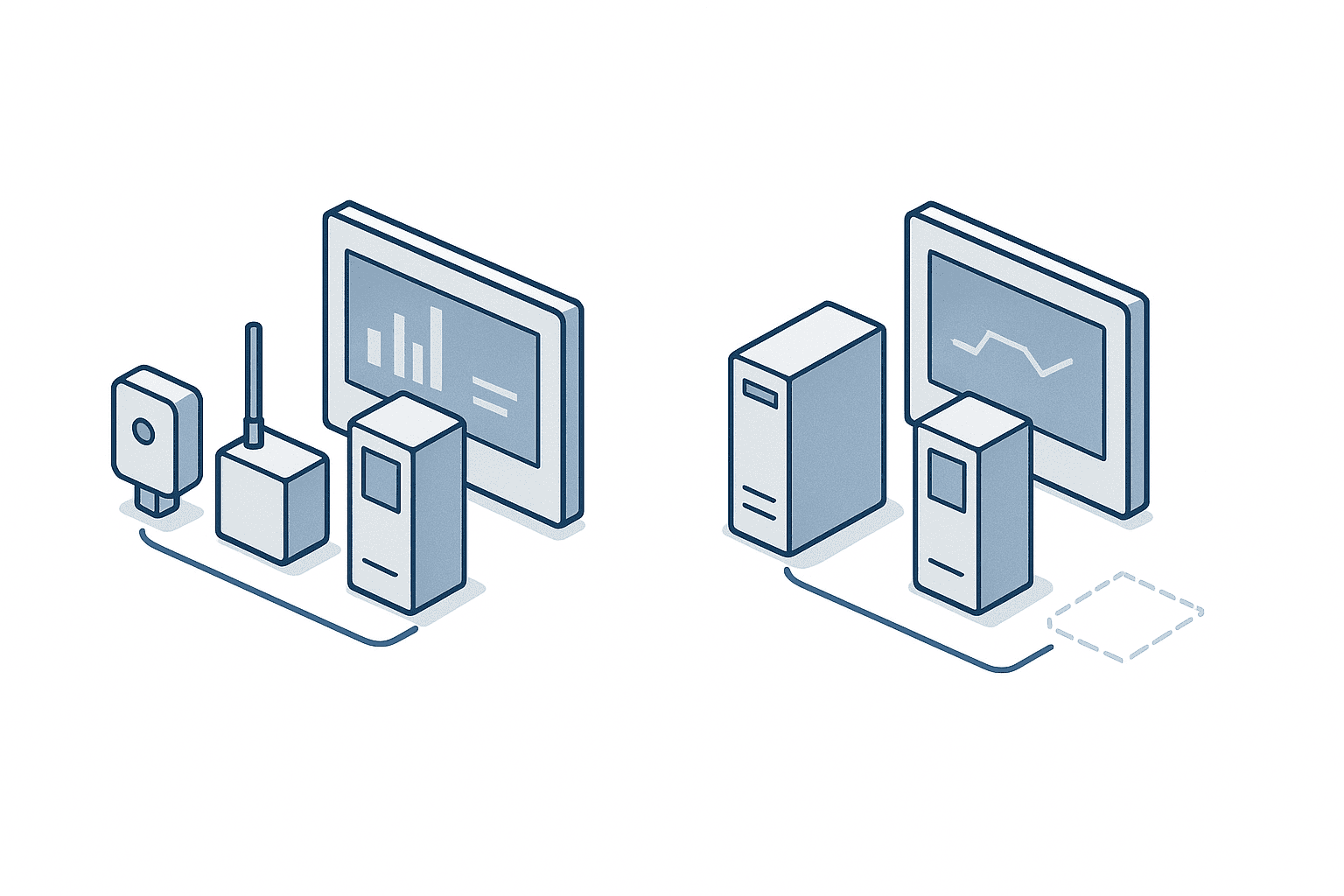
We compare Scenario A (including the power-backup layer, investment of 300,000,000 VND) against Scenario B (skipping it, investment of 249,000,000 VND). Layers 1 through 4 are the same in both; Scenario B simply zeroes out Layer 5. The investment gap is only 17.0% less for B than for A.
Scenario A — Including the Power-Backup Layer
There are two effects.
A1 is the reduction in wasted maintenance dispatches caused by false triage. Currently, the plant sees 8 wasted dispatches a month; we assume the power-backup layer’s continuous logging brings that down to 2 a month. That’s a reduction of 6 a month, or 72 a year. At a per-dispatch cost of 850,000 VND, 72 × 850,000 VND works out to about 61,200,000 VND a year.
A2 is the effect of shortening downtime. As a baseline, we assume a 27-minute reduction per incident. 240 incidents a year × 27 minutes ÷ 60 minutes × 1,850,000 VND comes to about 199,800,000 VND a year.
Combined effect: 261,000,000 VND a year. Annual operating cost is 24,000,000 VND (8% of the investment). Net annual benefit is 237,000,000 VND, giving a payback period of 1.27 years — roughly 15.2 months.
Scenario B — Skipping the Power-Backup Layer
Total cost is 249,000,000 VND. Layers 1 through 4 are the same amount as in Scenario A; Layer 5 is zero.
B1 assumes only 20% of A1’s effect is realized. The noise generated at the instant power is restored after an outage actually increases false alarms. That works out to about 12,240,000 VND a year.
B2 assumes only 30% of A2’s effect is realized, since the record gap during the outage means the cause still has to be triaged manually. That works out to about 59,940,000 VND a year.
Combined effect: 72,180,000 VND a year. Annual operating cost is 14,940,000 VND (6% of the investment) — a lower figure than Scenario A. But that lower cost is the flip side of not maintaining a battery; it’s savings you get in exchange for a gap in your record. Net annual benefit is 57,240,000 VND, giving a payback period of 4.35 years — roughly 52.2 months.
The Heart of the Comparison
| Item | Scenario A | Scenario B |
|---|---|---|
| Investment (VND) | 300,000,000 | 249,000,000 |
| Annual effect (VND) | 261,000,000 | 72,180,000 |
| Annual operating cost (VND) | 24,000,000 | 14,940,000 |
| Net annual benefit (VND) | 237,000,000 | 57,240,000 |
| Payback (years) | 1.27 | 4.35 |
| Payback (months) | about 15.2 | about 52.2 |
Scenario B’s investment is only 17.0% less than Scenario A’s. Yet the payback period stretches from 1.27 years to 4.35 years — about 3.4 times longer.
The gap widens further over five years. As a simple cumulative total that does not account for a discount rate, Scenario A’s five-year net benefit is 237,000,000 VND × 5 years minus the 300,000,000 VND investment, or 885,000,000 VND. Scenario B’s is 57,240,000 VND × 5 years minus 249,000,000 VND, or 37,200,000 VND.
“Start cheap by skipping the power-backup layer” is not the cheapest choice — it’s the most expensive one. When the monitoring system itself goes down during an outage, the very information you want most after power returns — when it stopped, and for how many minutes — never gets recorded.
Sensitivity Analysis — What Actually Moves the Payback Period
We check what happens to the conclusion when we vary the assumption behind A2 in Scenario A — a 27-minute reduction per incident as the baseline. A1 (61,200,000 VND) stays fixed; only A2 moves. The investment of 300,000,000 VND and the annual operating cost of 24,000,000 VND are also the same across all four rows below.
| Reduction per incident | A2 (VND) | Combined effect (VND) | Payback (years) |
|---|---|---|---|
| 15 minutes | 111,000,000 | 172,200,000 | 2.02 |
| 20 minutes | 148,000,000 | 209,200,000 | 1.62 |
| 27 minutes (baseline) | 199,800,000 | 261,000,000 | 1.27 |
| 35 minutes | 259,000,000 | 320,200,000 | 1.01 |
Two things stand out.
First, the investment pays back even under a more pessimistic assumption than the baseline. Even at the smallest reduction, 15 minutes, payback is 2.02 years. The case for including the power-backup layer doesn’t fall apart even under fairly pessimistic assumptions.
Second — and this is the main point — what moves in this table isn’t the monitoring hardware’s performance or the sensors’ precision. What moves is a single variable: how quickly and confidently you can triage the cause of a stoppage. And what determines that speed is whether the record stays continuous through a blackout — in other words, whether the power-backup layer is there.
Put differently, what drives the payback period isn’t Layer 1’s sensor precision — it’s Layer 5’s continuity of record. Swapping in higher-precision sensors doesn’t shorten triage time, so it doesn’t improve payback; it only adds to the investment, making things worse if anything. The power-backup layer, on the other hand, prevents gaps in the record, steadily shortens triage time, and brings the payback period toward that 1.27-year mark.
A 90-Day Roadmap to Rollout
This is a rough timeline for rolling out the system with Layer 5 built in from the start, assuming the same model factory (30 units of target equipment).
| Period | Phase | Key activities |
|---|---|---|
| Day 1-30 | Assessment and design | Select the 30 target units, inventory existing stoppage records, decide whether to include the power-backup layer, review data location in light of Decree 356 |
| Day 31-60 | Procurement and installation | Procure sensors and communications equipment (including a Circular 08/2021 conformity check for radio equipment), install UPS for the monitoring nodes, build the collection infrastructure |
| Day 61-90 | Go-live and adoption | Train the shop floor on stoppage-cause triage rules, run blackout-response drills, tune the dashboard, record the first month of logs as a baseline |
The single most important thing in Day 1-30 is not deferring the decision on whether to include the power-backup layer. If you push that decision aside and order Layers 1 through 4 first, adding Layer 5 later usually means work that requires stopping a running line, driving up both cost and effort. During the Day 61-90 operational drills, include an actual power-down-and-restore drill so the shop floor knows how to respond without hesitation when a real outage hits.
This roadmap is only a guide and will shift depending on the number of target units and how well-organized your existing stoppage records already are. Plants where the “inventory of existing stoppage records” in Day 1-30 takes longer tend to see the whole schedule slip afterward. If stoppage records only exist as paper daily logs, this inventory step can easily take longer than expected. Rather than fixating on the 90-day figure itself, it’s more useful, from a progress-management standpoint, to define clear deliverables for each phase — a selection list, minutes from the investment decision, an installation completion report, and training records.
Frequently Asked Questions
Can Vietnam Equipment Monitoring Reuse the Same Design as Thailand?
Not as-is. The sensor and dashboard design itself can be carried over from the Thailand playbook, but three assumptions differ from Thailand — power stability, data localization rules (Decree 356/2025/ND-CP), and radio equipment regulation (Circular 08/2021/TT-BTTTT). This article focuses mainly on how unstable power affects your monitoring logs.
What Should You Check for Blackout Protection When Rolling Out Factory IoT in Vietnam?
The power supply for the monitoring node itself — the UPS (uninterruptible power supply) and your operating rules for a blackout. It’s not enough to protect against equipment stopping; you also need protection against the monitoring system itself losing power and creating a gap in the record. In our model calculation, this power-backup layer accounts for 17.0% of the investment, or 51,000,000 VND.
Do Radio Equipment Regulations Matter for Traceability Deployments in Vietnam?
Yes. The standard for license-exempt radio equipment moved from the old Circular 46/2016/TT-BTTTT to the current Circular 08/2021/TT-BTTTT. We don’t cover the technical detail of frequency bands and output power in this article, so check Traceability Barcode, QR, and RFID Selection for that.
Where Should You Start When Introducing IoT to Overseas Plants and Tracking Factory Operational Status Abroad?
We’d recommend first settling the cross-site framework for how head office coordinates across multiple countries and sites. Use the framework covered in Overseas Plant IoT Remote Monitoring as your foundation, then, as this article does for Vietnam, check country by country for where local assumptions break down. Tracking factory operational status abroad only works when the head-office framework and the on-the-ground assumption checks are both in place.
Are There Common Risks Across ASEAN Factory IoT and Southeast Asia Smart Factory Rollouts?
Power stability and regulatory differences need to be checked individually for each country, but the underlying structure — that a headquarters-standard design breaks down somewhere when carried in unchanged — shows up broadly across ASEAN factory IoT and Southeast Asia smart factory rollouts, not just in Vietnam. Before rolling out, we’d recommend mapping out the target country’s power situation, data protection law, and radio equipment regulations individually.
Conclusion
Take the “overseas equipment monitoring” design refined for Thailand plants and carry it into Vietnam unchanged, and three assumptions break — power stability, data localization, and radio equipment regulation. This article centered on power and modeled how much your payback changes depending on whether you include the power-backup layer in the monitoring system’s own cost structure.
Scenario A, including the power-backup layer, pays back in 1.27 years (about 15.2 months); Scenario B, skipping it, takes 4.35 years (about 52.2 months). The investment gap is only 17.0%, yet the payback period stretches roughly 3.4 times. Looking at the simple five-year cumulative total, net benefit comes to 885,000,000 VND versus 37,200,000 VND. As the sensitivity analysis shows, what drives this gap isn’t the monitoring hardware’s performance — it’s a single factor: how quickly and confidently you can triage the cause of a stoppage, which comes down to continuity of record.
On data localization (Decree 356) and radio equipment regulation (Circular 08/2021), the one thing worth holding onto is that you can’t simply reuse Thailand’s standards. That said, both of these are things you can handle as pre-rollout checks; they don’t bite from day one of operation the way power does. If you need to prioritize, the practical order is to first build the power-backup layer into your investment decision, then check your data location and radio equipment conformity individually.
Whether you’re still working out how to bring your Thailand design into Vietnam, or you just want a basis for deciding whether to include the power-backup layer, we’re glad to talk at whatever stage you’re at. If you’re considering equipment monitoring for a Vietnam site, feel free to reach out via our contact page and share where things stand today, even if that’s all you have so far.
References
- Trading Economics / S&P Global — Vietnam Manufacturing PMI data (July 2026) View the data
- JETRO — Vietnam confirms an average 7.2% minimum wage increase from January 2026 (published November 2025) Read the article
- JEPIC — Vietnam electric power industry, industrial tariff data (May 2025 revision) View the data
- vietbiz.jp — Reporting on Vietnam’s power supply shortage risk (October 2024) Read the article
- EY Vietnam — Overview of Decree No. 356/2025/ND-CP (published March 2026) Read the article
- Nemko — Update on radio equipment regulations in Vietnam (Circular 08/2021 effective November 2021) Read the article


