


Vietnam AGV 2026: RFP, TCO and a 90-Day Deployment Plan
The first question in many Vietnam AGV projects is, “How much does an AGV or AMR cost?” A vehicle price is not an investment case. Fleet size, charging, Wi-Fi, floors, doors and lifts, interfaces to production systems, safety measures, local support, replacement parts and the cost of downtime all change the total cost of ownership (TCO). This guide therefore does not repeat a generic AGV-versus-AMR comparison. It gives a Vietnam factory a practical way to combine its RFP, proof of concept (PoC), FAT/SAT, local service, OT security, ISO safety and VDA 5050 interoperability requirements, then bring one production lane into controlled operation within a 90-day programme.
Vietnam’s National Statistics Office reported that manufacturing and processing output in June 2026 was 12.6% higher year on year. That does not prove that any individual factory should buy mobile robots, but it is a useful signal to check whether internal material movement is becoming a capacity constraint. Decree 293/2025/NĐ-CP also updated the minimum-wage framework with effect from 1 January 2026. Do not turn a regional minimum-wage number directly into an assumed headcount saving. Use the plant’s own total labour cost, vacancies, overtime, indirect work and production opportunity in the business case.
At policy level, Decision 840/QĐ-TTg establishes the digital technology industry development programme for 2026–2030 and includes autonomous mobile robots, industrial robots and smart-manufacturing systems in its strategic-product context. Decision 1266/QĐ-TTg establishes the national digital transformation strategy for the same period. Neither decision guarantees a subsidy or return for an individual project. They do show why an RFP should examine local service capacity, technology transfer and data foundations rather than only imported hardware.
Why Vietnam factory automation should start with the transport service, not the robot
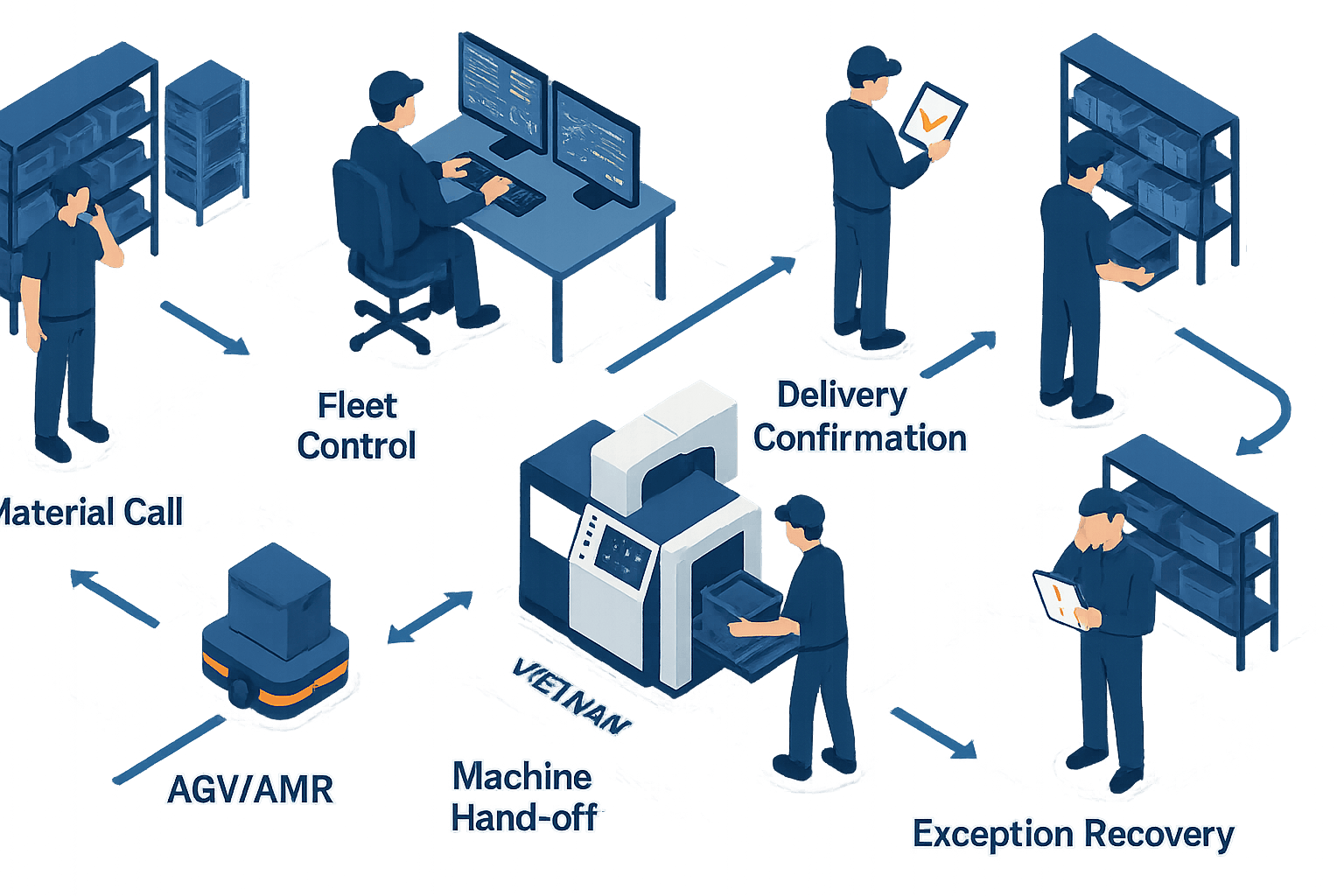
An AGV is usually strong where a defined route and repeatability matter. An AMR is suitable where the vehicle needs to perceive its surroundings and re-plan a route. But “AGV is cheaper” or “SLAM is more modern” does not describe the operating conditions of a Vietnam plant. The correct unit of design is the complete transport service: load, hand-off, traffic, communication, human activity and recovery.
A vehicle may reach its destination while the service still fails. The source station may not send a call, an empty pallet may block the destination, nobody may own the door interface, or the night shift may be unable to restore a map. Before selecting equipment, write the present process as who moves what, from where to where, at what time and to what quality. The broader sequence is covered in our Vietnam factory automation roadmap; this article focuses on internal logistics procurement and acceptance.
Replace “remove operators” with a transport service level
If an RFP opens only with a headcount target, bidders tend to optimise vehicle count and headline speed. Define the service instead:
- on-time arrival rate for each material class;
- distribution of call-to-pickup and pickup-to-delivery times;
- number of outstanding calls that can be managed at peak;
- priority rules for urgent supply, quality hold and route closure;
- recovery time after planned and unplanned stops; and
- faults that the local shift can safely recover without a site visit.
This makes AGVs, AMRs, conveyors and retained manual transport comparable on the same basis. Labour benefit, where real, becomes an output of measured work rather than an assumption.
Twelve requirements for a Vietnam AGV RFP
An RFP is not a catalogue questionnaire. It is a tool for exposing operational ambiguity before the contract. Require every bidder to respond in the same format.
| RFP topic | Information supplied by the factory | Required bidder response and evidence |
|---|---|---|
| Load | Size, mass, centre of gravity, orientation, tolerances | Compatible top module or fixture, limits, failure behaviour |
| Demand | Calls by time, peak pattern, growth scenarios | Fleet calculation, queue assumptions, spare capacity |
| Route | CAD, widths, crossings, blind corners, slopes, gaps | Navigation method, speed zones, congestion control |
| Hand-off | Machine, cart, rack and conveyor I/O | Sensors, interlocks, retry and manual recovery |
| Mixed traffic | Pedestrians, forklifts, contractors, visitors | Risk controls, signs, training and residual risk |
| Safety | Intended use and foreseeable misuse | ISO 3691-4 evidence, verification and change control |
| Communications | APs, SSID, authentication, VLAN, survey data | Roaming, disconnection behaviour, logs, recovery test |
| Integration | WMS, MES, PLC, door and lift interfaces | API/I/O boundaries, time sync, retry, test environment |
| Interoperability | Current and future robots, fleet strategy | VDA 5050 version, scope, exclusions and test method |
| Support | Plant calendar, languages, shift structure | SLA, triage, remote access, local spares and training |
| Security | OT zoning, connection approval, log retention | Accounts, updates, vulnerability notice and backups |
| Commercial | Acceptance, warranty, expansion and removal | TCO breakdown, exclusions, change rates and exit terms |
The RFP attachment needs more than clean CAD
Overlay temporary work-in-process, doors, cleaning equipment, parked forklifts, sunlight, dust, reflective surfaces and radio weak spots on the layout. Observe shift start, breaks, model change, shipping cut-off and cleaning—not only normal running. At the same travel distance, crossing waits and failed hand-offs can dominate the cycle.
Make bidders submit the fleet-size equation
A useful starting structure is:
Required fleet = total service time during the peak window ÷ net service time available per vehicle in that window × variability allowance
Total service time includes travel, waiting, load transfer, charging, crossings, doors and retries. Net time excludes planned charging, inspection, reconnection and congestion losses. Do not accept a fixed allowance without evidence. Test normal, peak and equipment-failure scenarios against the plant’s call variability and allowable delay. For a deeper treatment, use our AGV layout and fleet-sizing guide.
An AGV implementation PoC must test failure, not merely motion
The purpose of a PoC is not to produce a successful demonstration. It is to break assumptions that cannot survive production. Select one representative lane and use the real load, floor, wireless network, traffic and operators. A run in a supplier showroom can explain the product, but it is not evidence of site fit.
Exceptions to create deliberately
Do not introduce these exceptions without controls in live production. Execute them in a segregated test area under a documented risk assessment and approved procedure, using representative test objects, restricted speed, a dedicated safety observer and an immediately accessible emergency stop. Define the test-abort criteria and responsible person before starting; no pedestrian or forklift operator should be exposed to a hazard for the sake of a test.
- Send a pedestrian and forklift toward a crossing at the same time.
- Place a permitted temporary obstruction on the route.
- Cross an AP boundary and degrade connectivity in a controlled test.
- Move the load position and orientation to the edge of its tolerance.
- Burst calls with different priorities.
- Withhold a response from a door, conveyor or PLC.
- Put the vehicle into a safe stop and require the local team to recover it.
- Restore maps, recipes and fleet settings from backup.
Record the initiating condition, detection time, stop state, alert recipient, recovery steps, recovery duration and log location. The primary deliverable is a requirement-to-evidence traceability matrix, not a demonstration video.
A Go/No-Go gate is not based on top speed
Combine lane capacity, major risks, recovery after a protective stop, disconnection behaviour, local maintenance capability and the closure plan for open issues. A good mean cycle time can hide a long tail at peak. If routine recovery requires an international site visit, production readiness is low.
Separate FAT and SAT for overseas factory automation
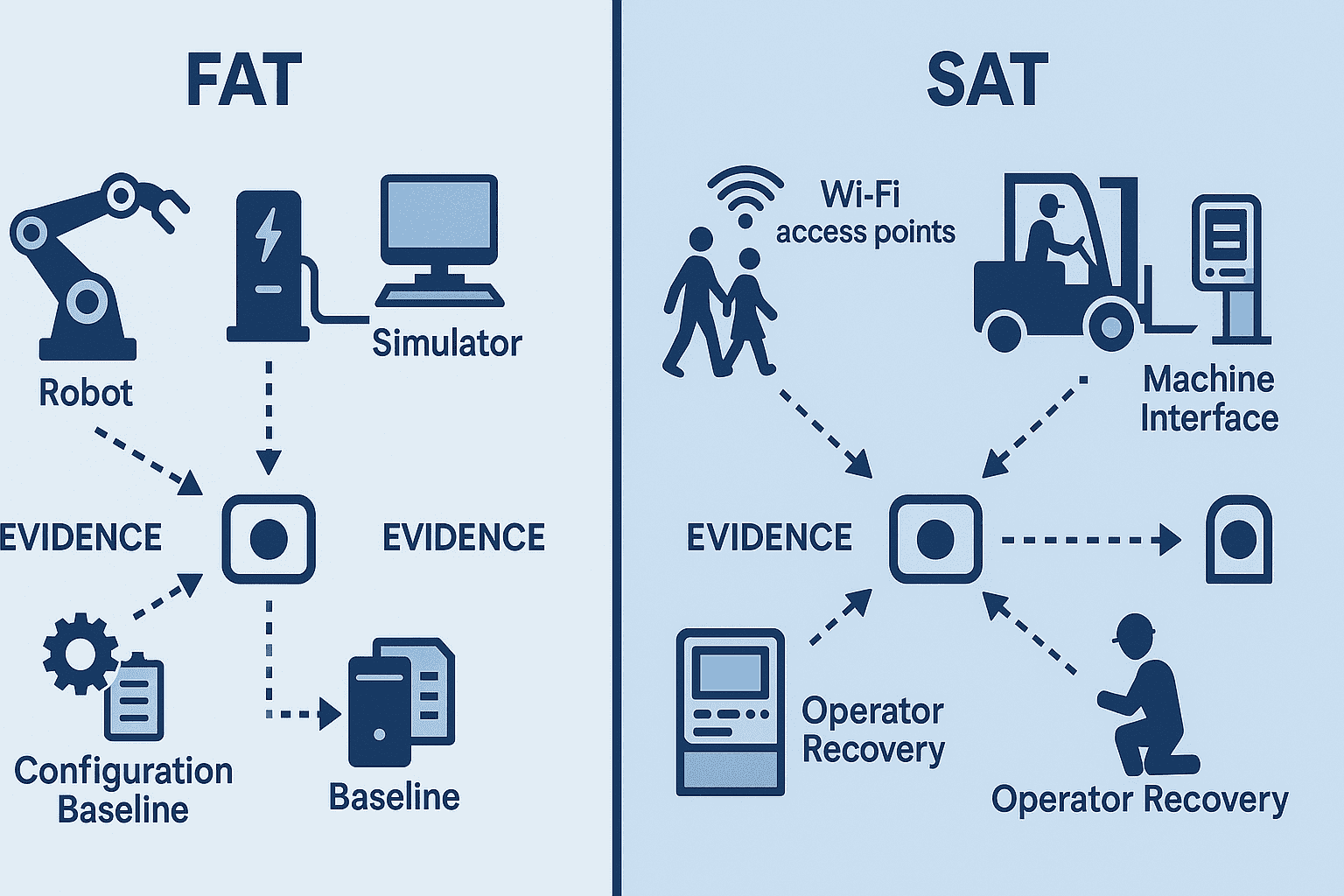
FAT and SAT are not the same test in two locations. FAT checks the vehicle, charger, fleet controller and simulated interfaces before shipment. SAT verifies the integrated Vietnam site with its floor, radio, traffic, equipment and operating team.
| Gate | Main scope | Acceptance evidence | Must not pass to next gate |
|---|---|---|---|
| Design review | Requirements, risk, I/O, network, recovery | Approved drawings, risk register, interface matrix | Unowned safety, data or I/O decisions |
| FAT | Vehicle, charging, fleet control, simulated equipment | Test record, logs, configuration baseline, backup | Core function defects or major safety nonconformity |
| Installation | Floor, route, APs, power, barriers and signs | Measurements, photographs, asset record | Inaccessible route, wireless dead zone, missing guard |
| SAT | Real equipment, loads, traffic and operators | Requirement-level results, exceptions, recovery record | Failed acceptance criterion, incomplete training or major residual risk |
| Stabilisation | Shifts and peak production | KPI trend, fault classification, closed corrective actions | Repeatable stop without an agreed control |
The contract should define severity, retest procedure, deadlines for conditional acceptance and the tests that must be repeated after configuration changes. “To be discussed” is insufficient when a stop may sit between the vehicle, wireless network, machine and higher-level system.
ISO 3691-4 safety is more than a certificate
ISO 3691-4:2023 is the current international standard covering safety requirements and verification for driverless industrial trucks and their systems, including AGVs and AMRs. As of September 2026, the next edition, ISO/DIS 3691-4 Edition 3, is publicly at the DIS stage. A DIS is under development; it must not be described as the current published standard. Procurement should request evidence against the current edition and ask how the supplier monitors the draft and controls future design changes.
Safety is not created by a scanner on the vehicle. The assessment includes the operating zone, load, transfer equipment, doors, crossings, charging, manual operation, cleaning, maintenance, loss of power, emergency response and reasonably foreseeable misuse. Link these records to the RFP and acceptance plan:
- risk assessment with scope and exclusions;
- protective measure and residual-risk register;
- safety-device settings and verification results;
- conditions requiring reassessment after changes to load, speed, route or equipment;
- restart after emergency stop, protective stop and communication loss; and
- training material and completion records in the languages used on site.
Do not accept “ISO compliant” or “CE ready” as a complete answer. Confirm the exact hardware, software version, load, speed and layout covered by the evidence.
The boundary of VDA 5050 v3.0 interoperability
VDA 5050 v3.0.0 was published as the March 2026 version, followed by the VDA release announcement in April. It defines a common interface for order and status exchange between mobile robots and a fleet control system. Version 3.0 adds capabilities for more autonomous, freely navigating robots, including zones and path sharing. A Vietnam factory that may use several manufacturers can create a better exit path than with a fully proprietary interface.
But “VDA 5050 supported” does not mean interoperability is finished. Safety, cybersecurity, valid traffic rules, equipment I/O, performance and site acceptance remain separate responsibilities. Ask each bidder:
- Which VDA 5050 version and mandatory/optional features are implemented?
- Which order, state, error, connection, action, zone and path-sharing cases are tested?
- Where are proprietary extensions used, and what is lost without them?
- Who executes cross-vendor tests, against which test cases?
- If fleet control stops, what safe state is entered and how are orders reconciled after recovery?
Wi-Fi and OT security belong in the design baseline
A mobile device continuously crosses AP cells. Seeing a network in the office is not evidence of reliable control communication along the travel route. The wider method is explained in our factory wireless LAN and industrial network design guide. For an AGV project, put route-level measurement, roaming, authentication, interference and safe disconnection behaviour into SAT.
NIST SP 800-82 Rev.3 provides guidance for protecting OT while respecting performance, reliability and safety. It is not a product certificate. Use it to structure plant risk management:
- an asset register and owner for vehicles, chargers, fleet control, management stations, APIs and APs;
- segmentation between production, robot, maintenance and office networks, with allowed flows;
- named accounts, roles, strong authentication and timely removal of access;
- approved, time-bounded and logged supplier remote access with an emergency cut-off;
- software component information, vulnerability notification, patch evaluation and support life;
- tested backup and restore for configuration, maps, certificates and fleet databases; and
- time synchronisation, log retention, anomaly detection and incident contacts.
An OT update may not be deployable immediately. Define a test environment, rollback and compensating controls rather than choosing between “never patch” and “patch production today.”
Build a TCO sheet before asking for an AMR price
Public prices and other companies’ projects may frame a budget discussion, but they are not the basis for approval. Specification, quantity, currency, taxes, freight, site work, warranty and support differ. Do not invent a market range; collect the same TCO fields through the RFP.
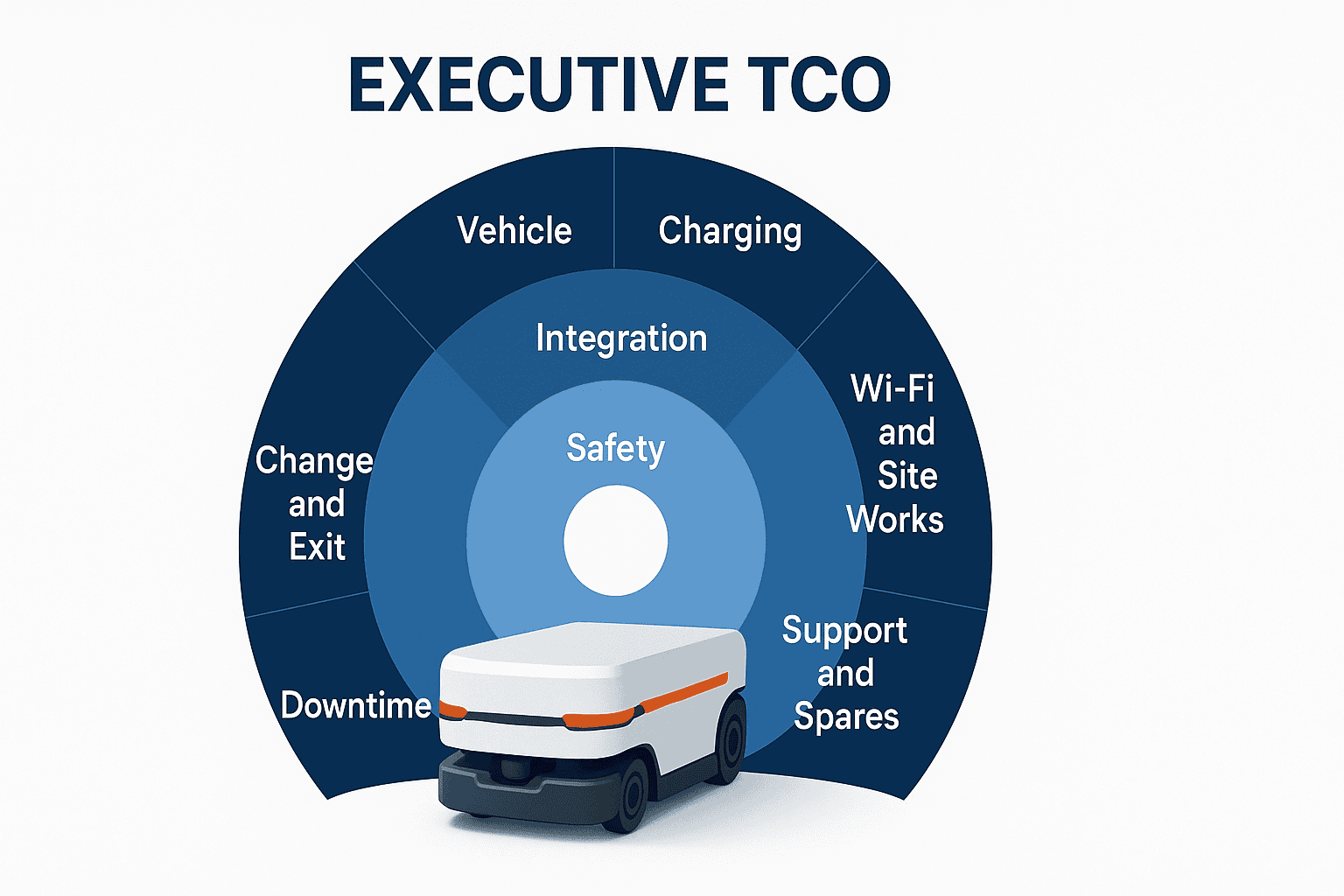
Initial TCO = vehicles + charging + fixtures + fleet software + system integration + wireless + floor/power/safety works + freight/customs + installation + testing + training + initial spares
Operating TCO = support + consumables + batteries + software + communications + periodic safety verification + internal operating labour + planned downtime + failure loss
Evaluation-period TCO = initial TCO + Σ annual operating TCO + expansion/relocation - residual value
| Cost layer | Price and condition required in RFP | Commonly missed question |
|---|---|---|
| Vehicle | Vehicle, charging, fixtures, standby unit | Replacement conditions for battery, sensor and wheel |
| Software | Fleet control, licence, API, history | Fee change with vehicle, site or version count |
| Integration | PLC, WMS/MES, door, lift | Other-side changes, retest and simulator included? |
| Infrastructure | Wi-Fi, power, floor, signs and guarding | Night work, shutdown coordination and reinstatement? |
| Delivery | Design, freight, installation, FAT/SAT, training | Travel, interpretation, tax, customs and permits? |
| Operation | SLA, remote/onsite, parts and inspection | Support language, hours, arrival target and holidays? |
| Change and exit | Move, expand, migrate and remove | Ownership and export format of maps, logs and settings? |
Benefits must go beyond “people × wage”
Annual net benefit = avoidable handling labour + avoided overtime/outsourcing + reduced material-flow loss + reduced quality loss + contribution margin from proven additional demand - additional annual operating cost
Populate every term with site measurements and avoid double counting. If nobody leaves the organisation, describe the benefit as avoided hiring, reassignment to value-adding work or overtime reduction—not a cash labour saving. Count contribution margin from capacity only when demand is supported.
Decree 293/2025/NĐ-CP is a primary source for the regulatory change, but total labour cost varies by location, role, allowance, insurance and shift. This article intentionally does not reproduce wage figures; Finance and HR should provide the plant-specific input.
Local service starts with the first 30 minutes, not the SLA headline
A support desk does not necessarily recover production. Confirm who works in Vietnamese, English or Japanese, in which hours, with what access and which parts. Ask for evidence of the local team, competence, backup staffing, spare-parts location, entry procedure and remote-access workflow.
Split recovery responsibility into levels:
- L1: the shift checks safety, removes an allowed obstruction and performs an approved restart;
- L2: local maintenance or the supplier analyses logs, replaces parts and restores configuration;
- L3: the manufacturer handles software defects, design issues and critical vulnerabilities.
Define trigger, prohibited action, escalation time, required logs, spares and trainer for every level. Make recovery a SAT test using the post-handover team, not an engineer standing beside the operator.
A 90-day plan for the first production lane
Ninety days is a management window for one selected lane, from requirements to a controlled production decision. It is not a promise to automate an entire plant, and equipment production or import lead times may change the calendar.
| Period | Factory work | Joint gate |
|---|---|---|
| Days 1–15 | Observe work; collect demand, loads, routes, risks and IT/OT conditions | Freeze use case and RFP inputs |
| Days 16–30 | Compare proposals, walk the route, review TCO and boundaries | Technical clarification and PoC plan |
| Days 31–45 | Site PoC, exceptions, radio survey and recovery | Go/No-Go and open-issue register |
| Days 46–60 | Detailed design, safety, I/O, network and FAT preparation | Design and FAT-procedure approval |
| Days 61–75 | FAT, shipment, site preparation, training and backup review | FAT pass and installation release |
| Days 76–90 | Installation, SAT, shift trials, correction and handover | Conditional/final acceptance and stabilisation plan |
At day 90, retain not only the vehicle but the specification, risk register, I/O matrix, network drawing, configuration baseline, recoverable settings, backups, test evidence, training record, spares list, SLA, fault taxonomy and a standard template for the next lane. Scaling means reproducing a verified operating model, not simply ordering more units.
Compare proposals by exposing uncertainty, not only scoring price
Do not stop at adding a technical score to a price score. Classify every answer as compliant, conditionally compliant, noncompliant or information missing. For every conditional answer, record the enabling condition, extra work owned by the factory, verification date and fallback if the condition fails. Merely giving missing information zero points hides the change order that may return after contract award. Assign an owner and response deadline, then close the question at a level that can be attached to the contract.
Adjust weighting to the factory constraint. Give safety and traffic validation more weight where pedestrian–forklift crossings are frequent; recovery and local support where the IT/maintenance team is small; interoperability and licence terms where fleet expansion is planned. Unresolved I/O, civil works, Wi-Fi remediation, customs, night work and retesting can move lifecycle cost more than the visible vehicle-price difference. Show quoted price, evaluation-period TCO, unresolved cost, major risk and the cost if an assumption fails in separate columns.
The decision should not be made only by the demonstration team and contract approver. Involve production, logistics, maintenance, EHS, IT/OT, quality, finance and purchasing at the gates relevant to them. They do not all need to attend every meeting, but the record must show who approved each boundary. AGV projects often fail not because one department makes a poor choice, but because a requirement sitting between departments has no owner.
Frequently asked questions
Should a Vietnam factory select AGV or AMR?
Do not decide from navigation alone. Convert load, accuracy, layout-change frequency, congestion, exception handling, local maintenance and integration into requirements, then compare under the same PoC. If a mixed fleet is plausible, verify the VDA 5050 version and implementation scope.
What belongs in an AMR price comparison?
Use one evaluation period for vehicle, charger, top module, fleet control, licences, integration, Wi-Fi, site works, freight/customs, testing, training, support, spares, battery, downtime, expansion and removal. Obtain figures in a common RFP instead of reusing an online range.
Is a PoC necessary for Vietnam factory automation?
It is strongly recommended for the first lane because floor, wireless conditions, traffic, load variation and local recovery materially affect the outcome. Test exceptions such as disconnection, obstruction, failed hand-off and peak calls—not only a successful trip.
Is ISO 3691-4 compliance enough for AGV safety?
It is important but does not complete site-system safety. Assess layout, load, surrounding equipment, pedestrians, forklifts, operation, maintenance and change. As of September 2026 the current standard is ISO 3691-4:2023; the next-edition DIS remains under development.
Can another brand be added immediately if both support VDA 5050?
Not necessarily. Versions, messages, actions, extensions, capabilities and traffic assumptions may differ. Require an implementation matrix and cross-vendor test. VDA 5050 also does not replace safety, security, performance or site acceptance.
Conclusion
A Vietnam AGV or AMR project should start by turning service levels, exceptions, recovery and ownership into an RFP—not by comparing vehicle prices. The PoC should expose failures, FAT and SAT should have separate purposes, and ISO 3691-4 evidence, VDA 5050 boundaries, Wi-Fi, NIST-informed OT security and local service must connect to one acceptance system. Compare TCO across vehicles, integration, infrastructure, support, downtime, change and exit. If the first 90 days create one production lane and a reusable standard, the next deployment becomes a controlled replication of a proven operating model.
Even if the route and vehicle have not been selected, a factory can start with material-flow data, RFP fields and PoC/FAT/SAT acceptance criteria. TOMAS TECH supports manufacturers in Thailand and Vietnam with AGV/AMR, equipment interfaces, networks, safety and operating-boundary design. Share the current layout and transport problem through our contact page, and we can structure the decision before a model or budget is fixed.
Sources
- National Statistics Office of Vietnam: Index of industrial production in June 2026
- Government of Vietnam: Decision 840/QĐ-TTg
- Government of Vietnam: Decision 1266/QĐ-TTg
- Government of Vietnam: Decree 293/2025/NĐ-CP
- ISO 3691-4:2023
- ISO/DIS 3691-4
- VDA 5050 Version 3.0.0
- VDA: Version 3.0 release announcement
- NIST SP 800-82 Rev.3


