


Thailand WMS 2026: RFP, 90-Day PoC and Acceptance for Brownfield Warehouses
A Thailand WMS project succeeds or fails on operational boundaries, not on the length of a feature list. A live factory warehouse cannot pause while a new system is fitted. Item, location, lot and packing-unit masters must be reconciled; ERP ownership must be explicit; and Thai, English and Japanese operations must produce one auditable record. This guide is for factory, logistics, supply-chain and IT leaders planning a warehouse management system implementation in Thailand. It deliberately covers brownfield implementation, RFP design, interfaces, field testing and rollout—not a generic product comparison or price survey.
Executive answer: select a Thailand warehouse management system by seven boundaries
Agree these boundaries before scoring vendors:
- Inventory system of record: which system confirms quantity, lot, serial and inventory status?
- Master-data authority: who changes items, units, packaging, locations, parties and quality codes?
- Business events: what completes receiving, inspection, put-away, replenishment, issue, picking, packing, shipping and returns?
- Connectivity boundary: what continues during a network outage, what stops, and how is recovery reconciled?
- Role and language boundary: what can operators, supervisors, inventory control, IT and auditors see or approve in each language?
- Evidence boundary: how are scan, correction, approval, device, worker and timestamp linked?
- Cutover boundary: which zone, item family or transaction starts first, and which evidence authorizes expansion or rollback?
Microsoft’s official Warehouse management overview illustrates why this matters. Warehouse execution interacts with purchase, sales, transfer, production, quality, transport and return processes. It also involves mobile work, locations, batches and serials, counting, labels and outbound waves. A WMS is therefore an execution layer across business boundaries, not simply another inventory screen. Turn every boundary into an input, rule, exception, output, owner and evidence requirement.
Start with the live warehouse, not the software demonstration
A greenfield warehouse can be designed around the system. A brownfield site already contains mismatches between ERP locations and physical racks, handwritten labels, multiple units, informal workarounds, wireless shadows and customer-specific exceptions. Selecting a package first encourages the team to assume configuration will absorb every difference. The failure appears late, during integrated testing.
Before issuing an RFP, walk representative flows. Follow a truck from arrival through unloading, staging, inspection, label creation and put-away. Follow an outbound or production request through allocation, replenishment, picking, verification, packing and confirmation. Observe urgent issues, shorts, damage, quarantine, returns, repacking, label reprint, partial cases, mixed pallets and poor connectivity—not only the standard flow.
Classify findings instead of copying the current process blindly:
| Classification | Example | Convert it into |
|---|---|---|
| Control to preserve | Quarantined stock cannot be consumed | Enforced rule, approval and evidence |
| Workaround to remove | Delayed posting, shared IDs, duplicate spreadsheets | Retirement date and monitored replacement |
| Temporary exception | Legacy fixed code or customer label | Named owner, expiry and removal plan |
| New standard | License plates, cycle counts, reason codes | Master, workflow, KPI and test scenario |
Baseline improvement measures at the site itself. Candidate measures include mis-shipments, inventory differences, search time, rescans, quarantine ageing, interface reprocessing and device downtime. Public case-study improvements must not be copied as acceptance targets because scope and measurement conditions differ.
Define Thailand WMS scope as inventory-changing events
Scope should be expressed as events, not menu names. For every event, define its trigger, completion rule, inventory effect, ERP notice and reversal:
- inbound advice, vehicle arrival, unloading, quantity/condition/quality inspection;
- license-plate or container identification, label printing and controlled reprint;
- staging, put-away, mixing rules, cube, weight, temperature and hazard constraints;
- movement, status change, lot/serial correction and repacking;
- replenishment, production issue, line-side supply and return of surplus;
- allocation, wave, picking, short, substitution, packing, loading and ship confirmation;
- cycle count, wall-to-wall count, variance investigation, adjustment and approval;
- return, quarantine, disposal, reuse and return to supplier.
Give each event a unique business key and explicit state transition. Acceptance must prove that a replayed message does not double inventory, a delayed ERP response is not shown as confirmed, and a cancellation points to the original event. Duplicate, out-of-order, timed-out and partially failed messages are normal engineering conditions, not rare exceptions.
GS1 EPCIS 2.0.1 distinguishes a raw read from a visibility event with business context—what happened, when, where and why. A project does not have to implement EPCIS, but the model is valuable: “a barcode was read” is not the same as “receiving inspection was completed.” Preserve business meaning when traceability or partner exchange is in scope.
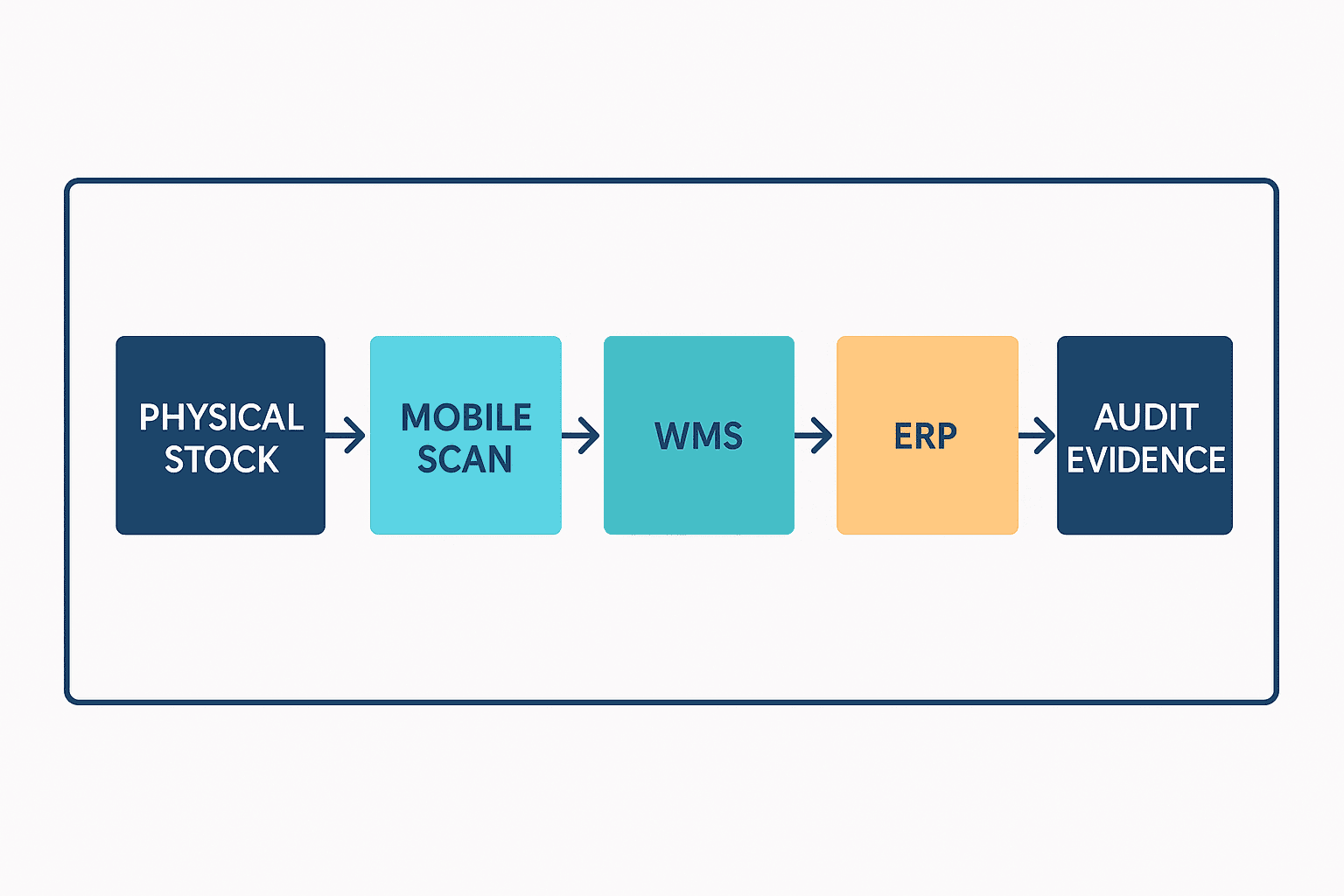
Master data: the contract behind WMS–ERP integration in Thailand
The most dangerous integration defect is often not a failed API. It is a shared code with different meanings. Establish a master-data contract before an interface specification.
Item and unit conversion
An item may be purchased by case, stored by piece, issued by kilogram and shipped by pallet. Conversion rounding and effective dates matter. A revised case pack must not rewrite historical inventory. State what WMS receives, what ERP owns, who approves a change, when it becomes effective and how old labels are treated. Include catch weight, dual units, partial packs, kits and substitutes in test data.
Locations and logistics units
An ERP storage location, a WMS warehouse/zone/bin and the physical sign may not align. A location also carries capacity, mixing, temperature, hazard, FIFO/FEFO, replenishment and work-sequence rules. If a pallet or case is managed as a logistics unit, preserve parent-child, split, merge and repack history.
Lot, serial and status
Distinguish supplier lot, manufacturing lot and internal receipt lot. Identify expiry, manufacture date, quality status, hold reason, origin and owner attributes that affect allocation. Decide whether WMS can change them or must wait for ERP/QMS authorization.
Change governance
After go-live, daily changes are a greater risk than the initial migration. New items, pack changes, locations, customer-label revisions and parties require request, validation, approval, distribution and monitoring. Ask for delta distribution, rejection, replay, audit history, prior-value lookup and controlled transport between environments.
Microsoft’s WMS-only mode documentation provides a current example of separating advanced warehouse execution from an external ERP. Its setup guidance calls for synchronization of master and reference data such as released products, item model groups and countries/regions, together with business events for exchange. Treat this as a design example, not a universal product prescription.
Make every ERP interface a six-column agreement
“Real-time integration” is too vague. Document each message as follows:
| Field | Decision | Acceptance evidence |
|---|---|---|
| Business purpose | Decision and inventory effect | Scenario and expected posting |
| Ownership | Sender, receiver, business owner, recovery owner | RACI and contact route |
| Contract | Schema, required values, codes, units, time and version | Sample payload and schema validation |
| Delivery | API/file/queue, frequency, order and idempotency | Delay, duplicate and reverse-order tests |
| Exception | Reject, hold, replay, correction, cancellation | Error queue and reason history |
| Reconciliation | When and how WMS, ERP and physical stock agree | Daily comparison and approved variance |
Inbound advice, outbound orders, production issues, inventory adjustments and masters do not need one SLA. Separate an interactive response that blocks an operator from an asynchronous result that can be reconciled later. Use a business key, correlation ID, creation time, effective time, send time and process time to diagnose replay and timezone failures.
Reconciliation must compare more than record counts. Align item, lot, WMS location or ERP storage location, inventory status, quantity, unit, owner and cut-off time. Never hide a discrepancy with an automatic balancing entry; retain root cause, containment, correction and approval.
Thai-language WMS support is an operating design, not a translation checkbox
Separate user interface, label, input, training, support and audit requirements.
Screens and terminology
Build one controlled glossary across Thai, English and Japanese. Test short buttons, long errors, item descriptions, reason codes and help text on the real device. Codes alone may look language-neutral but can increase confusion among similar items. Long explanations can slow a handheld workflow. Design toward one decision per screen under gloves, noise and variable light.
Labels and fonts
Test both machine-readable symbols and human-readable Thai/English, lot, quantity, unit, date and status. Include printer model, resolution, stock, ribbon, humidity, surface and scan distance. A reprinted label must remain linked to the original with a reason and protection against simultaneous use.
Training and access
Separate curricula for operators, supervisors, inventory controllers, administrators, IT support and auditors. A translated manual is not evidence. Use scenario-based practical checks. Avoid shared identities; if the device and worker authenticate separately, the transaction must still identify the actual worker.
Local support
Define the hours in which first-line support is available in Thai, contact channels, escalation and fallback for night shifts and holidays. Distinguish time to acknowledge, time to provide a workaround and time to restore.
Scanning and offline work: design connectivity loss as a tested path
Metal racks, chilled rooms, yards, docks and machinery create changing radio conditions. Walk the actual route with devices and test roaming, reconnect, peak concurrency, battery swaps, drops and read angles.
“Offline capable” can mean cached instructions, buffered scans or full local confirmation. These are not equivalent. Full offline updates create harder conflicts when another device acts on the same stock. It can be safer to continue low-risk work and block high-risk confirmation. Require a matrix of permitted and prohibited actions by connectivity state.
Recovery tests should:
- cut connectivity immediately before and after scan and confirmation;
- force-close the app, reboot a device, expire a session and remove power;
- process the same label on a second device and observe conflict handling;
- inspect unsent count, sequence, deduplication, failure reason and replay result;
- reconcile WMS, ERP and physical stock after recovery.
Microsoft’s current Warehouse Management mobile app documentation separates device authentication from worker sign-in and describes fleet configuration through MDM, QR code or file. Its 2026 V4 migration, release and support guidance also demonstrates why OS, distribution channel, application version and backend compatibility belong to operations governance. Do not infer offline capability from those pages; make every required outage behavior a product-specific demonstration and acceptance test.
Build PDPA and security into the procurement
Warehouse records mainly describe items and stock, but worker IDs, names, devices, location, timestamps, photos, signatures and driver details may relate to people. Use Thailand’s official Personal Data Protection Act as the legal starting point and confirm purpose, necessity, access, retention, processors, transfers, deletion/anonymization and incident procedures with legal counsel and the DPO. This article is implementation guidance, not legal advice.
Require:
- a data inventory with purpose, owner, retention, viewers and destinations;
- separation of duties and least privilege, including joiner/mover/leaver controls;
- device encryption, lock, remote revocation, MDM and secret/certificate protection;
- encryption in transit and at rest, key management, backup and restoration tests;
- logs for administration, master changes, stock correction, export and authentication failure;
- vulnerability, dependency, maintenance-life, patch and emergency-change processes;
- disclosure of cloud, vendors and subprocessors, data location and exit deletion/return;
- incident detection, containment, evidence preservation, notification workflow, continuity and review.
NIST SP 800-161 Rev.1 Update 1 integrates ICT product and service supply-chain risk into organizational risk management. NIST SP 800-18 Rev.2, finalized in June 2026, treats security, privacy and cybersecurity supply-chain risk plans as related system plans. NIST does not certify Thai-law compliance, but these publications provide useful structures for documenting vendor responsibilities, boundaries, controls, evidence and residual risk.
Write an RFP that can be answered, scored and tested
A strong RFP is the first draft of acceptance testing. Give every requirement an ID, mandatory/desirable class, response format, evidence, score, PoC flag and contract destination.
| RFP area | Required response | Evidence to score |
|---|---|---|
| Process fit | Standard/configuration/extension/external/not available | Scripted demonstration on supplied data |
| Masters | Authority, sync, version, effective date, errors | Delta update and invalid-data rejection |
| ERP integration | Message, order, idempotency, cancellation, reconciliation | Fault injection and replay history |
| Mobile | OS, device, auth, upgrade and offline behavior | Outage/recovery in the warehouse |
| Languages | UI, label, input, training and support | Thai operator practical test |
| Performance | Peak scenario, response and batch completion | Timed run with representative volume |
| Security | Access, logging, encryption, vulnerability and suppliers | Design, configuration, logs and terms |
| Migration | Bins, stock, open transactions and reconciliation | Rehearsal result and approved variances |
| Cutover | stop, fallback, rollback and restart | Rehearsal and signed evidence |
| Support | coverage, version, SLA and change handling | Operating guide and report sample |
Do not accept “supported.” Force the vendor to state whether it is standard, configured, custom, third-party, roadmap or unavailable, together with assumptions, limits, cost, lead time, maintenance owner and demonstration evidence.
If you still need to determine the appropriate WMS class, see our WMS comparison guide. To structure investment categories, use the Thailand factory WMS cost and three-year TCO guide. This article begins at the next question: how to implement the chosen architecture safely in a live site.
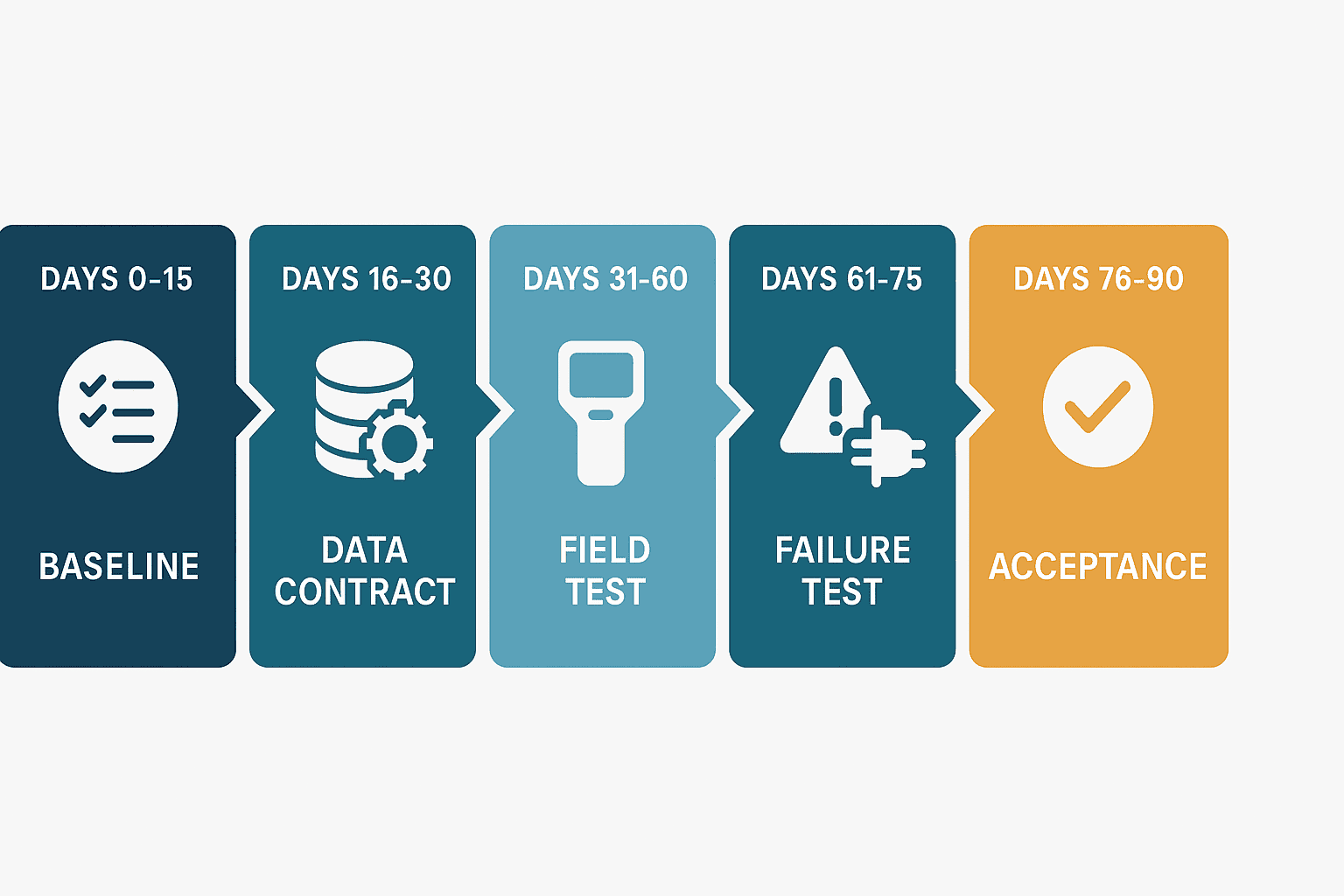
A 90-day PoC that produces a cutover decision
A PoC is not a smaller version of every feature. It resolves the highest-risk assumptions with representative data, devices, radio coverage, users and ERP connections. Adapt the calendar to operations; 90 days is a planning frame, not a guaranteed duration.
Days 0–15: baseline and scenarios
Select one warehouse/zone, representative item families and shifts. Measure current differences, exceptions and processing time. Freeze the future-state flow, master dictionary, interface inventory, access model, scenarios and acceptance authority. Include missing, duplicate and legacy values from a protected production-like copy.
Days 16–30: master and integration contracts
Synchronize item, unit, lot, location, party and worker records. Test rejection, correction and replay. Connect inbound advice, outbound instruction and inventory result. Establish correlation IDs, reconciliation and fixed versions of access, logging, devices and labels.
Days 31–60: happy path and field fit
Run receiving, put-away, replenishment, picking, packing, shipping and counting on real devices. Thai operators use Thai screens and labels under realistic noise, gloves and light. Include peaks, partial packs, mixed loads, lots and quarantine. Record hesitation, backtracking, rescans and supervisor calls.
Days 61–75: failure and misuse
Inject Wi-Fi loss, ERP outage, latency, duplicate and out-of-order messages, printer failure, lost device, bad master, unauthorized action and duplicate label. Prove that unsafe work stops, safe work continues, detection is timely and recovery reconciles. Test the order of business restart, not only technical backup restoration.
Days 76–90: acceptance and rollout gate
Assemble process, data, performance, security, operations, training and cutover evidence. Give each open item severity, containment, due date and owner. A cross-functional authority chooses “scale,” “conditional scale,” “retest” or “stop.”
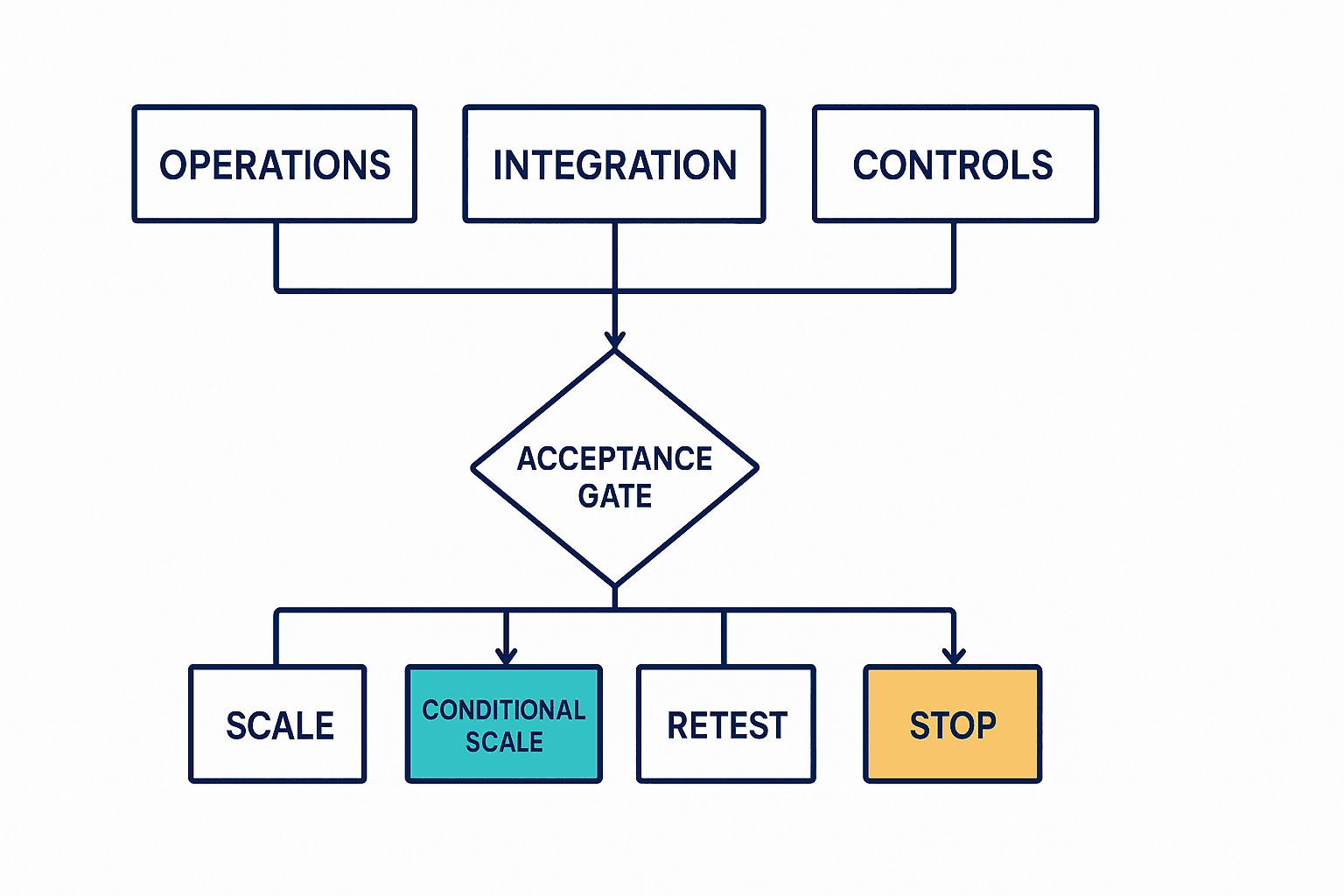
Acceptance must prove the evidence chain
“One hundred transactions completed” is not acceptance. An instruction must arrive correctly; the worker must scan the correct object; WMS state must change; ERP must receive the intended result; downstream accounting, production or quality processing must follow; and the complete chain must be retrievable.
The evidence pack should contain requirement-to-test traceability, master/config/app/device/label versions, inputs and expected results, actual screens/logs, executor and time, WMS/ERP/physical stock before and after, reconciliation, failure chronology and recovery, denied unauthorized actions, administrator audit, multilingual training outcomes, open defects and accepted exceptions.
Set thresholds from the site baseline and risk tolerance. Separate absolute safety/inventory-integrity gates from improvement measures such as time, errors or variance. State denominator, measurement period, exclusions and retest conditions.
Roll out in controlled increments
A live warehouse does not need a big-bang conversion. Expand only when evidence gates are met—for example, one zone/day shift, all shifts in that zone, adjacent zones, production issue, customer outbound, the full site and then another site. The sequence will differ, but one rule is constant: one system of record per inventory population. Parallel comparison can help; parallel updating of the same stock usually creates differences.
The cutover plan covers freeze, last transaction, count/variance sign-off, migration, opening-balance reconciliation, devices, labels, ERP queues, legacy forms, additional staffing and decision times. Rollback must define how post-cutover transactions are treated and which timestamp becomes authoritative.
Govern days 30, 60 and 90 after go-live
Daily review covers interface failure, unfinished work, negative stock, quarantine, reprints, manual corrections and equipment failure. Weekly review covers differences, productivity, top exceptions, master changes and training. Monthly review covers SLA, vulnerabilities and patches, licenses, capacity, access recertification and the improvement backlog.
Do not use worker-level KPIs only for surveillance; that can encourage skipped scans and abused reason codes. Use evidence to improve flow, instruction quality, layout, masters and system waiting. Where individual activity is used, make its purpose and treatment explicit and minimize retention consistent with PDPA review.
Treat configuration, interface, handheld app, OS, device, printer, label, radio network and ERP as one dependency map. Test representative process and recovery in a validation environment, set stop and rollback conditions, then deploy in waves.
Frequent failures and prevention
Rebuilding every current workaround
Customizing duplicate ledgers and informal exceptions removes the benefit of standardization. Preserve controls, time-box migration exceptions and retire workarounds.
Letting both ERP and WMS adjust inventory
Dual authority hides root cause. Define inventory-affecting events, adjustment roles, delayed-state display and cut-off reconciliation.
Using clean PoC data
Go-live problems live in blanks, old codes, duplicates, unit changes and open transactions. Use protected, production-like anomalies and prove safe rejection.
Approving Thai support from translated screenshots
Thai operators must complete real scenarios with devices, labels, errors and local support. A Japanese-speaking reviewer cannot substitute for the user.
Defining offline as “continue everything”
That increases concurrent conflict. Define permissions, local queue, reservation, recovery and reconciliation by transaction.
Treating the target date as success
The calendar is not evidence. Governance must permit a reduced scope, retest or delay when integrity, security, training or reconciliation gates fail.
Implementation checklist
Before issuing the RFP
- [ ] Observe standard, exception and outage flows in the operating warehouse.
- [ ] Assign WMS and ERP authority for inventory and master data.
- [ ] Build dictionaries for items, units, packaging, locations and lots.
- [ ] Define a Thai/English/Japanese glossary and role-based training.
- [ ] Survey actual wireless routes and decide permitted/prohibited work during an outage.
- [ ] Map personal data, access, logs, retention, vendors and subprocessors.
- [ ] Attach evidence and a PoC scenario to every material requirement.
During the 90-day PoC
- [ ] Include messy masters and open transactions representative of production.
- [ ] Test delay, duplicate, reverse order, outage and recovery.
- [ ] Have Thai operators evaluate real devices and real labels.
- [ ] Reconcile physical stock, WMS and ERP at the same cut-off.
- [ ] Test unauthorized action, lost devices and audit-log extraction.
- [ ] Define the denominator, period, exclusions and retest conditions for every acceptance measure.
Before production rollout
- [ ] Hold one system of record for each inventory population.
- [ ] Time-box freeze, cutover, reduced operation, rollback and decision authority.
- [ ] Avoid dual updating and prepare a controlled reconciliation procedure.
- [ ] Schedule 30-, 60- and 90-day reviews with named improvement owners.
- [ ] Govern application, OS, device, printer, radio network and ERP changes as one dependency map.
FAQ about WMS implementation in Thailand
What is the difference between a WMS and an inventory system?
An inventory system often emphasizes balances and transaction records. A WMS generally adds detailed location and work execution—put-away, replenishment, picking, packing, mobile and labels. Product names are unreliable; compare your required events and boundaries.
What must Thai-language WMS support include?
Test UI, Thai input, handheld layout, label fonts, reason codes, training, administration and local-shift support. Acceptance evidence is successful completion by Thai operators in the real environment.
Must WMS–ERP integration be real time?
No. Separate decisions that block an operator from results that can be asynchronous and reconciled. Inventory integrity under delay, duplicate, reversal and cancellation is more important than a “real-time” label.
Is 90 days enough for a WMS PoC in Thailand?
It depends on scope, shifts, seasonality and interfaces. The purpose is to test master, integration, multilingual field work, outage, recovery and reconciliation—not to fill 90 days.
When should an existing warehouse switch to the new WMS?
Do not assume the whole warehouse must stop and switch at once. Stage the change by zone or transaction, keep one system of record for each inventory population, and plan the data freeze, last transaction, migration, opening reconciliation and restart with exact decision times. A rollback plan must also state how transactions created after cutover will be treated.
Should the WMS vendor own PDPA compliance?
The vendor supplies technical and operational facts. The deploying organization, legal counsel and DPO must decide purposes, roles, retention, processors and transfers, then verify that contract and configuration agree.
Conclusion: make the WMS the shared language of the warehouse
The outcome to procure is a verifiable operating system connecting physical goods, workers, WMS, ERP and management. In a Thailand brownfield site, that means observing exceptions, defining events, contracting masters and ownership, and field-testing language, devices, outages and security. A 90-day PoC should prove recovery and reconciliation, not merely present polished screens. Expand only where evidence is complete.
TOMAS TECH supports brownfield warehouse observation, RFP definition, ERP interface design, multilingual PoCs and acceptance evidence in Thailand. You can contact us while evaluating options, before selecting a product, or when retaining an existing WMS but redesigning its interfaces.
References
- Microsoft Learn, “Warehouse management overview”: https://learn.microsoft.com/en-us/dynamics365/supply-chain/warehousing/warehouse-management-overview
- Microsoft Learn, “Warehouse management only mode overview”: https://learn.microsoft.com/en-us/dynamics365/supply-chain/warehousing/wms-only-mode-overview
- Microsoft Learn, “Enable and configure Warehouse management only mode”: https://learn.microsoft.com/en-us/dynamics365/supply-chain/warehousing/wms-only-mode-setup
- Microsoft Learn, “Install the Warehouse Management mobile app”: https://learn.microsoft.com/en-us/dynamics365/supply-chain/warehousing/install-configure-warehouse-management-app
- Microsoft Learn, “Warehouse Management mobile app release schedule”: https://learn.microsoft.com/en-us/dynamics365/supply-chain/warehousing/warehouse-app-control-updates
- GS1, “EPCIS Standard 2.0.1”: https://ref.gs1.org/standards/epcis/2.0.1/
- Royal Thai Government Gazette, “Personal Data Protection Act B.E. 2562”: https://ratchakitcha.soc.go.th/documents/17082307.pdf
- NIST, “SP 800-161 Rev. 1 Update 1”: https://csrc.nist.gov/pubs/sp/800/161/r1/upd1/final
- NIST, “SP 800-18 Rev. 2”: https://csrc.nist.gov/pubs/sp/800/18/r2/final
This article reflects public information available on 7 September 2026. It is general implementation guidance, not legal advice, a product guarantee or an investment-return guarantee.


