


Selecting a stacker crane on travel speed and pallet positions alone can leave a Thai factory with a fast machine and a blocked infeed. The practical starting point is a single requirement set covering actual loads, peak storage and retrieval, the building, the material flow and software interfaces. This guide takes a buyer from comparing pallet AS/RS layouts through a quotation request and acceptance tests. The focus is the performance of the operating system, rather than an isolated catalogue maximum.
Stacker crane selection starts with the load and the production deadline
A stacker crane travels along a rack aisle and stores or retrieves pallets or other unit loads. Its effective output depends on load inspection, conveyors, transfer stations, rack positions and WMS/WCS instructions. Dematic notes that pallet AS/RS performance depends on integration with upstream and downstream operations; a fast crane cannot compensate for a conveyor that cannot accept the load. Dematic: pallet AS/RS integration
Use this order for a selection project: define the accepted load envelope and pallet quality; calculate simultaneous inbound and outbound peaks; survey the building and safety constraints; compare layouts using the same order data; price the same equipment and software scope; then agree on FAT and SAT scenarios before issuing the purchase order. A stock figure such as 3,000 pallets does not reveal which SKUs need direct access, whether FIFO is mandatory, or how quickly a production line needs the next pallet. Ask each bidder to prove the proposed arrangement under a realistic peak, not only on an average day.
Compare pallet AS/RS crane configurations
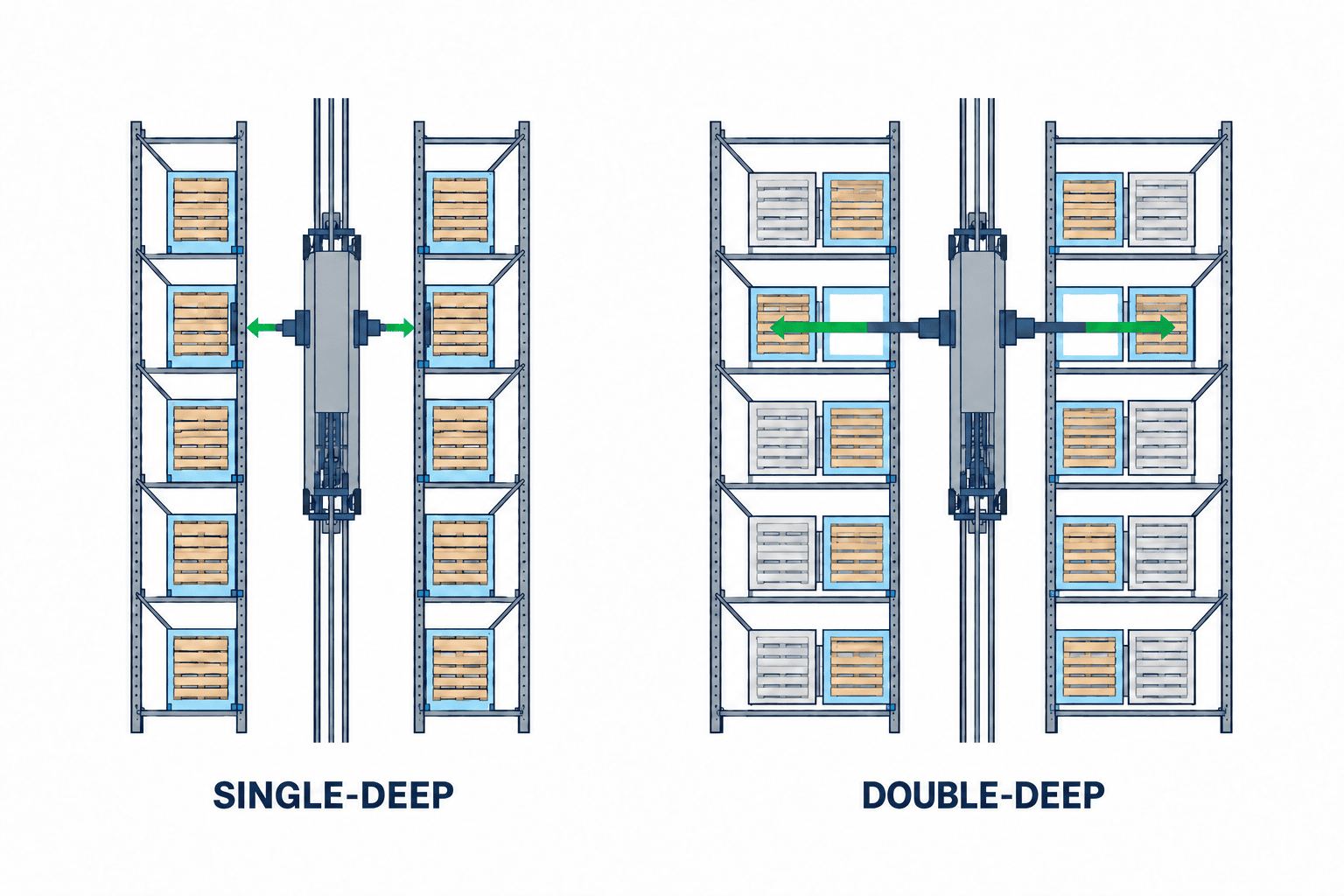
Daifuku describes single-deep storage as a standard unit-load AS/RS layout and double-deep storage as a high-density option suited to lower or medium throughput in its portfolio. These are product descriptions, not a universal ranking. Daifuku: Unit Load AS/RS
| Configuration | Potential fit | Questions to resolve |
|---|---|---|
| Single-deep crane | Many SKUs and direct access to each pallet | Aisles, building width and crane count |
| Double-deep crane | More pallets of the same SKU and density priority | Access to the rear position, relocation and slotting rules |
| Crane plus shuttle/deep storage | Large batches of one SKU and usable depth | Shuttle count, extraction order and failure recovery |
| Pallet flow plus handling equipment | Predictable FIFO flow and repeated replenishment | Lane imbalance, SKU changes and end-to-end capacity |
Storage density must be weighed against extraction order. A fast-moving SKU placed behind another load may need a relocation before it can leave. Lot and expiry rules can further limit usable positions. Mecalux publishes different heights and load ratings across its crane models; do not treat one maximum as the specification of every machine. Mecalux: stacker cranes
Crane speed and aisle throughput are different measures
A complete cycle includes travel, lift, fork extension, load confirmation and transfer to a station. A dual cycle may combine storage and retrieval, but the achievable pairing rate depends on the incoming orders and stock locations. Interroll states up to 1,000 kg per pallet and up to 100 pallets per hour for its PM 9770 in a pallet-flow and conveyor application. That is a product-specific figure, not a benchmark for every high-bay crane. Interroll: PM 9770
Dematic cites options of up to 1,800 kg, 45 m and 60 loads per hour for its unit-load AS/RS portfolio. Those figures describe Dematic configurations; they are not a guarantee for a particular Thai site and should not be ranked directly against Interroll’s different system architecture. Dematic: AS/RS
An existing building may impose columns, low beams, floor loads or fire-service constraints. Compare a lower rack with more aisles, partial automation or a conveyor and buffer upgrade where appropriate. For the broader cost scope around a warehouse project, see our automated warehouse price guide for Thailand.
Measure the real pallet and load envelope
“Suitable for 1,000 kg” is not a complete handling specification. Record pallet footprint, overhang, overall height, off-centre load, wrapping, the condition of bottom boards and the smallest and largest loads accepted. A damaged pallet can catch on a chain, be rejected by a profile check or fail to sit on the fork. Define how nonconforming loads are routed and who corrects them.
Daifuku’s published small model combines one crane, 139 pallet positions, a 1,100 × 1,100 × 150 mm pallet and 1,000 kg per pallet. Its medium model uses three cranes and 1,650 positions. These are examples of complete manufacturer layouts, not promises that another building will achieve the same capacity or footprint. Daifuku: model systems
Build a load register with pallet type, measured dimension range, gross mass, eccentricity, maximum height, packaging protrusions, damaged-pallet criteria and customer-specific exceptions. For chilled or frozen facilities, add condensation, defrost periods, packaging behaviour and safe human access. Food and pharmaceutical operations may require additional cleaning, lot traceability and contamination controls. Test physical samples that represent the heaviest, tallest, softest and least stable loads, rather than only an ideal pallet.
Calculate stacker crane storage and retrieval throughput
Specify hourly and shorter peaks, not just monthly averages. Receiving bursts, shift starts, dispatch cut-offs and post-holiday restarts can place inbound and outbound work in the same window. Separate the normal day, month end, busy season and recovery after a stoppage. Give bidders anonymised order history where possible.
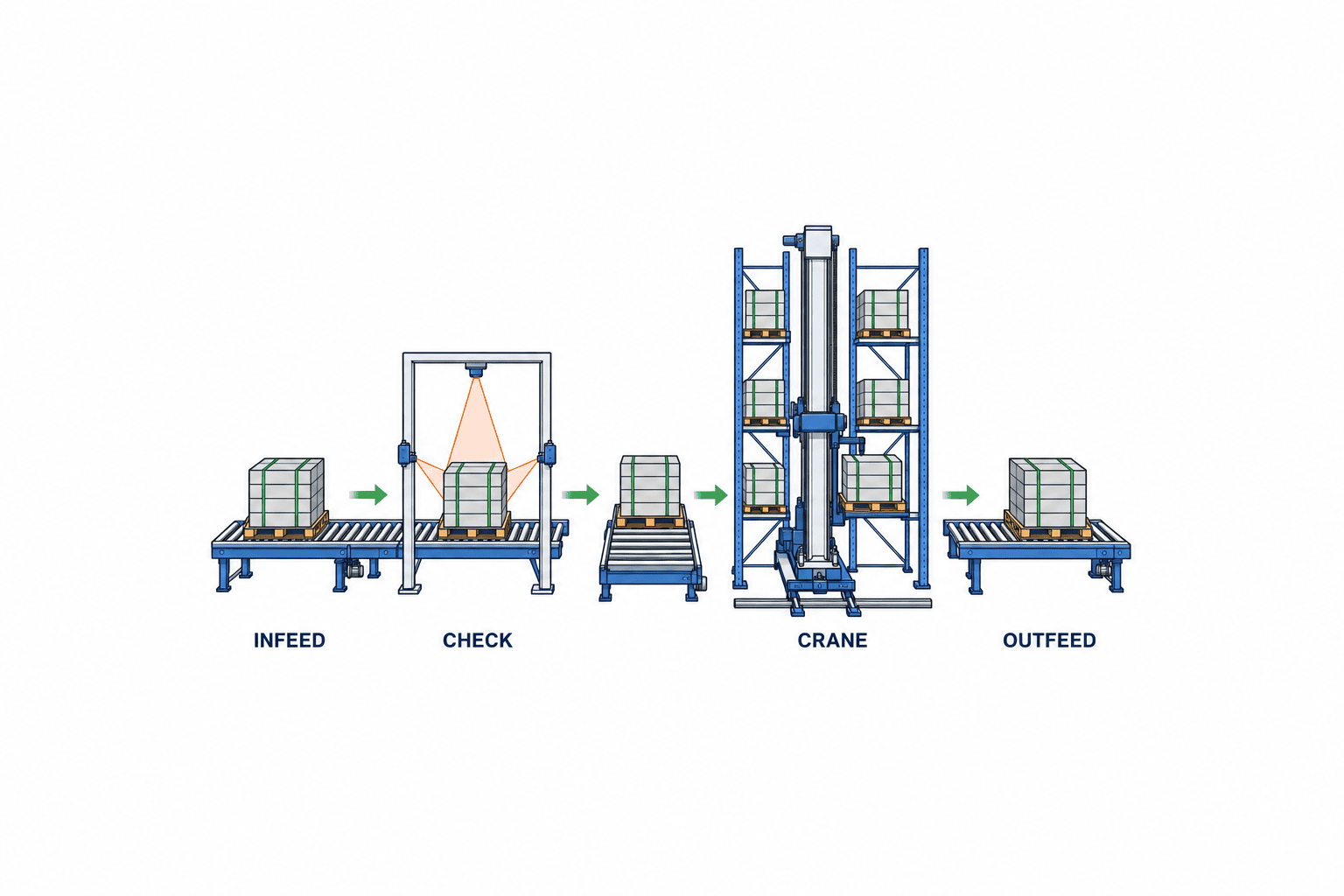
For illustration only, suppose the busiest hour requires 42 inbound and 38 outbound pallets. These 80 moves per hour are a workload, not an automatic crane rating. Dual-cycle opportunities, slot distribution, handoff times, buffer positions, downtime and the length of the peak affect the design. If the inbound induction conveyor can handle only 30 pallets per hour, it falls 12 pallets per hour short of the 42-pallet inbound demand. A faster crane cannot remove that inbound shortfall. The 38 outbound pallets use a separate flow, so 30 must not be presented as a combined inbound-plus-outbound limit. The figures 42, 38 and 30 are hypothetical planning numbers, not product specifications.
Ask vendors to state whether “pallets per hour” means inbound, outbound or a combined total. If a proposal uses dual-cycle maximums, request the inbound/outbound mix and slotting assumptions. Include a waiting-time distribution, such as the 95th percentile time from retrieval request to delivery, alongside average throughput. That percentile is a project KPI suggestion, not a regulatory limit.
Trace every step: receiving, profile and barcode check, induction, crane, rack, extraction, sorting, dispatch or line feeding. List the capacity and queue size of each link. Dematic explicitly warns that upstream supply and downstream acceptance can constrain an otherwise capable AS/RS. Dematic: integration The bottom shape and direction of the pallet matter at crane-to-conveyor interfaces; our chain conveyor selection guide covers those conditions.
Survey the building, rack and safety envelope
For a retrofit, verify dimensions on site: columns, beam clearance, services, fire systems, floor levelness, structural load, power and delivery access. Agree which party calculates and warrants the rack, floor and building interface. Local designers and the relevant Thai authorities should confirm egress, fire provisions and construction requirements for the actual site. This article does not establish legal compliance for any building.
Normal no-entry operation is only one safety state. Specify how technicians isolate power, remove a rejected load, retrieve a stalled crane, replace sensors and prevent an unintended restart. Interroll’s PM 9770 technical document gives an ambient range of 0–40°C under non-condensing conditions for that product. It is not an operating range for all cranes. Require a product-specific written specification for freezer, dusty, washdown or hot sites. Interroll: PM 9770 technical data
Maintenance access has to fit the layout: platforms, hoist access, spare parts and lockout procedures. If one failed crane makes an aisle inaccessible, decide how critical materials reach production. Possible controls include distributing critical SKUs, holding an emergency ground-level stock and contracting a response time. A 24-hour response requirement, if chosen, is a contractual example rather than a general service standard.
Define WMS, WCS and PLC responsibilities
The machinery quote and the IT quote should share an interface schedule. WMS commonly manages stock, locations, lots and allocation. WCS or MFS coordinates material flow and resources. PLCs control device motions and interlocks. Product naming varies by supplier and region, so specify behaviour rather than relying only on acronyms. SSI SCHAEFER describes WAMAS WCS as coordinating storage, conveying and other resources between business systems and control equipment. SSI SCHAEFER: WAMAS WCS
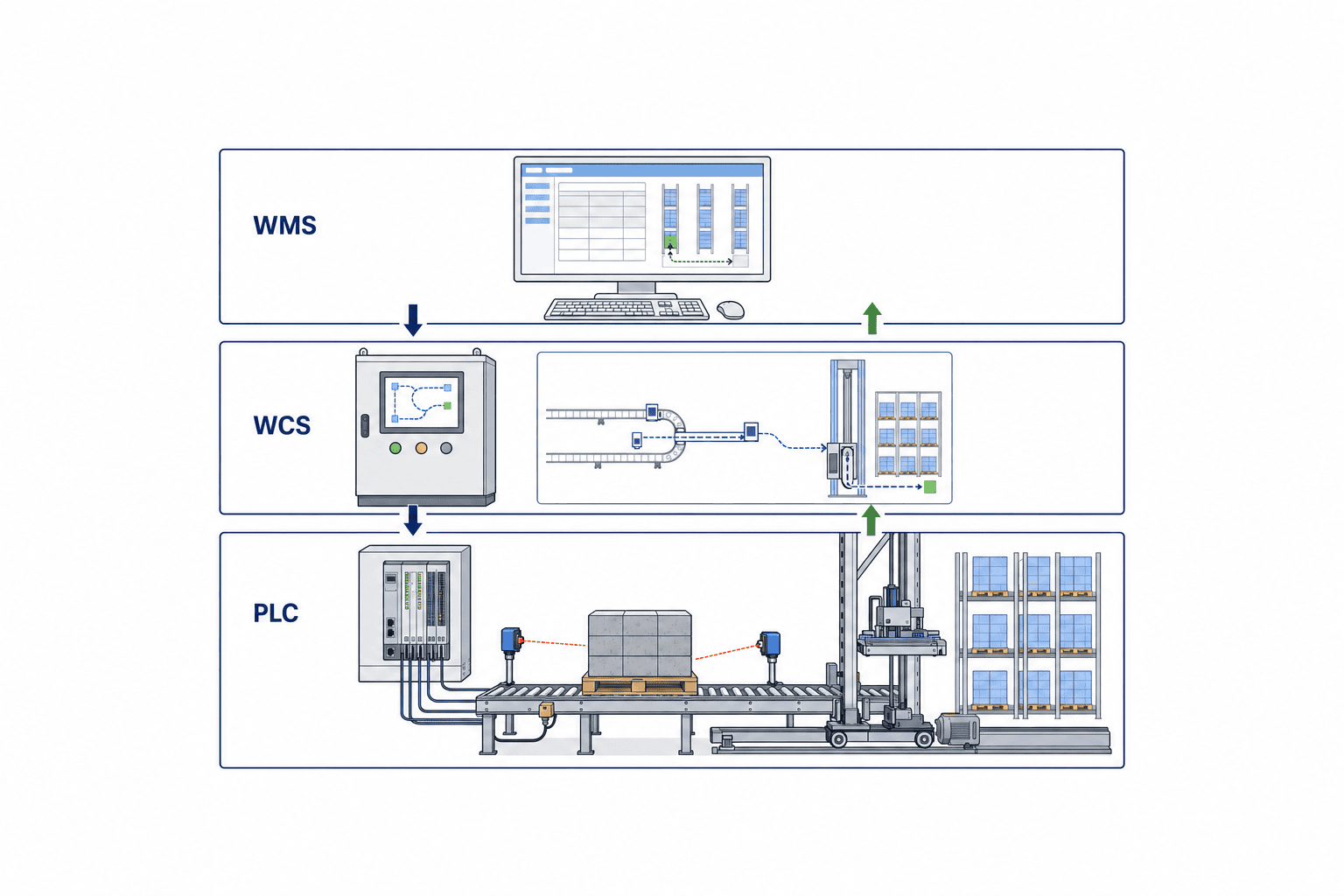
Write down which system authorises induction, assigns a location, creates the crane task, confirms physical placement and updates inventory. Include pallet ID, SKU, lot, expiry and serial data where relevant. Determine how each interface handles a timeout, duplicate message, unreadable barcode, location conflict, urgent retrieval and restart after power loss. Operators need a clear alarm, permitted recovery action and role-based access. SSI SCHAEFER’s High Bay MFS is one example of software coordinating storage machines, conveyors and higher-level systems; purchase requirements should describe the needed behaviour independent of a brand. SSI SCHAEFER: High Bay MFS
Compare stacker crane quotations on identical scope
Split a quotation into crane, rack, rail, forks, conveyors, profile checking, guarding, controls, WMS/WCS integration, civil and electrical works, installation, FAT/SAT, training, initial spares and maintenance. For imported equipment, clarify currency, transport, customs, Thai inland delivery, taxes and exchange-rate responsibility. Costs vary by project and date, so a generic unit price would be misleading.
| Item | Comparable answer required from every bidder |
|---|---|
| Load | Accepted dimensions, mass, pallet types and reject handling |
| Performance | Normal and peak inbound/outbound, test conditions and warranty boundary |
| Storage | Net usable locations, slotting and unavailable positions |
| Construction | Who owns floor, rack, fire protection and electrical design |
| Software | Functions, APIs, recovery, licences and data ownership |
| Service | Access, spares, training and local response |
| Acceptance | FAT/SAT scripts, measures and corrective action |
“60 pallets per hour inside the rack” differs from “60 pallets per hour from receiving to shipping”. State the measured boundary. Dematic’s cited maximum of 60 loads per hour would require an agreed load, aisle geometry, task mix, conveyor and software test condition before it could be used as a site acceptance commitment. Compare total ownership cost over the same company-selected period: capital works, service, replacement parts, software subscriptions, energy and credible downtime scenarios. If labour or electricity savings are claimed, request operating hours and baseline measurements.
Use the same order sample in competing simulations. Ask for queue sizes, utilisation, recovery time after a peak and delays to critical production lines, not only average moves per hour. Preserve model assumptions and logs for the later SAT.
Gather operating evidence before requesting quotations
Collect a representative normal week and busy week. For each pallet, record receipt time, putaway completion, retrieval request, delivery time, SKU, lot and destination. If records are on paper, start with the most important products and time windows. Add the production line’s material deadline, not merely the warehouse dispatch timestamp. For storage, capture daily occupied positions, maximum simultaneous quantity per SKU, dwell time, seasonal variation and stock held for quality inspection. Nominal rack capacity differs from usable capacity when positions are reserved or blocked.
Share photographs of the actual pallet from all sides and underneath, plus damaged examples, dimensions and packaging. Photographs help discuss forks and sensors, but do not replace physical FAT/SAT samples. Separate confirmed load requirements from future expansion allowances so a speculative maximum does not drive today’s equipment cost.
For a fair simulation, give all bidders the same order record, load distribution, starting rack occupancy, task priorities and operating hours. Ask them to disclose acceleration, handoff times, dual-cycle pairing, maintenance stops and slotting rules. Review queue length, waiting times for critical SKUs and time to clear a peak. Stress-test an extra dispatch surge, load rejects and an unavailable crane. A crane with low utilisation might be appropriate resilience; trace whether a delay actually arises at WMS allocation, a conveyor or a staffed outfeed.
Document interfaces and the site transition
The quotation must say who owns each connection between crane, conveyor, WMS and building. An interface schedule should name the sender, receiver, normal acknowledgement, retry, timeout and log retention. Track changes to these points against the throughput guarantee and FAT/SAT scripts. For a retrofit, plan temporary stock, safe construction zones, power cutovers and inventory migration. A phased startup with representative SKUs can validate recovery before the whole warehouse moves. If old and new processes run together, specify who reconciles duplicate stock records and what triggers a rollback.
Set stacker crane FAT and SAT criteria before ordering
Factory acceptance testing (FAT) checks agreed machine controls and simulated interfaces before shipment. Site acceptance testing (SAT) checks the installed rack, actual conveyors, building conditions and operational data. Some site-dependent matters cannot be proven at FAT; list them explicitly for SAT. Define the load samples, test window, expected result and evidence for each case before contract signature.
| Scenario | What to test | How to define pass/fail |
|---|---|---|
| Normal storage/retrieval | Different weights, heights and pallet types | Sample count, success condition and logs |
| Peak load | Concurrent inbound and outbound requests | Task mix, rack distribution, duration and completed moves |
| Bad load | Overhang, unreadable code or damaged pallet | Safe rejection, routing and accurate inventory state |
| Communication loss | WMS/WCS and WCS/PLC interruptions | Recovery without duplicate physical movement |
| Power loss/emergency stop | Controlled restart | Load, location and task state remain consistent |
| Maintenance | Interlocks, modes and permissions | Local SOP and operator training demonstrated |
An empty rack with light pallets travelling to nearby positions does not represent a month-end production peak. Use representative stock and orders, then classify failures by machine, conveyor, software and human process. Agree in advance who performs and pays for corrective work and a retest.
At handover, obtain as-built drawings, electrical diagrams, PLC/WCS backups, interface definitions, alarm lists, spare-parts lists, service instructions, training records and licence details. The Thai operating team needs procedures in a language it can use and must demonstrate recovery on the installed equipment.
Buyer checklist
- Measure real load extremes, damaged-pallet frequency and pallet construction.
- Separate inbound and outbound peaks by hour and duration.
- Record SKU, lot, expiry, FIFO and urgent-order constraints.
- Compare single-deep, double-deep and shuttle options using identical data.
- Check aisle count and stock inaccessible during a crane outage.
- Measure conveyor, inspection, sorting and crane bottlenecks separately.
- Survey building, floor, fire systems, power, temperature and access.
- Allocate WMS/WCS/PLC duties and communication-failure behaviour.
- Normalise each quotation’s scope, currency, construction and service terms.
- Attach load samples, scripts, criteria and retest rules for FAT/SAT.
An unknown does not have to halt procurement. State it as an assumption and ask each bidder to show its effect on price, output and lead time. That makes an omitted software interface or civil work visible in a superficially cheap proposal.
Frequently asked questions
How many stacker cranes does a pallet AS/RS need?
Pallet count alone cannot decide it. Aisle count, simultaneous peaks, port capacity, slotting and required availability determine the answer. Simulate alternatives with the same order record. Daifuku’s example layouts use one crane for 139 pallet positions and three for 1,650, but that ratio cannot be extrapolated to another site. Daifuku: model layouts
Should we choose a crane or a shuttle system?
Compare the share of SKUs needing direct access, depth per lot, required extraction order, peak flow and the failure plan. Deep storage can raise density while constraining access to rear pallets. For time-critical line feeding, measure retrieval waiting-time variation as well as average capacity.
What should be compared besides the quoted price?
The warranted load and test conditions, rack and conveyor boundary, software and civil works, service, spares and FAT/SAT criteria. See our automated warehouse cost breakdown for the broader budget categories.
When should FAT and SAT be defined?
Before ordering. Otherwise the parties may use different interpretations of throughput, test pallets and the software interface. Carry site-dependent items from FAT to SAT and include correction and retesting terms in the contract.
Can a crane AS/RS fit an existing Thai factory?
Sometimes. Survey beam clearance, columns, floor loads, fire systems, utilities and equipment delivery access. Compare lower racks, more aisles or partial automation where a high-bay layout cannot fit.
Summary
Effective stacker crane selection connects the real load, peak work, building, conveyors, inventory software, maintainability and acceptance tests. Catalogue maxima describe specific configurations; bidders must demonstrate the target site and task mix on the same basis. A clear specification and a measurable FAT/SAT plan make competing proposals easier to compare.
If your Thai facility is still gathering pallet measurements or order data, you can contact TOMAS TECH at that early stage. We can help organise the conditions a useful quotation needs.
Primary sources
- Daifuku, Unit Load AS/RS and model systems
- Interroll, PM 9770 and technical data
- Dematic, AS/RS and integration analysis
- SSI SCHAEFER, WAMAS WCS and High Bay MFS
- Mecalux, stacker cranes
All published numbers above refer to the named maker’s particular product or model. They are not a performance guarantee, a Thai regulatory requirement or a generic industry average. The 42/38/30 pallets-per-hour scenario and 24-hour service example are hypothetical planning illustrations.


