



Social security procedure AI has, until now, mostly been framed as a question of accuracy — can AI fill out the forms correctly on its own? In Thailand in 2026, that framing no longer holds, because the assumption underneath it has broken: the government system receiving those filings has become unstable. This article looks at where back-office AI actually helps, from the angle of an in-house design that avoids late fees even when the receiving system is down.
What Changed in Thailand’s Social Security Procedures in 2026 | Two Assumptions Shifted at Once
For management departments based in Thailand, the monthly filing with the Social Security Office was for years one of the most unchanging tasks on the calendar. Submit the contribution declaration by the 15th of each month, and file enrollment and cancellation notices whenever staff join or leave. One person could keep it running — a quiet, routine task.
That quiet routine broke down from two directions at once in 2026. First, the core system on the receiving end — the Social Security Office itself — stopped working properly. Second, the scheme itself has been revised in quick succession, and on October 1, 2026, a brand-new contribution obligation called the Employee Welfare Fund (EWF) will begin.
What matters is that these are not two separate events. When the scheme changes, the forms and calculation base change with it, and the party receiving the filings that reflect those changes is running on an unstable system. Regulatory change and system failure are landing on the same desks, at the same time, handled by the same people.
Assumption Shift 1 | The Receiving System Can No Longer Be Assumed Stable
The Social Security Office spent 850 million baht overhauling its core system and brought the new system online at the end of 2025. But malfunctions began immediately after launch, and as of the end of January 2026, reports indicated the system still had not fully recovered — to the point where reverting to the old system was reportedly under consideration.
What does this mean in practice? Previously, whether a filing was accepted on time was purely a question of whether your side was ready in time. Now there is an additional variable you cannot control: whether the other side is even in a state to receive it.
Assumption Shift 2 | The Calculation Base and Contribution Items Are Both Expanding
From January 1, 2026, the wage ceiling subject to social security contributions was raised, and from October 1 the Employee Welfare Fund contribution begins. The first is a matter of changing a coefficient in an existing formula; the second adds an entirely new ledger and registration process.
Because the two are different in nature, they are different in difficulty. Fixing the coefficient change only requires updating the payroll system’s master data. The new scheme, on the other hand, brings judgment-heavy steps: determining who is covered, whether exemption applies, and managing registration deadlines.
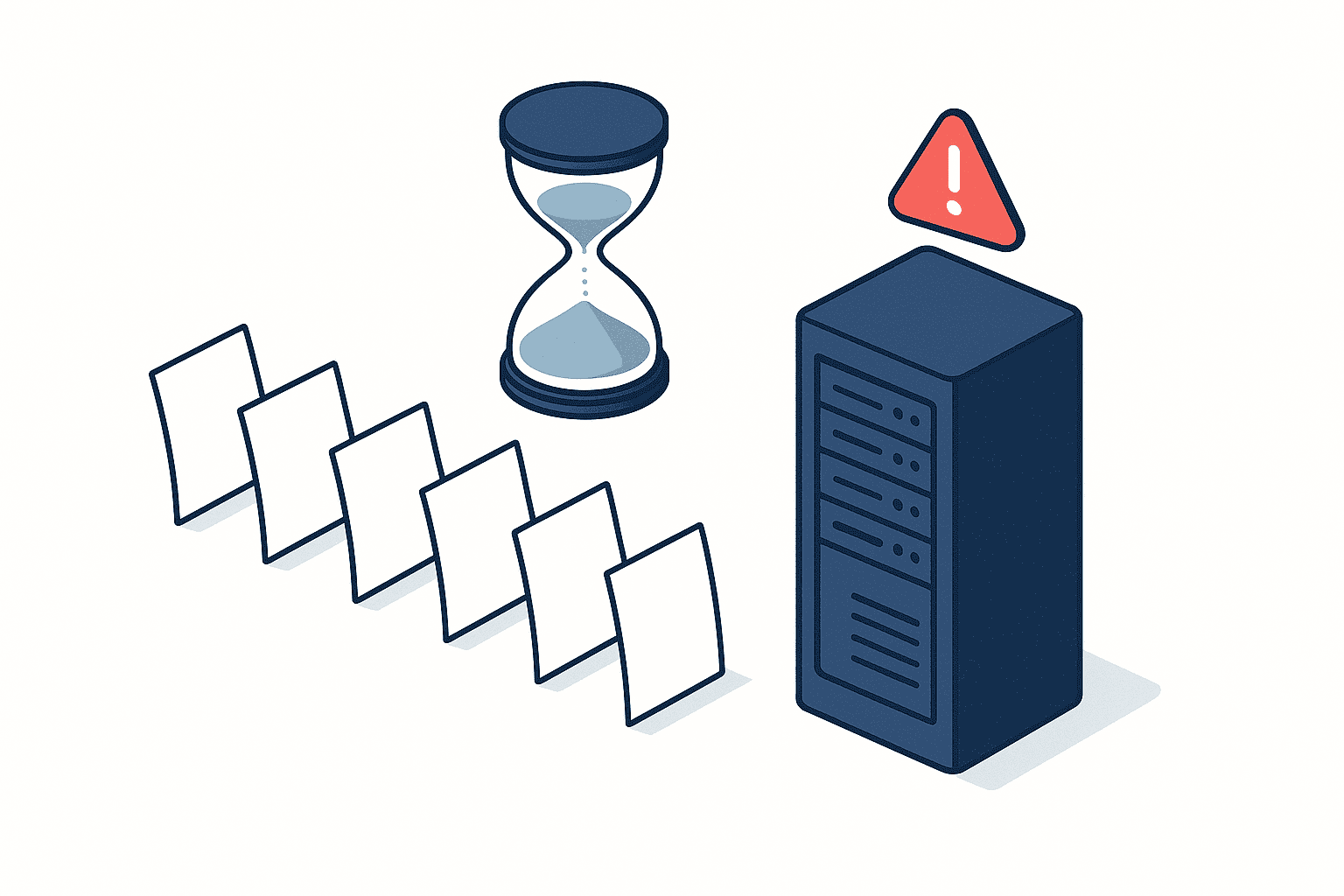
The SSO Core System Outage | Late Fees Don’t Stop Just Because You Can’t Submit
What Happened With the 850 Million Baht System
Piecing together the reported timeline gives the following picture.
| Item | Details |
|---|---|
| End of 2025 | The new core system goes live. Malfunctions begin immediately afterward |
| As of January 28, 2026 | The outage continues. Reverting to the old mainframe is reportedly under consideration |
| Recovery effort | More than 100 staff mobilized on overtime, targeting 35,000 approvals processed per day |
What stands out in this table is that the last row is a target, not a result. Deploying more than 100 people with a goal of 35,000 approvals a day is itself evidence of a backlog that normal operations cannot clear.
As of this writing, no official declaration of full recovery has been confirmed. More than half a year after the outage began, there is no clear follow-up report showing it has been resolved. Companies would do well to plan on the assumption that instability could persist through the rest of the year.
The practical impact is straightforward. Until the backlog clears, individual filings may sit waiting longer than expected. The gap between the day you submit, the day it is accepted, and the day processing completes will likely be wider than in normal times.
The 2% Monthly Late Fee Doesn’t Ask Whose Fault It Was
The monthly contribution declaration, Form SPS.1-10 (สปส.1-10), must be filed by the 15th of the following month, and late filings incur a monthly late fee of 2% of the unpaid amount. This is where the process becomes coldly indifferent.
The late fee is levied on the outcome, and the scheme does not automatically distinguish whether the delay was your own negligence or the other side’s system failure. Authorities may grant case-by-case relief for delays caused by system outages, but that is a matter for after-the-fact negotiation, not something you can count on in advance.
Take a site with total monthly contributions of 300,000 baht that files one month late. The late fee would be 6,000 baht, not a crippling amount. But the real problem is not the money. It’s that a record of the delay now exists, and that clearing it means someone has to go to the office in person, explain what happened, and gather supporting documents.
Management departments at Japanese manufacturing sites in Thailand tend to be lean, with accounting, HR, and general affairs often covered by just a few people wearing multiple hats. It isn’t hard to imagine what happens when this kind of unplanned explanation work collides with month-end closing or an audit.
The Right Way to Respond to a Variable You Can’t Control
The stability of the other side’s system is not something your effort can change. Against something you cannot change, there are, in principle, only three moves available:
- Act early. Try to submit with margin to spare, rather than right up against the deadline
- Keep records. Document when, what, and in what state you attempted to submit
- Prepare an alternative route. Decide in advance on the in-person filing procedure for when e-filing doesn’t go through
All three can be done by hand, without AI or any system. But when done by hand, they always get pushed aside by the rest of the month’s work. That’s exactly why they are a good candidate for automation.
The EWF Launching October 1, 2026 | A New Obligation Called the Employee Welfare Fund
A Postponed Scheme Is Now Confirmed
The Employee Welfare Fund had its implementation postponed by a year, but its launch on October 1, 2026 is now confirmed. It applies to establishments with 10 or more employees, with both employer and employee each contributing 0.25% of wages, rising to 0.5% from October 2031.
It’s tempting to treat this as “still in the future,” but covered establishments face a new registration obligation. The first contribution will be deducted from October 2026 wages and paid by the 15th of the following month. Given that establishments nationwide are likely to rush to register right before the deadline, starting with time to spare is the realistic move.
Note that EWF registration and reporting fall under the Department of Labour Protection and Welfare at the Ministry of Labour, a separate system from the Social Security Office, where the outage is occurring. The two are not technically connected. Even so, in practice, the same staff will be handling two different kinds of work at the same time. The accurate way to describe it is that the workload overlaps.
The Late Fee Rate and Enforcement Are Heavier Than Social Security’s
The EWF’s contribution rate is small, but the penalties for non-compliance are designed to be heavier than the late fee on the monthly social security contribution.
| Item | Social Security Monthly Contribution | Employee Welfare Fund |
|---|---|---|
| Contribution rate | 5% of wages (employer and employee each) | 0.25% of wages (employer and employee each; 0.5% from October 2031) |
| Wage ceiling | 17,500 baht per month | No ceiling |
| Coverage | Insured persons at covered establishments | Establishments with 10 or more employees |
| Late fee | 2% per month | 5% per month |
| Other penalties | Recovery of unpaid amounts | Asset seizure and auction by labor inspectors |
| Criminal penalty | Provided separately under the Social Security Act | Imprisonment of up to 6 months or a fine of up to 10,000 baht, or both |
| Start date | Existing scheme | October 1, 2026 |
The row most likely to be misread here is the criminal penalty row. This doesn’t mean social security carries no criminal penalty — the Social Security Act has its own penalty provisions for violations of filing obligations. What’s being compared here is the late fee rate and the enforcement mechanism, and on those two specific points, the EWF is the heavier of the two.
Another point worth not overlooking is the wage ceiling. Social security contributions cap out at 17,500 baht per month, but the EWF’s 0.25% has no ceiling. Because the wages of managers and expatriate staff feed directly into the contribution base, sites with more high earners will bear a heavier burden than the small contribution rate suggests.
Exemption Is Determined at the Business-Establishment Level
Establishments that already have a legally recognized alternative scheme in place, such as a provident fund, may qualify for exemption. Because many Japanese manufacturing sites in Thailand already offer a provident fund as part of their benefits package, the first task is to check whether your company qualifies for exemption.
The point most commonly misunderstood here is the unit at which exemption is judged. According to the BDO commentary used as a source for this article, exemption is granted only to schemes that fully comply with the Provident Fund Act and cover every single employee without exception, including those still on probation and those who opted out of enrollment. In other words, the determination is made at the establishment level, and it is all or nothing.
Reading this as “only enrolled employees are exempt, while the EWF still applies to those who aren’t enrolled” leads to a major misstep. If the scheme is designed so that only certain positions are enrolled, exemption does not apply at all, and every employee at that establishment remains subject to the EWF. In that case, the choice comes down to two options: extend provident fund enrollment to all employees to qualify for exemption, or register for the EWF and contribute.
In other words, the first step in dealing with the EWF isn’t a systems question — it’s the distinctly unglamorous data work of cross-checking your existing benefits regulations against your enrollment roster to confirm whether every employee is covered. And the answer to that question determines everything that follows.
The Contribution Ceiling Revision to 17,500 Baht | The Calculation Base Changes for the First Time in 30 Years
Effective January 1, 2026, the wage ceiling subject to social security contributions was raised from 15,000 baht to 17,500 baht per month. It’s the first revision in roughly 30 years, and is said to affect more than 4 million people.
From the employer’s side, the per-employee monthly ceiling rises from 750 baht to 875 baht, an increase of 125 baht per employee per month.
The amount looks small, but its impact scales with headcount. At a site with 150 employees earning more than 17,500 baht a month, that’s an increase of 18,750 baht a month, or 225,000 baht a year. The higher the proportion of managers at a site, the bigger the impact.
The mistake most likely to occur with this revision isn’t about the ceiling itself, it’s about correctly identifying which employees are now “at the ceiling.” Among those who previously capped out at 15,000 baht, anyone earning under 17,500 baht now reverts to a calculation based on actual wages. Because employees who remain capped and employees who no longer are now sit side by side, a single uniform coefficient change cannot handle it.
The design needed on the payroll side to correctly branch this logic follows the same structure discussed in the three-layer design for payroll calculation AI: effort concentrates not in the calculation itself, but in what happens before and after it.
The Role of Social Security Procedure AI | Confirming Before Submission, Not Filing on Your Behalf
Given everything above, what should you actually expect from social security procedure AI? It isn’t about having AI log into the government portal and file on your behalf. It’s about confirming what you’re about to submit before you submit it.

Thinking in Four Layers
Breaking down the social security filing process gives four layers.
| Layer | Step | Main Work | AI Suitability |
|---|---|---|---|
| Layer A | Event detection | Catch every hire, departure, wage change, and change of name or address without missing any | High |
| Layer B | Data formatting | Convert data into the fields each form requires and flag anything missing | High |
| Layer C | Pre-submission validation | Cross-check against scheme requirements and verify contribution amounts and covered employees | High |
| Layer D | Submission and confirmation | Submit to the portal, obtain the receipt number, and store the record | Limited |
When most companies think about automation, Layer D is the first thing that comes to mind. Watching a person open a browser and type into the portal looks like the most “unautomated” part of the process.
But the actual burden of work and mistakes concentrates in Layers A through C. A departing employee’s cancellation notice not caught until the following month. A wage change that never made it into the contribution amount. The headcount for EWF coverage counted differently department by department. Every one of these mistakes happens before the submit button is ever pressed, and no amount of speeding up Layer D would have prevented them.
And the instability of the government-side system in 2026 pushes this conclusion further. Automating Layer D depends on the specifications and stability of the other side’s portal. Building it out while the other side keeps changing is like constructing a building on ground that’s still shifting. Layers A through C, by contrast, are self-contained within your own data and are not affected by the other side’s state.
What Layer C Actually Does
Concretely, Layer C validation means cross-checks like these:
- Does the wage figure in the payroll master match the calculation base for the contribution amount?
- Are employees subject to the 17,500 baht ceiling correctly identified?
- Does the difference between last month’s and this month’s insured headcount match the record of hires and departures?
- Does the provident fund enrollment roster cover every employee on the staff roster without exception? If not, the EWF applies to all employees
- Where a company has multiple branches or plants, does the establishment-level total reconcile with the company-wide total?
None of these is “calculation,” they are all “reconciliation.” This isn’t the kind of text-generation task generative AI is known for; it’s rule-based cross-checking, combined with explaining any mismatch in terms a person can follow. This is a good fit for AI agents that can carry out multiple steps while presenting their reasoning, and companies are, in fact, shifting from simple question-and-answer use of AI toward delegated execution that includes deadline management. An industry survey found that the average number of AI agents deployed per organization grew from 5 in early 2025 to 13 by April 2026, a figure that supports this shift.
Thailand Social Security E-Filing Forms and Deadlines | Turning Four Forms Into a Process
The Four Forms You Need to Know
In day-to-day Thai social security work, there are effectively four forms in play.
| Form | Purpose | When It’s Triggered |
|---|---|---|
| SPS.1-03 (สปส.1-03) | Insured-person enrollment notice | Upon hiring |
| SPS.6-09 (สปส.6-09) | Insured-person cancellation notice | Upon departure |
| SPS.6-10 (สปส.6-10) | Change notice | Upon changes to name, address, wages, etc. |
| SPS.1-10 (สปส.1-10) | Monthly contribution declaration | Every month, by the 15th of the following month |
All four forms carry a statutory deadline, but the nature of the deadline splits into two types. SPS.1-10 (สปส.1-10) runs on the calendar, filed by the 15th of the following month, with delays subject to a monthly 2% late fee on the unpaid amount. Because the same date comes around every month, it’s straightforward to manage.
The other three forms run on the date the triggering event occurs. The clock doesn’t start until a hire, departure, or change actually happens, so if you haven’t caught the event in the first place, deadline management never even begins. In practice, the real challenge isn’t “can we meet the deadline” so much as “can we avoid missing the event.” Sites with frequent local hiring or short-term contract turnover on the factory floor are especially prone to missing these.
Check E-Filing Eligibility Ahead of Time
The Social Security Office’s electronic channels include several access points, including an employer filing system and a mobile app. Registering as an employer to use e-filing requires submitting documents such as the commercial registration certificate, identification, and a power of attorney, and review is said to take 3 to 5 business days. That’s the normal-times estimate; it’s safer to plan for it taking longer during a period when the system is unstable.
Even at sites that already use e-filing, access can lapse when the responsible staff member changes or the power of attorney expires. Ahead of the EWF registration starting in October 2026, it’s worth checking the validity of accounts and powers of attorney now.
Manage Deadlines by “Finalization Date,” Not “Submission Date”
What works in practice is holding the deadline in two stages. Separate from the statutory deadline of the 15th of the following month, set an internal content-finalization date several business days earlier. Once that date passes, the numbers don’t move, and every remaining day is devoted to attempting submission and confirming receipt.
This two-stage approach is especially effective while the other side’s system is unstable. If finalization slips to the 15th itself, and the portal doesn’t respond that day, there’s nothing left you can do. Set the finalization date on the 10th instead, and you keep five days of room for retries and switching to in-person filing.
A Design That Avoids Penalties Even When Government Systems Go Down | The In-House Backup Layer

What Is a Backup Layer
The backup layer described here isn’t about server redundancy. It’s a business-process layer that keeps your side in a state where, even if the receiving end can’t accept a filing, you have finalized what needs to be submitted before the deadline and hold a record that you attempted to submit it.
This layer needs four capabilities:
- Save the finalized content to be submitted, as a file, per form
- Record the date and time of each submission attempt and its outcome
- Store the receipt number or confirmation screen whenever one is obtained
- When submission fails, automatically surface the next scheduled attempt and the alternative route
The Practical Value of a Paper Trail
A paper trail isn’t a magic device that gets your late fee waived. But when it comes time to discuss a delay caused by a system outage with the authorities, having content finalized before the deadline and a record of multiple submission attempts changes how that conversation goes.
There’s practical value beyond that, too: this record helps with audits. Japanese companies sometimes face questions from head-office internal audits or financial audits about the validity of their social security contributions, and whether you have material on hand to explain “why the filing was late” directly affects how much of a burden that puts on staff.
Designing the Alternative Route
The alternative to e-filing that doesn’t go through is in-person submission at the office counter. Looking this up for the first time during an emergency won’t leave enough time. Document, during normal times, the jurisdiction of the relevant office, its opening hours, the full set of documents you need to bring, and your internal approval process for taking them off-site.
This documentation, once done, lasts for years, yet nobody gets around to it in normal times. With the EWF’s firm launch date, 2026 is an easy moment to use as the reason to finally do it.
The Backup Layer and AI
None of the backup layer’s individual functions requires advanced technology on its own. What’s hard is sustaining it. The only real question is whether it gets carried out reliably, every month, without being pushed aside by other work.
That’s exactly why this layer should run on a system, not on someone’s willpower. Generate tasks by counting back from the deadline, lock in the content on the finalization date, log the outcome of each submission attempt, and follow up again if something is still incomplete. This whole sequence is a natural fit to delegate to an AI agent. The ideal setup escalates only the exceptions that require judgment to a person, while everything else keeps running quietly on its own.
The Payroll AI Integration Perspective | Don’t Design Social Security Automation in Isolation
If the Upstream Is Dirty, the Downstream Can’t Be Fixed
Social security contribution amounts are mechanically derived from payroll results. That means automating social security procedures alone is pointless if the payroll data underneath it isn’t correct. A wage change that never got reflected, a wrong hire date, a benefit misclassified for tax purposes: every one of these becomes an error in the contribution amount.
This is a point that keeps coming up as companies introduce AI process by process. What Is Back-Office AI named three conditions for a process where AI tends to pay off quickly: the rules are clearly documented, exceptions are infrequent, and the input data is structured. Social security procedures satisfy the first two, which already makes them a strong candidate. The third, whether the input data is structured, depends on the state of payroll. Once the upstream is in order, the third condition falls into place too, and the range and accuracy of what can be automated expands another notch.
Toward Automatic Reflection of Regulatory Changes
Industry forecasts suggest that 2026 is the year payroll systems move toward automatically reading and applying regulatory changes, with revisions like the contribution ceiling increase or the EWF mandate arriving as system-side updates rather than manual master-data edits.
That said, this direction shouldn’t be over-relied on. Automatic reflection works for clear parameters like “a rate” or “a ceiling amount,” but judgment calls, such as whether your own benefits scheme meets the EWF exemption requirements, won’t be filled in by an external system update. Parameters come down from outside; judgment stays with your company. Designing with that line in mind matters.
Overlap With Adjacent Processes
Back-office HR and labor processes lose much of their value when social security is automated in isolation. Departure procedures trigger a cancellation notice and a severance calculation at the same time, and the hardest part of that calculation touches on issues like the special dismissal compensation covered in severance pay calculation AI. Payment items that sit on the border between expenses and benefits connect to the documentation requirements discussed in the expense report AI implementation guide.
Rebuilding automation design around events, hiring, departure, wage change, rather than around individual processes naturally sorts out these overlaps.
Implementation Sequence | A Reverse-Engineered Schedule to the EWF Launch
Running in Parallel to Meet the First Payment Deadline
One thing worth facing directly here: as of this article’s publication, roughly one month remains until the October 1, 2026 effective date. The steps below add up to about three months of work, so running them one after another won’t get you there in time.
On the other hand, the first payment deadline is November 15, covering October 2026 wages. So the realistic goal isn’t “finish everything by the effective date,” it’s “be able to correctly finalize the contribution amount by the first payment.” The following table shows the effort needed for each stage on the assumption that the stages run in parallel rather than in sequence, against that goal.
| Stage | Content | Estimated Duration |
|---|---|---|
| Stage 1 | Cross-check the employee roster against the benefits regulations; determine EWF exemption | 3 weeks |
| Stage 2 | Verify the validity of the e-Service account and power of attorney; document the alternative route | 2 weeks |
| Stage 3 | Automate Layers A through C; begin operating the finalization-date rule | 4 weeks |
| Stage 4 | Validate through parallel operation; finalize the paper-trail format | 3 weeks |
The stage most commonly overlooked here is Stage 1. Because it isn’t a systems question, it tends to get pushed back, but the Stage 3 validation rules can’t be written until this is settled. Even on the assumption that everything else runs in parallel, Stage 1 alone needs to start first. Whether exemption applies determines whether the population handled in later stages is zero people or every employee.
Don’t Cut the Parallel-Run Period Short
The Stage 4 parallel run is the period where you run the old manual process and the new system side by side and confirm the results match. Cut this short, and if a mismatch turns up on the first real run, there’s no way to tell which side was right.
The social security monthly cycle only turns over once a month, so a three-week window really only gives you one real opportunity to validate. Given that constraint, you need a way to validate without waiting on the monthly cycle. Running several months of past payroll data through the new system and checking it against what was actually filed at the time, a retrospective validation, lets you run multiple checks without waiting for a single cycle.
What Should Not Be Left to AI
When deciding the scope of automation, three things should remain human judgment calls:
- The final determination on exemption. Because it involves interpreting the scheme, it should go through a licensed labor consultant or advisor
- Negotiating with the authorities. Explaining the circumstances of a delay or requesting relief requires shared context
- Handling exceptional employment types. Secondees, employees still on probation, and short-term contract workers each need individual judgment
Leave these to AI, and you get plausible-sounding conclusions whose grounds don’t actually match the scheme’s real provisions. The governing principle for using AI in the back office is this: delegate reconciliation and validation, not interpretation and negotiation.
Frequently Asked Questions
Can our company complete social security e-filing entirely on its own?
Technically, yes. Once you complete employer registration for e-filing, you can submit enrollment notices, cancellation notices, change notices, and monthly contribution declarations all electronically. That said, as of 2026, given the system’s instability, we recommend also preparing a fallback procedure for in-person filing at the office counter. Registration also requires documents such as the commercial registration certificate and power of attorney, and review takes 3 to 5 business days.
By when does EWF registration need to happen?
The effective date is October 1, 2026, and establishments with 10 or more employees face a new registration obligation. In practice, the contribution is deducted from October 2026 wages and paid by the 15th of the following month, making the first payment deadline November 15. The details of registration will follow official guidance from the authorities, but given that covered establishments are likely to move all at once, starting before the effective date is the realistic approach.
If we already have a provident fund, is the EWF unnecessary?
It depends on the conditions. According to the BDO commentary used as a source for this article, exemption is granted only to schemes that fully comply with the Provident Fund Act and cover every employee without exception, including those still on probation and those who opted out. The determination is made at the establishment level, and it’s all or nothing. If the scheme only covers certain positions, exemption doesn’t apply, and every employee becomes subject to the EWF. Start by cross-checking your enrollment roster against your employee roster to confirm there are no gaps. If there are gaps, the choice is either to extend enrollment to everyone to qualify for exemption, or to register for the EWF and contribute.
If a government system outage delays our filing, is the late fee waived?
No automatic waiver mechanism has been confirmed as part of the scheme. There is room to negotiate with the authorities case by case, but it isn’t something you can count on in advance. That’s exactly why finalizing content before the deadline and keeping a record of your submission attempts serves as your practical line of defense.
Can we automate social security procedures without replacing our payroll system?
Yes. In fact, it’s better to start with a layer that takes existing payroll output as input and handles form-specific formatting and pre-submission validation; that requires less investment and less switchover risk. Overhauling the payroll system itself can wait until social security handling has stabilized.
Conclusion
Social security procedures in Thailand in 2026 sit in an unprecedented situation: regulatory revision and an unstable filing infrastructure are unfolding at the same time. The contribution ceiling has been raised for the first time in 30 years, a new obligation called the Employee Welfare Fund begins in October, and meanwhile the receiving system is still recovering.
What works in this situation isn’t automating input into the government portal. It’s building an in-house layer that finalizes what needs to be submitted before the deadline and keeps a record of the attempt and its outcome. Event detection, data formatting, and pre-submission validation, steps that stay self-contained within your own data, aren’t affected by the other side’s condition, and they become an asset as-is.
And the deadline for putting this in place isn’t set by your own convenience, it’s set by the scheme. The EWF’s fixed effective date is a reason you can’t push this off.
Whether EWF exemption applies given your own workforce, and how much of your existing payroll process can be automatically validated, these are questions that can’t be answered without looking at your actual data. TOMAS TECH has worked on both the back-office processes and the systems behind them for Japanese manufacturers in Thailand. Even if you haven’t decided to move forward yet, feel free to reach out through our contact page — a simple stocktake of where things stand, or help thinking through next steps, is a fine place to start.
References
- Report on the SSO’s New Core System Outage – DroidSans, January 28, 2026
- Employee Welfare Fund is back – BDO Thailand, August 7, 2026
- Thailand Social Security 2026 – RBA Asia
- Thailand social security contribution changes for 2026 – HLB Thailand
- Guide to Filing Social Security Online for Employers – ByteHR
- Official SSO Documentation on Monthly Contribution Filing and Late Fees – PDF
- Social Security Office e-Service Official Portal
- Payroll automation trends 2026 Thailand – Sprout Solutions
- AI Update August 21, 2026 – MarketingProfs


