


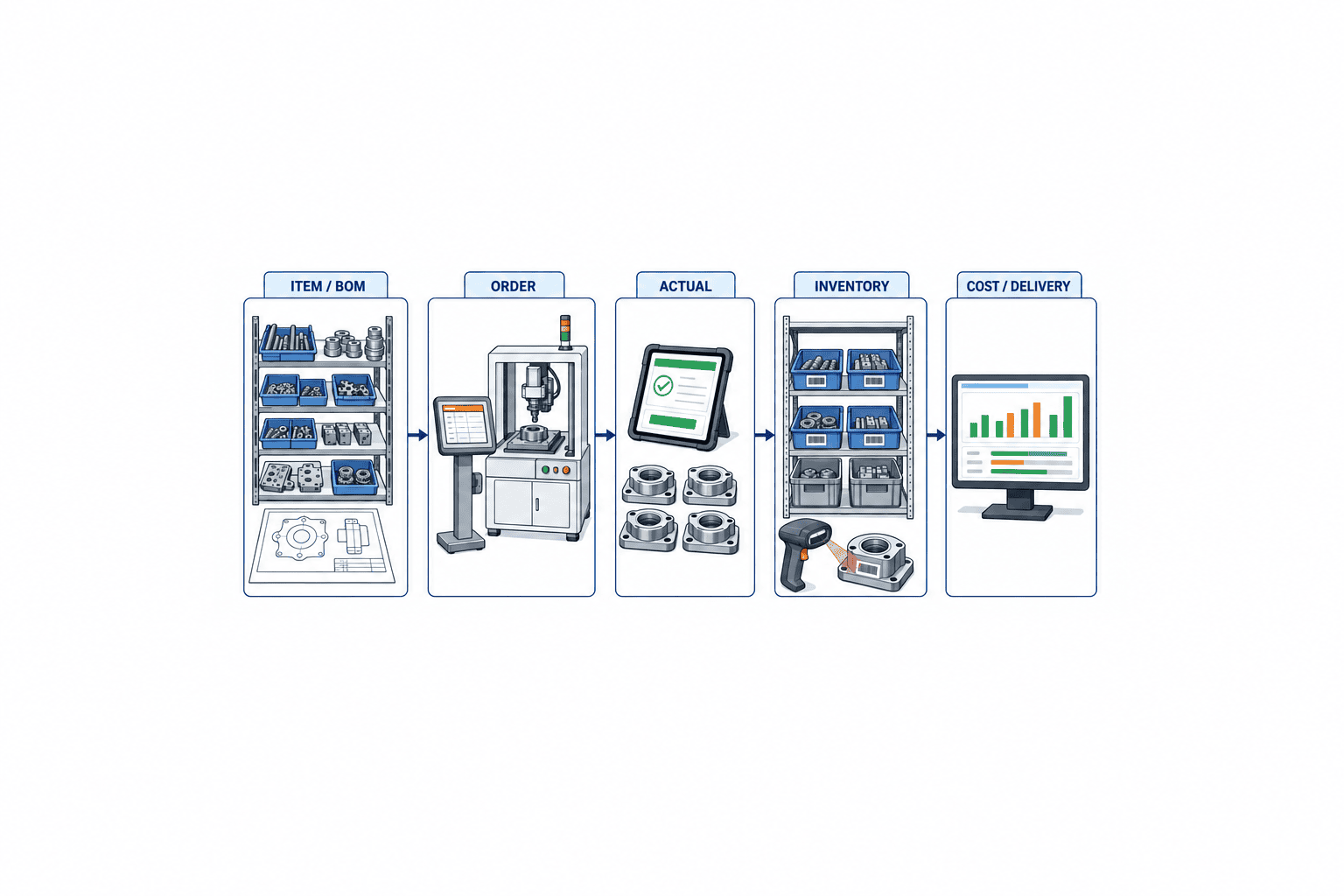
A production management system for a small factory does not need to begin with every sales, purchasing, planning, quality, maintenance, costing and accounting function switched on. It should begin with the shortest reliable chain of data that prevents a recurring operational loss. This guide is written for owners, plant managers and administration leaders at small manufacturers in Thailand and ASEAN. It explains how to choose among five minimum control objects—item and BoM, order and work order, actual result, inventory, and cost/delivery—and then decide whether to keep Excel, adopt a package, commission custom development or combine them.
The short answer: start with two or three connected objects, not an “all-in-one” scope
The five objects below are not five modules that must be purchased together. They are five sets of questions. Select the two or three that form an unbroken path from an operational event to the decision you need to improve.
| Minimum control object | Question it must answer | Minimum records | Typical symptom that makes it urgent |
|---|---|---|---|
| Item and BoM | What are we making, from what, and under which revision? | item, BoM, substitute, revision | wrong material, obsolete drawing, planning mismatch |
| Customer order and work order | What quantity must be made, by when, under which instruction? | order, due date, work-order ID, route | missed instruction, duplicate instruction, priority confusion |
| Actual result | What was completed, where, when and in what quantity? | good/reject quantity, time, operation, stop reason | unknown progress, late daily report, manual consolidation |
| Inventory | What is available, at which location, in which lot? | receipt, issue, transfer, WIP, shipment | shortage, excess stock, count variance |
| Cost and delivery | What did it cost, and will it be on time? | material, labor, subcontract, planned/actual dates | margin discovered late, late-delivery surprise |
If material shortages stop production, connect item/BoM, work orders and inventory first. If customers keep calling for progress, connect work orders, actual results and delivery dates. If profitability is the priority but material usage and labor time are unreliable, a sophisticated costing module should not be first. The initial scope must include the data source that makes the management number credible.
“Small factory” is an operating condition, not just an employee count
Thailand’s Office of SMEs Promotion defines a small manufacturing enterprise as having annual revenue above THB 1.8 million and not exceeding THB 100 million, or employment above five and not exceeding 50. If revenue and employment fall into different classes, the higher class is used. This is a policy definition; it does not determine the complexity of a factory system. OSMEP: Definition of MSMEs
System complexity is driven by factors such as:
- the number of active items, BoM levels and engineering changes;
- whether make-to-stock, make-to-order and engineer-to-order coexist;
- operations, subcontract steps, shared machines and setup constraints;
- the traceability boundary across material, WIP and finished goods;
- Thai, English and Japanese approvals and documents;
- interfaces with HQ ERP, accounting, customer EDI and label equipment; and
- the volume of exceptions: rework, reversal, substitution and manual correction.
A 30-person plant producing a stable range can use a simple system. A 10-person plant with order-specific designs, repeated BoM revision and subcontract processing may need stricter controls. Do not accept “SME edition” as proof of fit. Count how many records and decisions one order creates before shipment.
In April 2025, Thailand’s Digital Economy Promotion Agency published findings from its 2024 Digital Density Survey. It described much of Thai industry as being at Industry 2.0 and reported that 57% of the manufacturing sample had reached the “Solution” level in supplier relations, using tools such as online order and payment systems. This does not assess any individual plant. It does support a practical priority: stable connections among basic commercial and manufacturing data often deserve attention before advanced optimization. depa: 2024 Digital Density Survey
Why an all-in-one implementation can overwhelm a small manufacturer
An integrated suite is not inherently wrong. It can be the right answer when a group needs one backbone across sites and finance, purchasing and manufacturing. The danger for a small plant is the amount of simultaneous change. Master data, approval, documents, month-end routines, interfaces, training and migration may all change while the same people are still running daily production.
A familiar sequence follows:
- A feature-rich demonstration wins attention.
- Each department adds “just in case” requirements.
- Item codes, units and stock balances turn out to conflict.
- The team tries to reproduce every spreadsheet exception before go-live.
- Training becomes a tour of screens rather than practice in real scenarios.
- Users keep the old spreadsheets, creating two competing sources of truth.
The answer is not simply to delete features. For each selected object, define the authoritative record, who updates it, when it becomes effective, and how an error is reversed. Japan’s Information-technology Promotion Agency structures its guidance for smaller manufacturers around a target state, self-assessment, implementation steps and cases—an approach consistent with staged change instead of indiscriminate digitization. IPA: Digital transformation in manufacturing for small and medium-sized manufacturers
Minimum object 1: item and BoM—control changes before adding attributes
Item and bill-of-material data supports planning, material issue, costing and traceability. The first release does not need every possible attribute. It needs a stable identity and controlled changes:
- unique item code and a recognizable shop-floor name;
- purchased, semi-finished and finished-goods classification;
- base unit and conversions for purchasing, storage and production;
- parent, component, standard usage and yield convention;
- effective date, revision and approval of the BoM; and
- rules for substitutes and who may approve them.
Small factories often use different names for the same material on a drawing, quotation, purchasing list and issue sheet. A company-wide recoding exercise is not always necessary on day one. Select a representative product family and enforce one code per item across its order-to-shipment flow. Extend after the rule works.
Acceptance testing must go beyond opening a normal BoM. Test an order released before a revision becomes effective, a substitute material, a unit conversion, a discontinued component and a correction. A new BoM must not silently alter already released work orders. For engineer-to-order production, decide whether the standard BoM or project BoM is authoritative and how approved changes reach purchasing and WIP.
Excel can remain appropriate where few people make changes, revisions are infrequent and history and approval are controlled. When several people update the structure, or a wrong revision can directly cause scrap or delay, a database-backed BoM may be the most valuable first control even if other planning remains in Excel.
Minimum object 2: customer order and work order—preserve the chain of IDs
The purpose of order control is not to display a beautiful schedule. It is to translate customer demand into executable factory instructions and preserve every important change. At minimum, link customer order, customer part, internal item, quantity, requested date, committed date, work-order ID, BoM revision, route and planned date.
At Japanese-affiliated plants in Thailand, headquarters or customers may communicate in Japanese or English while the shop floor works in Thai. Full translation of every screen is not the first problem to solve. Use language-neutral codes, language-specific display names and a clear rule for free-text fields. A status such as HOLD or RELEASED must mean the same thing in every language.
Do not overwrite major changes without history. Quantity reductions, pull-ins, partial shipments, cancellation and reprioritization should record who changed what, when and why. The goal is not to forbid urgent decisions. It is to ensure that a priority changed on a whiteboard or chat message is reflected against a work-order ID, so that plan and actual can later be compared.
Test split orders, post-release quantity changes, prevention of reporting against cancelled orders, over-completion and the interaction between a pulled-in date and missing material. A small factory may not need an advanced scheduler. It still benefits from one authoritative work-order list and a visible list of today’s changes.
Minimum object 3: actual result—capture at a granularity people can sustain
Actual-result projects can be distracted by one-second machine data or recording every operator motion. Start with what is required to manage an order: operation, good quantity, reject quantity, start/finish or reporting time, operator or machine, and stop/reject reason where relevant.
Choose the reporting unit from piece, box, lot, job completion or shift completion. The finest technically possible granularity is not automatically the best. Use the granularity that balances decision speed and input effort. Piece-level tracking needs a clear reason such as serial traceability or high unit value. Requiring real-time input for an operation that only needs a daily total can encourage delayed and proxy entries, destroying the meaning of timestamps.
Select tablets, handhelds, shared PCs or automatic machine collection at the point of work. Validate gloves, oil, dust, battery, Wi-Fi gaps, shift handovers, Thai text and dirty barcodes. A large button is not enough if the operator must search through hundreds of work orders. Scanning the order traveler to identify one job can be more important than a polished dashboard.
Corrections must be designed, too. Preserve before/after values, reason and approval rather than deleting a mistake. Test additions to yesterday’s result, a correction after costing cutoff, duplicate transmission and replay from an offline device. A simple daily exception list is often more valuable than a complex analytics page during the first phase.
Minimum object 4: inventory—standardize events before chasing a perfect balance
Inventory mathematics is simple: opening balance plus receipts minus issues. Inventory still disagrees because physical movements are not recorded consistently. Define the event vocabulary first: supplier receipt, material issue, location transfer, operation transfer, finished receipt, shipment, return, scrap and count adjustment.
Do not necessarily start with every warehouse, item and lot. Start with the material family where shortages or variances cause the greatest loss, or with one controlled warehouse. But define the boundary in three dimensions—location, items and events. “Twenty critical raw materials in Warehouse A, from receipt through production issue” is clear. “Inventory pilot” is not.
Barcodes and QR codes can reduce entry effort, but weak label governance creates new errors. Decide how reprints work. Does a reprint invalidate the old label, or represent a quantity split? If the network fails, store an event locally and give it an immutable transaction ID so that retry does not double-count the movement.
Choose a negative-inventory policy deliberately. Blocking negative stock detects errors early but may stop reporting where postings lag physical work. Allowing negative stock protects flow but requires an owner and deadline for exception clearance. The right answer depends on recording discipline; silence is the wrong answer.
Minimum object 5: cost and delivery—make every variance traceable to action
Cost and delivery are management outputs, but their evidence begins on the shop floor. A small implementation should not aim immediately for perfect agreement with financial absorption costing. It should define which variance matters and make that variance explainable.
A minimum production-cost view can combine standard or actual material, labor time and subcontract charge. Equipment depreciation, energy and overhead allocations can follow later. Select one actionable variance: material usage, labor, reject/rework or subcontract. If users can drill from the variance to the order, transaction and correction, the number can support improvement.
For delivery, keep requested date, committed date, internal plan and actual shipment as separate fields. One column called “due date” cannot show whether the original request was unrealistic, the promise was changed, internal planning slipped or manufacturing ran late. Link operation completion to the committed date so that risk appears while WIP still exists, not after the shipment KPI turns red.
Management dashboards should link totals back to controllable detail. A red number without a work order, shortage, delay reason or owner is only decoration.
When continuing with Excel is a sound decision
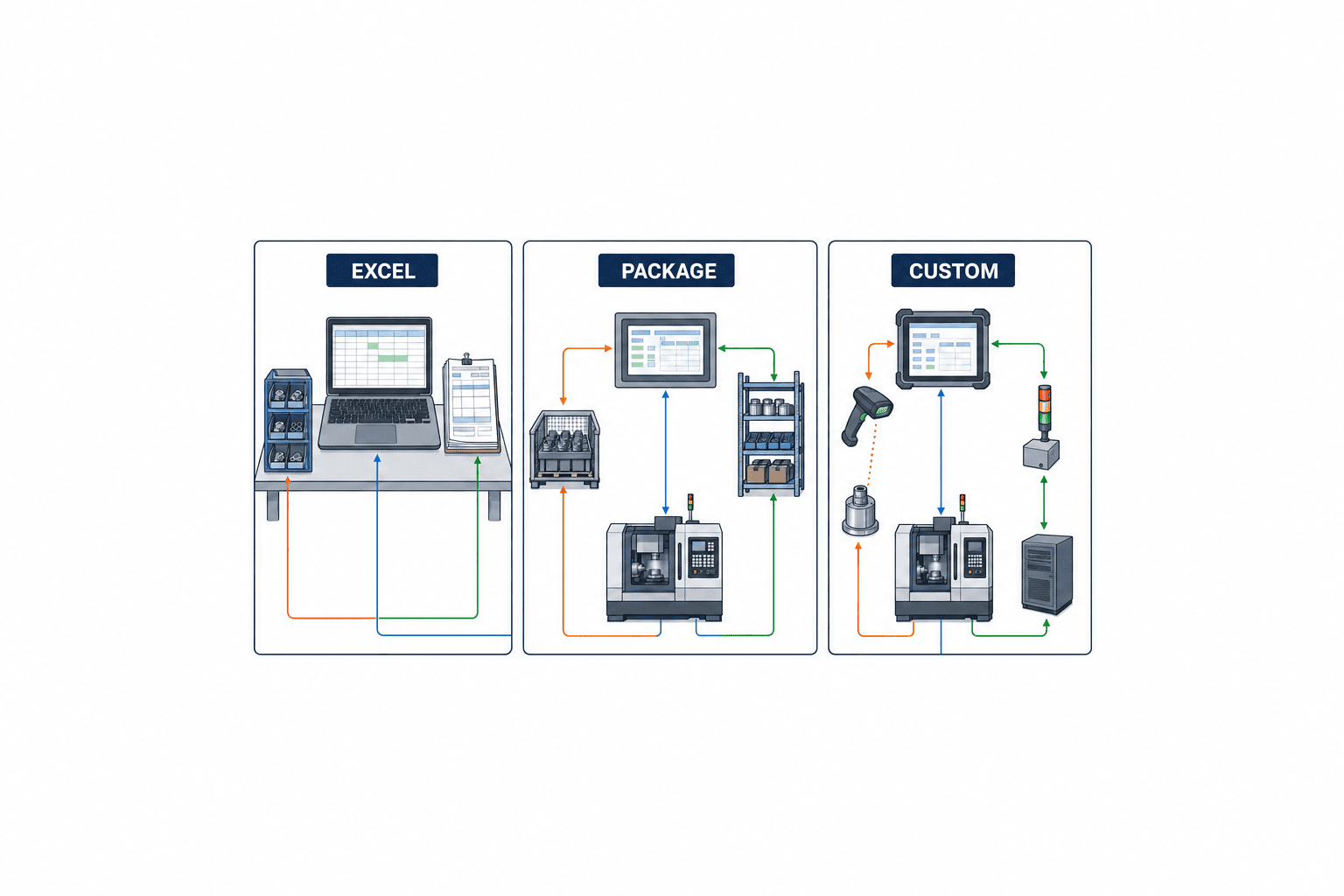
Excel is quick to start, familiar and flexible for calculations and documents. Microsoft’s current specification allows 1,048,576 rows by 16,384 columns on a worksheet. That limit is not the practical limit for production control. Concurrent editing, version ownership, access rights, transaction uniqueness, audit history and synchronization usually fail first. Microsoft: Excel specifications and limits
Continue with governed Excel when most of the following are true:
- one or two named people update the record;
- simultaneous editing is rare and a cutoff can be enforced;
- item and order volumes remain easy to search and reconcile;
- an owner controls formulas, validation, protection and backup;
- everyone knows which file is authoritative;
- changes and errors are reviewed daily; and
- shift- or day-level information is sufficient.
Consider migration even at a low row count when folders fill with “latest,” “latest-final” and copied versions; only one person understands formulas; departments copy the same list; users retype data into another sheet; or unexplained adjustments concentrate at month end.
Keeping Excel is not equivalent to doing nothing. Separate input from reporting, publish column definitions and code lists, name an owner, set an update cutoff, back up and control changes. If Power Query or macros automate consolidation, monitor source changes and refresh failures. Governed spreadsheets can be the right lightweight control for a stable boundary.
When a production management package fits
A package fits when the target process is reasonably standard and the plant can adopt a defined workflow. Purchasing, receipt/issue, sales order, conventional BoM and daily production reporting commonly fit configured functions.
Evaluate with real scenarios rather than a feature checklist. Provide a representative item, a difficult BoM, a partial shipment, return, rework and stock-count variance. Ask actual users to perform the tasks. Separate what works through configuration, what needs an extension and what requires an operational workaround.
The package advantage is an established data model, business rules, maintenance and support. Its risk is workload created when local exceptions do not fit, plus upgrade impact when extensions multiply. Compare three-to-five-year cost including users, environment, support, reports, interfaces, upgrades and recurring training—not only the implementation quotation.
For Thailand, verify Thai-language operation and support, local support hours, integration boundaries with accounting and VAT documents, and English/Japanese reporting to headquarters. Thailand’s Revenue Department publishes technical standards for e-Tax Invoice & e-Receipt, but a production system is not automatically the statutory document system. Define the boundary and interface with accounting/tax applications. Thai Revenue Department: e-Tax Invoice & e-Receipt technical standards
When custom development or a hybrid fits
Custom development fits when a distinctive process, traceability obligation, machine interface or customer-specific EDI is central to competitiveness or contract compliance, and forcing the work into a package would cost more. “Turn our current Excel into screens” is not enough. It can preserve unnecessary copying and accidental rules.
Before screen design, include these responsibilities in design and contract:
- data owner and system of record;
- API, CSV, EDI and equipment input/output specifications;
- duplicate prevention for retries;
- error monitoring, replay and reconciliation ownership;
- source, configuration and data handover terms;
- backup and restore testing;
- support window and change-request governance; and
- FAT, SAT, UAT and stabilization exit criteria.
A useful hybrid can keep item and sales order in the current ERP, handle work orders, actuals and WIP in a shop-floor application, then return completion. The smaller replacement scope is attractive, but queues, retries and daily reconciliation become permanent work. Price those interfaces as an operating product, not a one-time connection.
Excel, package or custom: a practical decision matrix
| Decision axis | Governed Excel | Package | Custom/hybrid |
|---|---|---|---|
| Process standardization | high and low-volume | high to medium | low; differentiated process matters |
| Concurrent use | few users | multiple departments | departments, machines and external parties |
| History and authorization | light control | standard workflow fits | special approval and evidence required |
| Timeliness | daily or shift | minute to daily | seconds to minutes, machine events |
| Integration | manual CSV is sufficient | standard API/CSV fits | custom API, EDI or PLC required |
| Initial speed | fastest | fast through configuration | more discovery and design |
| Future change | dependent on spreadsheet owner | dependent on product roadmap | controlled by business priorities |
| Main risk | key-person and version risk | process gap | overbuilding and maintainability |
One answer does not have to cover the entire plant. A package can own item/BoM, a custom application can own shop-floor actuals, and Excel or BI can support analysis. What must not happen is uncontrolled writing of the same item name, standard cost, stock balance or due date in several places. Assign one write authority per critical field.
For a broader selection process, see Production Management System Comparison 2026. To interpret case studies by operating conditions rather than brand, see Production Management System Implementation Cases: 3 Practical Patterns.
A “loss → decision → data” workshop to fix the minimum scope
Starting requirements with a long feature list makes every feature look important. A 90-to-120-minute workshop can narrow the scope in five moves.
1. List ten loss events from the last three months
Use concrete events: a line stopped for missing material; an obsolete drawing caused machining; a partial-shipment change did not reach production; margin was discovered after shipment; or a count variance had no explanation. Record when it occurred and its operational consequence.
2. State the decision that was needed at that moment
Examples include approving a substitute, choosing which work order moves first, adding a shift, buying urgently or revising the promise date. A system exists to deliver evidence for these decisions, not to maximize screen count.
3. Identify the minimum data and freshness
A shortage decision may require on-hand, allocation, inbound purchase and planned consumption. It may not yet require demand forecasting. Define the required accuracy, age and granularity of each field.
4. Put capture at the point of fact
Receiving, planning, operator and inspection staff—or equipment—should create the record closest to the event. Later retyping by administration loses timeliness and ownership. If point-of-work entry is impossible, identify whether the constraint is device, network, authorization, language, training or workload.
5. Select two or three objects and publish exclusions
Separate future candidates, processes retained in the current system and documents that will be retired. Explicit exclusions control scope and make supplier quotations comparable.
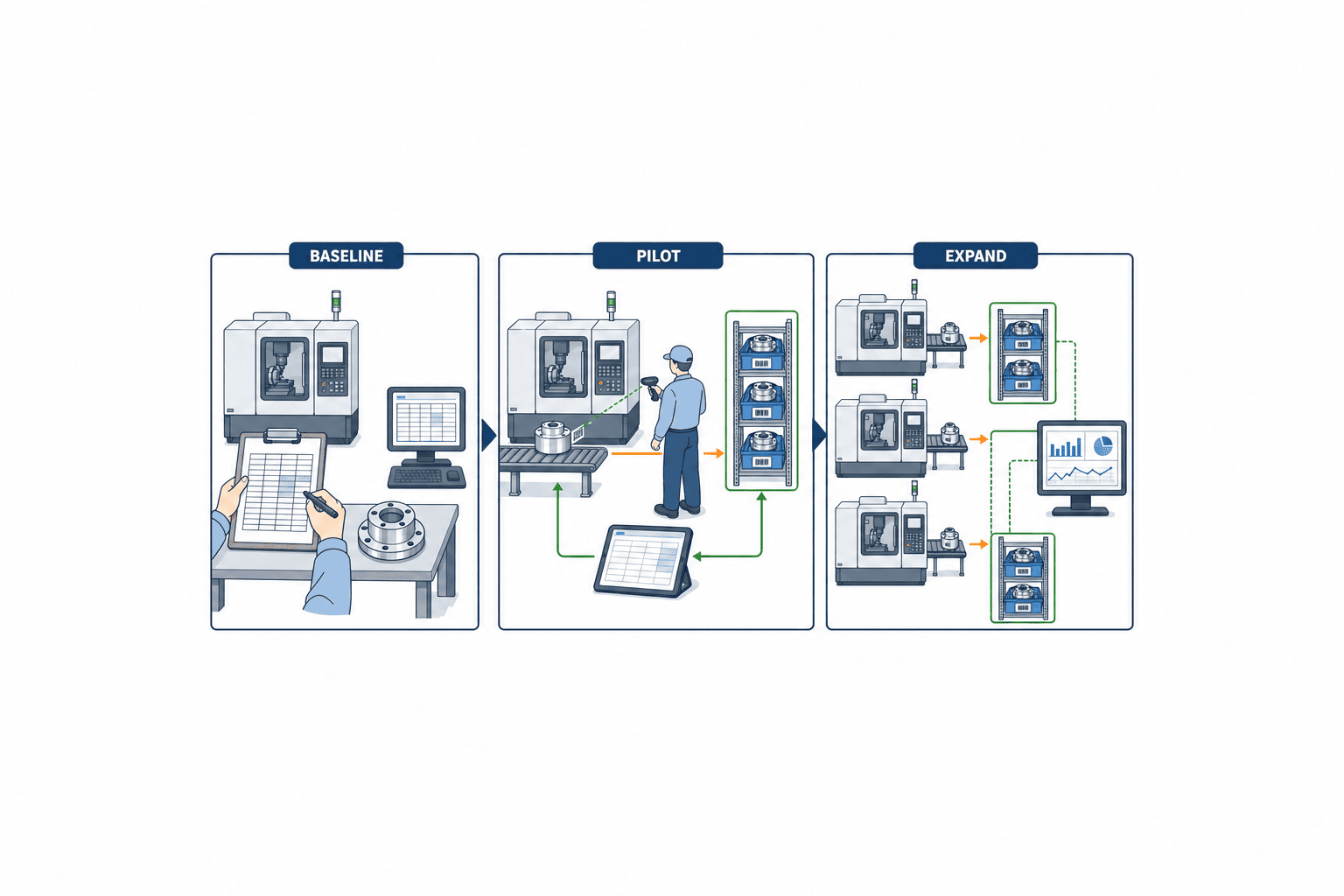
A 12-week small-start model
This is a planning example for a limited scope, not a delivery promise. Data quality, machine interfaces and decision speed can change the schedule.
Weeks 1–2: establish the baseline
Inventory the target product, operation, users and current files. Define the KPI and measurement rule: shortage downtime, daily-report consolidation time, unexplained count variances, response time for delivery dates or manual cost corrections. Without the baseline, benefits cannot be demonstrated.
Weeks 3–4: design minimum data and exceptions
Map normal, change, cancellation, correction, retry and network-outage flows. Fix the item code, order/work-order IDs, immutable transaction ID, source of truth and write authority. Load representative data early to expose unusable records.
Weeks 5–7: configure or build, with weekly floor review
Show working increments and let actual users operate them at the workplace with target devices, labels and network. Rank requests by impact on the chosen KPI and acceptance scenario, not by how attractive they appear.
Weeks 8–9: rehearse migration and train by role
Migrate masters and open transactions in the real sequence, then reconcile counts, quantities and amounts. Train normal work, corrections, cancellation, outage and escalation. Validate that Thai terminology is natural to operators.
Weeks 10–11: limited operation and daily reconciliation
Run one family, warehouse or line. Keep dual recording only for a defined short validation window. Every day review unprocessed records, negative stock, duplicates, errors and corrections. Long parallel operation makes both systems appear authoritative.
Week 12: evidence-based go/no-go and expansion
Review KPI movement, input completion, variances, support requests and workarounds. If the pilot fails, separate data, process, training, device and responsibility causes before requesting more features. Expand because acceptance evidence is met, not because a calendar date arrived.
Thailand and ASEAN conditions that belong in the first design
Multilingual operation is a code and ownership problem
Use language-neutral keys for items, operations and stop reasons; maintain Thai, English and Japanese display names. Decide the language of free text according to its reader. Confirm terminology with operators rather than relying only on literal translation.
Divide decision rights between headquarters and the plant
Headquarters may own item-code policy, chart of accounts, group reporting and security standards. The plant may own shifts, locations, terminal placement, stop reasons and daily priorities. Define rights field by field. “HQ owns production; the plant owns inventory” is too coarse because the data crosses both.
Treat an outage as a normal scenario
Choose availability by function, not by one cloud-versus-on-premise label. Label printing may tolerate only minutes, while monthly costing can wait. Specify offline capture, local printing, queue, retry and reconciliation for each critical function.
Include basic cybersecurity from the start
NIST provides small manufacturers with staged guidance around identifying, protecting, detecting, responding and monitoring, and describes security segmentation as a cost-effective approach that groups assets by communication and security requirements. NIST: Where to Start and NIST CSWP 28
Avoid shared user accounts, use role-based access, remove access after transfers or departure, test restoration from backup and log vendor remote access. When connecting IT and equipment networks, document required communication and deny what is not needed.
Check investment incentives after the operational case is sound
Thailand’s BOI publishes Smart and Sustainable Industry measures covering upgrades such as machinery modernization, digital technology, automation and robotics. A BOI/OSOS release dated 23 July 2026 reported 132 applications worth approximately THB 17.2 billion under the initiative in the first half of 2026. Those are application counts and application value—not proof of approval, disbursement or eligibility for a specific factory. BOI/OSOS: Thailand Secures $43.6bn 1H 2026 Investment Surge
Define the minimum business scope first, then verify current eligibility and timing directly with BOI or an adviser. If application, ordering and commissioning sequence matters, manage it as a separate dependency.
The minimum RFP that makes quotations comparable
A small project still needs written assumptions. A concise three-to-five-page RFP can include:
- plant, users, languages, shifts and sites;
- target loss and KPI baseline;
- selected two or three control objects and explicit exclusions;
- representative normal and exception scenarios;
- item, BoM, order and stock volumes and data quality;
- ERP, accounting, equipment and label interfaces;
- hosting, acceptable downtime and security requirements;
- migration, training, Thai materials and operating support;
- FAT, SAT, UAT and stabilization acceptance; and
- initial/recurring costs, change rates and end-of-contract data return.
Break down the word “included.” For migration: how many cycles and who cleans data? For integration: which fields, direction, frequency and error behavior? For training: which language, audience, sessions and materials? This prevents a threefold quote gap from being mistaken for a price difference when it is actually a scope difference.
Measure avoided loss and operating workload, not a generic DX score
Useful weekly measures for a small factory include:
- shortage downtime and emergency purchase count;
- uncommunicated work-order changes;
- missing/re-entered daily reports and consolidation hours;
- count variance cases, value and unexplained share;
- time to promise and days of early warning for delay;
- obsolete BoM use, wrong material and rework; and
- days to close production cost and manual corrections.
Benefit calculations can include labor time, downtime, premium freight, disposal and working capital tied in excess stock. Do not promise an improvement percentage without a verified baseline. Freeze the formula and comparison period before implementation.
Also measure the new operating burden: master maintenance, error clearance, support tickets and reconciliation. Saving shop-floor consolidation while adding greater monthly correction in administration is not an overall gain.
Three common minimum configurations
Configuration A: prevent material shortage and count variance
Connect item/BoM, work orders and inventory. Derive required material and capture receipt, issue and finished receipt. Actual reporting can initially be completion quantity. Refine costing only after inventory events are stable.
Configuration B: reduce progress calls and delivery surprises
Connect work orders, actual results and delivery. Capture operation start/finish, good and reject quantity; show remaining quantity and plan. Inventory can initially arrive once daily from ERP or Excel. Use finer reporting only at the bottleneck.
Configuration C: detect loss-making orders earlier
Connect item/BoM, actual result and cost. Link standard material, actual usage, labor and subcontracting to the order or work order. Do not allocate every overhead category in phase one; make material, labor and subcontract variances explainable first.
Small start does not mean improvised architecture. Keep the scope small while designing IDs, write authority and interfaces so that the boundary can expand.
Frequently asked questions
Does a small factory need a production management system?
Not because of headcount alone. It becomes worth evaluating when concurrent updates, revision mistakes, shortages, stock variances, progress calls or month-end adjustments create recurring losses greater than the operating burden of control. If transactions are few and governed Excel has a clear owner and source of truth, replacement need not be rushed.
What should an SME decide first when introducing a production management system?
Decide the loss to stop, the decision that was delayed, the minimum data, the capture owner and the excluded scope. Then select two or three connected objects from the five.
When has Excel reached its limit for production management?
The practical limit is not the worksheet row count. It is reached when concurrent editing, history, access, versioning, retyping and timeliness can no longer be reconciled reliably.
How do we choose a production management package versus custom development?
Prefer a package when the plant can adopt standard workflows and representative exceptions work through configuration. Consider custom or hybrid when differentiated processes, equipment or customer obligations cannot be handled without heavy workarounds. Compare both through identical scenarios, acceptance evidence and three-to-five-year cost.
Can a small-start system be too narrow?
It becomes too narrow when exclusions and future connection points are undefined. Even the smallest scope should define unique IDs, source of truth, API/CSV boundary and expansion ownership.
Cloud or on-premise for a Thai factory?
Decide per function using downtime tolerance, connectivity, remote support, data obligations and local maintenance capacity. Shop-floor capture or labels may need an offline path while analytics and periodic costing can run in the cloud.
Summary: choose control objects and authority before buying functions
A production management system for a small factory is not an all-in-one suite purchased in a smaller license. It is a reliable chain across two or three of five objects: item/BoM, order/work order, actual result, inventory, and cost/delivery. Excel, package and custom development each have a valid place. Select through concurrent-use needs, exceptions, interface responsibility, downtime tolerance, change ownership and acceptance evidence. Start with a measured baseline, reconcile daily, and expand only after the first boundary works. That approach is especially important in multilingual Thailand and ASEAN operations, where local usability and HQ reporting must coexist.
TOMAS TECH can help a small factory in Thailand or ASEAN decide what should remain in Excel, what should become the first controlled system boundary, and where a package should end and custom development should begin. You can contact us even before an RFP exists or when you are considering a pilot on only one line or warehouse through our contact form.
Sources
- OSMEP: Definition of MSMEs
- depa: 2024 Digital Density Survey
- BOI/OSOS: Thailand Secures $43.6bn 1H 2026 Investment Surge
- IPA: Manufacturing DX for smaller manufacturers
- Microsoft: Excel specifications and limits
- NIST: Where to Start — Cybersecurity Resources for Manufacturers
- NIST CSWP 28: Security Segmentation in a Small Manufacturing Environment
- Thai Revenue Department: e-Tax Invoice & e-Receipt technical standards


