


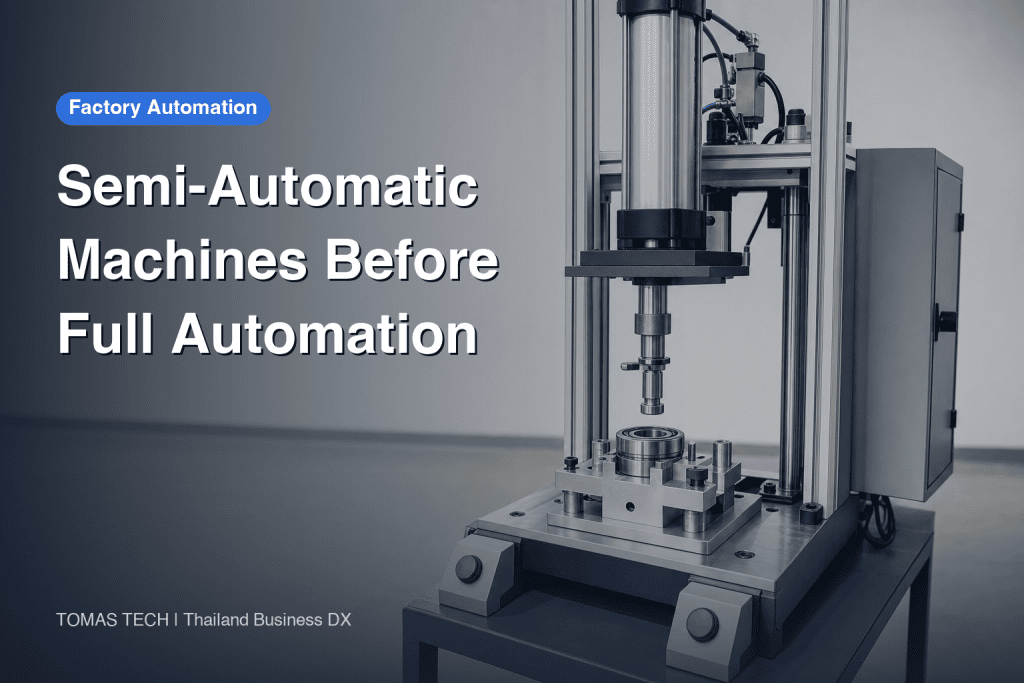
There is not a single year when factory managers in Thailand and Vietnam are not saying the same two things. Operators are hard to recruit, and wages keep climbing. Yet committing to a large fully automated line is not an easy call when you cannot forecast how your production volume will move. Semi-automatic machines fill exactly that middle ground, the space where manual work has hit its ceiling but full automation is still premature. The operator loads the workpiece, and the machine performs the demanding motion such as press-fitting, caulking or fastening. This article works through what a semi-automatic machine actually is, which processes suit it, how the investment compares with full automation, why the ASEAN labour market makes this option compelling, and how to step up in stages, all grounded in published figures and sources.
What Is a Semi-Automatic Machine
A semi-automatic machine is equipment in which part of the cycle is performed by a person and the rest by the machine. The classic sequence runs like this. The operator sets the workpiece into a fixture, triggers the cycle with a two-hand push button or a foot switch, the machine executes one processing cycle, and the operator removes the finished part. Because human and machine work alternate along the time axis, the machine always has idle time in every cycle. Accepting that idle time is precisely what allows you to compress equipment cost and commissioning time so dramatically.
Automation discussions tend to collapse into a binary, automate or do not automate. On the shop floor that resolution is far too coarse for a real decision. In practice you break the target process into elements, part feeding, positioning, the processing motion, quality judgement, part ejection and transfer to the next process, and then decide element by element which ones you hand over to the machine.

Viewed through that lens, the three forms become clearly distinct. In a fully manual process, positioning depends on the operator’s eyes and hands, the processing motion comes from human-powered tools such as an arbor press or a torque driver, and judgement rests on the operator’s feel and visual inspection. Capital expenditure is close to zero, but quality tracks the operator’s skill level and physical condition, and output scales only with headcount.
With a semi-automatic machine, positioning and the processing motion move to the machine side. The fixture mechanically guarantees the workpiece attitude, and the machine guarantees press-fit load, tightening torque and stroke. What remains with the operator is feeding and removing parts, plus the flexible judgement of rejecting anything that is obviously wrong. Equipment cost typically lands an order of magnitude below that of a fully automatic machine, and it can usually be introduced without a major layout change.
With a fully automatic machine, part feeders or robots handle supply, inline sensors handle inspection, and conveyors handle ejection and transfer, leaving people to supervise, change over and respond to faults. You gain unattended continuous operation, but the majority of the cost and engineering hours disappear into the parts that are not the processing itself, the mechanisms that stabilise part feeding attitude, the mechanisms that detect and reject feed faults, and the model changeover mechanisms. It is genuinely common for a fully automatic machine quotation to show a larger figure for feeding, transfer and inspection than for the processing unit itself.
The benefit of a semi-automatic machine is not only labour cost. First, quality variation shrinks. Because the machine controls press-fit load and tightening torque, the same result comes out regardless of who is on the station. Second, physical workload drops. Repetitive arbor press operation and high-force caulking work impose real strain on the body and contribute to both turnover and workplace injuries. Third, data remains. Once you can record the load-displacement curve of every press-fit, the torque value of every screw and the judgement result by lot, the quality of customer audits and of root cause tracing after a field failure changes completely. That third point matters more than most people expect, given how steadily customer requirements on Japanese suppliers have been rising.
Processes That Suit a Semi-Automatic Machine
Semi-automatic machines earn their place in processes that need both human flexibility and machine repeatability. The representative cases look like this.
- Press-fitting. Pushing bearings, bushings, pins or shafts to a specified load and depth. Combining a pneumatic or servo press with load and displacement sensors lets you judge good from bad by whether the load-displacement curve falls inside the specified window. A manual arbor press only tells you whether the part went in. A semi-automatic machine lets you separate foreign object entrapment, wrong part and chamfer defects by the shape of the curve.
- Caulking and crimping. Spin caulking, heat staking, self-piercing rivets and terminal crimping. In crimping, crimp height and crimp force control are the core of quality, so being able to fix the conditions on the machine side carries real weight.
- Screw fastening. An electric driver combined with a torque control unit lets the machine handle screw counting and torque judgement. A fully automatic multi-spindle unit is expensive, but a single-spindle positioning arm into which an operator sets the workpiece comes in far cheaper. This is the area where you can eliminate missing screws and over-tightening, two of the most common customer complaints, for a relatively small investment.
- Simple inspection. The operator sets the workpiece into an inspection fixture, and the machine captures images, measures dimensions or verifies electrical continuity and then displays and records the result. Where one hundred percent inspection currently relies on human eyes, the improvement in escape rate is easy to demonstrate.
- Part insertion and assembly. O-ring insertion, connector insertion, seal application, label application and marking, work that demands positional accuracy but where a person still handles the part faster than a machine would.

What these share is that the workpiece attitude can be stabilised by a fixture, the motion the machine should perform can be defined clearly, and there is room for human judgement before and after. The processes that do not suit a semi-automatic machine are equally clear. Ultra-fast processes where the cycle is a few seconds and the human motion becomes the bottleneck, processes that assume 24-hour unattended running, and processes where the parts are so small that human handling reduces productivity are all better considered for full automation from the start.
One more point deserves emphasis. Most of a semi-automatic machine’s real capability is determined by the fixture. However precise the servo press you mount, if workpiece positioning is loose the press-fit axis tilts and the load curve varies on every cycle. Conversely, when positioning is solid, a mature drive configuration such as a pneumatic cylinder delivers perfectly adequate quality. When you semi-automate a process, starting from the fixture concept is the shortest route. Our article on jig and fixture design and manufacturing covers this thinking in more depth.
Cost Comparison Against Full Automation
The question every investment decision comes back to is how much it costs and how quickly it pays back. A useful reference comparison has been published for the packaging industry in Southeast Asia. It examines a Southeast Asian packaging manufacturer processing 10,000 units per month and compares performing the strapping process with a semi-automatic machine against a fully automatic system.
| Comparison item | Semi-automatic strapping machine | Fully automatic system |
|---|---|---|
| Initial investment | USD 5,000 | USD 35,000 |
| Labour cost reduction versus manual work | 44% | 71% |
| Payback period | About 8 to 10 months | 14 to 18 months |
The source is the Alibaba Seller Blog guide to automatic versus semi-automatic machinery investment. What you should read here is not the absolute reduction figures but the difference in character between the two options.
Start with the gap. The labour cost reduction differs by 27 points, 44% against 71%, while the initial investment is 7 times as large. A semi-automatic machine is an investment with the character of betting small and recovering fast. A fully automatic system is an investment with the character of betting big and letting it work over a long horizon. In payback terms the semi-automatic machine finishes recovering in about 8 to 10 months against 14 to 18 months for the fully automatic system. That faster recovery is inseparable from the fact that the total savings available after recovery are smaller for the semi-automatic machine.
Just as important, do not transplant these numbers directly onto your own plant. This comparison sits at a production scale of 10,000 units per month. If your volume were several times higher, the fully automatic system’s payback period would shorten. If your volume is unpredictable or may fall, the relative advantage of the semi-automatic machine widens. The subject is also a strapping process, and there is no guarantee that press-fitting or caulking would produce the same reduction rate. Use it as a reference for grasping the structural relationship between investment scale and recovery speed, not as a forecast for your own numbers.
Beyond that, when you build a real payback calculation, do not put labour cost alone in the numerator. Reduced scrap, reduced rework hours, reduced overtime pay and shorter training periods for new hires all belong there before the figure resembles reality. On the denominator side you need more than the machine price. Installation, primary-side electrical and pneumatic work, safety measures such as guarding and light curtains, production losses during commissioning, and the initial stock of spare parts all count. Overlooking the denominator is the most common reason a project fails to pay back as planned, and our article on automation investment failure risk works through those cases in detail.
Why Semi-Automatic Machines Work in Thai and ASEAN Plants
Why has this middle ground become a realistic option for Japanese plants in ASEAN right now. The answer lies in the structure of the labour market.
In a JETRO survey of Japanese companies operating in Thailand, 42.3% of respondents described the shortage of factory operators as serious. In the same survey, 72.8% cited rising personnel costs as an investment risk, the highest response of any item. In other words, the recognition that people are hard to hire and that people are getting more expensive, both at once, is already widely shared. Yet when the same survey asks about automation, only 27.9% answered that they are already working on it and 27.5% that they plan to. In other words, just 27.9% have actually started, so execution lags a long way behind the shared sense of urgency.
Actual wage movement backs up that sense of urgency. According to a report on the latest labour trends in Thailand, the wage growth rate in Thailand was 3.8% in 2023, 4.58% in 2024 and a projected 4.64% in 2025, accelerating year on year. The spread by job category is wider still, with IT and digital talent rising 8 to 12% annually and technical and engineering roles rising 5 to 8%. On the minimum wage, rates moved to a range of 337 to 400 baht from 1 January 2025, and to 400 baht across all of Bangkok from 1 July 2025. On top of that, Thailand’s new government has pledged to raise the minimum wage to 600 baht per day by 2027, which represents a 61% increase from the 372 baht the pledge uses as its baseline.
The supply side of labour offers little prospect of relief either. An analysis of Thailand’s economic outlook points out that Thailand’s working-age population has already entered a period of decline as of 2026. The same analysis argues that for labour-intensive industries such as garment manufacturing and simple assembly, Thailand is no longer the optimal production base, and that shifting toward capital-intensive and knowledge-intensive industries is the path to survival. The Thai government’s promotion of Thailand 4.0 and the BCG economic model sits on the same line of reasoning.
Does that mean every company can leap straight to full automation. It does not. In most small and mid-sized Japanese plants, several constraints coexist. There are many product variants with small lots per variant, customer production plans are visible only six months ahead, and there is no spare floor space in the existing building. Install a single large fully automated line under those conditions, and the moment the product mix shifts, utilisation drops and the payback plan collapses. A semi-automatic machine keeps the investment unit small, absorbs model changes through fixture exchange, and keeps layout changes within a realistic scope.
Market data from the region points the same way. The Alibaba Seller Blog guide cited above reports that semi-automatic systems account for a 37.63% share of the Southeast Asian warehouse automation market. Warehouses and factories serve different purposes, but it is reasonable circumstantial evidence that entering through semi-automation first is a widely adopted choice in this region.
There are also cases where phased automation delivered real results. The labour report cited above describes a Japanese automotive parts manufacturer in Thailand that reduced headcount by 30% while increasing production volume by 20%, through measures including robotising simple-task processes. Cutting people while raising output is achievable without replacing every process at once, by handing the highest-load processes over to machines in order. We have collected similar improvement cases in our article on labour-saving automation in factories.
How to Decide on a Semi-Automatic Machine
Whether you should choose a semi-automatic or a fully automatic machine is largely settled by measuring the character of your own process, well before you start comparing equipment specifications. There are four axes.
Production volume and cycle time. Start by producing the measured actual cycle time and the required cycle time for the current process. With a semi-automatic machine, one cycle is the sum of the time the operator spends loading, the time the machine runs and the time the operator spends unloading. The point most often overlooked is what the operator does while the machine is running. If the machine motion takes ten seconds or more, the operator can prepare the next workpiece or work the preceding process during that window, which raises effective utilisation. Configure one operator to tend two machines and you can drive operator waiting time close to zero. Conversely, if the machine motion finishes in two seconds, human work time dominates and semi-automating will not reduce headcount. In that case you either set quality stability as the objective or consider full automation.
Handling product mix and volume variation. Where there are many variants and changeovers occur several times a day, the advantage of the semi-automatic machine shows clearly. Model changeover on a semi-automatic machine is, in principle, a fixture exchange and a recipe selection. A fully automatic machine, by contrast, tends to need dedicated part feeders and chutes per variant, so every added variant brings additional investment and tuning hours. Whether your variant count is likely to grow is a fork in the road that separates the total cost of the two approaches by a wide margin.
Room for future volume growth. The optimum changes with how you view volume three and five years out. If growth is a confident forecast, designing for full automation from the beginning ends up cheaper overall. If the outlook is uncertain, installing one semi-automatic machine, accumulating a track record, and then adding a second unit or committing to full automation once growth is real, carries less risk. Lining up semi-automatic machines side by side has the great merit of letting investment follow actual volume rather than lead it.
Ease of phased migration. This axis concerns design philosophy. If full automation is in your sights, then from the semi-automatic stage the machine should be built so that the loading and unloading a person performs today can later be replaced by a robot. Concretely, that means securing sufficient access space at the workpiece transfer position, designing fixture datum surfaces in a form usable for robot teaching, and leaving spare input and output points and communication capacity in the control panel. The added cost of preserving that headroom is on the order of a few percent of the total machine, but it dramatically compresses both the cost and the downtime of a later retrofit.
Before entering any of these judgements, measure the present state. Measured cycle time by process, first-pass yield and the breakdown of defect modes, operator headcount and overtime hours. Debate equipment specifications without those numbers and you will reliably arrive at the outcome where the machine is installed but the expected effect never materialises.
Stepping Up from Semi-Automatic to Full Automation
The route to successful phased automation can be laid out fairly consistently.
The first step is understanding the present state and decomposing the process. Across every process on the target line, gather measured cycle time, operator headcount, defect rate and physical workload, then sort the work into what only a human can do and what can be handed to a machine. At this stage, you do not talk about equipment.
Fixture design comes next. Simply guaranteeing positioning and holding mechanically through a fixture visibly reduces quality variation, even at a stage with no drive elements at all. The fixture structure you build here becomes the heart of the semi-automatic machine.
On that base, choose one process with high workload and high quality impact, and semi-automate it. The convention is to select not the process that looks most rewarding but the process that is easiest to verify. The purpose of the first machine is to make one process work and to leave operating and maintenance experience inside the company.

Once the semi-automatic machine is running, collect data. The distribution of actual cycle times, the distribution of press-fit loads and tightening torques, the pattern of defect occurrence, the real duration of a changeover. This measured data is what justifies the design of the next stage. Design a fully automatic line from a standing start and you have no choice but to build the feeding mechanism cycle time and the defect rate on desk estimates. Hold measured values from the semi-automatic stage and the full automation specification can be settled with numbers rather than rules of thumb.
Then come horizontal deployment and feed automation. Roll the same configuration out to the adjacent process or to a second unit to confirm investment efficiency, and then replace the loading and unloading the operator was performing with part feeders or a collaborative robot. At that point the semi-automatic machine has effectively become a fully automatic cell. Linking cells with conveyors or AGVs into a line is the final step.
Note that you do not always need to build new equipment. In some cases you can semi-automate existing equipment through modification, adding positioning fixtures, retrofitting a load control unit, and updating safety measures. For the approach of making use of equipment already in operation, see our article on factory equipment modification.
The most important property of this route is that at every stage you retain both the option to proceed and the option to stop. Order a fully automated line in one block and you cannot halt it when the premises change midway. Proceed in stages and you always keep the choice of postponing the next investment or changing direction as production plans and orders shift. That flexibility is the strongest risk countermeasure available in a high-uncertainty environment.
The Possibility of BOI Incentives
When considering capital investment in Thailand, the BOI investment promotion scheme belongs on the table every time. According to a guide to Thailand’s BOI investment incentives, machinery and equipment used in a promoted project can be eligible for full exemption from import duty. For projects falling under categories A1 through A4, corporate income tax exemption of up to eight years is available.
The point to hold onto is that eligibility is not decided by the degree of automation of an individual machine, whether it is fully or semi-automatic. BOI promotion is assessed on the basis of the project’s business content and the applicable category. Accordingly, a semi-automatic machine may well be eligible depending on the content of the investment plan. That said, scope and conditions change with scheme revisions and with the specifics of each business, so please confirm applicability through individual consultation with BOI or a qualified specialist. Do not treat this article as a basis for an investment decision that presumes eligibility.
The practical advice is that the most regrettable pattern is deciding on your own that a semi-automatic machine must fall outside the scheme and giving up before asking. Import duty exemption alone changes the effective cost of imported machinery, and the options available to you can differ depending on whether the equipment is applied for on its own or positioned as part of a capacity expansion project. We recommend moving the confirmation forward early, in parallel with your equipment specification work.
How TOMAS TECH Supports Semi-Automatic and Special Purpose Machine Design
TOMAS TECH is based in Bangkok and designs and builds factory automation and production equipment for Japanese manufacturers in Thailand and Vietnam. In the semi-automatic machine field, the enquiries we receive tend to take these forms.
- Process decomposition and automation concept development. Support from the stage of deciding which process to tackle first and whether semi-automatic or fully automatic is the appropriate answer.
- Jig and fixture design and manufacturing. Design and fabrication of fixtures covering positioning, holding and changeover characteristics.
- Semi-automatic machine design and manufacturing. Special purpose machine design including pneumatic and servo press-fitting units, caulking units, screw fastening units with torque control, and simple inspection fixtures.
- Local manufacturing, installation and commissioning in Thailand and Vietnam, together with the supply of maintenance parts.
The practical significance of covering all of this in one place is that process requirements, machine specification and local manufacturing realities all connect inside the same team. Design in Japan and build locally, and the availability of materials and the particular strengths of local machining suppliers never make it into the design, which tends to inflate both lead time and cost. Designing on the premise of local manufacturing shrinks that gap. For the detail of our special purpose machine design process see our article on special purpose machine design and manufacturing, and for the fixture side see the jig design and manufacturing article.
We can also design with eventual full automation in view. As described above, whether you preserve room for robotisation at the semi-automatic stage makes a large difference to the cost and schedule of the next investment. Consult us at the concept stage and we can propose a specification that includes that headroom.
Frequently Asked Questions
What is a semi-automatic machine
A semi-automatic machine is equipment in which part of the cycle is performed by a person and the rest by the machine. Typically the operator sets the workpiece into a fixture and presses a start button, the machine automatically executes the motion, press-fitting, caulking, fastening or inspection, and the operator removes the part when it finishes. Because the machine handles positioning and the processing motion, quality variation is suppressed, while the operator continues to feed and remove parts, which compresses equipment cost and commissioning time substantially compared with a fully automatic machine. It suits high-mix low-volume production and processes where the volume outlook is uncertain.
How much does a semi-automatic machine cost
The range depends on the process content and the accuracy required, but a comparison case from the packaging industry in Southeast Asia gives a sense of investment scale. At a company processing 10,000 units per month, the initial investment for a semi-automatic strapping machine was USD 5,000 against USD 35,000 for a fully automatic system. In that case the labour cost reduction compared with manual work was 44% for the semi-automatic machine and 71% for the fully automatic system, with payback periods of about 8 to 10 months and 14 to 18 months respectively. This is a comparison of a strapping process and does not transfer directly to press-fitting or caulking, but it does show that a semi-automatic machine is an investment with the character of betting small and recovering fast. In a real quotation, evaluate the total including installation, primary-side electrical and pneumatic work, safety measures, production losses during commissioning and the initial stock of spare parts, not only the machine price.
How should we move from a semi-automatic machine to full automation
Begin with process decomposition and fixture design, semi-automate one process with high workload that is easy to verify, gather measured data there, and only then advance to the next stage. The distribution of actual cycle times, the distribution of load and torque values and the pattern of defect occurrence obtained from running the semi-automatic machine become the design basis for the fully automatic line. If migration is the premise, secure access space at the workpiece transfer position, design fixture datum surfaces usable for robot teaching, and leave spare input and output capacity and communication headroom in the control panel, all at the semi-automatic design stage. The added cost of that consideration is on the order of a few percent of the machine, and it substantially reduces the cost and downtime of a later retrofit.
Summary
A semi-automatic machine is the realistic option sitting between manual work and full automation. By handing positioning and the processing motion to the machine while leaving part feeding, part removal and flexible judgement with the operator, you achieve quality stability and data capture while holding investment down.
In the comparison case from the packaging industry in Southeast Asia, the semi-automatic machine carried an initial investment of USD 5,000, a 44% labour cost reduction against manual work, and a payback period of about 8 to 10 months. The fully automatic system under the same conditions came in at USD 35,000 initial investment, a 71% reduction and a payback period of 14 to 18 months. The practical guideline this structure suggests is straightforward. Where volume is predictable, lean toward full automation. Where it is not, lean toward semi-automation. As noted above, treat the figures themselves as a reference for that structure rather than as a forecast for a process that differs in both operation and scale.
In Thailand, 42.3% of Japanese companies described the shortage of factory operators as serious and 72.8% cited rising personnel costs as an investment risk. The wage growth rate is projected at 4.64% for 2025, and the minimum wage moved to 400 baht across all of Bangkok from 1 July 2025. The working-age population has already entered decline as of 2026. Continuing to plan around a ready supply of labour is no longer viable.
At the same time, leaping straight to a fully automated line carries its own risks. Under the real constraints of high product mix, uncertain planning and limited floor space, starting small with a semi-automatic machine, gathering measured data and widening the scope of automation in stages is the path least likely to fail. On BOI incentives too, it is worth confirming applicability through individual consultation with a specialist rather than assuming a semi-automatic machine is excluded.
TOMAS TECH supports the full path, from process decomposition through fixture design, semi-automatic machine design and manufacturing, and local production and commissioning in Thailand and Vietnam. An enquiry at the stage of asking whether your process needs a semi-automatic machine or a fully automatic one is entirely welcome. Even while your internal direction is still unsettled, we can help by organising the options from your current process data. Feel free to reach us through the contact page.
References
- Alibaba Seller Blog|Automatic vs Semi-Automatic Machinery Investment Guide
- JETRO|Survey Report on Labour Shortage and Automation in Thailand
- Tokyo Consulting Group|Latest Trends in Thai Labour and Labour Management 2026
- Career Link Asia|Thailand BOI Investment Incentives Guide 2026
- Allied Thai|Thailand Economic Outlook 2026


