



A scale data integration project can fail even when a number appears correctly on an MES screen. Receiving, batching, filling, inspection and shipping each attach different meanings to weight: a confirmed result, a material lot, a tare, a unit, an operator and a correction rule. This guide takes a Thai factory from an inventory of installed scales through a measurement-event design, an RFP and FAT/SAT acceptance. It is written for the buyer who must decide what evidence to request before expanding beyond one production step.
The decision: buy a measurement event, not a stream of numbers
Specify an auditable record of which scale measured which material or unit, when, for which order and lot, in what state, and who confirmed it. Define the boundary among scale, gateway, MES and ERP before selecting an interface. Test exceptional paths as carefully as normal ones. Starting with one bounded process lets the team find conflicts between the specification and actual work before a factory-wide rollout.
Product traceability, the ability to follow materials and products through operations, differs from metrological traceability, the documented calibration chain relating a measurement result to a reference. Both matter, but neither automatically establishes the other. If weight is used for trade or another legally controlled purpose, confirm the applicable Thai requirements, verification, instrument type, display and record rules with qualified local specialists and authorities. The OPC UA for Weighing Technology Companion Specification expressly leaves use cases affected by legal requirements outside its scope.
Inventory processes and weighing points first
Count the decisions weight changes, rather than merely counting scales. Receiving quantity, batch input, fill result, inspection disposition and shipping package weight are distinct events. Even when a single scale serves several activities, their start, confirmation and cancellation conditions differ. Mark each weighing point on the process map. Record its workpiece, container, order, lot, scale, terminal, operator, form and exception action.
| Check | Evidence at the factory | Decision for the RFP |
|---|---|---|
| Instrument | Manufacturer, model, firmware, range, division, calibration and verification | Which models are in scope and what must be retested after replacement |
| Output | Serial, USB, Ethernet, PLC, file or printer output | Collection method, adapter and no-output procedure |
| Meaning | Gross, tare, net, stable flag and confirmation key | What becomes the official record |
| Identity | Scale, product, material, container, lot, order and operation | Who assigns and validates each identifier |
| Time | Instrument, terminal, gateway and server clocks | Event time, receipt time, time zone and clock drift |
| Exceptions | Unstable, out-of-range, reweigh, outage, disconnection and reprint | Hold, replay, correction, rejection and approval |
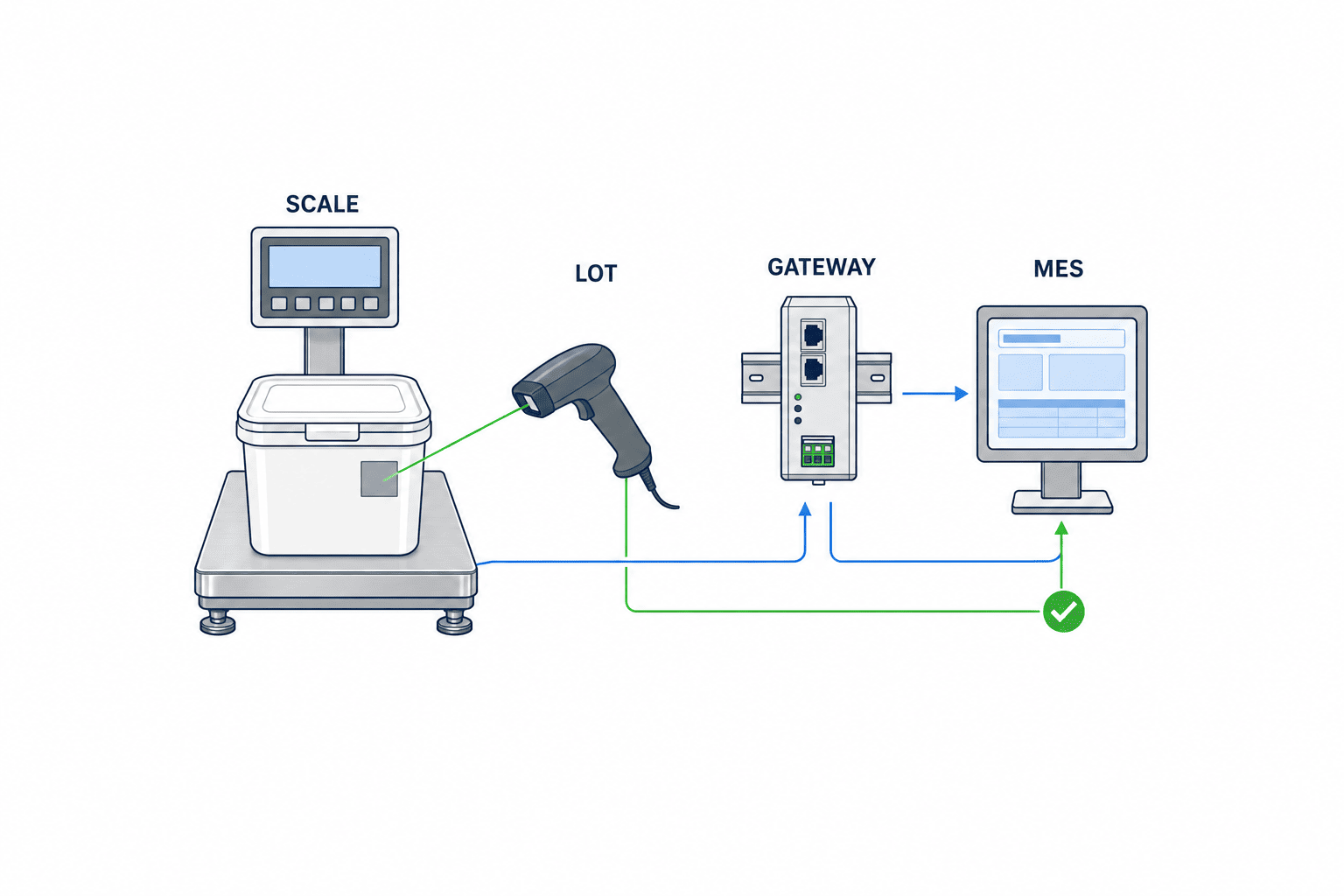
A legacy scale may have a communication port yet fail to expose the fields required together. Obtain raw samples from the exact installed model and firmware, including the path from measurement start to confirmation, container change and restart. A photograph of the display cannot reveal decimal encoding, units, terminators or state bits. When several scales share a terminal, document physical ports and logical scale IDs. After rewiring, a valid weight may otherwise be posted to the wrong operation while a simple connectivity monitor reports success. MES should verify that the scale and weighing point are allowed for the current order.
Separate gross, tare, net and state in the data contract
Meaning comes before precision. If net is gross minus tare, record whether tare came from a container master, an actual scale measurement or manual input. Decide which system is authoritative if the instrument’s net and an MES recalculation differ. Store the unit with the number; a mixed kg/g field can remain syntactically valid while destroying production results.
A useful minimum event is event ID, scale ID, weighing-point ID, measurement time, receipt time, order ID, lot ID, container ID, gross, tare, net, unit, stability state, confirmation action, operator ID, acquisition method, reference to calibration state and a raw-record reference or hash. This is a design checklist, not a claim that every field is mandatory in every process. Decide mandatory fields and whether a missing value blocks confirmation for each operation.
Write the calculation and rounding rules explicitly: for example, net kg = gross kg − tare kg. Distinguish display, stored and decision precision. If the display shows two decimals but the internal record retains three, test values exactly at a limit so the operator and system do not disagree. If the device sends integer grams, avoid unnecessary floating-point conversion. Preserve the source value and version of each transformation rule.
“Stable” is instrument-specific. Software inference from an unchanged value over time is not automatically equivalent to the instrument’s confirmed or legal indication. Depending on process risk, combine operator confirmation, a time window, reweighing and quality approval. Do not force a continuous checkweigher and a one-off bench weighing into the same one-reading-one-record assumption.
Link identifiers in a defined order
Separate the physical weighing-point ID from the replaceable scale ID. Then link the production order, material or product, lot and container. Finally attach operator authorization and calibration or maintenance status. Free-text lot entry breaks genealogy through spelling variations. A barcode scan still requires validation against the current order and permitted material.
GS1 EPCIS 2.0 frames events through what, when, where, why and how. It does not require every plant-scale record to be converted to EPCIS. For external product traceability, it helps the team decide which identity and business context to expose. Detailed source values, audit history and corrections can remain in MES or the quality system, with only the required subset shared externally.
Set the MES, ERP and instrument boundaries
ISA-95 provides a framework for information exchange between manufacturing operations and enterprise systems. A scale’s sensor output, local control, MES history and ERP inventory need not live in one application. Define one system of record and one update authority per item. For example, ERP owns orders and item masters, MES owns operation results and lot genealogy, and the instrument owns the source measurement. A particular factory may allocate responsibilities differently, but two systems must not independently finalize the same result.
In batching, ERP can send an order and planned materials; MES verifies an allowable input lot; the scale supplies a confirmed result; MES links it to the operation; and approved consumption returns to ERP. If the display value goes directly to ERP and separately to MES, a replay on only one path can make inventory and genealogy disagree. Use an event ID and business key so replay of the same measurement does not add a second result.
For wider system boundaries, see our MES implementation and FAT/SAT guide for Thai factories. For the choice of product and material traceability units, see the traceability implementation and vendor selection guide.
OPC UA is an option, not a promise of connectivity
The OPC Foundation and VDMA’s OPC UA for Weighing Technology v2.00 defines an information model for several classes of scales, including simple, hopper and checkweighing systems. Its usual architecture has the scale system as an OPC UA server and a client reading results and state. It is a useful RFP reference, but installed instruments do not all support it. Even on a supported model, confirm implemented nodes, available fields, licence, communication load and certificate lifecycle on the actual device.
A gateway can normalize serial output from an older scale. If it infers meaning from a frame, retain the raw frame and test the mapping rules. Printer output may arrive only on print, and reprinting may create duplicates. A PLC may expose a current value without an unambiguous “one result confirmed” signal. A protocol name alone does not guarantee the business event needed by the factory.
Compare connection options on four criteria
Judge fit to installed equipment, data integrity, recovery and maintenance ownership. OPC UA can fit a new device, while retaining serial output from a proven legacy scale can reduce downtime and initial cost. Conversely, accumulating proprietary drivers raises the verification burden when instruments change. Keep an interface decision per weighing point.
| Method | Suitable when | Verify |
|---|---|---|
| Direct scale OPC UA | The actual model exposes needed result and state | Implemented model, certificates, clock, load, network boundary |
| Serial/USB through a gateway | Replacement is difficult and output is documented | Encoding, terminator, reconnect, port identity, raw-frame retention |
| PLC or SCADA | The controller already owns a confirmed result | Lost pulses, overwritten values, control-change responsibility |
| File or batch import | Low frequency; no real-time decision | Delay, duplicate, missing files, exchange and correction history |
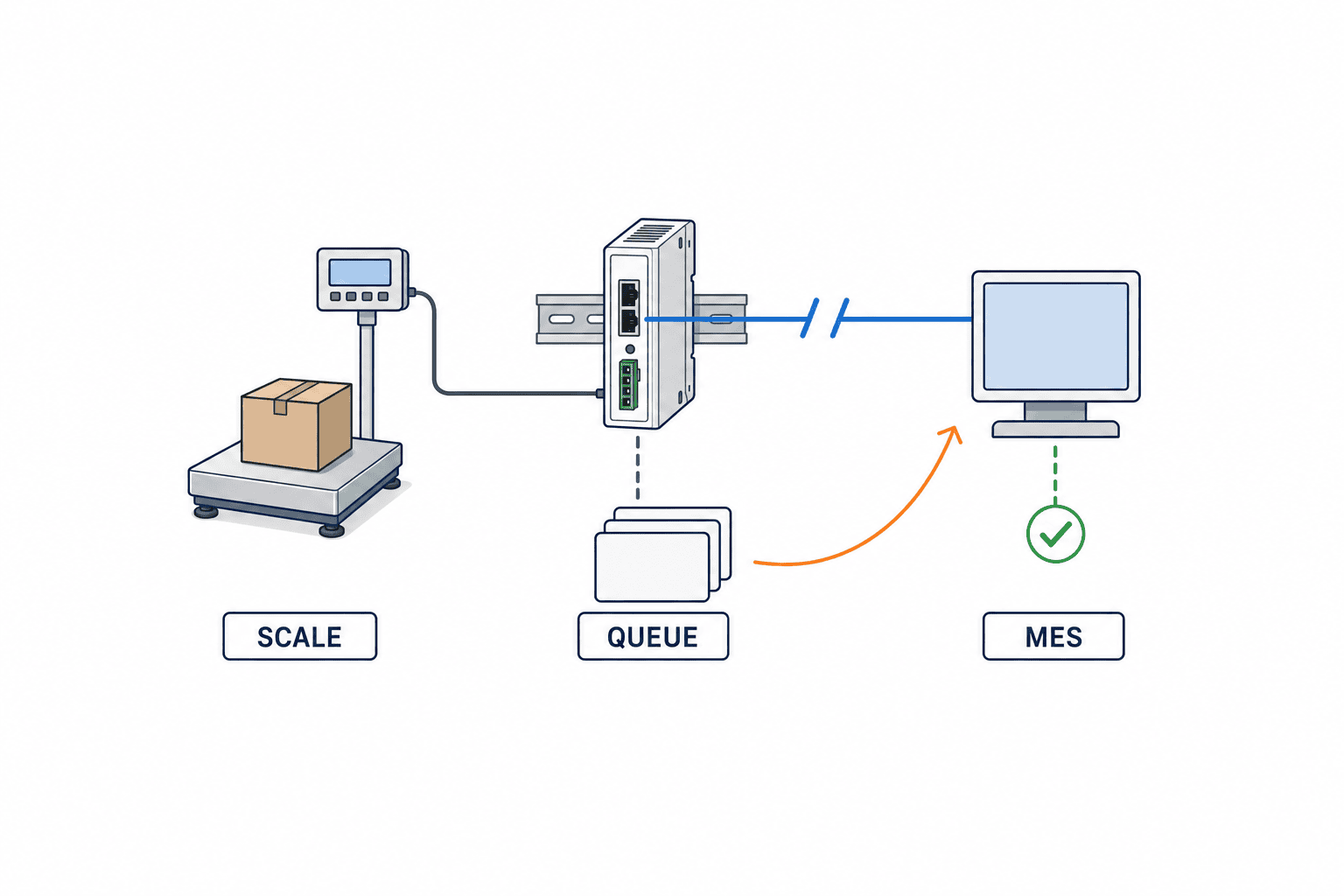
Cloud delivery is a separate decision. If weighing must continue during a line or network outage, the edge needs a queue, capacity limit, replay order, deduplication and monitoring. The process owner decides whether offline production is allowed or must stop pending a quality decision. “Sync later” can otherwise deliver an unapproved record after the finished product has shipped.
Choose event granularity for each process
At receiving, connect the supplier lot, site receiving lot, container and acceptance decision. A vehicle scale may use entry and exit readings to make one receipt quantity; define what happens if one reading is absent. A bag-by-bag bench scale raises a different question: retain a record per bag or only a supplier-lot total? If investigations may need bag-level evidence, retain the source events before aggregation.
At batching, a value near target does not prove correct material was charged. Verify lot authorization, tare and whether a step was already completed. If material can be swapped between weighing and charging, assign a temporary container ID and verify it again at the vessel. Capturing scale output alone does not prove which material entered the tank.
For filling or checkweighing, per-item pass/fail, line speed and reject-device association matter. Sending every sample synchronously to MES can interfere with control timing. Keeping decisions in control and sending confirmed item events or validated aggregates may be more suitable. Any control-logic change needs safety, quality and maintenance approval.
At shipping, link package ID, product lot, carton count, weight and label revision. Decide how repacking or label reissue affects the previous package ID. A reweigh must not count as another shipment: separate the business key from the measurement event ID. These are questions for process design, not one compulsory implementation pattern.
Evaluate vendors with device evidence
A check mark beside “scale support” can mean live value display, confirmed stable capture, gross/tare/net recording, lot validation or outage replay. Require each bidder to state model, option, tested case, evidence and limitation. Compatibility depends on exact model and firmware.
Apply mandatory gates before weighted scoring. A proposal that cannot obtain the needed confirmation state, prevent duplicate posting or support operators in their working language fails the purpose even if its dashboard and price look attractive. Score qualifying bids on integrity, recovery, maintainability, scalability and total cost, with weights based on process risk. Shipping-release weighing and a reference-only equipment metric should not have identical weights.
Ask whether a reference project used the same instrument class, interface and process, and what it actually recorded. When the scale manufacturer and integrator differ, establish modification and warranty boundaries with both. Check who can handle the real device during site tests and capture logs after hours. Put configuration files, field definitions, operational procedures and any agreed source deliverables into the contract so the factory can add a future instrument without relying on an individual engineer.
What an RFP should require
“Connect scales to MES” is too vague. Attach the weighing-point register and raw samples. Ask every bidder to answer fit, assumptions, exclusions and test method in the same template. A total price without separate instrument survey, driver work, OT network changes, terminals, ERP work, night cutover or Thai-language training cannot be compared fairly.
- Scope and boundary: Lines, points, scale models, MES/ERP versions, systems of record and each party’s change scope.
- Data definition: Gross, tare, net, unit, display precision, stable state, clocks, IDs and raw frames in a field dictionary.
- Confirmation: Person, screen or signal that finalizes a reading, and holds for unstable or out-of-range results.
- Failure and recovery: Disconnect, power loss, restart, network outage, replay, duplicate, out-of-order message and clock drift.
- Quality and audit: Calibration status, change history, correction reason, any required signature and retention.
- Security: Accounts, roles, certificates, network segmentation, backup, patches and maintenance access.
- Acceptance: FAT, SAT and initial-operation evidence, pass criteria, deliverables and sign-off owners.
- Handover: Languages for screens, procedures, training and first-line support.
Add an evidence column beyond “standard”, “custom” or “unsupported”: a live log, screen, test case or mapping table. Mark untested legacy devices “site verification required”, with survey cost and fallback separately priced. Break down the quote into instruments, gateways, terminals, cabling, network, drivers, MES and ERP interfaces, tests, training, maintenance and future model additions. Assign first-line fault isolation among the manufacturer, integrator, MES vendor and plant IT/OT.
Follow a reading from raw data to MES during FAT
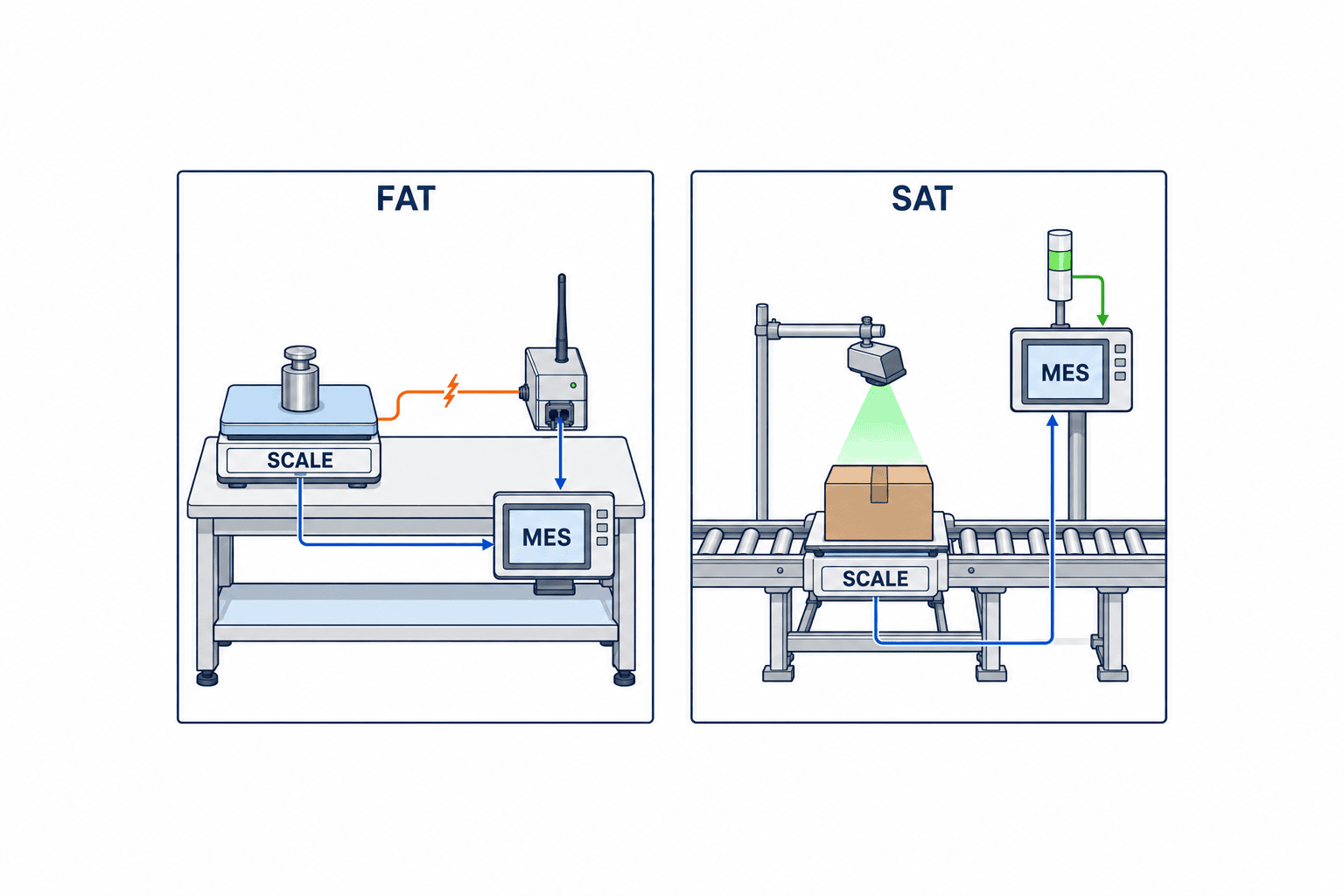
FAT tests agreed behaviour in a vendor or controlled test environment. Do not stop at a value on screen. Trace the instrument output, gateway receipt, normalized event, confirmed MES record and ERP result with the same event ID. Approve cases and expected outcomes in advance and retain actual results and logs. A simulator is useful for edge conditions, but cannot prove how a specific installed firmware behaves.
Use zero, near-full-scale, any permitted negative result, unit changes, tare near gross, display-boundary values and values immediately either side of a limit. Verify whether each case is physically possible under instrument and process rules. Test clocks and time zones, particularly across shifts and dates if screens show Thailand local time while stored events use UTC.
Change the point at which a connection is interrupted: instrument to gateway, gateway to MES, and after MES commits but before the sender sees an acknowledgement. Each has different replay behaviour. Confirm that one source event produces one official record, unresolved items are visible, and operators can follow the recovery procedure. A failed replay must not silently disappear.
| Case | Expected outcome | Evidence |
|---|---|---|
| Stable result with valid order and lot | One official result | Raw output, mapping log, MES record, event ID |
| Unstable or out-of-range result | No automatic confirmation | State, warning and action history |
| Same event resent | No extra result | Send and deduplication logs, record count |
| Disconnected then restored | Hold/replay per agreed process | Queue, timestamps and order |
| Wrong scale or lot ID | No posting to wrong operation | Input, rejection reason and audit trail |
| Correction or cancellation | Preserve original with role, reason and history | Before/after, approval and time |
The factory sets numeric acceptance values from cycle time, quality risk, network constraints and shipping conditions. Do not copy a generic latency or offline-duration threshold. If an open FAT item moves to SAT, record severity, containment, owner, deadline and retest condition.
Verify real instruments and real workflow during SAT
SAT uses the actual scale, wiring, network, order, material and operators. A FAT-approved mapping can fail because of cable noise, firmware variation, shared ports or clock drift. Safety, quality and production owners approve test windows and lots first. Do not bypass safety functions or mix an unresolved test result into accepted production.
Begin with an empty or isolated test product to verify scale and point identity. Then compare ordinary production weight, operator, lot and order with an independent shop-floor or reference record. Finally perform controlled interruption and recovery. Compare official event count, unmatched items, duplicates and corrections as well as displayed values. Investigate a discrepancy back to the raw frame to locate where value or identity changed.
At handover, operators should demonstrate reweigh, release of a held result, first isolation of a communication failure and correction request for a wrong lot. In a multilingual plant, test screens, warnings, instructions and training in the language the actual shift uses. English management documents alone may not support a night shift.
Monitor operations and control changes after acceptance
Review source events, confirmed events, held, deduplicated and unmatched records, manual entries, corrections, delay, gateway downtime and overdue calibration. Zero errors can also mean no data arrived: monitor expected operating windows and last receipt per point. A scale replacement, firmware update, terminal change or ERP item-code change triggers a defined regression test. Record affected points, fields, business rules, rollback and historical continuity in a change request.
NIST SP 800-82 Rev.3 addresses the availability, safety and performance constraints of OT. Use these principles to plan asset inventory, communication paths, roles, remote maintenance, backup and recovery. Do not give a legacy-scale gateway unlimited access across plant and external networks. Include certificate and account expiry and termination of vendor access. Citing NIST is guidance for design, not a claim that a particular installation is certified.
FAQ: cost and implementation decisions
Is OPC UA required for scale data integration?
No. The weighing companion specification is useful for a common model, but the installed interface and needed business event come first. Serial, PLC and file methods can work if source, identity, confirmation, replay and audit are controlled. An OPC UA connection that lacks stable status, tare or order linkage still misses the purpose.
Can we connect a legacy scale to MES without replacing it?
Check exact model, firmware, output fields and timing, wiring and manufacturer support. No port, missing state information or a modification affecting verification or warranty may make replacement or a changed procedure preferable. Capture a complete raw cycle from the real unit before committing.
Which costs belong in a scale integration quote?
Compare instrument, gateway, terminal, wiring, network, driver, MES and ERP work, testing, training, support and future model additions on the same scope. A universal project price is not credible without knowing points and exception cases.
Must traceability retain every weight sample?
Not always. A discrete weighing usually needs a confirmed value, source reference, state and links. Continuous weighing needs separate rules for sample rate, totalization, missing data, aggregate and raw-series retention. Define what a later investigation must prove and the applicable quality or contractual retention requirements.
Why separate FAT and SAT?
FAT reproduces logic and failures in a controlled setting; SAT checks the real scale, cable, network, material and operator. Shared event IDs and expected results help locate differences. Passing FAT does not replace site acceptance.
Summary: start with one process and its acceptance rules
A successful scale-to-MES integration is defined by the meaning of each record. Inventory the point and device; specify gross, tare, net, unit, state, identity and time; allocate authority across MES and ERP; and make duplicates, outages and corrections testable in the RFP. FAT verifies logic and SAT verifies the factory. This sequence reveals missing records and ownership gaps before expansion.
A Thai factory can contact TOMAS TECH while still surveying installed scales and deciding the MES or traceability boundary. A weighing-point register, raw output samples and current forms are enough to make the RFP questions concrete.
Sources
- OPC Foundation / VDMA, OPC UA for Weighing Technology v2.00 — Scope.
- OPC Foundation / VDMA, OPC UA for Weighing Technology — General Use Cases.
- International Society of Automation, ISA-95.
- GS1, EPCIS and CBV 2.0.
- OIML R 76-1:2006, Non-automatic Weighing Instruments.
- NIST SP 800-82 Rev.3, Guide to Operational Technology Security.


