


When a discontinued PLC, variable-frequency drive, servo amplifier or HMI can no longer be bought new, refurbished automation parts can buy a Thai factory valuable time. Yet an OEM-remanufactured unit, a third-party refurbished unit and a used PLC sold after a basic power-on check are not equivalent. A low purchase price can disappear quickly if the firmware does not match, the production backup cannot be restored, a network module will not communicate, or the replacement fails after installation. This guide compares four practical routes—OEM remanufacturing, third-party refurbishment, used-as-is equipment and migration to a current platform—through quality evidence, firmware and backup compatibility, FAT/SAT, downtime exposure and a fixed modernization deadline.
What changed in 2026: OEM-remanufactured parts are becoming easier to source
On 9 September 2026, Siemens announced a partnership with German B2B platform Sparepartsnow. The initial offer covers a defined portfolio of Siemens-refurbished drives, controllers and HMI panels. Siemens says the approach combines its refurbishment process with a digital marketplace that makes those products easier to find and buy.
The announced scope is initially Europe. It does not prove that a Thai factory can use the same buying route, warranty or return process. Buyers in Thailand should confirm the exact order number, territory, export eligibility, local warranty coverage, core-return terms and service point with the local manufacturer organization or an authorized channel.
The word “refurbished” must also be read precisely. Siemens states that these units are restored to the technical specifications and performance characteristics they had when originally placed on the market. They are not functionally modified or performance-enhanced. The applicable safety, conformity and cybersecurity requirements are those in place at original market placement. That is not the same claim as equivalence to a current new model, nor is it proof of compliance with today’s cybersecurity requirements.
Four choices for lifecycle-extension automation hardware
| Route | What is being purchased | Main advantage | Main concern | Best fit |
|---|---|---|---|---|
| OEM-remanufactured | A legacy unit restored and tested by the OEM or under its controlled process | Clearer process, parts, testing and firmware accountability | Portfolio, stock, region and warranty may be limited | Keep the same platform while requiring strong evidence |
| Third-party refurbished | A unit repaired, cleaned, component-replaced and tested by an independent provider | Wider availability when the OEM route is closed | Process quality and authorized firmware vary widely | A qualified supplier can provide evidence and warranty |
| Used-as-is | A previously operated unit sold as-is or after a simple function check | May be fast and inexpensive | Unknown history, residual life, storage and authenticity | Laboratory, low-criticality or strictly temporary bridge |
| Migrate to new | Redesign for a current PLC, HMI or drive | Long-term supportability, capability and security architecture can be renewed | Engineering, conversion, commissioning and training are required | Remaining operating life and risk justify modernization |
There is no universal winner. The evidence required for a controller whose failure stops an entire plant is different from that for an auxiliary machine with a manual bypass. Start with asset criticality and the consequence of a failed replacement, not with unit price.
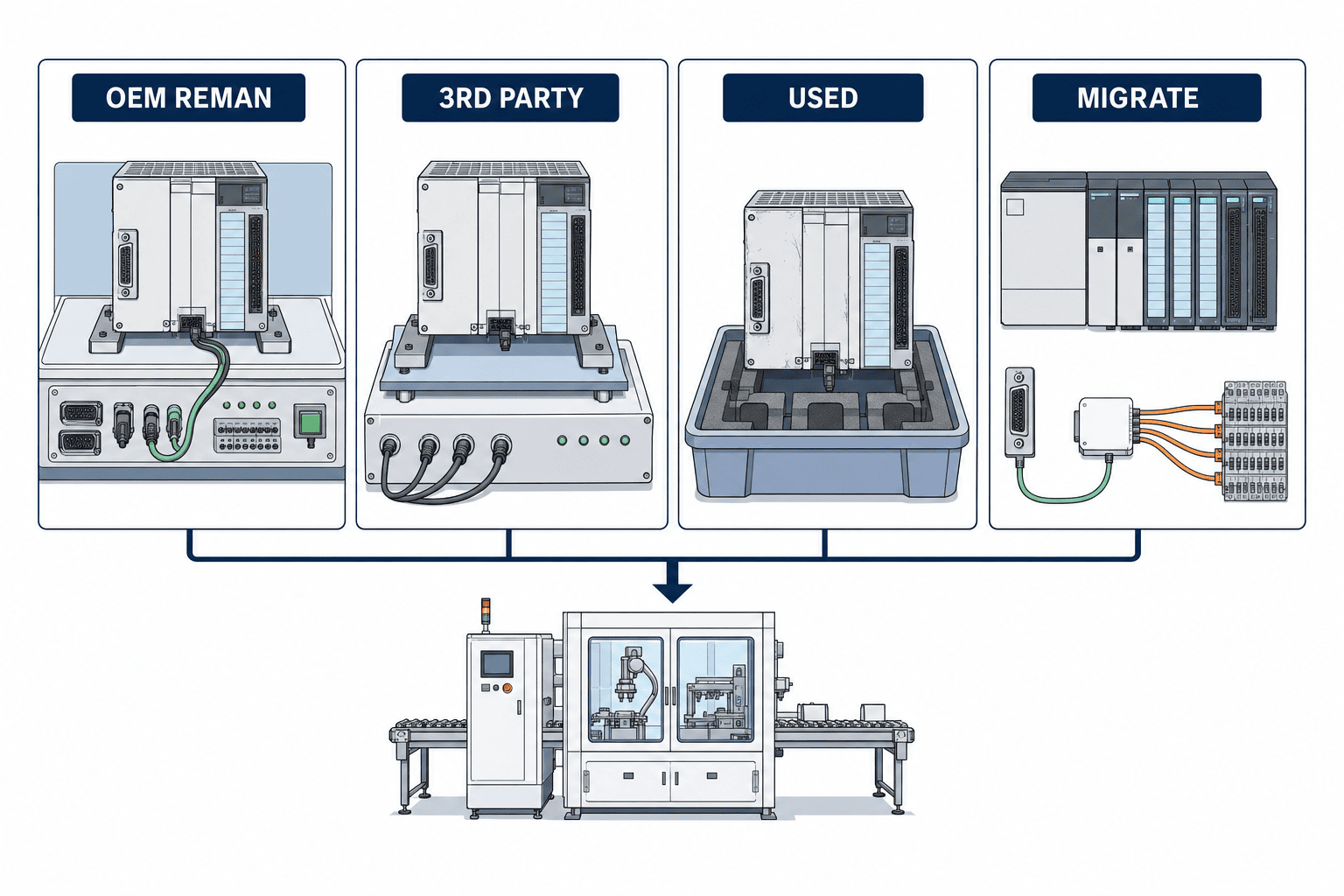
OEM-remanufactured, third-party refurbished and used PLCs are different products
OEM remanufacturing clarifies who restored the unit and against which standard
The value of an OEM-remanufactured part is not cosmetic condition. It is the clearer restoration standard and responsible party. Siemens describes technical repair, required hardware and software updates, visual restoration where needed and comprehensive quality testing. Rockwell Automation describes OEM-specified components, functional and load testing, environmental simulation and final inspection within a seven-step remanufacturing process. Its page also states a minimum 12-month warranty depending on service level and region.
Those are vendor-specific examples, not a universal promise. Process, warranty and availability differ by manufacturer, product family, service contract and country. Procurement should therefore obtain evidence tied to the purchased model and serial number rather than rely only on a general website description.
Evaluate third-party refurbishment by its process, not its label
Independent refurbishment ranges from replacing one failed component to preventive replacement of age-sensitive parts, board cleaning, coating repair, load testing and temperature cycling. Terms such as “refurbished,” “reconditioned” and “overhauled” do not carry an identical scope across sellers.
Ask how the supplier handles incoming inspection, diagnosis, disassembly, component selection, repair, final testing, record retention and nonconforming units. For a PLC, tests should address power, CPU, memory, communications and the I/O bus. For an HMI, cover display, touch, backlight and communications. For a drive, cover control power, power stage, cooling, capacitors and representative output load. The treatment of batteries, relays, fans, connectors and electrolytic capacitors should match the product and its age.
“It powered on” does not prove a used PLC is production-ready
A RUN lamp, visible display or successful boot does not demonstrate performance in the machine. Intermittent communication under load, weak memory retention, damaged terminals, touch-position drift or a high-load drive trip can escape a basic check.
For used equipment, request the exact order number, hardware revision, serial number, date code, source, removal context, storage condition and known operating history. If that information is unavailable, record the uncertainty as risk. Do not erase it from the decision merely because the price is low.
Discontinued FA equipment has more than one lifecycle date
“Discontinued” is not a single event. Order-stop, production-stop, standard repair end and spare-component end may occur on different dates. Mitsubishi Electric’s published product pages, for example, list end-of-order, discontinued and repair-support-expiration dates separately. On the cited MELSENSOR page, selected code readers show 2025 order/discontinuation dates and repair support through 2032.
For the MELSEC-A/QnA large-type series, Mitsubishi Electric states that production ended in September 2006, service availability continued for seven years after discontinuation, and repair service ended in September 2013. It points users toward MELSEC iQ-R. The lesson is simple: a legacy unit may still exist in the market after the manufacturer’s repair and engineering support has ended.
Maintain these five dates separately in the asset register:
- Manufacturer order-stop date
- Production discontinuation date
- Standard warranty or repair-support end date
- Date the factory last proved a recoverable backup
- The factory’s own deadline to exit the legacy platform
The first three are set externally. The last two remain under plant control. Use a refurbished unit as a bridge from today to a planned migration date, not until market stock disappears.
Twelve items of quality evidence to request before comparing quotations
| Check | Evidence to request | Weak response |
|---|---|---|
| Product identity | Photos of model, hardware revision, serial and date code | Model family only or stock photo |
| Authenticity | Supply chain, nameplate, seals and modification status | “Believed genuine” |
| Refurbishing party | OEM, OEM-authorized or independent status | Subcontractor not disclosed |
| Incoming inspection | Initial fault, visual and electrical checks | No retained record |
| Replaced parts | Part list and OEM-specified/equivalent classification | “Parts replaced as needed” |
| Firmware | Version, authorized source, signature or integrity evidence | File of unknown origin |
| Functional test | I/O, communications, memory and restart results | Power-on only |
| Load test | Load condition, duration and acceptance limit | Brief no-load test |
| Environmental test | Temperature, vibration or humidity where critical | Not considered for a critical asset |
| Warranty | Term, scope, exclusions, freight and DOA response | “Warranty included” |
| Core return | Deadline, charge and title to the failed unit | Surprise charge after delivery |
| Logistics | Packaging, ESD, import, duty and Thailand service point | Incoterms and responsibility unclear |
Incomplete evidence does not automatically mean rejection. It means the plant must either obtain the missing evidence or compensate through deeper FAT, a second tested spare, a shorter service window or a lower-criticality application. Installing an undocumented unit directly into a critical machine is the worst combination.
Make the serial number the primary key for every record
A certificate that lists only a model does not prove that its result belongs to the delivered unit. Put the same serial number on the purchase order, incoming photographs, refurbishment report, firmware record, FAT certificate, warranty and SAT report. If the device lacks a usable serial, agree on a unique combination such as hardware revision, MAC address, date code, tamper label and internal asset ID. Photograph the identity before and after FAT so that a passed unit cannot be substituted unnoticed.
Make authorized firmware provenance an acceptance condition
A matching version string does not establish that a firmware image is legitimate. Request a record showing it came from an official distribution site, authorized service tool or approved service center, and verify a signature or hash when the manufacturer supplies one. If licensing prevents the seller from redistributing the image, agree before purchase that the buyer will download it with an authorized account and install it during FAT. State the delivered version, permitted substitute, downgrade rule and recovery owner in the purchase specification.
Treat core return as a recovery condition, not only a price condition
An exchange service may require the failed unit to be returned within a fixed period. Returning it immediately after SAT can remove the rollback asset before early-life monitoring is complete. Define when the clock starts, extension options, core charge, accepted damage, import/export paperwork, data-erasure duty and transit liability. Where possible, retain the old unit through the post-SAT observation period; otherwise prepare another rollback unit or an approved temporary mode.
Firmware and backup compatibility are the most common hidden traps
Matching the model number is not enough
The same order number can still carry different hardware revisions, firmware, memory sizes, communication options or regional configurations. A project may download successfully while remote I/O recognition, network participation, HMI tags or motion synchronization still fails.
Before buying, capture the following from the running asset:
- Exact model, hardware revision and firmware for PLC, HMI, drive and key modules
- Engineering-software name, version, service pack and license status
- Latest source project, online/offline comparison and checksum
- Parameters, recipes, alarm/history data and retentive-data recovery method
- Network map, IP/node addresses and GSD/EDS or equivalent device descriptions
- Owner of passwords, keys, certificates and memory cards
A backup is not healthy merely because a file exists. Prove that the required software can open and compile it and that it can be restored to a test unit. Unknown passwords, upload-prohibited configurations and a mismatch between source code and the running controller are risks to resolve before the spare arrives.
A firmware update is not automatically the safest choice
Newer firmware can change compatibility with old logic, communication modules, HMIs or servo systems. Keeping old firmware can preserve compatibility but leave unsupported software or known vulnerabilities. The acceptance rule should not be “install the latest.” It should be “match the approved configuration and manage its residual risk.”
Confirm whether the firmware can be obtained through an authorized source, whether signatures or hashes can be checked, whether downgrade is permitted and how rollback will work. OT security should also review segmentation, access control, remote access, monitoring and other compensating controls. Restoring original behavior is not proof of current cyber compliance.
FAT: find incompatibility before the unit reaches the production line
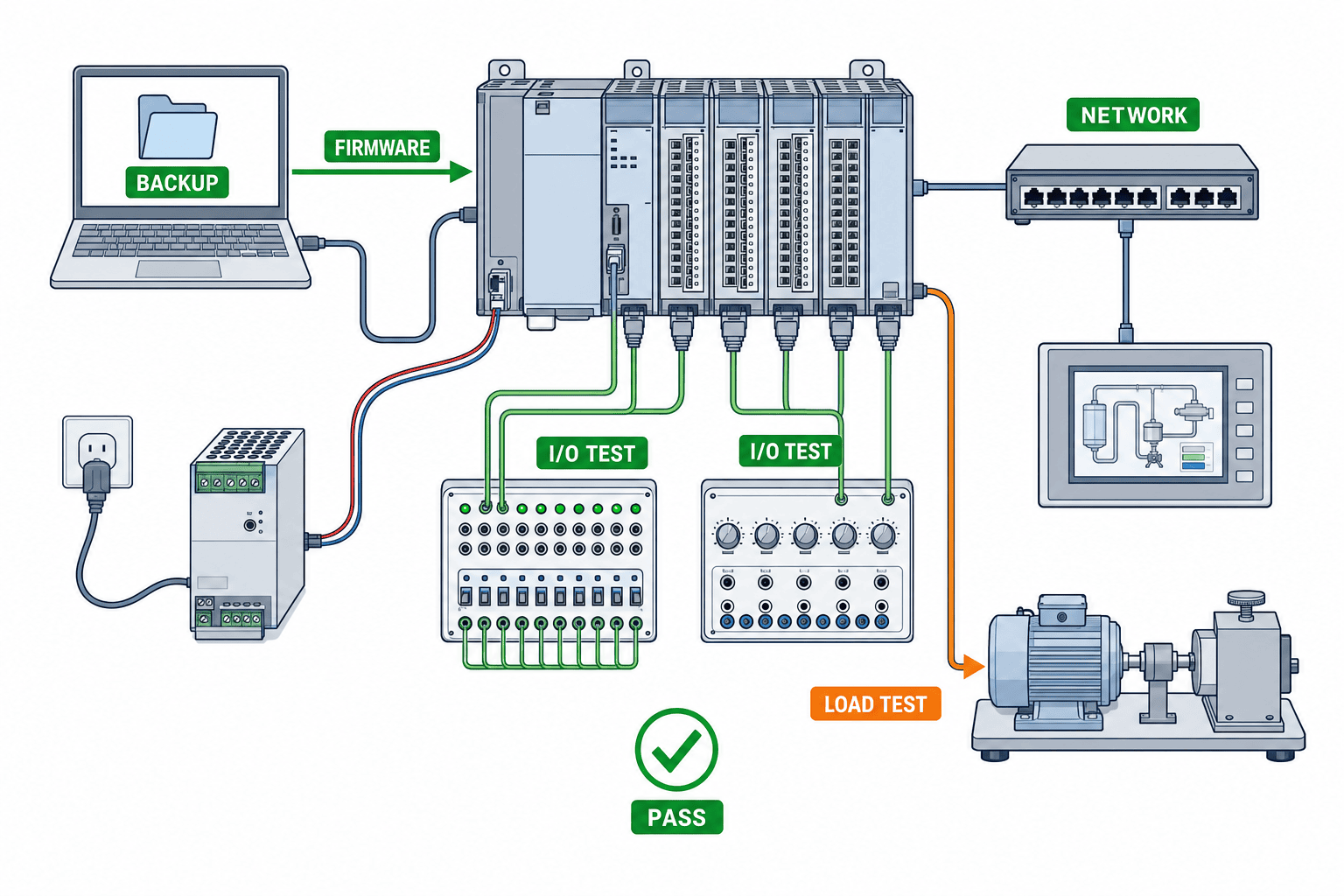
Factory Acceptance Testing is not only for a new machine. A refurbished PLC or HMI deserves a bench test precisely because its value is avoiding an unplanned production experiment.
Practical FAT checklist
- Match nameplate, model, hardware revision, serial number and seals to the purchase order.
- Inspect enclosure, terminals, connectors, boards, fan, battery and display.
- Read the approved firmware and compare it with the configuration record.
- Restore the backup; record compile result, version and checksum.
- Simulate digital and analog I/O used by the machine.
- Exercise Ethernet, fieldbus and serial ports with real protocol traffic.
- Verify HMI navigation, tags, alarms, recipes and history.
- Test power loss, cold/warm restart and recovery from communication loss.
- Run a representative load or burn-in period while monitoring temperature, errors and resets.
- Close every nonconformity, repeat failed tests and sign the final as-tested configuration.
For drives and servos, add motor/encoder pairing, braking, acceleration, current limit and applicable safety functions. Safety validation requires competent personnel and the applicable standards. A simple I/O bypass is not safety-function validation.
SAT: prove the refurbished part works with the actual machine
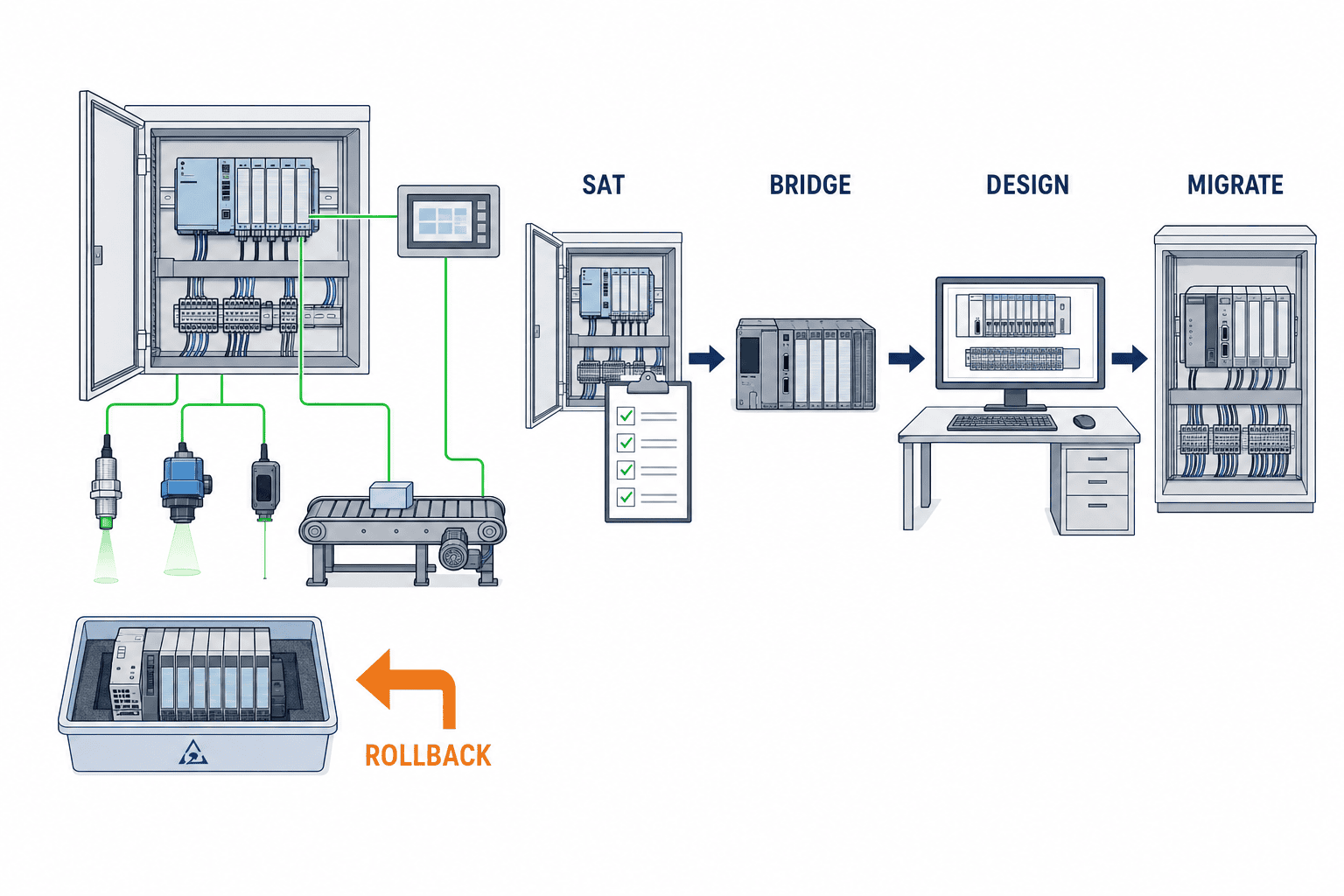
A FAT pass cannot prove compatibility with the real cabinet, wiring, power quality, network peers and mechanics. Site Acceptance Testing should take place in an approved shutdown window and include a controlled rollback plan.
Before removal, save a configuration snapshot, label wiring, nominate the work owner, apply lockout/tagout and define the condition that triggers reinstallation of the old unit. After installation, check power and grounding, field I/O, interlocks, sequence, upper-level communications, HMI behavior, recipes and production-quality data. Qualified personnel must validate safety circuits under local law and plant rules.
Do not define success simply as “the machine produced one piece.” Use representative products, speeds, loads, changeovers and stop/restart scenarios. After SAT, retrieve the final firmware, program and parameters again. Record date, owner, checksum and storage location in the asset register.
Convert downtime risk into a comparable cost
A refurbished unit often wins when only purchase prices are compared. The real comparison should include purchase, testing, inventory carrying cost, installation, repeat-failure exposure and eventual migration.
An illustrative worksheet is:
Expected annual downtime loss = annual failure probability × average outage hours × contribution loss per hour
For example—and these are assumptions, not industry statistics—if annual failure probability is 12%, average outage is 18 hours and contribution loss is THB 180,000 per hour, the result is 0.12 × 18 × 180,000 = THB 388,800 per year. This excludes quality escapes, scrap, premium freight, safety events and customer impact. Replace every input with plant data.
A used unit that is THB 100,000 cheaper can therefore be the expensive choice. Conversely, if manual operation is possible, another line can cover demand and a second FAT-tested spare is available, refurbished equipment can be economically sound.
Minimum acceptance by asset criticality
| Criticality | Consequence | Recommended minimum | Avoid |
|---|---|---|---|
| A: plant-wide, safety or major quality impact | Severe impact on plant, customer or compliance | OEM remanufacturing or equivalent evidence, full FAT, tested spare, rollback and migration plan | Unknown-origin used unit installed immediately |
| B: production-line stop | Hours or more of lost production | Evidence-backed refurbishment, real-traffic FAT, planned SAT and contingency | Power-on test only |
| C: local stop | Bypass or manual operation available | Qualified third party may be acceptable, function test and fixed expiry | Turning a bridge into a permanent solution |
| D: test or training | Little production impact | Used equipment can be acceptable with electrical safety and data checks | Moving it into production without requalification |
Classify by function, not price. A small communication module may be critical if it is the only path to a supervisory system. An expensive HMI may be less critical if another authorized station can operate the machine.
From sourcing to operation: a controlled seven-step flow
Step 1: Freeze the installed configuration
Capture model, hardware/firmware, software, parameters, network and licensing. Prove the backup matches the running machine. If the facts are missing, conduct a site survey before rushing to purchase.
Step 2: Put all four routes on one scorecard
Compare OEM-remanufactured, third-party refurbished, used and migration-to-new for lead time, evidence, FAT cost, SAT outage, warranty, remaining use period and migration spend. “OEM stock unavailable” should not automatically mean “buy the first used unit.”
Step 3: Confirm territory and commercial route
Verify sale to Thailand, authorized contact, importer, duty and tax, warranty territory, repair return address and advance exchange. Mitsubishi Electric describes a global FA network covering sales, repairs, service, support, training and consulting, but the exact product and service terms still require local confirmation. Do not copy European marketplace terms into a Thailand purchase order.
Step 4: Make evidence contractual
Specify serial identity, process, replaced components, firmware, testing, warranty, DOA, core return and packaging. Include remedies and deadlines for a failed FAT.
Step 5: Standardize pre-shipment FAT, receipt and storage
Run FAT before shipment at the supplier or agreed test site and freeze the certificate for the passed serial. After delivery, perform an incoming bench check for transit damage and identity; do not confuse this with the full pre-shipment FAT. Store the unit under appropriate ESD, humidity and temperature controls. Even unused batteries, capacitors and contacts can age over time, so set a re-test date.
Step 6: Plan SAT and rollback together
Reserve the outage, competent people, tools, old unit, backups and estimated restoration time. Define the decision owner and the exact point at which the team rolls back.
Step 7: Approve the modernization deadline
Treat the start of successful refurbished operation as the start of the migration window. Set design, FAT and cutover milestones against the next planned shutdown, budget year and support deadline.
Prevent temporary lifecycle extension from becoming permanent delay
“Upgrade when it fails again” is too late. The thresholds below are examples for a plant-specific policy, not universal rules. Adjust the months and supplier count for criticality, budget cycle and approval lead time, then trigger migration when an approved threshold is reached:
- Twelve to twenty-four months remain before authorized repair or firmware support ends.
- Fewer than two suppliers can provide units that meet the acceptance evidence.
- The plant can no longer maintain a test environment that proves backup recovery.
- The engineering PC, operating system or license can no longer be sustained.
- Compensating OT-security controls can no longer reduce risk to an acceptable level.
- Expected annual downtime loss plus extension cost exceeds annualized modernization cost.
- Capacity, quality data or traceability requirements exceed the legacy platform.
For the broader replacement decision, see our PLC replacement and retrofit decision guide. For ABC classification, storage and recurring stock checks, see FA spare-parts inventory management. This article deliberately focuses on serial-linked evidence, authorized firmware, core return and acceptance gates for the refurbished unit. Whether maintenance should be in-house or outsourced, and how many spares to stock, are outside its scope.
Common failures and how to avoid them
Buying a cheap used PLC before checking compatibility
A suffix, hardware revision or firmware mismatch can make it unusable. Build the installed-base configuration and recovery-test record first, then quote only matching units.
Trusting the seller’s phrase “OEM refurbished”
Distinguish refurbishment by the OEM, an authorized provider, and an independent company working on an OEM-branded product. Verify who issued the certificate and whether it identifies the serial number.
Powering the unit for the first time during the shutdown
The production window becomes troubleshooting time. Complete every reproducible backup, I/O, network and load test on the bench; leave only site-specific checks for SAT.
Cancelling modernization because the refurbished unit works
One successful unit does not guarantee the next spare, firmware, license or skilled technician. Keep the migration project alive and use the gained time for design and budget approval.
FAQ
What is the difference between a used PLC and a remanufactured PLC?
A used PLC may be sold as removed or after a limited check. A remanufactured or refurbished PLC has undergone a defined degree of diagnosis, repair, parts replacement, cleaning and testing. Because scope varies by seller, verify process, test record, warranty and serial traceability.
Is an OEM-remanufactured part equivalent to new?
Not as a universal rule. Siemens’ September 2026 announcement says its products are restored to their original market-placement specifications and performance characteristics without functional enhancement. That does not establish equivalence to a current new model. Review the certificate and warranty for the exact unit.
How long can discontinued automation equipment be extended with refurbished parts?
There is no fixed number of years. The limit depends on authorized repair, legitimate firmware, engineering tools, recoverable backups, qualified suppliers and asset criticality. Set the deadline according to the ability to test and manage the risk, not merely market availability.
Is putting refurbished FA spare parts on a shelf enough?
No. Complete incoming FAT and backup-recovery proof, control storage, track battery/capacitor age, set periodic re-testing, and maintain installation and rollback procedures. Link the physical serial number to its evidence.
What should a Thai factory check before importing a used PLC?
Confirm sales territory, exporter/importer responsibilities, duty and tax, warranty territory, repair-return path, core-return terms, ESD/moisture protection and legitimate rights to software and firmware.
How much FAT does a refurbished PLC need?
Define coverage by criticality rather than a fixed number of hours. A critical controller normally needs program recovery, representative I/O, real network communication, power-cycle recovery and load or burn-in testing. Independent witnessing may be appropriate.
Conclusion: refurbished hardware is controlled migration time, not simply a cheap spare
Safe lifecycle extension begins by comparing OEM-remanufactured, third-party refurbished, used-as-is and migration-to-new on one scorecard. Verify hardware, firmware and backup recovery; obtain serial-specific quality evidence; use FAT for unit, communication and load behavior; use SAT for the actual machine; and approve the modernization deadline at the same time as the refurbished purchase.
TOMAS TECH can help Thai factories survey installed PLC/HMI/drive configurations, verify backups, write refurbished-part procurement specifications, design FAT/SAT and create a migration roadmap. Even before the model list or budget is complete, we can help prioritize the assets with the greatest downtime exposure. Contact TOMAS TECH.
References
- Siemens, “Siemens and Sparepartsnow partner to expand access to Siemens’ refurbished automation products,” 9 September 2026: https://press.siemens.com/global/en/pressrelease/siemens-and-sparepartsnow-partner-expand-access-siemens-refurbished-automation
- Siemens, Circular Spares & Repairs: https://www.siemens.com/en-us/products/industrial-sustainability-services/circular-spares-repairs/
- Rockwell Automation, Remanufacturing & Exchange Services: https://www.rockwellautomation.com/en-us/capabilities/industrial-maintenance-support/product-application-support/remanufacturing-exchange-services.html
- Mitsubishi Electric FA, Discontinued/alternative models: https://www.mitsubishielectric.com/fa/products/dbdbsearch/SearchServlet.page?bunrui1=Code+Reader&category=discon&kisyu=%2Fsensor
- Mitsubishi Electric FA, MELSEC-A Series Renewal: https://fa-faq.mitsubishielectric.com/fa/id_en/products/cnt/plca/pmerit/renewal/
- Mitsubishi Electric FA, Global Service Network: https://www.mitsubishielectric.com/fa/about-us/core-competencies/global-network/


