



The purpose of production planning simulation is not simply to automate an existing Excel schedule. It is to model finite capacity, materials, people, changeovers, shared molds and tools, and maintenance downtime, then compare normal demand, rush orders, equipment failures, and supply delays on the same basis. This guide explains how a Thai factory can turn that capability into an RFP, a 90-day proof of concept (PoC), and a defensible investment decision.
Why Thai factories need production planning simulation now
An industry average can conceal the volatility faced by an individual factory. Thailand’s Office of Industrial Economics reported a Manufacturing Production Index of 94.80 for July 2026, down 0.94% month on month and up 0.46% year on year. Yet electronic components and boards rose 9.04% month on month and 2.36% year on year; steel fell 4.01% year on year; and computer peripherals fell 25.11% month on month while rising 28.23% year on year. The variations between industries and between months are much larger than the headline movement.
NESDC reported that Thailand’s GDP grew 2.8% year on year in Q1 2026, while manufacturing grew 0.9%. These figures do not predict demand for any specific company. They do show why a plan built on last month’s fixed assumptions can become obsolete quickly. Demand mix, supplier commitments, machine condition, and skilled-worker availability can all change at once.
Simulation does not promise an accurate prediction of the future. It makes assumptions explicit, compares alternatives using common KPIs, and helps managers explain why one executable plan should be selected now. The useful acceptance question is therefore not, “Did AI find an optimum?” It is, “Did the system produce feasible alternatives, with understandable trade-offs, before the decision deadline?”
What a production planning simulation must model
A production planning simulation tests which item should run, through which route, on which machine, with which people, at what time and in what sequence. Its job is not to draw an attractive Gantt chart; it is to expose whether the plan can actually be executed.
Microsoft’s description of finite-capacity planning explains that existing capacity reservations are considered and dates are pushed later when capacity is unavailable. It also warns that results will be wrong if capacity settings, such as shifts, do not match reality. Master-data and calendar quality therefore determine schedule quality.
At job level, orders can be broken into operations while the scheduler considers resource availability, reservations, finite materials, and required capabilities. Forward scheduling, backward scheduling, and duration adjustments based on efficiency are all relevant. APS—advanced planning and scheduling—usually spans strategic capacity, tactical production planning, and detailed sequencing. A production scheduler often emphasizes detailed sequencing, but product scopes overlap. An RFP should define time horizons, constraints, objectives, and ERP/MES interfaces instead of relying on labels.
For a product-selection framework, see our production scheduler comparison for Thailand. The focus here is the model and evidence needed before ranking solutions.
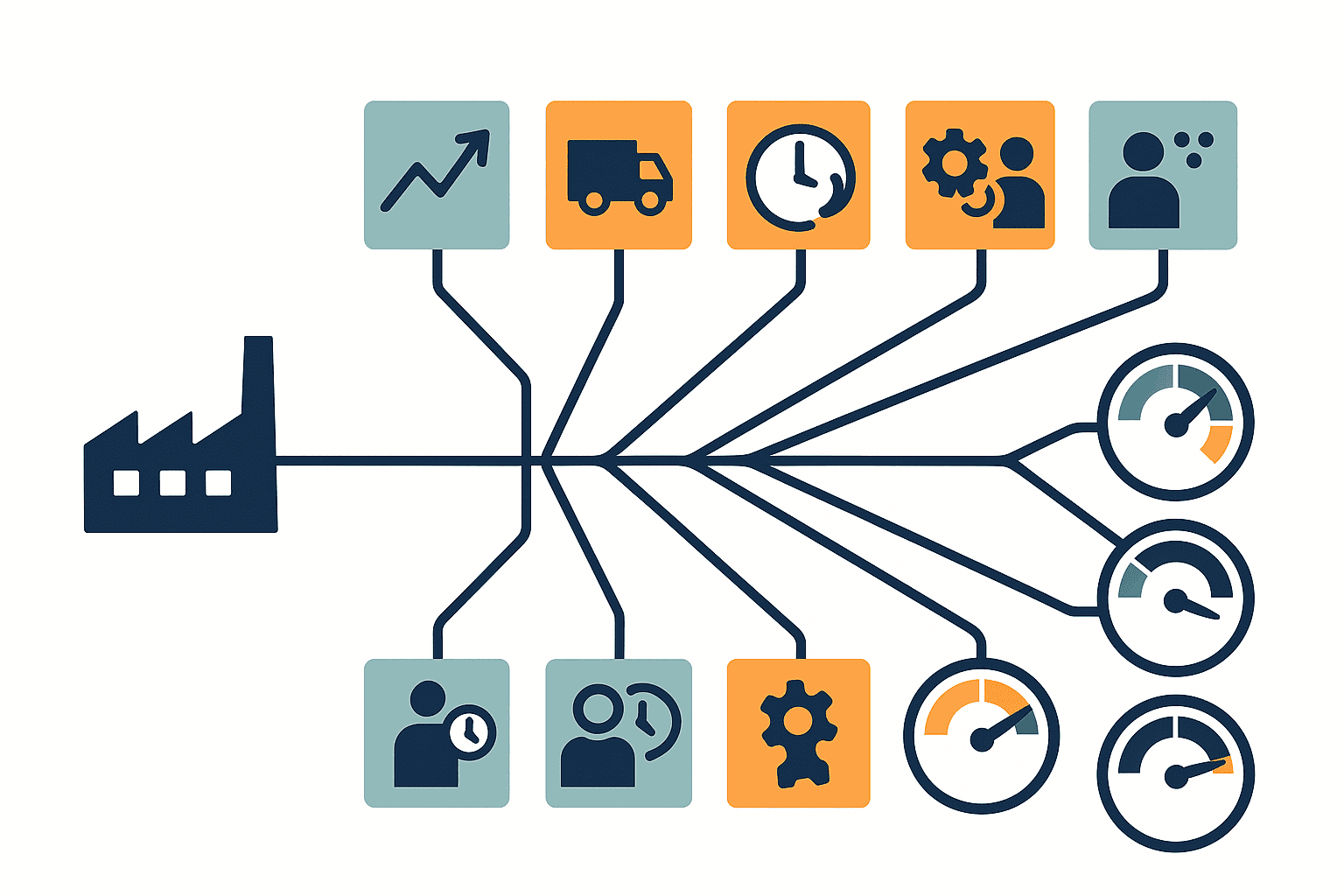
Put What-if comparison at the center of the decision
Automating the current spreadsheet may reduce repetitive work, but it does not transform response time if planners still edit hundreds of cells whenever assumptions change. The real value of simulation is the ability to compare a baseline and alternatives with the same data and KPIs.
Scenario 1: Normal orders
Build a baseline from current orders, inventory, machines, people, shifts, and maintenance. The result does not need to copy the planner’s frozen schedule exactly, but every material difference must be explainable. Unrecorded cleaning sequences, color rules, preferred customers, mold cooling time, and inspection restrictions should be logged as missing model knowledge.
Scenario 2: Rush order
Insert a high-priority order and compare the effects on existing due dates, changeovers, overtime, and staffing. The output should identify which existing orders move and by how much, whether an approved alternative machine or split lot reduces the impact, and whether the answer is available before Sales must respond to the customer.
Scenario 3: Critical-equipment downtime
Stop a bottleneck machine and test several recovery times. An alternative machine may differ in tool compatibility, output rate, quality approval, or operator certification. Model those eligibility rules and determine when outsourcing, overtime, or customer negotiation becomes necessary.
Scenario 4: Material delivery delay
Delay a critical material by one day, three days, and one week. Compare the effect of pulling other jobs forward. A schedule that reserves machine capacity for a job with unavailable material can look full while remaining impossible to execute. Decide how confirmed deliveries, unconfirmed supplier promises, substitute materials, and inspection lead time are represented.
Scenario 5: Overtime ceiling
Compare normal shifts, limited overtime, and no overtime. Unlimited overtime is not a valid balancing mechanism. Include limits by department and skill, holiday approval, and practical operating conditions such as transport and meal arrangements.
Scenario 6: Shared molds and tools
A mold that fits several machines is still a single shared resource. Include removal, transport, preheating, cleaning, maintenance, and preparation. If machines are finite but the mold is modeled as infinite, the plan may assign the same mold to two lines at once.
Scenario 7: Shortage of multi-skilled operators
An idle machine cannot run without a certified operator. Represent skill matrices, shifts, permitted support areas, setup crews, and supervisory requirements. Test absenteeism, competition for setup staff, and shortages of inspectors. The results may also show which cross-training action releases the most useful capacity.
The point is not to optimize every scenario simultaneously. It is to let management, production control, manufacturing, purchasing, and sales see what changes, which KPI moves, and why.
Data required in an APS and production-scheduler RFP
An RFP must go beyond screens and feature checklists. Define each PoC data field, its granularity, history, update frequency, source of truth, and owner. Our guide to production-management system functions and RFP requirements can help clarify the boundary between ERP, MES, and planning.
Items and BOMs
Align codes for finished goods, intermediates, raw materials, and approved substitutes, including effective dates. Identify whether engineering or manufacturing BOMs govern planning. Include yield, by-products, rework, customer-supplied materials, and version-selection rules.
Routings
Define operation sequence, branches, parallel work, subcontracting, queues, and transport. Include routes selected by inspection result and customer-approved equipment restrictions.
Standard times and efficiency
Separate fixed, quantity-dependent, and lot-dependent setup, run, labor, waiting, and transport time. Compare old standards with actual distributions. Precise numbers are not useful unless they correspond to real performance.
Changeover matrix
Changeover depends on the “from” and “to” combination of color, material, size, mold, and cleaning class. Start with product families and bottlenecks that materially affect the decision instead of trying to populate every possible combination.
Equipment and labor calendars
Load working days, shifts, breaks, holidays, approved overtime, maintenance, and effective capacity. Add setup teams, inspectors, forklifts, furnaces, or other auxiliary resources only where they form a real constraint.
Inventory and inbound supply
Distinguish available, allocated, quarantined, and safety stock. Separate confirmed receipts, supplier responses, and forecasts. If book stock differs materially from physical stock, inventory accuracy must be addressed before the scheduling algorithm is blamed.
Due dates and priorities
Separate customer request date, committed date, shipment date, and transport lead time. Priorities need a reason—expedite approval, customer class, line-stop impact, or penalty—not just high, medium, and low. Log who changes a priority and why.
Alternative resources and capabilities
Define machines, people, and subcontractors that can perform the same operation, with differences in speed, cost, quality approval, maximum size, and material compatibility. A single “alternative allowed” flag is rarely enough.
Maintenance downtime
Include preventive maintenance, calibration, statutory inspection, planned repair, restart, warm-up, cool-down, and first-piece approval. Test unplanned downtime with several uncertain recovery estimates.
Lot, split, and merge rules
Define minimum and maximum lot, transfer batch, permitted splitting, extra setup after a split, and conditions for merging orders. Smaller lots may improve delivery flexibility while increasing setup and inspection load.
For every field, the RFP should state where it exists now, who maintains it, how often it is synchronized, and what happens when it is missing. A PoC does not need perfect data, but it must not silently treat unknown values as zero or stale values as current.
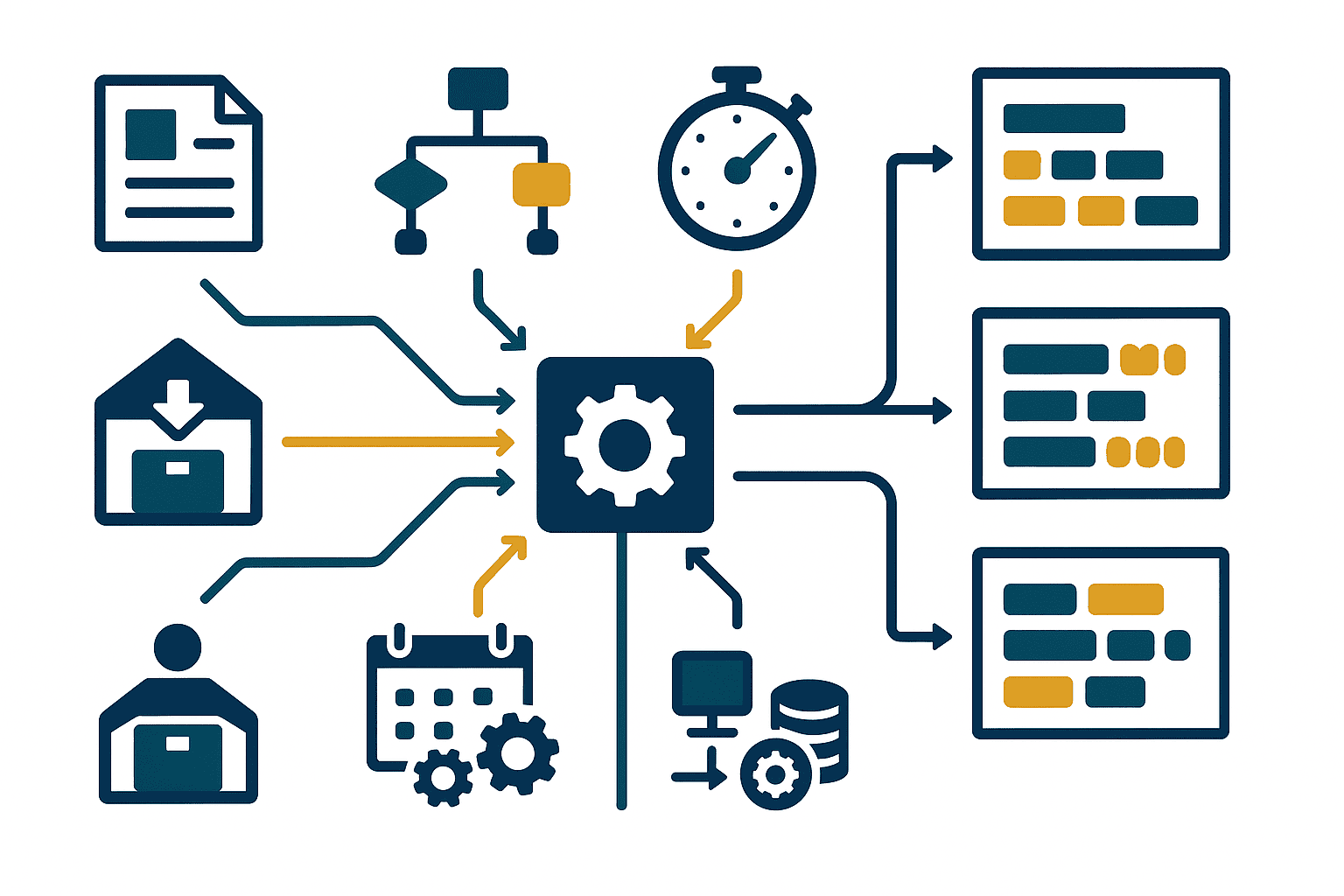
Choose the right detail for short-term scheduling
Adding constraints can make a model appear more realistic, but it also increases computational work. Microsoft’s scheduling-engine guidance cautions against making every resource finite or modeling unnecessary operation detail. Parallel calculations may also produce results that are not perfectly deterministic. The most detailed model is therefore not automatically the best model.
Start with constraints that drive delivery and WIP: typically bottlenecks, shared tools, and scarce skills. Represent non-bottleneck operations as aggregated or infinite during the first PoC, then add detail only when a measured discrepancy changes a decision. Use time fences as well: minute-level detail for the near term and day- or week-level capacity farther out.
Define an acceptable planning time from the operating need. For example, a rush-order scenario must return alternatives before Sales has to answer—not within an invented universal number of seconds. Specify what happens at timeout: fail, show the best available plan, or return a deliberately relaxed scenario.
Reproducibility matters. Store the input snapshot, execution time, algorithm settings, frozen operations, and manual edits. If the engine can produce different sequences from the same apparent input, planners must still be able to explain what changed.
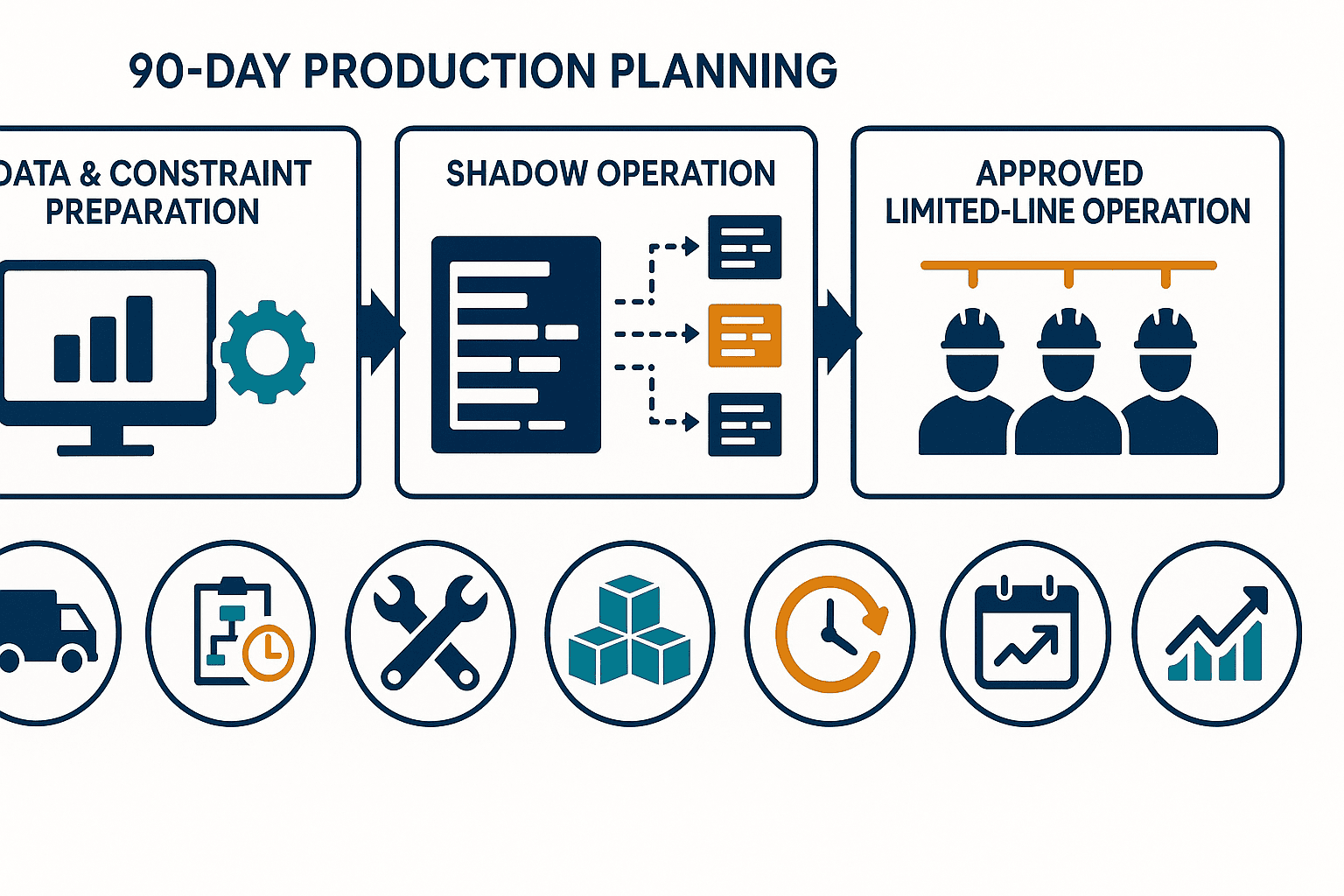
A 90-day PoC for an investment decision
A PoC is not a prolonged product demonstration. It should test whether the factory can make better decisions with its own data and constraints.
Days 0–30: Prepare data and define constraints
Limit scope to one product family, line, or bottleneck. Prepare one to three representative months of item, BOM, routing, time, changeover, calendar, order, inventory, supply, and maintenance data.
Interview planners and supervisors to capture rules outside formal systems: whiteboards, chat messages, morning meetings, and individual memory. Classify each as mandatory, preferred, or informational. Agree which system—ERP, MES, equipment data, or Excel—is authoritative and who owns updates.
Recreate the baseline and list discrepancies. Classify each discrepancy as planner judgment, poor master data, or functional gap. At the same time, agree on KPI definitions and how each measurement will be collected.
Days 31–60: Shadow operation and What-if tests
Keep the current plan as the official plan while running the simulator in parallel. Test normal demand, rush orders, machine failure, delayed materials, overtime limits, shared molds, and skill shortages using both historical cases and live conditions.
For every run, log the data timestamp, frozen assumptions, computation time, output KPIs, planner decision, and reason an alternative was rejected. Include slow calculations, infeasible plans, and manual corrections. A correction is not merely a failure; it reveals knowledge that the model is missing.
Do not automatically post results to ERP or MES yet. Let an approver compare start and finish time, machine, lot, and priority against the official plan and assess whether the differences are explainable.
Days 61–90: Decide on a limited line
Use approved schedules for a low-risk product group or limited line. Retain a planner or manager approval gate even if an interface can post schedules automatically. Verify rollback, audit history, and the ability to return to the current procedure if calculation or integration fails.
The final decision should include licensing, data cleanup, master-data maintenance, integration, training, support, and effort to change the model. Do not generalize PoC results to products or sites that were not tested; record those as hypotheses for the next stage.
PoC KPIs and acceptance conditions
On-time delivery alone is not sufficient. A plan can improve delivery while increasing overtime, WIP, or changeovers. Compare at least these KPIs against the current baseline:
- On-time performance: define whether customer request, committed, or shipment date is used.
- Planning lead time: include data collection, computation, manual adjustment, and approval.
- Changeover time: measure actual time, not just the count of changes.
- Work in process: choose quantity, value, and/or dwell time.
- Overtime: measure by department, shift, and skill; exclude unapproved capacity.
- Replanning response: time from a disruption to communicating an alternative.
- Plan-versus-actual variance: compare start, finish, quantity, machine, setup, and delay reason.
Set targets from the customer’s measured baseline and decision deadlines, not generic vendor numbers or invented improvement percentages. ISO 22400-1:2014 provides an industry-neutral framework for defining and using manufacturing-operations KPIs and was confirmed as current in 2025. Apply the same discipline by recording numerator, denominator, period, exclusions, and source system in a KPI dictionary.
Acceptance also needs operating criteria: users can explain why an operation was placed, manual freezes survive replanning, changes are auditable, Thai, English, and Japanese teams interpret the same terms, and the factory can fall back safely after a failure.
Clarify the responsibility of ERP, MES, and APS
As a general pattern, ERP manages commercial transactions such as orders, purchasing, inventory, and cost; APS or the production scheduler creates a constraint-based plan; and MES manages execution instructions and actual results. Real products overlap, so responsibility must be assigned by data element, not system name.
Choose one source of truth for order dates, maintenance plans, skill matrices, and schedule sequence. For every interface, define ownership, synchronization direction, frequency, version, error retry, and approval. Otherwise one system can overwrite a newer plan with an older one.
A schedule sent to MES may include order, operation, resource, planned start and finish, quantity, lot, priority, and revision. MES can return actual start and finish, good and rejected quantity, downtime reason, material consumption, and operator. Not every interface must be real time; its frequency should match the deadline for the associated decision.
Common failure patterns
Outdated standard times
Optimization cannot compensate for unrealistic standards. Compare actual distributions for the PoC scope and correct the processes with the largest gaps. Continue monitoring plan-versus-actual variance after go-live.
Exceptions remain in people’s heads
Customer priority, cleaning order, quality approvals, and prohibited combinations must be captured. To avoid an excessively heavy model, classify them as mandatory constraints, preferences, or warnings.
Every operation is over-modeled
Making every machine, person, tool, and transfer finite from day one expands both data work and calculation time. Start with the constraints that affect the decision and add detail only when evidence shows it matters.
Delivery is the only KPI
A schedule can appear successful while shifting the burden to overtime, setups, WIP, or planners. Review a balanced KPI set and make cross-department trade-offs visible.
ERP/MES responsibility is unclear
Duplicate maintenance of the same data creates conflicts. Document the source, direction, timing, approval, and retry process at field level in the RFP and interface design.
Plan changes are not logged
Save before and after values, user, time, reason, and approval. Frequent manual edits should become input for constraint, priority, or master-data improvement.
Implementation governance and investment considerations in Thailand
Define roles for headquarters, local production control, manufacturing, IT, purchasing, sales, and the vendor. Name the PoC owner, data owners, schedule approver, scenario approvers, and investment decision maker. A model designed only at headquarters misses local operating rules; a local-only project can delay enterprise integration and standards.
Language is also an implementation requirement. Align master-data names, downtime reasons, change reasons, training materials, and support routes—not only screen labels. A shared glossary prevents Japanese management, Thai planners, and regional English-speaking IT from applying different definitions to the same KPI or constraint.
Thailand BOI’s automation information includes references to software/IT supporting manufacturing and to AI and data analytics. However, the page also includes measures whose listed application deadlines ended in 2025. Do not assume that an incentive is available in 2026. Verify the latest announcement, eligible activity, deadline, cost classification, and corporate eligibility with BOI or a qualified adviser before including it in a business case.
FAQ about production planning simulation
What is production planning simulation?
It models orders, materials, machines, people, changeovers, tools, and downtime so a factory can compare alternative schedules. It does not predict the future with certainty; it shows how changed assumptions affect delivery, WIP, overtime, and setup.
What is the difference between APS and a production scheduler?
APS commonly covers broader long-, medium-, and short-term planning, while a production scheduler often emphasizes detailed shop-floor sequencing. Product functions overlap. Compare time horizon, constraints, objectives, interfaces, and operating responsibility instead of names.
Can we start from Excel?
Yes. Existing item, routing, time, calendar, order, and inventory sheets can seed a PoC. First resolve inconsistent codes, undocumented columns, and missing version control. Excel can remain part of comparison and approval while the data definition is standardized.
What determines the cost?
Licensing model, users, sites and lines, model complexity, ERP/MES interfaces, data cleanup, customization, infrastructure, training, and support all matter. Include internal effort to maintain masters and change constraints. Quotes are not comparable unless vendors receive the same PoC scope and deliverables.
What data is required for a PoC?
At minimum: item, BOM, routing, standard time, major changeover rules, equipment and labor calendars, capacity, inventory and inbound supply, order due dates, priority, alternative resources, maintenance downtime, and lot/split conditions. Label missing, estimated, and stale values instead of hiding uncertainty.
Should optimized schedules post automatically to the shop floor?
Not at first. Use shadow operation, then a limited line with an approval gate. Validate snapshots, change history, frozen operations, and rollback before widening automatic posting.
Conclusion: compare executable plans, not attractive charts
Production planning simulation succeeds when it represents the necessary finite capacity, materials, labor, changeovers, shared tools, and maintenance at an appropriate level of detail; compares normal and disrupted scenarios with the same KPIs; and explains why results changed. A good RFP defines data and system responsibilities. A 90-day PoC moves from data and constraints to shadow use and then limited operation, measuring planning time, setup, WIP, overtime, response time, and plan-versus-actual—not just delivery. Starting with a bottleneck and retaining an approval gate creates a more credible path to adoption and investment.
TOMAS TECH can help you define the target line, RFP data, integration boundary, and acceptance conditions for a production planning simulation in Thailand, including approaches that build on existing Excel, ERP, and MES assets. You can discuss the project while it is still at the evaluation stage through our contact page.
Sources
- Thailand Office of Industrial Economics, Industrial Production Index July 2026: https://www.oie.go.th/view/1/Home/en-us
- NESDC, Thai Economic Performance in Q1 2026: https://www.nesdc.go.th/wordpress/wp-content/uploads/2026/05/03-PRESS-EN-Q1-2026.pdf
- Microsoft Learn, Finite capacity planning: https://learn.microsoft.com/en-us/dynamics365/supply-chain/master-planning/planning-optimization/finite-capacity
- Microsoft Learn, Job scheduling: https://learn.microsoft.com/en-us/dynamics365/supply-chain/production-control/job-scheduling
- Microsoft Learn, Scheduling engine performance: https://learn.microsoft.com/en-us/dynamics365/supply-chain/master-planning/scheduling-engine-performance
- Siemens, Advanced Planning and Scheduling: https://www.siemens.com/en-us/products/opcenter/advanced-planning-scheduling-aps/
- Siemens, Manufacturing scheduling software: https://www.siemens.com/en-us/technology/manufacturing-scheduling-software/
- ISO, ISO 22400-1:2014: https://www.iso.org/cms/%20render/live/en/sites/isoorg/contents/data/standard/05/68/56847.html
- Thailand BOI, Automation measures: https://www.boi.go.th/index.php?language=th&page=automation-en


