


A production management system implementation failure rarely begins with software that simply does not run. More often, management outcomes were never translated into operating rules, data ownership, interfaces, and evidence-based acceptance criteria. Thai factories also have to coordinate headquarters and local decision rights, Thai and Japanese working languages, legacy machines and Excel masters, intermittent shop-floor networks, and relevant tax or electronic-document interfaces. This guide treats failure as a preventable chain of design and decision defects. It provides a practical framework covering RFP preparation, a 90-day discovery and PoC pattern, migration, UAT, cutover, and stabilization.
What production management system implementation failure really means
Failure includes more than an aborted go-live. A system may technically launch while operators return to Excel, inventory becomes unreliable because postings are late, planners work longer hours, every support request waits for one vendor, or management still cannot obtain decision-ready numbers. Conversely, a phased rollout can be successful even when it does not implement every original wish, provided it protects the agreed business outcomes and manages deferred scope explicitly.
Thailand’s depa published its Digital Density Survey 2024 in April 2025. It reported that most surveyed industrial sectors were at Industry 2.0, and that 57% of the sample used Industry 2.0-style online ordering and payment solutions in supplier relations. This is a 2024 survey finding, not a 2026 maturity measure and not a success rate for any individual factory. It does, however, reinforce a practical point: an implementation roadmap should start from the company’s actual digital baseline instead of assuming advanced integration is already in place.
The Thailand BOI/OSOS 1H 2026 update reported 1,300 approved applications valued at about THB 1.31 trillion. Projects valued at THB 17.2 billion involved machinery upgrades, digital adoption, automation, or robotics. A separate BOI statement reported that realized investment in 1H 2026 exceeded THB 535.8 billion, up 27%, with more than THB 127 billion associated with AI-related activities. These figures describe the investment environment. They do not prove ERP or MES ROI, nor do they establish an implementation success rate. A strong investment cycle makes disciplined acceptance criteria more important, because “installing a system” can easily replace the real objective.
Failure is a chain of decisions, not only a product defect
Risk builds when a project follows this pattern:
- Management asks for “visibility” or “DX” without defining the decision or KPI that must improve.
- The team automates the existing process before resolving exceptions and responsibility gaps.
- Vendors are assessed through polished demos rather than representative data and peak conditions.
- Every gap becomes customization without reconsidering the standard operating model.
- No owner is assigned for master definitions, approval, change, and retirement.
- Interface ownership, retries, duplicate prevention, and recovery remain ambiguous.
- UAT becomes a participation exercise with no exit criteria.
- Cutover and rollback are not rehearsed under production-like conditions.
- Roles, training, support, and post-go-live KPIs are postponed.
Each delay can appear small, yet the accumulated ambiguity surfaces at go-live. Prevention therefore begins before product selection, by sequencing decisions and specifying the evidence required at every gate.
Define five outcomes before listing functions
Before building an RFP feature list, management, factory operations, IT, finance, and quality should agree on five outcome groups.
1. Management outcomes
Examples include creating one defensible basis for delivery promises, explaining work-in-process differences daily, stabilizing manufacturing-cost close, or making changes auditable. Do not stop at “reduce inventory.” State who will use which number, in which meeting, to change which decision. Any numerical target should be based on the company’s measured baseline rather than an external generic claim.
2. Process outcomes
Describe the end-to-end path from sales order, planning and procurement through receipt, issue, production reporting, inspection, shipment, and cost. A department-only design often loses information at the handoff. Cover real exceptions such as partial delivery, substitutions, rework, scrap, rush orders, subcontracting, stock differences, lot splitting, and skipped operations.
3. Data outcomes
Name the owner and authoritative source for items, BOMs, routings, equipment, partners, lots, units, locations, and cost elements. “Clean the data” is not an acceptance criterion. Define mandatory fields, duplicate logic, code structure, effective dates, conversions, approvers, retirement rules, and reconciliation evidence.
4. Technology and security outcomes
Draw the boundaries among ERP, MES, WMS, accounting, quality, machines, barcode systems, EDI, and electronic documents. Specify identity, authorization, logging, backup, recovery, and behavior during network outages. The final NIST Cybersecurity Framework 2.0 describes high-level cybersecurity risk-management outcomes across sectors; it does not prescribe one implementation. NIST IR 8183 Rev. 2, published in 2025 as an initial public draft, offers manufacturing-oriented guidance on supply-chain risk, platform security, and infrastructure resilience, but it must not be presented as a final standard.
5. Operating outcomes
Define first-line intake, second-line diagnosis, vendor escalation, service levels, review meetings, and change control. Decide who owns operations after the project team disbands, who responds during a Thai night shift or holiday, and whether support is available in the needed language.
Design an RFP that changes how the system is selected
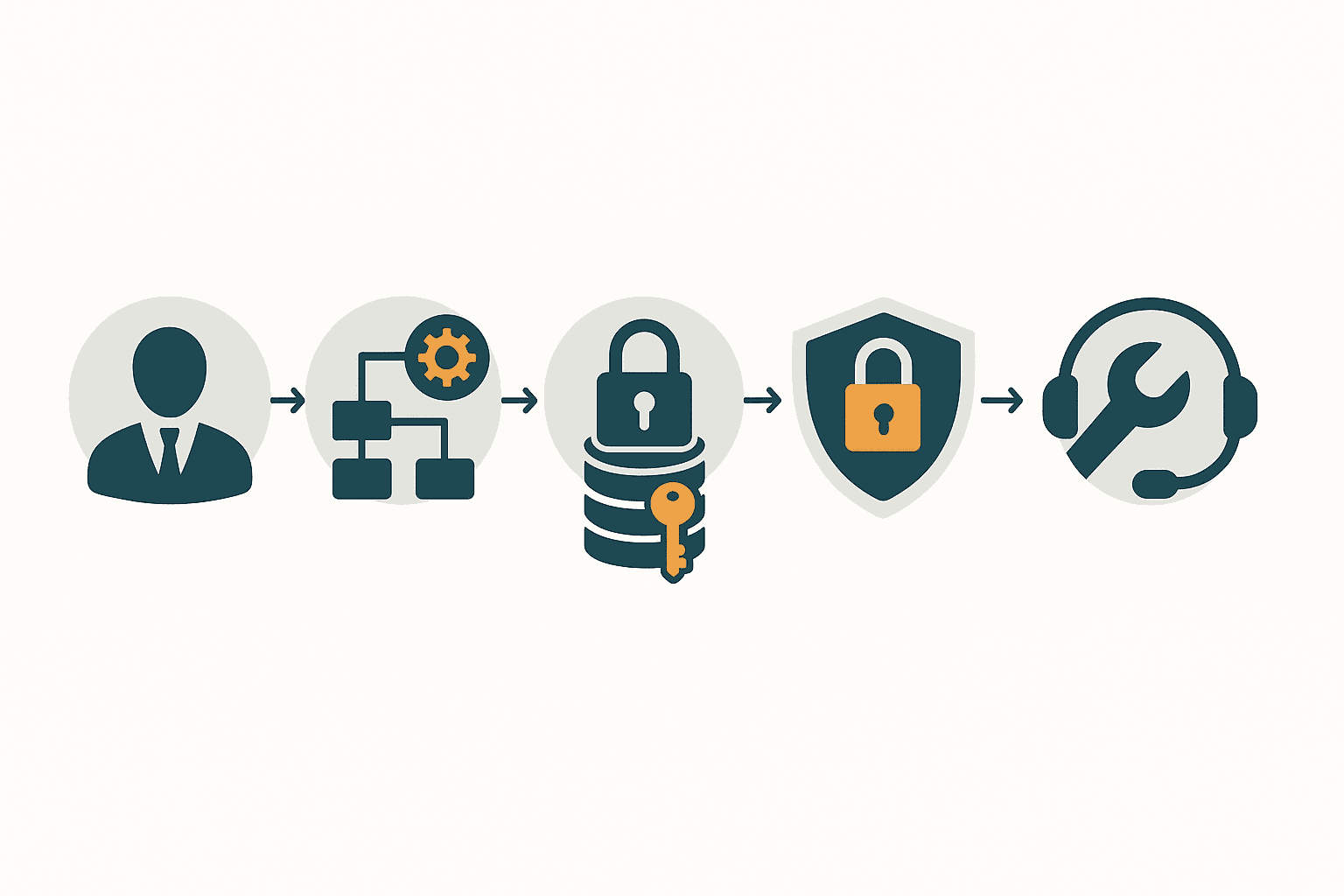
An RFP should not be a yes/no function checklist. It should force each vendor to explain the solution method, limitations, assumptions, proof, responsibilities, and cost on comparable terms. For a functional baseline, see our production management system functions and RFP guide. To structure the commercial and technical comparison, use the production management system comparison guide for Thailand.
Require a precise response type for every requirement
Ask vendors to classify each response as one of the following:
- Delivered by standard functionality, with the relevant configuration identified.
- Delivered by additional configuration or workflow design.
- Dependent on an external interface, with boundary and ownership defined.
- Dependent on customization, with maintenance and upgrade effects stated.
- Replaced by an operating-process change, with the control procedure stated.
- Unsupported or only on a future roadmap.
“Possible” is not enough. The response should identify whether the capability is standard or custom, who maintains it, what must be retested after upgrades, and how an incident is traced.
Thai factory requirements to make explicit
The following are implementation questions, not legal or tax conclusions. Company-specific obligations should be confirmed with the appropriate advisers.
- Which screens, reports, masters, and training materials require Thai, Japanese, or English?
- Are Thai tax or electronic-document interfaces relevant, and what are the target service, storage, and evidence requirements?
- How will ICT, headquarters time, factory calendars, and shifts crossing midnight be handled?
- What conversion and rounding rules apply to pieces, boxes, kilograms, metres, and sets?
- What data can legacy PLCs, machines, scales, and barcode printers provide, and what cannot they provide?
- During a network outage, what is stored locally, retried, deduplicated, or entered manually with approval?
- When will Excel masters be retired, and how will emergency export and reimport be controlled?
- Which decisions belong to headquarters and which belong to the local factory for templates, masters, roles, and custom work?
- Where is data stored, who can access it, how long are logs retained, and how is overseas support access governed?
- What local support hours, response targets, languages, on-site conditions, and severity definitions apply?
There is no universal answer. The RFP should expose the factory’s constraints and require vendors to separate the standard design from exception handling.
A 90-day discovery and PoC pattern to remove risk before contracting
The 90-day pattern and all thresholds below are example planning targets, not industry statistics or mandatory standards. Tailor them to scope, sites, data quality, interfaces, and decision speed. The value lies in the evidence produced at each interval.
Days 1–15: align purpose, current state, and authority
Reduce the initiative to a small set of priority outcomes and define in-scope and out-of-scope processes. Observe shift handover, queues, rework, network interruptions, and month-end work—not just screens and forms. Name the process owner, data owner, design approver, budget approver, and go-live decision-maker.
Example deliverables include a project charter, current and future process maps, risk and issue log, decision-rights matrix, and KPI baseline. Measure the baseline from company data and document the method.
Days 16–30: prepare representative scenarios and data
Do not limit the PoC to a clean happy path. Select business-critical combinations from mass production, high-mix low-volume orders, substitutions, partial delivery, rework, scrap, equipment downtime, and stock differences. Use appropriately controlled real data to represent items, BOMs, routings, stock, open orders, and access roles.
Write the expected result before execution. Replace “the screen opens” with who enters what, how inventory, capacity, delivery, and cost change, and which audit evidence proves the outcome.
Days 31–60: test end to end in the PoC
Run the flow from order to shipment and cost, including interfaces, approvals, and exception recovery. A vendor expert completing the script is insufficient. Actual users should work in Thai or the operating language while the project records training effort, confusing steps, response time, and fallback work.
Test disconnected links, duplicates, reordered messages, invalid values, and timeouts in addition to normal transmission. For intermittent shop-floor networks, verify local buffering, retransmission after reconnection, processed-message recognition, and clock differences.
Days 61–75: assess gaps and total effort
Classify every gap as standard configuration, operating change, external interface, customization, or exclusion. Compare total effort, including data remediation, training, testing, local support, monitoring, backup, future sites, upgrade work, and customization regression testing—not just licences and initial development.
Customization is not automatically wrong. It should be challenged when the team cannot connect it to differentiation or a specific contractual or control need. Compare the cost of adopting the standard process with the long-term cost of maintaining custom logic.
Days 76–90: make the pre-contract exit decision
Transfer unresolved gaps, assumptions, exclusions, migration responsibility, interface responsibility, SLA, deliverables, and acceptance conditions into the contract. PoC completion is not the same as PoC success. Use agreed evidence to decide: accept, accept with conditions, investigate further, or reject.
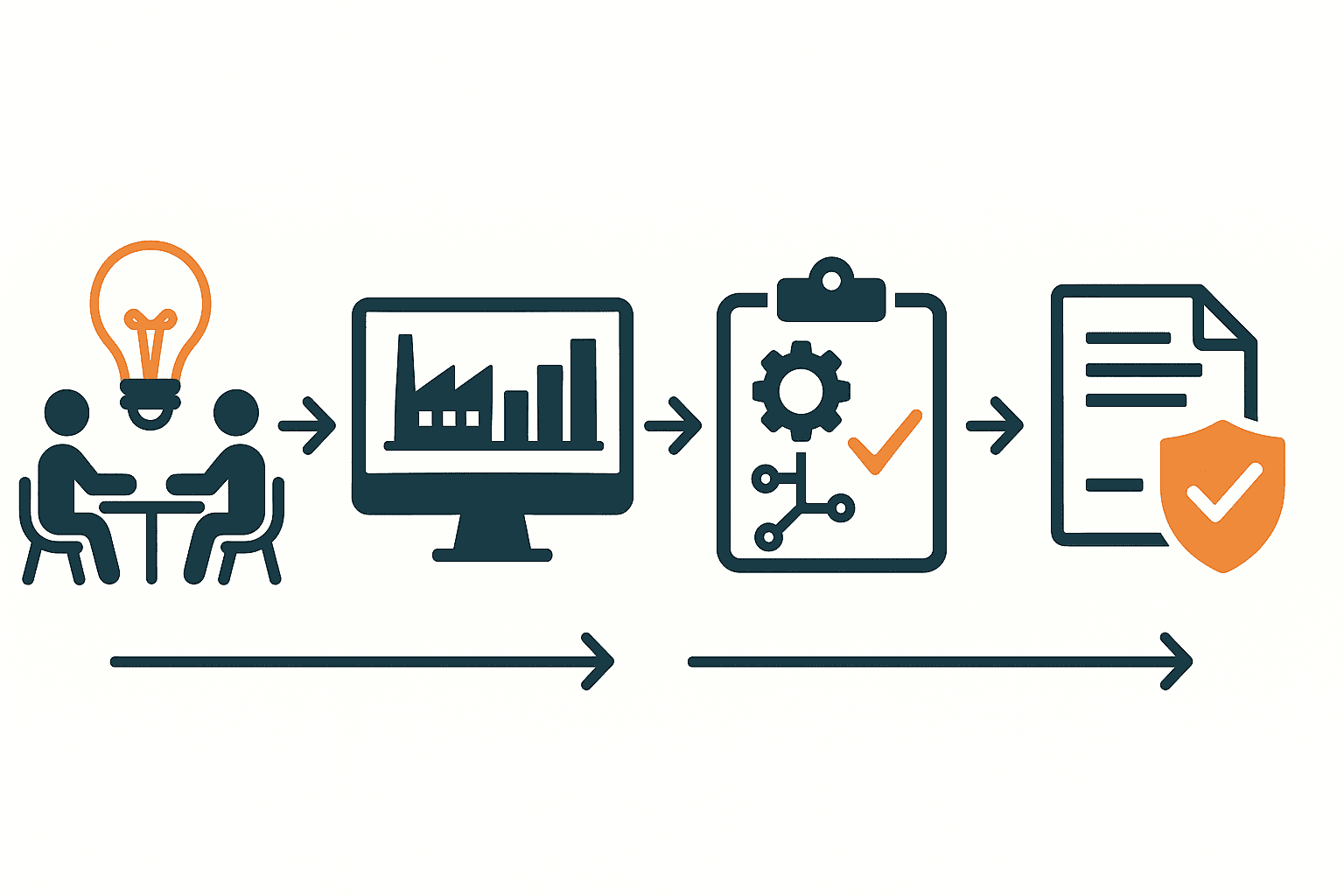
Use an acceptance matrix to separate a PoC from a sales demo
The following matrix is an example. Its thresholds are not recommended universal values; set them from the company baseline, peak conditions, risk tolerance, and business consequences.
| Area | Example test | Evidence | Example exit condition |
|---|---|---|---|
| Process | Run representative scenarios from order to shipment and cost | Transaction IDs, screens, reports, journals, logs | No unresolved blocking defect in a critical scenario |
| Exceptions | Partial delivery, substitution, rework, cancellation, stock difference | Before/after data and approvals | Accountable user can reproduce recovery |
| Data | Migrate items, BOMs, stock, and open orders | Counts, totals, sample reconciliation | Differences are explained and approved for agreed fields |
| Interfaces | Create outages, retries, duplicates, and reordering | Message IDs and reprocessing logs | No double posting; unprocessed items are detectable |
| Performance | Run peak-like concurrent processing | Response, queue, and resource records | Critical actions complete within company targets |
| Access | Test view, entry, change, and approval by role | Role matrix and access log | Forbidden actions fail; exceptions are traceable |
| Operations | Exercise monitoring, backup, recovery, and support | Tickets and recovery record | Local team performs first-line response |
| Usability | Actual users work in the operating language | Observation and training results | Extra support needs are identified and planned |
“Everything must be 100%” treats a cosmetic issue like a shipment-stopping defect. Define severity, workaround, due date, and approver. Separate conditions that block go-live from items that can be corrected under controlled post-go-live action.
Prevent data migration from blocking implementation
Microsoft’s Dynamics 365 implementation guidance distinguishes configuration data from migration data. It recommends defining sources and targets, volumes, methods, sequence and dependencies, roles, and pre- and post-cutover activities, and testing and verifying migration in SIT and UAT. This is product-vendor guidance, but the planning disciplines are broadly useful.
Align the meaning of master data first
One item code may have different granularity in sales, manufacturing, procurement, and accounting. Agree on BOM effective dates, substitution priorities, standard routing time, inventory status, and lot traceability through written rules and samples. If a headquarters template is used, confirm it can accommodate Thai units, language, suppliers, and subcontracting.
The data owner should normally be the business function accountable for meaning and use, not IT. IT can support extraction, transformation, and loading, but it cannot decide which conflicting value is commercially or operationally correct.
Rehearse migration more than once
Use an early cycle to uncover extraction criteria, encoding, missing values, and duplicates; a later cycle to validate corrections and reconciliation; and a production rehearsal to confirm timing and ownership. Reuse the same scripts, reconciliation sheets, and approval flow. Record manual corrections as controlled steps.
Counts alone do not prove readiness. Reconcile totals and representative detail for quantities and values, open sales orders, purchase commitments, WIP, lots, and opening balances. Microsoft’s Finance & Operations go-live guidance also calls for testing all implemented processes and customizations and using migrated data, including master data and opening balances, for UAT and performance readiness.
Oracle’s ERP implementation project-plan guidance describes communication and employee buy-in as cultural drivers and explains that well-planned data migration supports schedule and budget control. This is vendor guidance rather than independent success-rate evidence, but its warning against treating migration as a purely technical task is practical.
Turn UAT from user attendance into a go-live decision
UAT should demonstrate that process owners can complete business work under production-like roles, data, documents, interfaces, and timing constraints. Implementation teams should not write cases alone; users should approve the expected result and business impact.
UAT entry criteria
- In-scope configuration is deployed to the test environment.
- Required interfaces are available, or an agreed substitute is documented.
- Representative migrated data and roles are loaded.
- Blocking SIT defects are closed or explicitly accepted.
- Testers know the scenario, evidence method, and defect process.
UAT exit criteria
- Business users independently complete critical scenarios.
- No defect remains that would stop the required operation.
- Every accepted defect has a workaround, owner, due date, and approval.
- Segregation of duties and audit logging are verified.
- Migration reconciliation, interface recovery, reports, month-end, and shift boundaries are covered.
- Training and operating procedures reflect the tested design.
Do not approve UAT only from attendance or case-completion percentage. One missing critical process can outweigh many low-risk passed cases. Equally, minor wording defects need not block the whole program when their impact is controlled.
Rehearse cutover and rollback before production
Microsoft’s go-live checklist guidance covers stakeholder scope alignment; sign-off of system integration, performance, and UAT cycles; tested cutover scripts; alignment with external dependencies; training and change-management activity; and production monitoring and support readiness. It also advises that the cutover plan include dependencies, roles, verification steps, and documentation.
Build a time-based cutover runbook
Sequence legacy-system closure, final transaction time, extraction, transformation, loading, reconciliation, interface switching, user release, and first-business checks. Assign an owner, entry condition, completion evidence, expected duration, and escalation contact to every step. Coordinate the timing with accounting, logistics, customer and supplier EDI, and electronic-document providers.
Rollback must include the decision to return
A backup is not a rollback plan. Define the recoverable point, treatment of transactions created after switching, decision authority, and the delay or defect condition that triggers a decision meeting. If users may post into both systems, identify the authoritative record and reconciliation process.
Make Go/No-Go evidence based
Review unresolved critical defects, migration reconciliation, performance, interfaces, training, duty rosters, recovery rehearsal, and external dependencies—not only percent complete. Define the approval authority and rejection conditions at the beginning so schedule pressure does not become the only reason for an exception.
Do not bolt on access, security, and incident response
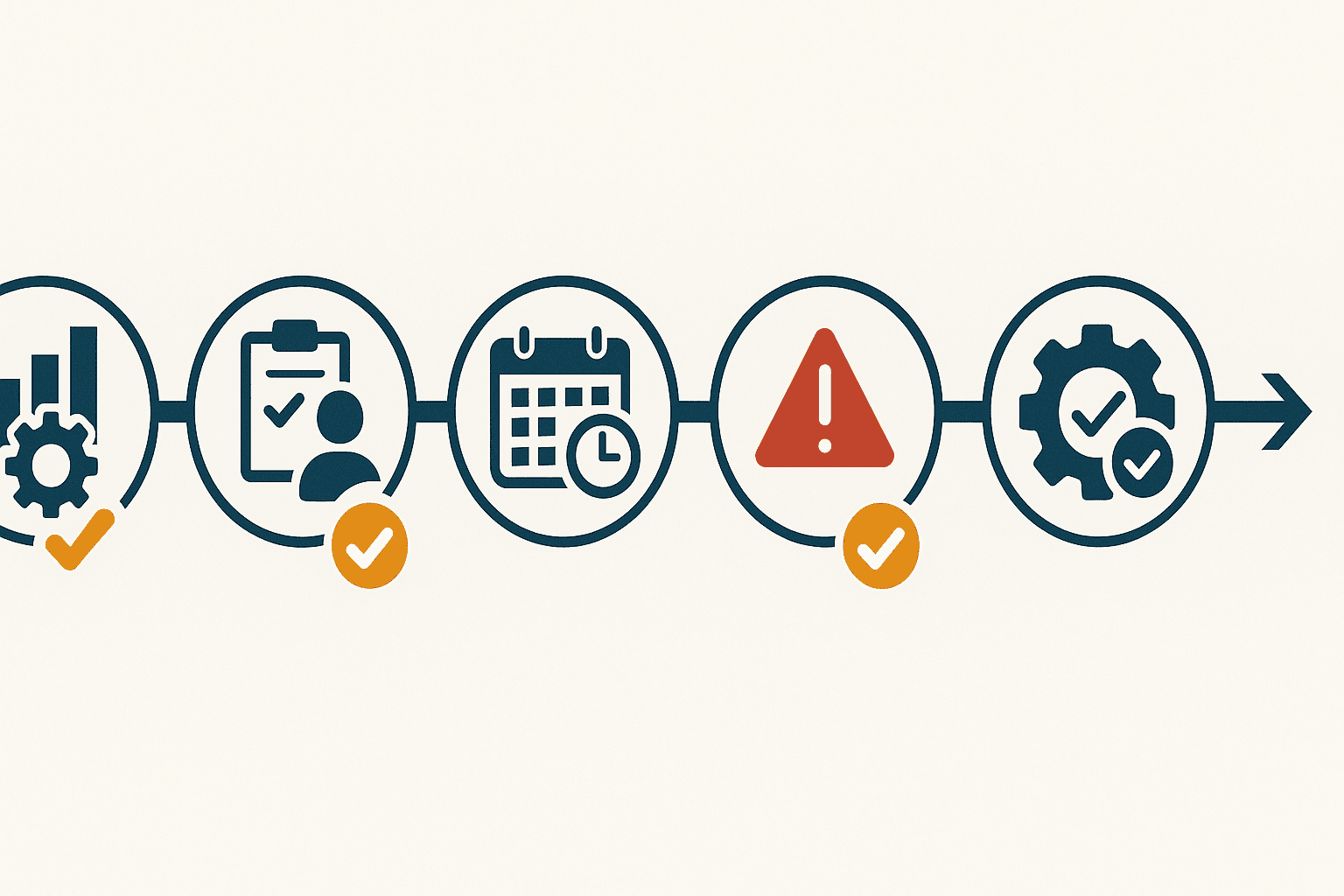
Production systems hold sensitive BOM, cost, inventory, partner, and execution data. Design access around actions—view, create, change, approve, cancel, maintain masters, export data, administer—not just job titles. Emergency access should require a request, expiry, usage logs, and retrospective review.
At the IT/OT boundary, permit only necessary communication, control the identity and timing of remote maintenance, and log configuration changes. Cloud versus on-premises does not by itself determine safety. Evaluate identity, endpoints, network, backup, monitoring, vulnerability response, and supplier access as one operating system.
Separate application outages, interface delays, network loss, device failures, wrong masters, and data inconsistencies in the response plan. If the factory falls back to paper or Excel, document how transactions are re-entered, deduplicated, and approved after recovery.
Make training and change management part of acceptance
Feature training alone does not change behavior. Teach why posting timing changes, how an error affects downstream operations and cost, and whom to contact for each exception. Thai and Japanese materials should be localized around agreed shop-floor terms, report names, and roles rather than translated word for word.
Key users need skills beyond routine entry: diagnosis, master requests, defect recording, fallback, and training maintenance. Verify that they can complete representative scenarios independently instead of relying only on attendance. Include night-shift teams, contractors, and future joiners in the operating plan.
Communication should explain what changes, what does not change, who made the decision, and where help is available. Treat shop-floor concerns as early evidence of process or data defects, not simply resistance.
Stabilize at 30, 60, and 90 days after go-live
Go-live starts a controlled stabilization period. The intervals below are examples to tailor around peak seasons, close, and rollout plans.
Days 0–30: protect continuity
Review critical incidents, interface backlogs, inventory differences, unprocessed transactions, response time, and support demand daily. Use a joint factory–IT–vendor desk and one ticket record. When a workaround is used, assign responsibility for normalizing the affected transaction later.
Days 31–60: remove recurring causes
Classify demand into operation, training, data, access, design, performance, and interface causes. Correct repeated causes and return the lesson to procedures and training. Compare KPIs using the pre-implementation definition; if they do not improve, investigate process constraints beyond the system.
Days 61–90: standardize and decide the next stage
Retire temporary access, Excel fallback, and manual interfaces or place them under formal control. Move remaining issues into normal change management. Rank enhancements by evidence from stabilization and contribution to priority KPIs before expanding to another site or process.
Evaluate implementation cost and current support programs carefully
Total effort includes process analysis, data work, interfaces, devices and networks, testing, training, migration, go-live support, monitoring, maintenance, upgrades, and future sites. A low quote cannot be compared when every out-of-assumption task becomes a change request. Give bidders the same scenarios and volumes, then separate inclusions, exclusions, rates, caps, and customer effort.
At the AI Solution for Industry EXPO 2026, depa described d-transform support as 50% of eligible digital product or service expense, capped at THB 200,000 per applicant. It described d-voucher as a free trial of at least six months for eligible smaller operators, and stated that participating solutions must satisfy dSURE and Thailand Digital Catalog conditions. These were descriptions of specific programs at that time; they do not establish that every company or production system is eligible. Confirm current eligibility, dates, expense rules, and product status with depa or the relevant official channel. Keep the same acceptance discipline whether or not support is available.
Warning signs of production management system implementation failure
Pause and revisit the plan if several of these conditions apply:
- Success means only “on time and on budget.”
- No one can connect management KPIs to operating scenarios.
- Exceptions are marked only “handled operationally.”
- IT is deciding whether business data is correct because no data owner exists.
- The demo uses only sample data and the happy path.
- Upgrade cost and regression scope for customizations are unknown.
- No one owns interface retry, deduplication, and reconciliation.
- UAT exit is measured only by executed cases.
- No authority is named for rollback.
- Thai-language training and support are out of scope.
- Headquarters and local decision rights change issue by issue.
- No owner or review meeting exists for post-go-live KPIs.
Frequently asked questions
What counts as a production management system implementation failure?
It includes more than failure to launch. Critical work may not complete inside the system, users may distrust the data, teams may return to Excel, customization may become unmaintainable, or the intended management decisions may not improve. Define failure in advance across continuity, data, performance, control, and KPI outcomes.
How long does production management system implementation take?
There is no responsible universal duration. It depends on sites, process scope, data quality, interfaces, customization, and decision speed. The 90-day discovery/PoC in this article is an example, not a statistic for full deployment. Use our implementation-process guide to plan backward from deliverables and approval gates.
What matters most when selecting a production management system?
Use representative company data and exception scenarios to distinguish standard configuration, interfaces, operating change, and customization. Compare responsibility, total cost, upgradeability, local support, and acceptance evidence—not only feature count and demo impression.
What should a PoC verify?
Verify critical end-to-end work, exceptions, representative data, interface failures, roles, performance, operating language, and recovery. Agree on expected results and exit criteria before execution, then confirm that actual users—not only vendor experts—can reproduce the outcome.
Should all customization be avoided?
No. Custom work can be rational when it supports explainable differentiation, a customer commitment, or a specific company control, and when maintenance, upgrade, retest, and alternatives are accepted. If the only reason is to copy an old form, compare the standard-process option first.
Who should make the Go/No-Go decision?
IT and the vendor should not decide alone. Process owners, factory leadership, data owners, and support owners should review the evidence, while a predefined authority makes the final decision. Rejection conditions for critical defects, unreconciled data, or untested recovery should already be agreed.
Conclusion
Production management system implementation failure is usually created across purpose, process, data, interfaces, access, testing, cutover, training, and stabilization—not at one product-selection moment. Prevention comes from collecting evidence with representative scenarios and data, assigning accountable owners, and setting exit criteria. A tailored discovery/PoC, acceptance matrix, migration rehearsals, evidence-based Go/No-Go, and post-go-live KPIs give Thai factories and headquarters a common basis for decisions before risk becomes expensive.
If your Thai factory is preparing for a production management system but has not yet selected a product, contact TOMAS TECH to discuss the RFP assumptions, representative scenarios, existing data, and machine-interface constraints. We can help structure what should be verified before committing to a solution.
Sources
- depa, Digital Density Survey 2024
- depa, AI Solution for Industry EXPO 2026
- Thailand BOI/OSOS, 1H 2026 investment update
- Thailand BOI, August 2026 investment statement
- Microsoft Dynamics 365, prepare go-live checklist
- Microsoft Dynamics 365, configuration data and migration
- Microsoft Finance & Operations, prepare to go live
- Oracle, ERP implementation project plan
- NIST IR 8183 Rev. 2 initial public draft
- NIST Cybersecurity Framework 2.0


