


If a Thai factory is planning an equipment control retrofit, Mitsubishi Electric’s Sales and Service bulletin No. 26-22E, announced on 30 September 2026, sets concrete milestones for selected MELSEC-Q motion controllers, Simple Motion modules and related parts. The products move to made-to-order production on 31 December 2028; order acceptance ends on 30 September 2029; production ends on 31 December 2029. Repairs are accepted through 31 December 2036, but may become impossible if parts inventory runs out. This is not an announcement that every MELSEC-Q PLC product ends on the same date. The original bulletin names the affected models. This guide turns that model-specific notice into an actionable migration plan for a Thai plant.
Start with the commissioning deadline, not just the last order date
Ordering a new CPU is rarely the first task. Identify the hardware actually installed, capture recoverable software, map the servo amplifiers, encoders and safety circuits, and agree on a shutdown window with production. The manufacturer’s replacement-model table identifies candidates; it does not promise that existing programs, wiring or synchronous motion will transfer unchanged. A cabinet may contain a PLC that is still obtainable while its motion CPU or special cable follows a different lifecycle.
The bulletin also does not require every plant to replace the whole machine immediately. If its mechanics are sound, baseline data can be recovered, and a planned shutdown is possible, a phased validation and retrofit may be practical. Judge residual machine life, the cost of a failure, and the product-change calendar together. Our PLC replacement decision guide compares life extension, partial retrofit and full replacement. This article concentrates on the motion and axis layer affected by 26-22E.
| Manufacturer milestone | Date | Plant action to complete ahead of it |
|---|---|---|
| Transition to made-to-order production | 31 Dec 2028 | Verify installed models, spares, replacement architecture and current lead times |
| Final order acceptance | 30 Sep 2029 | Decide whether any old-model purchases are justified and confirm delivery |
| Production discontinuation and final shipment | 31 Dec 2029 | Approve the migration design, tests and outage prerequisites |
| Repair acceptance | Through 31 Dec 2036 | Maintain a recovery plan that does not assume every repair will be possible |
An order cutoff is not the same as guaranteed delivery. The notice asks customers to consult the local sales office if the requested delivery date is close to production end. A retrofit also takes time for survey, design, conversion, factory acceptance testing (FAT), field wiring, site acceptance testing (SAT) and start-up. A verified prototype and realistic outage plan are easier to arrange before an unplanned failure.
Which MELSEC-Q models are actually covered?
Table 1 of 26-22E lists Q172DSCPU and Q173DSCPU motion controllers; Q170MSCPU and Q170MSCPU-S1 stand-alone motion controllers; and QD77MS2, QD77MS4 and QD77MS16 Simple Motion modules. It also lists the Q172DEX synchronous encoder interface, Q172DLX servo external-signal interface, Q173DPX manual pulse-generator interface, Q173DSXY safety-signal module, battery units, cables, connectors and operating-system software. Special models derived from the listed models are included.
That breadth matters. A photo of the CPU alone is not an inventory. A special battery holder or forced-stop input cable may change the required cabinet wiring. An encoder used for web registration or conveyor tracking may determine the timing architecture. A manual pulse generator may be essential to the operator’s setup procedure even though it looks like an accessory on the bill of materials. Record each part against the machine function it enables.
Mitsubishi Electric says that difficulty obtaining some components is expected to affect continued production. For the same reason, the 2036 repair-acceptance date is not a guarantee that every failed unit can be repaired until then; repair may be unavailable when component stock is exhausted. Count verified, working spares rather than merely boxes on a shelf. Check the software version and project needed to use each spare, along with its storage condition.

The bulletin also has a separate marking exception for Q170MSCPU and Q170MSCPU-S1. Because these products do not comply with the EU Cyber Resilience Act, Mitsubishi Electric says their CE marking, and consequently UKCA marking, will be removed; orders placed in or after April 2027 will be supplied without either marking. This is distinct from the production and order milestones above. A Thai plant exporting equipment to the EU or UK, or working to a customer specification that requires those marks, should confirm machine-level compliance and contract requirements before ordering more of the old model. A marking change on one component does not by itself determine the conformity status of the complete machine.
Build a model-and-function register on the shop floor
For each machine, record equipment ID, cabinet ID, full unit model and serial number, number of axes, servo amplifier and motor models, encoder inputs, home and limit sensors, emergency-stop circuit, network connections, and the location of the program backup. Compare drawings and bills of material with the installed cabinet, online diagnostics and photos. If a past repair changed a part without updating the drawings, flag the discrepancy rather than guessing. A label on a removed-part box is not proof of what is running now.
Describe what each axis does, not simply “X” and “Y.” Conveyor tracking, electronic camming, registration, torque monitoring, pick-and-place and manual jogging each produce different acceptance tests. Record position targets, operating speeds, homing sequence, recipe-change procedure and the state on fault recovery. Where written instructions differ from real operation, turn the difference into an explicit validation item.
Reading the replacement table: a candidate is not a drop-in equivalent
Table 2 names R16MTCPU, R32MTCPU and R64MTCPU as MELSEC iQ-R replacement candidates for Q172DSCPU and Q173DSCPU. For QD77MS2, QD77MS4 and QD77MS16, it lists RD77MS2, RD77MS4, RD77MS8 and RD77MS16. Choosing the largest number is not automatically safest, nor does the table establish a one-to-one swap. An engineer must check axis count, functions used, base unit, network, servo compatibility and future expansion. Mitsubishi Electric’s Q-to-iQ-R migration tool helps identify candidates, but its output does not replace detailed specification review and validation on the machine.
Some rows explicitly have no direct replacement model. These include Q170MSCPU and Q170MSCPU-S1, Q173DSXY, Q170MSBATN-SET and Q170DBATC. Q172DEX has no direct replacement, with a note about an alternative signal path via MR-J4-B-RJ or MR-J5-B-RJ. For Q172DLX, the table points to an iQ-R input module such as RX41C4; for Q173DPX it points to high-speed counter modules RD62D2, RD62P2 and RD62P2E. The forced-stop input cables and connector are marked “not required” because the new motion controller’s forced-stop device is used. That means the stop-signal design changes. It does not remove the need to verify the machine’s safety function.
| Installed example | Direction in 26-22E | Engineering check |
|---|---|---|
| Q172DSCPU / Q173DSCPU | R16MTCPU / R32MTCPU / R64MTCPU | Axes, synchronization, peripheral I/O, OS and project conversion |
| QD77MS2 / 4 / 16 | RD77MS2 / 4 / 8 / 16 | Axis configuration, parameters, network and drive compatibility |
| Q170MSCPU / -S1 | No direct replacement | Reconsider controller and cabinet architecture |
| Q172DEX | No direct replacement; note on drive-side path | Encoder route and synchronization accuracy |
| Q173DSXY | No direct replacement | Reassess the safety circuit and stop behavior |
The replacement table is a starting point for design, not a shopping list. A quotation package should include existing circuit diagrams, machine timing, HMI screens, maintenance recovery procedures and measurable functions to retain. Ask the supplier to show how equivalent behavior will be demonstrated. Where the stand-alone controller or safety module lacks a direct successor, functional decomposition and redesign may be unavoidable.
Five boundaries an equipment control retrofit must cover
1. Keep PLC logic and motion data in separate backup sets
The PLC ladder or sequence program and motion positioning, interpolation and synchronization data may use different software and storage locations. A PLC backup alone may not restore motion. Collect the online machine data, offline project, OS versions and servo parameters as one recovery set. Verify access rights, licenses and connection leads, and ask an engineer other than the original author to open it. If a password is unknown or a region cannot be read, report it as an unresolved recovery issue, not a “complete backup.”
2. Establish measured axis performance before conversion
Cycle time, positioning scatter, vibration during acceleration and phase error depend on mechanics and load as well as the CPU. Measure healthy-machine performance with normal and edge-case workpieces. Log position, velocity, following error and alarms, then repeat the test after retrofit under equivalent conditions. If old servo amplifiers remain, verify interface compatibility and functional limits against manufacturer documentation. If drives will be upgraded later, include the second shutdown and validation cost in the option comparison.
3. Treat encoders and stop circuits as core machine functions
Moving a synchronous encoder signal to a different input path can alter both timing and diagnostics. Overlay home sensors, limit switches, emergency stop, door interlocks and safety relays on the new circuit diagram. The “not required” forced-stop cable row means designers must define where the stop request now enters and how every axis reacts. The safety team should review this against the machine-specific risk assessment, applicable local requirements and internal standards. A successful motion test is not a safety validation.
4. Include the HMI, upstream systems and recovery instructions
On many machines, a recipe passes from HMI through PLC and motion controller to an axis. A unit or data-type mismatch at one boundary can shift product position. Check alarm text, manual-operation rights, homing buttons, production-complete signals and maintenance replacement steps. The broader lifecycle perspective is explained in our legacy equipment replacement guide. The objective is that a future maintenance engineer can restore the machine, not merely that a contractor can run it on handover day.
5. Separate component lead time from the outage sequence
A delivered CPU is not a ready retrofit if the base, power supply, network hardware, terminal conversion, drive interface or engineering software is still missing. Track each item as identified, ordered, delivered and inspected. Do not dismantle the old cabinet before the complete new configuration and rollback materials are available. Preserve old parts, programs and parameter files until acceptance is signed.
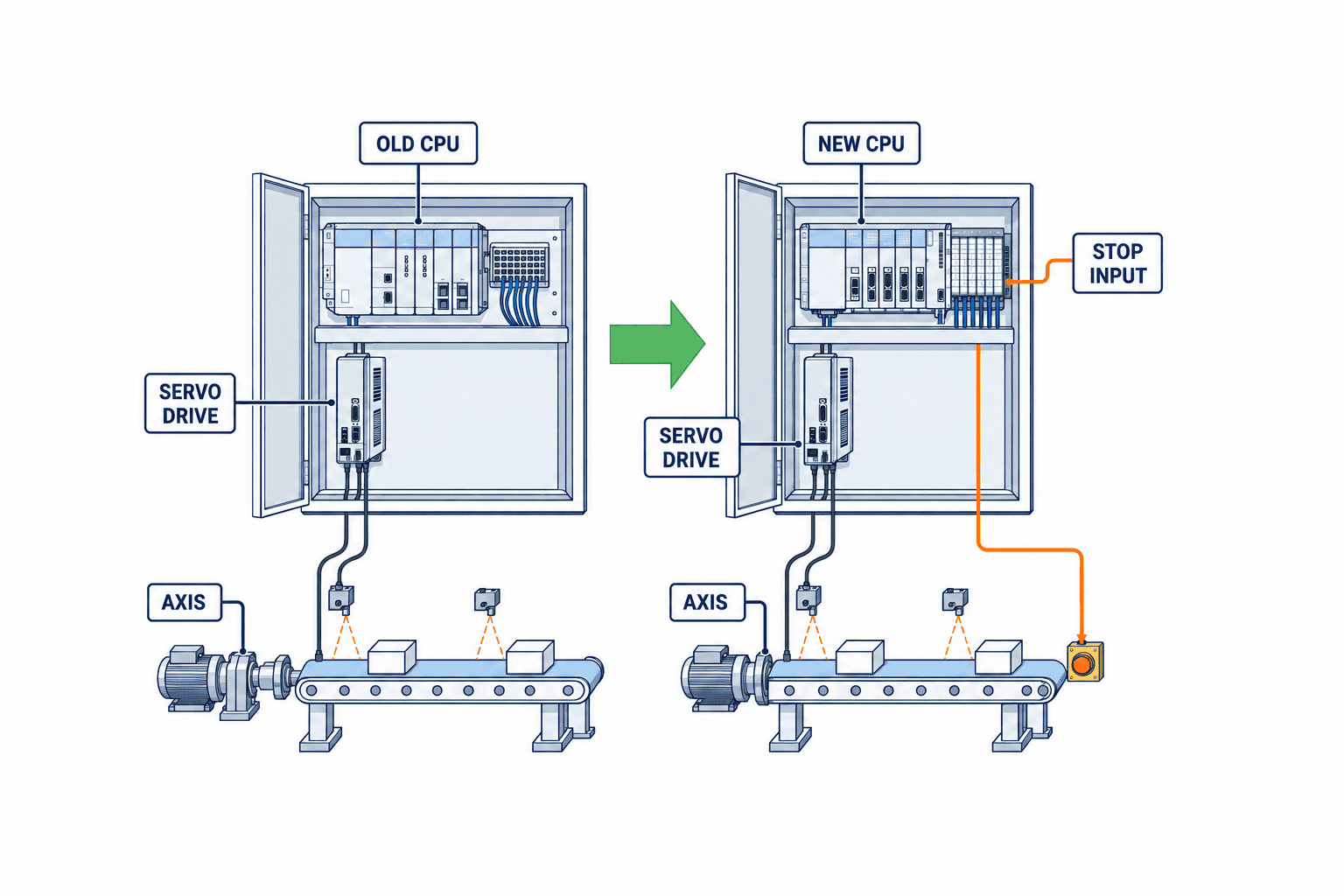
Six practical stages from inspection to site acceptance
Stage 1: rank machines by consequence
A bottleneck running around the clock has a different priority from a machine with spare capacity elsewhere. Compare failure history, downtime loss, tested spares, recoverability, quality impact and alternative production routes. Separate the question “is the machine mechanically usable?” from “can its controls be maintained?” A pilot on one representative machine can create drawings, tests and training material for later rollouts.
Stage 2: freeze the installed baseline
Under safe access conditions, photograph the cabinet, record model numbers and wire identifiers, and obtain PLC, motion, HMI and servo data. Label backups with equipment ID, source, version, engineer and comparison result. The valuable outcome is a file that opens and can be compared with the running hardware. Manage passwords in a controlled location rather than in drawings or project emails.
Stage 3: specify required behavior
“Replace Q172DSCPU with R32MTCPU” is not a complete specification. For each axis, state motion modes, maximum speed, acceleration, homing, synchronization start, fault stop, restart authorization, operator commands and system interfaces. Agree how performance will be measured and what counts as a pass. Select hardware using current product specifications, manuals and authorized sales support. The migration tool is a design aid rather than final approval.
Stage 4: validate conversion offline and at FAT
Use actual backed-up programs. Check conversion warnings, I/O allocation, device addresses, data range, synchronization functions and abnormal handling. Simulate drives and sensors where possible. Leave mechanical interference and vibration checks for SAT when they cannot be reproduced on a bench. A clean software conversion does not demonstrate product quality or safe stopping.
Stage 5: agree on changeover and rollback
Production, maintenance, quality, EHS, the machine builder and the local integrator may all be involved. Document who authorizes cutover, when a go/no-go decision occurs, what triggers restoration of the old controls and who quarantines product after a failed trial. Include test workpieces, quality checks, observation after power-up and next-shift handover in the shutdown plan. Keep the old hardware and a restoration diagram available until the decision point passes.
Stage 6: use SAT to prove repeatable production
An unloaded axis moving is only a starting condition. Test the hardest relevant workpieces, real recipes, continuous running, power-loss recovery, emergency-stop restart, network failure and loss of home reference. Compare position and cycle time with baseline measurements; let quality approve output. Deliver alarms, backup procedure, spare replacement steps, updated drawings and final software versions. If parameters are tuned after trial, synchronize the delivered project and test record with those final values.
Make acceptance tests specific
“Auto, manual and emergency stop” is too vague. For automatic operation, distinguish low and high speeds, varying load during acceleration, continuous running, absent workpieces, upstream stop and downstream blockage. For positioning, measure repeatability after homing, restoration after power loss, recovery near a travel limit and the first product after recipe change. For synchronized axes, change master speed, interrupt encoder feedback under an approved safe procedure, and check phase recovery after an abnormal stop. Each row needs conditions, expected behavior, measured result, evidence file and decision owner.
Manage safety tests separately from normal production tests. Verify how each axis stops when a guard opens, E-stop is pressed, control power fails or the servo drive alarms; also verify what must happen before restart. Assess unexpected restart, dropped workpieces and access to hazardous areas against the machine risk assessment. Fault-injection itself requires a safe, approved method. For quality, test more than the easiest product: thickness, weight, spacing and temperature changes can reveal vibration or position errors. There is no universal position tolerance in this article; derive acceptance limits from drawings, process capability and customer requirements.
Specify deliverables for future maintenance
Require as-built circuit diagrams, terminal lists, bill of materials, source and online software versions, OS and firmware versions, servo parameters, HMI projects, backup/restore instructions, FAT/SAT records and an open-issues list. Screenshots cannot be edited, while an unexplained binary is difficult to compare. If a vendor will not transfer source or licenses, define the contractual boundary and emergency support before ordering. Do not overwrite old and new projects under the same filename. Update the asset register and spare labels when the cabinet changes.
Compare quotations by shutdown and recovery risk, not CPU price alone
Scope each bid consistently: site survey, drawings, software conversion, drive checks, panel work, wiring, FAT, cutover, quality testing, training, spares and support. Missing legacy source files may increase investigation work. Special areas such as cleanrooms or hazardous zones may impose additional construction constraints. Require a connection list, unknowns, schedule, FAT/SAT criteria, sample needs and rollback cost. If a long-lead component is proposed through a different supply channel, require proof of authenticity and compatibility rather than assuming interchangeability.
The choice is not limited to “retrofit today” versus “wait for failure.” A plant might build a trial panel first, preserve the old machine until a planned outage, or temporarily retain compatible servo drives while renewing cabinet controls. A phased option is valid only if compatibility and safety can be demonstrated at each stage. Compare total cost across both shutdowns and keep quality validation in the plan.
A first 90-day action plan
In days 1–30, identify machines using the affected models, verify installed parts and spares, locate programs, assign asset owners and rank recovery risk. Ask authorized manufacturer channels about applicability, successors and current lead times. A machine without a restorable backup needs investigation before purchase commitments. Put the final-order date and the plant’s own design and trial deadlines on the calendar.
In days 31–60, measure baseline functions on one priority machine. Start with alarms, takt time and position variation available without shutdown; plan safe access for the rest. Define what will be retained, what will be changed, and which safety functions need reassessment. Send the same functional specification to bidders. Draft the FAT/SAT plan around quality-critical axes and the point at which rollback becomes difficult.
In days 61–90, validate the selected architecture and make a procurement decision. If the first test fails, distinguish program conversion defects from signal wiring and mechanical causes. Confirm the outage only after parts, trial results, qualified staff and production and quality approval are in place. Evaluate old-model spares as a temporary risk control, not a reason to interpret repair acceptance through 2036 as a reliability guarantee.
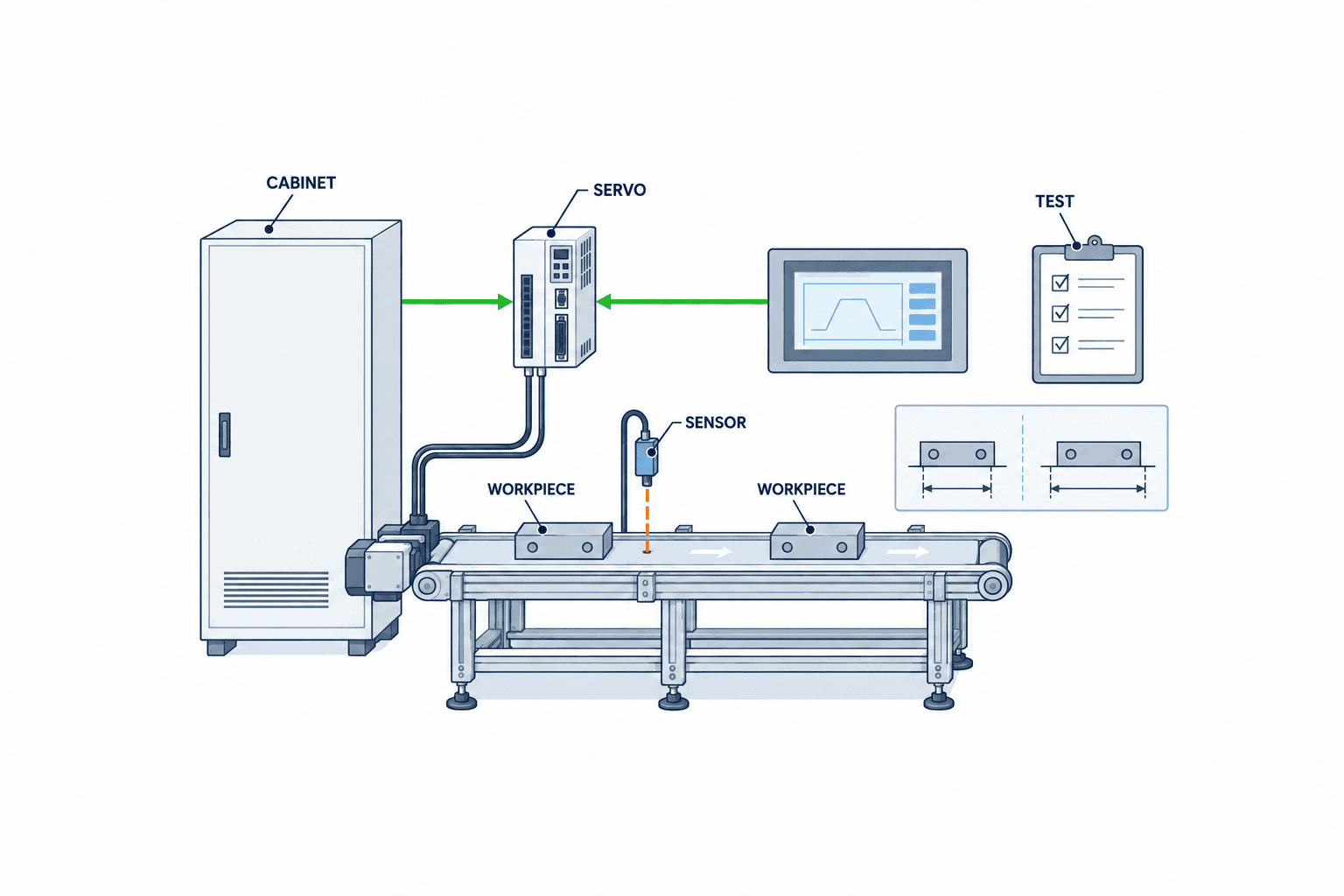
Responsibilities in a Thai plant
The plant’s engineering team owns the installed-asset record, drawings, software access and outage window. Production defines allowable downtime and alternative output; quality defines trial workpieces and acceptance; EHS approves risk assessment and stop behavior. A designer/integrator supplies the replacement architecture, cabinet, software, FAT/SAT evidence and recovery instructions. Confirm bulletin interpretation, model applicability, supply, repairs and current product specifications through an authorized Mitsubishi Electric channel, including the Thailand service page. Keep the manufacturer’s product support role distinct from the integrator’s responsibility for the complete machine.
If head-office design approval is required, share the model list, circuit changes and test plan in a form both Japanese and Thai teams can review. Thai operator instructions should match the exact HMI wording for mode selection, homing, alarm reset and restart after emergency stop. At handover, state who can change parameters, where licensed software and backups are stored, and how the knowledge moves when a technician leaves. A retrofit does not solve the next failure if all project knowledge remains on one person’s laptop.
FAQ: MELSEC-Q motion retrofit and dates
Does every MELSEC-Q PLC end production in December 2029?
No. Bulletin 26-22E covers the motion controllers, Simple Motion modules and related models listed in its Table 1. It does not set a blanket date for every MELSEC-Q CPU, I/O or power supply. Check the installed model and any separate notice for other products.
What replaces Q172DSCPU and Q173DSCPU?
Table 2 lists R16MTCPU, R32MTCPU and R64MTCPU as iQ-R candidates. The choice depends on axes, functions and system configuration. It does not mean the old program runs unchanged.
Can QD77MS2, QD77MS4 and QD77MS16 simply be swapped for RD77MS?
The notice lists RD77MS2, RD77MS4, RD77MS8 and RD77MS16 as candidate replacement modules. It does not say that terminals, base units, networks, parameters and machine behavior are identical. Validate the whole configuration.
Can a plant wait because repairs are accepted until 2036?
Repair acceptance runs through 31 December 2036, subject to parts inventory. A critical machine needs a plan based on recovery time, compatible spares and downtime consequences.
What if Q170MSCPU or Q173DSXY has no direct replacement?
Break down the existing function and redesign the controller or safety circuit as required. Demonstrate equivalent machine behavior and appropriate safety through testing. Do not treat it as a simple model-number substitution.
When should a Thai plant request a retrofit quotation?
Once installed models, backup availability, axis functions and an approximate outage window are known. If drawings are incomplete, procure a survey and recovery assessment first. Compare bids that state unknowns and acceptance criteria rather than an undefined “one lot” price.
Summary: turn a product notice into a machine-specific plan
For the specified MELSEC-Q motion products, 26-22E gives a made-to-order transition at end-2028, a final order date in September 2029, production end at end-2029 and repair acceptance through end-2036 subject to parts. Inventory the actual installed models rather than treating it as the end of all Q-series products. The listed successors become a credible retrofit only after wiring, programs, servo drives, encoders, safety circuits, HMI and recovery procedures have been tested against a measured baseline. Secure the baseline and acceptance criteria before setting the outage date.
If your Thai plant is still identifying affected machines and defining migration scope, send the installed model list, cabinet photos, available drawings and desired shutdown period to TOMAS TECH. We can help structure the survey and validation plan before the architecture is final.
Primary sources
Checked 2 October 2026. Verify the latest manufacturer revision before design or purchasing decisions.


