



When a manufacturer in Thailand considers deploying AI for maintenance spare-parts demand forecasting, the first decision is not which model to buy. It is which asset, part and storeroom decisions the forecast should support, how far ahead a buyer must act, and who approves the result. Issue history alone hides requests that could not be filled during a stockout and demand that moved to a successor part number. This guide gives maintenance, procurement, production and IT teams a common set of requirements for an RFP, backtest, FAT, SAT and ongoing operation.
What should manufacturing spare-parts demand forecasting AI predict?
“How many bearings will we need next month?” is too broad for a procurement specification. A useful decision is whether part P, compatible with asset A, can be available at storeroom B within the supplier lead time for both approved work and unexpected repairs. The output should identify the part or approved substitution group, location, horizon, probability of demand, quantity distribution, input snapshot, data freshness and model version. Procurement then combines that forecast with on-hand and allocated stock, lead-time uncertainty, criticality, budget and supplier options. A person approves the final purchasing decision.
This article is about procuring and validating the forecast model and its data pipeline. For ABC classification and basic replenishment policy, see our spare-parts inventory management guide. For detecting possible equipment failures, see predictive maintenance case studies. A fault alert is only one possible input here. The question is whether approved work orders, installed assets, replacement patterns and supply constraints improve the decision about which part to prepare, when and where.
Choose a unit that matches the decision and the available data
A monthly, plant-wide total conceals the fact that stock in another warehouse may arrive too late. An asset-by-part-by-day series, on the other hand, may contain almost no transactions. A practical candidate is part or approved substitution group by storeroom by week, with an asset-group dimension for critical equipment. Compare granularities against the procurement decision horizon and the number of observed events. If a hierarchical model pools data across parts, require engineering evidence that the parts can legitimately share a demand signal. Do not infer interchangeability from similar names.
Separate demand forecasting from inventory optimisation
A demand forecast estimates the distribution of future requirements. An inventory policy uses that distribution and supply constraints to recommend when and how much to order. A screen that shows only one “AI order quantity” makes it impossible to tell whether a change came from demand, supplier lead time or the stock policy. Require separate exportable fields for forecast and recommendation. Begin with read-only analysis and a human-approved purchase requisition workflow; do not give the model authority to release purchase orders.
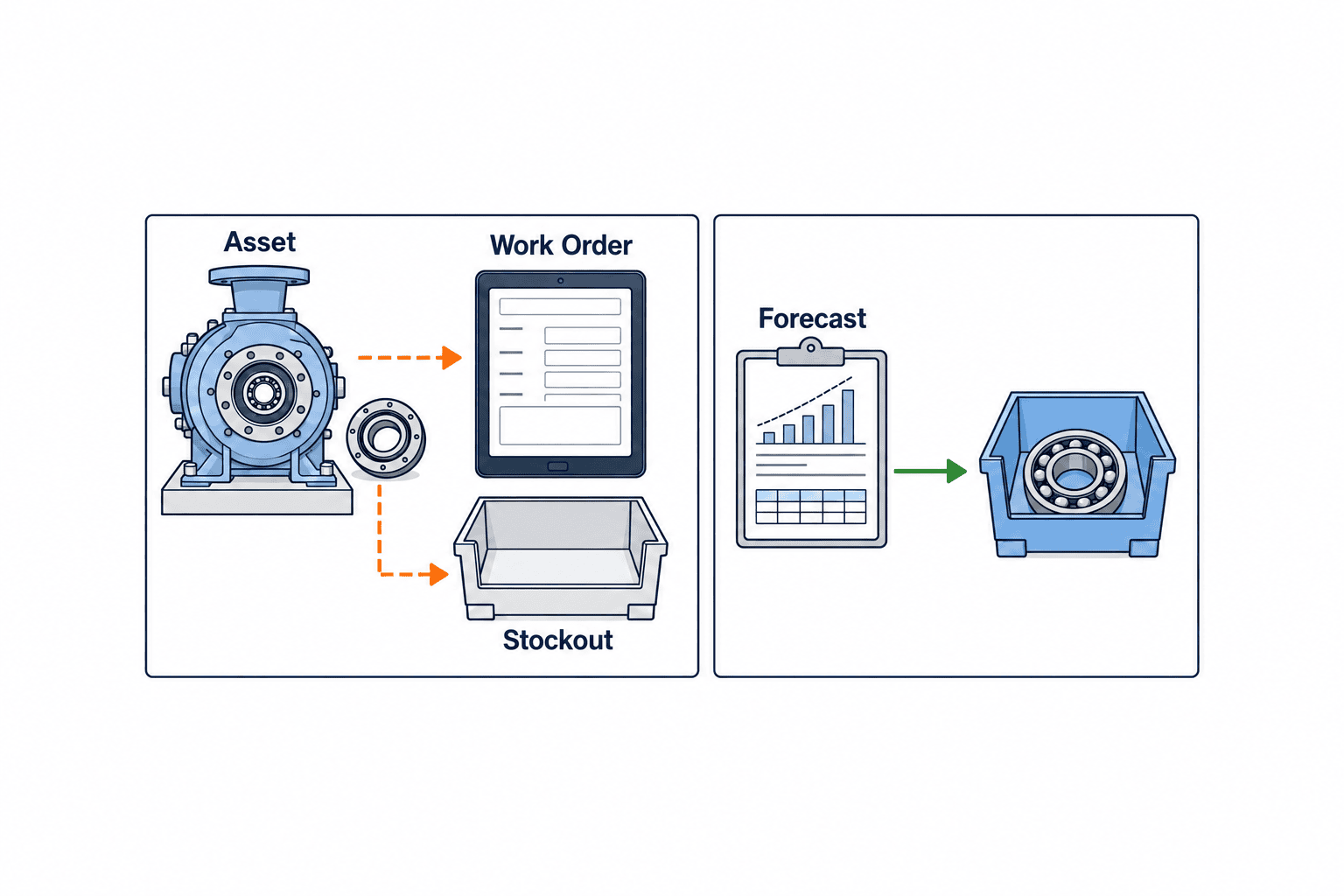
Why issue transactions alone give the wrong answer
Maintenance parts often have long runs of zero transactions followed by occasional demand. Microsoft’s documentation on Croston’s method explains why ordinary forecasting methods can misread such intermittent series. IBM describes inventory optimisation capabilities for intermittent and variable MRO demand. These product descriptions do not prove that a particular AI model will beat a simple baseline at your site. That must be demonstrated on your own historical data, using time-ordered testing and an inventory outcome measure.
Consider a week when a technician requests a part that is out of stock. The site may borrow from another plant, buy urgently, postpone the job or fit an approved substitute. None of these necessarily appears as a normal issue of the original part. Training on “zero issues” as “zero demand” can perpetuate under-forecasting. The RFP should ask how the system links stockout periods, unfilled requests, expedited purchases, transfers and postponed work. Where records do not exist, true demand is unknown: flag the observation as censored or missing and show the sensitivity of the result. Do not silently label it zero.
Part-number supersession creates a second trap. An old part may cease to be issued when a successor is introduced, while the underlying equipment need remains. Preserve effective dates, drawing revisions, asset compatibility, directional substitution and engineering approval. Combining two historical series for prediction is a different decision from authorising one physical part as a safe substitute for another. The latter must remain under technical control.
Planned and unplanned requirements also differ. A seal kit listed on an approved shutdown work order is known prospective demand; it need not be “discovered” from past transactions. Microsoft documents how maintenance schedules can create work orders, while IBM documents work orders containing materials, tools and asset information. Ingest approved work orders and their bills of materials as dated inputs, then forecast the uncertain remainder. Define when a postponed or cancelled work order triggers a new forecast.
Minimum reconciliation table for an RFP
| Data | Typical source | Error if omitted | Acceptance evidence |
|---|---|---|---|
| Issues, returns, adjustments | ERP or WMS | Returns and transfers become “new demand” | Transaction type and source document |
| Approved work and planned materials | CMMS or EAM | Known replacements are missed | Approval status and revision history |
| Asset BOM and supersession | Asset master and engineering | Demand appears to vanish or unsafe substitutions are suggested | Effective date, asset fit and approver |
| Unfilled requests and stockouts | Store and maintenance desk | Censored demand is treated as zero | Stockout interval and workaround |
| Purchase orders and receipts | ERP and supplier | Lead-time variability is ignored | Promised versus actual receipt dates |
| Installed fleet and shutdowns | MES and asset register | Expansion or mothballing is ignored | Dated changes to the asset base |
Do more than mark each source “available”. Align identifiers, units and clocks. A Thai plant may record local ICT time while a regional system stores UTC. The request date, work-order approval time, supplier commitment date and system entry time are different facts. Every historical backtest must use only information visible at the forecast origin. Leakage from a future BOM revision or actual receipt date makes a laboratory result look impressive and then fail in production.
Fix simple baselines before comparing AI candidates
Insist on a comparison with the current decision process, a straightforward average, an intermittent-demand method such as Croston or TSB, and a rule-based method that adds approved work orders. Croston, SBA and TSB each make assumptions; none is universally best. Microsoft labels its Croston functionality as a preview, so check contractual availability and product version if that feature matters. Research on MRO forecasting likewise compares methods under different data characteristics. Use the same data snapshot, forecast origin, lead-time horizon and replenishment policy for every candidate.
One AI candidate estimates two quantities: the probability that demand occurs during the horizon and the quantity conditional on occurrence. Possible features include installed asset count, load, approved work, failure history and shutdown windows. A part with only one or two historical events cannot support confident part-specific parameters. A hierarchical model may borrow evidence from an engineering-approved family; otherwise a simple baseline or expert override may be safer. Make low-data uncertainty visible instead of presenting every SKU with equally precise figures.
Another candidate produces a probability distribution directly. Procurement needs more than the mean: it needs the chance that demand during the supplier lead time exceeds available stock. Test calibration. If a model reports an 80% prediction interval, roughly eight out of ten comparable held-out outcomes should fall inside it. This is an illustration of calibration, not a universal coverage target or a service-level recommendation. Intervals that are too narrow can increase stockouts; excessively wide intervals can inflate inventory.
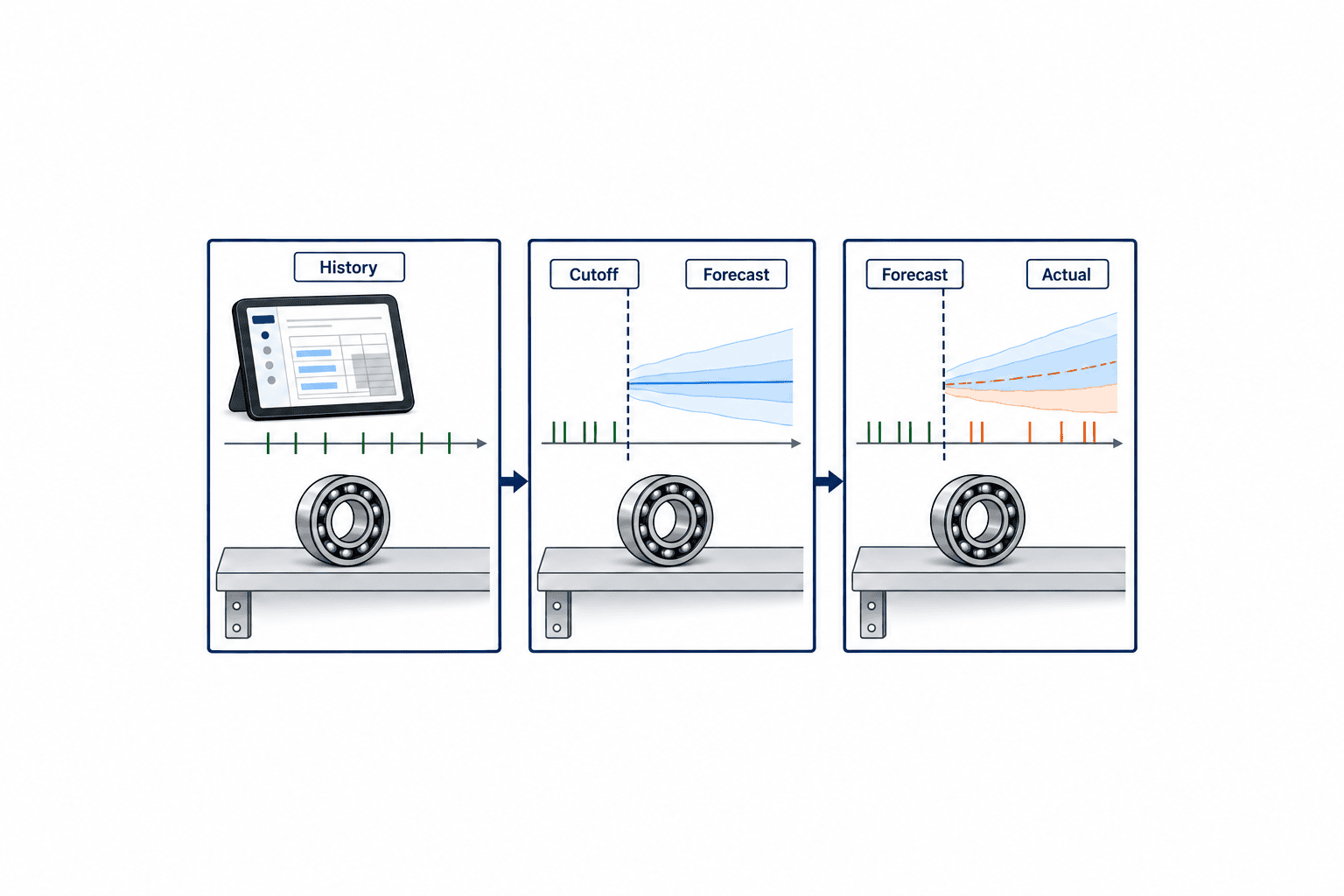
Make rolling, time-ordered backtesting mandatory
A random split of transaction rows is unsafe. It may leak a later BOM revision, a successor part number or the supplier’s actual delivery into a forecast supposedly made earlier. Reconstruct several historical origins: “What did the planner know on this Monday morning?” At each origin, train or update using only earlier available records and forecast over the lead-time horizon. Predefine the origins, horizons and exclusions in the RFP. Separate training, model selection and final holdout periods; a period repeatedly used to tune parameters is no longer an independent test.
Include ordinary operations and a period with a structural change, such as equipment expansion or a major maintenance campaign. Report new parts and new equipment separately. Plant-wide average error can conceal poor performance on expensive, highly critical, very intermittent SKUs. Break results down by demand frequency, criticality, lead time, warehouse and part group. Provide the underlying list of forecasts and outcomes so the site can reproduce the summary.
Evaluate decisions, not one error statistic
MAE and related quantity errors are useful but a “forecast zero forever” model can look deceptively good when almost every period is zero. Report demand-occurrence performance, conditional quantity error, probability calibration and the effect of applying each forecast to the same purchasing policy. Record critical-part stockouts, emergency orders, inventory value, obsolescence and buyer review time. MAPE is undefined when actual demand is zero, so it should not be the headline measure. Keep starting inventory, lead-time distribution, supplier constraints and service targets constant across models.
Set non-negotiable gates separately from financial trade-offs. A safety-critical item may need a fixed minimum regardless of a model’s average error. For a readily substitutable part, inventory cost may matter more. Define these groups and acceptance thresholds before FAT. Do not convert an unpriced safety risk into a convenient monetary average or choose the metric that flatters a preferred vendor after seeing the data.
As a hypothetical example, not a customer result, candidate A improves mean quantity error across 100 SKUs by 10% but increases stockouts among 20 critical parts. Candidate B gives a smaller mean improvement, avoids extra critical-part stockouts and explains changes to purchase proposals. If the pre-agreed critical-part gate is binding, candidate A fails despite its attractive average. Vendor-wide improvement claims cannot be inserted into a Thai plant’s investment case without site-specific testing.
Build an asset–part–storeroom data model
Link the ERP item master, CMMS work orders and BOM, asset register, warehouses, suppliers, purchase orders and receipts in an analytical layer. A name match is insufficient. Preserve site-specific item codes, manufacturer numbers, units and conversions, drawing revision, compatible asset and effective date. Exception reports must show unresolved links and their criticality, not just a total mismatch count.
Separate stock on hand from stock available. Five units on a shelf may include four reserved for approved jobs and one under inspection. Repairable parts require removal, repair, test and release dates rather than the lifecycle of a new purchase. Returns and interwarehouse transfers are physical movements, not automatically new demand. Before optimising a model, demonstrate that these quantities reconcile to the system of record.
Maintain both event time and entry time. A maintenance record entered three days late was not visible three days earlier. Require input refresh frequency, maximum delay, missing-data behavior, timezone treatment, recalculation triggers and correction history. Test the week boundary between ICT and UTC at the actual Thai site during SAT.
Keep a person accountable for spare-parts purchasing
Show the forecast distribution beside on-hand stock, allocations, open orders, approved maintenance work, lead-time range, approved substitutes and the proposed purchase quantity. Maintenance validates equipment impact and technical suitability; purchasing validates supplier, price and delivery; production validates the shutdown window. Record any override with its reason and approver. An override is valuable feedback, but an exceptional purchase order is not automatically a demand label for retraining.
Grant system permissions in stages: read and recommend first, then create a purchase-requisition draft after approval. The normal ERP purchasing workflow should release the actual order. Expire an approval if the job is postponed, stock is transferred or a part is superseded. As our industrial AI agent security guide explains, access limits, audit and the ability to disable writes belong outside the model. This application supports maintenance and purchasing decisions; it does not require direct equipment control.
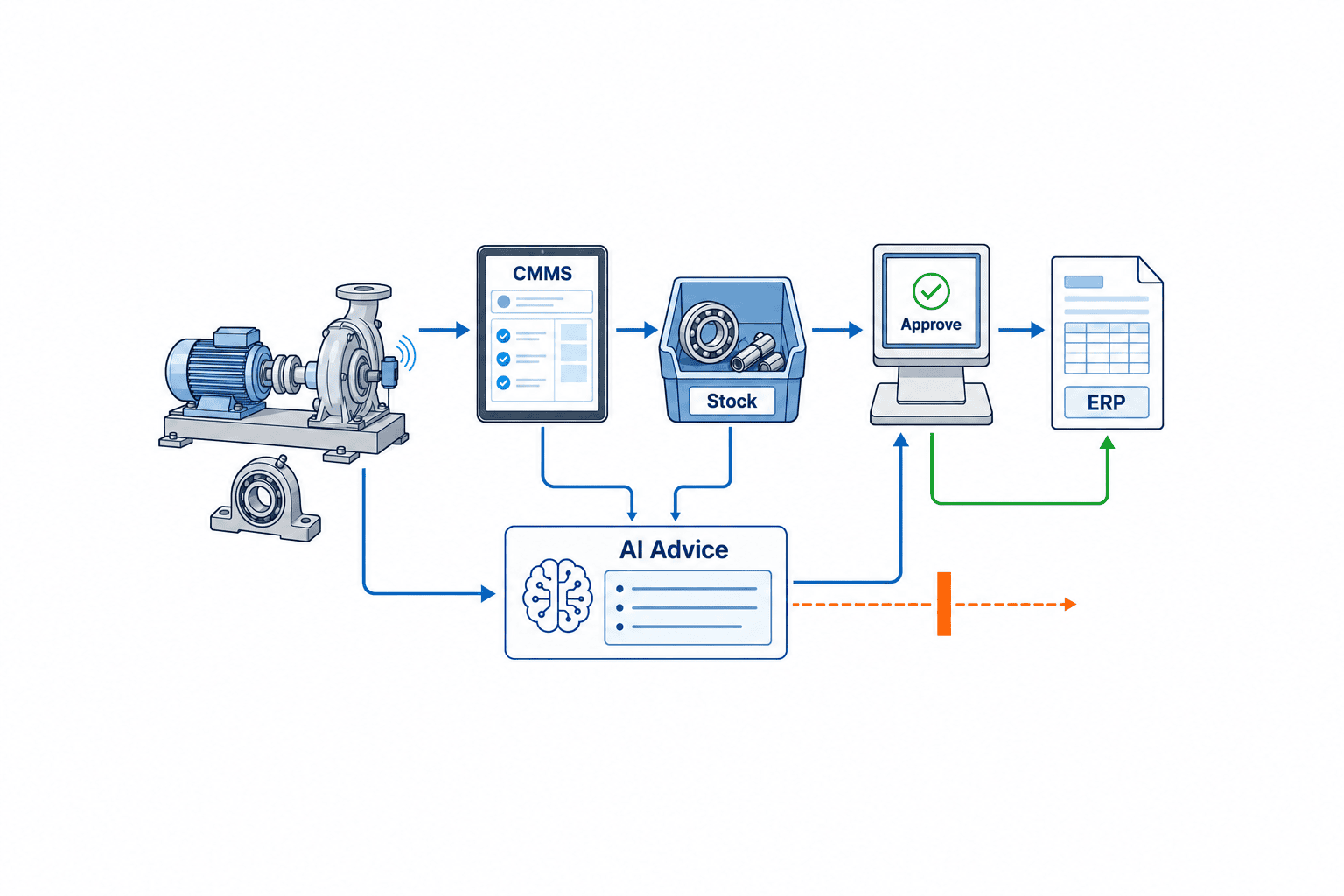
Nine requirements for the spare-parts forecasting AI RFP
- Scope and accountability: list plants, warehouses, assets, part groups, horizons, decision rights and approvers.
- Data contract: map ERP and CMMS fields, identifiers, units, timestamps, stockouts, returns, transfers and supersession.
- Fair comparisons: predefine current practice, simple baselines, intermittent-demand methods and AI candidates under identical time-ordered tests.
- Uncertainty: expose occurrence probability, quantity range, calibration and warnings for sparse histories.
- Traceable explanation: identify the dated approved work order, installed fleet or lead-time change that altered a recommendation.
- Approval and audit: log proposal, reviewer, override, authorised ERP write and resulting document ID.
- Failure behavior: on missing input, ERP outage, master-data conflict or model anomaly, hold proposals or use the last approved rule.
- Change control: version model, features, thresholds and master mappings; test and document rollback.
- Deliverables: data dictionary, mapping exceptions, reproducible evaluation, FAT/SAT logs, operating runbook and training.
Choose SaaS or bespoke development based on integration, explainability, support, data residency and rollout needs. “AI-powered” on a brochure does not explain how stockouts or part succession are treated. Ask vendors to replay anonymised examples from your site from raw input through recommendation. Test the difference between Thai shop-floor names, English ERP descriptions and Japanese head-office reporting. Fluent natural-language explanations cannot compensate for a wrong part number or unit conversion.
FAT and SAT: prove behavior with negative tests
In FAT, inject known stockouts, part supersession, delayed work, supplier delays and missing data into a controlled environment. In SAT, repeat the relevant cases with the actual Thai site’s ERP, CMMS, stores, permissions, timezone and network failure modes. A correct numerical model is unusable if the live asset register points to the wrong part. For equipment-critical substitutions, prove that only engineering-approved compatibility records can authorise an alternative.
| Test | Injected condition | Expected behavior | Evidence |
|---|---|---|---|
| Censored demand | Zero issues, unfilled request | Flag unknown demand, not certain zero | Input series and reasoning |
| Supersession | Old part retired; one-way compatibility | Pool history only as approved | Engineering master and version |
| Work postponement | Approved job moves to later week | Move known requirement in time | Before/after proposal |
| Lead-time deterioration | Actual supplier delivery stretches | Keep forecast and order decision distinct | Lead-time assumption and decision |
| Future leakage | Later BOM inserted into old evaluation | Reject data unavailable at origin | Timestamps and test log |
| ERP outage | Purchase API times out | No duplicate order; hold or retry safely | Error, retry and recovery log |
| Unauthorised user | Request to release purchase order | Deny and audit | Permission and denial log |
Set numerical thresholds using your own baseline and asset risks. Non-negotiable conditions may include no increase in critical-part stockouts, audit evidence for every proposal and ERP writes limited to approved requisition drafts. Inventory reduction and forecast-error targets require a fixed comparison period and assumptions. Agree on the evaluation method, minimum acceptance level, remediation and retest before the supplier claims a return.
A practical rollout sequence
Start with an asset group whose criticality is known, a storeroom with reasonably linked work orders and issues, and a clear purchasing approval route. Testing only fast-moving items misses the intermittent MRO problem; testing only zero-history items makes model comparison impossible. Include different demand frequencies and criticalities. First audit transactions, master data and lead-time records. Next build the rolling baseline backtest. Then add AI candidates in a read-only weekly review. Only after the result survives FAT should reviewers approve purchase proposals and test limited ERP writes in SAT. Expand by part group and site after operational evidence. Do not promise that every factory can complete this in exactly 90 days; allow for data repair, shutdown windows and supplier checks.
Record why any part is excluded from testing: retired asset, unapproved supersession, no work history or missing receipt dates. Report the count, criticality and inventory value of excluded parts; removing difficult SKUs after seeing results inflates the apparent gain. Apply the same interwarehouse transfer assumptions in backtests and production. A transfer that takes days because of transport, customs, approval or quality inspection cannot be treated as immediately available stock in the test.
After go-live, monitor demand occurrence, calibration, critical stockouts, urgent buys, stale stock and human overrides. Equipment replacement, maintenance-plan changes, supplier switches and obsolescence can all change the data pattern. Investigate override reasons rather than trying to reduce the override rate at all costs. If performance deteriorates, revert to a tested baseline or last approved policy; do not promote a freshly retrained model automatically.
How to explain the business case
Include master-data cleanup, CMMS/ERP integration, historical repair, staff review, training, audit and model operation alongside software fees. Measure postponed maintenance, emergency freight, substitute qualification, downtime exposure and obsolete stock without double counting. Treat unpriced safety and quality constraints as acceptance gates, not benefits to be offset. A PoC approval should compare critical-part stockouts, order value, slow stock and buyer workload by candidate. A contract should permit a simple baseline to remain in use for groups where AI cannot demonstrate an advantage. IBM documents a forecast mode that combines historical usage with projected maintenance or production demand; that is a useful reminder to separate known future work from uncertainty.
Five operating-contract terms to settle before go-live
Data ownership: assign the ERP item master to purchasing, asset BOM and substitution approval to engineering or maintenance, forecast logic to the analytics owner, and order approval to purchasing. A model vendor must not silently rewrite part compatibility because names look similar. Return mapping exceptions to the responsible team with evidence and apply only approved corrections.
Decision evidence: preserve the input snapshot, stock and reservations, unfilled requests, work-order approvals, lead-time assumptions, compatible-part master, model and threshold versions, and human approval under one case ID. A later data correction must not overwrite the evidence of what was visible at the time. Limit access and retention instead of duplicating sensitive supplier or personal data without control.
Expiry and replay: define which events trigger recalculation, reapproval or a stop: an earlier shutdown, asset retirement, supplier date withdrawal or revoked substitution approval. Give proposals an expiry and idempotent case ID so a network recovery cannot send old orders in bulk.
Model promotion: a retrained model is not automatically better. Compare critical stockouts, calibration, slow stock and override reasons with the approved version. Test on a limited part group before rollout, and document who can revert and when. Maintenance must decide whether an exceptional overhaul represents repeatable demand or a one-off event.
Exit and portability: require export of part mappings, forecasts, input timestamps, exceptions and approval history in usable formats. The factory need not own every algorithm, but it must retain the evidence needed to audit purchasing decisions and migrate systems later.
FAQ: deploying AI for maintenance spare-parts demand forecasting
Can AI work when issue history is sparse?
Sometimes, but high part-level accuracy cannot be promised. Use approved work, installed asset counts and engineering-approved part groups, display uncertainty and retain human review. Keep a simple method where AI fails the same backtest.
Is AI always more accurate than Croston or TSB?
No. Performance depends on event count, demand structure and useful explanatory data. Compare methods using the same historical origins, available information and inventory policy; include critical-part stockouts in acceptance.
Does a predictive-maintenance alert automatically tell us which part to buy?
No. A possible fault does not specify an approved job, compatible part, quantity or delivery date. Link the alert to a reviewed CMMS work order, BOM, substitution approval and lead time before it can affect purchasing.
Should the AI automatically send purchase orders?
Not at initial deployment. Start with transparent recommendations and human approval through ordinary ERP permissions. Test duplicate prevention, obsolete approvals, wrong parts and budget boundaries before widening any write capability.
How should a Thai factory estimate the project cost?
Price depends on part and asset master quality, history gaps, CMMS/ERP APIs, sites, approval screens and operational support. Compare proposals against the same scope, data fields, integration direction, test evidence and service obligations rather than assuming a universal fee.
Summary: make every recommendation reproducible
Maintenance spare-parts demand forecasting AI is more than fitting a model to issue history. Reconcile censored demand, supersession, approved work, supplier lead times and asset criticality with dated evidence. Compare AI against simple methods through rolling backtests and common purchasing rules. Keep the forecast separate from the order decision, give maintenance and procurement a clear approval path, and use FAT/SAT to test stockouts, unsafe substitutions, future-data leakage and incorrect ERP writes. The system is ready only when a team can explain and reproduce why it recommended a particular part, quantity, location and time.
If you are designing an RFP or a focused PoC for a Thai factory, contact TOMAS TECH. Your existing CMMS/ERP layout and a few examples of stockouts or obsolete parts are enough to begin defining the data reconciliation and acceptance tests.
Primary references
- ISO TC 251, ISO 55001:2024 and its decision, risk and resourced-planning context: https://committee.iso.org/sites/tc251/home/projects/published/iso-55001.html
- Microsoft Learn, Croston’s method forecasting (preview): https://learn.microsoft.com/en-us/dynamics365/supply-chain/demand-planning/croston-method
- Microsoft Learn, Creating work orders: https://learn.microsoft.com/en-us/dynamics365/supply-chain/asset-management/preventive-and-reactive-maintenance/creating-work-orders
- IBM Docs, Maximo Inventory Optimization product overview: https://www.ibm.com/docs/en/mio?topic=product-overview
- IBM Docs, Projected demand and forecast modes: https://www.ibm.com/docs/en/mio?topic=items-projected-demand-forecast-modes
- IBM Docs, Work Orders module: https://www.ibm.com/docs/en/masv-and-l/maximo-manage/cd?topic=manage-work-orders-module
- Procedia CIRP (2025), comparative MRO spare-parts forecasting research: https://www.sciencedirect.com/science/article/pii/S221282712500263X
Public information reviewed 18 October 2026. Product functions and preview availability may change by version and contract. Validate detailed acceptance criteria against each plant’s systems and equipment.


