


Introducing AI action tracking to a manufacturing production meeting should do more than produce minutes quickly. The aim is to turn decisions about downtime, material shortages, quality deviations and delivery changes into work with an owner, a deadline and evidence of completion. This practical guide helps plant leaders, production planners, quality, maintenance and IT teams in Thailand connect meeting audio or notes to tasks in ERP, MES and other systems without allowing an AI summary to become an unapproved production instruction.
Why production meetings need AI action tracking
If a team must ask in another chat who will investigate Line A’s delay, when substitute material will be approved, or whether yesterday’s stoppage is resolved, a good meeting summary has not solved the operating problem. A production meeting identifies gaps between plan and actual, makes decisions within defined authority, assigns work and checks the result. Its useful outputs are therefore decisions, open questions, assigned tasks and evidence, not only a document.
A general guide to AI meeting minutes explains how to review speech and key points. This article starts at the next step: identifying production-relevant actions, having a person confirm them, linking them to an execution record and following them through to closure. For the separate monthly planning horizon, see the S&OP implementation guide. A daily shift meeting and a monthly supply-and-demand decision should have different levels of detail and approval.
Start with one meeting type
Choose a recurring daily production meeting with stable participants and an agenda. The same line, machine, product and order names appear repeatedly, and the next meeting can verify whether action was taken. An organization-wide rollout at the outset multiplies naming conventions, task types and unclear ownership. A practical pilot begins with one plant, one meeting and one kind of downstream task until the team has observed a complete decision-to-closure cycle.
Separate decisions, requests and proposals
The sentence “order the part today” may be a final decision, a proposal or an option that was rejected later in the discussion. Do not turn such speech directly into an ERP purchase instruction. Classify statements as facts, risks, options, provisional directions, approved decisions, work requests or deferred items. Keep the meeting timestamp, speaker candidate, a short source excerpt and any uncertainty with the extracted action so a reviewer can judge it.
“Secure material by tomorrow” still lacks a part number, quantity, required time and related order. The correct initial task may be to clarify the shortage, not to issue a purchase request. “Ask quality about the defect” names a department but not necessarily an individual or due date. The AI should flag missing fields instead of inventing them. The gaps reveal decisions the meeting has yet to make.
Microsoft Teams Recap can show AI-generated notes and follow-up tasks, while Microsoft warns that generated content may be inaccurate or incomplete. Use those outputs as candidates. A responsible person should confirm any action affecting production or quality before it becomes an instruction. Availability also depends on product and license conditions; do not assume every language or tenant has identical features. See Microsoft’s Recap documentation.
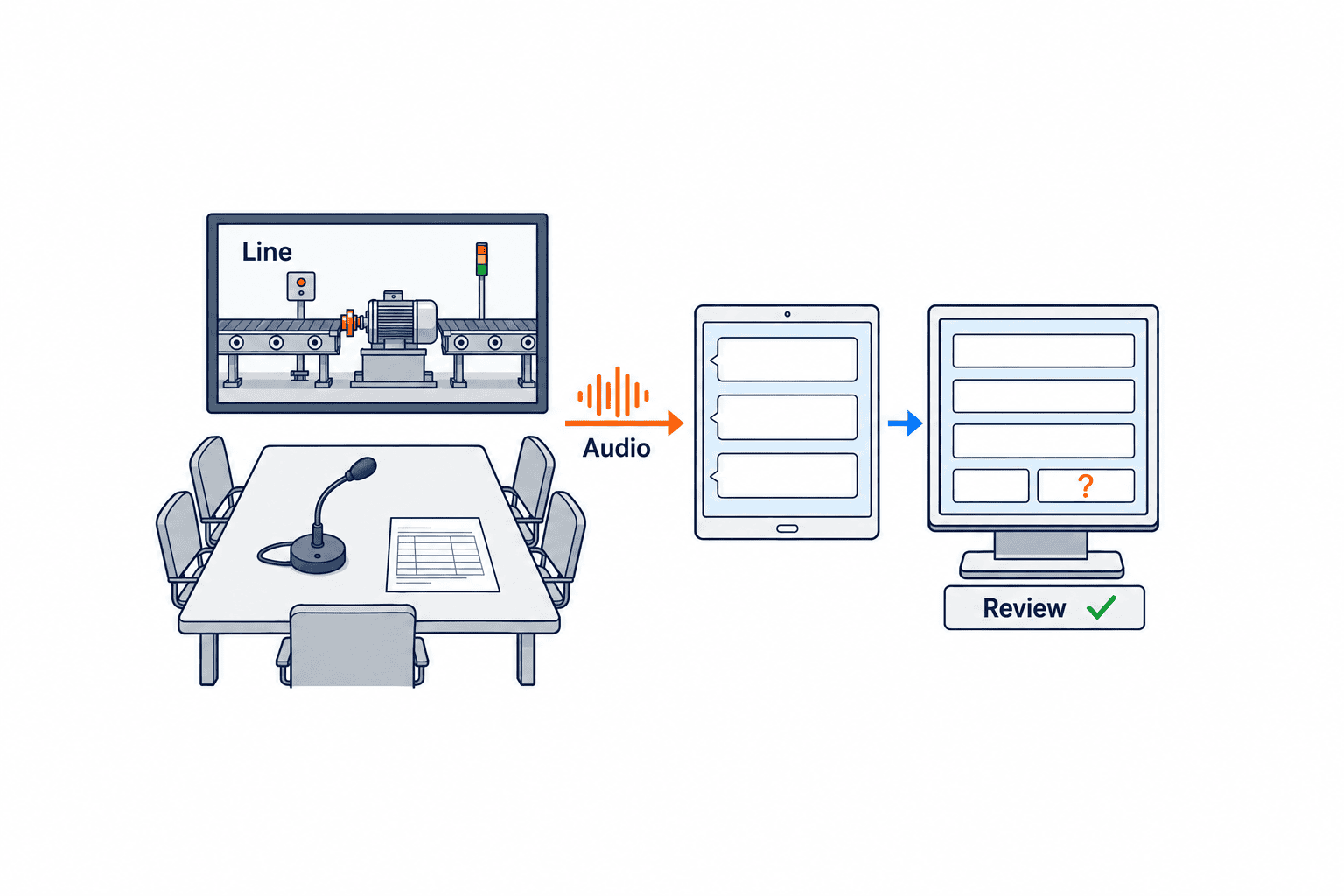
What one action record must contain
A useful record has a meeting ID and date, plant and line, equipment or production-order ID, issue type, decision/request classification, action, owner, approver, deadline, priority, source evidence, status, completion criterion and linked ERP/MES ID. Required fields differ by destination. A maintenance inspection and a production-plan change are both actions but have different authority and evidence of completion.
If the unique key is only a meeting ID and statement number, the same unresolved issue becomes a fresh ticket each morning. Compare plant, order or equipment, issue category and open ticket IDs. Show likely duplicates to a person, who decides whether to update an existing case or create a new one. Automatic merging can combine separate quality problems from different lots; automatic creation can inflate overdue counts. Neither outcome helps the plant.
Resolve relative deadlines such as “tomorrow afternoon” using the meeting’s local time zone, and retain the original wording. A Thai plant and a Japanese headquarters may view the same deadline in ICT and JST. Record who changed it and whether shifts or holidays were considered. Prefer a person ID as the owner. If only a department is named, leave the record in an assignment queue.
Keep “awaiting review” distinct from “not started”
A practical state model is extracted candidate, awaiting review, awaiting approval, ticket created, in progress, awaiting completion check, closed, returned or canceled. Generating a candidate does not formally assign work. Creating a ticket does not mean the equipment was repaired. Log the reviewer, approver and external-system event for each transition. Show review queues and overdue execution work separately on the dashboard.
How to ingest audio and notes
Inputs may include Teams transcripts, room recordings, chairperson notes and an existing issue list. Join them by meeting ID and time rather than relying on a single recording. Noise, overlapping speakers, masks, equipment codes and mixed Thai-English speech can distort transcription. Negative statements such as “not approved” and large quantities deserve specific comparison against the recording or source document.
Microsoft Graph provides ways to retrieve Teams transcripts and receive availability notifications, subject to tenant settings and permissions. An administrator can disable API access. Check the Graph transcript notification documentation before promising automated extraction. Establish recording consent and retention under plant policy first. Where an API is unavailable, approved written meeting notes can be the pilot input.
Azure Speech documents speaker diarization and support for Thai and Vietnamese, among other languages. Listing a language does not prove that the service will recognize local equipment names in a noisy plant meeting. Test with the site’s own recordings. Review speaker diarization and language support, and check where audio is processed and stored.
From extraction to human approval
A workable sequence is: register audio and notes; normalize meeting metadata; transcribe and identify candidate speakers; match equipment, part and order names; extract decisions and actions; show possible duplicate tickets; obtain chairperson or owner review; request required approval; create an ERP/MES or task-system record; synchronize progress; verify closure criteria. Preserve the source and approved record separately. Reprocessing with a new model must not silently overwrite a previously approved ticket.
The AI needs a current dictionary of lines, equipment, orders, operations and owners, together with an open-issue list. Restrict those references by role so irrelevant personnel or customer data is not exposed. Ask for structured output and validate missing fields and IDs in ordinary code. Cross-check consequential identifiers against the system of record; do not accept a part number solely because a speaker used it in conversation.
A reviewer should see the proposed summary, source passage, existing ticket status and planned edits together. If the external API rejects the ticket, return an explicit failure and keep it visible for retry. Power Automate approvals illustrate how a person can be placed in the workflow; licensing and integration fit still require site-specific evaluation.
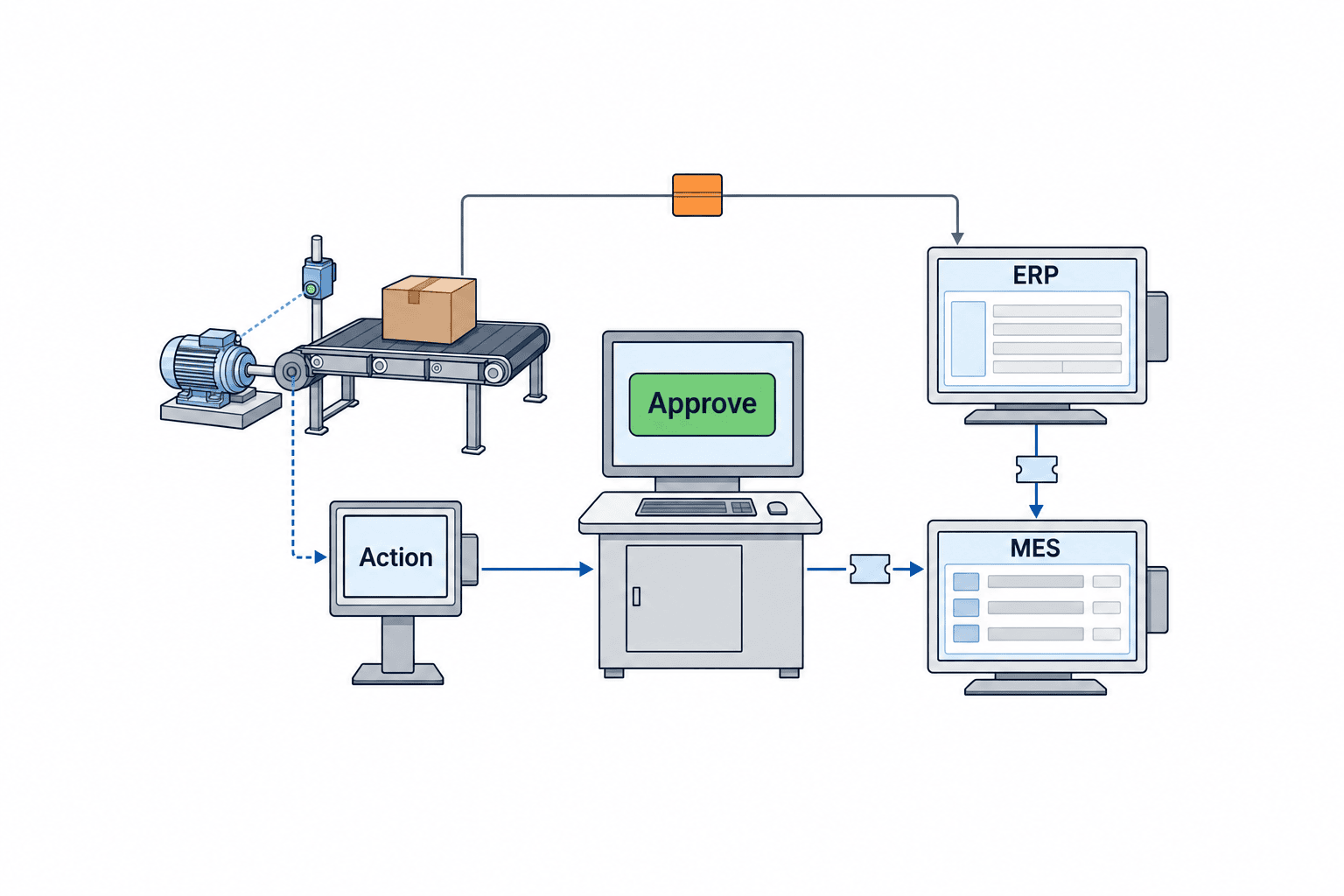
Choose where ERP/MES writes belong
Assign each type of action a system of record. Material shortages may belong in purchasing and inventory; sequence changes in planning; nonconformances in QMS; inspection requests in maintenance. An action layer should connect and monitor these records, not overwrite manufacturing actuals or stock quantities in its own database. The concepts behind a shift note associated with a production order are illustrated in SAP documentation, but availability in a particular ERP must be verified.
Define the destination API, required permissions and fields, idempotency key, success response, retry policy, update direction and cancellation behavior. Store the meeting action ID on the external record so a retry cannot create another ticket. Treat the action as “ticket created” only when the external ID is returned. Reconcile the case in which the meeting system thinks a write succeeded but the ERP has no corresponding record.
Planner can be a temporary or permanent task destination. Its official connector supports creating, reading and updating tasks. Checking a Planner task complete does not automatically complete an ERP production order. If the operation must be traced in MES or ERP, keep external IDs and synchronize status. Dynamics 365 production-order lifecycle documentation shows why an order status has specific operational meaning.
Separate authority by impact
“Check a document” may be an ordinary task. Changing production quantity, delivery date, BOM or safety conditions calls for the existing approval and change-control process. AI may prepare a proposed change, but it should not bypass role permissions. Classify risk by quality, safety and customer delivery as well as cost. A meeting chair’s approval of a note may not be sufficient authority to edit the system of record.
Prepare plant data before the pilot
Map the line names used on the shop floor to ERP/MES master data. “Machine 2” and “old A line” can refer to a single official ID; an abbreviation can also refer to several machines. Maintain an alias dictionary and prohibit automatic matching when multiple records remain plausible. Check that transferred or departed employees are absent from owner suggestions. Name the person who will maintain each dictionary after go-live.
Update the meeting routine too. Before adjournment, the chair can restate the issue, decision, owner, deadline and verification method while the group checks the screen. This need not make the meeting long. A short confirmation of missing owners and deadlines can reduce extensive corrections afterward. Automating ticket creation before people make clear decisions simply creates many low-quality tasks.
Measure closure, not only extraction accuracy
For a pilot, select enough real meetings to include stoppages, material shortages, quality incidents and schedule changes. Two to four weeks is a planning example, not a universal requirement. Plant staff should create a reference set from their own recordings and notes; a vendor’s studio-quality demo cannot test local names, mixed language or overlapping speech.
Measure action precision and recall, correct owner and deadline, correct equipment or order ID, duplicate-ticket rate, reviewer time, integration success, on-time closure and the share of closed actions with evidence. High extraction scores do not compensate for poor follow-through. A transcript need not be perfect if critical actions are accurately confirmed and tracked. Define acceptance criteria and baseline measures before the test.
| Area | What to examine | Typical failure | Practical acceptance check |
|---|---|---|---|
| Extraction | Decision versus proposal | Proposed action marked approved | Review every critical false ticket |
| Ownership | Named person and deadline | Department guessed as a person | Keep unresolved fields in review |
| Duplicates | Link to open case | Fresh ticket every morning | Reviewer chooses existing case |
| Integration | External ID returned | ID lost after successful API call | Retries never duplicate a ticket |
| Closure | Evidence from the plant | Checkbox treated as proof | Trace evidence and approval |
Compare with today’s manual spreadsheet or chat workflow. Record how long it takes to find carried-over actions, identify overdue work and clarify ownership, not only minutes-writing time. If estimating money saved, state meeting volume, labor rate and correction time. Do not add assumed downtime or scrap savings without evidence. Preserve indicators that did not improve so a wider rollout decision is credible.
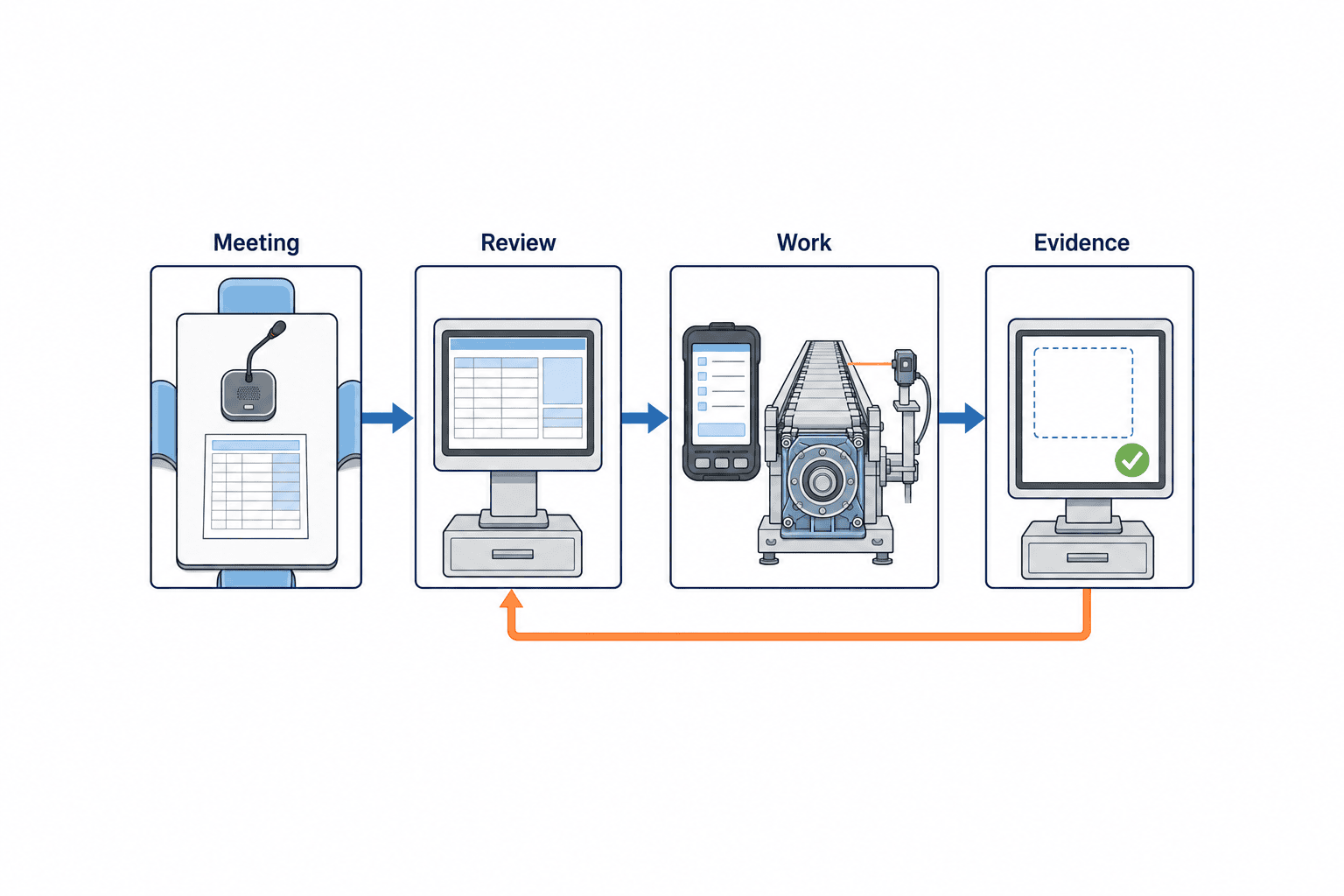
What to ask in an RFP
Describe target meetings, audio and note formats, languages, master-data location, issue categories, approvers, destination systems, closure rules and retention. Ask vendors to demonstrate how their system handles a wrong part number, a negative statement and overlapping speech. Evaluate correction screens, access control, audit logs and failed-write retries alongside summary quality.
Specific questions include: Can missing owner and deadline remain blank? Can the reviewer return to the original audio or note? Can the product suggest an existing open ticket? Does replaying a meeting avoid duplicate writes? How does an ERP/MES API failure appear to staff? What event proves completion? Does a model upgrade preserve approved records? Where are recordings stored, who can access them and how are they deleted?
Budget for microphones, network, storage, ERP/MES integration, master-data cleanup, reviewer time, monitoring, change control and training as well as transcription and language-model usage. Verify licenses, language capability and data locations for each candidate product. State assumed monthly audio hours and meeting count, and allow for months with many exceptions. When planning multiple plants, ask how each site’s dictionaries and access permissions are separated.
Multilingual operations and data control in Thailand
A Thai plant may discuss an issue in Thai, report to Japan in Japanese and use English machine names. Show source text, translation and normalized equipment/order ID for consequential actions. Record the language in which approval was given. A translation that reverses “stop” and “resume” can be serious. Local authorized staff should review source audio or text for safety, quality and delivery instructions.
Recording, transcript, extracted candidate and approved task can have different retention periods and access rights. Confirm the destination of data sent to external services and whether it is used for model training. Decide whether employee speech history may be used for any purpose beyond task follow-up. The NIST generative AI risk profile is useful background for human review, tracking and documentation, while local legal requirements need their own assessment.
Move to production one decision cycle at a time
First show AI candidates while people continue to create tickets as before. Next allow approved candidates to write to a limited task destination and verify that external IDs return and retries work. Extend to maintenance, quality and planning actions according to site risk, testing permissions, audit logs and rollback with every expansion. These are example phases; the system owner should set their order.
Each day, the operating owner should inspect awaiting review, overdue, ticket-creation failure and awaiting closure queues. Each week, classify extraction errors by audio quality, master data, meeting practice or model logic. Name the people responsible for chairing the meeting, approving actions and maintaining ERP/MES links. Plan for personnel changes.
Between “decided in the meeting” and “done on the floor” lie acceptance, execution, result review and prevention of recurrence. A dashboard should show delay reasons, reopened issues and repeated problems in addition to a simple completion percentage. Do not close an action with an unclear completion criterion. AI can surface forgotten items; people and the system of record determine whether the work is complete.
A concrete example: turning meeting speech into work tickets
Imagine a morning meeting where a supervisor says: “The packaging machine on Line B stops intermittently and may affect this afternoon’s production order. Maintenance should inspect the sensor this morning, while Planning checks whether we can move the order to another line.” This is not one long minutes entry. It contains at least two distinct actions. The first is an equipment inspection, owned by Maintenance, linked to a machine ID, due in the morning and closed with inspection results and a restart check. The second is a capacity check, owned by Planning, linked to the production order, due before the transfer decision and closed with a documented assessment of capacity and quality conditions. The actual transfer remains undecided until those checks are complete.
Link both tickets to the same meeting passage, but do not mark the whole issue resolved when only one closes. A faulty sensor does not itself prove that the alternate line can make the product. The person approving a plan change needs to review Quality’s assessment and scheduled ERP/MES work. The ability to represent these dependencies matters more than a simple count of extracted actions. If a later development makes an action unnecessary, record it as canceled with a reason, rather than falsely completed.
Consider a second statement: “Yesterday’s defect should be resolved.” The wording expresses uncertainty. AI should not change the quality disposition to “passed.” It can propose a check for the Quality owner to verify inspection results for the affected lot. Only after the inspection record ID is known should it link to a nonconformance ticket. Several lots on the same day must not be merged based on date alone. Copying natural-language minutes directly into a ticket hides these conditions and dependencies.
Build acceptance tests for the pilot
Use meeting data that deliberately includes negation, deferred decisions, missing owners, relative deadlines, similarly named machines, recurring issues and an API failure, not only routine days. Keep the original audio or note, the expected action, the reviewer’s correction reason and the expected ERP/MES outcome together. For each case test four steps: AI proposes a candidate; a person confirms it; the external system receives it; the next meeting can see its progress. Evaluating extraction alone lets integration defects surface only after launch.
A single headline such as “95% AI accuracy” is a poor acceptance criterion. Review every false ticket that could lead to an incorrect purchase or quality decision. For low-risk investigation tasks, assess the time required to correct suggestions. Set thresholds from the site’s risk tolerance and baseline workflow, rather than accepting a product’s advertising number. Also test whether missing owner and deadline fields block approval, replaying the same meeting leaves one ticket, and the system retains unsent requests after a network outage.
Break down results by severity, issue category, language and noise condition, rather than reporting only a meeting-wide average. Excellent performance in a few easy meetings does not establish repeatability across plants. Include human correction time. Generating ten candidates quickly is no gain if eight must be deleted and two rebuilt. Conversely, fewer candidates may still be valuable when critical overdue actions are reliably surfaced.
Operate ERP/MES links through failures
Treat success in the meeting application and successful registration in ERP/MES as separate events. If an API response is lost, the external ticket may already exist. Before repeating a create request, look up the meeting action ID in the destination; retry only if no ticket exists. Where the external API lacks a unique key, retain an integration mapping and send suspected duplicates to human review. Do not guess that a ticket was created. This is how the design avoids duplicate production instructions.
An externally closed ticket should not automatically close the meeting action. For maintenance, confirm inspection results and equipment operation; for Quality, the affected lot and disposition record; for planning, the approved plan version and actual application. If “closed” in the external tool only means administrative closure, the meeting action can stay “awaiting completion check.” Show reopened and canceled tickets differently at the next meeting and retain the reason for their change.
Failure handling needs an owner and a response time. Notify the meeting owner as well as IT when ticket creation fails, and prepare a manual route for critical work. Before bulk-sending a backlog after recovery, recheck expired deadlines and issues already resolved so the system does not create stale tickets. Monitor API changes, invalid owner IDs and master-data changes. Document who authorizes a retry and who contacts the shop floor.
Operational metrics and continuous improvement
After go-live, show more than the number of actions extracted per meeting. Track time awaiting review and approval, failed ticket writes, time until an overdue item is noticed, missing closure evidence and reopened cases. A rise in ticket counts is not automatically a success: it may reveal previously hidden work or unnecessary duplicates. Plant leaders and IT should inspect sample records together each week to interpret the measures.
Choose the improvement based on the failure stage. For misheard part numbers, examine microphone placement, part-number dictionaries and whether meeting materials display the code before changing the AI model. For wrong ownership, check the personnel master and how people are referred to in meetings. When work stalls after ticket creation, the cause may be an absent approver or a weak ERP/MES alert rather than extraction. Classify issues under audio, terminology, decision, approval, integration and closure; improve the bottleneck instead of spending solely on model tuning.
Judge sustained adoption by behavior. Does the chair review outstanding tickets in the next meeting? Do owners update progress themselves? Can approvers handle exceptions? More automation does not always mean less effort. A durable system makes the source passage, relevant operational record and change history easy to inspect at the moment a person must make a decision.
FAQ
Can a meeting-minutes tool alone implement manufacturing AI action tracking?
It can cover the capture stage. Decide whether you also need named owners and deadlines, duplicate checks, approvals, ERP/MES ticket creation and evidence of completion. A small operation may initially use AI notes with a shared task register. Evaluate investment against missed actions and repeated clarification, not meeting count alone.
Can it handle Thai, Japanese and English in one meeting?
Some speech services support these languages, but accuracy varies with noise, speaker overlap and technical terms. Test actual plant recordings and assess owners, dates, part numbers and negation. Preserve source language and let a local authorized person check consequential instructions.
Should AI update a production order automatically?
Start by preparing a proposed change for approval. Quantity, due date, quality decision and safety condition changes should follow existing authority. If a narrow automatic update is later considered, specify eligible fields, limits, exceptions, audit trail and recovery. Never change the system of record based on an unconfirmed utterance alone.
How should the plant judge results?
Beyond minutes-writing time, compare missed critical actions, unclear ownership, duplicate tickets, time to spot an overdue action and evidence-backed closure. Establish the current baseline before the pilot. Do not apply an improvement rate from one meeting type to every plant without checking local differences.
Conclusion
For AI action tracking in manufacturing production meetings, first define who confirms a decision, where it becomes a ticket and what proves completion. AI extracts and matches candidates; people approve; ERP/MES and other systems of record hold the operational result. Clear boundaries make next-day follow-up faster and reveal work that is still unresolved.
TOMAS TECH can help map the current path from production meetings to work tickets in a Thai plant and select a manageable pilot across audio, notes and ERP/MES integration. You can discuss the scope even before requirements are final through our contact page.


