


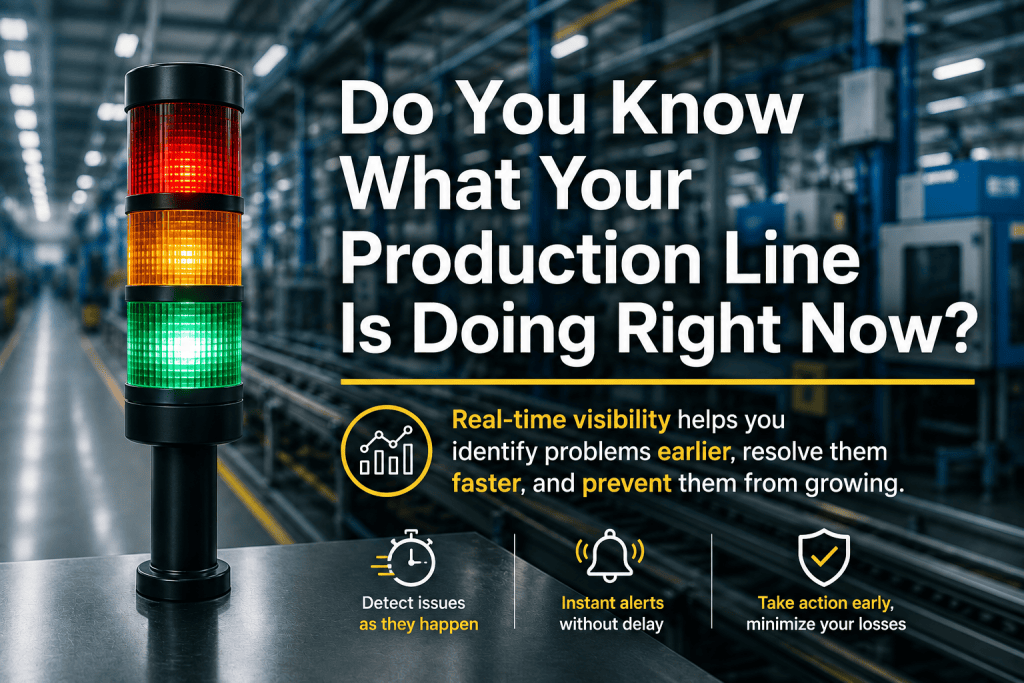
If you’re a Japanese expat tasked with running a factory in Thailand, there’s one worry I hear more than any other: “I can’t see what’s happening on the floor.” How the line is running right now, whether something has gone wrong — usually you only find out after the fact.
Working on the ground here in Thailand, I’ve come up against that “you only learn later” problem many times myself. Most people assume that putting in a visualization system will solve it. That’s half right and half wrong — because the real cause of not being able to see has another layer to it, one that sits in front of any system.
It’s not that reports are slow — it’s that the assumptions behind reporting have drifted apart
What a Japanese manager asks of the floor is simple: when a problem comes up, report it right away; let me know while it’s still small. For those of us raised in Japan, that’s just common sense. But that “common sense” isn’t necessarily shared out on the floor.
| What Japanese-style management takes for granted | What actually tends to happen on site |
|---|---|
| Bad news should come up early, while it’s still small | People try to settle problems among themselves, so word reaches the top late |
| People should act exactly according to the agreed procedure | On-the-spot judgment about the situation can take priority over the procedure |
So a problem that could have been handled if someone had flagged it early only comes to light once it has grown large. From a Japanese point of view, the reporting is “slow.” But this is not laziness, and it’s not a question of ability.
This isn’t about laziness — it’s about culture
There’s a cultural difference behind it. Thailand is often said to have a deeply rooted sense of krengjai (consideration for others — a deference that takes the other person’s position into account). The reluctance to bring bad news to someone senior is the flip side of that very feeling. It’s not ill will; if anything, it’s care for the people around you.
And how each person relates to their work differs, too. Values aren’t something you can force people to change. Some companies teach the Japanese style of hou-ren-sou (report, inform, consult) in training, but the underlying feeling doesn’t shift so easily — nor should it have to. This isn’t a matter of one side being right.
So instead of changing “people,” close the gap with a “system”
This is the key point. Trying to close a disconnect with reprimands or training usually just wears everyone out. Let’s flip the thinking. Stop depending on “getting people to report,” and instead build a state where “you can see what’s happening even without a report.”
- You can tell whether the line is running or stopped in real time, without waiting for a report
- The moment an abnormality occurs, an alert goes up on its own, with no human judgment in between
- It’s not “will someone raise it for me” — it’s “the system tells me”
Do this, and there’s no longer any need to blame anyone. Each staff member can simply perform at their best, in their own way. The system takes on just one job: spotting problems. The disconnect stays as it is — only the gap gets filled.
Don’t go in big. Build a small “window” of visibility
The moment you think “a full visualization system, then,” the quote runs from several hundred thousand to a few million baht, approval means a sign-off from head office, and rollout takes half a year. And that’s where it stalls.
But do you really need all of it? Start by making just the one thing you most struggle to see a little more visible. For example, monitoring the operation of a single piece of equipment — a minimal setup of nothing but a sensor and a display — can start from a scale of a few tens of thousands of baht. Once that one thing becomes visible, the mood on the floor changes, and you begin to see what to look at next.
In closing: a disconnect can be bridged with a system
The difference in how Japanese and Thai people go about their work is not a matter of better or worse. Rather than trying to change it, understand it — and then build a bridge with a system. That, I believe, is the surest shortcut to making DX work on the factory floor in Thailand.
In your own operation, what is the one thing you most struggle to see? If you’d like, let’s start by simply walking the floor together.
Related Articles
- AI Assistants to Offset the Manager Shortage in Thai Manufacturing: Automating Reporting, Meeting Minutes, and Task Creation
- Going Smart-Factory with BOI Incentives: 3 Conditions to Evaluate When Investing in IoT and AI for Thai Manufacturing
- Preventing Excess Inventory in Thai Manufacturing: A Practical Roadmap for Connecting ERP with Shop-Floor IoT
- Factories That Stall at “Visualization” vs. Factories That Drive Improvement: Redesigning IoT for Thai Manufacturing