


Introducing AI for manufacturing after-sales service does not make technical answers or spare-parts quotations reliable if the system is merely a chatbot trained on CRM conversations. Reliability requires a path from the customer and serial number to the delivered configuration, current service BOM, engineering changes, warranty and contract, availability and lead time, and price approval. This guide explains how a manufacturer in Thailand or ASEAN can test that path in a bounded 90-day proof of concept.
What changed in manufacturing after-sales service AI: reading the Siemens–Salesforce announcement carefully
On September 15, 2026, Siemens and Salesforce announced deeper integration between Teamcenter and Agentforce for industrial sales and service. The announced use cases go beyond automating conversation. They include answering questions that previously had to go back to engineering, identifying the correct spare part for a serial number before the first site visit, quoting only technically valid and manufacturable upgrades, and enabling customers to find and order the correct part. These are workflows in which product-configuration accuracy determines whether the result is usable.
The Siemens release says complex industrial processes can potentially be compressed from weeks to hours. It also cites industry analysis stating that aftermarket revenue grows about six times faster and carries roughly four times the margin of new-equipment sales. These figures are analysis cited in a Siemens release, not universal audited benchmarks for every manufacturer. An investment case should therefore use the company’s own inquiry volumes, repeat visits, wrong-part shipments, and quote-rework data.
Salesforce’s release on the same date confirms the combination of Agentforce and Teamcenter Service Lifecycle Management (SLM) to bring engineering-grade answers into sales, service, and customer workflows. It also describes Siemens using two AI agents for inbound-lead engagement and qualification: more than 2,500 unqualified leads per month, 18,000 sellers, and engagement of 100% of inbound leads across 132 countries. That is an example of sales-development scale. It is not evidence of serial-number-level parts compatibility or service-answer accuracy. Lead engagement and configuration-dependent technical decisions require separate evaluation.
McKinsey’s May 2026 analysis also reports organization-specific examples: AI-enabled scheduling at a water-treatment company increased technician capacity by 40% and reduced overtime by 6%; an engine OEM reduced labor hours per job by 15% and parts per job by 18%; automated invoicing reduced manual billing hours by 80%; and service copilots were associated with a 10% increase in first-time-fix rates. These are reported examples from particular organizations or analysis, not guaranteed TOMAS TECH outcomes or promises for another company.
The important change is not simply that “AI became smarter.” It is that implementations can increasingly connect CRM cases and conversations with the engineering and configuration evidence held in PLM/SLM while retaining permissions and traceability.
Why a generic chatbot or CRM-only approach fails as technical inquiry AI
A CRM contains the customer, dealer, opportunity, inquiry, contact, contract, and conversation history. It is still unsafe to decide “which part currently fits this serial number” from conversation history alone. Two machines with the same model can differ because of build date, factory options, engineering changes, field modifications, or previous service. An old email may describe another revision or another customer’s configuration.
Conversely, PLM/SLM or an equivalent configuration source does not by itself contain the full customer, contract, channel, service-level, regional, pricing, or open-case context. Technical validity for a product and commercial validity for a customer are separate information domains. Trying to turn either system into the sole source for everything leaves important decision evidence missing.
Common failure modes include:
- searching by model and ignoring serial-specific options or modification history;
- citing the latest drawing without checking whether its revision has been applied to the installed asset;
- suggesting a substitute without checking compatibility conditions, co-replacements, certification, or warranty impact;
- promising delivery from an on-screen quantity without checking allocation, regional warehouse, transport, or lead time;
- reusing a similar past answer without preserving its source, version, approver, and applicability; and
- confusing Japanese engineering terms, Thai shop-floor language, and English part descriptions.
The AI model must never be described as guaranteeing engineering accuracy. Accuracy is controlled through grounding in authoritative data, access control, deterministic compatibility rules, source citations, versioning, approval gates, and audit logs. Generative AI should gather evidence, explain it, and prepare drafts.
These principles align with our guide to AI agent implementation, but after-sales service adds a crucial rule: fix the serial number and actual installed configuration before relying on conversation history. Our explanation of the digital twin in manufacturing provides additional context for representing an asset and its state.
Data architecture for trustworthy answers and quotes: an eight-step evidence chain
Before designing screens, define how every answer traverses its evidence. The minimum chain has eight steps:
- Customer and serial number: identify the requester, installed site, asset ID, serial number, and dealer or distributor.
- Delivered configuration and as-maintained BOM: retrieve the current maintained structure, not only the original as-built record.
- Applicable engineering revision: check build date, change notice, retrofit kit, and applicability start and end conditions.
- Compatible spare or upgrade: narrow the authorized spare, substitute, successor, co-replacement, and application conditions with rules.
- Warranty and contract: check warranty period, service agreement, chargeability, channel responsibility, and exception approval.
- Availability, supply, and lead time: query usable stock, allocation, procurement, manufacturability, and transport assumptions.
- Price and approval: apply price list, currency, discount authority, treatment of tax and freight, validity, and approver.
- Audit log: record data, version, rule, AI output, human edits, approvals, and external transmission.
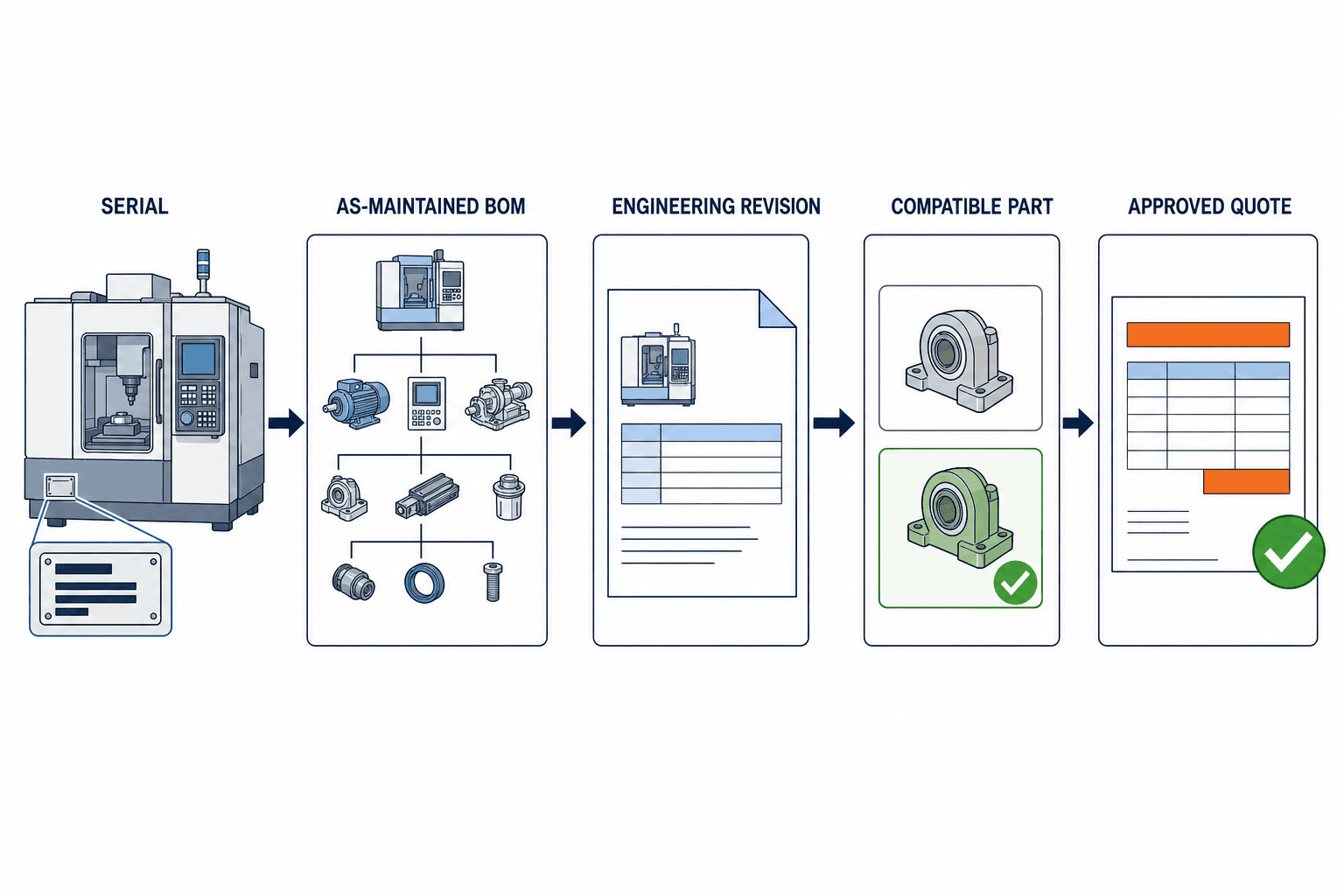
The order matters. A priced part cannot be quoted if it does not fit the asset. A technically valid part cannot receive a committed delivery date if it is obsolete or not manufacturable. Even an available part cannot become a confirmed customer condition before warranty and discount approval. The interface should distinguish “verified,” “conditional,” “unknown,” and “awaiting approval” at each stage instead of returning one apparently definitive search result.
The Teamcenter SLM product information describes connecting service BOMs with engineering and managing physical structures, as-built and as-maintained records, service history, asset status, and service plans as a source of service knowledge. Its Spring 2026 product release describes fault codes assigned to Service BOM parts, spare definitions derived from alternates or substitutes with system-generated flags and traceability, Service BOM authoring from EBOM, part-movement tracking, and Salesforce integration. The release uses the phrase “100% spare coverage” for its described recursive feature. That is a product-feature claim; it does not mean that a company’s entire dataset or every business answer is 100% accurate.
Fix the structure of an “answer package”
Every answer or quote draft should carry structured evidence as well as prose.
| Field | Required content | Behavior when unknown |
|---|---|---|
| Subject | Customer, site, serial number, case ID | Provide only general information until identified |
| Configuration evidence | As-maintained BOM version and retrieval time | Hold technical answer and request confirmation |
| Engineering evidence | Drawing, change notice, or service instruction version | Escalate to engineering |
| Compatibility decision | Part or upgrade, rule, and conditions | Do not expose externally even as a candidate |
| Commercial evidence | Contract, warranty, price list, approval status | Mark price and warranty as unconfirmed |
| Supply evidence | Stock, allocation, lead time, and timestamp | Do not promise a delivery date |
| Output state | Answer, draft, approved, or executed | Reflect state in the external view and log |
| Sources | URL or record ID, version, and retrieval time | Suppress unsupported claims |
BOM matching, contract decisions, price calculations, and approval rights should use deterministic processing where possible. Generative AI can turn the results from multiple systems into a readable explanation. This reduces both fluent but unsupported answers and rule-correct results that no one can explain.
Use-case priorities for manufacturing sales AI and technical inquiry AI
Do not automate everything at once. Prioritize by input clarity, consequence of error, and data maturity.
| Use case | AI assistance | Required evidence | Recommended PoC authority | Stop conditions |
|---|---|---|---|---|
| Technical inquiry | Classify, retrieve configuration, draft answer, cite sources | Serial, as-maintained structure, engineering revision, service history | Draft answer | Unknown configuration, safety impact, conflicting evidence |
| Spare-parts selection | Recommend fitting parts, substitutes, co-replacements | Service BOM, substitution rules, change notices, inventory | Recommend | Unknown serial, unapproved substitute, missing applicability |
| Upgrade quote | Build technically valid option and quote draft | Current configuration, option rules, manufacturability, price | Draft quote | Pending technical, discount, or lead-time approval |
| Service dispatch | Suggest skills, parts, work instruction, time options | Fault code, history, skills, stock, geography | Draft work order | Safety issue, unknown site condition, out of contract |
| Customer self-service | Serial-specific documents, candidates, case intake | Customer permissions, assets, publishability, fit rules | Search and order request | Another customer’s data, regional restriction, approval needed |
Select one product family with enough inquiries, available serial numbers, and outcomes that experts can later judge. “Consumable-part selection and quote drafting for one product series” is appropriately bounded. Safety-critical diagnostics, warranty exceptions, complex retrofits, and obsolete parts should be out of initial scope or routed to specialists.
The writing stage can also benefit from AI proposal and document generation. Faster prose, however, does not prove that a part fits. Complete the compatibility evidence first.
Human and AI authority: separate answer, draft, and execute
The highest-risk PoC design gives an agent combined authority to quote, promise delivery, order parts, and dispatch technicians. Split authority into three levels.
Level 1: answer and recommend
AI retrieves evidence, ranks candidates, and presents an answer draft with sources. A person verifies serial, configuration, and conditions before sending the answer. Even low-risk general information should show its source and version and distinguish confirmed facts from general guidance.
Level 2: draft a quote or work order
AI structures line items, quantities, assumptions, exclusions, warranty candidates, and work content. An authorized person approves price, discount, currency, delivery, warranty, substitutions, and safety conditions. Mark the document “DRAFT” and technically prevent external transmission before approval.
Level 3: execute an order, dispatch, or external commitment
Order creation, inventory allocation, technician dispatch, committed delivery, and warranty authorization change business state. During the PoC, do not execute these automatically. A person should confirm approved data and execute it, or the transaction should pass through the existing workflow gate. Any later automation must be bounded by subject, value, risk, exception, and cancellation method.
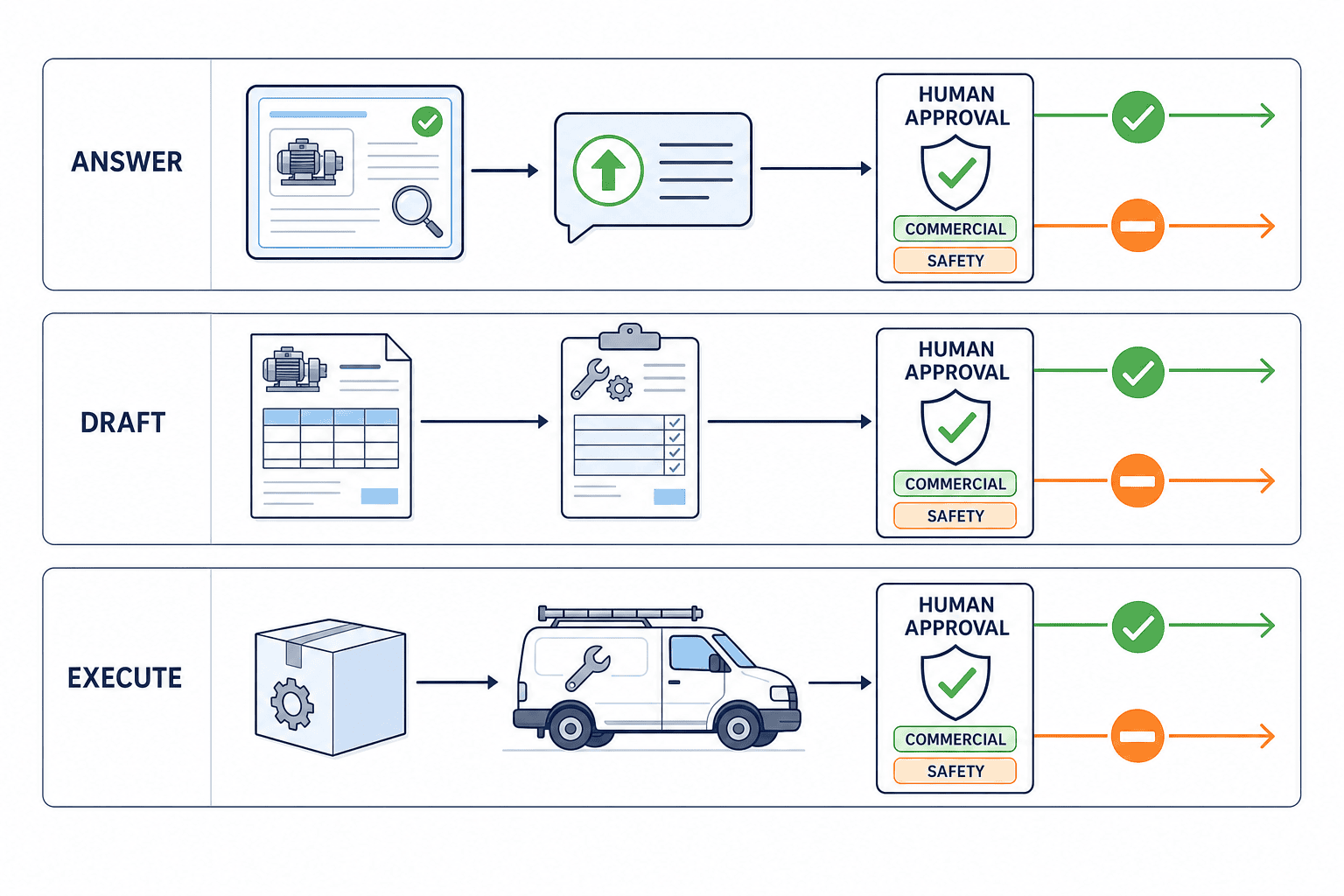
Human approval is mandatory during the PoC for commercial terms, safety-affecting technical guidance, warranty decisions, substitutions, and external commitments. Approval is not just an “OK” click: retain who reviewed which evidence version and approved what. When a person edits AI output, log the before-and-after versions and reason, then use those patterns to improve rules.
Apply access control before retrieval results reach the model. Dealer pricing differs from internal cost; customer-visible documents differ from service-technician instructions. Enforce tenant, row, and attribute permissions in data access rather than asking a prompt not to reveal restricted content.
Implementation issues in Thailand and ASEAN
Data location and operating responsibility can be harder than model performance. Product information may be split among a Japanese headquarters PLM, Thailand ERP, regional CRM, distributor spreadsheets, and service staff email. A company need not migrate everything before starting, but it must define where each field for the PoC product comes from and who corrects it.
Govern Japanese, Thai, and English terminology
One part may have a Japanese engineering name, an English item description, a Thai shop-floor nickname, and an old part number. Do not rely only on machine translation. Maintain approved aliases, prohibited terms, old numbers, units, and abbreviations around the canonical part number. If a term is ambiguous, the system should ask whether the user means candidate A or B. Serial, part number, and revision must resolve to the same record in every answer language.
Define responsibility for distributor and dealer data
When a distributor or service partner receives the inquiry, end customer, location, serial number, and contracting party may appear as separate CRM entities. Define who may update the installed configuration, see prices, and submit warranty requests. Minimize shared data and use tenant-, row-, and attribute-level controls so results never mix another dealer’s or customer’s information.
Treat missing serial and BOM history on old equipment as a normal exception
Legacy assets may lack a complete as-maintained BOM because of paper drawings, field modifications, unreadable plates, or migration gaps. Do not let AI guess. Open a configuration-verification case from photographs, plate data, known parts, and previous reports, then write the confirmed result back to configuration management. The ability to say “unknown” is a safety requirement. A quote draft should be blocked below a configuration-confidence threshold, while the actual threshold is determined in the PoC according to product risk.
Do not pretend multiple ERP, CRM, and PLM instances are one database
When systems differ by country, business unit, or acquired company, first define common IDs and a minimum data contract. Map customer, asset, serial, part, revision, case, and contract IDs while retaining source and update time. Use live queries for inventory and price that must be current at quotation, while pinning historical configuration evidence to a version. Do not synchronize every field simply because integration is possible.
A 90-day PoC: complete one evidence-backed decision workflow
The goal is not a theatrical demo. The goal is to repeatedly receive one product’s technical inquiry, select a configuration-compatible part, and hand an evidence-backed quote draft to a person. Divide the 90 days into four stages.
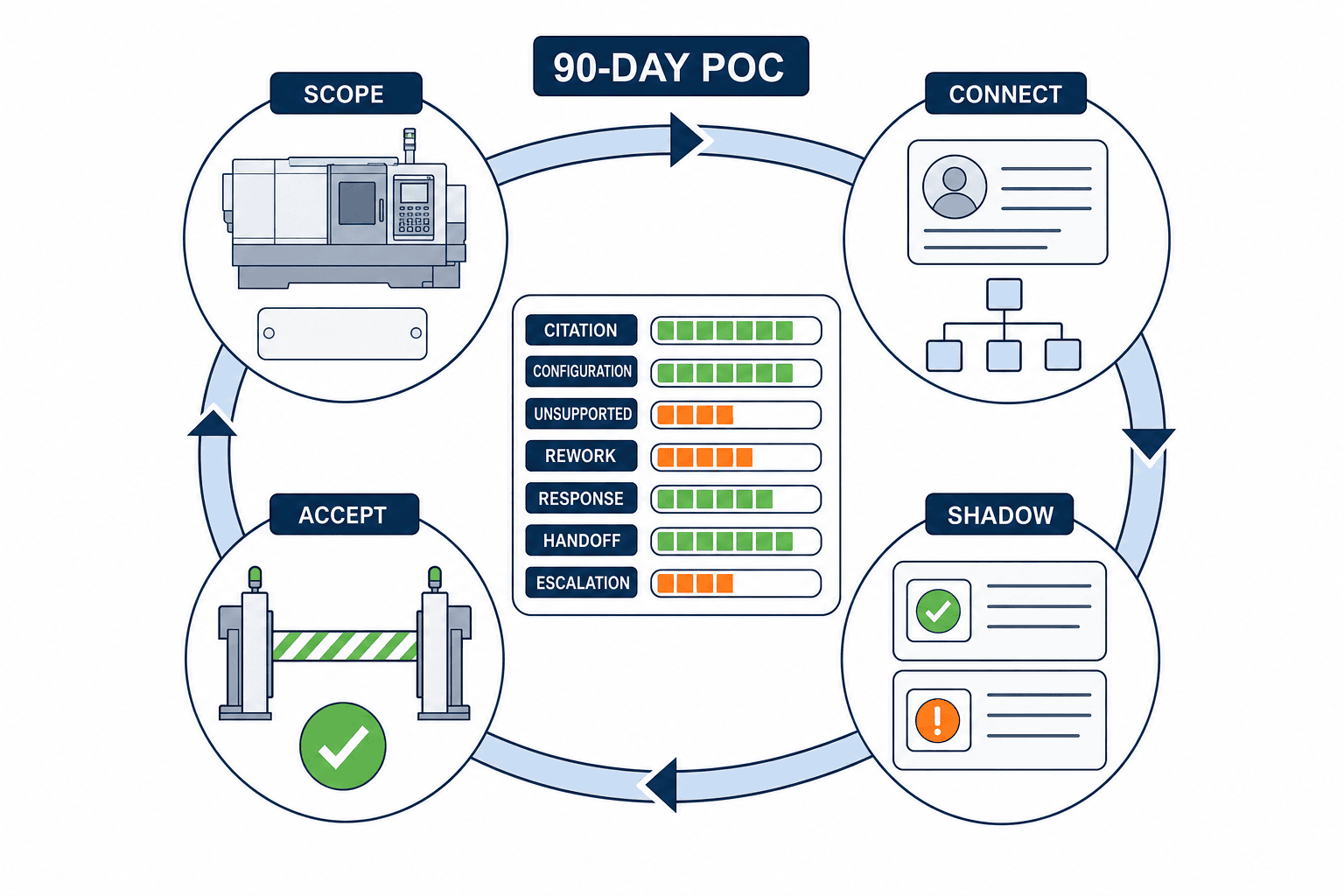
Days 1–15: define scope and truth
- Agree on the product, country, inquiry type, users, and exclusions on one page.
- Extract historical cases and have experts validate configuration, correct part, answer, and escalation reason for the evaluation set.
- Register source, owner, update frequency, access rights, and retained version for each field.
- Make current first-response time, quote rework, and engineering-escalation rate measurable.
Days 16–35: connect the evidence chain
- Map CRM customers and cases to serial and as-maintained configuration in PLM/SLM or its equivalent.
- Create read-only connections to compatibility rules, engineering changes, warranty and contract, inventory, and price.
- Store source, version, retrieval time, and unverified fields in the answer package.
- Implement the Japanese–Thai–English terminology dictionary and clarification questions.
Days 36–60: shadow answers and quote drafts
- Keep AI output away from customers and compare it with staff answers.
- Classify wrong configurations, unsupported statements, old revisions, unauthorized data, and overconfident delivery language.
- Test stopping on uncertainty, specialist handoff, and approval logs.
- Let staff edit and use quote drafts only for in-scope cases.
Days 61–90: limited production and acceptance
- Limit production use to approved users and products, with Levels 1 and 2 only.
- Review failures, edit reasons, data gaps, and access violations weekly.
- Decide whether criteria are met, improvement is needed, or expansion should stop.
- Do not make autonomous ordering or dispatch an acceptance condition.
PoC acceptance metrics
Do not copy improvement percentages from vendor examples. Set internal pass levels for process metrics.
| Metric | Definition | Validation |
|---|---|---|
| Evidence citation rate | Share of externally used claims with versioned sources | Sample audit of answer logs |
| Correct-configuration retrieval rate | Share retrieving the expert-approved serial configuration | Compare with the approved evaluation set |
| Unsupported-answer rate | Share not supported by a source or rule | Full or risk-based sample review |
| Quote rework rate | Share recreated for configuration, part, or term errors | Analyze version history and reason codes |
| First-response time | Time from intake to evidence-backed first response | Compare case timestamps |
| Handoff completeness | Share containing subject, evidence, open points, and destination | Audit the escalation template |
| Engineering-escalation rate | Share of target cases requiring engineering review | Track by reason over time |
A low unsupported-answer rate alone is insufficient. A system can avoid errors by forwarding almost everything to a person, yet create no value. View it with correct-configuration retrieval, response time, and escalation rate. Conversely, optimizing only automation rate rewards risky assertions.
Cost and ROI without invented implementation pricing
As displayed publicly on September 16, 2026, the Salesforce Manufacturing Cloud page lists Manufacturing Cloud Sales Enterprise and Service Enterprise at USD 275/user/month, Sales and Service Unlimited at USD 475/user/month, and Agentforce 1 for Sales and for Service at USD 700/user/month, billed annually. These prices are informational and subject to change. Do not convert them to THB or treat them as total implementation cost.
Total cost also includes configuration-data preparation, identity mapping, integrations, access control, terminology, evaluation sets, testing, change management, training, monitoring, and operations. Effort varies with existing PLM/SLM maturity, legacy-asset gaps, site count, and distributor scope. Multiplying license price by users is not an investment case.
An illustrative 200-hour annual calculation
The following assumptions illustrate the calculation; they are not benchmarks:
- 1,000 service inquiries per year;
- 35 minutes of current triage per inquiry;
- a 15-minute target for eligible cases; and
- 60% of cases eligible for AI assistance.
(35 − 15) minutes × 1,000 × 60% = 12,000 minutes = 200 hours/year. Converting this to money requires the company’s loaded labor rate, including benefits and overhead. No such rate was supplied, so this article does not attach a monetary value. The 200 hours also do not necessarily translate into head-count reduction; they may be reinvested in response speed, case capacity, or protected engineering time.
ROI can also include avoided wrong-part shipments, fewer repeat visits, less quote rework, shorter equipment downtime, and fewer engineering interruptions. Calculate them from company incidence and unit cost rather than inventing values.
McKinsey’s March 2025 analysis of more than 50 industrial organizations over 15 years found that high-service-focus companies generated 1.7 times the total shareholder return of product-focused companies; this does not prove causation. The article also reports a water-technologies OEM generating more than USD 350 million in aftermarket leads across 45,000 customers, including 8,000 white-space opportunities, and Ascendum using more than 13,000 documents, increasing first-contact resolution by 50%, and reducing typical troubleshooting from 30 minutes to under one minute. These are specific cited examples, not expectations for another company. Use them to ask which data and process change enabled the outcome, not as a base-case forecast.
Vendor and product selection checklist
Evaluate with your serial numbers and exception cases, not demo fluency.
| Area | Question | Evidence to request |
|---|---|---|
| Configuration | How are as-built, as-maintained, and field modifications distinguished? | Serial-level retrieval and version history |
| Compatibility | How are substitute, successor, co-replacement, and change rules controlled? | Rule, source, and stop behavior |
| CRM | How are customer, dealer, contract, and case linked to configuration? | ID mapping and data flow |
| ERP | When are stock, allocation, price, and lead time queried? | Timestamping, refresh, and error handling |
| AI control | How are unsupported answers, old versions, and conflicting sources handled? | Evaluation, refusal examples, audit log |
| Permissions | Where are internal, dealer, and customer views filtered? | Role-based retrieval and answer tests |
| Approval | Who approves commercial, safety, warranty, substitution, and commitment decisions? | Workflow and segregation of duties |
| Languages | How are Japanese, Thai, and English part terms governed? | Dictionary and ambiguity behavior |
| Operations | Who monitors missing data, model updates, and rule changes? | RACI, change, and rollback process |
| Cost | What is required beyond licenses? | Assumption-based breakdown, exclusions, run cost |
Include difficult test cases: a legacy asset with a missing BOM, assets on opposite sides of an engineering change, a warranty-boundary case, and a part in stock without substitution approval. Assess not only correct answers but the ability to stop and request human confirmation.
FAQ: deciding on manufacturing after-sales service AI
Can manufacturing sales AI and after-sales AI use the same platform?
They can share CRM customer, opportunity, and conversation data, but their decision evidence differs. Lead engagement centers on intent and qualification; service centers on serial configuration, revision, compatibility, warranty, and history. Connect service workflows to maintained PLM/SLM or equivalent configuration data and give them separate evaluations and approvals. The Salesforce example of 2,500+ leads, 18,000 sellers, 132 countries, and 100% inbound engagement must not be reused as evidence of service accuracy.
Can technical inquiry AI eliminate engineering confirmation?
That should not be the PoC goal. Accelerate routine cases with clear configuration and evidence, while handing unknown configurations, safety implications, conflicts, and novel failures to specialists with complete context. Measure handoff completeness and missed escalations, not only a falling escalation rate.
How far should spare-parts quote automation go?
Initially, stop at a draft containing compatible candidates, quantities, assumptions, and candidate price list. A person approves price, discount, currency, tax and freight treatment, delivery, warranty, substitution, and customer transmission. The quote becomes final only after both technical and commercial approval.
Does digital twin AI remove the need for PLM/SLM?
No. A digital twin can make asset state and configuration usable, but a governed source is still needed for part numbers, revisions, change notices, Service BOM, and applicability rules. The requirement is not a particular product name; it is maintained, versioned asset configuration linked to CRM and ERP context.
Can we start when old equipment has incomplete BOM data?
Yes, with a bounded scope. Start with a series whose serial and configuration can be verified, and route missing assets through configuration verification. Write results from photographs or physical checks back to as-maintained records. Never let AI guess a missing structure and finalize a quote.
How should we estimate manufacturing after-sales service AI cost?
Estimate data preparation, integration, access, evaluation, approval, training, and operations separately from public per-user license prices. Bound the PoC to one product and decision flow, and agree on acceptance metrics first. Public prices can change and are not total implementation cost.
Conclusion: give AI evidence before giving it authority
The value of AI for manufacturing after-sales service is not producing prose in seconds. It is traversing customer and serial number, current configuration, engineering revision, compatible part, warranty and contract, supply, and price approval—and reproducing why an answer or quote was made. Neither CRM nor PLM/SLM is sufficient alone; connect them with clear IDs, rules, versions, permissions, and approval gates.
For the first 90 days, choose one product family, one inquiry type, and one quote-draft workflow. Allow AI to answer, recommend, and draft while people approve commercial terms, safety, warranty, substitutions, and external commitments. Accept the PoC using citation rate, correct-configuration retrieval, unsupported-answer rate, quote rework, response time, handoff completeness, and engineering escalation—not automation rate alone.
TOMAS TECH can help from the initial inventory of how serial numbers, service BOM, CRM, and ERP connect across Thailand and ASEAN. If you are considering a bounded 90-day PoC, please use our contact page.
References
- Siemens and Salesforce deepen AI partnership to redefine industrial sales and service, Siemens, September 15, 2026.
- Siemens and Salesforce Expand Strategic Partnership to Redefine Industrial Sales and Service with AI, Salesforce, September 15, 2026.
- Teamcenter Service Lifecycle Management, Siemens.
- What’s new in Teamcenter Service Lifecycle Management Spring 2026, Siemens, June 15, 2026.
- Manufacturing Cloud, Salesforce, accessed September 16, 2026.
- AI is already rewiring the aftermarket sales and services, McKinsey, May 29, 2026.
- From pilot to profit: Scaling gen AI in aftermarket and field services, McKinsey, March 13, 2025.


