


When a Thailand factory starts looking for labor-saving equipment by asking which advanced machine can remove the most people, the investment often grows before the real constraint is understood. The better target is the smallest verified intervention that removes a defined constraint without sacrificing safety, quality evidence, maintainability or changeover flexibility. This guide compares jigs and poka-yoke, a semi-automatic machine, dedicated factory automation equipment, and a robot or cobot cell on one decision basis, then turns the choice into an RFP, FAT/SAT gates, a 90-day trial and a site-specific automation ROI model.
The answer first: remove the constraint with the smallest sufficient system
Do not begin with an equipment catalogue. Observe the current work and separate takt demand, waiting, minor stops, rework, physical burden, changeover and skill-dependent recovery. Then test the options in this order:
- Can a jig or poka-yoke remove a positioning, orientation, sequence or mix-up failure?
- Can a semi-automatic machine retain useful human judgment and feeding while taking over only a hazardous, strenuous or variable operation?
- If product and process conditions are stable, can dedicated automation reproduce cycle time and quality?
- Only when reach, mix, recipe change or future reuse creates value, should a robot or cobot cell be preferred?
This is not a rule to buy the cheapest machine. It means specifying the smallest complete system—including required safety, measurement, PLC integration and support—then proving it before scaling. The IFR reports 542,000 industrial robots installed worldwide in 2024, more than twice the annual volume ten years earlier; Asia represented 74% of new deployments. These global figures do not establish a Thailand adoption rate or prove that a robot is best for a particular factory.
Why a “headcount removed” target often fails
An operator’s cycle mixes value-adding motion, transport, waiting, inspection, adjustment, abnormal judgment, recovery and recording. Replacing a nominal thirty-second operation does not release an operator if feeding, model change, tool replacement, cleaning and minor-stop recovery remain. By contrast, automating only a heavy transfer or torque operation can let the same person oversee several steps or spend recovered time on quality improvement, even when payroll headcount does not change.
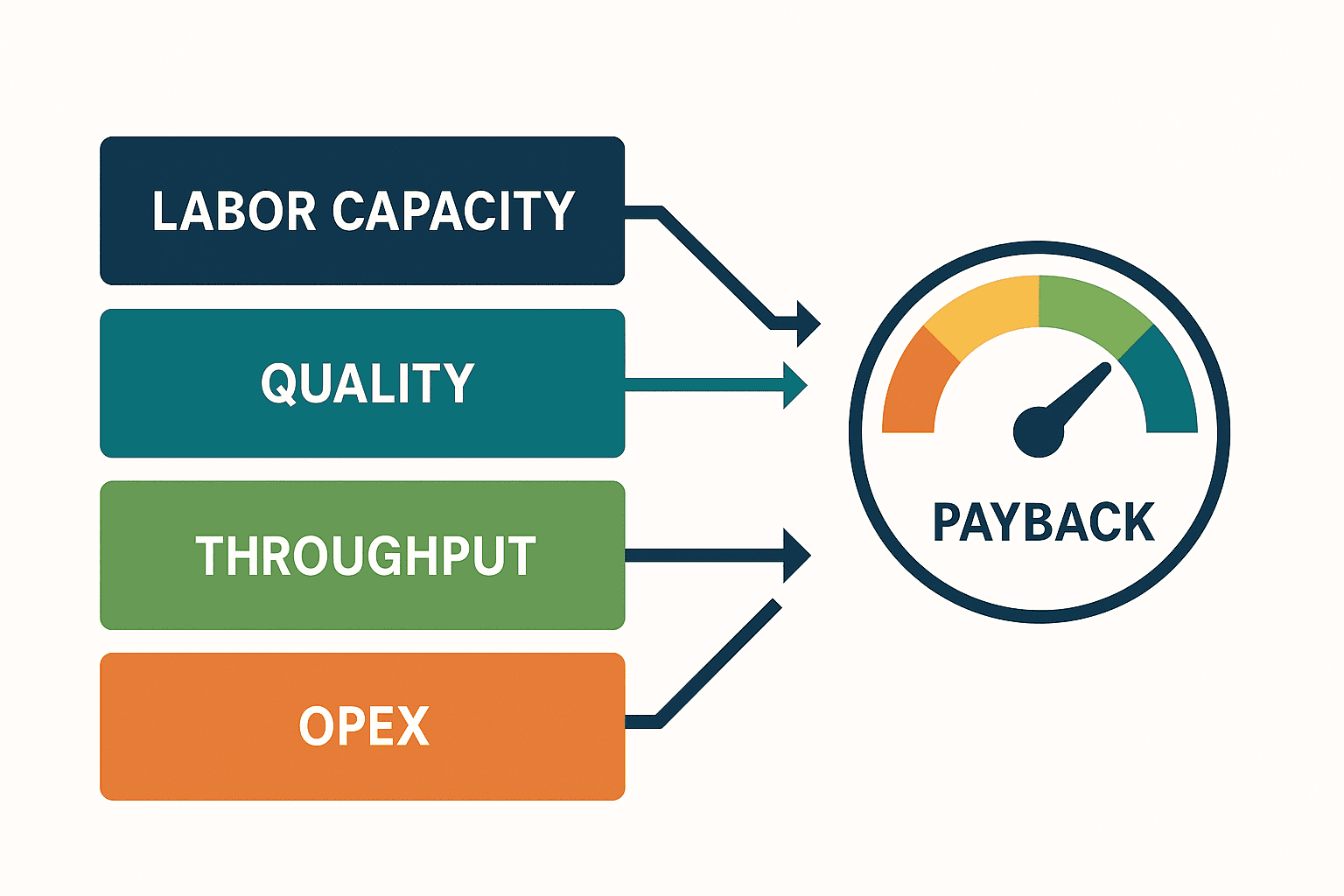
We therefore use recovered labor capacity, not automatic labor reduction. Capacity has economic value only when the site can name its use: reassignment, avoided overtime or avoiding an additional hire as volume grows. A throughput contribution needs demand and downstream capacity before it becomes realized sales. Keep recovered capacity, scrap/rework reduction, throughput and downtime contribution as separate benefit lines so the same minute is not counted twice.
Step 1: measure the work before searching for equipment
Observe representative products, difficult products, changeover and abnormal recovery. Record variation and causes, not only an average. Break the cycle into feeding, travel, positioning, processing or fastening, inspection, discharge, recording and rework.
Minimum baseline
- Required takt and the median and variation of actual cycle time.
- Product count, lot sizes, changeover frequency, fixture swap, recipe change and first-piece approval time.
- Failure modes, detection points, false accepts, false rejects, reinspections, rework and scrap paths.
- Posture, load, pinch, cut, heat, chemical and unexpected-start hazards.
- Minor stops, breakdown, material wait, quality hold, and upstream/downstream loss as separate categories.
- Product, lot, result, timestamp, alarm and operator/equipment IDs needed by PLC, MES or ERP.
- Parts that local maintenance can replace, required tools and software, backups and supply lead times.
“Current cycle is thirty seconds; new machine must be twenty-five” is not testable enough. Define the boundary from product entry to accepted discharge, whether manual handling is included, start and end signals, consecutive-run duration and treatment of abnormalities. For a brownfield project, also see our guide to production line modification in Thailand.
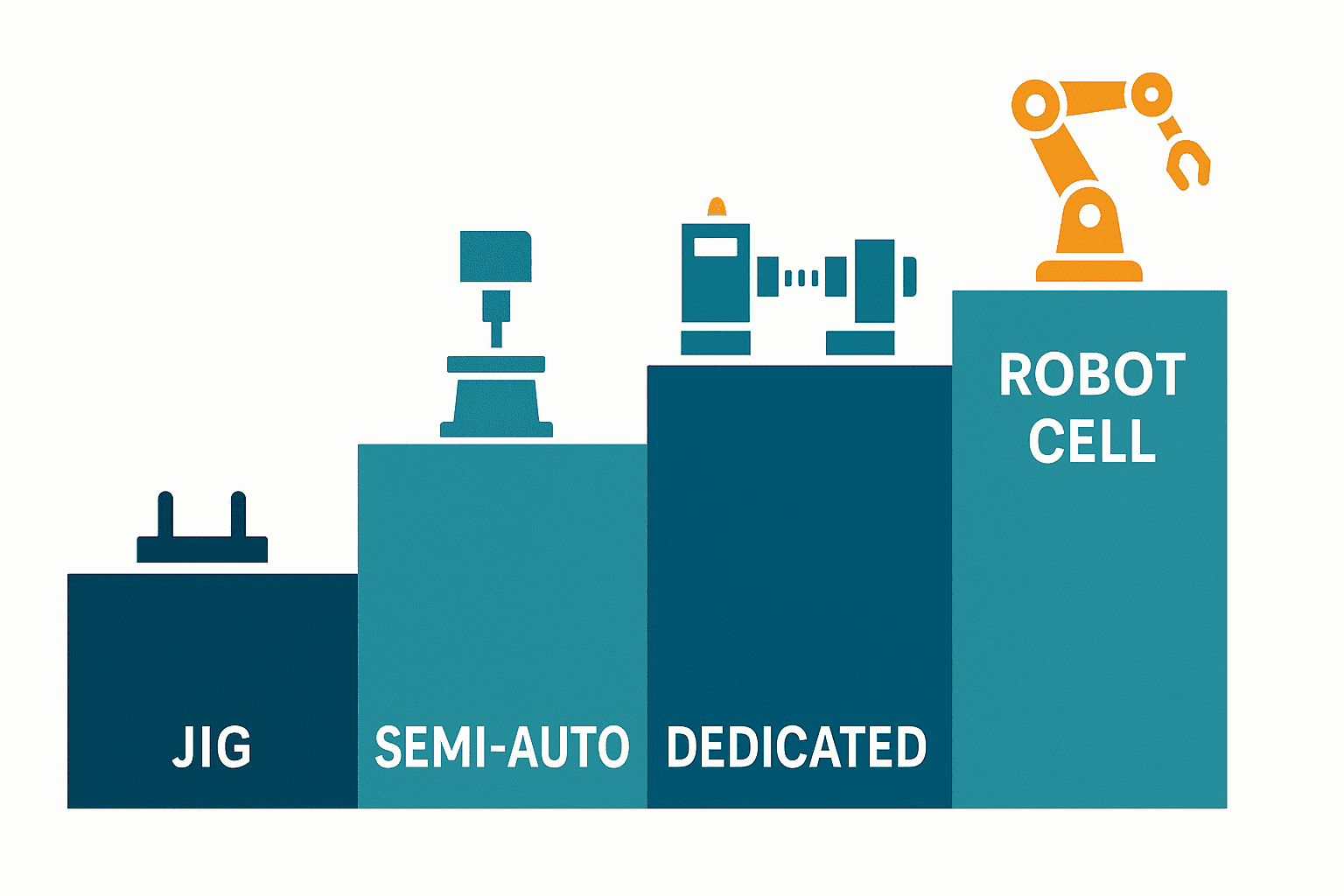
The four-level option ladder
Level 1 — jig and poka-yoke
Locating pins, guides, clamps, presence sensing, left/right prevention and sequence interlocks can remove decision load and rework. This level suits changing products and a small first step. It will not recover the expected capacity when repetitive burden or the major part of cycle time remains manual.
Level 2 — semi-automatic machine
The operator supplies or verifies the part while the machine performs pressing, fastening, insertion, dispensing, inspection or discharge. This retains human flexibility while stabilizing a hazardous, strenuous or variable operation. Whether one operator can tend several machines depends on walking, feeding, abnormal frequency and safe intervention, not only automatic cycle time.
Level 3 — dedicated automation equipment
A dedicated system automates feeding, positioning, processing, inspection and discharge as a sequence. It can fit stable products, volumes and conditions where speed and repeatability matter. Its weakness is change: a small product revision may require new fixtures, sensors, software and validation. Without spare parts, drawings and source backups, recovery becomes vendor-dependent.
Level 4 — robot or cobot cell
Consider a robot where multi-point work, reach, recipes or future reuse carry value. Evaluate the whole cell—gripper, fixture, feeder, inspection, safeguarding, controls and peripherals—not robot catalogue performance. ISO 10218-1:2025 addresses industrial robots, while ISO 10218-2:2025 addresses integration and robot applications or cells. A compliant robot does not by itself make the integrated cell safe. Our SME robot implementation guide for Thailand provides additional implementation context.
Decision matrix for factory automation equipment
Use this matrix to reject options that cannot satisfy a mandatory condition. Do not let a weighted score conceal a safety, quality or support failure.
| Criterion | Jig / poka-yoke | Semi-automatic | Dedicated automation | Robot / cobot cell | Evidence required in RFP |
|---|---|---|---|---|---|
| Takt | Main manual cycle remains | Stabilizes selected operation | Strong for high-speed repetition | Depends on motion and feeding | Consecutive logs for representative and difficult parts |
| Mix and changeover | Flexible with exchange jigs | Recipe plus fixture | Best for stable mix | Re-teach and tool change possible | Procedure, time, first-piece approval, wrong-recipe prevention |
| Quality evidence | Often needs added sensing | Process values are recordable | Full trace data is practical | Requires measurement integration | Result, unit, time, part, lot and decision basis |
| Safety | Simple still needs assessment | Human-machine transfer is central | Guarding, access and recovery | Application risk reduction required | Hazard log, reduction, verification and residual risk |
| Maintainability | Often locally repairable | Check standard-part content | Watch custom-part dependency | Robot and peripherals both matter | BOM, drawings, backups and recovery exercise |
| Local spares/support | Usually accessible | Depends on brand and stock | Custom lead time is critical | Service location and skills matter | Thailand stock, response, substitute and obsolescence policy |
| PLC/MES/ERP | Minimal integration | Results and alarms | Rich process integration | Define the cell boundary | Tag list, protocol, time sync, retry and authorization |
Price comes after mandatory fitness. A low-cost machine that stops for every product addition and waits for a proprietary part overseas may be expensive over its life.
Design the measurement system and quality evidence
Where torque, press force, dimensions or images determine acceptance, “a sensor is installed” is not evidence. Define range, resolution, calibration or verification, traceability, uncertainty, environmental effects and data processing according to intended use and risk. ISO/IAF auditing guidance similarly explains that control depth depends on intended use and risk, and that suitability, calibration or verification, uncertainty and traceability may matter. AIAG identifies Measurement System Analysis as a quality core tool that improves data quality and therefore decision quality. This article does not prescribe proprietary or universal pass thresholds.
Machine vision cannot be accepted from one static demo image. Camera, lens, lighting and software form the system; surface, defect, distance, pose, ambient light and contamination change results. KEYENCE guidance notes that lighting geometry, type, size, angle, color and wavelength affect contrast and repeatability, and that bright-field, dark-field, diffuse, backlight and coaxial arrangements suit different targets. Begin with the defect or measurement need, then select 2D or 3D technology—not megapixels alone.
If AI classification is proposed, narrow the defect scope and validate it. An OMRON TECHNICS sheet-inspection case used a CNN after diverse defect patterns proved difficult to classify with feature rules. The reported site had four to five hours of downstream work per day where post-production visual review changed shipment approval or grading. This is one supplier-reported case, not a universal savings benchmark.
Machinery safety: use ISO 12100 as a design process
ISO 12100:2010 remains current after confirmation in 2022 while a successor draft is under development. It provides principles and methods for hazard identification, risk estimation and evaluation, reduction, documentation and verification over the machinery life cycle. The valuable question is not whether a brochure says “ISO 12100 certified”; it is who assessed which hazard for the intended use, what design measure reduced it and how that measure was verified.
Cover loading, unloading, changeover, cleaning, tool change, jam clearing, maintenance, teaching, loss of power or air and restart—not only normal production. A cobot application can still present sharp-workpiece, hot-part, crushing, dropped-load or external-axis hazards. The presence of a safety PLC, curtain or scanner is different from verified performance of the required safety function. Separate tests possible at FAT from tests needing the site’s actual access, floor and adjacent equipment at SAT.
Automation ROI: an illustrative model without double counting
The following is a hypothetical calculation model, not a market price, project result or guarantee. Replace every value with your site’s quotation and measurements.
| Item | Model assumption | Treatment |
|---|---|---|
| Initial investment | THB 3.00 million | Assumed total equipment and integration |
| Annual support, spares and software | THB 0.25 million/year | Deducted as annual operating cost |
| Annual recovered labor capacity | THB 0.80 million/year | Reassignment or avoided overtime, not automatic headcount reduction |
| Annual scrap/rework reduction | THB 0.32 million/year | Quality benefit, separate from labor capacity |
| Annual throughput/downtime contribution | THB 0.28 million/year | Requires realizable demand and downstream capacity |
| Gross annual benefit | THB 1.40 million/year | 0.80 + 0.32 + 0.28 |
| Net annual benefit | THB 1.15 million/year | 1.40 − 0.25 |
| Simple payback | 2.61 years | 3.00 ÷ 1.15 |
The arithmetic is: gross annual benefit = 0.80 + 0.32 + 0.28 = THB 1.40 million; net annual benefit = 1.40 − 0.25 = THB 1.15 million; simple payback = 3.00 ÷ 1.15 = 2.61 years. The sensitivity is consistent:
| Assumed net annual benefit | Simple payback |
|---|---|
| THB 0.70 million | 4.29 years |
| THB 1.15 million | 2.61 years |
| THB 1.60 million | 1.88 years |
This simple model explicitly excludes financing, tax, depreciation, residual value, ramp-up loss, realization of capacity-constrained sales and BOI incentives. Evaluate them separately. Give every benefit line a baseline, formula and owner so a minute of shorter work is not counted again as throughput, or rework labor inside the quality saving is not repeated in recovered capacity.
Treat BOI incentives as a project-specific upside
Thailand BOI’s 1H 2026 announcement reported about THB 1.47 trillion of investment applications across 1,299 projects, up 37% year on year. Under Smart and Sustainable Industry, 132 applications worth about THB 17.2 billion covered machinery upgrades, digital technology, automation and robotics. This is market context; it does not mean all of that value was labor-saving equipment or that every project receives incentives.
The current BOI Smart and Sustainable Industry page states a minimum efficiency-enhancement investment of THB 1 million, excluding land and working capital. It lists machinery import-duty exemption and a three-year corporate-income-tax exemption for existing projects, capped at 50% of qualifying efficiency-improvement investment. It also states a three-year exemption up to 100% of investment where machinery linked to Thailand’s domestic automation industry represents at least 30% of automation/robotics machinery value. Eligibility, qualifying cost, timing and incentive value are project-specific. Confirm with BOI or appropriate advisers before commitment and keep incentives outside the base ROI case.
Twelve requirements for a scoreable RFP
1. Constraint and outcome
State the process, product, shift, takt, loss, defect, workload and intended use of recovered capacity. Replace a vague “save labor” goal with a measurable constraint and evidence.
2. Scope and responsibility
Assign equipment, fixtures, grippers, feed, discharge, inspection, safety, controls, utilities, foundation, delivery, existing-line modification, network and training.
3. Product and change conditions
Provide drawings, tolerances, material, surface, weight, mix, annual volume, lot and future candidates. Ask for time, cost and skills to add fixtures and recipes.
4. Cycle and capacity
Define boundary, manual handling, consecutive run, abnormalities, representative and difficult products, and how accepted output is counted. Do not accept a single fastest cycle.
5. Quality and measurement
Specify CTQs, units, range, calibration or verification, data linking, false accept/reject, remeasurement, bypass authority and MSA plan. See our inspection-equipment vendor selection guide.
6. Safety and local compliance review
Require application risk assessment and reduction, safety-function verification, residual risks, and identification of Thailand requirements to be confirmed. A list of standard names is not acceptance evidence.
7. PLC, MES and ERP integration
Define signals, data types, units, time synchronization, handshake, timeout, retry, duplicate control, offline behavior, system of record and permissions. An upper-system outage should not undermine safe machine control.
8. Maintenance and spares
Require PM tasks, consumables, critical spares, Thailand inventory, lead time, substitutes, diagnostics, logs, backups, restoration and remote-support conditions.
9. Documentation and intellectual property
Agree before order on mechanical/electrical drawings, BOM, PLC/HMI/robot source, passwords, licences, configuration, calibration evidence, risk documents and revision history.
10. FAT, SAT and open items
Define cases, samples, assumptions, evidence, witnesses, retest, punch-list severity and due dates, retention and warranty-start conditions.
11. Training and local support
Specify practical training in required Thai and English for operation, changeover, quality, maintenance, safety and administration. Verify night-shift recovery routes as well as daytime support.
12. Commercial and change control
Separate base equipment, options, installation, rigging, downtime, travel, tax, software, annual support, spares, additional products, re-FAT and re-SAT. Define quotation and approval for changes.
FAT and SAT: prove different meanings of “it works”
FAT checks at the vendor site whether design and manufacture meet requirements early enough to correct them. SAT checks outcomes under real power, air, floor, materials, operators, adjacent processes, network and environment. FAT acceptance does not replace SAT.
| Gate | Main check | Typical evidence | Ambiguity to close before passing |
|---|---|---|---|
| Design review | Scope, hazards, CTQ, interfaces, maintenance | Approved drawings, risk log, I/O and tag list | Who supplies, modifies and approves |
| FAT | Function, cycle, abnormal, safety and data | Signed procedure, logs, video and measurement | Requirements not tested on representative material |
| Pre-shipment | Punch items, packing and backup | Open-item list, restore check, shipment approval | Owner, deadline and cost for site fixes |
| SAT | Real material, environment, integration and capability | Consecutive run, good count, stop and interface records | Boundary including upstream/downstream work |
| Handover | Training, documents, spares and warranty | Receipt, competency check and backup | Warranty start and support contacts |
Set pass criteria before test according to process risk and customer requirements. This guide does not claim universal cycle-count, accuracy or availability thresholds. If a criterion must change, preserve the reason, impact and approver.
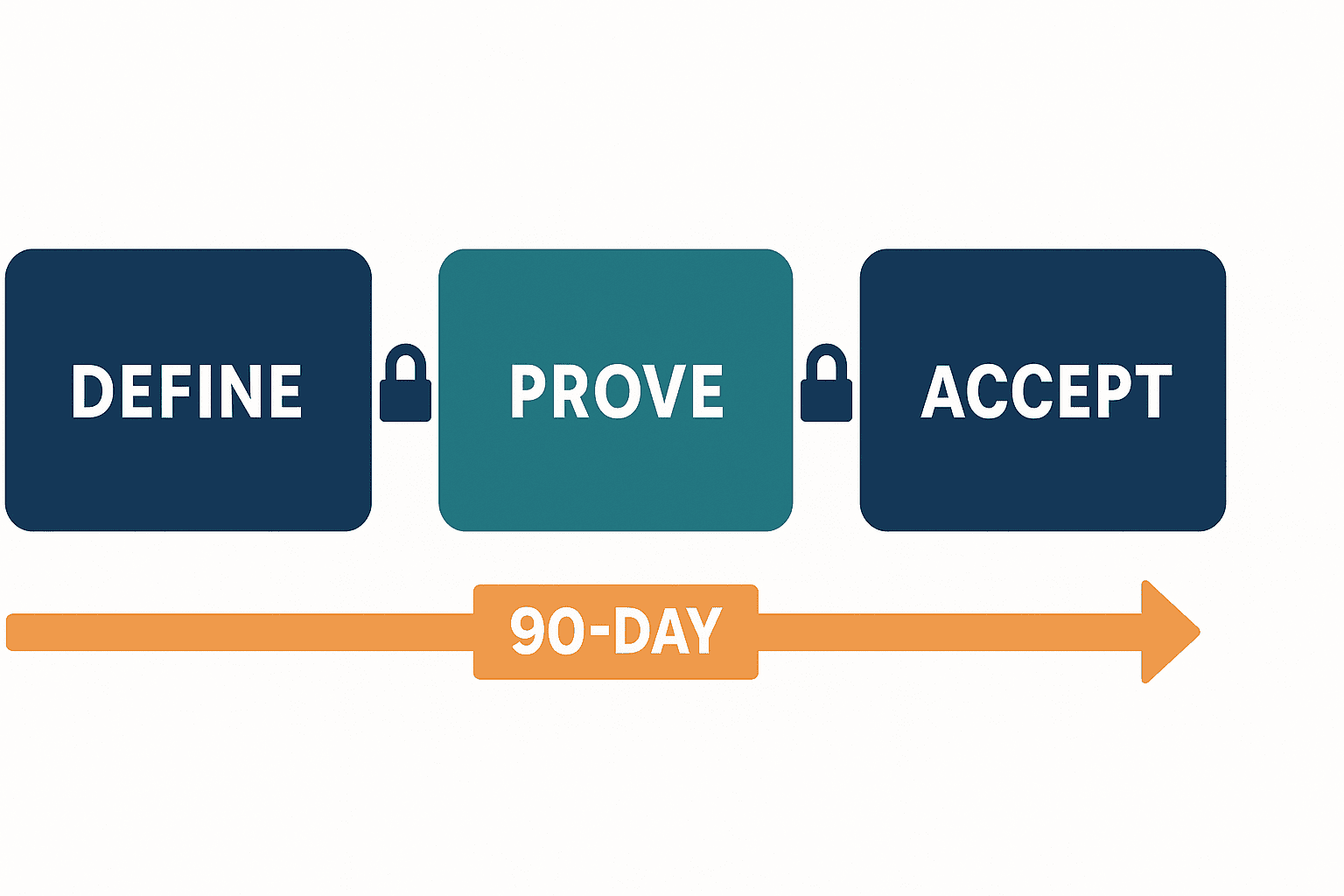
A 0–30 / 31–60 / 61–90 day validation plan
Days 0–30 — DEFINE
Observe work and confirm hazards, CTQs, losses, products and interfaces. Compare all four option levels and use a simple jig or offline test to close the largest assumptions. Approve the benefit baseline and equations before refining the capital quotation.
At the day-30 gate, the constraint, scope, responsibility, measurement method, data owner, use of recovered capacity and safety stop conditions must be unambiguous. If not, reduce the trial scope rather than enlarging the machine.
Days 31–60 — PROVE
Test difficult products and changeovers as well as normal production. Inject missing parts, reversed loading, dirty sensor, low air, communications loss, power recovery, emergency stop, jam and NG discharge. Link measurements to part, lot and time. Verify safe behavior while an upper system is unavailable and no duplicate records after recovery.
At the day-60 gate, decide whether major assumptions were reproduced in FAT or a trial rig and whether open items can be closed safely during SAT. Review variation, stop reasons, false decisions and manual intervention—not only averages.
Days 61–90 — ACCEPT
Use SAT to cover real material, all relevant shifts, upstream/downstream processes, MES/ERP and local maintenance. Measure recovered capacity, scrap/rework, and throughput/downtime contribution separately, then replace the illustrative ROI assumptions with actual observations. After training, local personnel demonstrate changeover, abnormal recovery, backup and critical-part replacement without the vendor taking over.
The day-90 choice is not only “roll out everywhere.” Limited production, conditional extension, redesign or stop can each be correct. Give every open point a severity, interim measure, owner, due date and residual-risk approver.
Define the PLC/MES/ERP data boundary
More equipment data is not automatically better. Candidate trace data includes equipment ID, part, lot or serial, start and completion time, recipe version, measurement, disposition, alarm, bypass and rework. Decide which system owns product master, work order and disposition; test local buffering, retry, duplicate prevention and clock synchronization.
PLC usually handles deterministic and safe machine control, MES work instruction and traceability, and ERP planning, inventory and cost, but actual boundaries differ. An upper-system failure must not disable required safety. Vendor remote access should use named identity, approval, a time window, logging and least privilege.
Vendor-comparison red flags
- Only catalogue cycle time is shown; loading, unloading, changeover and abnormal recovery are excluded.
- “One person saved” is claimed without remaining work or a use for recovered capacity.
- Risk assessment is postponed until after delivery.
- Vision quality is shown with one image or average accuracy, without false accept/reject and lighting variation.
- PLC/HMI/robot source, passwords or backups are excluded from handover.
- Thailand critical-spare stock, substitutes and response time are undefined.
- MES/ERP integration is merely “supported,” with no tags, owner or failure behavior.
- All FAT punch items are deferred to SAT without dates and cost responsibility.
- Possible BOI incentives are booked as a certain discount in base payback.
Implementation checklist
Before RFP
- [ ] Measure the bottleneck, variation and stop reasons.
- [ ] Compare jig, semi-auto, dedicated automation and robot cell on one basis.
- [ ] Separate baselines and equations for capacity, quality, throughput and downtime.
- [ ] Record hazards, CTQ, product change, maintenance, local spares and IT/OT boundary.
Before purchase order
- [ ] Separate capital, annual cost, new products, changes, retest and spares.
- [ ] Agree FAT/SAT procedures, samples, evidence, witnesses and retest conditions.
- [ ] Decide ownership and handover of drawings, source, licences, passwords and backups.
- [ ] Confirm BOI treatment per project and keep it separate from base economics.
Before day-90 acceptance
- [ ] Test difficult products, abnormal, safety, communications, recovery, changeover, cleaning and maintenance.
- [ ] Confirm the measurement system is suitable for its intended decision.
- [ ] Have local staff demonstrate operation, change and recovery.
- [ ] Update automation ROI with actual values and review double counting.
FAQ: labor-saving equipment, cost and selection
What is labor-saving equipment?
It is a broad term for jigs and machines that reduce burden, repetition, hazard, waiting or variation. It can include poka-yoke, a semi-automatic machine, conveying, inspection and a robot cell. The objective here is not headcount by default, but safe, verifiable removal of a defined constraint.
How should we choose semi-automatic versus dedicated automation?
Semi-automation fits high mix and useful human judgment or flexible feeding. Dedicated automation fits stable volume and process where end-to-end repeatability justifies it. Compare safety, evidence, maintenance, parts and future change as well as takt.
What payback period is acceptable?
There is no universal answer. It depends on capital policy, product life, demand, risk and alternatives. The example invests THB 3.00 million for a modelled THB 1.15 million net annual benefit and 2.61-year simple payback; it is illustrative. Use site data and a downside sensitivity.
Does a cobot eliminate the need for guarding?
Not universally. Assess the workpiece, tool, speed, force, pinch points, peripherals and approach for the application. Robot characteristics alone do not establish cell safety.
How many samples are enough for vision acceptance?
There is no universal number. Design the evaluation from defect classes, frequency, false-accept/reject risk, product, lighting, pose and lot variation. Use both a controlled fixed set and a site trial, preserving conditions and version.
Can we copy a factory labor-saving case study?
Use a case to discover questions, not to import its hours or payback. Boundaries, wages, operations, quality loss, demand and maintenance capability differ. Turn the concept into a hypothesis and measure it in your own 90-day validation.
Conclusion: select small, verify deeply and preserve a route to scale
The right labor-saving equipment is not the most automated machine. Define the constraint through work measurement and failure modes, then compare a jig, semi-automatic machine, dedicated automation and a robot cell for the smallest sufficient intervention. Put safety, quality evidence, maintainability, local support, changeover and PLC/MES/ERP boundaries into the RFP; prove them through FAT, SAT and the three 90-day gates. Keep recovered labor capacity, quality, throughput/downtime and operating cost separate, and update the model with site evidence.
Even before the equipment format is decided, TOMAS TECH can help structure work measurement, option screening, the RFP, FAT/SAT and a 90-day validation for a Thailand factory. Contact TOMAS TECH while the project is still at the definition stage.
Sources
- Thailand BOI/OSOS, 1H 2026 investment applications: https://osos.boi.go.th/EN/news/2430/Thailand-Secures-43-6bn-1H-2026-Investment-Surge-as-Big-Tec/
- Thailand BOI, Smart and Sustainable Industry: https://www.boi.go.th/index.php?language=en&page=smart_sustainable
- IFR, Global robot demand in factories doubles over ten years: https://ifr.org/ifr-press-releases/news/global-robot-demand-in-factories-doubles-over-10-years
- IFR, World Robotics 2025 Executive Summary: https://ifr.org/img/worldrobotics/Executive_Summary_WR_2025_Industrial_Robots.pdf
- ISO 12100:2010: https://www.iso.org/standard/51528.html
- ISO 10218-1:2025: https://www.iso.org/standard/73933.html
- ISO/IAF, Monitoring and Measuring Resources: https://committee.iso.org/files/live/sites/tc176/files/PDF%20APG%20New%20Disclaimer%2012-2023/ISO-TC%20176-TF_APG-MonitoringMeasuring.pdf
- AIAG, Quality Core Tools: https://www.aiag.org/expertise-areas/quality/quality-core-tools
- KEYENCE, Basics of Lighting Selection: https://www.keyence.com/products/vision/resources/vision-resources/basics-of-lighting-selection.jsp
- KEYENCE, What Are Vision Inspection Systems?: https://www.keyence.com/products/vision/resources/vision-resources/what-are-vision-inspection-systems.jsp
- OMRON TECHNICS, AI defect classification case: https://www.omron.com/global/en/technology/omrontechnics/vol55/004.html


