


When implementing handwritten OCR in a Thailand factory, warehouse or back office, a polished demo and one vendor confidence score are not acceptance evidence. The real question is whether the organization can control how forms are captured, which fields are extracted, which errors are reviewed, and which approved values may enter ERP, MES, QMS or WMS. This guide provides a practical sequence for multilingual handwritten forms: RFP requirements, a proposed 90-day PoC, acceptance metrics, audit trails and regression tests after change.
The conclusion first: buy an error-controlled process, not merely a reading engine
Before procurement, agree on nine controls:
- Classify form type, version, language/script, handwritten fields and critical fields.
- Specify scanner/camera, lighting, skew, blur, glare, crop, missing-page and duplicate conditions.
- Separate OCR extraction from normalization of dates, decimals, units, part and lot numbers.
- Establish human-approved ground truth and separate tuning data from final holdout data.
- Measure field exact match, critical false accepts, review rate, correction time and posting exceptions.
- Do not equate provider confidence with measured accuracy; calibrate thresholds on company data.
- Route low-confidence and high-severity fields to review and block unapproved postings.
- Retain the source image, extracted and corrected values, reviewer, time, model/version and posting result.
- Re-run a frozen acceptance set after model, prompt, preprocessing, form or master-data changes.
Acceptance therefore means that errors can be detected, held, corrected and traced—and that a critical wrong value cannot silently become a business transaction.
Why handwriting is harder than a general AI-OCR shortlist
Printed forms already vary by image quality, rules, stamps, carbon copies, folds, backgrounds and layout versions. Handwriting adds writer, pen, pressure, shorthand, overwriting, corrections and notes outside boxes. A single ambiguous character can turn a quantity, part number or lot into a different transaction.
Thailand operations may combine Thai headings, alphanumeric part codes, Japanese approval notes and Arabic numerals on one page. A language on a support list does not prove that a particular product, version and region can read the buyer’s handwriting. Amazon Textract’s documented limits, for example, state that handwriting recognition is supported only in English. Google Cloud and Microsoft documents describe text, layout, geometry, confidence and handwriting-related output, but they do not guarantee correctness on a buyer’s forms.
An RFP should therefore ask for the product, API/processor version, region, script, handwriting scope, page limits, input formats and output structure, followed by tests on buyer-supplied samples. For the earlier product-shortlisting stage, see our AI-OCR comparison and RFP guide for Thailand. This article addresses the next, handwriting-specific decision.
Step 1: classify documents and critical fields before selecting a product
Create a document register containing business purpose, issuer, owner, version, pages, normal and peak volume, language, handwritten areas, downstream system, retention and possible personal data. The same form name with different layouts is a different class.
Then create a field register. Give each field a type, required flag, validation rule, master reference, business severity, exception action and approver. A document-wide average treats an address typo and a digit error in shipment quantity as equal. Acceptance must reflect business impact.
| Example field | Type and validation | Example severity | Exception route |
|---|---|---|---|
| Work date | Date and operating calendar | Medium | Review out-of-range values |
| Part number | Exact item-master match | High | Stop posting on mismatch |
| Lot number | Format, active lot and process relation | High | Independent human check |
| Quantity | Number, unit and limits | High | Do not post before approval |
| Comment | Free text | Low–medium | Search use; review when needed |
| Name/signature | Authorized person; possible personal data | High | Confirm handling with legal/DPO |
High, medium and low are an editorial classification example, not an external standard. Operations, quality, finance, IT and governance owners should define them from safety, inventory, accounting, delivery and individual impact. A critical field may require review even at high confidence; a low-severity comment may be retained for search without becoming authoritative data.
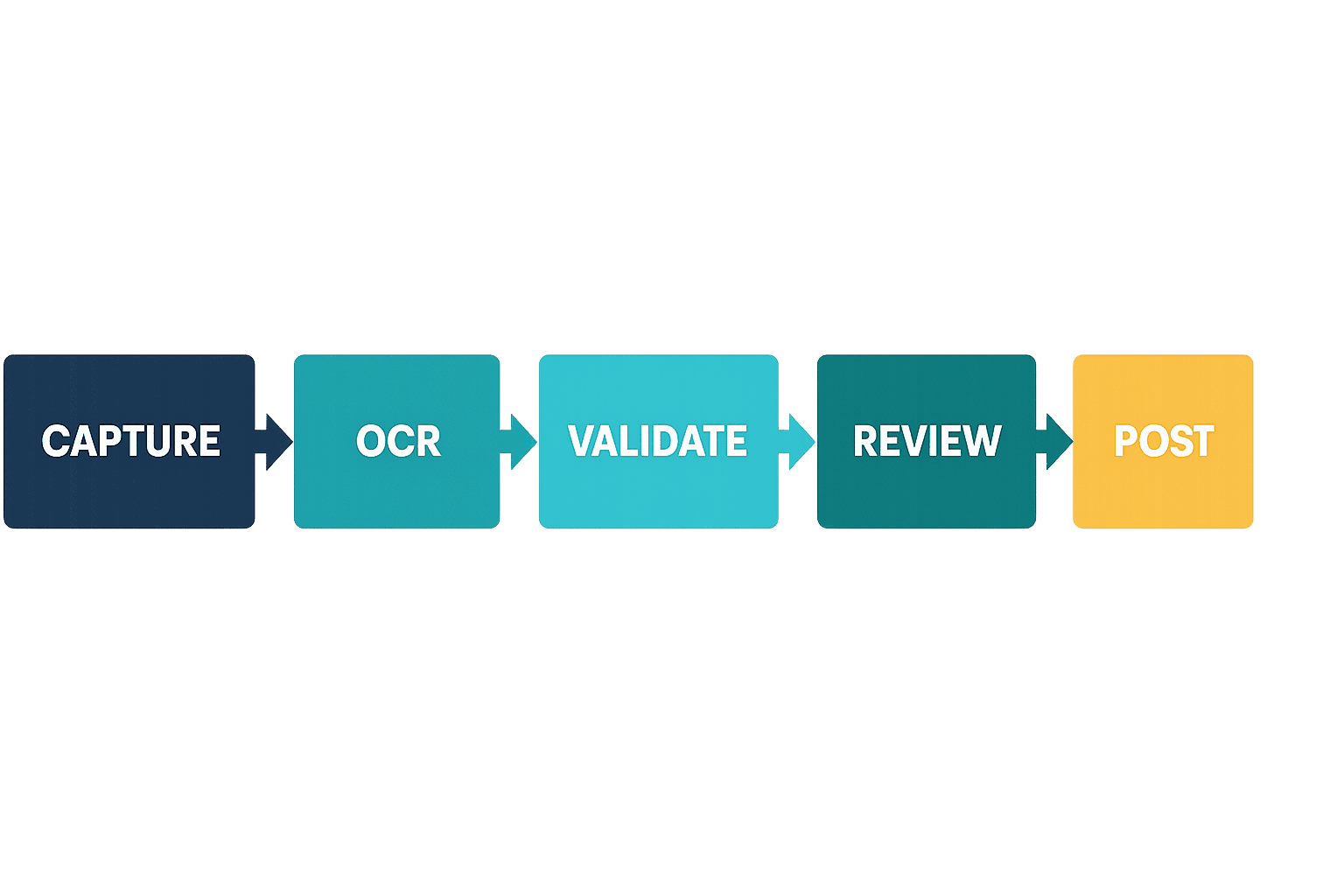
Step 2: manage capture quality as an input specification
Google Cloud Enterprise Document OCR describes features such as rotation correction, image-quality scoring, handwriting and language hints. These can help, but they do not guarantee recovery from a poor source. Treat capture conditions as PoC variables and apply a quality gate at intake.
A flatbed scanner offers consistent resolution and geometry but introduces transport and mix-up risk. A mobile or industrial camera captures at the work site but adds skew, shadow, glare, motion, background, distance, dirty lenses and device variation. Evaluate each channel separately.
At intake, detect missing pages, clipped corners, skew, blur, glare, exposure, low resolution, bleed-through, upside-down pages and duplicates. Decide whether to recapture, hold or continue. Where practical, link the original image, processed image and preprocessing parameters; otherwise, a later investigation cannot identify what changed before OCR.
Do not remove difficult cases from the PoC. Include faint carbon copies, different pen colors, pencil, strike-throughs, stamps, stains, oblique camera angles, dark locations, reflective covers, folds and cropped edges. Tag each condition so its effect can be analyzed instead of mixing everything into one average.
Duplicate detection is also a business control. If one form is photographed twice and becomes two transactions, perfectly transcribed text still produces a wrong outcome. Test exact and near duplicates using a document ID, image fingerprint, issue time and meaningful field combinations.
Step 3: separate extraction from business-value normalization
OCR services may return raw text, lines or words, geometry, detected languages and confidence. Google’s response structure, Microsoft’s Read OCR model and Amazon Textract’s line/word documentation describe such outputs. But visible text is not yet the value that should enter a system of record.
For “1,250.00,” keep the OCR raw value, normalized value, currency/unit and validation result separately. Thai Buddhist and Gregorian years, date order, commas and decimal points, full/half-width forms, spaces, hyphens, O/0, I/1 and unit conversions should not disappear inside a black box.
Use an explicit sequence:
- Extract raw text and geometry from the source image.
- Assign values to fields using the known form version and layout.
- Normalize Unicode, spaces, symbols, dates, numbers and units by controlled rules.
- Match parts, lots, customers, equipment or workers against authoritative masters.
- Evaluate intra-field and cross-field business rules.
- Route by severity, confidence and validation outcome.
- Post only approved values and retain the response or exception.
Normalization must not silently “fix” a value. If the system suggests a master-data candidate, retain the raw value, candidate, selected value and reason. An apparently unique fuzzy match may still be unsafe for a critical part number.
Step 4: create ground truth and separate tuning from acceptance
Ground truth—not the sales demo—is the core PoC asset. For critical fields, use two independent entries with adjudication, or review by an accountable specialist. Treat unreadable as a valid ground-truth state instead of forcing a guessed character. It is unreasonable to require a model to be right where people cannot determine the source.
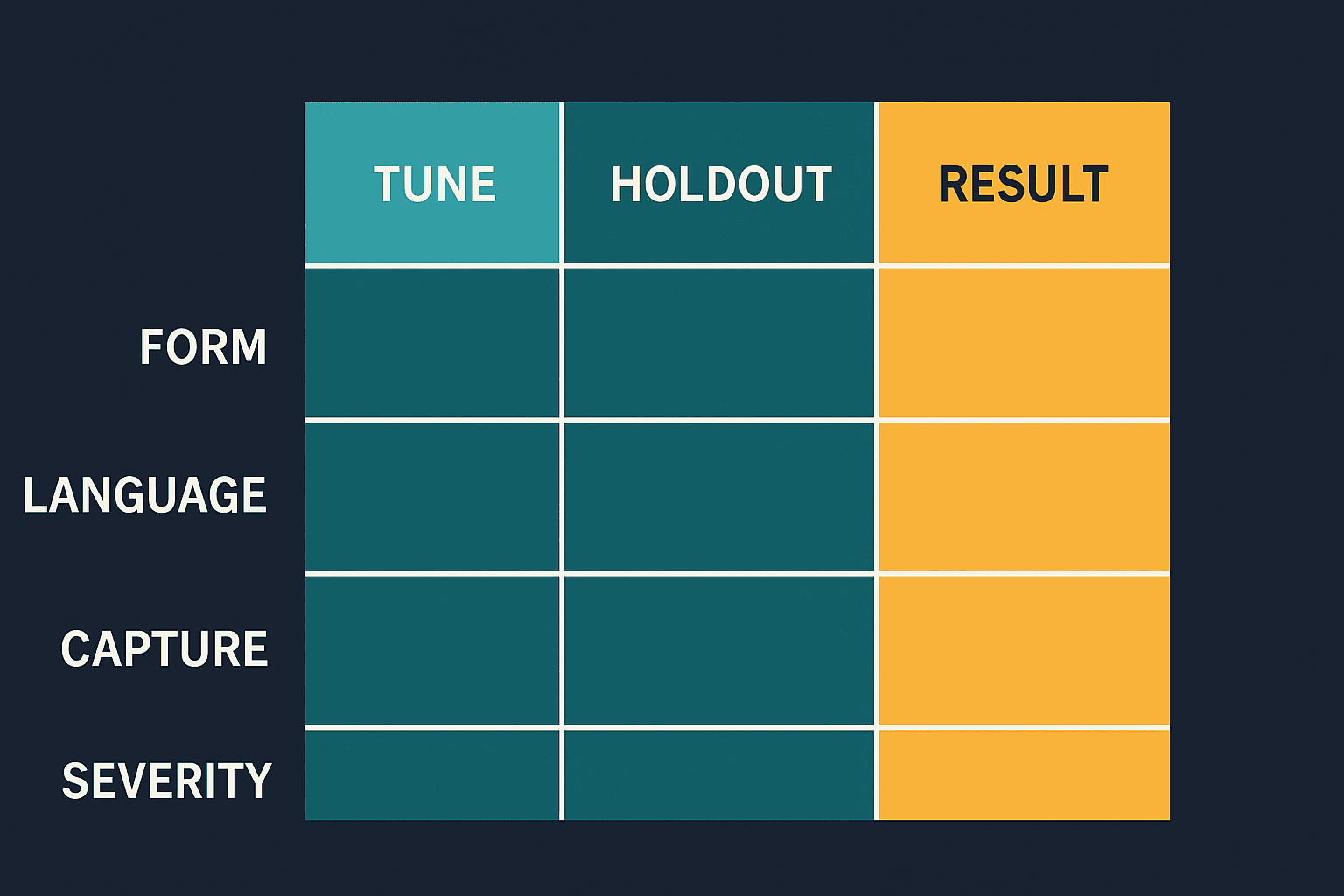
Split tuning and holdout data. Do not place images from the same writer, continuous capture session or carbon-copy bundle on both sides. Split by writer or document bundle and keep one intentionally difficult group hidden from configuration teams until final evaluation.
The following is a proposed evaluation design, not an external standard or market benchmark:
| Stratification | Illustrative proposal | Caveat |
|---|---|---|
| Forms | 5 primary + 2 exception types | Tag layout versions separately |
| Language/script | Thai, alphanumeric, Japanese, mixed | Label at field level |
| Writers | Experienced, new, external | Minimize personal identification |
| Capture | Scanner, device A/B, light levels | Preserve device metadata |
| Difficult cases | Blur, skew, glare, corrections | Observe operational incidence too |
| Split | 70% tuning, 30% holdout | Example only; not a fixed ratio |
A project might propose 2,000 pages and 10,000 critical fields, but those numbers are illustrative and not universal requirements. Rare high-impact fields must not disappear inside a page average. Where the set contains confidential or personal data, confirm purpose, access, retention, deletion and processors.
Step 5: never accept confidence as accuracy
Confidence is model output, not a measured probability that a field is correct on your workload. A displayed 0.98 need not mean 98% correctness. Scales may differ by model, version, language, form and preprocessing. Microsoft, Google and Amazon describe confidence in their structured outputs; the business threshold still needs calibration against approved answers.
Combine severity and validation with confidence instead of using one global threshold.
| Condition | Proposed route | Reason |
|---|---|---|
| Critical field + master mismatch | Mandatory review | Business contradiction outranks confidence |
| Critical field + all rules pass | Review or second approval | Decide from false-accept impact |
| Low severity + high confidence + rules pass | Candidate for auto-pass | Monitor measured false accepts |
| Unreadable or cropped field | Recapture or return | Avoid guessed postings |
| Unknown form version | Hold | Prevent wrong field mapping |
Report measured exact-match and false-accept results by confidence band. Raising a threshold usually increases review workload; lowering it may increase silent errors. Show the trade-off by critical field, not only overall. For broader measurement principles, see how to evaluate AI-OCR accuracy on operating forms.
Step 6: design human review as an operating process
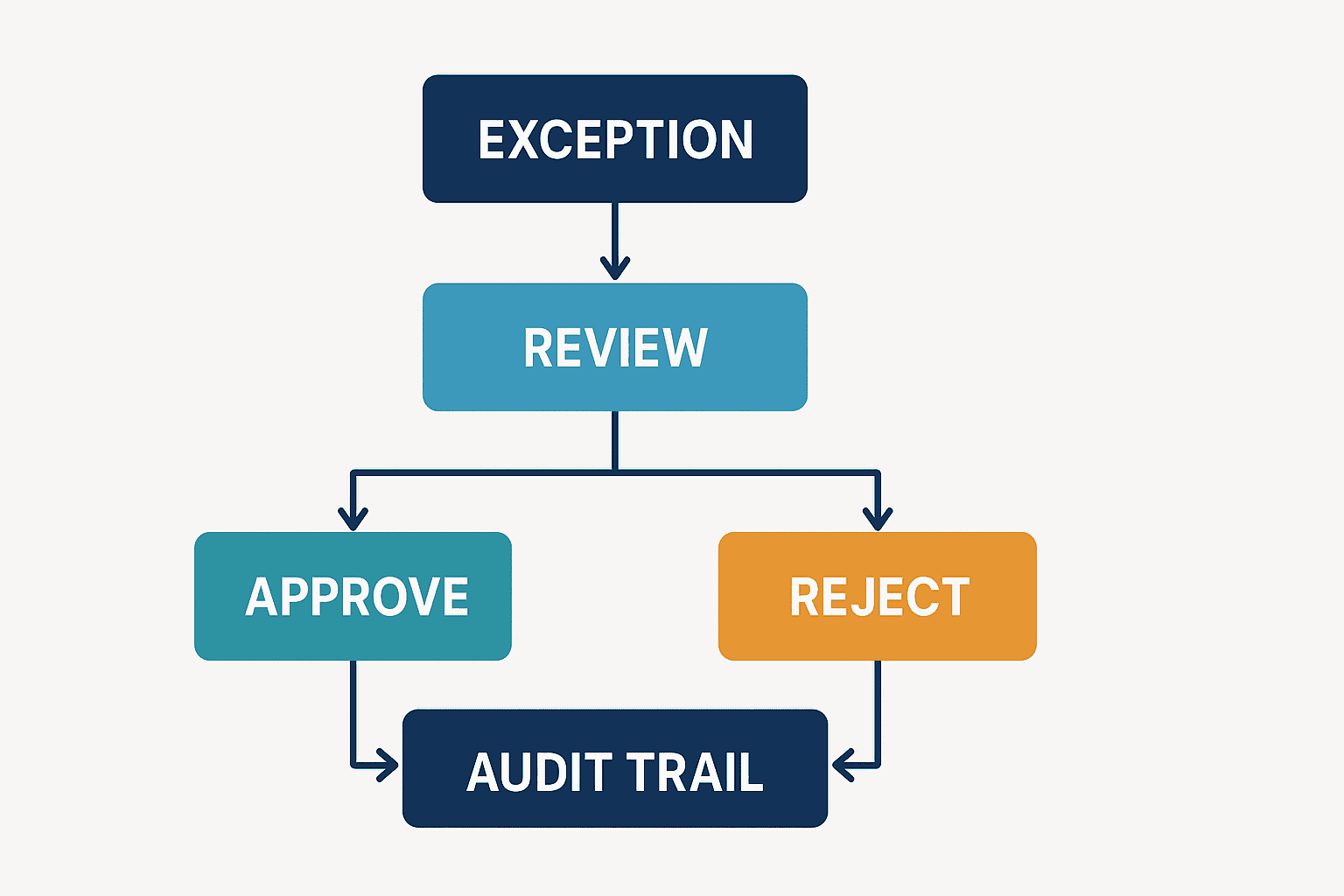
Human-in-the-loop should not mean “someone reads every page at the end.” A useful review screen shows the relevant image crop, zoom, OCR raw value, normalized candidate, master candidates, failed rules, severity and related fields. Making a reviewer hunt through a full page increases time and transcription risk.
Prioritize queues by deadline, severity, form type, department and exception reason. Define who adds capacity, when automation stops and how paper fallback works if a queue exceeds limits. Review rate alone is a poor KPI because it may encourage unsafe auto-passing; measure quality, timeliness, critical errors and rework together.
Use correction reason codes such as OCR error, capture defect, form-entry error, missing master, wrong version and rule clarification. The data can indicate whether the next improvement belongs in the model, form, camera process, master or reviewer interface. If corrections will be reused for model improvement, govern their purpose, quality, access and retention separately.
Define segregation of duties. The person correcting OCR may or may not be permitted to approve a high-risk transaction. Flag—not automatically accuse—patterns such as bulk overrides, unusual repeated values, after-hours approvals or master changes outside role.
Step 7: protect ERP, MES, QMS and WMS with an approval gate
Separate “OCR complete” from “business posting complete.” Decide where pending values live and ensure only approved values reach the target. An HTTP success response alone may not mean the transaction passed business validation. Track receipt, validation, posting, returned document number and subsequent processing.
Every interface should carry a business key, correlation ID, document ID/version, approval and send times, sender, schema version and retry count. Test duplicate delivery, reverse order, timeout, partial failure, master changes, downstream outage, cancellation and correction. Avoid unmanaged CSV bypasses that break the audit chain.
An end-to-end state trail can be:
DOCUMENT RECEIVED → IMAGE ACCEPTED → OCR EXTRACTED → VALUE NORMALIZED → RULE VALIDATED → HUMAN APPROVED → SYSTEM POSTED → RECONCILED
Attach time, actor, input version, output and reason to each state. If a later correction is required, retain the old value, new value, correction reason, approval and downstream reversal/reposting relationship.
A proposed 90-day PoC: move from demo to acceptance evidence
The 90-day structure below is an editorial planning example, not a delivery guarantee or external standard. Adjust it to scope, data availability, procurement and operating calendars.
Days 0–15: scope, ownership and answer-key method
Build document and field registers; define severity and baseline processing, errors, rework and downstream effects. Assign owners across operations, IT, quality, finance, legal/DPO, audit and vendor teams. Confirm the purpose, access, masking, retention and deletion of evaluation data. Name the ground-truth entry and adjudication roles.
Days 16–30: capture gate, extraction and normalization
Vary capture conditions on representative forms and tag input quality. Retain raw OCR and geometry, then implement date, number, unit, part and lot normalization as separate rules. Create routes for unknown versions, empty fields and multiple candidates. Automate comparison with ground truth.
Days 31–60: review and downstream integration
Configure the review screen, queue, reasons, permissions and any second approval. Send only approved values into an ERP test environment. Inject timeouts, duplicates, reversed order, master mismatch, target outage and cancellation; verify replay and reconciliation. Thai-speaking operators should use actual devices to evaluate terminology, fonts, input, screen width and response time.
Days 61–75: holdout and difficult-condition evaluation
Run the frozen set containing unseen writers, bundles, devices and difficult conditions. Report field exact match, critical false accepts, review rate, straight-through processing, correction time and posting exceptions by form, language, condition and severity. If one segment underperforms despite a good average, define exclusion, mandatory review or recapture.
Days 76–90: acceptance board and staged-release decision
List open defects with severity, containment, due date and owner. Assemble process, security, data, operation, maintenance, recovery and contract evidence. A cross-functional board chooses release, conditional release, retest or stop. Keep denominator, exclusions, version, execution date and tester—not merely a pass mark.
Acceptance metrics beyond average accuracy
All thresholds are organization-defined. The values below are examples, not product guarantees or market norms.
| Metric | Definition | Interpretation |
|---|---|---|
| Field exact-match rate | Normalized fields exactly equal to ground truth / evaluated fields | Report by field and severity |
| Critical false-accept rate | Wrong critical fields automatically passed / critical fields | State denominator even at zero |
| Review rate | Fields or forms routed to people / processed population | Lower is not automatically better |
| Straight-through rate | Forms approved and posted without human work / population | Posting failures are not success |
| Correction time | Review start to approval | Separate queue and touch time |
| Posting exception rate | Held, rejected or inconsistent target records / sent records | Track the final result after retry |
A team might propose gates such as zero critical false accepts, at least 98% field exact match and no more than 25% review. These are illustrative. Zero errors among 20 critical fields is weaker evidence than zero among 10,000. Explain impact, denominator, uncertainty, seasonality and unobserved conditions rather than optimizing a decimal point.
Define straight-through processing through approved target-system posting, not merely extraction. Disclose later retries and corrections so a person opening a form is not counted as “fully automatic.”
Make RFP answers testable
Attach an ID, mandatory/desirable status, target forms, response format, limitation, assumption, evidence, PoC test and contract destination to every requirement.
| RFP area | Required answer | Acceptance evidence |
|---|---|---|
| Language/handwriting | Product, version, region, script, limitation | Stratified results on nominated forms |
| Input | Format, size, pages, quality gate, correction | Blur/skew/glare/crop behavior |
| Output | Raw value, geometry, language, confidence, tables | JSON examples and missing/duplicate fields |
| Normalization | Standard, configuration and custom boundary | History for dates, units, parts and lots |
| Human review | Queue, permission, second check, reasons | Critical and low-confidence routes |
| Integration | API, schema, idempotency, replay, cancellation | Fault injection and reconciliation |
| Change | Model/version/configuration notice and rollback | Frozen-set regression record |
| Data | Region, retention, training use, subprocessors, deletion | Contract, settings and logs aligned |
| Support | Language, hours, severity and version lifecycle | Incident runbook and contact test |
Do not accept “supported” or “high accuracy” without product/version, standard/configuration/custom/third-party classification, assumptions, exclusions, extra cost and maintenance ownership. Google’s processor list documents broad coverage, but the buyer still needs exact handwriting, version, region and form verification. Azure pages identify current and retiring API versions, so the contract should assign version migration and regression-test responsibility.
For the broader sequence, see our AI-OCR implementation guide. For retention, search and source-document management, see paper document digitization with AI in Thailand.
Data protection, security and AI governance
Forms may contain names, signatures, employee identifiers, contact details or health and incident notes. Applicable law, contract, cross-border transfer, retention, deletion, access and incident duties depend on the actual data and architecture. Confirm them with legal and DPO stakeholders; this article is not legal advice.
Google Cloud’s Document AI security page describes options including data residency, VPC Service Controls, Access Transparency and CMEK, and makes product-specific statements about use of customer content for Document AI model training. It also distinguishes online and batch handling. Do not generalize those statements to all OCR vendors; recheck current contracts, regions, retention, support access, subprocessors and deletion at decision time. Microsoft’s privacy documentation likewise reminds users of their responsibility for applicable laws. Neither page produces a Thailand PDPA conclusion by itself.
NIST AI RMF is voluntary. Its Govern, Map, Measure and Manage concepts can organize ownership, context, evaluation, residual risk and monitoring; AIRC supports testing, evaluation, verification and validation practices. Use does not imply NIST certification. The voluntary ASEAN Guide on AI Governance and Ethics emphasizes context, human involvement and applicable national laws. Thailand’s ETDA AI Governance Practice Center describes assessment and testing initiatives, but it is not an OCR product approval or legal safe harbor.
At implementation level, verify least privilege, segregation, encryption in transit and at rest, keys and secrets, logs, vulnerability handling, backup, deletion and export control. Prevent uncontrolled copies of evaluation forms. A fallback-to-paper runbook must include duplicate prevention and reconciliation after recovery.
Change management: a passed result does not stay fixed
Cloud processor versions, APIs, models, prompts, preprocessing libraries, cameras, form versions and master data change. A prior acceptance result may not apply after any of them changes. Each change should carry reason, scope, risk, test, approval, implementation, rollback and monitoring.
The frozen regression set should include representative forms, critical fields, difficult conditions, previous incidents and boundary values. Add fresh operational samples to detect drift, but keep data used for threshold tuning separate from final acceptance.
An overall improvement can hide regression in one language or critical field. Compare before/after results on the same population for critical false accepts, review rate, processing time and downstream exceptions. Record model/version on each transaction so items processed during a change can be identified even after rollback.
Common failures and controls
- Using a sales demo as acceptance: test unseen writers, actual devices and difficult conditions.
- Calling confidence “accuracy”: calibrate exact-match and false-accept results against ground truth.
- Passing on a document average: create separate gates for part, lot, quantity and approval fields.
- Hiding normalization inside OCR: retain raw, transformed, candidate and approved values.
- Reviewing only low confidence: also route by severity, contradiction, missing data and unknown versions.
- Cleaning PoC data: include tagged blur, glare, corrections, old layouts and edge writing.
- Treating every error as a model problem: compare improvements to forms, capture, masters and UI.
- Counting extraction as completion: verify approval, posting, response and reconciliation.
- Skipping retests: run regression after model, preprocessing, form or master changes.
Practical handwriting digitization checklist
Before the RFP
- [ ] Inventory form types, versions, languages, scripts, handwritten fields and volumes.
- [ ] Define each field’s type, master-data check, severity, error action and approver.
- [ ] Include capture device, lighting, skew, blur, glare, cropping and duplicates in evaluation conditions.
- [ ] Define ground-truth entry, second checking, unreadable values and disagreement resolution.
- [ ] Confirm data purpose, access, region, retention, deletion and processors.
- [ ] Require provider answers by product, version, region and standard-versus-custom capability.
During the PoC
- [ ] Separate tuning data from holdout data by writer and document bundle.
- [ ] Trace raw OCR values, geometry, normalized values, master-data matches and approved values.
- [ ] Calculate measured exact match and false accepts by confidence band.
- [ ] Stratify results by critical field, difficult condition, language and form version.
- [ ] Test the review queue, reason codes, permissions, deadlines and backlog handling.
- [ ] Inject downstream duplicate, delay, outage, cancellation, retry and reconciliation failures.
At acceptance and after go-live
- [ ] Record each metric’s denominator, exclusions, version, period, owner and threshold owner.
- [ ] Assign severity, containment, due date and owner to every unresolved defect.
- [ ] Export an audit trail from source image through correction, approval and system posting.
- [ ] Define retesting after changes to the model, API, preprocessing, form or master data.
- [ ] Review false accepts, review rate and exceptions at 30, 60 and 90 days.
- [ ] Rehearse degraded operation, paper fallback, recovery, duplicate prevention and reconciliation.
FAQ about handwritten OCR implementation
What is handwritten OCR?
It is image-to-text recognition for handwritten content plus the operating controls around capture, field mapping, normalization, validation, review and system posting. The second part determines whether extracted text becomes safe business data.
Can one engine process Thai, Japanese and English handwriting together?
Capability varies by product, version, region, script and handwriting style. Do not infer it from a general language list. Test mixed fields on actual forms and report by language and field.
What AI-OCR accuracy percentage is acceptable?
There is no universal percentage. Separate free text from high-impact quantity, part and lot fields. Use exact match, critical false accepts, review rate, straight-through rate, correction time and posting exceptions with thresholds owned by your organization.
Does provider confidence of 0.99 remove human review?
No general conclusion follows. Confidence is model output rather than measured correctness on your forms. Criticality, failed business rules, unknown layouts and poor capture may independently require review.
How many forms are required for a PoC?
There is no universal sample size. Cover form types, versions, languages, writers, devices, conditions and critical fields. Numbers such as 2,000 pages in this article are planning examples, not standards.
May approved OCR values be posted automatically to ERP?
Potentially, according to business risk. Low-risk fields may pass after validation; high-risk fields may need a reviewer or second approver. Acceptance must include duplicate, timeout, replay, cancellation and reconciliation tests.
Is cloud OCR automatically compliant with Thailand PDPA?
No product-page statement resolves that question. The answer depends on data, purpose, roles, region, transfer, retention, deletion, subprocessors, contract and configuration. Confirm current requirements with legal and DPO stakeholders.
Conclusion: accept reproducible controls, not an OCR score
A handwritten OCR program needs more than an API that returns text. It must classify forms and critical fields, govern capture, measure against ground truth, separate extraction from normalization, route risky values to people, and post only approved values. A proposed 90-day PoC should produce evidence from difficult cases, holdouts, failures, retries, corrections and regression tests. Only then can the organization expand scope while preserving control when the model or form changes.
TOMAS TECH can support current-state mapping, critical-field classification, RFP preparation, ground-truth planning, multilingual AI-OCR PoCs, human review, ERP/MES/QMS/WMS integration and acceptance evidence for Thailand operations. You can contact us while volumes and product choices are still under consideration.
References
- Google Cloud, Enterprise Document OCR: https://docs.cloud.google.com/document-ai/docs/enterprise-document-ocr
- Google Cloud, Processor list: https://docs.cloud.google.com/document-ai/docs/processors-list
- Google Cloud, Handle processing response: https://docs.cloud.google.com/document-ai/docs/handle-response
- Google Cloud, Security and compliance: https://docs.cloud.google.com/document-ai/docs/security
- Microsoft Learn, Azure Document Intelligence overview: https://learn.microsoft.com/en-us/azure/ai-services/document-intelligence/overview?view=doc-intel-4.0.0
- Microsoft Learn, Read OCR model: https://learn.microsoft.com/en-au/azure/ai-services/document-intelligence/prebuilt/read?tabs=sample-code&view=doc-intel-4.0.0
- Microsoft Learn, Data privacy and security: https://learn.microsoft.com/en-us/azure/foundry/responsible-ai/document-intelligence/data-privacy-security?view=form-recog-3.0.0
- Amazon Textract, Lines and words: https://docs.aws.amazon.com/textract/latest/dg/how-it-works-lines-words.html
- Amazon Textract, Document limitations: https://docs.aws.amazon.com/textract/latest/dg/limits-document.html
- NIST, AI Risk Management Framework: https://www.nist.gov/itl/ai-risk-management-framework
- NIST, AI Resource Center: https://airc.nist.gov/
- ASEAN, Guide on AI Governance and Ethics: https://asean.org/book/asean-guide-on-ai-governance-and-ethics/
- ETDA, AI Governance Practice Center: https://www.etda.or.th/th/Our-Service/AIGC/index.aspx
This article is a general implementation guide based on public information checked on 8 September 2026. It does not guarantee product performance, investment return, legal compliance or project outcomes. Recheck versions, regions, contracts and laws immediately before a decision.


