


A defect escaped to the customer, and the question comes back immediately. Why did sampling inspection not stop it? Unable to answer on the spot, the plant promises a switch to full inspection as the countermeasure. This scene repeats itself in Japanese-owned factories across Thailand. Yet full inspection is not something that can be achieved simply by adding people. This article approaches full inspection automation not as a question of which equipment to buy, but as a question of whether the switch should be made at all. It works through the assumptions that sampling inspection rests on in the standards, the areas where switching becomes effectively unavoidable, the break-even point between the cost of a missed defect escape and the cost of investment, and the problems that remain unsolved even after the switch.
Going back to the standards to confirm what sampling inspection assumes
When a switch to full inspection is under consideration, the first task is not to start gathering information on automated inspection equipment. It is to put into words how far the sampling inspection currently in use guarantees quality, and from what point it does not. If that remains vague while the discussion moves on to equipment, the basis for the investment decision never amounts to anything more than the fact that the customer was angry.
Sampling inspection decides acceptance at the lot level
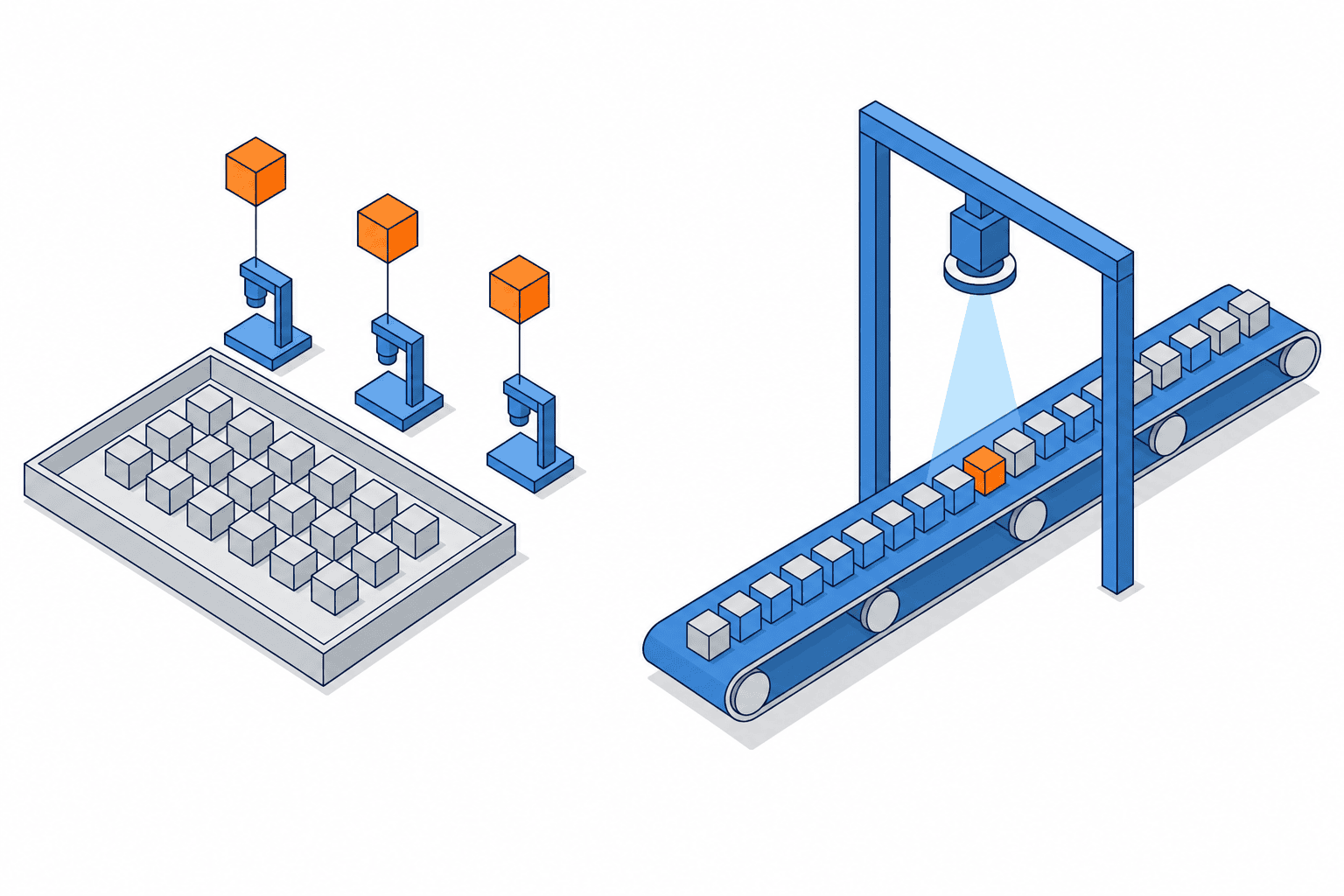
Sampling inspection draws a fixed number of items at random from a lot, inspects them, and accepts the lot as a whole if the number of nonconforming items found is at or below the acceptance number. The relevant international standard is ISO 2859-1, which covers sampling procedures for inspection by attributes and specifically the acceptance quality limit (AQL) indexed scheme. In Japan, JIS Z 9015-1 is specified in a form that conforms to ISO 2859-1.
The rationale for this approach is clear. Without inspecting every item, the quality level of the whole lot can be estimated statistically from the results of the extracted sample, which compresses inspection man-hours substantially. It can also be applied to characteristics that require destructive testing, where inspecting every item is physically impossible. There are sound reasons why factory inspection systems have been built on this foundation.
Normal, tightened and reduced — the 3 inspection modes
JIS Z 9015-1 and ISO 2859-1 define 3 levels of inspection severity: normal inspection, tightened inspection and reduced inspection. What matters is that these 3 are not fixed. The scheme is designed so that severity switches according to the recent record of lot acceptance. If lots are accepted continuously, the scheme moves to reduced inspection; if rejections continue, it moves to tightened inspection.
In other words, sampling inspection was created not as a static inspection rule but as a feedback mechanism whose severity moves with the performance of the process. Once that is understood, the conditions under which sampling inspection stops working also become visible. It is not unusual to find factories where the switching rules are never actually operated and the same sampling conditions have been used for years. That state differs from the operation the standard assumes.
What AQL guarantees and what it does not
This is the point most often misunderstood in discussions of sampling inspection. AQL is an indicator that expresses an accepted quality level, and the fact that a lot has been accepted does not mean that the lot contains no nonconforming items at all. What sampling inspection shows is that, judged from the sample results, the quality level of the lot has been assessed as acceptable against the level that was set.
Consequently, finding a defect in a lot that passed sampling inspection is, in itself, within the range that the standard anticipates. Even so, when a defect escapes, many shop floors explain it as inspection having been too lax. In a substantial number of cases the inspection was not lax at all; a structural property inherent to the sampling method simply became visible.
Without this distinction, countermeasures miss the target. Changing the sampling conditions to tightened inspection will reduce missed defects, but it will not bring them to zero. If the aim is to approach zero, the method itself has to change, which means a decision to move to full inspection. Put the other way round, a decision to continue with sampling inspection is equivalent to a decision to accept a certain level of escape risk.
The 3 preconditions that make sampling inspection valid
The standards themselves do not state this, but for a decision to adopt sampling inspection to be rational, several practical preconditions are needed. As a starting point for the switching decision, test the following 3 points against your own processes.
- Quality within the lot is broadly uniform, and the extracted sample is representative of the lot
- Defects occur sporadically rather than systematically across the whole lot
- The damage caused when a single defective item escapes is not extremely large relative to the cost of full inspection
If even one of these 3 has broken down, the case for continuing with sampling inspection is weak. The third in particular breaks down quietly when the application of the product changes or when the delivery destination changes. Even for the same component, the order of magnitude of the escape cost per item changes the moment a part that was supplied for general-purpose equipment is adopted as a safety component for an automobile.
Turning the difference between sampling and full inspection into decision-making language
The difference between sampling inspection and full inspection is often explained as a difference in the number of items inspected, but in an investment discussion that is not enough. What a decision needs is 3 axes: what can be guaranteed, how costs increase, and where the method fails.
| Perspective | Sampling inspection | Full inspection |
|---|---|---|
| Unit of judgement | Lot | Individual item |
| Governing document | ISO 2859-1 and JIS Z 9015-1 | Customer requirements or the company’s own in-house criteria |
| What can be guaranteed | That the quality level of the lot has been judged acceptable | The fact that every item has been judged against the inspection characteristics |
| How inspection cost grows | Broadly flat even as production volume rises | Increases in proportion to production volume |
| Main failure mode | Escape through missed defects | Variation in judgement criteria and overlooked defects |
| What remains as a record | Acceptance or rejection by lot | Judgement results for each individual item |
In this table, the row on how inspection cost grows and the row on what remains as a record are the ones that bear directly on the switching decision. They are worth taking in turn.
Cost grows in structurally different ways
The inspection man-hours for sampling inspection barely change even when production volume doubles. Sample size rises with lot size, but the rate of increase is gentle. Manual full inspection, by contrast, increases man-hours roughly in proportion to production volume. If output doubles, the number of inspectors has to double as well.
Because of this difference, any attempt to sustain manual full inspection through a production ramp-up will break down somewhere. In practice, before it visibly breaks down, other things happen first: inspection time is shortened, judgement criteria are relaxed, and the process effectively becomes sampling again, so that the records still say full inspection while the reality is something else. This is precisely why the factories that continue full inspection manually are the ones for which automation becomes urgent.
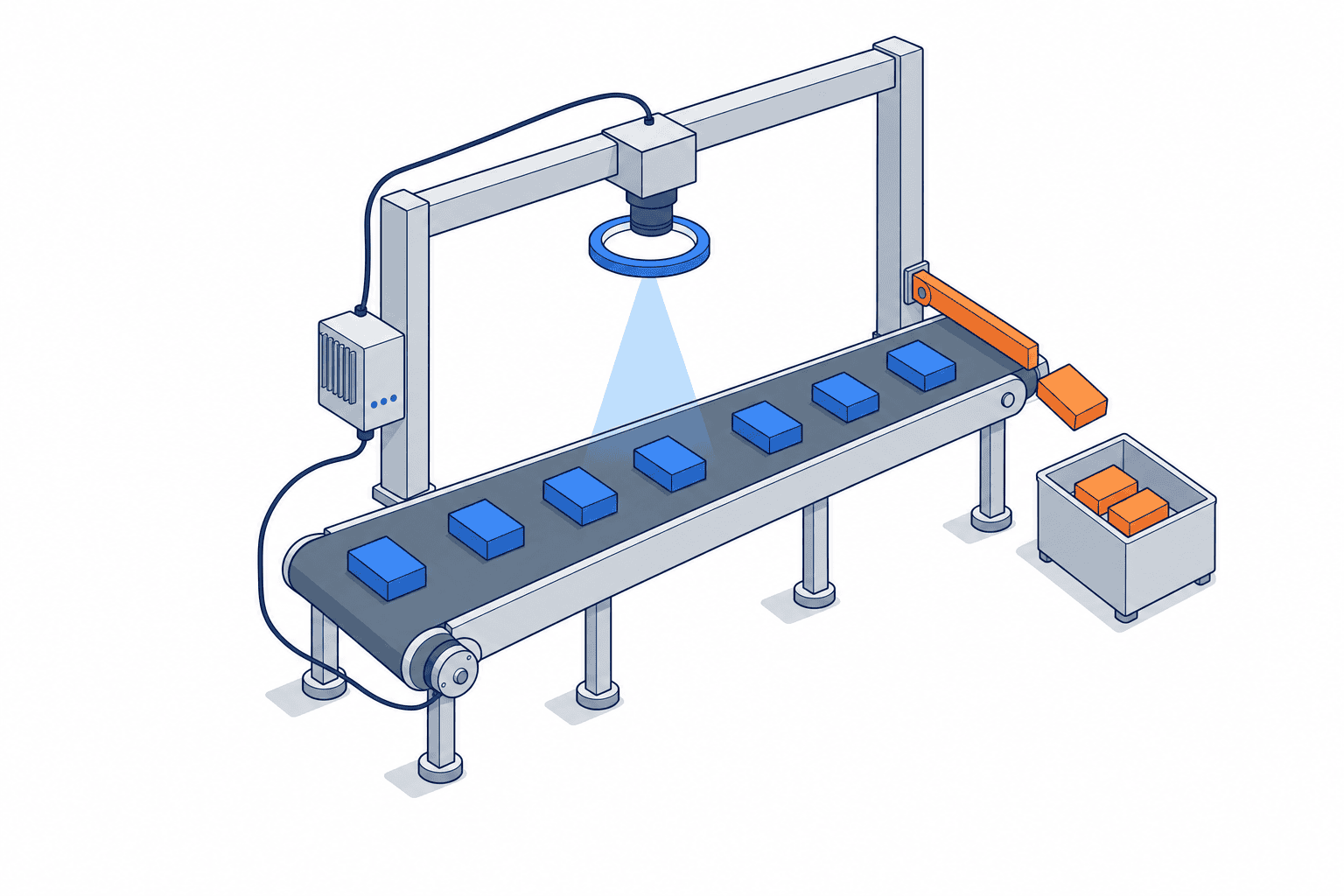
Automated full inspection severs that proportional relationship. Within the throughput capacity of the equipment, inspection cost barely rises as production volume increases. Investment discussions become easier to organise if full inspection automation is understood as having management significance less because inspection accuracy improves and more because the structure of how cost grows changes.
What remains as a record differs
The other difference is the granularity of the record. Sampling inspection leaves only acceptance or rejection at the lot level, whereas full inspection leaves a judgement result for each individual item. Once automated, this record accumulates as data automatically.
This difference shows its value when a quality enquiry arrives from a customer. Where only lot-level records exist, there is a limit to what can be said about the specific item that caused the problem. With item-level judgement records, the plant can show the judgement value at which that particular item passed. In factories with customers who impose strong traceability requirements, this point alone can become the direct motive for full inspection automation.
Areas where switching to full inspection becomes effectively mandatory
What complicates the decision is that in some cases whether to adopt full inspection is not determined by the plant’s own quality policy alone. In the following 2 contexts in particular, forces other than the internal profit-and-loss calculation are at work.
Automotive parts and Customer Specific Requirements under IATF 16949
Under IATF 16949, the quality management standard for the automotive industry, each vehicle manufacturer defines its own Customer Specific Requirements separately from the body of the standard itself. Suppliers must satisfy those customer documents in addition to the requirements of IATF 16949.
The practical implication is clear. Where the Customer Specific Requirements specify whether full inspection is to be carried out, it becomes necessary regardless of the internal cost-effectiveness discussion. For factories handling automotive parts, therefore, the first step before starting any break-even calculation is to re-read the Customer Specific Requirements for each customer and check whether they contain any description of the inspection method. If a requirement is confirmed there, the question shifts from whether to do it to how to achieve it.
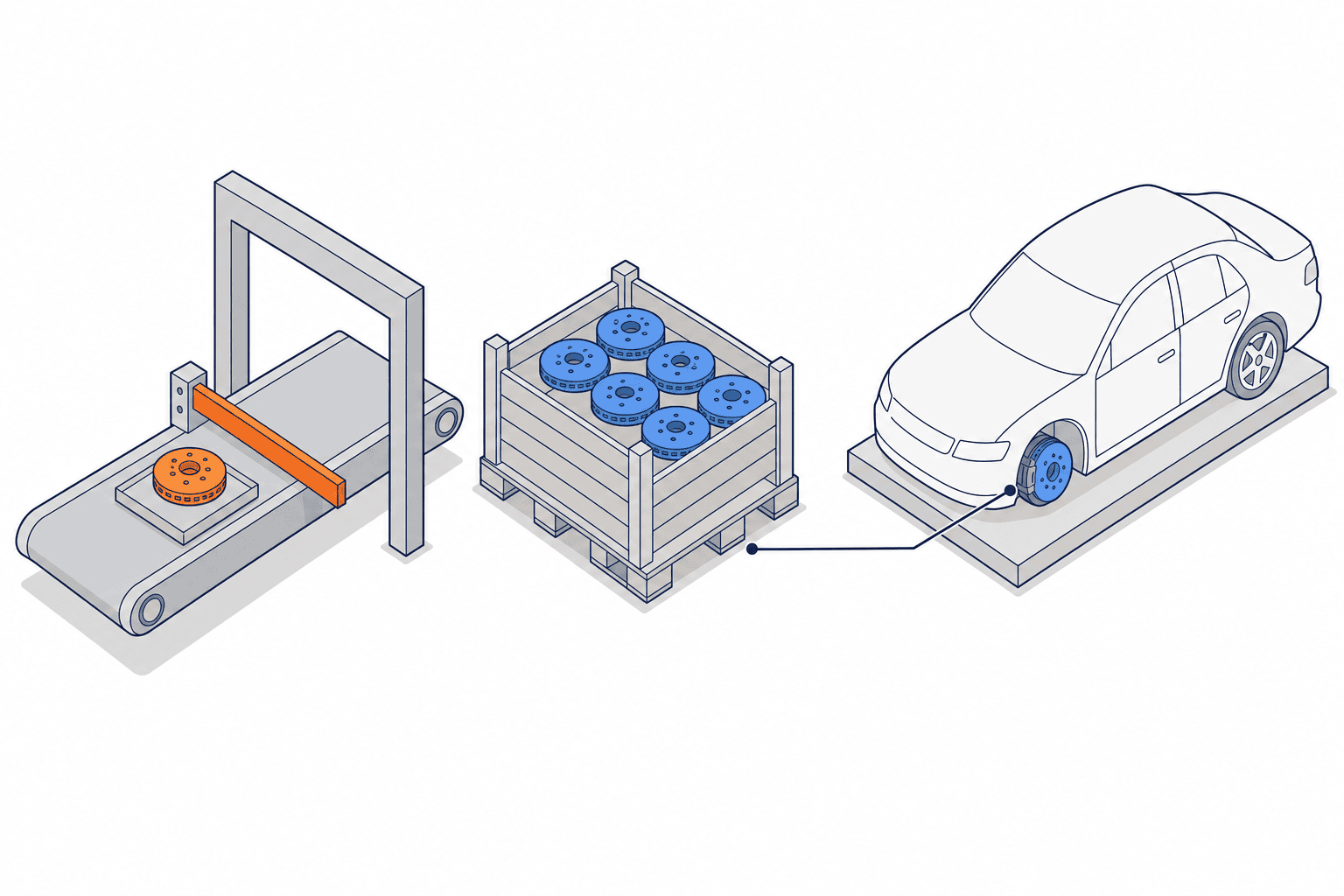
The escape of quality defects is regarded as a serious risk that, if it occurs repeatedly, can lead to product recalls, production stoppages and financial losses. For an automotive parts supplier, this type of risk carries a large loss per incident, and when it occurs the continuation of the business relationship itself can become an item for discussion. It is also an area where estimates of the cost of a missed defect escape tend to be too optimistic in break-even calculations.
The revision of the type designation system as contextual information
In Japan, the Ministry of Land, Infrastructure, Transport and Tourism has been advancing a revision of the type designation system for motor vehicles. The revision will newly oblige vehicle manufacturers and parts manufacturers to submit internal control reports and to carry out sampling from mass-production vehicles after type designation to confirm conformity with safety standards, known as mass-production conformity monitoring. The schedule set out for it is promulgation at the end of March 2026 and entry into force from April 2026. The purpose is to prevent fraud at the point of application for type designation.
What must be understood accurately here is that this is a revision concerning the procedures of a certification system called type designation, and that it does not regulate line inspection at individual factories. This revision does not oblige factories to carry out full inspection. Writing this point incorrectly in internal documents or capital expenditure requests creates a source of inconsistent explanations later, when responding to an audit.
That said, it does carry meaning as contextual information. It is a fact that, as type designation procedures tighten, momentum is building across the supply chain to re-examine whether inspection arrangements are appropriate. Allowing for the possibility that customers will more frequently ask for a rationale for the inspection method is a useful input when deciding the timing of a switch.
Products that affect human life or safety
More generally, full inspection is described as a method that inspects every product manufactured, and one that is particularly necessary for products affecting human life or safety. Automotive parts are the representative example. This criterion applies regardless of industry. Reasoning from where the product is ultimately used and what happens if it fails keeps the decision stable.
How to estimate the break-even point for full inspection automation
Apart from cases determined by customer requirements, the decision reduces to a break-even problem. What many factories stumble over here is the failure to assemble the 2 figures being compared correctly.
The cost items that make up the cost of a missed defect escape
The cost of a missed defect escape tends to be simplified into the cost of handling returns, but in reality it extends far more widely. Before consolidating it into a single figure for a capital expenditure request, try filling in each of the following cost items.
- The cost of sorting every item at the customer site or in a warehouse, and the travel expenses required for it
- Direct costs of returns, scrapping and remanufacture, plus the additional cost of expediting replacement production
- Costs of deviation permit procedures and special transport arrangements
- Administrative labour costs for responding to customer audits and preparing corrective action reports
- Deterioration in commercial terms and the loss of opportunities to win new business on the next model
The last item is often left out of estimates because it is hard to convert into a monetary figure. Yet in areas such as automotive parts, where relationships run over long periods, this item can account for the bulk of the real damage. If it cannot be quantified, the later discussion stays healthier if it is stated explicitly as a management consideration outside the monetary total.
The cost items on the automation investment side
The investment side is broken down in the same way. Judging on the equipment quotation alone leaves out commissioning and running costs.
- The equipment itself, meaning cameras, lighting, lenses, controllers and other constituent devices
- Conveyance mechanisms, jigs and modification work on the existing line
- Commissioning man-hours, meaning alignment of judgement criteria, threshold tuning and teaching work
- Running costs, covering maintenance, consumable parts, updates to judgement models and re-teaching
- The cost of redeploying and retraining inspection personnel
Identify the cost items that automation does not remove first
Break-even estimates most often reverse their conclusion when no distinction has been drawn between the cost items that automation removes and those it does not. Even with full inspection automated, the following items remain.
- Quality control department man-hours to maintain the inspection criteria themselves and update them when they change
- Man-hours for people to re-check over-detection, meaning good items judged as defective
- Man-hours for daily equipment checks and periodic confirmation that the measurement system remains valid
- Changeover and re-teaching when switching between product variants
The second item in particular has a large influence on estimates of headcount reduction. If the system is introduced with a high over-detection rate, a process in which people re-check the items the equipment rejected remains in place, and the number of inspectors does not fall as far as expected. This is the reason why any evaluation of equipment performance must always confirm the over-detection rate alongside the missed defect rate. Booking a cost layer that carries no offsetting benefit on the investment side alone and drawing a conclusion from it leads to numbers that do not add up in real operation.
How to read the payback periods that are reported
In the field of AI image inspection, reports can be found stating that operating costs were compressed by 30 to 50% through reductions in inspection personnel and unattended night-time operation, together with explanations that the initial investment can in many cases be recovered in 1 to 2 years. These are worth referring to, but they need careful handling.
They are figures presented within articles introducing industry trends, not the results of statistical surveys with a stated population and calculation method. Carrying them into a capital expenditure request as an industry average is therefore not appropriate. They should be presented only as reports that exist, while the basis for the decision should be figures recalculated with your own production volume, current number of inspectors and assumed over-detection rate. Payback period in particular depends heavily on production volume, so the assumptions change considerably on a high-mix low-volume line.
Do not get the order of the decision wrong
There is an order to follow before entering the break-even calculation. Proceeding in the following sequence reduces wasted quotation requests.
- Confirm whether the Customer Specific Requirements of each customer specify an inspection method
- Become able to explain, in the language of the standard, how much statistical room for escape remains under the current sampling conditions
- For escape incidents over the past few years, compile the actual damage in line with the cost items above
- List the defect modes of the target process and estimate the share of them that image or dimensional inspection can detect
- Only then obtain rough equipment quotations and calculate the payback period
Skipping step 4 leads to the situation where the equipment has been installed and yet defects continue to escape. If the main cause is a defect mode that cannot be detected, escapes will not decrease even after switching to full inspection.
The technical factors that made the switch from sampling inspection possible
The main reason full inspection was once impractical was that manual inspection could not keep up with line speed. That constraint has been changing in recent years.
Synchronising with line speed through image processing and edge AI
With edge AI devices, full inspection synchronised with line speed becomes technically feasible. Cases are reported to be increasing in which lines previously run with sampling inspection are switched to full inspection to reduce the risk of defect escape. The background is that completing the judgement processing on devices at the shop floor avoids communication latency and makes it possible to return a judgement within the takt time.
However, being technically feasible and working on your own line are 2 different things. How much time can be allocated to imaging and judgement within the takt time, how stable the orientation of the item is during conveyance, and whether lighting conditions vary with season or time of day are all conditions that need to be confirmed individually. This part cannot be settled on paper and requires verification with actual samples brought to a trial.
The fall in implementation costs
The cost of implementing AI image inspection has fallen in recent years, and cloud-based services costing on the order of several tens of thousands of yen per month have appeared, which is said to have made adoption easier for small and medium-sized manufacturers. In other words, options that can be started in stages have increased.
This change also alters the nature of the switching decision. Previously it was a single large investment decision, so certainty was demanded and the decision consequently tended to be deferred. If it can be started in stages, a plant can switch a single process to full inspection first, measure the over-detection rate and the actual headcount reduction, and only then decide on horizontal deployment. The concrete implementation steps and cost thinking for AI visual inspection are set out separately in our guide to introducing AI visual inspection.
Choosing the equipment is a separate problem from the switching decision
Procurement-side questions such as which manufacturer’s equipment to select, how to write the requirement specification, and how to design the factory acceptance test (FAT) and the site acceptance test (SAT) should be considered separately from the decision on whether to switch. Starting a quotation comparison before the decision is settled means deciding on price alone, with no agreed axis of comparison. Our thinking on how to run the procurement stage is summarised in our guide to selecting inspection equipment vendors.
Problems that switching to full inspection does not solve
The problems that factories face after deciding to switch are fairly consistent. Understanding them in advance makes the estimate of return on investment more realistic.
If inspection criteria are not put into words, they cannot be automated
Human inspection contains a great many judgements that have never been written down. This scratch is acceptable, this stain is not, this position is fine. These judgements sit in the heads of experienced inspectors. To automate, they have to be expressed as thresholds.
This work cannot be delegated to the equipment manufacturer; it has to be led by the plant’s own quality control department. And in many cases, the process reveals that the inspection criteria differed between departments and between individuals all along. It is safer to assume that a substantial share of the real man-hours of an automation project will be consumed here.
Over-detection and missed defects are in a trade-off relationship
Tightening the judgement threshold reduces missed defects but increases over-detection. Loosening it does the reverse. Switching to full inspection does not make that relationship disappear. How far each type of error is tolerated is a management decision, taken from the application of the product and the requirements of the customer.
The dangerous part is that this setting drifts quietly during operation. When over-detection is high and the shop floor is struggling, pressure builds to loosen the threshold. Who is authorised to change a threshold, and how the change history is retained, need to be decided at the point of implementation.
Typical patterns in which defects escape despite full inspection
Full inspection is not a mechanism that brings escapes to zero. Escapes can still occur in the following forms.
- The inspection characteristics do not cover the actual defect modes, so a defect outside the scope of inspection passes through
- The defect arises in a process after inspection, such as packing or conveyance
- Thresholds are loosened during operation, so that the records still say full inspection while real detection capability has fallen
- An abnormality or drift in the inspection equipment itself goes unnoticed and it continues to issue incorrect judgements
As a countermeasure for the 4th pattern, the inspection equipment itself needs daily checks and a mechanism for periodically confirming that the measurement system remains valid. With manual inspection, an operator may notice that something feels wrong; equipment will go on making incorrect judgements in silence. Full inspection automation is also an exercise in redesigning the inspection process itself as something to be managed.
Processes where sampling inspection should remain
Switching to full inspection does not make sampling inspection unnecessary. Characteristics that require destructive testing, characteristics that take a long time to measure, and characteristics close to sensory evaluation that equipment cannot replace will continue to be run on a sampling basis. The switch fits reality better when it is understood not as all or nothing, but as a design in which the method is selected process by process.
Additional considerations at sites in Thailand and ASEAN
There are several areas at overseas sites that cannot be judged within the same framework used in Japan.
The assumptions about inspector labour costs are moving
Whether manual full inspection can be kept as an option depends on the level of labour costs. Thailand’s minimum wage underwent a nationwide revision in January 2025, and in July 2025 a unified revision to 400 baht per day was implemented for Bangkok. In 2026, with inflation also a factor, rates have continued to be held, but a nationwide unification at 400 baht within 2026 is widely regarded as likely. Wage increase rates at Japanese-owned companies are also on a rising trend, at 3.8% in 2023, 4.58% in 2024 and a projected 4.64% in 2025.
Changes at this level alone do not determine whether automation is justified, but if an estimate built on labour costs from 5 years ago is still being reused, it needs updating. When placing a manual full inspection option in the comparison in particular, restate both the headcount and the wage level at current values.
What customer audits ask about is the record of the decision
In customer audits at overseas plants, what is questioned is sometimes less the inspection method itself than the record of why that method was chosen. Even where sampling inspection continues, the explanation holds up if the plant retains the rationale for the sampling conditions, evidence that the switching of inspection severity is actually applied, and a history of reviews carried out when escape incidents occurred. Conversely, even a plant that has switched to full inspection will attract a finding if the rationale for the threshold settings has not been retained.
Whether a maintenance structure can be built locally
Who takes on maintenance after the equipment is installed is a weightier question than it is in Japan. If updates to judgement models, replacement of lighting components and teaching for new product variants cannot be completed locally, the line stops. Before entering into performance comparisons between machines, we recommend confirming the local support structure and drawing a clear line around what the plant can handle in-house.
The order in which to advance the switching decision
The content so far can be summarised as a practical sequence.
- Check the Customer Specific Requirements for each customer and identify whether any inspection method is specified
- Inspect whether the current sampling conditions and the switching of inspection severity are operated as the standard requires
- For escape incidents over the past few years, compile the damage by cost item, from sorting costs through to lost opportunity
- List the defect modes of the target process and estimate the range detectable by image or dimensional inspection
- Confirm whether the detectable range covers the main causes of escape, and if it does not, prioritise process improvement instead
- Select 1 process to go first, measure the over-detection rate and the headcount reduction, and then decide on horizontal deployment
Proceeding in this order means that, by the time the comparison of equipment begins, what needs to be detected and how much investment can be justified are already settled as figures.
Frequently asked questions
Which should we choose, full inspection or sampling inspection?
There is no single correct answer; the decision comes down to 3 points. First, whether the customer’s Customer Specific Requirements specify an inspection method. Where they do, that takes priority. Second, how large the damage from a single defective item escaping is relative to the cost of full inspection. For products affecting human life or safety, this ratio becomes extreme. Third, whether the defect modes in question are detectable by equipment. If they are not, switching to full inspection will not stop the escapes. Working through these 3 points in order settles the conclusion naturally in most cases.
What is the difference between sampling inspection and full inspection in one sentence?
What they guarantee is different. Sampling inspection is a method that shows the quality level of a lot has been judged acceptable; it does not show that the lot contains no nonconforming items at all. Full inspection leaves a record of the fact that every item has been judged against the inspection characteristics. From this difference follow the differences in record granularity and in how cost grows. Inspection man-hours for sampling inspection stay broadly flat as production volume rises, whereas manual full inspection increases in proportion to volume.
Can we switch to full inspection just by installing visual inspection equipment?
Installing equipment is a necessary condition, not a sufficient one. For the switch to work, 4 things must be in place: the defect modes concerned must be detectable in images, imaging and judgement must fit within the takt time, judgement criteria must be expressed in words as thresholds, and headcount must fall even after including the process for re-checking over-detection. The third in particular is work led by the plant’s own quality control department and cannot be delegated to the equipment manufacturer. In pre-implementation verification, confirm both the detection rate and the over-detection rate using actual samples.
Once we switch to full inspection, do sampling inspection records become unnecessary?
They do not. Characteristics requiring destructive testing, and characteristics that equipment cannot replace, continue to be run on a sampling basis. It is also common practice to retain manual sampling re-inspection in order to confirm that the inspection equipment is judging correctly. Full inspection automation should be understood not as an effort to abolish sampling inspection, but as a shift to a design in which the method is selected process by process.
Summary
When full inspection automation is under consideration, the first question is not equipment selection but confirmation of what the sampling inspection currently in use actually guarantees. Sampling inspection, based on ISO 2859-1 and JIS Z 9015-1, is a method for judging whether the quality level of a lot is acceptable, and it is designed so that normal, tightened and reduced inspection switch according to performance. That an accepted lot may contain nonconforming items is a structural property of the method.
The switching decision is settled along 3 routes. Where the inspection method is specified in Customer Specific Requirements under IATF 16949, as with automotive parts, the decision is made somewhere other than the internal profit-and-loss calculation. In Japan, a revision to the type designation system for motor vehicles obliging the submission of internal control reports and mass-production conformity monitoring follows a schedule of promulgation at the end of March 2026 and entry into force from April 2026, but this is a revision to the procedures of a certification system and does not oblige factories to carry out full inspection. Outside those areas, the axis of the decision is the break-even point between the cost of a missed defect escape and the automation investment.
On the technical side, edge AI has made full inspection synchronised with line speed possible, and cloud services costing on the order of several tens of thousands of yen per month have lowered the barrier to adoption. There are reports of operating costs being compressed by 30 to 50% and of initial investment being recovered in 1 to 2 years in many cases, but these are figures introduced in industry-trend articles, so base the decision on figures recalculated with your own production volume and over-detection rate. And the challenges of putting inspection criteria into words, the trade-off between over-detection and missed defects, change control over thresholds, and checks on the equipment itself all remain after automation.
Whether your processes should continue with sampling inspection or switch to full inspection, and which defect modes equipment can detect, are difficult to judge without looking at the actual inspection criteria and escape incidents. We are happy to help simply with organising information at the review stage, or with reviewing your current sampling conditions, so please tell us about your present situation through our contact page.
References
- JIS Z 9015-1 Sampling procedures for inspection by attributes — Text of the Japanese Industrial Standard that conforms to ISO 2859-1, specifying AQL indexed sampling inspection procedures
- Explanation of sampling inspection methods – Yachiyo Solutions — Basic thinking behind sampling inspection, the 3 severity levels of normal, tightened and reduced inspection, and switching according to the recent record of lot acceptance
- Explanation of full inspection – Smart F — Full inspection as a method of inspecting every product manufactured, particularly necessary for products affecting human life or safety
- Customer Specific Requirements – IATF Global Oversight — List and positioning of the Customer Specific Requirements defined by each vehicle manufacturer under IATF 16949
- How to meet IATF 16949 requirements for automotive suppliers – Net-Inspect — The need for suppliers to satisfy Customer Specific Requirements in addition to the standard itself, and the treatment of quality defect escapes as a serious risk leading to product recalls, production stoppages and financial losses
- Review of the type designation system for motor vehicles – Japan Auto-Body Industries Association — The revision obliging submission of internal control reports and mass-production conformity monitoring, promulgated at the end of March 2026 and scheduled to take effect from April 2026
- Comparison of AI visual inspection services for manufacturing – AI Market — Industry trends on falling implementation costs for AI image inspection, the appearance of cloud services costing on the order of several tens of thousands of yen per month, and full inspection synchronised with line speed using edge AI
- Explanation of AI visual inspection in manufacturing – koromo — Aggregated figures from industry-trend articles for compression of operating costs by 30 to 50% through reduced inspection personnel and unattended night-time operation, and payback of initial investment in 1 to 2 years
- Minimum wages and wage trends in Thailand – Kuno Certified Public Accountants Office — The nationwide minimum wage revision in January 2025, the unification to 400 baht per day in Bangkok in July 2025, and trends in wage increase rates at Japanese-owned companies
- Commentary on legal and labour matters in Thailand – Tilleke and Gibbins — Commentary on trends in minimum wage revisions in Thailand


