


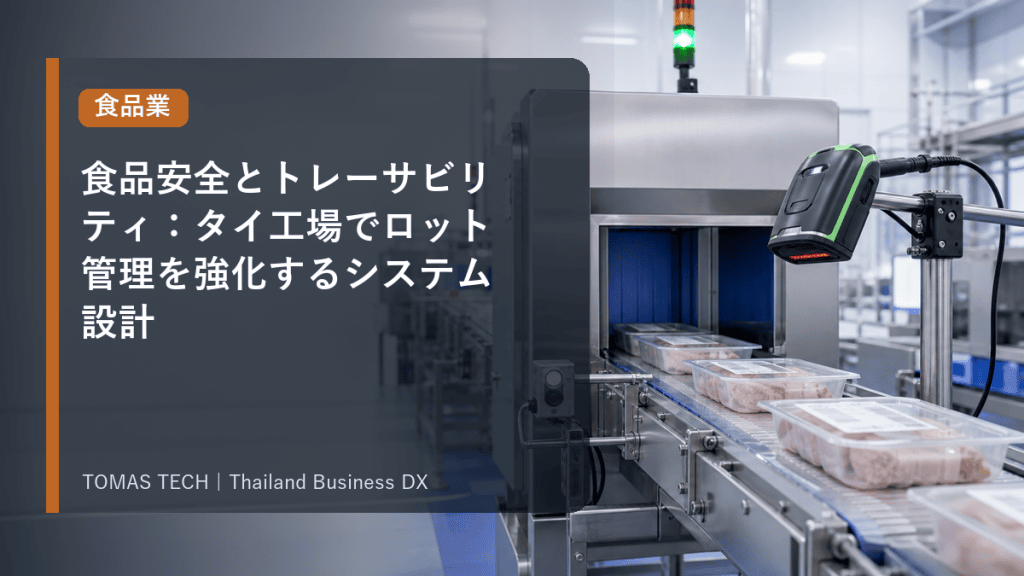
When a complaint or recall occurs, fragmented records across raw materials, production, inspection, and shipping slow down your response. As Thailand’s economy heads toward slower growth in 2026, manufacturing, logistics, and consumption sites alike face rising costs and management burdens that revenue growth alone can no longer absorb. At the same time, BOI is encouraging investment in automation, AI, data analytics, enterprise management IT, and Industry 4.0—creating a landscape where some situations call for holding back investment while others call for pressing forward.
Lot management is not just for audit readiness; it is a management foundation that protects customer trust and accelerates root-cause investigation. What matters is not DX as a buzzword, but DX that connects to shop-floor numbers and management decisions. The challenge TOMAS TECH must address for Japanese-affiliated companies is not simply installing a system, but standardizing operations at Thai sites, reducing dependence on individuals, and creating an investment return that can be explained even to Japanese headquarters.
1. Why this theme matters now
In Thailand in 2026, while overall economic growth slows, structural challenges remain—labor costs, energy, logistics, quality response, and a shortage of managers. In a strong economy, some waste can be absorbed by revenue, but when growth is sluggish, small inefficiencies on the floor directly erode profit margins.
As a result, investment decisions are no longer as simple as “proceed because the economy is good” or “stop because the economy is bad.” What should be stopped are large investments with vague objectives. What should be advanced are investments that move concrete numbers—time saved, inventory discrepancies, defects, downtime, missed billing, waste, and idle time.
2. Problems that commonly arise on the floor
When a complaint or recall occurs, fragmented records across raw materials, production, inspection, and shipping slow down your response. What makes this problem so troublesome is that it does not stay contained on the shop floor. If floor records are delayed, the management department’s aggregation is delayed; if the management department’s numbers are delayed, management decisions are delayed as well. Furthermore, when explaining to Japanese headquarters, the reality unfolding on the ground is hard to convey with a sense of urgency, making investment approvals harder to obtain.
At Thai sites, information in Japanese, Thai, and English is intermingled, and paper, Excel, existing systems, chat, and email tend to be fragmented. This fragmentation is precisely the first target for DX. Before expensive equipment or large-scale systems, you first need to organize the flow of information.
3. Key points to consider in investment decisions
There are three key points to consider for this theme:
- Connect lot IDs from raw-material receipt through to shipping
- Make it possible to trace inspection records and work records on the same screen
- Turn complaint-response investigation time into a KPI
These are not merely functional requirements. They are management requirements for explaining the return on investment. How many hours can be saved per month? Which errors will decrease? Which risks can be detected sooner? Can it be recouped within three years? An investment that can answer these questions is worth advancing even when the economy is sluggish.
4. Implementation steps for starting small
Step 1: Narrow the target operation to one
Aiming for a company-wide rollout from the start causes requirements to balloon and stall. First, narrow the scope to where results are easy to see—one process, one warehouse, one store, one form, one meeting.
Step 2: Do not increase the input burden on the floor
A major reason DX fails is that it increases the work on the floor. You need to choose input methods that feel natural to the floor by using QR codes, barcodes, sensors, voice input, and integration with existing Excel.
Step 3: Build it into meetings and KPIs
Data goes unused if there is no place to review it. Build it into weekly meetings, morning briefings, quality meetings, sales meetings, and monthly reports, and decide who judges what.
Step 4: Record the results in numbers
Record time saved, defect reduction, shorter idle time, less waste, and fewer missed billings. This becomes the material for your next investment proposal.
5. How to think about BOI and incentive programs
BOI places importance on investments that contribute to upgrading Thailand’s industry—automation, robotics, AI, big-data analytics, IT for enterprise management, and cloud utilization. Whether a given project actually qualifies requires individual confirmation, but it is at least worth keeping BOI’s direction in mind from the early stages of an investment plan.
What matters is framing it not as a mere equipment purchase or system installation, but as an investment plan that includes productivity improvement, quality improvement, labor savings, data utilization, and sustainability. This is effective not only for BOI but also for explaining to Japanese headquarters.
6. How TOMAS TECH can help
TOMAS TECH builds lot-tracking and quality-evidence mechanisms in stages while making use of existing forms. TOMAS TECH’s strength lies in its ability to consider, as a single flow, the on-the-ground reality of Japanese-affiliated companies in Thailand, explanation to Japanese headquarters, system implementation, AI utilization, and accounting DX.
Simply building what is requested, as in contract development, can end up merely transferring the floor’s complexity into the system. What is needed going forward is support premised on standardization, non-customization, phased implementation, and operational establishment. Build small, use it on the floor, measure the results, and then expand horizontally to the next area. This approach is the most realistic for Thai sites.
Summary
The theme of “Food Safety and Traceability: System Design to Strengthen Lot Management at Thai Factories” is not merely a story about IT adoption. Amid an environment of slowing growth, rising costs, talent shortages, and heightened quality demands, it is a management theme about how Thai sites protect their profit margins and shop-floor capabilities.
What is needed in 2026 is not flashy DX, but DX that changes the numbers on the floor. Separating the investments to stop from those to advance, and accumulating small improvements that can be discussed on a three-year payback basis, is the most solid growth strategy for Japanese-affiliated companies in Thailand.
References
- World Bank: Thailand Economic Monitor February 2026
- S&P Global Thailand Manufacturing PMI
- Thailand BOI Investment Promotion Guide 2025
- PwC Thailand: Corporate tax credits and incentives
Related Articles
- Yield Improvement DX for Food Factories: The Data Japanese Manufacturers in Thailand Should Look At First
- Automation to Address Labor Shortages in Thai Food Factories: Investment Decisions Starting with Packaging, Inspection, and Material Handling
- BOI Incentives for the Food Industry: How Far Do Automation, AI, and Data Analytics Qualify?
- AI-Powered Daily Reports for Food Factories: How to Detect Early Signs of Anomalies, Losses, and Quality Complaints


