


If you are planning AI coagulant dosing for factory wastewater, begin with the operating decision, not with a promise that an algorithm will drive a pump. Define when influent flow, turbidity and pH are measured, how jar tests inform the recommendation, who approves a change and what the existing controls will reject. This guide is for Thai factory teams procuring decision support for coagulation. It covers data, human approval, PLC/SCADA boundaries, the request for proposal (RFP), factory acceptance testing (FAT) and site acceptance testing (SAT). For the wider treatment-control architecture, see our factory water and wastewater automation guide. For instrument choice, see industrial turbidity meter selection. The question here is how reliable measurements become a safe dose decision.
When AI-assisted coagulant dosing is useful
Two factories with similar average flow can face very different influent conditions. Product changeovers, cleaning, batch discharge, rainwater ingress and raw-material changes alter the load. A constant pump speed can therefore underfeed at one moment and overfeed at another. Yet an increase in turbidity does not automatically mean a proportional increase in chemical. pH, alkalinity, particle properties, coagulant type, mixing energy, residence time and downstream clarification all matter. The US EPA’s suspended-solids process manual emphasizes laboratory experiments to establish and maintain coagulation conditions and discusses the jar test. It is a process-design reference, not a Thai effluent standard.
The useful role for AI is to present a consistent, traceable dose recommendation based on current influent and previous tests and operations. An operator should see the reason, data quality and applicable operating range, then approve or reject it. A proposal to replace existing PLC or SCADA interlocks with AI deserves separate risk evaluation. Manual operation, fixed-rate dosing and existing flow-proportional control should remain documented fallback paths.
Define the process boundary and success criteria first
The phrase “optimize dosing” is too broad for procurement. Locate the coagulant injection point, rapid mixer, flocculation tank, clarifier and final measurement point on the piping and instrumentation diagram. If the plant uses both a primary coagulant and a polymer aid, specify which is in scope and how interactions are handled. Where pH adjustment chemicals are used, keep their control and the coagulant recommendation within distinct safety boundaries. Poor mixing cannot be corrected by a prediction model alone; rectify a mechanical or hydraulic constraint before promising an AI benefit.
Success must include effluent quality and required laboratory measurements, compliance with site-specific conditions, sludge amount and dewaterability, pump stability and operator workload, as well as chemical use. “Less chemical, unstable discharge” is not success. Compare like influent conditions and record production level, season and raw-material changes. Agree on the order of priorities and measurement methods before signing the contract. A verifiable site trial is more credible than a universal savings claim.
Confirm the actual permit and legal obligations
Thailand’s Department of Industrial Works (DIW) lists factory environmental rules and wastewater notices under the Factory Act. The list itself does not determine the limit or monitoring obligation for every facility. The industry, location, receiving water, individual permit, industrial estate requirements and current notices must be reviewed by the site’s environmental team. Put the resulting site control values in the RFP. Do not let an AI-generated “typical limit” set a PLC parameter. Obtain control values from approved permits and procedures, record changes and retain human accountability for compliance.
Prepare flow, turbidity and pH as trustworthy inputs
For influent flow, examine instantaneous and totalized values alongside equalization-tank level and pump state. During batch discharge, the water measured upstream may reach the dosing point later. Check pipe volume, tank residence and sampling position, and align timestamps. If training data are misaligned, a valid dose action can be paired with the wrong influent condition and produce a misleading correlation.
Influent turbidity is a proxy for particles, not a measure of every contaminant. Color, oil, dissolved constituents, particle size and temperature may differ even at the same turbidity. The EPA manual conditions the correlation of residual solids with turbidity on solids character not varying widely. Record the sensor location, cleaning and calibration, range exceedance, bubbles and fouling. Flag unreliable readings and allow the system to withhold a recommendation. The linked turbidity-meter guide addresses the instrument and installation decision itself.
For pH, store calibration date and measurement location, including whether the tag is before or after a pH-adjustment point. Give those tags distinct names. Flow, turbidity and pH are still insufficient if chemical concentration, tank changeover, pump stroke, suction blockage or meter failure are unknown. Specify how chemical inventory, product concentration and pump calibration are maintained. A pump setpoint is not proof of actual injected mass. Connect stroke, discharge conditions and concentration to measured feed verification.

Make a data dictionary, not only a tag list
For every signal, document equipment, physical location, unit, acquisition interval, missing-value representation, calibration owner and abnormal-value behavior. Separate raw readings, corrected values and laboratory entries. Preserve both the raw jar-test record and the electronic interpretation. A reviewer must be able to reconstruct which instrument, chemical and experiment supported a past recommendation. That traceability is the minimum quality requirement for model validation.
Put jar tests into the learning and operating loop
A jar test divides site water into containers and compares mixing, coagulation and settling under different chemical conditions. The EPA manual describes its role in simulating a full-scale process and in testing dose and pH candidates. Its example mixing durations are not universal instructions for Thai factories. An engineer should approve a local procedure reflecting the plant’s mixer and residence time. Retest when influent changes materially, a chemical changes, or recommendations diverge from results.
Record sampling time and point, flow, turbidity, pH, temperature, chemical name and lot, product concentration, laboratory dilution, dose in each jar, mixing conditions, settled turbidity and visible floc. Do not select solely the lowest chemical quantity. Include treated-water quality, sludge and operational margin when an operator chooses a candidate. Keeping only one “correct dose” column in the AI database while the original tests stay in a notebook makes later explanation impossible.
Distinguish the setting adopted by the operator, actual delivered dose and downstream result as separate training labels. A rejection made for safety is not automatically a model error: record the reason. Equipment faults, chemical changes, unusual discharges and sensor cleaning are separate events. If good data are sparse, begin with jar-test guidance and simple rules, then compare more complex models when sufficiently varied operating data exist.
Design a recommendation screen operators can approve
Show the proposed setting, current setting, valid influent range, main supporting inputs, data freshness and any limiting constraint together. Before approval, display chemical, concentration, pump train, target line and magnitude of the change. Store approvals, rejections and holds with reasons so the next shift can follow the decision. Model explainability is not only a technical score. Translate it into operating statements such as “within the latest jar-test envelope” or “hold because pH data are stale.”
Start with display-only comparison against existing practice. Record why recommendations differ. In the next stage, pass only approved settings through the established SCADA route. If fully automatic writing is later considered, preserve emergency stop, low tank level, pump fault, bad-sensor, lost-communication and range checks in the PLC. Rejection of the AI suggestion must leave the treatment plant in a documented safe mode. This is a responsibility boundary, not merely a user-interface preference.
The NIST AI Risk Management Framework describes continuous risk management and clear roles for human oversight throughout an AI system’s life. It is not a wastewater permit, but it is useful when specifying ownership, change approval, performance monitoring and recovery. Record each model version, training period, validation, applicability range and approver. Provide a tested path back to a prior version.

Keep the PLC and SCADA safety boundary intact
Begin by reading monitoring data and placing recommendations on a separate approval screen. If PLC writes are required, restrict them to approved tags and ranges, and let SCADA/PLC independently check operating mode, bounds and rate of change. Test that an extreme value arriving after a calculation or communication fault is rejected. Mechanical pump capacity, chemical-handling procedures and emergency-stop circuits take priority over digital recommendations. Adapt the design to the site’s equipment risk assessment.
Watch the units. A model may output coagulant mass per volume while the PLC accepts a pump stroke percentage. Convert using influent flow, product concentration, density and a verified pump curve. Unit confusion may be more consequential than a small prediction error. Test a product concentration change on actual equipment. Do not hold a high previous recommendation indefinitely after input loss; define validity time and fallback mode.
Include network separation, access rights, logging retention, clock synchronization and backup in the RFP. Approve remote maintenance under the factory’s IT/OT policy. Ask vendors to show what processing remains on site, what data leave it, whether records are anonymized and where they are stored. A generic cloud dashboard connected without that map is difficult to troubleshoot or audit.
Evaluate the model under site conditions
A published study predicts coagulant dose for coal-laden runoff at a coal port and examines explainable machine learning. Its reported accuracy belongs to that particular water, plant and dataset. It cannot establish a performance guarantee for an electronics, food or metalworking factory. The transferable lesson is to ask whether the relationship among influent, target effluent quality and proposed dose can be explained and checked at the target site.
Separate validation periods rather than randomly mixing all historical records. Test across seasonal and raw-material changes and on batches not used for training. Include high and low flow, abrupt turbidity shifts, pH change, missing sensors and chemical concentration changes. A low average error cannot excuse an unsafe recommendation during an uncommon high-load event. Correctly refusing to recommend outside a validated range is itself a useful capability.
Compare against existing manual decisions, flow-proportional control and a simple rule if relevant. Measure chemical consumption together with downstream water quality. Align influent and effluent data for hydraulic delay; otherwise the comparison joins different water parcels. Log operator interventions. Freeze data exclusion rules before the trial, rather than changing them after results are seen.
What to put in the RFP
Attach the process boundary: wastewater types, injection point, tanks, pumps, instruments, PLC/SCADA make and communications, available history, current operating procedure and site control limits. Ask the vendor which missing or invalid inputs stop a recommendation, how retraining is governed and how an operator approves it. If instruments need installation or relocation, price construction, shutdown, commissioning and maintenance separately.
Functional requirements should cover data-quality flags, jar-test records, recommendation rationale, approval history, bounds and rate limits, manual recovery, model versions, audit logs and appropriate local-language screens. Nonfunctional requirements include clock sync, missing-data and communication-loss behavior, cybersecurity, backup, support response and training. Deliverables must include the tag list, data dictionary, screen design and write-permission matrix. A model file alone is not an operable system.
Separate the proof-of-concept period and required data from site works, sampling and laboratory responsibilities, annual support and model-update fees. For an investment case, include laboratory work, labor, sludge treatment and downtime exposure alongside chemical cost. Benefits remain estimates until tested with the site’s wastewater. Contract for defect correction and retesting if FAT or SAT fails, data handover and export at contract end.
Questions worth asking vendors
There is no universal minimum training dataset. Ask a supplier to assess the diversity of historical conditions and the density of jar-test records, not only the number of rows. Ask what the operator sees when inputs are unreliable; how chemical change triggers revalidation; which party owns recommendation calculation versus PLC limits; and how rejection reasons are used and audited. Require a missing-sensor and communications-failure demo, not just a normal dashboard.
Five checks when comparing bids
First, distinguish software from field instrument checks and pipe modifications. If an existing turbidity probe loses data during cleaning, a bid that hides the gap by imputation is not equivalent to one that improves the maintenance procedure. Second, trace every approved value from the screen to the exact PLC tag and unit. A line item called “interface” does not identify who validates a concentration-to-pump conversion at the site.
Third, put responsibility for proposing, approving and rolling back a model update into the contract. Fourth, confirm the format, frequency and end-of-contract handover for source data and original jar-test worksheets. Fifth, check whether training reaches night-shift operators, maintenance and environmental staff, as well as day-shift engineers. Compare the ability to sustain safe operation, not only the predicted model accuracy.
Decision gates from a small pilot to production
In the first pilot stage, do not write to the PLC. Test data collection and time alignment, jar-test entry and on-screen recommendations. Passing criteria might require continuous collection of mandatory tags, visible missing and abnormal values, traceability from original worksheets to each recommendation, and refusal to recommend outside the tested water-quality range. In the next stage, collect operators’ reasons for accepting or rejecting daily suggestions and compare previous operation with treatment results. Investigate large mismatches individually rather than relying only on average agreement.
Before enabling production setpoints, require the site risk assessment, restricted write tags, PLC bounds, manual recovery procedure and operator training. If the pilot has not encountered a chemical change or unusual discharge, automatic use in those conditions can remain disallowed, even after the planned evaluation period ends. Define three states for each process: usable, display-only and recommendations suspended. Document the condition that moves the process between states. An end date alone must not unlock an untested function.
Apply the same gate to later improvements. A new instrument should not become an input until its calibration, time synchronization, missing-data behavior and relationship to existing tags have been checked. On another line, a similarly named dosing pump may have different capacity, concentration and pipe delay. Prepare that line’s instrumentation diagram and test record before copying a setting to equipment. Written gates in the RFP and acceptance plan let the supplier and factory decide progress against the same evidence.
Site records and owners to prepare before ordering
Missing site records often become schedule delays. Compare the latest piping and instrumentation diagram with the physical plant, and mark unused instruments, temporary pipework and relocated injection points. Put flow, turbidity and pH measurement locations, sample points and chemical injection on the same drawing. Items that look close on paper may have a long delay through an equalization tank. Identify product changeovers, cleaning and unusual discharges in the operating log, then connect them to readings and samples. Show data gaps openly so a supplier can scope a realistic trial.
Assign more than a maintenance owner. The treatment supervisor explains chemical and water-quality decisions; environmental staff check permits and sampling; instrumentation staff own sensor and pump calibration; IT staff check network and permissions; procurement checks that deliverables and acceptance criteria match the price and contract. Decide who can approve a recommendation on both day and night shifts. Absence of the usual approver must not silently count as approval.
When providing data, link instrument calibration, chemical purchase specifications, pump checks, original jar tests and final-water analyses rather than sending an unexplained export. Define who may receive records that contain production or customer details. A supplier should be able to see that a chemical concentration changed in one period or that a turbidity value was recorded during cleaning. Agree which historical periods are usable before testing so neither side later selects only favorable results.
Predefine what happens when water quality deteriorates
Compliance and water quality take priority on a trial day. If influent moves outside the expected range, suspend the recommendation and let operators follow the existing procedure. Where downstream measurements arrive with a delay, prevent a series of rapid setting changes before their effects can be observed. If treatment deteriorates, check the mixer, clarifier, sludge-return equipment if present, and instruments as well as chemical dose. Do not assign a cause solely because an AI value was approved; record sampling time and equipment state.
If an operator sharply increases dose for safety during an abnormal event, do not automatically treat the day as an ordinary model error. Classify whether the influent exceeded usual capability, a sensor misread, or existing equipment failed. Once stable, repeat jar tests if needed and revisit the valid operating range. Writing these exceptions into the contract helps keep safety decisions and model scoring aligned. Operators need a clear rule that they can suspend the system when conditions warrant it.
FAT and SAT: acceptance tests that matter
FAT, before site installation, can use simulated signals to verify screens, calculations, interfaces, permissions, logs and fault handling. Include zero flow, turbidity overrange, missing pH, reversed timestamps and chemical changeover. Record not only numerical agreement but also withheld recommendations, disabled approval and alarms. Verify that nothing is written to the PLC before approval and that SCADA refuses out-of-range values. Capture expected result, actual result, evidence and correction owner for every case.
SAT includes actual wiring, tags, instruments, pumps and hydraulic delays. First reconcile tag identity and time in a read-only phase. Then shadow the existing procedure and assess recommendations against jar tests and treated water. When an approved value is passed to a setting, start with small changes under operator supervision. Demonstrate bounds, rate limits, lost communications and manual recovery on the actual equipment. Predefine stop conditions for abnormal influent or inadequate compliance margin. Never relax permit conditions for a trial.
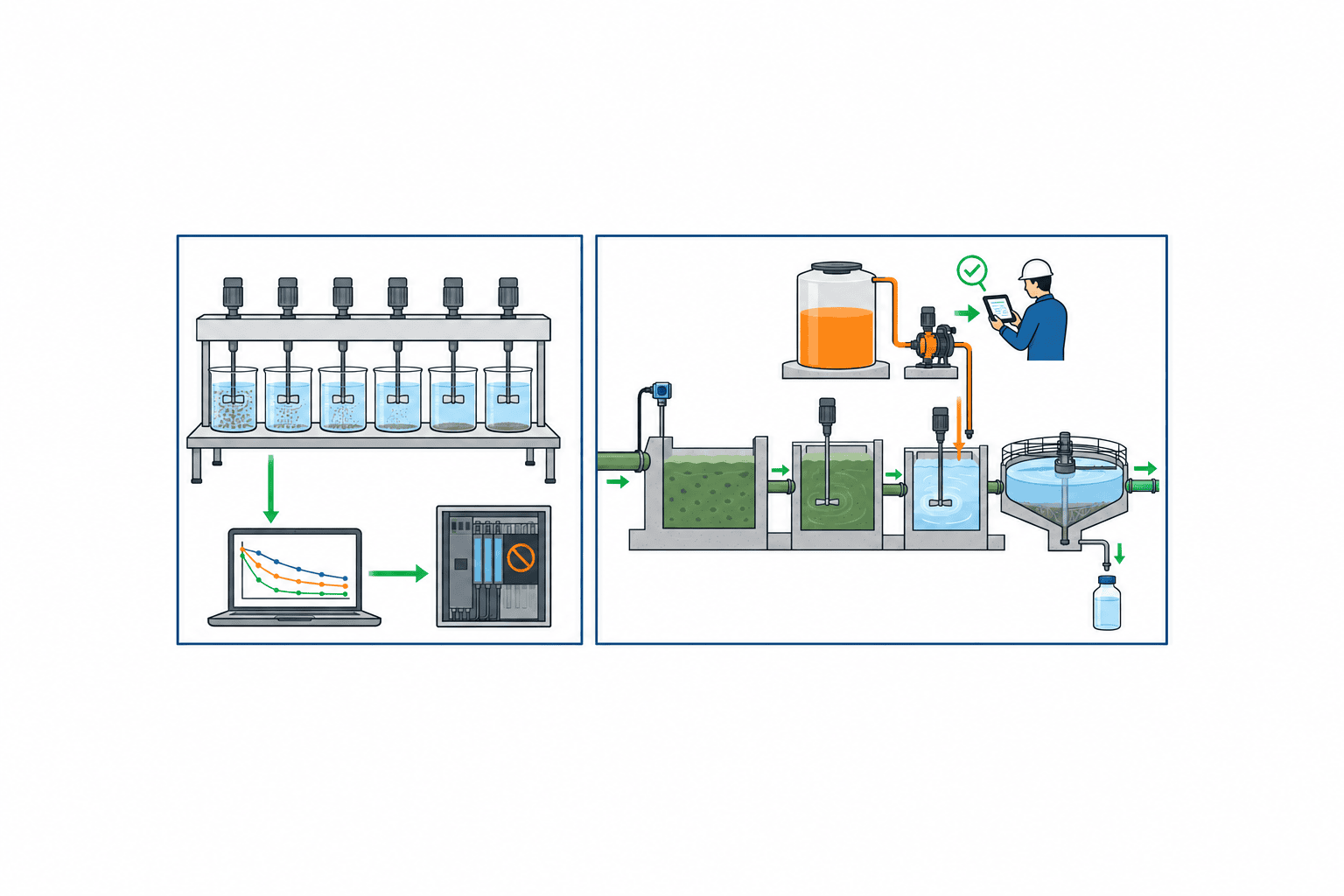
An acceptance statement such as “AI screen operates” is too weak. Require observable conditions: units and timestamps match for every mandatory tag; missing data stop recommendations; approvals are traceable; out-of-range writes are rejected; and local staff can complete manual recovery. Define how process results are compared with a baseline and mark incomparable days as contextual observations. Assign ownership for unresolved issues and post-handover monitoring.
Write test cases as operating sequences
For sensor cleaning, a test could require a bad-quality flag, an on-screen reason, disabled approval and a transition to the site’s predefined operating mode. Returning to service may require calibration confirmation, good data and a fresh operator approval. Merely unplugging and reconnecting a cable misses those operational gaps. For chemical tank changeover, reconcile change time, stock record, conversion factor and pump calibration in the screen and audit log. Do not reuse the prior concentration conversion before approval. Include insufficient user rights, log-storage failure, bad clock sync and shift handover.
Choose the baseline carefully
Comparing daily averages across different production loads or influent qualities can mislead. Fix the lines, wastewater streams, chemicals, measurement locations and sampling frequency before SAT. Agree how incomparable days will be treated. Where seasonal variation is large, a short trial cannot establish annual savings. Expand scope in stages: establish safety and data credibility first, then assess operational benefit. Distinguish chemical withdrawn from storage from the amount actually fed to the target process.
Maintenance and retraining after startup
Add instrument calibration, pump-delivery checks and chemical-concentration management to normal maintenance. Review recommendation-versus-approved differences, the frequency of withheld recommendations, actual treated-water results, seasonal changes and operator feedback. Do not deploy a new model automatically merely because a drift alert fires. Perform jar tests and parallel evaluation, then obtain approval. Link the model-update date to sensor replacement and chemical-change records.
Train replacement staff for normal operation, withheld recommendations, sensor cleaning, night emergencies and computer outages. Underfeeding can harm treatment performance; overfeeding can raise chemical use and sludge. Operators need to understand a suggestion and be able to decline it. Even if the first line performs well, do not copy its model to a new wastewater stream without checking that line’s data and limits.
At monthly review, classify rejected suggestions. Missing inputs call for instrument repair; confusing rationale calls for screen revision; new influent conditions call for jar tests and revalidation. Treating every mismatch as a retraining problem may teach the model equipment faults. Preserve change requests, approvals, implementation dates and verification results beyond the memory of a single engineer.
Frequently asked questions
Can AI dosing use only turbidity and flow?
A preliminary comparison may be possible, but safe recommendations require checks on chemical type and concentration, pH, jar tests, mixing and actual delivery. Similar turbidity can hide different particles or dissolved constituents. The system should show insufficient data and withhold a recommendation.
Must AI control the dosing pump directly?
No. A display-only stage followed by operator-approved transfer through SCADA can establish value and safety. If automatic writes are contemplated later, retain independent PLC interlocks, bounds, rate limits and communications-failure behavior and test them during SAT.
Are jar-test results sufficient training data?
They are valuable evidence but must be tied to full-scale mixing, residence time, concentration and downstream results. Preserve the original worksheets and run the recommendation in parallel with site operation to identify differences.
How should cost and payback be estimated?
Separate instrument work, data integration, model and screen, PLC/SCADA integration, FAT/SAT, training and support. Include laboratory, sludge, staff time and downtime as well as chemicals. Site data and a trial determine any credible payback period.
Does entering a Thai discharge limit into AI guarantee compliance?
No. The applicable condition depends on the facility, permit and discharge route. AI supports an operating decision; it does not replace sampling, analysis, records, maintenance or the site’s legal responsibilities. Use approved control values from the actual permit and procedures.
Conclusion
Procure AI coagulant dosing as a traceable decision-support process grounded in jar tests and operating history. Align the timing and quality of flow, turbidity and pH; show where a recommendation applies and why; preserve human approval and PLC safety limits. Specify measurement points, ownership, failure behavior and data deliverables in the RFP, then write reproducible FAT and SAT criteria. Confirm any chemical saving or stability benefit with the plant’s own wastewater and equipment.
If you are still defining the project, you can share your existing instruments, PLC/SCADA arrangement and jar-test records when you contact TOMAS TECH. We can help turn the treatment step and acceptance criteria into a practical scope.
Sources
- Thailand DIW: Factory Act environmental-law list (site-specific obligations require review of applicable documents).
- US EPA: Process Design Manual for Suspended Solids Removal (coagulation control and jar tests).
- US EPA: Metal Products & Machinery Effluent Guidelines Development Document (US sector process reference, not a Thai limit).
- Xue et al.: Explainable ML for coagulant dosage prediction in coal-port wastewater (site-specific research).
- NIST: AI Risk Management Framework Core (human oversight and ongoing risk management).


