



AI daily report automation in a factory is not achieved by pasting a paper or Excel report into an AI tool and asking it to produce polished prose. If no one can trace where the production quantity, downtime, defect count, machine ID, or work-order number came from—and if the record does not show who checked it—the result cannot reliably support shift handover or an audit. The target should not be “a machine that writes well.” It should be a controlled evidence pipeline that captures shop-floor facts in structured form, allows AI to draft only bounded narrative fields, requires a named person to review and approve the differences, and carries open actions into the next shift.
This guide is written for manufacturing decision-makers running Japanese, Thai, and English reporting at plants in Thailand and across ASEAN. It explains how to scope factory daily report automation, define a data contract and system boundaries, design human review, run a 90-day pilot, write an RFP, retain acceptance evidence, and build an illustrative business case. It does not present vendor pricing or invented implementation results. It provides a decision framework into which each plant can insert its own operating conditions.
Why copying a paper or Excel report into AI is not automation
At first glance, daily reports appear well suited to generative AI. AI can help organize bullet points, standardize wording, translate text, and summarize long notes. A factory daily report, however, is not merely a writing exercise. It is an operational record that transfers production results, downtime, quality, safety, maintenance, staffing, work in process, and unfinished work to the next shift and to management. Before readability, it needs factual accuracy, completeness, provenance, approval, and a correction history.
Suppose an operator copies “30 minutes downtime, 12 defects” from an Excel report. The AI adds, “The machine stopped briefly, but the impact on quality was limited.” If the input contains no evidence that the quality impact was limited, the sentence may be fluent but it is not evidence. If the AI also changes a unit, adds values from multiple rows, or infers a reason for the stop, a polished presentation can make the error harder to notice.
A copy-and-paste approach creates several recurring problems:
- It cannot reliably distinguish approved source data from data changed later.
- It may fill a missing required field with plausible prose.
- It makes transcription errors in quantities, timestamps, equipment IDs, work-order numbers, and units difficult to detect.
- It cannot reconcile the same event when it appears in MES, maintenance, and quality records.
- It does not necessarily retain who entered, corrected, and approved each item.
- An open action may disappear when a summary is regenerated.
- Translation can alter proper nouns, part numbers, error codes, units, or responsibility boundaries.
- If an API or model is unavailable, the daily-report process itself may stop.
NIST MEP identifies data quality and availability, initial cost, workforce readiness, privacy and cybersecurity, and legacy-system integration as barriers to implementing AI in manufacturing. It also explains that digital production dashboards and real-time data tracking can establish infrastructure for future AI use. The practical sequence is therefore to make the correct facts repeatedly retrievable before building the generation screen.
Define the four jobs of factory daily report automation
If an implementation requirement says only “generate the daily report automatically,” the plant and the supplier are likely to interpret it differently. Divide the target process into at least four jobs: evidence capture, shift handover, exception triage, and action closure.
| Job | Purpose | Main inputs | Definition of done |
|---|---|---|---|
| Evidence capture | Collect every fact required by the report | PLC, SCADA, MES, ERP, quality, maintenance, manual input | Required fields are present; source and capture time are traceable |
| Shift handover | Help the next shift understand current conditions and constraints quickly | Shift results, exceptions, temporary measures, WIP, cautions | The next owner can confirm material exceptions and unfinished work |
| Exception triage | Prioritize the issues that require attention | Threshold breaches, stops, quality exceptions, overdue items | Rule and evidence are visible so an accountable person can decide |
| Action closure | Prevent a problem from ending as a paragraph in a report | Owner, due date, status, completion evidence | Action passes to the next shift and is completed or formally withdrawn |
Separating these jobs also shows where AI is unnecessary. Capturing sensor values, checking required fields, applying thresholds, and carrying an owner and due date forward can use deterministic rules and workflow. AI is better confined to ambiguity: organizing several approved facts for a particular reader, drafting a bounded explanation field, or extracting candidate issues from a long operator observation.
The success metric should not be the number of reports generated. That only shows that the system ran. Measure whether preparation and handover time decline, while confirming that factual-error rate, missed-material-event rate, loss of open actions, correction volume, approval delay, and the proportion of untraceable narrative do not worsen.
Separate the daily report into four layers
The foundation for safe AI automated report generation is to avoid mixing everything into one body of text. Separate daily-report data into source facts, derived KPIs, an AI-drafted narrative, and an approved record. Give each layer different update rights and retention rules.
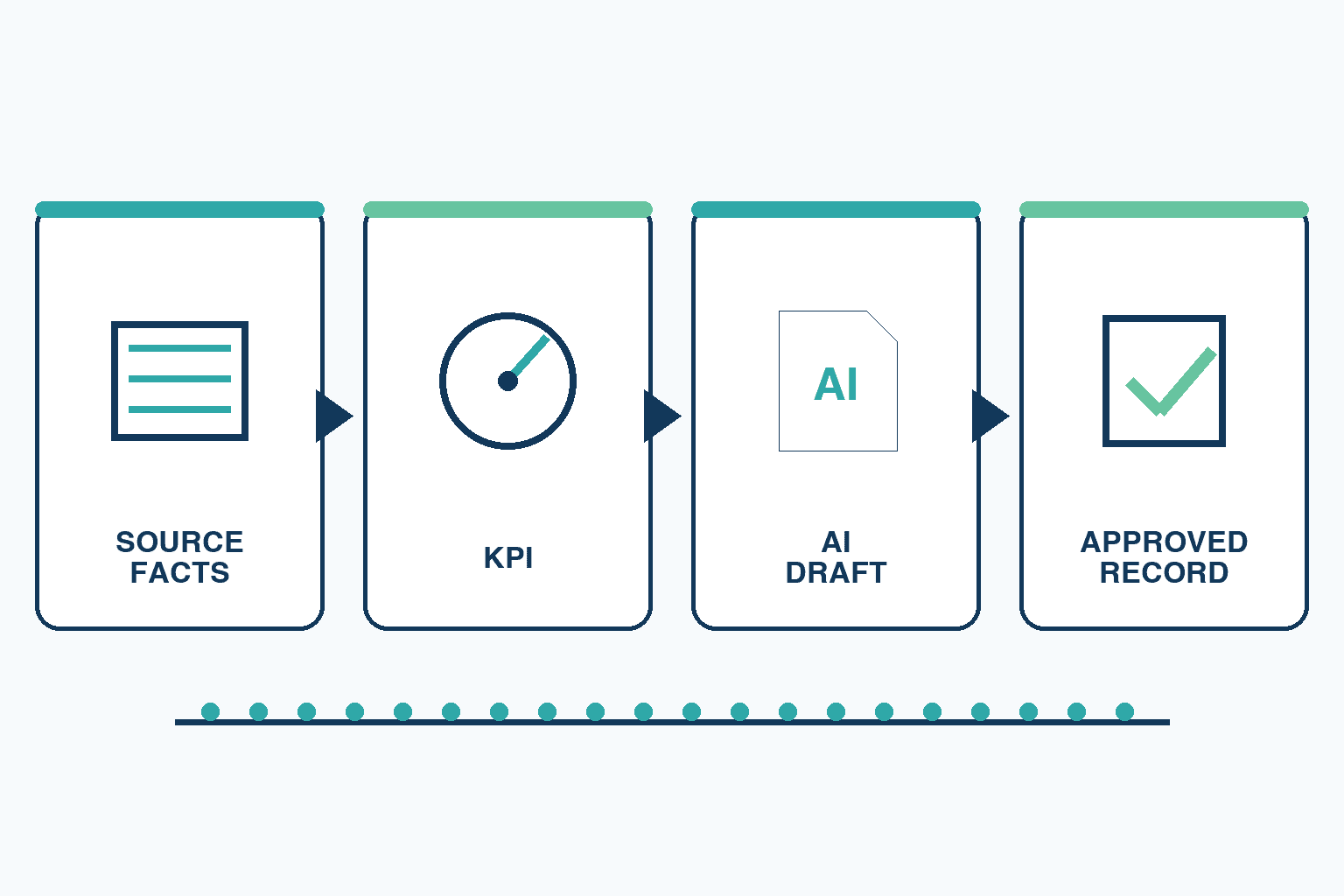
| Layer | Content | Created by | Change rule |
|---|---|---|---|
| 1. Source facts | Quantities, timestamps, machine IDs, work orders, stop events, inspection results, manual observations | Source system or named operator | AI may not overwrite; a correction is a separate record with reason and corrector |
| 2. Derived KPIs | Attainment, aggregated downtime, defect rate, and similar measures | Approved deterministic formula | State denominator, exclusions, period, and version; do not ask AI to calculate |
| 3. AI draft | Key points, trend explanation, handover text, translation candidate | AI receiving approved inputs | Display as draft; retain source links and differences |
| 4. Approved record | Published daily report and open actions | Named approver | Immutable snapshot after approval; issue a linked new version for corrections |
Layers 1 and 2 must not change whenever AI regenerates prose. Layer 3 may be regenerated, but it cannot move to Layer 4 without human approval. At approval, retain the approver, timestamp, differences from the AI draft, correction reasons, referenced sources, and model and prompt versions. If a published report is overwritten in place, it becomes impossible to establish what was shared at the time; publish a correction as a related new version.
NIST’s Industrial Artificial Intelligence Management and Metrology program describes actionable industrial intelligence as combining knowledge of physics, insights from data, and human observation and intuition for informed decision support. In daily reporting, sensor and business-system facts should therefore be combined with named shop-floor observations such as unusual noise, odor, difficult working conditions, or a temporary response. An operator observation should remain explicitly labeled as an observation rather than being blended with a sensor fact.
Define the data contract first
A data contract is the agreement between systems about each field’s meaning, type, unit, source, capture time, required status, permitted value, correction method, and owner. Its purpose is not to produce an elaborate document. It is a practical table for resolving ambiguity before data reaches AI—for example, whether “production quantity” includes reworked units, or how overlapping downtime events are counted.
At minimum, maintain the following in the data dictionary:
| Attribute | Example | Control question |
|---|---|---|
| Field ID | good_qty | Does the stable identifier remain unchanged when a display label changes? |
| Business definition | Good units counted after inspection acceptance | Are rework, WIP, and scrap explicitly included or excluded? |
| Data type and unit | integer / pcs | Are decimals, rounding, and conversion rules defined? |
| Source | MES production table | Is the system of record distinguished from a reference copy? |
| Time basis | ICT and shift cut-off | Are overnight shifts and time zones handled? |
| Required and missing-data rule | Required; block publication if missing | Is zero distinguished from no entry? |
| Correction authority | Shift leader may correct with a reason | Are original value, corrected value, reason, person, and time retained? |
| Confidentiality | Plant-internal | Are AI transmission, storage, access, and export boundaries defined? |
Inputs to AI should follow this contract as structured data wherever possible. Free text cannot be eliminated, but attach the observer, target machine, time, category, confidence, and related event ID. This preserves the boundary between fact and interpretation and prevents a note such as “something seemed different” from being turned into a confident machine-failure diagnosis.
Where a plant repeatedly re-enters the same fields from forms or Excel into ERP, it is worth examining how to automate form-data re-entry before optimizing the daily report alone. Daily-report AI should consume a controlled data flow, not hide a broken input process behind polished language.
Use ISA-95 to draw practical system boundaries
Daily-report data rarely resides in one system. PLC and SCADA hold equipment state and time-series events. MES holds work orders and production results. ERP holds commercial and inventory information. Quality systems hold inspection and nonconformance records. Maintenance systems hold failures and responses. People contribute observations. Draw where each item is obtained and where any approved output is written back.
ISA-95 is a family of standards addressing enterprise-control system integration. Parts 3 and 4 cover manufacturing operations management activities and objects; Parts 5 and 6 address exchanges supporting collection, retrieval, transfer, and storage. This does not mean every factory must implement the complete standard. It is a useful common reference for discussing responsibility boundaries and information models.
| Data source | Candidate daily-report data | Default treatment |
|---|---|---|
| PLC / SCADA | State, alarm, start and stop time, count | Preserve raw events; do not overwrite them in the report layer |
| MES | Work order, part, actual output, process, machine, lot | Identify which fields are candidates for the manufacturing system of record |
| ERP | Order, plan, inventory, shipment constraint | State timing differences and update frequency relative to shop-floor actuals |
| Quality system | Inspection, nonconformance, quarantine, disposition | AI must not decide acceptance or shipment release |
| Maintenance system | Failure, work request, response, recovery, open work | Maintain the relationship ID to the downtime event |
| Manual input | Noise, operating concern, temporary measure, handover note | Record person, time, subject, and whether content is observation or inference |
The boundary diagram should show write-back as well as read direction. Even when AI extracts an action for automatic creation in a maintenance system, define the pre-registration reviewer, duplicate control, permission, retry behavior, and cancellation method. A read-only pilot and a production bidirectional integration carry substantially different risks.
If the plant is also reconsidering how it manages process progress and actual work, see this guide to selecting and implementing a manufacturing process management system. If the system of record for process status is unclear, the daily report can become the only place holding the newest state, perpetuating disagreement between systems.
The official abstract of ISO 22400-1:2014 describes an industry-neutral framework for defining, composing, exchanging, and using manufacturing-operations-management KPIs; its current status was confirmed in 2025. For a daily-report KPI, it is therefore useful to govern the formula, denominator, exclusions, covered period, update point, and version—not only the KPI name. Do not infer requirements that appear only in the paid text of the standard.
What AI may draft—and what it must never decide
Determine AI authority by the consequence of an error and the ability to correct it, not by technical capability. Being able to express something in prose does not make it appropriate to delegate the decision.
Appropriate candidates for AI drafting
- Produce a candidate shift summary from approved quantities and events.
- Put downtime events in chronological order and summarize them with reference IDs.
- Extract candidate issues requiring review from long observation notes.
- Format open actions by owner, due date, and status.
- Produce Japanese, Thai, and English translation candidates under an approved glossary.
- Reorder the same approved information for a shift leader, plant manager, or maintenance reader.
- Flag a missing field or possible contradiction and request human confirmation.
Decisions and changes AI must not make silently
- Fill in or revise production quantity, good quantity, scrap quantity, downtime, or defect count.
- Determine the severity, reportability, cause, or responsibility for a safety incident.
- Approve a quality disposition, shipment release, or machine restart.
- Treat a missing value as zero or remove an unusual value as an outlier.
- Mark an action “completed” when its owner or due date is undetermined.
- Replace an original code, unit, part number, machine name, or person’s name with natural wording.
- Substitute for a human approval mark, electronic signature, or audit record.
Use approved deterministic formulas for numbers and pass their results to AI. When AI mentions a number in prose, show the number and a link to its source field. If inputs conflict, the safe behavior is to hold publication and return the issue to a designated person—not to select the most plausible value.
Treat human review as a control point, not a bottleneck
“Human in the loop” cannot mean simply that someone reads the output at the end. Specify who checks each field, what evidence they compare it with, and which conditions require rejection or escalation.
The approval screen should display source facts, AI draft, differences from the previous version, missing and contradictory data, correction-reason input, approver name, and approval time together. Pin quantities and safety, quality, and action fields in a prominent position so that reviewers see them before being influenced by fluent prose. Even when regenerated text shows no visible difference, record any change to the model or input version.
| Role | Main responsibility | Delegate or escalation |
|---|---|---|
| Operator | Record observations, confirm input candidates, request correction of an error | Hand over to shift leader |
| Shift leader / supervisor | Approve quantities, downtime, handover, and actions | Notify production manager when overdue |
| Quality, safety, or maintenance owner | Decide within the specialist field and link the formal record | Follow the existing severity-based procedure |
| System owner | Permissions, integration, availability, change control | Report to IT and business owners |
| AI service owner | Model, prompt, evaluation, incident, supplier management | Require reevaluation after a change |
| Data owner | Definition, quality, retention, purpose, correction rules | Escalate to the plant’s data-governance body |
The NIST AI RMF Core is voluntary and non-sector-specific. It treats governance as continuous and emphasizes documentation for transparency, human review, accountability, defined roles and human-AI oversight, and objective, repeatable or scalable, documented testing and metrics. For a factory daily report, translate this into reevaluation after a model, prompt, report form, or connected-system change rather than a one-time go-live checklist.
NIST’s TEVV-Athlon Framework, published as a draft in August 2026 with public comment closing on 6 October 2026, is not a final standard. Its approach is nevertheless useful for acceptance design: customize test, evaluation, verification, and validation to organizational objectives and retain evidence about performance and impact. A single generic “AI accuracy” number is not enough; decide what must be demonstrated for the daily-report job.
Manage Japanese, Thai, and English reporting at a Thai plant
For a multilingual daily report, consistency of codes, units, names, decisions, and responsibility matters more than elegant translation. Automatically translating from a Japanese master is not always the correct operating model. A shop-floor observation may be most accurate in Thai while a customer or regional office requires English and headquarters requires Japanese. Preserve the original and create an approved rendering in each required language.
Build a glossary for part numbers, machine names, process names, defect modes, alarm codes, safety terms, quality dispositions, job titles, and standard actions. Separate identifiers that must never be translated from terms whose rendering must be standardized. Do not let AI paraphrase numbers and units as free text; insert them into each language template from structured fields.
Minimum multilingual QA controls
- Store the original, translation candidate, and approved translation separately.
- Preserve part number, lot, machine ID, work order, error code, personal name, and unit.
- Require a qualified reviewer in the target language for safety, quality, shipment, restart, and open-action fields.
- Record the glossary version and approver; identify affected reports after a glossary update.
- Reference the same event ID and action ID in every language.
- Test local differences in date, time, decimal mark, thousands separator, and shift notation.
- Return an untranslatable or ambiguous input with the original text rather than guessing.
- Include text clipping, combining-character rendering, and missing PDF fonts in acceptance tests.
ETDA’s Generative AI Governance Guideline for Organizations addresses data governance, monitoring and improvement, human oversight, cybersecurity, legal and regulatory compliance, and third-party evaluation. ETDA’s “AI 2026: Driving Trust AI Governance” also emphasizes practical governance, impact and risk assessment, safe and transparent use, testing, and red teaming. Treat both as guidance, not as a binding Thai AI law or legal advice for a specific project. The plant’s legal and information-security teams should review the actual data and operating model for personal data, cross-border transfer, retention, employment matters, and contractually confidential information.
Run a 90-day pilot
Reading AI use cases on the shop floor does not establish whether a solution will operate safely at your plant. Equipment, report definitions, shifts, network, permissions, language, and approval flows differ. A 90-day pilot should not be a race to produce a dramatic demo. It should collect acceptance evidence within a limited boundary and establish both the conditions for proceeding and the conditions for rolling back.
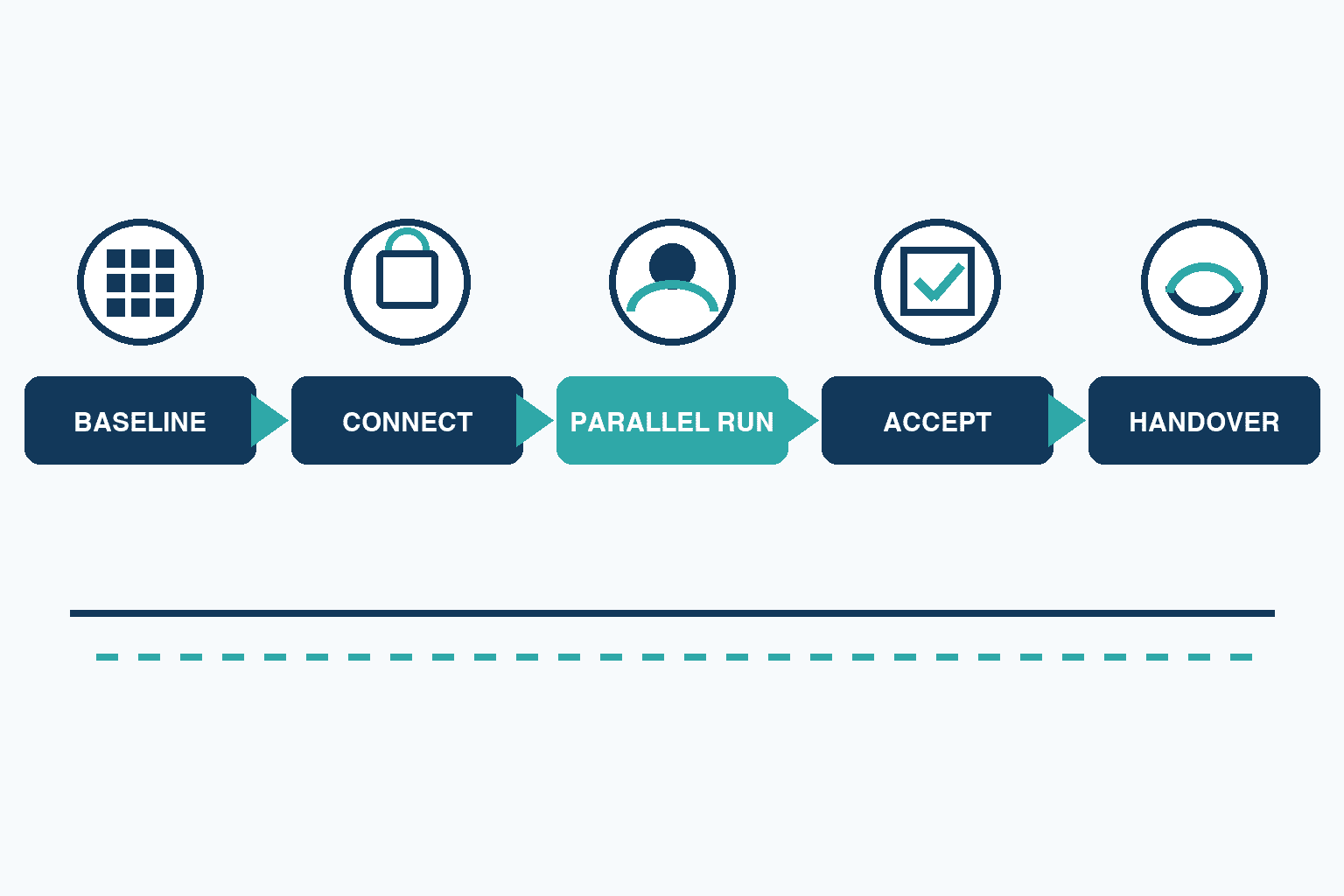
Days 1–15: scope and baseline
Start with one line, one report type, and representative shifts. For at least two representative operating weeks, use the same report type and shifts to measure preparation time, handover time, missing required fields, numerical corrections, missed material events, approval time, and the rate at which open actions carry into the next shift. Fix the measurement method in advance so the post-implementation sample cannot be selected for convenience.
At the same time, confirm the data contract, source systems, permissions, storage location, unavailable data, and manual exceptions. State what is out of scope. Do not automate high-impact decisions—such as safety-incident classification, quality release, or equipment restart approval—in the first pilot.
Days 16–30: read-only connection and test data
Read from the sources first and avoid writing back to existing systems. Use historical data to detect missing and duplicate records, delay, clock drift, unit mismatches, machine-ID mismatches, and events crossing shift boundaries. Confirm that the system can produce a structured report with provenance links even before an AI narrative exists.
Test data should include more than normal days. Include overlapping stops, a quality hold, lost communication, frequent manual corrections, and mixed Japanese, Thai, and English. A system accepted only on normal cases may fail on the day when support matters most.
Days 31–60: limited parallel run
Keep the current manual report as the official record while running the new system in parallel. AI produces only a pre-approval draft, and the report owner compares it with source facts and reviews the differences. Do not classify every problem merely as “the AI was wrong.” Identify whether the failure arose from missing input, conflicting definition, inadequate rule, wrong retrieval scope, translation, model output, or interface design.
Deliberately test upstream-system outage, API failure, AI-service outage, permission error, delay, and malformed response. Verify that the plant can return to the manual report, does not publish a partial report, and does not publish a duplicate after recovery.
Days 61–75: acceptance decision and operating practice
Compare the same report types and shifts used in the baseline. Evaluate not only time but required-field completeness, factual consistency, traceability, approval, action carry-over, and multilingual quality. Shift leaders, operators, quality, maintenance, and IT should perform correction, rejection, incident response, manual fallback, and permission-request procedures themselves.
If acceptance criteria are not met, do not expand the scope. Record the cause and conditions for retesting after remediation. Silent alteration of quantities or safety information, untraceable narrative, loss of an open action, and failure of manual fallback should be critical publication-stop gates.
Days 76–90: limited production and ownership transfer
Move only the accepted scope into formal operation. Name the business owner, data owner, system owner, and AI service owner. Transfer incident contact procedures, change approval, retesting after model updates, glossary maintenance, audit-log review, and supplier management. Do not leave the supplier as the only party who understands the configuration. Confirm that data, settings, evaluation results, and logs can be exported in a contractually permitted format.
Day 90 is not an automatic company-wide rollout date. It is the date to decide—using predetermined evidence—whether to continue, continue within a limited scope, remediate and retest, or stop. Expanding to another line, report, or language requires a focused reassessment of the new data and risks.
Design acceptance evidence before the pilot
“Operators liked it” and “the AI was mostly correct” do not support an investment decision or an audit. Define the evidence to retain at the RFP stage.
| Evaluation area | Acceptance evidence | Decision caution |
|---|---|---|
| Baseline | Preparation and handover time plus quality records for at least two representative operating weeks | Compare the same report types and shifts |
| Field completeness | Required-field records, denominator, and exclusions | Distinguish zero from missing |
| Fact consistency | Reconciliation log for quantity, time, downtime, defects, machine ID, and work-order ID | Compare with an approved source or logged human correction |
| Traceability | Link from every sentence or key point to a source field, event, or named observer | Do not publish unsupported narrative |
| Human review | Approver, visible diff, correction reason, approval time, immutable snapshot | Avoid approval under a shared account |
| Fallback | Test record for switch to and recovery from the manual report | Test upstream, API, and model failures separately |
| Multilingual quality | Glossary tests, retained codes and units, native-language specialist review | Do not pass content on fluency alone |
| Action closure | Owner, due date, and status carried to the next shift with completion evidence | Confirm regeneration cannot delete an action |
Whenever a ratio is used, define its numerator, denominator, exclusions, and period. “Required-field completion rate” means something different depending on whether the denominator is all required fields or all reports. Do not hide a critical safety or quality event in an average; define separate stop gates that can fail acceptance on a single occurrence.
What the RFP should require
An RFP should make the target process, data, permissions, failure behavior, evidence, and handover more concrete than a model name or screen mock-up. Vendors may use different feature labels, but each should be compared against the same acceptance conditions.
Scope and responsibility
- Plant, line, shift, report, language, user, and excluded work.
- Current creation, review, approval, distribution, correction, and retention flow.
- Responsibility boundaries among customer, vendor, AI service, cloud, and existing-system teams.
- Method for naming business, data, and system owners and approvers.
Data and integration
- Field list and system of record for PLC, SCADA, MES, ERP, quality, maintenance, and manual input.
- Data type, unit, time zone, update interval, delay, missing record, duplicate, and correction treatment.
- Read and write direction, API limits, network segregation, retry, and duplicate prevention.
- Training use, storage location, retention, encryption, deletion, backup, and audit logs.
Boundary between AI and people
- Fields AI may draft and fields restricted to rule-based calculation or human judgment.
- Controls preventing silent alteration of quantities, downtime, defects, safety, quality, or approvals.
- Source references, handling of untrusted input, refusal or hold behavior, and regeneration conditions.
- Human diff review, correction reason, named approval, and immutable snapshot.
Performance and operations
- Measurement of required-field completeness, fact consistency, generation latency, publication latency, and availability.
- Peak report volume, concurrent users, and shift-close processing demand.
- Behavior during upstream outage, API or model failure, malformed output, and permission error.
- Manual fallback, recovery objectives, incident notification, support hours, and change control.
Language and presentation
- Japanese, Thai, and English glossaries, non-translatable fields, and retention of original text.
- Target-language review of safety, quality, and action fields.
- Fonts, combining characters, tables, and print layout in PDF, desktop, and mobile displays.
- Tests proving the same event ID, action ID, number, and unit remain identical between languages.
Security, suppliers, and exit
- Least privilege, segregation of duties, prohibition of shared identities, access review, and activity logs.
- Disclosure of model, subcontractor, hosting region, third-party evaluation, and vulnerability response.
- Notification and retest conditions for model or prompt changes.
- Export of data, settings, glossary, evaluation results, and logs at contract end.
- Evidence of deletion and retention of a supplier-independent manual process.
Require more than a statement that a feature is “supported.” Ask for results using demonstration data, sample logs, a permission matrix, failure-state screens, and an export sample. Give shortlisted vendors the same exception cases and compare the evidence. Make the decision using the plant’s daily reports and acceptance criteria, not a generic market claim about “AI accuracy.”
Write measurable acceptance criteria
This article does not prescribe one pass rate because thresholds depend on the plant’s risk and baseline. It does prescribe measurable language.
Weak criteria include “summarizes with high accuracy,” “translates naturally into Thai,” and “generates in real time.” Stronger criteria specify the target, evidence, and conditions. Examples include: “For the designated test reports, every number in the published text matches an approved source field and every sentence links to its referenced event”; “Safety, quality, and action fields comply with the approved glossary and pass the specified native-language review”; and “Time from shift close to availability of the approval screen is recorded under the agreed load condition.”
Pair average-performance criteria with stop gates. A fast average processing time should not compensate for deleting one safety incident, changing a quantity, distributing before approval, or generating a sentence that cannot be traced to a source. Conversely, AI withholding an output and returning it to a person may present an availability issue, but it can be a safer behavior than making an unsupported assertion.
Illustrative TCO and payback model
The following is an illustrative planning scenario using hypothetical assumptions. It is not a market price, a typical result, a TOMAS TECH customer result, or a performance guarantee. Replace every value with your plant’s report volume, measured time, planning labor value, integration scope, and contract terms.
Hypothetical assumptions
| Item | Hypothetical value |
|---|---|
| Reports per operating day | 12 |
| Operating days per month | 26 |
| Current preparation time | 20 minutes per report |
| Stabilized pilot target | 8 minutes per report, including human review |
| Fully loaded planning labor value | 300 THB/hour |
| Illustrative recurring cost | 8,000 THB/month |
| Illustrative one-time implementation cost | 180,000 THB |
Illustrative monthly time saved is:
12 reports/day × 26 days × (20 minutes − 8 minutes) ÷ 60 = 62.4 hours/month
Illustrative gross monthly time value is:
62.4 hours × 300 THB/hour = 18,720 THB/month
After subtracting the illustrative recurring cost, illustrative net monthly benefit is:
18,720 THB − 8,000 THB = 10,720 THB/month
The simple illustrative payback is:
180,000 THB ÷ 10,720 THB/month = about 16.8 months
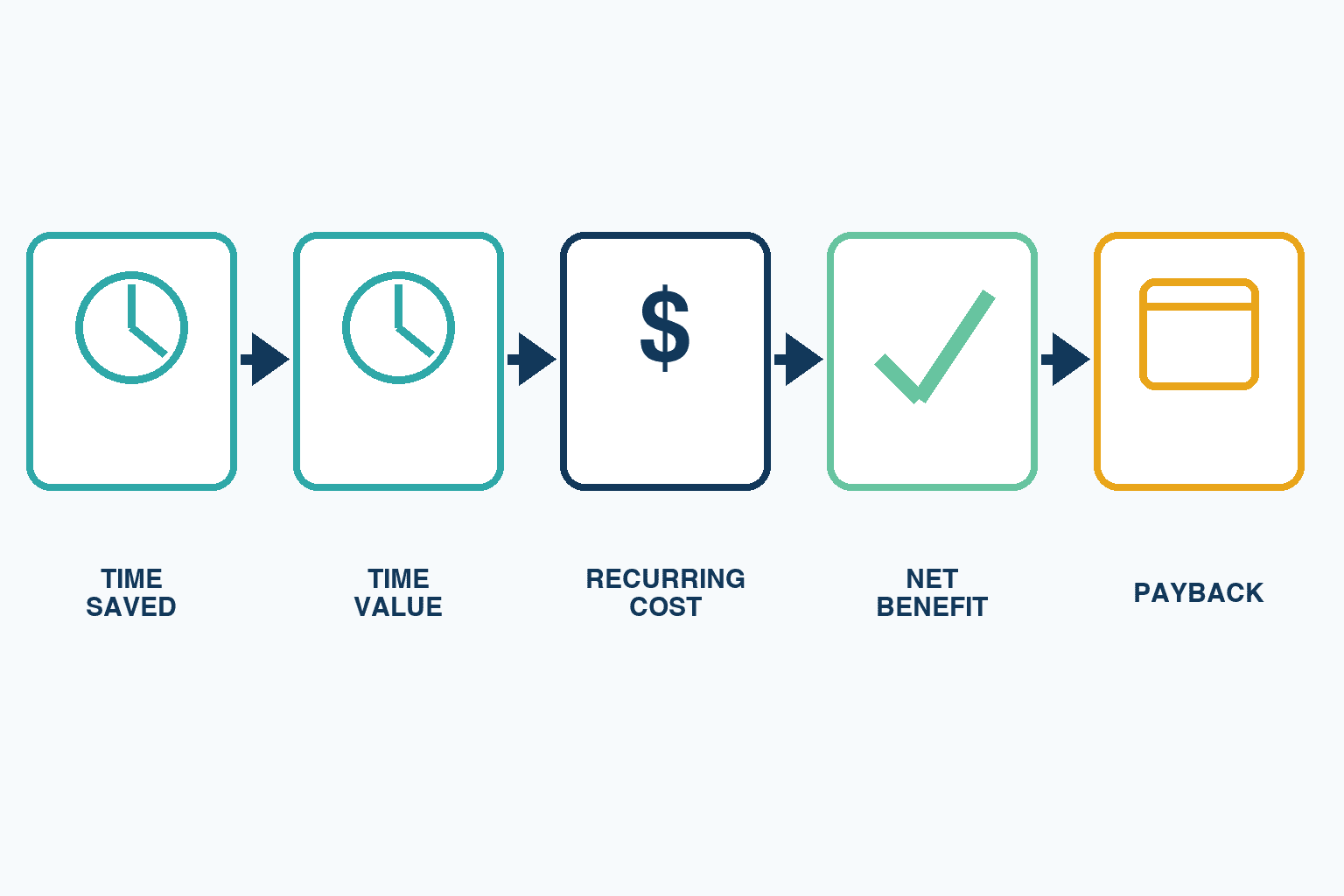
| Planning item | Calculation | Hypothetical result |
|---|---|---|
| Monthly time saved | 12 × 26 × (20−8) ÷ 60 | 62.4 hours |
| Gross monthly time value | 62.4 × 300 | 18,720 THB/month |
| Net monthly benefit | 18,720 − 8,000 | 10,720 THB/month |
| Simple payback | 180,000 ÷ 10,720 | About 16.8 months |
The most important caveat is that time saved is not automatically cash saved. Economic value materializes only when capacity is actually reassigned to setup, improvement, or exception response, or when overtime or outsourcing is reduced. Decide the capacity destination and how it will be verified before the pilot.
This model also excludes avoided-defect and avoided-downtime value from the daily-report AI benefit. Add such value only when the cause and intervention path are defined separately and measured over comparable periods. Observing faster reporting and less machine downtime at the same time does not establish causation.
TCO should include more than model usage fees. Include data connections, network, permission design, report-form changes, glossary, evaluation data, training, monitoring, incident response, retesting after model changes, log retention, and exit migration. Estimate a small pilot separately from the operating cost of expansion across multiple factories.
Common failure patterns and recovery gates
Failure 1: Building the AI screen before defining the system of record
The same quantity exists in Excel, MES, and ERP, and each person selects a different one. Recovery gate: define the system of record, update interval, and correction owner field by field; hold publication during a conflict. Do not expand AI summarization until the source is resolved.
Failure 2: Mistaking fluency for accuracy
A readable sentence contains an unsupported cause or impact. Recovery gate: every sentence must trace to a source fact, derived KPI, or named observation. Warn on untraceable narrative at the approval screen and exclude it from publication.
Failure 3: Making human review ceremonial
Approvers read long text without visible differences, so review becomes a click. Present numbers, safety, quality, and open actions first, and make changes and contradictions explicit. Classify correction reasons; if the same error repeats, repair the input or rule.
Failure 4: Adding translation at the end
Thai shop-floor observation, Japanese head-office reporting, and English regional reporting drift apart. Keep original and translation together, lock identifiers and numbers, and require native-language review for safety, quality, and actions. Do not distribute automatically before the glossary is controlled.
Failure 5: Testing only the happy path
The system works during normal production but publishes a wrong report after upstream outage, communication delay, duplicate event, API failure, or permission change. Inject failures and verify that an incomplete report is never labeled complete, manual reporting remains available, and recovery does not create duplicates.
Failure 6: Burying an open action in narrative
The next shift regenerates the summary, and the owner and due date disappear. Store each action as a separate structured object with owner, due date, status, related event, and completion evidence. Make guaranteed carry-over of every open action an acceptance criterion.
Failure 7: Treating a model change as routine maintenance
A model or prompt change can alter missing-data behavior or translation as well as style. Compare old and new versions with the same evaluation set and release only after critical gates pass. Retain a rollback method and the version used to create each report.
Failure 8: Completing the pilot without an owner
Only the vendor understands configuration and incident response, while glossary and permissions become stale. Before production, name business, data, system, and AI service owners and hand over procedures, evaluation sets, settings, logs, and export methods.
Decision checklist
If the plant cannot answer the following questions, it may need to organize the process and data before selecting an AI model.
- Is the daily report’s reader clear, as well as the decision that reader makes next?
- Are required fields and publication-stop fields defined?
- Is the system of record defined field by field for quantity, downtime, defects, quality, and maintenance?
- Can the denominator, exclusions, period, unit, and version of every KPI be traced?
- Can human observation be stored separately from system facts?
- Are fields AI may draft and fields it may not decide clearly defined?
- Can each sentence be traced to a source field or named observation?
- Can the approver, delegate, rejection condition, and correction reason be recorded?
- Are codes, units, and names that must remain unchanged across Japanese, Thai, and English defined?
- Can the plant return to a manual report after upstream, API, or model failure?
- Does every open action remain with an owner and due date in the next shift?
- Were the baseline and acceptance evidence defined before the pilot?
- Can the system be retested after changes to model, prompt, report form, or glossary?
- Can data, settings, logs, and evaluation results be exported at contract end?
Frequently asked questions
Where should factory daily report automation begin?
Select one line, one daily-report type, and representative shifts. Observe the current creation, review, and handover process. For at least two representative operating weeks, record not only preparation time but missing required fields, numerical corrections, missed material events, approval time, and open-action carry-over. Then identify the system of record and data contract for each field. Adding AI narrative after the structured report and provenance links work makes root-cause analysis much easier.
Should AI automated report generation calculate production numbers?
Use an approved deterministic formula for quantities, downtime, defect rates, and other report figures. Retain the denominator, exclusions, covered period, unit, and formula version. Pass the calculated value and its source to AI and use AI only to draft an explanation. When AI detects missing or contradictory input, it should return the issue for human confirmation rather than infer a value.
Can another company’s AI use cases on the shop floor be applied directly to our plant?
External examples help identify possible use cases, but equipment, data quality, shifts, permissions, language, approval, and network conditions differ. Do not transfer another company’s claimed effect or accuracy directly. Run a limited pilot with representative plant data and exception cases and compare it with the same report types and shifts in the baseline. Give more weight to the acceptance evidence your plant can retain than to the number of vendor case studies.
How should the business case for daily-report AI be calculated?
Use the plant’s report count, current preparation time, future time including human review, planning labor value, recurring cost, and one-time implementation cost. Multiply measured time saved by the labor value, subtract recurring cost, and calculate simple payback. It does not become a cash effect until capacity is reassigned or overtime or outsourcing is reduced. Include avoided-defect or avoided-downtime value only when a separate causal path and measurement method can be established.
Can one AI create Japanese, Thai, and English daily reports?
Technical generation is not the same as approval as an operational record. Store original text, translation candidate, and approved translation separately, and govern part numbers, equipment, processes, defect modes, and safety and quality terms with a glossary. Insert numbers, units, codes, and names from structured data. Require qualified reviewers for safety, quality, and action fields in each target language, and use the same event ID and action ID across languages.
If generative AI stops, does the daily-report process stop?
It should not. Make it possible to display or export a structured report from source facts and derived KPIs without AI, and retain the current manual report during the pilot. Test API, model, upstream-system, and permission failures. Retain evidence that a partial report is not published, manual operation is available, and recovery does not publish a duplicate.
Are the AI governance guidelines discussed here legal obligations?
The NIST AI RMF cited here is voluntary and non-sector-specific. The NIST TEVV-Athlon Framework was a draft as of August 2026, and the ETDA materials are used here as practical guidance. Do not treat them as equivalent to binding legal requirements. Ask the plant’s legal and information-security teams to review the applicable data, countries, contracts, personal data, cross-border transfers, employment requirements, and sector obligations.
Summary
The critical capability in factory daily-report AI is not fast prose generation. It is collecting facts from the correct sources, calculating KPIs with approved formulas, having a person review the AI draft and its differences, and carrying an approved record and every open action into the next shift. Separating source facts, derived KPIs, AI draft, and approved record makes both AI authority and publication-stop conditions explicit.
Start with one line and report, obtain a baseline covering at least two representative operating weeks, and use a 90-day pilot to test read-only connection, limited parallel operation, acceptance, fallback, and ownership transfer. In the RFP, compare completeness, factual consistency, latency, traceability, human approval, multilingual quality, permission boundaries, failure behavior, and exportability—not model names or demo fluency. Time reduction becomes investment value only when the plant designs and verifies how the freed capacity will be used.
TOMAS TECH can support the planning stage even when report fields, systems of record, acceptance evidence, and the boundary of a 90-day pilot are still being defined. If you want to map PLC, SCADA, MES, ERP, quality, and maintenance data at a Thai plant—and design a Japanese, Thai, and English approval flow that clearly separates AI drafting from human judgment—share your current report and operational concern through our contact page.
Sources
- NIST MEP — The Rise of Artificial Intelligence (AI) in U.S. Manufacturing
- NIST — Industrial Artificial Intelligence Management and Metrology
- NIST AI RMF — Core
- NIST — TEVV-Athlon Framework for Evaluating AI Systems
- ETDA — AI 2026: Driving Trust AI Governance
- ETDA — Generative AI Governance Guideline for Organizations
- ISA — ISA-95 Enterprise-Control System Integration
- ISO — ISO 22400-1:2014


