


For any manufacturer in Thailand that handles rubber, rubber components, timber or paper products, the end of 2026 is a deadline that cannot be quietly ignored. EUDR compliance, meaning compliance with the EU Deforestation Regulation, moves from discussion to enforcement, and products entering the EU market will have to carry geolocation data showing the land on which their raw material was produced. This article sets out what you actually have to prove, where Thailand’s natural rubber sector stands today, and what to build on the IT and OT side of the plant so that the requests arriving from your customers can be answered.
What EUDR Compliance Means – Application Dates and the Three Things You Must Prove
The EU Deforestation Regulation requires operators placing goods on the EU market to demonstrate that the raw material behind those goods is not linked to deforestation. Seven commodities are in scope, namely cattle, cocoa, coffee, palm oil, rubber, soy and wood, together with a long list of derived products made from them. Tyres, rubber hoses, gaskets, furniture and paper all trace back to those seven commodities, so processed goods sit squarely inside the perimeter.
Two application dates, split by company size
The first thing to get exactly right is the calendar. On 18 December 2025 the Council of the EU signed off a targeted revision of the regulation covering both simplification and a change to the application dates, and the European Parliament completed its side of the procedure the same month. The amending act was published in December 2025 as Regulation (EU) 2025/2650, and the application dates now stand as follows.
| Operator category | EUDR application date |
|---|---|
| Large and medium-sized enterprises | 30 December 2026 |
| Micro and small enterprises | 30 June 2027 |
The critical point is that 30 December 2026 does not apply uniformly to everyone. Micro and small enterprises have a separate date of 30 June 2027. If an internal briefing or a supplier notice simply says that EUDR starts on 30 December 2026, it loses the six-month gap between the two categories. Reading it the other way round is equally dangerous. Concluding that there is breathing room until 2027 misses the fact that if your EU-side importer is a large or medium-sized enterprise, that company carries the obligation from 30 December 2026. In other words, the moment when data requests land on your desk is governed by the size of your counterparty, not the size of your own company.
The European Commission’s Access2Markets portal presents the same picture. The revision postpones application to the end of 2026, large and medium-sized operators take on the main obligations from 30 December 2026, and natural persons together with micro and small enterprises follow from 30 June 2027. The same amendment also clarified definitions and adjusted the due diligence obligations.
Because the application date arrived only after several rounds of postponement, a persistent view holds that it will slip again. Betting your preparation on that expectation is not a rational position. Preparation is a sequence, running from taking stock of your current situation, through identifier design, digitising shop-floor records, and finally system integration, and it takes several quarters from kick-off to a state you can actually use. Even if another delay does arrive, the preparation window is likely to be longer than the delay itself.
Legality, deforestation-free, and due diligence
EUDR asks operators for three broad proofs.
- Legality. The material was produced in compliance with the relevant legislation of the country of production, covering land use rights, labour, tax, and trade and customs law.
- Deforestation-free. The material was not produced on land converted from forest after 31 December 2020. For wood, an additional requirement relating to forest degradation applies.
- Due diligence. The operator must carry out due diligence to verify the two points above and submit the outcome as a statement, with records showing the sequence of information collection, risk assessment and risk mitigation.
For anyone responsible for factory systems, the second requirement carries by far the heaviest load. Demonstrating that material is deforestation-free means identifying the plot of land on which it was produced as geolocation data, and holding that data in a form that can be checked against satellite imagery to confirm the plot has not been converted from forest since the cut-off date. Traditional traceability answered the question of which plant and which lot. EUDR pushes the question back to which piece of land and which plot. The endpoint of the trace moves one step deeper, from the factory to the farm, and that shift is the essential change EUDR compliance brings.

Thai plants are not the direct addressee, but they are far from unaffected
The legal obligation falls on operators placing goods on the EU market and on those exporting from the EU. A factory in Thailand does not file a due diligence statement with an EU authority. However, in order to file that statement, the EU-side importer needs plot-level geolocation data from upstream suppliers, plus evidence tying that data to the specific goods it received.
What happens in practice is that Tier 1 suppliers and OEMs shipping into the EU pass the requirement down to component makers in Thailand as a request for origin information on raw materials. The format of the request varies from customer to customer. Some send an Excel template, others ask you to key data into their procurement portal. If your company has no structured way of holding that data, every request turns into a manual document-building exercise on the shop floor, and the resulting document cannot be traced in an audit. This is precisely why EUDR compliance should not be left to the compliance function alone, and why the systems team needs to be involved early.
Thai Natural Rubber and EUDR – Where RAOT Mapping and the TRT Platform Stand
Of the seven commodities, natural rubber is the one where Thailand takes a direct hit as a global supply hub. What follows is what published sources tell us about how far the Thai side has progressed.
Exports to the EU are growing, so the impact is not marginal
Reporting by Mongabay, based on figures compiled from the World Integrated Trade Solution database, puts the increase in the value of Thai rubber entering the EU at roughly 65 percent between 2019 and 2024. The bulk of export volume still goes to China and Malaysia, but the EU-bound trade is growing in value terms. The regulation is therefore not arriving during a retreat from the EU market. It is arriving while that trade expands.
Some companies fall back on the idea that if EUDR compliance proves too hard, they can simply sell outside the EU. For the Thai rubber industry as a whole, that is not a realistic escape route. For Japanese-affiliated component makers, the same logic applies indirectly. As long as your parts end up in vehicles or finished goods bound for the EU, you sit inside the same requirement perimeter.
RAOT has mapped 79 percent of cultivated area and launched the TRT platform
Institutional groundwork on the Thai side is further along than many people assume. The Rubber Authority of Thailand, known as RAOT, has been surveying plantation plots and has now mapped more than 3.1 million hectares of rubber-growing land, equivalent to roughly 79 percent of Thailand’s total cultivated area. Mongabay reports this figure as coming from a 2024 report published jointly by RAOT and the European Forest Institute.
The trading framework has started moving as well. In April 2024, a kick-off trade of traceable rubber took place on the Thai Rubber Trade platform, known as TRT, which RAOT operates. According to material published by the Office of Agricultural Affairs of Thailand in the EU, the trade was carried out through a digital bidding process, yield data is collected systematically from each cooperative member so that origin can be traced at lot level, and blockchain technology is used in the transaction itself to strengthen transparency and auditability.
The private sector is moving too. Sri Trang, a major Thai rubber and tyre group, launched a scheme referred to as GPS tires with EUDR in view. The scheme distributes GPS-enabled natural rubber grades so that the plantation of origin can be identified, and it covers several material forms including cup lump, fresh latex and sheet rubber. It is fair to read the current situation as a national-level framework and company-level implementation running in parallel.
The unmapped fifth, and the fifth without paperwork
Turn that 79 percent around, though, and roughly a fifth of cultivated area still sits outside the mapping. Rubber coming off an unmapped plot cannot be accompanied by plot geolocation data, which means any lot containing that material cannot be used in an EU due diligence statement. Seen from the procurement side, that translates into a fifth of the cultivated area behind your supply base becoming unusable purely because origin cannot be evidenced, not because there is anything wrong with the material.
Land rights present an even harder problem. The same reporting notes that roughly a fifth of the smallholders involved in Thai rubber production hold no formal documentation proving the legality of their plantation. Land use in many cases is governed by informal arrangements with government agencies, and the pattern is said to be strongest in areas bordering forest. Of the three proofs EUDR requires, legality is the one that stumbles right here.
These two figures of roughly a fifth are different statistics with different denominators. The first is the share of cultivated area that remains unmapped. The second is the share of farmers lacking documentation. Because the numbers are so close, they get conflated easily in internal briefings, so whenever you cite either one, state which denominator it belongs to.
Against this backdrop, Mongabay reports that support for smallholders in Thailand is expanding under private sector leadership. Read the other way, that says public support alone will not close the gap in time, and that buyers themselves increasingly recognise they will have to help farmers register and survey their plots if supply is to continue.
For a procurement function inside a Japanese-affiliated manufacturer, this carries two implications. First, simply asking a supplier to produce an EUDR compliance certificate leaves the smallholder segment upstream as a blank space. Second, risk assessment needs to be framed around the geographies where material is aggregated rather than around the first-tier suppliers you happen to contract with. Practitioner commentary on EUDR deforestation risk assessment for the Thai rubber supply chain makes the same structural point, treating collection from very large numbers of smallholders as a risk factor in itself.
What EUDR Traceability Actually Requires – Joining Geolocation, Raw Material Lots and Production History
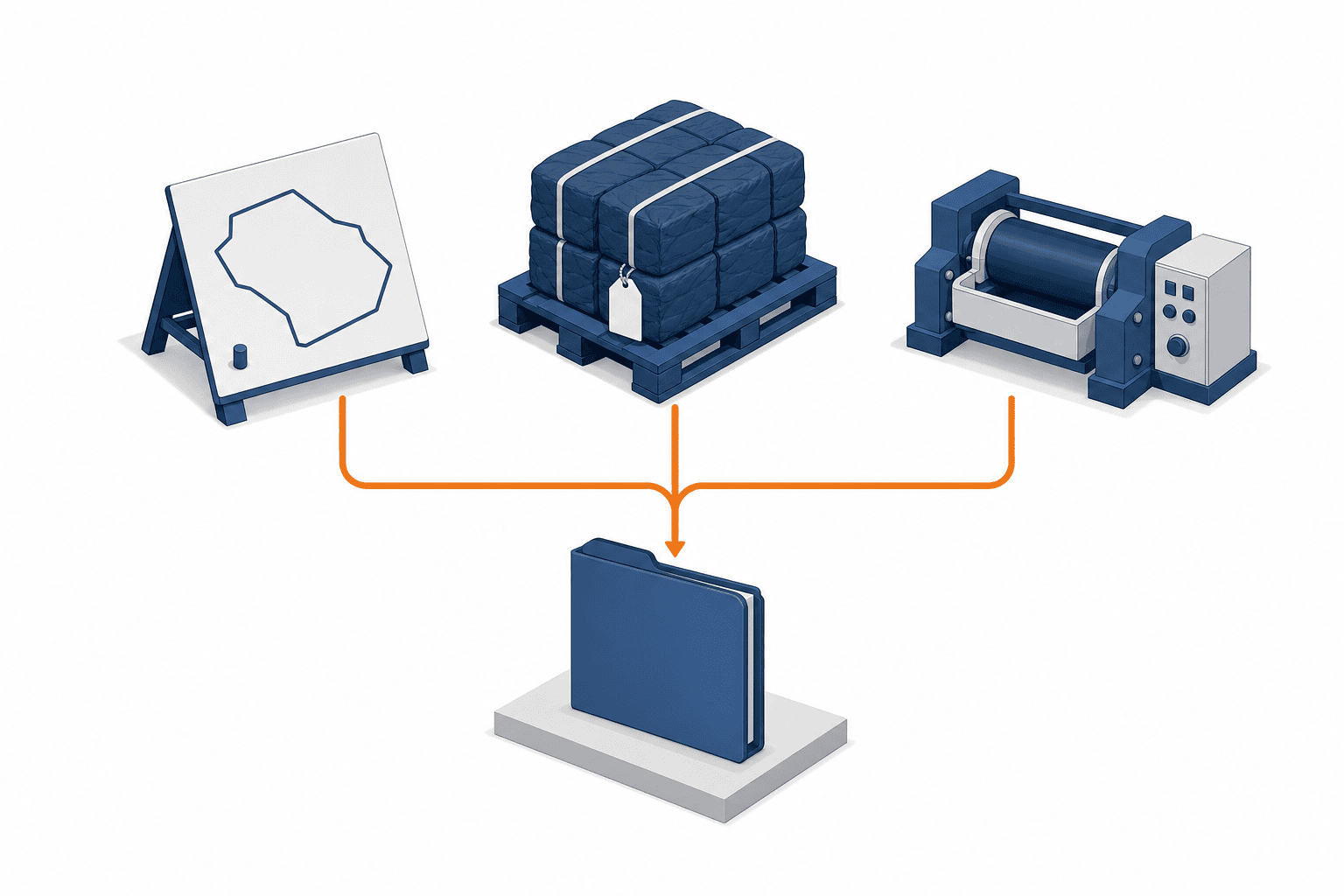
From here the discussion turns to systems. EUDR traceability is a phrase used loosely, but break it down technically and it reduces to joining three kinds of data with completely different characteristics into a single continuous thread.
The three data types differ in origin, update frequency and precision
| Data type | Main origin | Update frequency | Practical difficulty |
|---|---|---|---|
| Geolocation | Plantation plot surveys, government registration, satellite data | Largely fixed once captured | Captured outside your company, so you cannot guarantee its accuracy or freshness yourself |
| Raw material lot | Collection points, receiving and weighing records at the processing plant | Generated at every delivery | Material from several farms is mixed, so it often does not tie to a single plot |
| Production history | Equipment, process records, inspection records | Continuous, at every process step | Self-contained internally, but the link back to the raw material lot is often weak |
What trips most companies up is that these three live in three different systems. Geolocation sits in a procurement spreadsheet, raw material lots sit in the purchasing and inventory system, and production history sits in the MES or in equipment logs. Each exists on its own, yet the moment the EU side asks which plots the material in a given product lot came from, joining the three becomes manual work.
Records break at the merge point, not the split point
Traceability design tends to focus attention on splits, where one lot fans out into several products. In reality the trace breaks on the other side, at merges, where several deliveries enter one tank or one mixing batch. With natural rubber this merge happens extremely early. Latex and cup lump from multiple farms are already combined at the collection point, and by the time material reaches the processing plant, dozens of plot origins have been consolidated into a single unit. Mongabay’s reporting describes exactly this, with traders and middlemen mixing rubber from multiple origins without asking producers for origin or legality documents, and that material then flowing into more than 200 processing factories. The article concludes that producers, traders and processors alike will have to change established practice if shipments to the EU are to continue. Once material is mixed, separating out its origins after the fact is effectively impossible.
This is a structural issue shared across materials industries. Our article on chemical lot management and why traceability breaks at merges rather than splits works through the mechanism in detail, showing how lot genealogy fails to connect when you track only the output side without holding records on the input side. In the EUDR context, whether you can record which plots entered in which proportions at that merge point directly determines the granularity of the information you are able to submit.
If you do not fix the join keys first, joining later is close to impossible
The key to making supply chain geolocation traceability work turns out to be something rather unglamorous. You have to decide the common keys that link the three data types before the data starts being created.
- A unique identifier for the plot. Will you use the government registration number, issue your own, or hold both and manage a cross-reference table?
- An identifier for the receiving unit. A delivery note number, or a number issued per weighing? Can you distinguish two deliveries from the same farm on the same day?
- An identifier for the production batch. Does it align with the numbering already used in your production management system, or does it run on a separate scheme?
Trying to harmonise these after the fact means an enormous reconciliation effort across historical data. Put positively, simply sorting out the numbering rules before you touch the systems themselves lowers the difficulty of the whole project dramatically. For a way of thinking about traceability in layers and how to size the investment, our article on traceability system build cost and a four-layer model with a 90-day roadmap is a useful reference at the stage where you are putting an internal budget together.
Designing a Rubber Origin Tracking System – What to Build and What to Ride On
Next, how to actually structure a rubber origin tracking system. The organising question here is how far you build in house and where you ride on external schemes instead.

Split the work into four layers and assign roles
The conventional way of describing an internal traceability platform uses four layers, namely identification, capture, linkage and retrieval. With EUDR, though, you have to bring in geolocation that is generated outside your company, so it is easier to allocate roles and make investment decisions if you redraw the layer boundaries around where each piece of data originates and how it reaches you. In this article the capture layer covers the process where data is first created, the interface layer covers receiving it from external schemes or suppliers and passing it into your own environment, the management layer covers identification and linkage, and the submission layer covers retrieval and output.
| Layer | Main role | Build in house or ride on external schemes |
|---|---|---|
| Capture | Plot geolocation capture, weighing and quantity records at receiving | Use external schemes such as RAOT mapping and TRT for plot data, keep receiving records in house |
| Interface | Passing data between external schemes, suppliers and internal systems | Build in house. This is where format conversion lives |
| Management | Linking and storing plot IDs, receiving IDs and production batch IDs | Build in house. This is the part that becomes an asset |
| Submission | Output in each customer’s required format, responding to audit enquiries | Build in house, on the assumption that formats differ by customer |
The important lesson from this four-layer view is not to attempt the capture layer entirely on your own. In Thailand, RAOT has already mapped more than 3.1 million hectares of growing area and the TRT trading framework is operating. Putting yourself in a position to receive what those schemes produce is more rational, on both cost and accuracy, than resurveying plantations from scratch.
The management layer, by contrast, cannot be delegated. Your company is the only party that holds the correspondence between its own production batches, its raw material lots and the plot IDs behind them. Collect external certificates while leaving that blank and you still cannot answer the question of which material went into a given shipment.
Build the submission layer assuming every customer wants a different format
The submission layer is where practical effort drains away fastest. Once EUDR compliance is live, each customer will ask for data in its own format. If you respond by building a dedicated spreadsheet per format, your maintenance burden grows with every new customer, and before long nobody knows which version is current.
The workable design is to hold one normalised dataset in the management layer and keep the submission layer thin, as a set of conversion views over that dataset. Customer A’s template and Customer B’s portal entry both become outputs from the same source. Set up that way, a new format costs you only a new conversion rule.
The same thinking applies in other domains where the shape of the required proof shifts with the certification or regulation in play. Our article on halal traceability and the way business is lost when eligibility cannot be evidenced describes the same structure, where an inability to prove the eligibility of a raw material costs the business itself. EUDR reproduces that pattern exactly. Material you cannot evidence cannot go to market, however good its quality.
Do not take “it runs on blockchain” as reassurance in itself
Partly because TRT is built on blockchain, the technology name sometimes gets treated as a guarantee. This deserves a cooler look. What blockchain protects is the integrity of data after it has been recorded. It says nothing about whether the content entered in the first place was correct. Whether the plot geolocation matches the actual plantation, and whether the link was made correctly at receiving, still depend entirely on the operational quality of whoever enters the data.
The investment priority that follows is that mechanisms guaranteeing input accuracy come before sophistication in the recording platform. That means automatic capture from weighing equipment, code scanning at goods receipt, and elimination of double entry, all of which are shop-floor design questions. This is OT territory inside the plant, and it cannot be completed by the IT department alone.
Getting Ready for 30 December 2026 – What Japanese-Affiliated Manufacturers Can Start Now
Finally, the practical sequence along a timeline. The application date of 30 December 2026 is the one that applies to large and medium-sized enterprises. Micro and small enterprises follow on 30 June 2027, but as noted above, the timing of the requests you receive is driven by the size of your counterparty, so planning against the earlier date is the safe choice.
Start by putting your own position on a single page
The first task is not system evaluation. It is understanding where you stand. Compile the following into one table.
- Which of your products could reach the EU market, including not only direct exports but goods that enter the EU through a customer.
- Which of the raw materials in those products fall under the seven EUDR commodities. Rubber, wood, paper and palm-oil-derived auxiliary materials are the ones most often missed.
- Who the first-tier supplier is for each of those materials, and how far upstream visibility currently extends.
- What origin-related information you already hold, which department holds it, and in what format.
Filling in those four points alone usually narrows the scope of work far more than expected. Identifying the products and materials in scope before moving into design keeps both cost and duration at a realistic level, rather than mobilising the entire company at once.
The order of preparation
| Stage | Main activities | Departments mainly involved |
|---|---|---|
| Situation assessment | Identify target products and materials, inventory existing information | Quality assurance, procurement, sales |
| Identifier design | Design the schemes and cross-reference tables for plot IDs, receiving IDs and production batch IDs | IT, production control |
| Capture setup | Establish routes for receiving geolocation from suppliers, digitise receiving records | Procurement, manufacturing |
| Linkage build | Build the management layer, integrate with existing systems | IT |
| Submission setup | Conversion into customer formats, enquiry procedures for audits | Quality assurance, IT |
The reason for this order is that each stage depends on the deliverables of the one before it. Commission a system build before identifier design is finished and development starts with requirements still unsettled, which ends in a rebuild.
Common pitfalls
A few problems recur often enough to be worth naming.
- Defining the scope too broadly. Trying to cover every product and every material at once delays the start. Begin with what reaches the EU.
- Sending suppliers an abstract request to comply with EUDR. Unless you specify which fields, in what format and by when, the granularity of what comes back will vary wildly.
- Receiving geolocation and then storing it on an individual’s laptop. Information you cannot produce during an audit is equivalent to information you do not have.
- Leaving receiving records on paper on the shop floor. If that step is paper, no amount of upstream geolocation will connect to a production batch.
- Simplifying the application dates in internal communication. Drop the distinction between 30 December 2026 for large and medium-sized enterprises and 30 June 2027 for micro and small enterprises, and you create misunderstandings in supplier negotiations.
The benefit does not stop at compliance
Systems built for EUDR tend to be booked as a regulatory cost. Yet data that runs in one continuous thread from a plot ID through to a production batch has uses of its own. Analysing quality variation by material origin. Instantly identifying the scope of impact when a problem appears at a particular origin. Cutting the response time on customer quality enquiries. Each of those was previously in the category of things you could find out, but only after a few days of digging.
More to the point, this kind of demand does not end with EUDR. The debate on digital product passports, which carry a product’s environmental information electronically, is one example among several, and the direction of travel toward presenting material-to-product history in machine-readable form is set to continue. Whether you treat EUDR as a one-off compliance exercise or as the occasion to build a history data platform will make a substantial difference to the burden you carry a few years from now.
FAQ
What is EUDR?
EUDR is the EU regulation requiring, for certain commodities placed on the EU market, proof that they are not linked to deforestation and that they were produced legally under the law of the country of production. Seven commodities are covered, namely cattle, cocoa, coffee, palm oil, rubber, soy and wood, along with products derived from them. The obligation falls on operators placing goods on the EU market and on those exporting from the EU, but because the evidence has to come from upstream suppliers, manufacturing sites in Thailand are effectively drawn in as well. The biggest difference from conventional traceability is the need to identify the plot of land on which the material was produced, as geolocation data.
When does EUDR compliance take effect?
Following the Council of the EU’s formal sign-off on a targeted revision on 18 December 2025, the application date for large and medium-sized enterprises is 30 December 2026, and for micro and small enterprises it is 30 June 2027. These are two separate dates, and 30 December 2026 does not apply uniformly to all operators. That said, even if your own company falls into the micro or small category, an EU-side importer that is a large or medium-sized enterprise carries the obligation from 30 December 2026, so requests for data will reach you before that. Planning against the earlier date is the safer basis.
Why does Thai rubber sourcing need EUDR compliance?
Because natural rubber is one of the seven commodities in scope, and Thailand is one of the world’s largest supply sources. Mongabay reports that the value of Thai rubber entering the EU rose by roughly 65 percent between 2019 and 2024, so the regulation lands during an expansion rather than a retreat. On the Thai side, the Rubber Authority of Thailand has mapped more than 3.1 million hectares of growing area, around 79 percent of total cultivated area, and in April 2024 traceable trading began on the RAOT-operated TRT platform. The institutional side is coming together, but roughly a fifth of cultivated area remains unmapped and roughly a fifth of smallholders hold no formal documents proving the legality of their plantation, and that is where the practical difficulty lies.
Do we have to build the whole rubber origin tracking system ourselves?
No. For capture-layer data such as plot geolocation, putting yourself in a position to receive information from external schemes like RAOT mapping and TRT is more rational on both cost and accuracy. What you must hold yourself is the management layer, storing the correspondence between plot IDs, receiving IDs and production batch IDs. That is the part tied to your own manufacturing records, and it cannot be delegated. For the differing submission formats each customer imposes, holding one normalised dataset in the management layer and building the submission layer as a thin conversion view keeps the maintenance burden from growing as customers are added.
Summary
The points worth holding on to when planning EUDR compliance.
- The application dates are 30 December 2026 for large and medium-sized enterprises and 30 June 2027 for micro and small enterprises. These are two separate dates, and the timing at which requests reach you is set by the size of your counterparty, not your own.
- EUDR asks for three proofs, namely legality, deforestation-free status, and due diligence. The deforestation-free proof is what creates the new burden of identifying the production plot as geolocation data.
- Thailand’s institutional groundwork is well advanced. RAOT has mapped more than 3.1 million hectares of growing area, roughly 79 percent of total cultivated area, and traceable trading began on the RAOT-operated TRT platform in April 2024.
- At the same time, roughly a fifth of cultivated area remains unmapped, and roughly a fifth of smallholders hold no documents proving plantation legality. These two figures are separate statistics with different denominators and must not be conflated.
- Support for smallholders is expanding under private sector leadership, with buyers helping farmers register and survey plots.
- Risk assessment therefore has to be framed around the geographies where material is aggregated, not around the first-tier suppliers you contract with.
- The technical challenge is joining three dissimilar data types, namely geolocation, raw material lots and production history. The trace breaks not at splits but at the merge that happens at the collection point.
- Divide the system into capture, interface, management and submission layers. Use external schemes for capture, always hold the management layer in house, and keep the submission layer thin on the assumption that formats vary by customer.
- Work in the order of situation assessment, identifier design, capture setup, linkage build, submission setup. Skipping identifier design and commissioning development anyway leads to a rebuild.
The outcome to avoid above all is being handed a template by a customer just before the deadline and then scrambling through the organisation looking for data. Neither geolocation nor receiving records can be reconstructed retroactively.
Are your products in scope for EUDR, and if they are, how much can your current records actually explain? Even sorting out that first distinction is worth doing early. TOMAS TECH is based in Bangkok, Thailand, providing production management and energy management systems for Japanese-affiliated manufacturers, and we support traceability platform builds covering everything from digitising shop-floor receiving records to linking raw material lots with production history. We are happy to help simply with mapping your current situation or putting together a rough estimate at the exploration stage, so please feel free to get in touch through our contact form.
References
- Regulation (EU) 2023/1115 on deforestation-free products – EUR-Lex
- Deforestation – Council signs off targeted revision to simplify and postpone the regulation – Council of the EU
- Deforestation law – Parliament adopts changes to postpone and simplify measures – European Parliament
- Delay until December 2026 and other developments in the implementation of the EUDR regulation – European Commission Access2Markets
- Understanding the EU Deforestation Regulation and its impact on businesses – SGS Thailand
- RAOT project paves the way – Thai rubber in inaugural trade under EUDR regulations – Office of Agricultural Affairs of Thailand in the EU
- Sri Trang launches GPS tires scheme to meet rubber traceability rules – European Rubber Journal
- In Thailand, EUDR pressure on small-scale rubber farmers prompts private sector assistance – Mongabay
- EU deforestation rules push Thai rubber farmers to seek support – Eco-Business
- EUDR deforestation risk assessment for the Thailand rubber supply chain – TracexTech


