


For manufacturers of semiconductors, electronics, sensors, machine tools and industrial software, dual-use export control in Thailand is not merely a legal checklist. It is an operating system connecting products, BOMs, firmware, production technology, customers, end uses and destinations before release. This guide explains how to keep Thai DUI rules separate from the EU dual-use regime, build versioned classification evidence, conduct end-user checks and put licensing decisions into a 90-day shipment workflow. It provides general operational information, not legal advice for a particular transaction.
What changed in September 2026—and what has not changed yet
On 14 September 2026, the European Commission adopted a delegated regulation updating Annex I to Regulation (EU) 2021/821. The Commission identified new or modified controls involving semiconductor manufacturing and test equipment and materials, advanced-computing ICs and electronic assemblies, inductive rotary encoders, additive manufacturing of energetic materials, CVD equipment for SiC fibres and axial-compressor technology, among other items.
The update was not yet in force when this article was prepared. It enters into force only after publication in the Official Journal following the usual two-month scrutiny period. Companies should therefore apply the currently effective list to current decisions, identify products potentially affected by the new text, record the effective date when confirmed and avoid saying the 14 September adoption itself made the update binding.
In Thailand, Ministry of Commerce notices dated 11 June 2026 were published in the Royal Gazette on 26 June, advance applications opened through e‑TCWMD from 30 June, and export/re-export licensing for nuclear-related Category 0 became effective on 30 July 2026. A product requires this licence when both its customs tariff line and technical characteristics satisfy the Category 0 criteria. Where the tariff line is in scope but the technical characteristics do not meet the criteria, the exporter may use the DFT procedure’s “Exempt 99” code; e‑Classification is available at https://etcwmd.dft.go.th . It does not mean that every semiconductor, sensor, machine or other dual-use item requires a Thai DUI licence. The current notice, item, transaction type and effective date must be checked.
Thailand’s statutory framework is the Trade Controls on Weapons of Mass Destruction Related Items Act B.E. 2562. The DFT’s Thai text and current notices should be treated as authoritative. The available English translation is useful but expressly unofficial.
As investment context, the BOI says Thailand targets more than THB 2.5 trillion in semiconductor investment by 2050 and more than 230,000 skilled workers; it reported 1,748 E&E promotion applications worth THB 1.17 trillion from 2018 through November 2025. These figures show industrial scale, not proof of any company’s legal obligation or compliance demand.
Keep Thai, EU and contractual controls in separate records
EU rules directly govern the EU exports, transfers, brokering, technical assistance and transit contexts defined in EU law. They should not be presented as generally extraterritorial to every Thai manufacturer’s activity. Thai firms can nevertheless encounter EU requirements through EU-origin equipment or technology, group controls, supplier restrictions, customer requests or onward-transfer commitments.
A ledger should therefore identify the regime explicitly—such as TH-DUI, EU-DUAL-USE, SUPPLIER-REEXPORT or GROUP-POLICY—and store a separate source, list edition and effective date for each. An EU “not listed” conclusion is not automatically a Thai conclusion, and a common HS code does not create one global classification.
| Dimension | Thailand DUI | EU dual-use | Corporate/contractual control |
|---|---|---|---|
| Basis | Thai law and DFT notices | Regulation (EU) 2021/821 and annexes | Group policy, supplier and customer terms |
| Direct scope | Notified items, transactions and parties | EU-law export and related contexts | Scope defined by policy or contract |
| Decision date | Thai notice edition/effective date | EU list edition/effective date | Policy or contract effective date |
| Evidence | DFT text, specifications, end-use/party files | EU text, technical rationale, transaction file | Clauses, supplier letters, approvals |
HS code, technical classification and transaction screening are different jobs
An HS code classifies goods for customs. A dual-use entry generally depends on technical characteristics such as performance, materials, accuracy, encryption or function. Products sharing one HS code can reach different control-list outcomes; the same model can also change outcome when options, firmware or configuration change.
A technical classification is not shipment approval. A non-listed product can still require escalation because of the parties, destination, end use, diversion indicators or another control. A listed item may be supplied when the applicable regime, transaction and authorisation permit it. Keep three linked but distinct layers:
- Customs classification: HS code, origin and customs value.
- Technical classification: product, component, software and technology against each relevant control list.
- Transaction review: parties, destination, end use, route, red flags and licence requirement for each order.
Do not collapse these layers into one “exportable” cell. Give every result an ID and separate the technical reviewer from the person authorised to release a shipment.
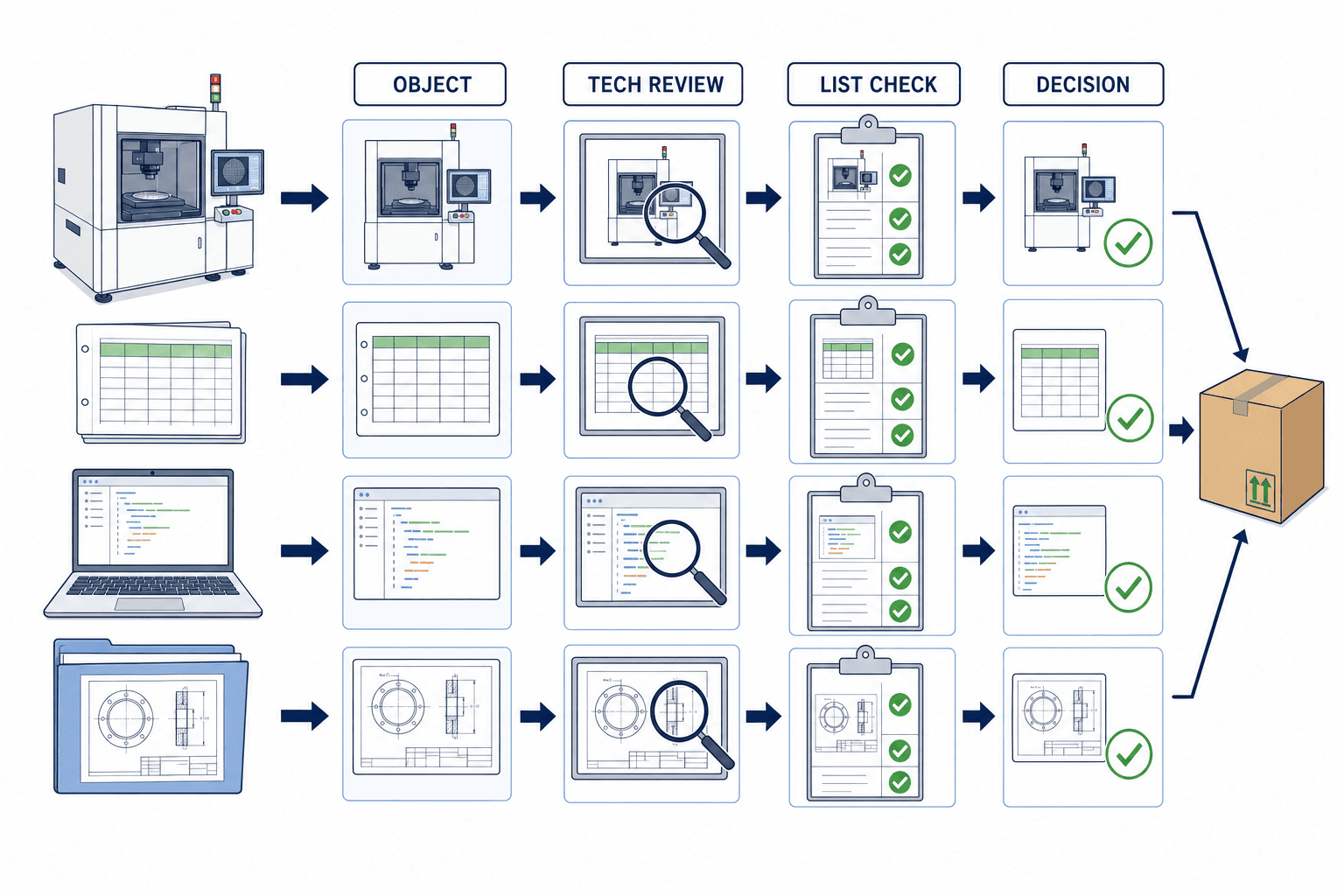
Classify configurations, not just model names
For a semiconductor line, inventory manufacturing and inspection machines, vacuum parts, precision encoders, control boards, sensors, special materials, spares, embedded software and engineering technology. Internal recipes, drawings and service instructions can matter when they are shared abroad or accessed remotely even if no physical shipment occurs.
Minimum classification-record fields
| Field | Required content |
|---|---|
| Object ID | Part number, software/document ID, BOM revision |
| Object type | Product, component, material, software or technology |
| Regime | Thai DUI, EU, another jurisdiction, contractual control |
| List edition | Publication/effective dates, URL and archived-file hash |
| Candidate entries | Entries reviewed and reasons for exclusion |
| Technical parameters | Threshold, design/test value, unit and conditions |
| Evidence | Datasheet, drawing, test report, supplier response |
| Conclusion | Entry, not listed, more information needed, external advice |
| Governance | Preparer, engineering reviewer, approver and dates |
| Recheck | Next date, change triggers and open questions |
A “not listed” conclusion is not an empty field; it is a versioned decision supported by technical facts. Record why alternative entries were excluded so a list revision can be assessed without restarting from zero.
Supplier classifications are inputs, not substitutes for company review. Ask for regime, classification, decision date, exact revision, technical basis and change-notification arrangements. Verify that the supplied configuration matches what is bought and resold. If evidence is unavailable, collect specifications internally, constrain use, hold shipment or seek specialist advice.
Semiconductor export control also covers software and technology risk
Do not examine only chips and capital equipment. Test programs, equipment control software, process parameters, layouts, masks, design data, maintenance instructions and remote-support sessions may require a technology/software assessment. Connect identity and access controls to the export-control ledger, recording who can access which revision from which country. Definitions, exclusions and exceptions must be checked under the applicable regime.
Build a versioned evidence ledger
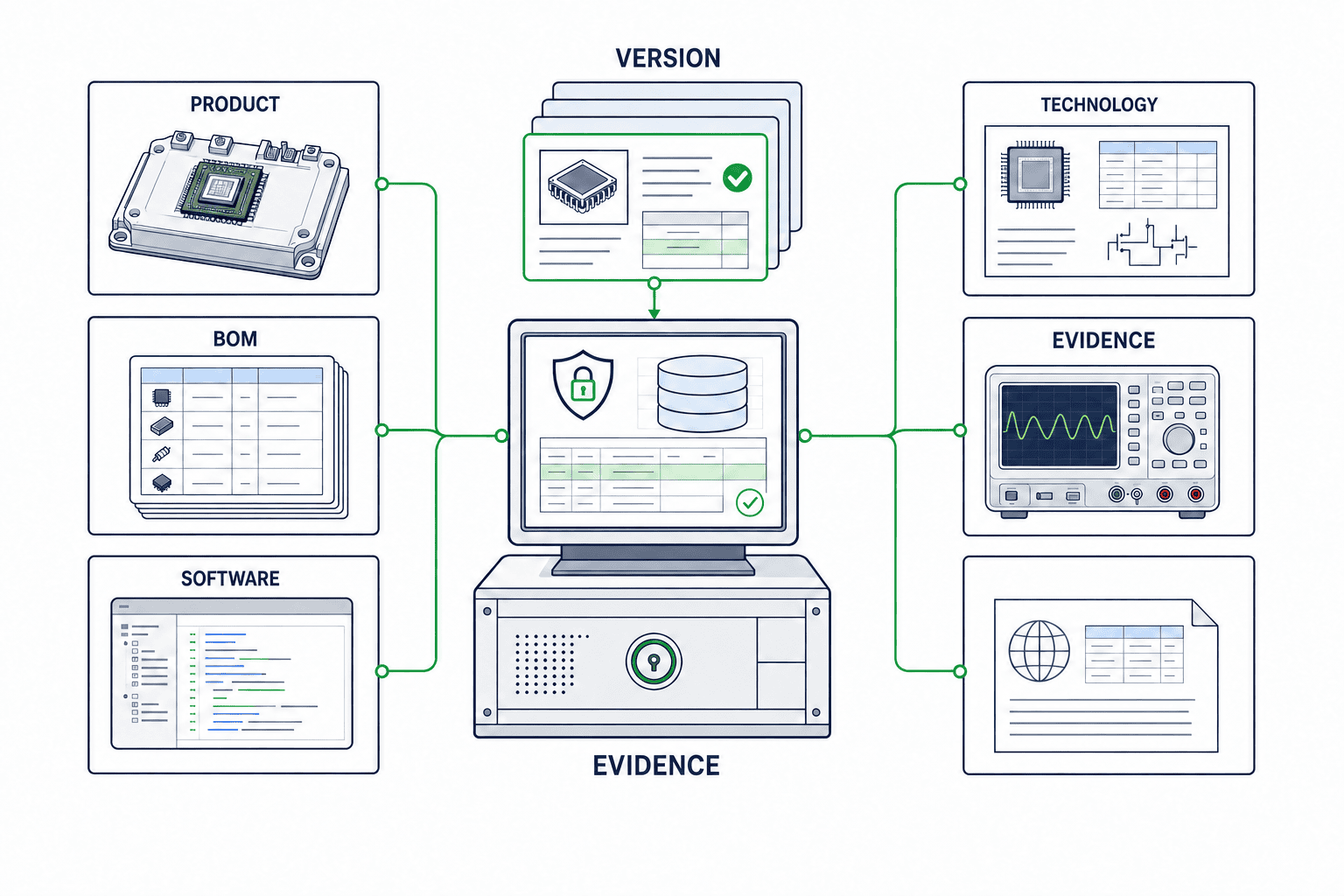
The objective is to reconstruct any shipment: what configuration moved, which list was effective, who decided, what evidence they used, and which party/end use was approved. Overwriting a single product-master field cannot provide that history. Use append-only classification decisions linked to:
- an object master for SKU, BOM, software and technical documents;
- evidence objects for specifications, drawings, tests, supplier statements and regulatory snapshots;
- classifications by regime, list edition and configuration revision;
- transaction reviews for order, parties, destination, end use and screening;
- licence records for number, conditions, value/quantity balance and validity;
- shipment releases showing referenced evidence and approver; and
- change events for BOM, firmware, performance, use, destination and legal updates.
URLs alone are fragile. Record issuer, retrieval date, applicable model/revision, language, storage location, hash and confidentiality. Where lawful, retain a PDF or snapshot of changeable web evidence. Protect technology files according to sensitivity and preserve access/change logs.
Turn end-user checks into analysis, not form collection
Identify the purchaser, consignee, end user, intermediary, payer and installation location, then evaluate whether the stated use fits the product and quantity. For a distributor order, visibility usually must extend to the downstream end user.
Collect legal name, registration and ownership; relationships among transaction parties; detailed process, final product and quantity; resale/re-export plans; possible military, nuclear, chemical, biological or missile connections; screening results; and an authorised, dated end-use statement. “Research”, “factory use” or “general electronics” is rarely sufficient. For a precision encoder, for example, ask which machine uses it, required accuracy and final product.
Escalate mismatched quantities, unusual routing, refusal to identify the end user, reluctance to explain specifications, or performance excessive for the stated civil use. A signed form does not cancel a red flag.
Put the Thailand DUI licence decision into a shipment gate
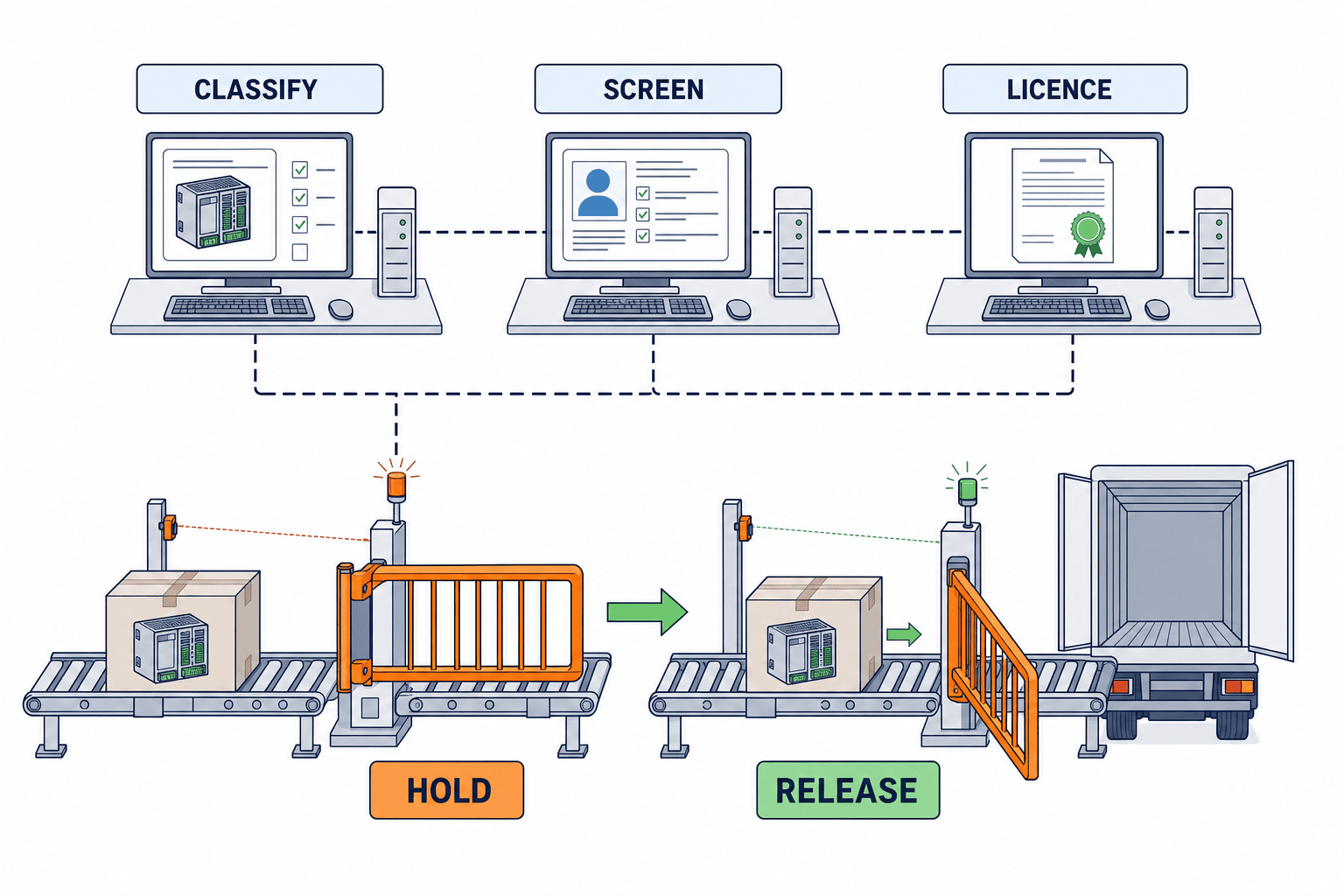
- Freeze configuration, quantity, parties, destination and end use at order review.
- If no valid classification exists, set
CLASSIFICATION HOLD. - If party or use data are incomplete, set
SCREENING HOLD. - If authorisation is required, set
LICENCE HOLD. - Link licence number, conditions, expiry and remaining quantity/value.
- After packing, reconcile actual model, serial, quantity and destination.
- Let an independent approver remove the hold and retain the audit record.
The Category 0 rollout does not make every other product automatically clear. Check WMD-related use/party risk, other jurisdictions and contractual conditions separately. Equally, do not impose a licence merely because a product belongs to the semiconductor industry.
Reclassify when facts change
Trigger review when a BOM component, supplier, origin or manufacturing location changes; when a chip, encoder or sensor changes performance; when firmware alters computing, encryption, accuracy or functionality; when a machine option adds test capability; when the scope of drawings, source code or process information expands; when customer, end use, route or destination changes; when a control list or licence condition changes; or when a supplier corrects old evidence.
Even when the result is “no reclassification needed”, record who compared which differences and why. The interval between publication and effective date of a future list can be used to identify affected objects and prepare time-dependent decisions.
A 90-day implementation roadmap
Days 0–30: inventory objects and define stop authority
Assign an executive owner and roles for export control, engineering, sales, logistics, IT and legal/external advice. Prioritise high-performance goods, semiconductor manufacturing/test items, encryption/communications, special materials, technology transfers, Category 0 candidates and sensitive destinations. Inventory products, BOMs, software and technology, marking missing evidence.
Define who can stop and who can release orders when classification, end use, parties or authorisation are incomplete. Even before full ERP integration, require a release ID before shipping documents can be issued.
Days 31–60: pilot classification and transaction review
Select 20–50 high-risk or high-revenue objects. Engineering extracts parameters; export control maps candidate entries; an independent approver challenges the rationale. Run real orders through end-user verification, screening, licence assessment and packing reconciliation. Capture exceptions and missing data, then improve questionnaires and workflows.
Send suppliers a standard request covering regime, entry, list/configuration revision, rationale and change notification. Give sales a consistent explanation of end-use questions so controls do not look arbitrary.
Days 61–90: scale, audit and measure
Connect ERP, PLM, CRM and evidence storage with common IDs. Review holds, classification lead time, missing evidence, expired decisions, unreclassified changes, licence-balance exceptions and post-shipment corrections. Pair speed measures with evidence completeness, audit pass rate and review returns.
Audit reconstructability: sample a shipment and trace actual configuration, then-effective list, engineering evidence, parties/end use, licence conditions and release approval. Repair data relationships and gates when the chain cannot be reproduced.
Illustrative workload calculation
This is a planning example, not an industry benchmark. Assume 1,200 active SKUs, with 15% high priority, and 1.5 engineering hours each: 1,200 × 15% × 1.5 = 270 hours. Add 40 priority software/technology objects at three hours each: 120 hours. The initial technical-review workload is 390 hours.
If two reviewers each provide 15 productive hours per week, 390 ÷ (2 × 15) = 13 weeks. Replace every input with plant data and budget separately for document collection, specialist advice, training and systems work.
Reuse traceability data without confusing its purpose
Export control can reuse BOM, supplier and revision data, but it is not the same as origin, DPP or cybersecurity compliance. Our guides on transshipment and origin traceability, iron and steel DPP readiness and ETSI EN 303 645 IoT security address those separate objectives. Export control adds technical thresholds, parties, end use, destination, licensing and release evidence. One “compliant” flag cannot replace them.
FAQ
Does every dual-use item require a Thailand DUI licence?
No. The initial 2026 licensing rollout specifically addresses nuclear-related Category 0. Check the current DFT notice, listed item, transaction and effective date; separately assess WMD end-use/party risk, other regimes and contracts.
Can an HS code determine dual-use classification?
No. HS is a customs classification. Control-list classification depends on technical characteristics. HS can help triage candidates but cannot replace a specification-based decision.
Is the EU 2026 update already in force?
Not at this article’s drafting date. The Commission adopted the delegated regulation on 14 September 2026; entry into force follows the usual two-month scrutiny and Official Journal publication. Recheck official sources at transaction time.
Is a supplier “not controlled” letter enough?
It is evidence, not the whole decision. Verify exact configuration, regime, list edition, date, rationale and change notification, then assess your finished configuration and any software or technology supplied.
Must end-user verification be repeated for every shipment?
Set a frequency proportionate to risk, but confirm at each release that the parties, end user, end use, destination, route and quantity still match the approved record. Perform a fuller review for a new customer or use, a changed destination or ownership, unusual quantities, expired evidence, a red flag or an applicable rule change.
Should drawings and remote maintenance be in the ledger?
Yes. They may involve controlled software or technology. Record document/revision, recipient, access country and approval basis, and verify applicable definitions and exceptions.
Conclusion: connect classification evidence to shipment release
A defensible system separates customs classification from technical classification, Thai rules from EU rules, and object classification from transaction screening. It versions products, BOMs, software and technology; investigates end users and uses; links licence conditions to holds; and reclassifies after change. The outcome is not a static spreadsheet but a reproducible shipment decision.
TOMAS TECH can help Thai and ASEAN manufacturers design the inventory, evidence ledger, BOM/document versioning, end-user review and ERP shipment gates. You can begin by defining required data and roles even before licence applicability for every object is settled. Contact TOMAS TECH.
Sources
- European Commission, 2026 update: https://policy.trade.ec.europa.eu/news/2026-update-eu-control-list-dual-use-items-2026-09-14_en
- Regulation (EU) 2021/821: https://eur-lex.europa.eu/legal-content/EN/TXT/?uri=CELEX:32021R0821
- Thailand DFT notice: https://www.dft.go.th/th-th/Detail-Law/ArticleId/30629/
- Thailand DFT advance applications: https://www.dft.go.th/th-th/NewsList/News-DFT/Description-News-DFT/ArticleId/30673/StyleSheetWidget
- Thailand DFT TMD/DUI laws: https://dft.go.th/%E0%B8%81%E0%B8%8E%E0%B8%AB%E0%B8%A1%E0%B8%B2%E0%B8%A2/cid/1140/-TMD-DUI
- DFT unofficial English translation: https://www.dft.go.th/Portals/0/Law/%E0%B8%9E%E0%B8%A3%E0%B8%9A-%E0%B8%AA%E0%B8%B4%E0%B8%99%E0%B8%84%E0%B9%89%E0%B8%B2%E0%B8%97%E0%B8%B5%E0%B9%88%E0%B9%80%E0%B8%81%E0%B8%B5%E0%B9%88%E0%B8%A2%E0%B8%A7%E0%B8%82%E0%B9%89%E0%B8%AD%E0%B8%87%E0%B8%81%E0%B8%B1%E0%B8%9A%E0%B8%81%E0%B8%B2%E0%B8%A3%E0%B9%81%E0%B8%9E%E0%B8%A3%E0%B9%88%E0%B8%82%E0%B8%A2%E0%B8%B2%E0%B8%A7%E0%B8%B8%E0%B8%98%E0%B8%97%E0%B8%B5%E0%B9%88%E0%B8%A1%E0%B8%B5%E0%B8%AD%E0%B8%B2%E0%B8%99%E0%B8%B8%E0%B8%A0%E0%B8%B2%E0%B8%9E%E0%B8%97%E0%B8%B3%E0%B8%A5%E0%B8%B2%E0%B8%A2%E0%B8%A5%E0%B9%89%E0%B8%B2%E0%B8%87%E0%B8%AA%E0%B8%B9%E0%B8%872562-2.pdf
- Thailand BOI semiconductor strategy: https://www.boi.go.th/index.php?_module=news&from_page=press_releases2&language=en&page=press_releases_detail&topic_id=138400


