


Equipment Manual Search AI 2026 | Citations Matter More Than Accuracy
When a machine stops, the first thing a technician does is not remember. It is search. Equipment manual search AI has become a live topic on the shop floor precisely because the time spent on that search leaves no trace anywhere. While the search goes on, the machine stays down. And yet, when reduced search time is the headline justification, this investment almost always underdelivers.
There is one decisive difference between searching equipment manuals and searching internal policies or an FAQ. It is where a wrong answer leads. If an AI returns an outdated clause from an HR policy, someone notices and corrects it. If it returns a tightening torque or a shutdown sequence from a superseded revision, equipment breaks or someone gets hurt. So the first design question is not how clever the answer is.
This article takes a clear position. What determines the outcome of an equipment manual search AI is not retrieval accuracy but whether every answer arrives with its citation attached. A citation here means four things. Which model and serial the answer applies to, which revision it comes from, which page it sits on, and what language that source document is written in. We call this the four-part citation and use it as the spine of the whole article. In Japanese-owned plants in Thailand and Vietnam, the fourth part becomes a wall of its own.
What Equipment Manual Search AI Is, and How It Differs From General Knowledge Search AI
Equipment manual search AI is a system that takes a natural-language question and locates the relevant passage inside technical documents such as operating manuals, maintenance manuals and troubleshooting procedures, then assembles an answer. Technically it is a form of knowledge search AI, built by retrieving from internal documents and having a generative model compose the reply. But the character of the source documents is different, so the design requirements diverge sharply from general internal knowledge search.
There are three differences. First, the answer touches safety and quality directly. Getting one clause wrong in a policy search delays a procedure. Getting one step wrong in a maintenance search means opening a line that still holds residual pressure. Second, the axis along which answers change is different. Internal rules change by date. Equipment manuals change by part number, model and serial. The same question text has a different correct answer depending on whether the target is machine three or machine five. Third, the source document was written outside your company. Policies are yours, so they are in your language. Equipment manuals were written by the machine builder, and in Japanese-owned plants they are frequently in Japanese.
How to handle questions whose answers switch by date, such as internal rules and HR policy, is covered separately in our article on internal helpdesk automation. This article stays on the other side of that line and deals only with searches that switch by model and serial.
The technician assistant that elevator maker KONE built on AWS is a useful reference point for this field. Its retrieval scope is user manuals, historical maintenance reports and IoT data from connected devices. The drivers were waiting time at the technical help desk and a shortage of experienced technicians. After a pilot with 100 users over three months, it grew to around 1,500 users across 11 countries, with a stated aim of reaching roughly 6,000 users within months and eventually all 40,000 technicians. What matters about the case is not the scale but the list of sources. Historical maintenance reports were in scope from the very beginning.
The Real Problem Is Not “Cannot Find” but “Cannot Read”, “Out of Date” and “Off Target”
Projects usually start with someone saying that manuals cannot be found. Dig into it and the symptom splits three ways. Each needs a different remedy, so writing them into requirements as one lump guarantees a miss.
| Symptom | What is actually the case | Does search AI solve it |
|---|---|---|
| Cannot read | The source is in Japanese and local staff cannot judge the content | Partly. The answer can be returned in the local language, but verifying the source needs separate handling |
| Out of date | The PDF on hand is a superseded revision and the current one sits in another folder | Not by retrieval alone. This needs revision control |
| Off target | The document exists, but the vocabulary in its table of contents differs from how the floor talks | Yes. This is the natural territory of semantic search |
As a side note, having the document does not by itself guarantee that skills carry over. In survey series No.194, published on 3 February 2020, the Japan Institute for Labour Policy and Training reported results from a stratified random sample of manufacturers with 30 or more employees, mailed to 20,000 companies. Only 45.0% answered that skill transfer was going well or somewhat well, and roughly 80% said they felt uneasy about future skill transfer. That survey covers skills broadly, including tacit knowledge. This article deals with the stage before that, where the knowledge has already been written down and still cannot be retrieved. If documentation is finished and the documents go unused, the problem lies with retrieval, not with the author.
The third symptom, off target, is the most natural fit for search AI. Being able to reach the right procedure by saying something like how to clear a jam on the filler, without remembering a document number, is the standard benefit cited by document management products built for manufacturing. That part works straightforwardly.
The trouble is the first two. Trying to solve them by improving retrieval accuracy fails no matter how many embedding models you swap in. Cannot read is a presentation-layer problem and out of date is a document lifecycle problem. Put the other way round, if you write both into the requirements from the start, justifying the investment becomes far easier.
Information Retrieval at 77.0%, Knowledge Management at 26.3%
The summary of the DX trend survey published by Japan’s Information-technology Promotion Agency (IPA) on 16 July 2026 carries figures that back this up. The fiscal 2025 round was run between April and June 2026 among companies in Japan.
Companies that have adopted AI came to 42.3% overall. Among those with 1,001 or more employees the figure is 78.3%, and among those with 100 or fewer it is 16.6%, a wide gap by company size. On outcomes, more effect than expected at 13.7% and as much effect as expected at 18.1% together reach only 31.8%, while the most common answer was some effect at 50.6%. On the nature of the effect, work became more efficient or faster stands out at 91.6%. The picture is that adoption is spreading but the benefit clusters around operational efficiency.
What matters for this article is the breakdown of use cases. Note that the figures below are shares among companies that have adopted or are using AI, not among all respondents. The largest is summarising, translating and proofreading documents and audio at 82.5%, followed by drafting documents and reports for internal and external use at 80.5%, then information retrieval, collection, analysis and reporting at 77.0%. Knowledge management and sharing, however, sits at 26.3%.
| Use case | Share |
|---|---|
| Summarising, translating and proofreading documents and audio | 82.5% |
| Drafting documents and reports for internal and external use | 80.5% |
| Information retrieval, collection, analysis and reporting | 77.0% |
| Knowledge management and sharing | 26.3% |
The gap between 77.0% and 26.3% is the starting point of this article. Among the companies using AI, three in four use it to look things up, while only one in four takes it as far as managing and sharing knowledge. The former is individuals using a tool at their desk. The latter is an organisational asset under operation. Equipment manual search is a domain where stopping at the individual stage is dangerous, because nothing records who decided what on what basis.
The machine builders are moving in the same direction. In a survey of 120 decision-makers at machine builders by IoT Analytics, 96% were at some stage of implementing AI, with 55% scaling specific use cases, 41% running proof-of-concept pilots and 4% at the planning stage. The leading barriers were high cost of AI at 54%, insufficient data infrastructure at 43% and workforce skills gap at 43%. In machine services, adoption rates were remote diagnostics 48%, service workflow automation 43% and AI-enabled augmented reality tools 30%. Note that the respondents build machines. These are not figures for factory users in Thailand. Read them as background showing that the equipment makers themselves are investing in diagnostics and service automation.
The Four-Part Citation for Technical Document Search AI
From here the discussion turns to design. What you should demand from technical document search AI is not the answer text alone. Specify a state in which the following four items come back alongside it.
| Citation element | What it returns | What happens if it cannot |
|---|---|---|
| Model and serial | The applicable model name and the range of serial numbers it covers | Someone performs a procedure meant for a different production lot of the same model |
| Revision | The revision number, its effective date, and confirmation that it is current | Someone applies a torque value or shutdown sequence from a superseded revision |
| Page | The chapter and page inside the document, and ideally the paragraph | Verification takes so long that in practice nobody verifies |
| Source language | Which language the underlying document is written in | Local staff cannot reach the source and take the answer on trust |

In an explainer published on 11 March 2026, the Japanese AI firm Emuni names hallucination and leakage of confidential information among the challenges of applying generative AI to manuals. Hallucination is described as output that presents information with no factual basis as though it were correct, and on the shop floor it can lead to serious accidents. The countermeasures the article names are restricting the material the AI is allowed to consult, and always making it state the manual page that the answer rests on. The second risk, leakage, is the concern that feeding data unguarded into a general cloud AI service allows reuse as training data and possible exposure to competitors, with on-premises environments or high-confidentiality enterprise cloud plus internal usage rules given as the response.
The four-part citation extends that always state the page rule to fit factory reality. A page alone is not enough. A page number only means something once the document is identified, and the document is only identified once the model and the revision are pinned down.
Drop Revision Control and Better Retrieval Brings the Accident Closer
Revision control is not a peripheral feature of search AI. It is a precondition. The reason is simple. The better retrieval gets, the higher the chance that a superseded revision surfaces. If both the old and the current revisions sit in the same index, there will always be cases where the semantically closer old one ranks first. Improving accuracy does not reduce accident probability. It sharpens the system’s ability to surface a plausible-looking obsolete procedure.
The revision-control patterns implemented by document management products for manufacturing are a useful reference. They should be read with the discount due to a vendor product description, but as a way of writing requirements they are concrete. The moment a new revision is approved and its effective date arrives, the old revision is automatically replaced at every access point, including tablets, workstation screens, mobile devices and QR code links. The old revision is retained for the audit trail but cannot be reached from the floor at all. Approval runs as a chain of author, reviewer and approver with electronic signatures. Communication extends to acknowledgement, with automatic reminders until every affected operator has confirmed with an electronic signature and timestamp. On top of that, the system flags procedures approaching their review date, documents referencing obsolete equipment or discontinued materials, and procedures citing superseded standards.
Three implementation points are worth taking from this.
- Do not delete old revisions. Isolate them. They are needed for audits and for tracing past incidents, so deletion is not an option. But remove them completely from the retrieval path used on the floor. Leaving them in the same index and relying on a weighting that prefers the current revision means the ranking will flip sooner or later.
- Make the replacement happen at every access point at once. If only the tablet view updates while printed booklets and locally saved PDFs remain, revision control is not in place. If paper will remain on the floor, design the paper recovery step as part of the process.
- Give revisions an effective date. An approved but not yet effective revision returned as the current one is also an accident. Approval date and effective date are separate attributes.
Revision control for drawings is covered in our article on drawing search AI. Whether the object is a CAD drawing or a prose manual changes how revisions attach and how coarse a change is, so if you hold both, design them separately.
Linking to Model and Serial Number, Because the Same Type Is Not the Same Machine
After revision, the next thing that bites is the link to model and serial. This is the technical core.
Questions from the floor take the form of what is the procedure when machine three throws this error code. If the document side carries attributes only down to type designation, retrieval can narrow no further than documents whose type matches. Yet within the same type, production lot and option configuration change the specification. A control panel refresh, an added safety relay, a change of conveyor supplier, each alters part of a procedure. The difference appears at chapter or paragraph level rather than across the whole document, so choosing one document is not enough.
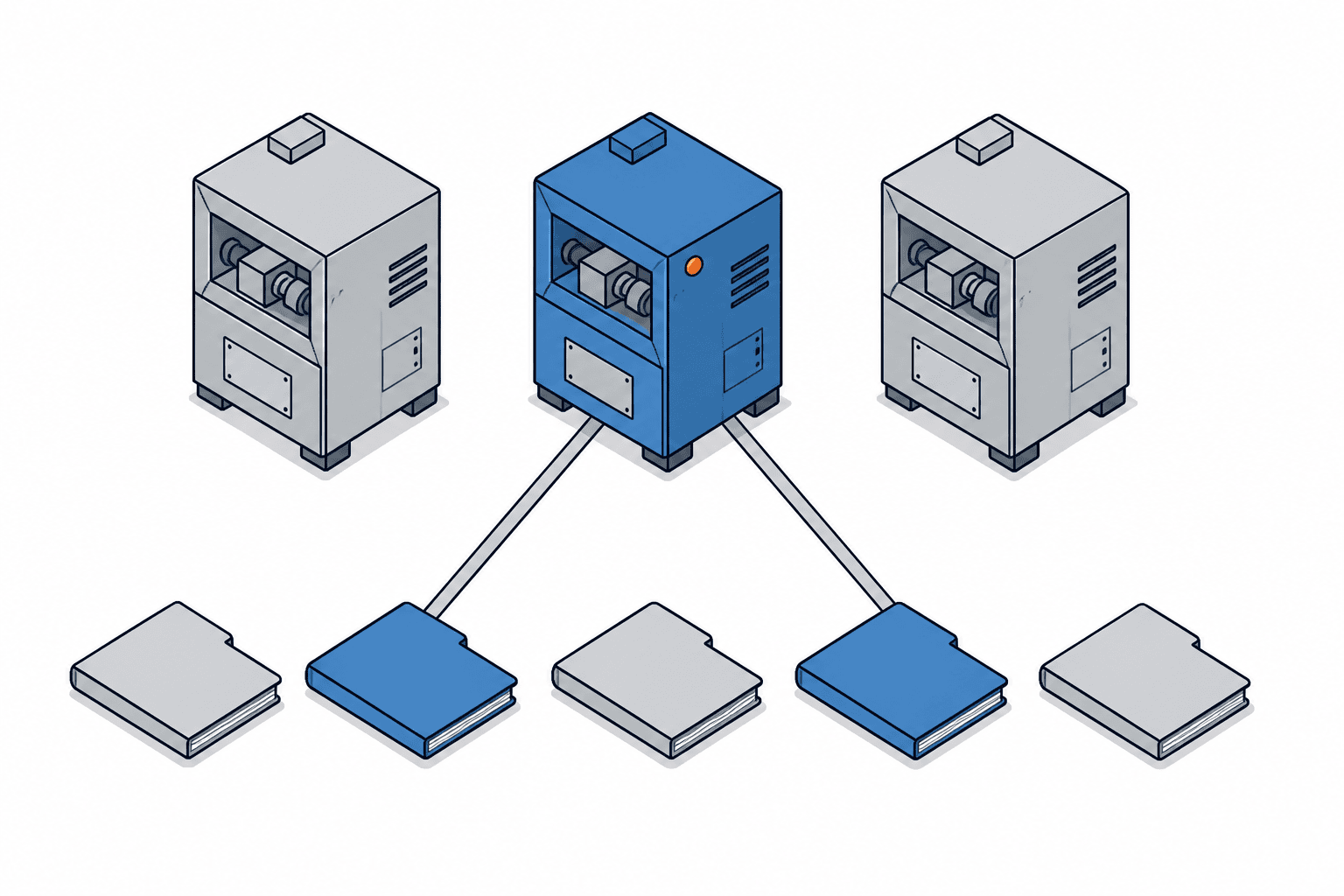
The link works when both the document side and the question side carry attributes.
| Side | Attributes to carry | Note |
|---|---|---|
| Document | Applicable model, applicable serial range, revision number, effective date, chapter | Machine builder originals are often written with range designations, which convert directly into attributes |
| Question | Asset number in local shop naming, model, serial number | The floor uses shop naming, so a register that maps shop naming to model and serial is required |
Many plants do not have that register, and in practice building the asset register becomes the first task. When there are three machines and five related documents, writing out line by line which machine corresponds to which revision of which document usually surfaces combinations nobody can identify. Resolving those unknowns sits outside the search system, but skipping it leaves you with a mechanism that simply returns a bundle of documents sharing a type designation.
Decide as well how to handle the way people actually ask. If someone says that filler over there without giving the asset number, the system has to confirm the target before answering. Answering with the most frequent machine instead of asking quietly breaks the first of the four citation elements.
The Multilingual Wall, Where a Japanese Source Cannot Be Verified
This is the point specific to Japanese-owned plants in Thailand and Vietnam. Most equipment manuals are originally in Japanese. That is obvious when the machine was shipped from Japan, but even for locally procured machines, maintenance procedures rewritten in house are often written in Japanese. The readers are Thai and Vietnamese speakers.
Returning the answer in the local language is not the hard part. What follows it is. The purpose of the four-part citation was to let the reader reach the evidence. If the evidence is a Japanese original, local staff can open the page and still not verify it. Presenting a citation that cannot be verified is more dangerous than presenting none, because readers reason that an answer with a citation attached is probably right.
So at overseas sites, design the answer language and the source language separately. The workable combination is the following.
- Return the answer in the local language and attach the relevant page of the source as an image underneath. Figures and symbols do not depend on language, so local staff can at least confirm from the figure which part the procedure addresses.
- Add local-language equivalents for headings and key points only on that source page. Not a full translation, but the chapter headings, warning notices and units attached to numbers. Narrow the scope and it stays maintainable.
- Do not let numbers and type designations be translated. Tightening torque, voltage, type designation and part numbers go out exactly as printed in the original, to avoid digits or units shifting during translation.
How to build multilingual retrieval and at which layer to place translation is covered in our article on RAG implementation. This article narrows to the applied case of finding the right passage.
One more point specific to overseas sites. Japanese expatriate staff typically rotate every three to five years. Where a Japanese maintenance procedure relies on assumptions a predecessor filled in verbally, those assumptions are not in the document, so no search system will surface them. That class of problem cannot be solved by searching explicit knowledge, and needs to be paired with the measures on the tacit side covered in our article on skill transfer AI. This article covers only the side where the answer is written down and still does not come up.
Designing for Hallucination Resistance by Implementing the Refusal to Answer
In a domain tied to safety, deciding the conditions under which the system must not answer is worth as much effort as raising the hit rate. Write these into the specification explicitly.
| Condition | System behaviour |
|---|---|
| The applicable document cannot be identified | Generate no answer. Return a request to confirm the target asset |
| The model is identified but the revision is not settled | Generate no answer. Return a request to confirm the revision |
| Retrieval similarity falls short of the threshold | Generate no answer. Return no match plus candidate document names |
| The question concerns shutdown, live-line work or pressure release | Return the answer together with a mandatory instruction to confirm against the physical original |
Generative models are poor at saying they do not know. They lean towards producing some text, so judge the refusal conditions outside the model. Blocking progression to generation the moment retrieval returns no candidate prevents most of it. Restricting the material the model may consult is likewise an effective measure, as Emuni’s article notes.
One more operational design point. Keep a history of answers. Record who asked what, and which revision of which document was returned as the basis. This exists so that the path can be traced if an incident occurs, and equally so that repeated questions point you back at the documents. If the same question arrives several times a month, that is not a retrieval problem. It is a writing problem in the document.
Growing Into Troubleshooting AI by Adding Near-Miss and Past Incident Records
Restrict the scope to manuals and the answerable range is limited to failures the machine builder anticipated. What is frequent in reality is the combination nobody anticipated. So adding unstructured data such as near-miss reports, past incident records, repair slips and comment fields in daily logs raises the value of the system as troubleshooting AI. In the KONE example above, the retrieval scope was user manuals and historical maintenance reports from the start.
They must, however, be handled differently. A manual is a master document approved by the machine builder. An incident record is a field observation, not an approved document. Mix them into one index and return them in the same format, and the observation gets read as a procedure. A note saying “we hit it last time and it worked” placed alongside the procedure manual becomes the procedure.

What is realistically buildable is separating the layers on the answer surface.
- Put evidence from the approved master in the upper block, with the four-part citation attached.
- Put past records as reference information in the lower block, with the record date, the recorder and the target asset, stating plainly that these are unapproved observations.
- Do not let the two be merged into a single passage. Merging them mixes the character of the evidence.
Decide this separation up front and adding past records becomes a matter of adding documents. Build a merged answer first and try to separate it later, and you are redesigning the answer surface. To avoid promising more than can be delivered, it is also wiser to keep any function that infers a cause from records out of the initial scope. Records are not causes. They are descriptions of what was done at the time.
How Far to Take Maintenance Manual Digitisation, and How to Narrow the Scope
Maintenance manual digitisation covers a wide span of work, from turning paper into PDF through splitting chapters and attaching metadata. This is where the cost sits. Emuni’s article likewise states that the usual approach is to convert manuals left as paper or PDF into a form AI can read, then build a mechanism that answers only on the basis of the latest internal manuals.
Attempting everything never finishes. Decide how to narrow.
| Criterion | Digitise first | Defer |
|---|---|---|
| Stoppage impact | Bottleneck machines whose failure stops production | Machines with a standby unit |
| Question frequency | Machines with many enquiries over the past year | Machines with no enquiry history |
| Document condition | Already in PDF with a table of contents | Paper only, with many handwritten additions |
| Safety class | Chapters covering shutdown, pressure release and live-line work | Chapters covering only cleaning and visual checks |
In practice, start from the documents for whichever machines rank high on these four axes. Loading every manual at once buries the work in attribute tagging. Narrowing to something like the 30 questions new hires ask most lets you finish the same period with citations included. Narrowing the scope is not a compromise. It is the condition for having all four citation elements in place from the beginning. Attaching attributes is per-document work, so without limiting the number of documents the quality of the attributes drops.
Draw the line by document type as well. CAD drawings belong to the territory covered in our article on drawing search AI, where title block OCR and drawing numbering schemes are separate technical elements. What this article addresses is operating manuals, maintenance manuals and troubleshooting procedures, in which prose, tables and figures are mixed.
Ninety Days to a System That Answers Thirty Questions
Emuni’s article organises adoption into a four-stage roadmap. First, taking stock of issues and setting priorities. Second, digitising knowledge and building RAG. Third, evaluation and operation led by the shop floor. Fourth, company-wide rollout and continuous improvement. Below is a ninety-day plan with this article’s points inserted into that skeleton.
| Period | What to do | Completion test |
|---|---|---|
| Day 1 to day 20 | Take stock of the questions. Extract the 30 most frequent from a year of enquiries and fix the target machines | For each of the 30, the document and revision holding the answer is identified |
| Day 21 to day 45 | Build the asset register. Map shop naming to model and serial | For every target machine, model and serial can be reached from shop naming |
| Day 46 to day 70 | Digitisation and metadata, retrieval infrastructure, citation return | All 30 questions return an answer with the four-part citation attached |
| Day 71 to day 90 | Shop floor evaluation. Maintenance staff use it in earnest and confirm the refusal conditions fire correctly | Not zero wrong answers, but a state where a wrong answer is caught immediately from its citation |
That last test matters. Make zero wrong answers the completion condition and you will never roll out. With the citation attached, the technician can judge the answer for themselves. The target is not a system that never errs, but a system in which errors are visible.
Costing the Investment on a Model Plant
Deciding on internal knowledge AI without a model turns the discussion abstract. The model plant below uses these assumptions. All figures stay in Thai baht (THB) and are not converted into any other currency.
- Located in Chonburi Province, Thailand. A Japanese-owned automotive parts maker with 420 employees
- 14 maintenance staff, with an hourly rate of 260 THB
- A Japanese expatriate engineer covering equipment, with an hourly rate of 900 THB
- Each maintenance member spends 36 minutes a day searching manuals and past records, over 20 working days a month
- Technical escalations to the expatriate engineer run at 24 a month, each interrupting both parties for 50 minutes
- Rework caused by consulting a superseded revision runs at 6 cases a year, at 18,000 THB each
Annual benefit splits into three lines.
| Benefit | Current annual cost | Reduction | Annual benefit |
|---|---|---|---|
| A Reduced search time | 524,160 THB | 45% | 235,872 THB |
| B Fewer escalations to the expatriate engineer | 216,000 THB | 40% | 86,400 THB |
| C Less rework from superseded revisions | 108,000 THB | 60% | 64,800 THB |
| Total | — | — | 387,072 THB |
Benefit A comes from 36 minutes over 20 days giving 12 hours a month, which across 14 people equals 524,160 THB a year. Benefit B comes from 24 cases at 50 minutes giving 20 hours a month, or 216,000 THB a year. Benefit C is 6 cases at 18,000 THB, or 108,000 THB a year.
Initial cost splits into four layers. The important property here is that every layer has a benefit attached to it. A layer carrying no benefit gets cut by the reader, and the conclusion changes the moment it is cut.
| Initial cost layer | Amount | Matching benefit |
|---|---|---|
| Layer 1 Document digitisation and preprocessing (PDF conversion, OCR, chapter splitting, metadata) | 480,000 THB | Precondition for benefit A. Without an index nothing comes back |
| Layer 2 Retrieval infrastructure and citation return | 320,000 THB | Benefit A |
| Layer 3 Linking to the model and serial register, and revision control | 260,000 THB | Benefit C |
| Layer 4 Shop floor UI (local-language display, citation links) and permission design | 190,000 THB | Benefit B |
| Total | 1,250,000 THB | — |
Annual running cost is set at 168,000 THB, covering cloud fees, model usage and the effort of maintaining revisions.
Annual net benefit is 387,072 THB less 168,000 THB, which is 219,072 THB. Divided into an initial cost of 1,250,000 THB, payback lands at 5.71 years.
Now to the thought every reader has next. Cutting layer 3 at 260,000 THB brings the initial cost to 990,000 THB, which looks like faster payback. But layer 3 is what produces benefit C, so cutting it removes 64,800 THB. Annual net benefit falls to 154,272 THB and payback becomes 6.42 years. Cheaper is slower. Cutting layer 4 at 190,000 THB has the same shape. Without local-language display local staff will not use it, so calls to the expatriate engineer do not fall. Benefit B of 86,400 THB disappears, and against an initial cost of 1,060,000 THB the annual net benefit of 132,672 THB stretches payback to 7.99 years.
The same structure appears in our article on RAG implementation, which handles the overall cost picture. Cost lands on permission design and integration with existing systems rather than on the retrieval engine itself. In this model too, the pure retrieval layer is only layer 2 at 320,000 THB, roughly a quarter of the total.
Sensitivity, or How Far It Holds When Adoption Slips
Payback of 5.71 years assumes the floor actually uses the system. Here is what happens when that assumption weakens. The factor is adoption among shop floor staff.
A caution is needed. This factor applies to benefits A and B, but not to benefit C. Benefit C comes from the mechanism that removes superseded revisions from the retrieval path on the floor. Once the old revision cannot be reached, incidents caused by following it fall regardless of whether anyone uses the search system. Applying the factor uniformly to all benefits erases that distinction and makes the result look worse than it is.
| Adoption | Benefit A | Benefit B | Benefit C | Annual net benefit | Payback |
|---|---|---|---|---|---|
| 100% | 235,872 THB | 86,400 THB | 64,800 THB | 219,072 THB | 5.71 years |
| 70% | 165,110 THB | 60,480 THB | 64,800 THB | 122,390 THB | 10.21 years |
| 50% | 117,936 THB | 43,200 THB | 64,800 THB | 57,936 THB | 21.58 years |
At 70% adoption payback is 10.21 years, and at 50% it stretches to 21.58 years. The width of that range shows that the investment decision turns on operations rather than technology. The IPA result, where “more than expected” and “as expected” sum to only 31.8% while “some effect” takes 50.6%, reflects the same structure. Adoption is achievable. Whether usage reaches the expected level is a separate question.
Measures that lift adoption concentrate on the shop floor UI and the refusal conditions. The answer comes back in the local language, the citation is attached, and when the system does not know it says so honestly. With those three in place, technicians keep using it. Return one plausible answer that turns out wrong, and that technician never opens it again.
Common Failure Patterns
Here are the failures that occur most often, organised by cause.
First, writing the business case on reduced search time alone. Even in this model, benefit A of 235,872 THB leaves only 67,872 THB after the annual running cost of 168,000 THB, which never recovers an initial cost of 1,250,000 THB in a defensible number of years. It works only with benefits B and C added. Both of those are tied to concrete functions, local-language display and revision control, so cutting the function removes the benefit.
Second, loading every manual at once. Attaching attributes is per-document work. The more documents, the lower the attribute quality, and once attributes degrade the four-part citation can no longer be returned, leaving a system that produces answers nobody can verify. Starting from 30 frequent questions is design, not compromise.
Third, deferring revision control. Proceeding on the basis of building retrieval first and adding revision control later means running the shop floor evaluation against an index that contains superseded revisions. If an old revision surfaces during the evaluation period, credibility on the floor is gone at that moment. Settle revisions first, then build the index.
Fourth, returning answers in Japanese. It works fine when Japanese managers try it, so the test passes. The moment it reaches local staff it goes unused, and escalations to the expatriate engineer do not fall. Benefit B vanishes entirely and payback stretches to 7.99 years.
Fifth, returning past incident records in the same format as manuals. When an approved procedure and a field observation appear identical, the observation gets executed as a procedure. Separating after mixing is hard, so split the layers on the answer surface from the start.
Summary, or What You Are Buying Is Not Accuracy but Verifiable Evidence
To restate the argument. What determines the outcome of an equipment manual search AI is not retrieval accuracy but whether every answer arrives with its citation attached. The citation is four items: model and serial, revision, page, and source language. A system that returns those four cannot be produced by improving retrieval accuracy. It rests on an asset register and on revision control.
Drop revision control and better retrieval means a better chance of surfacing a superseded revision. Retain old revisions for the audit trail, remove them entirely from the retrieval path used on the floor, and make the replacement happen at every access point on the effective date. The link to model and serial works when the document side carries applicable model and applicable serial range, and the question side carries a model and serial reachable from shop naming.
At sites in Thailand and Vietnam, the condition that the source is Japanese is added. Returning the answer in the local language is not sufficient. The design needs the relevant source page shown as an image, headings and warning notices supplemented in the local language, and numbers and type designations left exactly as printed. A citation the reader cannot verify is more dangerous than no citation at all.
On cost, the model plant gave an initial 1,250,000 THB and annual running 168,000 THB against an annual benefit of 387,072 THB, for payback in 5.71 years. That figure holds only with all four cost layers in place. Cut the revision control layer and it becomes 6.42 years. Cut the local-language display layer and it becomes 7.99 years. Because cheaper is slower, it makes more sense to shrink the initial cost by narrowing the document scope than to hunt for a layer to remove. And if adoption falls to 50%, payback is 21.58 years. Operations, not technology, decides the investment.
If You Are Considering Equipment Manual Search
Perhaps you cannot decide which documents to load first, or your manuals are scattered across PDFs and paper so the total volume is unknown, or the asset register and the documents do not line up. Enquiries at that stage are welcome. TOMAS TECH is based in Bangkok and works with Japanese-owned manufacturers across Thailand and ASEAN, covering everything from production management systems to building the information base of the plant. We can start by hearing how your documents and machines currently correspond, and helping you work out where to begin so that citations become returnable. Enquiries are welcome through our contact form.
Frequently Asked Questions
What is equipment manual search AI?
It is a system that takes a natural-language question, locates the relevant passage in technical documents such as operating manuals, maintenance manuals and troubleshooting procedures, and assembles an answer. Technically it is a form of knowledge search AI, but targeting equipment manuals changes the requirements in three ways. The answer touches safety and quality directly, the axis along which answers change is part number, model and serial rather than date, and the source was written by the machine builder so it is not necessarily in your own language. An implementation that returns only the answer text is therefore insufficient. The design must return the four-part citation of model and serial, revision, page and source language alongside it.
How much does equipment manual search AI cost to implement?
In the model plant used in this article, a Japanese-owned parts maker in Chonburi Province with 420 employees and 14 maintenance staff, initial cost is split into four layers totalling 1,250,000 THB, with annual running cost at 168,000 THB. The breakdown is 480,000 THB for document digitisation and preprocessing, 320,000 THB for retrieval infrastructure and citation return, 260,000 THB for linking to the model and serial register plus revision control, and 190,000 THB for shop floor UI and permission design. Note that the largest share is not the retrieval engine but the digitisation and preprocessing of documents. Real figures move considerably with the number of documents, the proportion still on paper, and how well the asset register is already maintained. Narrowing to 30 frequent questions shrinks the initial cost itself.
How do you stop knowledge search AI from returning the wrong procedure?
Combine three things. First, restrict the material it is allowed to consult. Limit the documents in the index and remove superseded revisions from the retrieval path used on the floor. Second, always make it state the page the answer rests on, a countermeasure also named in published guidance on generative AI for manufacturing manuals. Third, implement refusal conditions. When the applicable document cannot be identified, when the revision is not settled, or when retrieval similarity falls short of the threshold, generate no answer and return a request to confirm. Generative models are poor at saying they do not know, so make that judgement outside the model. The target is not a system that never errs but a system in which errors are visible.
Where should maintenance manual digitisation start?
Narrow the scope on four axes: stoppage impact, question frequency, document condition and safety class. Priority goes to bottleneck machines whose failure stops production, machines with many enquiries over the past year, documents already in PDF with a table of contents, and chapters covering shutdown, pressure release and live-line work. Loading every manual at once buries the project under the volume of attribute work. Once attribute quality drops, citations can no longer be returned and the system produces answers nobody can verify. Extracting the 30 most frequent questions from past enquiries and making those 30 answerable with citations is a realistic first goal.
How far can multilingual manual search actually go?
Returning the answer in the local language is entirely achievable. The difficulty lies beyond that, because if the source remains in Japanese, local staff cannot verify the evidence. The workable implementation is to return the answer in the local language, attach the relevant source page as an image, and supplement only that page’s headings and warning notices in the local language. Because it is scoped rather than a full translation, it stays maintainable. Numbers, units, type designations and part numbers are left exactly as printed in the original, to avoid digits or units shifting during translation. Note also that where a Japanese procedure relies on assumptions a predecessor filled in verbally, those assumptions are not in the document and cannot be retrieved. That problem sits outside the search of explicit knowledge.
References
1. IPA DX Trend Survey, fiscal 2025 highlights, published 16 July 2026
Source for AI adoption at 42.3%, the use case breakdown (information retrieval 77.0%, knowledge management and sharing 26.3%) and the outcome figures (more than expected plus as expected totalling 31.8%).
Highlights of DX and AI adoption trends among companies in Japan (PDF)
2. IPA DX Trend Survey portal
Positioning of the survey overall and data sets from earlier years.
3. Emuni, guide to generative AI for manufacturing manuals, published 11 March 2026
Source for the two risks of hallucination and confidential information leakage, the countermeasure of always stating the manual page behind an answer, and the four-stage adoption roadmap.
Guide to generative AI for manufacturing manuals
4. AWS KONE case study
A generative AI assistant for technicians drawing on user manuals, historical maintenance reports and IoT data. Source for the pilot of 100 users over three months, around 1,500 users across 11 countries, and targets of 6,000 and 40,000 users.
5. IoT Analytics, AI in machine building 2026
A survey of 120 decision-makers at machine builders. Source for AI implementation at 96%, the ranking of barriers, and adoption rates for machine service use cases. The respondents build machines and these are not figures for factory users.
6. iFactory, AI document management for manufacturing plants
Source for the revision-control patterns, namely simultaneous replacement at every access point on the effective date, isolation of old revisions for the audit trail, approval chains and acknowledgement, and AI flagging of expiring documents, plus the description of semantic search. This is a vendor product page.
AI document management for manufacturing plants
7. JILPT Research Series No.194 on skill transfer in manufacturing, published 3 February 2020
A stratified random sample of manufacturers with 30 or more employees, mailed to 20,000 companies. Source for skill transfer going well or somewhat well at 45.0%, and roughly 80% feeling uneasy about future skill transfer.


