


When considering “implementing AI for equipment alarm analysis” in manufacturing, the first challenge is not predicting breakdowns. The actual issue is that a flood of alarms often appears before and after a stop, making it difficult for on-site staff to quickly distinguish which alarms are the root cause and which are simply consequences. This article explains a practical approach for implementing AI to link alarm history, equipment status, and work records in order to present likely causes and the recommended sequence for checking them. Decisions related to safety will continue to follow the existing alarm design and operator procedures; AI is strictly limited to assisting with investigation.
What Problem Does Equipment Alarm Analysis AI Solve?
At the moment a piece of equipment stops, HMIs can show multiple alarms simultaneously, such as “motor overload,” “conveyor jam,” “downstream waiting,” or “communication error.” If you treat every message with equal weight and simply select the first one you see as the cause, you are likely to be misled by secondary alarms that occurred as a result of the primary issue. Conversely, it is also risky to treat only the first event in terms of timestamp as the root cause. Clock discrepancies in control devices, delayed logging, or mismatches between early symptoms and actual causes of stoppage all contribute to this challenge.
To address this, the unit of analysis shifts from “individual alarms” to “groups of equipment events.” By tracking each event’s initiation, restoration, acknowledgment, and reset, and by consolidating pre- and post-stop events by equipment system and process, AI can cross-reference similar past cases, alarm order, equipment status values, and descriptions from work tickets to present “likely causes to investigate,” along with supporting evidence. The final determination of the root cause, as well as recovery actions and line restart decisions, remains the responsibility of the shop-floor supervisors.
This use case is distinct from predictive maintenance or anomaly detection. Predictive maintenance seeks to estimate the possibility of a future breakdown. Anomaly detection finds behavior that deviates from normal. Alarm analysis as described here is for interpreting event sequences that have already occurred in order to clarify the appropriate response order. It is not about replacing existing thresholds or safety interlocks with AI.
The UK HSE explains that alarms should focus operators’ attention on required states and inform them of necessary actions. ISA-18.2 treats alarm priority, recording, operator procedures, training, evaluation, and management of change as ongoing activities. For this reason, before deploying AI, check whether the alarms themselves are meaningful and actionable at the site.
In an Alarm Flood, Prioritize Investigation Sequence Over Reducing the Number of Events
In an “alarm flood” scenario where many notifications surge in a short period, do not treat “reducing the number of visible events” as the main goal. Hiding important alarms may make the situation look improved on the surface, but it increases actual risk. Start by treating existing priorities and safety classifications as fixed criteria, then organize differences caused by duplication, chaining, and process state. Suppressing or changing the priority of safety-related notifications should always go through equipment manager’s change management processes.
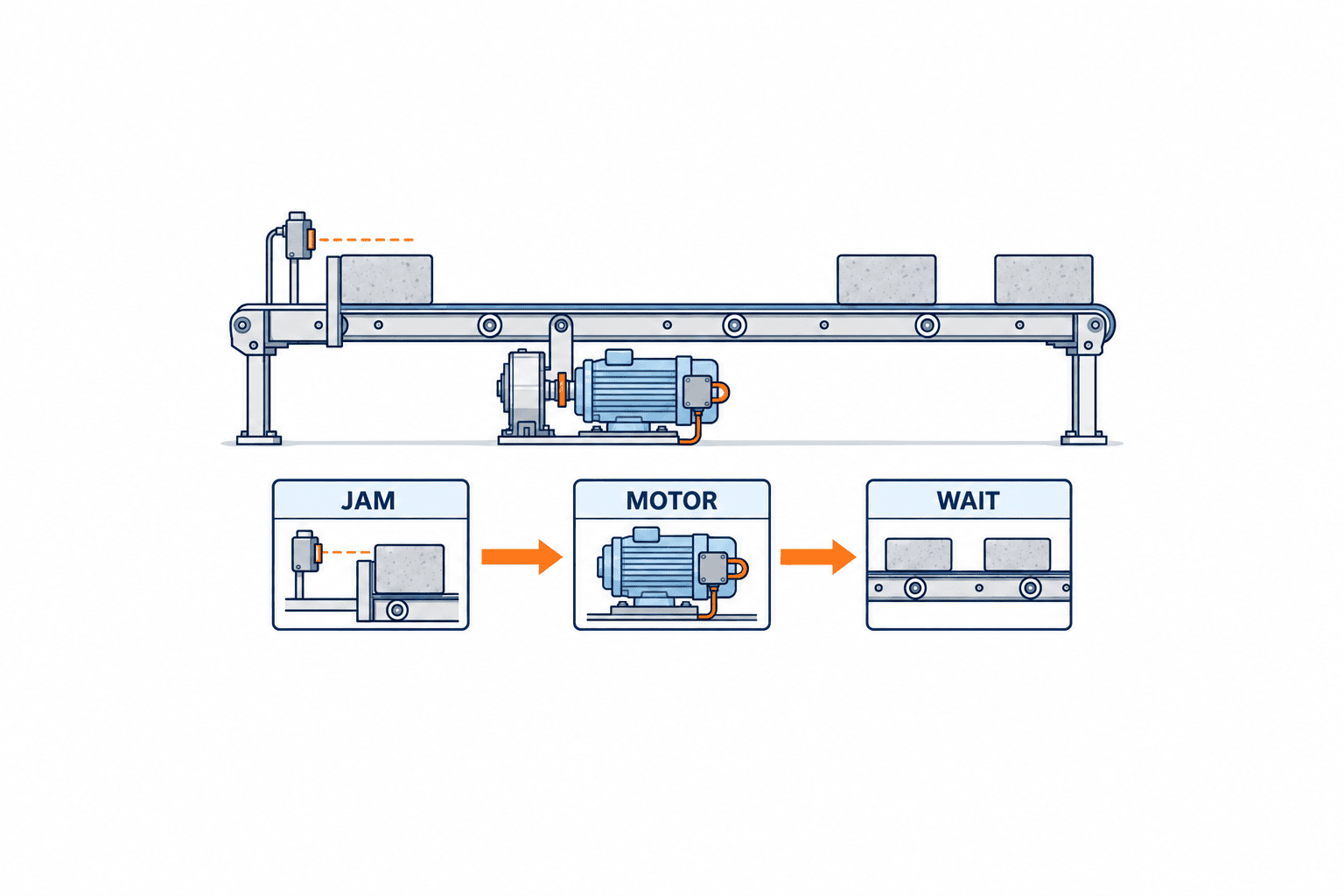
Let’s consider a concrete example. If an entry sensor on a conveyor detects a backlog, followed a few seconds later by a “motor overload” alarm, and subsequently a “waiting for transfer” alarm downstream, the fact that these three alarms appeared in a row does not automatically mean that “entry sensor is the root cause”—AI cannot make such a blanket conclusion. Possible explanations include a dirty sensor, actual workpiece blockage, drivetrain failure, or time synchronization discrepancies. Therefore, break down the candidates into “blockage at entry,” “sensor false positive,” and “drive system malfunction,” and indicate observation points required to check each. For example, you might inspect the sensor waveform at stoppage, motor current, or on-site visual inspection by an operator.
Next to each candidate cause, list both the “evidence” supporting it and “contradictory information” that could refute it. For example, evidence could be “the same sequence occurred on the same machine and product in the past”; contradictory data could be “if motor current at stoppage is normal, revisit the overload hypothesis.” Presenting the information this way allows the AI’s suggestions to be verified quickly, rather than being accepted uncritically.
Alarm History Data Points to Establish Before Implementation
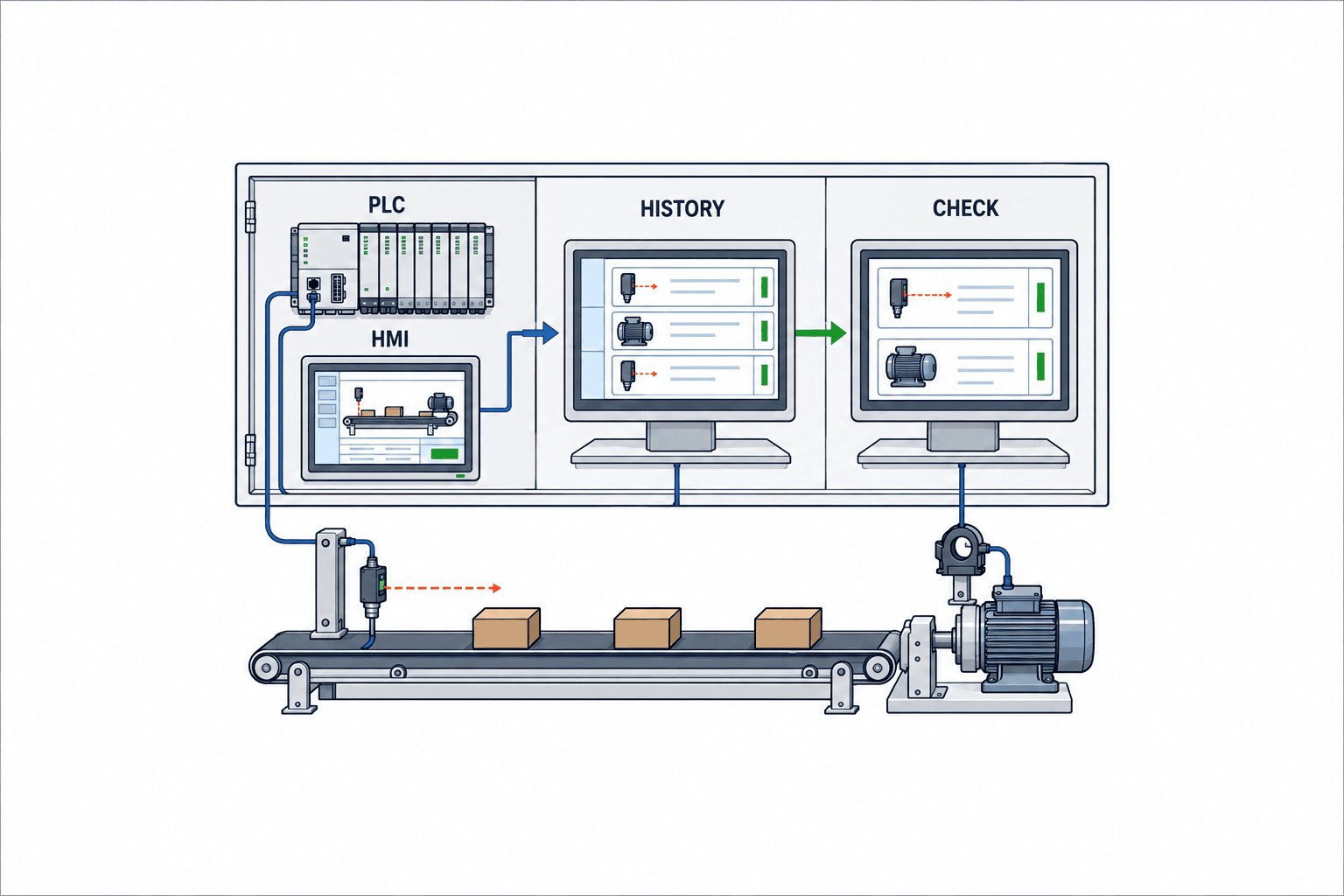
The first thing to check is not “can you capture HMI screens,” but whether you can reliably reconstruct event history. At minimum, confirm the presence of equipment ID, alarm ID, occurrence and reset timestamps, status, priority, message, operation mode, product or lot, shift, and stop event ID. For root cause analysis, also useful are acknowledgment time and operator, reset, manual stop, maintenance action, and restart time. If personal information is included, clarify its necessity and access permissions.
OPC UA Alarms & Conditions defines a model of Conditions (with states) and Events (state changes). OPC UA Part 11 defines how historical events are handled. However, using OPC UA does not mean history is automatically retained long-term. OPC Foundation states that alarm log retention is a client-side function, and which historical fields are available depends on storage settings. Connectivity protocol presence and availability of necessary logs for investigation must be verified separately.
Timestamp quality is especially important. If PLC, HMI, SCADA, MES, and maintenance systems have mismatched clocks, the apparent “first alarm” may be misleading. Record both the original timestamp and the receipt time, include time zone and synchronization status. In analysis, it is safer to display events with ambiguous order as “simultaneous or order unknown” rather than create misleading causal explanations. Do not try to deduce causes from millisecond-level orderings without evaluating timestamp accuracy.
Do not rely solely on alarm names to infer meaning—prepare an equipment configuration table as well. Map parent equipment, upstream and downstream relationships, sensors and actuators, process entry and exit points, and interlock relationships. If tag names change due to equipment modification, incorporate validity periods. If you can’t reconstruct the meaning of tag “ALM_003” at the time, comparisons to past cases will be unreliable.
Data Quality Checks to Confirm First
| Aspect | What to Check | How to Handle Issues |
|---|---|---|
| Timestamp | Time differences in PLC, HMI, history DB, time zones | Lower confidence in event order |
| Status | Missing occurred/restored/acknowledged/reset | Distinguish “not restored” vs. “missing” |
| ID | Changing equipment ID, tag, message history | Normalize using a dictionary with validity period |
| Context | Operation mode, product, lot, shift | Do not automatically fill unknowns |
| Actions | Linking work tickets to restart results | Limit scope of labeled learning |
This table is an example checklist for implementation. Not all equipment needs to have every item, but one common principle is never to hide data loss and display “root cause identified.”
How AI Narrows Down Likely Causes
Practically, implementation combines rules, statistics, and language models by function. In step one, enforce equipment alarm priorities, safety classifications, operating modes, and known interlocks using rules. In step two, use statistically frequent event chains within the same time window, the duration from first onset to recovery, and equipment-to-equipment positional relationships, to form sets of candidate events. In step three, search work tickets and past incident records to display both similar and dissimilar cases.
Language models are useful for reading tag names, work tickets, manufacturer documentation, and operator notes, and summarizing their findings in operator-friendly language. However, even if plausible explanations can be generated, language models do not directly observe the physical machine condition. Instead of stating definitively “the cause is bearing wear,” state: “In past work tickets, bearing replacement resolved this issue. For this case, vibration logs and direct onsite checks are necessary.” Show the referenced event IDs and document versions, and make it clear when speculation is presented with no source.
Be cautious when using past recovery results as training data. For example, “machine operated after cleaning” in a ticket does not prove dirt was the root cause—other adjustments or spontaneous recovery may have occurred simultaneously. Label data as “confirmed cause,” “strong hypothesis,” “action only recorded,” or “undetermined cause.” If you train on cases with unresolved causes as though they are correct, AI will simply reproduce the site’s assumptions.
When displaying candidate causes, evaluate not just simple frequency of occurrence, but also time order, equipment links, operation mode, and whether there was recurrence after action. Regardless of weighting scheme, display the “order of investigation.” Do not allow AI similarity scores to override safety priority; separate display and user permissions.
Five-Step Procedure for Implementing Equipment Alarm Analysis AI
1. Narrow Down Target Equipment and Investigation Scenarios
If you start with all alarms across the entire factory, you will face inconsistencies in tag meaning and ticket detail, making evaluation difficult. Start by selecting a population of equipment where investigation after stoppage takes a lot of time and repetitive alarm sequences occur—for example, conveyor systems, packaging lines, pump sets, or HVAC equipment. Define your objective explicitly as “reducing time to identify initial cause candidates” or “time to collect relevant records” rather than “predicting stoppages.”
It is also necessary for the teams in equipment management, production, maintenance, and quality to share common goals. For alarms involving quality, do not treat “restart” alone as success—include product lot quarantine and verification. For consecutive processes, large numbers of downstream alarms may be triggered by upstream abnormities. Decide what logs and what process scopes (upstream and downstream) to include at this stage.
2. Check the Alarm Register and Judgment Rules
Verify in the register the equipment IDs, tags, descriptions, priorities, required operator actions, and action deadlines. Classify safety, environment, and critical quality alarms separately, and explicitly define the conditions that take precedence over AI’s candidate ranking. ISA alarm management resources highlight priority, procedures, training, record-keeping, and audit as key lifecycle elements. If the AI project discovers flaws in the register, correct them on the equipment side rather than covering them up with the model.
If operator actions for an alarm are not defined, the notification may be useful for analysis but does not directly yield actionable recommendations. Make sure site procedures specify “what to check, who to notify, what not to do.” At this stage, also determine that decisions to bypass emergency-stop or safety interlocks will never be left to AI.
3. Group Past Cases and Distinguish Confidence Levels
Using stop event IDs as the axis, link before-and-after alarms, equipment values, work tickets, cause judgments, actions, and restart verifications. If work tickets just say “equipment error” with no detail, even lots of case data is not useful as supporting information. Class cases by level of confidence in the cause; prioritize those verified by site supervisors for evaluation. At the early stage, rather than setting fixed thresholds like 20 or 100 cases, focus on whether you’ve covered the typical abnormality patterns for the target equipment.
At this point, intentionally choose cases where “the same alarm sequence had different causes.” This tests for false assumptions. If the records alone are insufficient for determination, leave the cause label blank as “undeterminable.” To prevent tampering or retroactive editing, store original events and human annotations separately.
4. Validate Using Historical Data Before Deployment to Operators
Divide past stoppages by time period; configure using older data, then test with more recent data. If events from the same actual stoppage are split between training and validation sets, apparent accuracy can be misleadingly high. The goal is not only “was the correct cause candidate in the top list?” but also, “were essential safety or quality alarms always caught?” “Did justification point to correct events?” “Did the AI properly answer ‘unknown’ for unfamiliar cases?”
Metrics include correct answer inclusion in top candidates, time to begin investigation, proportion of times operators opened AI-supplied evidence, and number of misleads, among others. Only set numerical targets after measuring the current situation in your plant. Retain, as a benchmark, the time taken to respond to similar stops using traditional procedures.
5. Start With Shadow Operation, Expand via Change Management
Initially, display AI suggestions in parallel with current operator actions, without altering actual operations. Record errors and improve how candidate causes, equipment dictionaries, and work ticket searches are displayed. Next, use the AI solely as an investigation aid for approved equipment and shifts. Changes to operator procedures, alarm priorities, or connections to automatic control require separate approval processes. The design/management philosophy of EEMUA 191 and the NIST AI RMF’s focus on human oversight and continual evaluation align well with this phased rollout.
Display Not Only “Top Candidates” on Screen, But Also Verification Steps
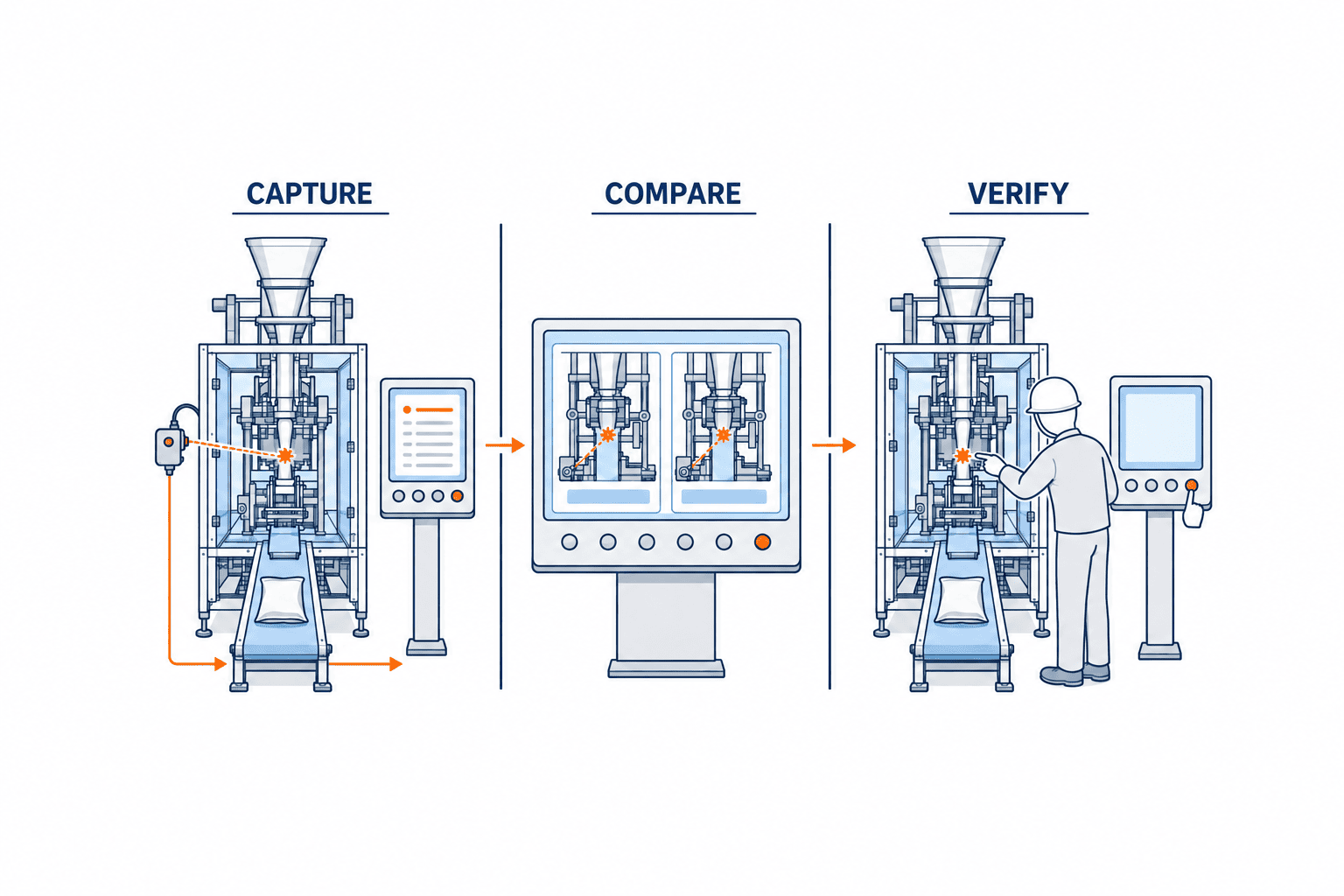
A user-friendly interface for AI is not one that simply displays lengthy explanatory text. Instead, it should allow operators to quickly decide “what to check next.” At the top, display high-priority safety and quality alarms using existing priority levels, and below that, show the current stop event as a single unit. For each candidate, list initiating events, related equipment values, past cases, points to confirm, and information that could not be verified.
For example, if presenting the candidate of “workpiece jam at transport entrance,” instead of just showing “80% probability,” also display supporting evidence such as: “entrance sensor remains ON,” “motor current increasing,” or “jam response occurred in the past with the same model type.” If model numbers are not yet calibrated, showing probabilities may risk misleading users into thinking the numbers represent objective failure rates. If needed, start with ranked expressions like “High / Medium / Low,” and only use calibrated numbers after verification confirms their significance.
For each candidate, attach methods for refutation. For example: “If there is no actual jam, check for sensor contamination and drive system,” or “Current history is missing, so this candidate is less reliable.” The ability for AI to express what it does *not* know is a critical quality during implementation. If operators record the reasons for rejecting a candidate and the corrective action taken, those records will help with future improvements.
When Considering Costs, Separate Connection Scope and Operational Burden
The costs associated with equipment alarm analysis AI are not limited to AI model usage fees. Initial setup varies greatly depending on whether events can be obtained from existing equipment, whether history retention periods are sufficient, if time synchronization is set up, and whether equipment dictionaries can be linked with work tickets. Even if you can obtain history from HMIs or SCADA, if states like recovery or confirmation are missing, the log system may need modifications. Furthermore, continued costs include tag updates after equipment modifications, on-site review, access rights management, and ongoing model evaluation.
When comparing estimates, standardize not just the number of target equipment, but also number of tags, items to be acquired, retention periods, connection methods, existing system modifications, screen and on-site training, and scope of monthly reviews. Do not make the AI’s answer accuracy the only contract condition—include requirements such as traceability to the evidence, not hiding major alarms, and the ability to report incorrect proposals.
When checking in a PoC, the goal is not simply to confirm “the demo gave the correct answer,” but to ensure that investigation time is shortened and misdirection does not increase with actual history data. Rather than quoting for a plant-wide rollout from the start, clarify assumptions by first checking data quality, evaluation, and operation procedures for one group of equipment, then calculating expansion costs.
Common Design Failures and Remedies
The first failure point is mistaking grouping of alarm floods on the UI for actual root cause analysis. Grouping similar notifications improves readability, but does not prove what initiated the issue. Always ensure that the original events can be opened and their order and state verified even after grouping. Second, it is a mistake to let the AI learn directly from tag names or work ticket narratives, ignoring equipment modifications or record errors. Versioning dictionaries and setting document validity periods are needed.
The third failure is using AI responses directly as work instructions. Especially for cases affecting safety, quality, or the environment, established procedures always take precedence. AI should suggest possible causes and points of reference, but operators should consult actual equipment, work manuals, or supervisors. The fourth is evaluating only successful cases. Always confirm handling for undetermined causes, missing logs, multiple causes, and time inconsistencies.
The fifth is failing to perform reviews after operations begin. Equipment modifications, product model changes, seasonal variation, and changes in maintenance methods can alter the meaning of the same set of alarms. From the perspectives emphasized by ISA on monitoring, evaluation, and change management, and NIST AI RMF on ongoing measurement, assign someone to collect incorrect suggestions and update the equipment dictionary and evaluation records.
How to Integrate With Existing Stop Monitoring and Quality Traceability
Stop monitoring provides the foundation for “when and how long production stops occurred.” Alarm analysis digs deeper into “what happened before and after the stop, and what should be checked first.” The link between these is the stop event ID, equipment ID, and timestamp. Link stop classifications with alarm groups to avoid counting the same stop separately. To review stop monitoring design, refer also to the article on minor stop reduction and equipment monitoring.
Quality traceability follows the relationship between specific lots or process conditions and defects. With equipment alarm analysis, if an alarm that may affect quality is issued, being able to look up which lots are involved speeds up decision making. However, product defects should not be assumed based solely on the presence of an alarm. Combine inspection results, lot boundaries, and process changes for evaluation. For cross-referencing data in root cause investigations, refer to the article on defect root cause investigation and traceability systems.
For cleanrooms or environmental monitoring, the meaning of equipment alarms may be tied to temperature, humidity, differential pressure, or other environmental conditions. In those cases too, you must distinguish between out-of-range readings, sensor failures, and actual equipment breakdowns. This article focuses on systems that correlate such multi-system events, providing an order of confirmation for operators.
How to Document PoC Acceptance Criteria
Before commissioning a PoC, mutually agree in writing on the success conditions. For example: “On the target packaging line, divide recent stop cases by period, and for each evaluation case, display the top three candidates, supporting alarm IDs, and the equipment values and physical checks to be performed.” For cases where the root cause is not determined on site, allow “undeterminable” as an outcome, and check that major safety or quality notifications are not buried in the candidate ranking. Set the time frame or number of cases according to actually available history and frequency of stops.
Operational requirements for the UI are crucial as well. Test steps from opening relevant alarm groups from a stop event, tracing evidence back to original logs, inputting rejections for candidates, and methods for handing over to different shifts. Even if the analysis results are correct, if too many screen transitions are needed to verify evidence, real-world effectiveness will be limited. Also test cases when data isn’t available from equipment, when network connections are down, or just after tag changes, to ensure the AI clearly states “cannot analyze” so operations revert to standard procedures.
Acceptance should also include operation for error reporting and re-evaluation. In monthly reviews, collect incorrect candidates, baseless suggestions, and unrecorded recovery actions, then update the equipment dictionary and searchable documents. After updates, verify improvements on the same test cases, and also re-test previous cases concerning safety and quality that were previously handled correctly. Record the dates of model or prompt changes, data range, and evaluation results, so you can later trace “which AI version presented what.”
What to Watch for in Multilingual Sites Like Thai Factories
In factories where Japanese headquarter documents, English machine manuals, and Thai or Vietnamese work tickets coexist, translation of terms alone does not ensure the meaning of equipment tags is unified. For example, even “jam” may have different on-site names for material supply shortage, discharge side accumulation, or by sensor position. Use language-independent equipment IDs and event IDs as common keys, and manage display names and explanations in each language. Keep the original text, add translations, and have technical terms confirmed by local staff for operational meaning.
For shift handovers, do not leave only the AI-generated text. Instead, structure records of original events, verified physical checks, unresolved points, and actions taken. If one shift records “sensor cleaned,” the next shift should see pre- and post-cleaning values and whether a recurrence occurred. As these records accumulate, plants can advance from simply tallying alarm counts to operations that review and revise the effectiveness of responses.
Responsibility Allocation for Handling AI Proposals on the Shop Floor
Analysis results of equipment alarms are interpreted differently by manufacturing, maintenance, quality, and information systems departments. Manufacturing personnel prioritize safe shutdown and physical inspections, while maintenance staff check equipment configurations and failure histories. Quality teams investigate potentially affected lots and inspection conditions, and information systems staff handle data loss, time synchronization, and access rights. Even if AI aggregates information onto a single screen, it is crucial not to obscure each department’s decision-making responsibilities. Before implementation, determine who records adoption or rejection of suggestions, actions taken, and approvals to resume operations.
After displaying likely causes, operation logs are retained. The AI’s version, range of referenced events, displayed suggestions, evidence reviewed by operators, and reasons for adopting or rejecting suggestions are all linked to the shutdown event. This enables clear distinction, at a later date, between what proposals the AI made based on which evidence, and what steps humans confirmed for recovery. Feedback used for learning is also tied not simply to approval/disapproval buttons, but to physical inspections and maintenance outcomes. This is because acceptances or rejections without supporting rationale are not treated as correct labels.
Procedures must also be in place for situations where AI services become unavailable on the shop floor. If the network or history server fails, outdated suggestions should not be presented as current, and the most recent obtainable timestamp with missing information should be indicated. A state should be maintained in which existing HMIs and paper or electronic operation procedures remain usable, ensuring that safety checks are not delayed while waiting for AI recovery. After reconnection, any missing periods must be identified and cases from those periods should be checked separately from the normal accuracy evaluation. Such behavior during failures is also an important point to test during the proof-of-concept phase.
Which Metrics Should Be Used to Evaluate Results After Implementation
After introducing AI, effectiveness is not evaluated solely by the accuracy rate of responses. First, record separately the time taken from the occurrence of a stoppage event to the start of the investigation, the time to gather the necessary logs and work orders, and the time to complete on-site verification. To assess the contribution of AI, compare these with data from past periods or shadow operation periods under similar equipment and operating conditions. If you simply average cases with different stoppage severities or product types, it may appear as though there has been improvement, but this cannot be properly explained. Since stoppage times are also influenced by production schedules and parts availability, it is important not to limit AI evaluation metrics to stoppage duration alone.
Next, monitor the safety and how the suggestions are utilized. Track the number of critical alarm oversights, the percentage of candidates supported by evidence, the rate at which the original logs are opened for confirmation, the proportion of cases appropriately put on hold due to unknown causes, and the number of detours taken due to incorrect suggestions. Even if the “number of suggestions made” is high, if operators are dismissing them without reviewing the rationale, it may be necessary to revise the screen design or data quality. Conversely, even if the adoption rate is high, there is an operational issue if on-site verification is being skipped. Alongside numerical data, keep records of cases of inaccurate suggestions and comments from field personnel.
During the monthly reviews, confirm modifications to the target equipment, tag additions, and any changes to product type or operating conditions. If there are changes that alter the meaning of the same alarm, update the search criteria and evaluation set for past cases. In the rush to show improvements, only presenting results that were favorable under past data should be avoided. Reevaluate performance for the new period and, in accordance with the acceptance criteria established during implementation, determine whether to expand, limit, or suspend use. Metrics should not simply serve as an “AI report card”; instead, they should be used as evidence to improve on-site investigative procedures.
Frequently Asked Questions
What is equipment alarm analysis AI?
It is a system that reads alarm history from equipment, in conjunction with operational status, equipment configuration, and past work records, to propose likely causes and key data to check. Its goal differs from predictive maintenance, which aims to forecast failures that have not yet occurred. Even when AI presents candidates, it does not automatically confirm causes or make recovery decisions.
Is it necessary to replace existing PLCs or HMIs?
Not necessarily. In many cases, history can be obtained from existing HMIs, SCADA, historians, etc. However, if only the occurrence time is recorded without reset, confirmation, or operating mode, review of log settings and connection method may be required. Feasibility should be based on checking the equipment and available data.
Is it safe to rely on AI for automatic suppression of alarm floods?
Uniform automatic suppression should not be assumed. Alarm prioritization, safety classification, and required responses should follow equipment management procedures. Even if AI organizes duplicate or chained alarms on screen, operators must always be able to trace back to the original critical alarms. Actual suppression and setting changes must be determined by evaluation and change management by equipment administrators.
How are the costs for equipment alarm analysis AI determined?
Cost varies depending on the number of target equipment, tags, history quality, connection method, integration with work tickets, on-site screen and training, and the scope of ongoing maintenance. Comparing only AI usage fees is inadequate. Practically, it is best to start with a single piece of equipment, confirm the necessary data and acceptance conditions, then estimate.
How do you verify the correctness of cause candidates?
Evaluate using actual past cases where the cause was confirmed on site, separated by time period. Besides checking if the actual cause appeared among the AI’s candidates, also review if any safety or quality notifications were overlooked, whether evidence can be traced, ability to defer unknown causes, investigation time, and risk of misdirection. After deployment, continue to incorporate operator feedback and reflect equipment changes in ongoing re-evaluations.
Summary
The purpose of introducing AI for manufacturing equipment alarm analysis is not to conclusively determine the “most probable cause” from large volumes of notifications, but to clarify event relationships and the order of checks for operators. The practical starting point is the alarm list, timestamp integrity, equipment structure, and work records. Verify with historical data and shadow operations on interfaces that maintain existing safety priorities and procedures, while showing both supporting evidence and refutation steps, before expanding scope.
Even if you are still just considering how to use alarm histories and which equipment to start with, feel free to contact TOMAS TECH for consultation. Together, we can check your current equipment setup and investigation procedures, and identify the necessary data and best starting scope for a pilot implementation.
References
- ISA, ISA-18 Series of Standards: Alarm management lifecycle, prioritization, performance monitoring.
- ISA, Alarm management life cycle: Alarm classification, recordkeeping, training, change management.
- OPC Foundation, OPC UA Part 9: Alarms & Conditions: Condition and Event modeling.
- OPC Foundation, OPC UA Part 11: Historical Access: Event history specification.
- UK Health and Safety Executive, Alarm management: Principles of alarms to inform necessary operator action.
- EEMUA, Publication 191: Guidelines for alarm system design and management.
- NIST, AI RMF Core: Human oversight, evaluation, risk management.


