


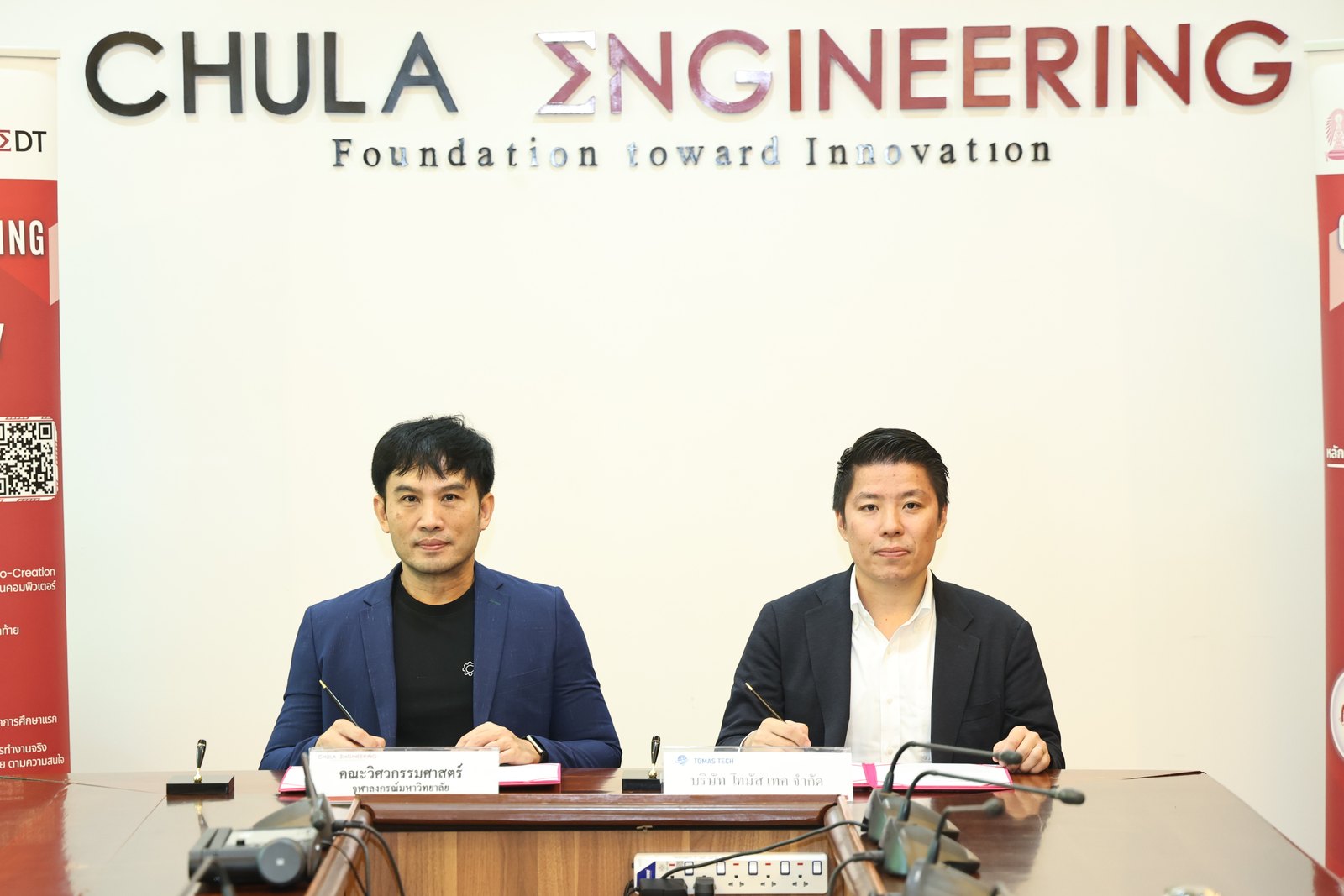
On 7 October 2026 we signed a Memorandum of Understanding with the Faculty of Engineering at Chulalongkorn University, covering the Faculty’s Bachelor of Engineering Program in Computer Engineering and Digital Technology (CEDT). This article does more than report the signing: it sets out why a system integrator partners with a university at all, and what industry-academia collaboration actually requires in order to work — based on what we have seen on site. We hope it is useful to anyone in Thailand considering talent development or a university partnership.
Conclusion: the shortage is not of people who can code, but of people who can define the problem
When you support the adoption of AI, IoT and automation in Thai manufacturing and logistics, the technology itself is rarely the obstacle. The obstacle is the absence of someone who can observe what is happening on site, talk to the people who run it, judge where automation will pay off, and connect that work to existing equipment and core systems without creating contradictions.
The number of people in Thailand who can write code is rising steadily. What remains scarce is the engineer who can pick up the constraints that were never written in the specification and translate them into a technical design. Across our work spanning IT, AI, OT and FA, this is precisely where we have created the most value.
Developing exactly that capability is what this agreement is for. In the announcement by Chulalongkorn’s Department of Computer Engineering, the stated aim of the cooperation is to develop students from mere programmers into solution-oriented computer engineers who can solve problems on the industrial floor.
The agreement in brief
| Item | Detail |
|---|---|
| Date of signing | Wednesday 7 October 2026 |
| Counterparty | Faculty of Engineering, Chulalongkorn University |
| Programme covered | Bachelor of Engineering in Computer Engineering and Digital Technology (CEDT) |
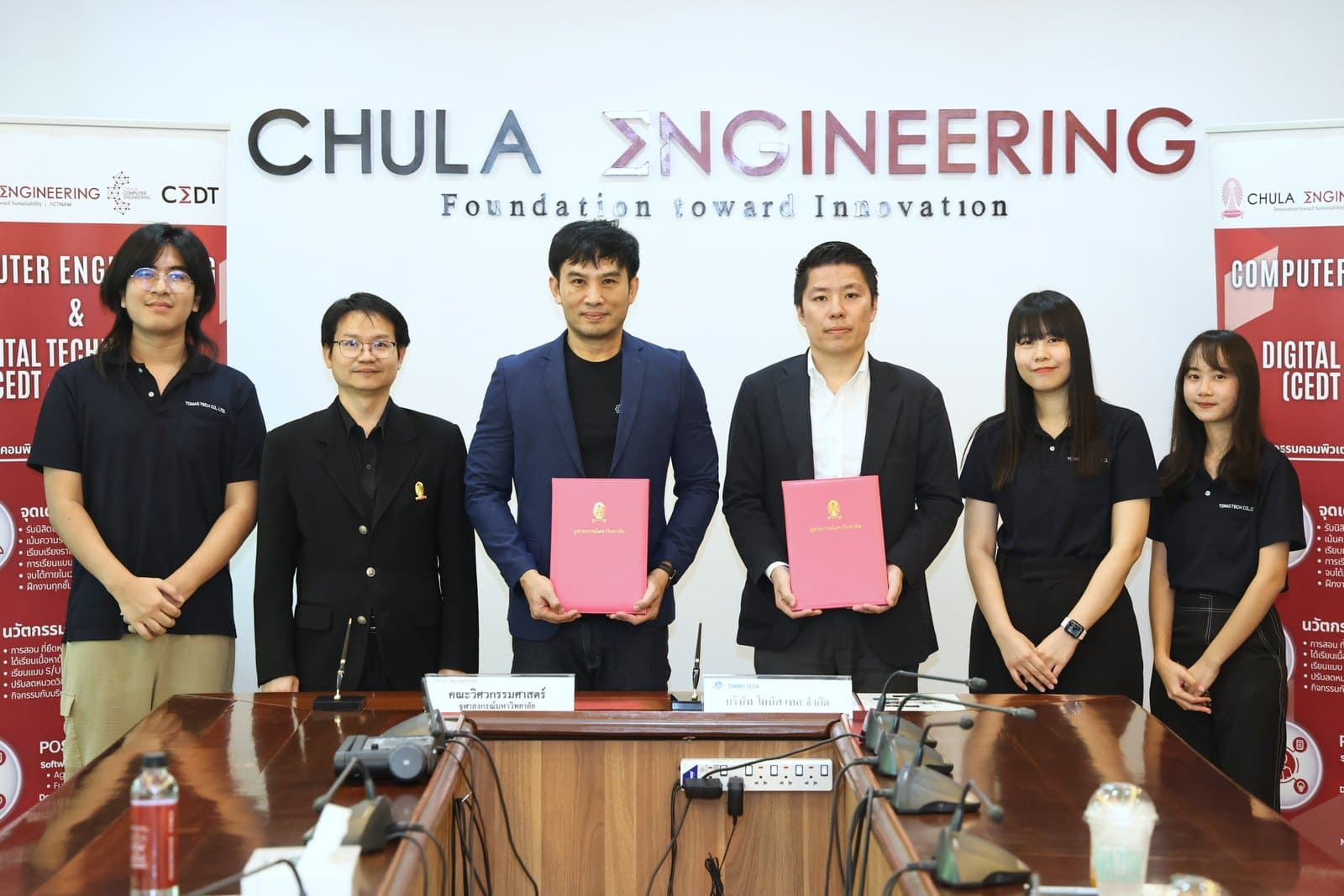
| Signatory, university side | Asst. Prof. Dr. Attawith Sudsang, Head of the Department of Computer Engineering, attending as the representative of the Dean |
| Signatory, company side | Ryo Nozaki, President and CEO |
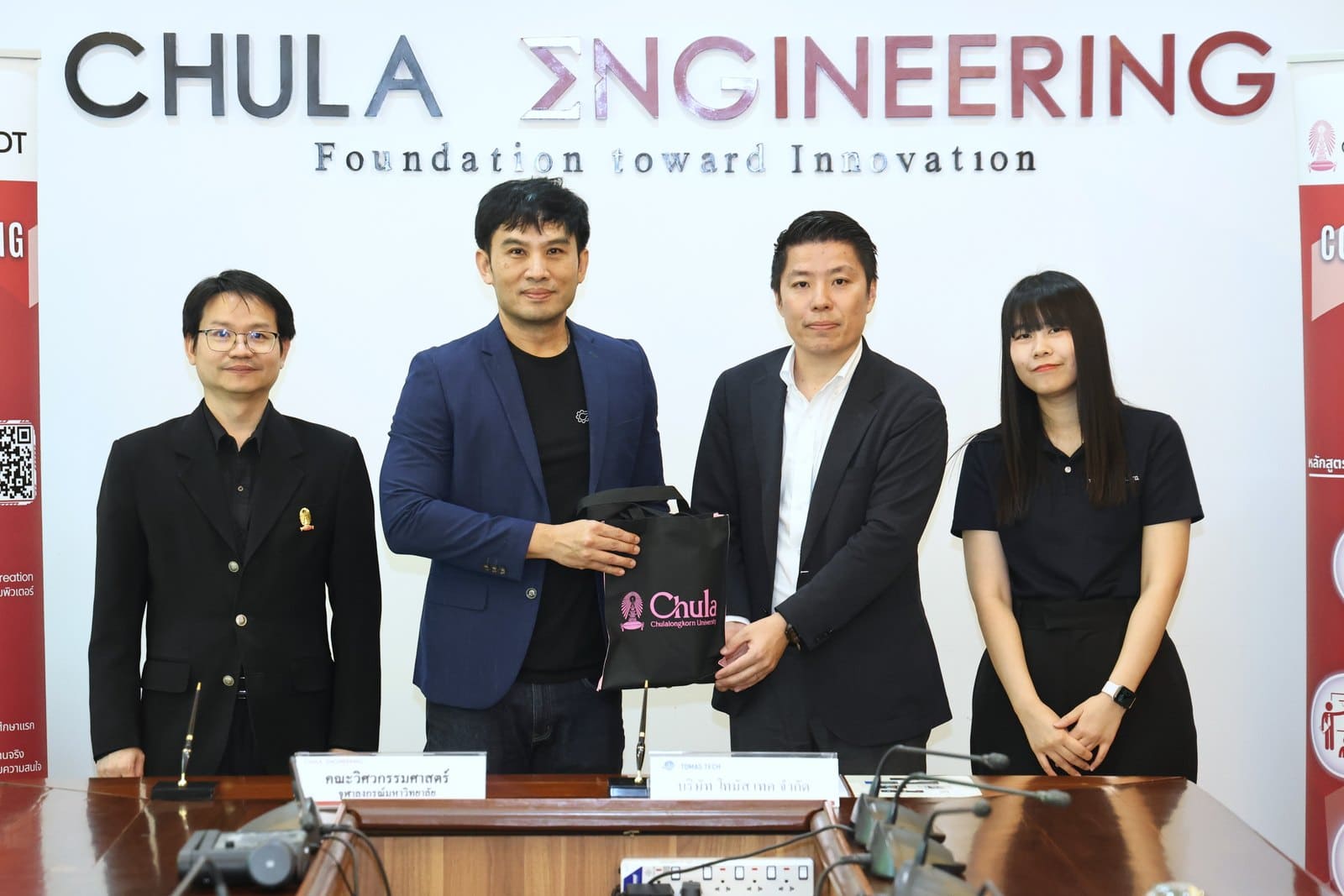
| Witnesses | Asst. Prof. Dr. Narongdech Keeratipranon, Chair of the CEDT Program / Kanthida Wannasiwaporn, Administrative Manager, TOMAS TECH |
| Term | Five years from signing, extendable by mutual written agreement |
CEDT runs under the Higher Education Sandbox
One point is essential to understanding this agreement: CEDT operates under Thailand’s Higher Education Sandbox. This is a regulatory framework that formally permits programmes to be run outside conventional higher-education standards, so that a curriculum can be designed around what industry actually requires.
In practice that difference matters a great deal. A company’s contact with a university is usually confined to the outside of a finished curriculum — guest lectures, hosting interns, recruiting graduates. In a sandbox programme, a company can take part from the curriculum design stage, bring real industrial problems in as teaching material, and participate in the assessment of students themselves.
In other words, the university and the company do not work in separate lanes; they turn the same development cycle together. That structure is what made this agreement worth signing for us.
What we will contribute
Under the MoU, we will support the Faculty principally in the following areas.
Co-supervising Capstone Projects
CEDT requires third-year students to integrate knowledge from several courses into a single body of work — the Capstone Project. We will supply themes drawn from problems happening on real industrial sites, with our engineers acting as co-advisors to support the students’ development work.
The value lies in working on problems that carry genuine constraints and contradictions, rather than problems tidied up for teaching. Requirements change midway; shop-floor practice differs from the specification; the data does not arrive as expected. In professional work these are ordinary events, but students rarely get to experience them before graduating.
Internships and cooperative education
We will host first- to third-year students for internships in the third term, and fourth-year students for cooperative education placements. Each placement is assigned a member of our staff as supervisor, and students are assessed against the criteria and timeframes the curriculum sets.
Teaching by practising engineers
Our engineers will serve as special lecturers and guest speakers on courses within the curriculum, covering the fields we actually work in: smart logistics, equipment and process visualisation through IoT, production traceability, paperless shop-floor forms, applied generative AI, and conveyance automation.
Curriculum feedback and the Job Fair
We will offer recommendations for improving the curriculum and teaching content in light of technology trends and shifts in industry requirements, and will take part in the department’s Job Fair on an ongoing basis.
What we think it takes to make industry-academia collaboration work
Setting the agreement aside, the following is what we have concluded from practice — because collaborations of this kind very easily stop at the signing.
First, choosing the theme is the company’s responsibility. A problem handed to students teaches nothing if it is too small and never finishes if it is too large. It also has to be plausibly completable within the term, and safe to fail without affecting the business. Only the company, which knows the site, can draw that line.
Second, supervision cannot be a side task. Naming a co-advisor achieves nothing on its own. Students get stuck less on the technology than on how to decompose a problem and how to check assumptions with the people involved, and whether you can staff that properly decides the outcome.
Third, if you are going to assess, articulate your criteria in advance. When our staff sit on an evaluation panel, the question is not only whether the thing ran, but whether the problem was defined soundly, whether the design respects the constraints, and whether it could be operated in practice. Without deciding in advance what the company considers good, assessment drifts into impressions.
Fourth, close the loop back to the students. What happened to the project inside the company — was it used or not, and if not, what was missing? Without that feedback, the work becomes an assignment that ends at submission.
Looking ahead
Under this agreement we will progressively begin providing Capstone Project themes, hosting students for internships and Co-op placements, and sending engineers to teach, from the 2026 academic year onward.
As a Japanese-affiliated company based in Thailand, we are honoured to take part in connecting Thai higher education with industry. It is also, frankly, talent development for us: students who come to know our work through an internship or a Capstone Project may well become colleagues.
If you would like to discuss talent development, industry-academia collaboration, or DX on the manufacturing and logistics floor in Thailand, please get in touch through the TOMAS TECH enquiry page.
References
- Announcement by the Department of Computer Engineering, Faculty of Engineering, Chulalongkorn University (in Thai): https://www.cp.eng.chula.ac.th/blog/archives/44832
- Post on the Department’s Facebook page: https://www.facebook.com/share/p/1Gp8vcEPFD/


