


Search for a chatbot comparison and you’ll find an overwhelming list of options — LINE, Microsoft Teams, generative AI tools, traditional FAQ bots — and it’s easy for the decision to stall because it’s unclear which one actually fits your company. What actually determines the outcome isn’t a specific product name, but which of four architectures — the LINE Official Account type, the Teams / Copilot Studio type, the RAG-based generative AI type, and the scenario-based rule-driven FAQ bot type — matches the nature of your inquiries. This article uses a model factory based on a Japanese-owned auto parts plant in Thailand to compare where each of the four categories fits and what it costs.
Why you should decide “which category fits” before asking “which chatbot is best”
Chatbot rollout discussions tend to stall in the same place. It isn’t a feature comparison between individual products — it’s the single question of whether this kind of mechanism even fits our inquiries in the first place. And product brochures rarely answer that question. Feature lists describe what a tool can do, but they rarely say which type of inquiry — external or internal, routine or cross-document — that capability is actually effective for.
That doesn’t mean adoption itself has stalled. According to UOB’s Business Outlook Study 2026 (Thailand H1, surveyed January 2026, n=265 Thai SME owners and executives), 71% of Thai SMEs say they have already adopted AI in their operations. Four out of five companies have adopted digital technology in at least one department. The market is clearly moving into a mature phase.
At the same time, there’s a gap between how fast companies adopt and how mature their operations are. According to the Microsoft Work Trend Index 2026 (Thailand edition), 32% of Thailand’s workforce qualifies as Frontier Professionals who use AI daily — twice the global average of 16%. Eight out of ten managers in Thailand encourage their teams to redesign work around AI, but only two out of ten teams have documented that success as a standardized workflow. Adoption is fast, but standardization and governance haven’t caught up. That same pattern applies directly to choosing a chatbot category.
The argument of this article is simple. What determines whether a chatbot comparison succeeds isn’t which product you choose — it’s which category you apply to which type of inquiry. Pick the wrong category and you can end up having invested money while the bot answers almost none of the questions it receives, leaving net benefit permanently negative. That failure usually doesn’t surface until well after the bot has been running, so it needs to be caught at the comparison stage.
That’s exactly why governance design should come before choosing a category
Precisely because there’s a gap between fast adoption and slow standardization, this article proposes an order of operations. Before choosing a category, tentatively settle the governance design — who approves answers, and how far the scope of an answer should extend. The reason is simple: if you decide the category first and leave governance for later, you’ll end up arguing over who is responsible for a given answer after the fact, and the strengths of the category you picked go to waste. Response-authority design itself is covered in detail elsewhere — for customer-facing use, see Response Authority Design for Customer Service Chatbots; for internal use, see Knowledge Management for Internal Helpdesks. This article focuses narrowly on the material you need to choose a category.
Assumptions behind the model factory
To keep the discussion grounded in actual figures, we set up a model factory with the following conditions. These are assumptions for the purpose of estimation, not measured values from a real factory.
| Item | Setting |
|---|---|
| Location | Amata Nakorn Industrial Estate, Chonburi Province |
| Industry | Japanese-owned automotive parts manufacturer |
| Employees | 380 (340 Thai staff, 40 Japanese expatriates) |
| Cost per manually handled inquiry | 50 THB (300 THB hourly wage x 10 minutes handling time / 60 minutes) |
This factory has four inquiry scenarios living side by side, each with a different character: shipment-status and quote inquiries from distributors and business partners (external, 700 per month), the internal helpdesk (routine questions about expense reports, work rules, and the like, 450 per month), cross-document search of quality and technical documents (drawings, work standards, spec-change history, 400 per month), and simple internal FAQs (leave policy, benefits, and similar, 380 per month). Even though all four get lumped together under the word “chatbot,” it doesn’t make sense to apply the same category to all of them.
Overview of the four categories — LINE Official Account, Teams / Copilot Studio, RAG-based generative AI, and scenario-based FAQ bot types
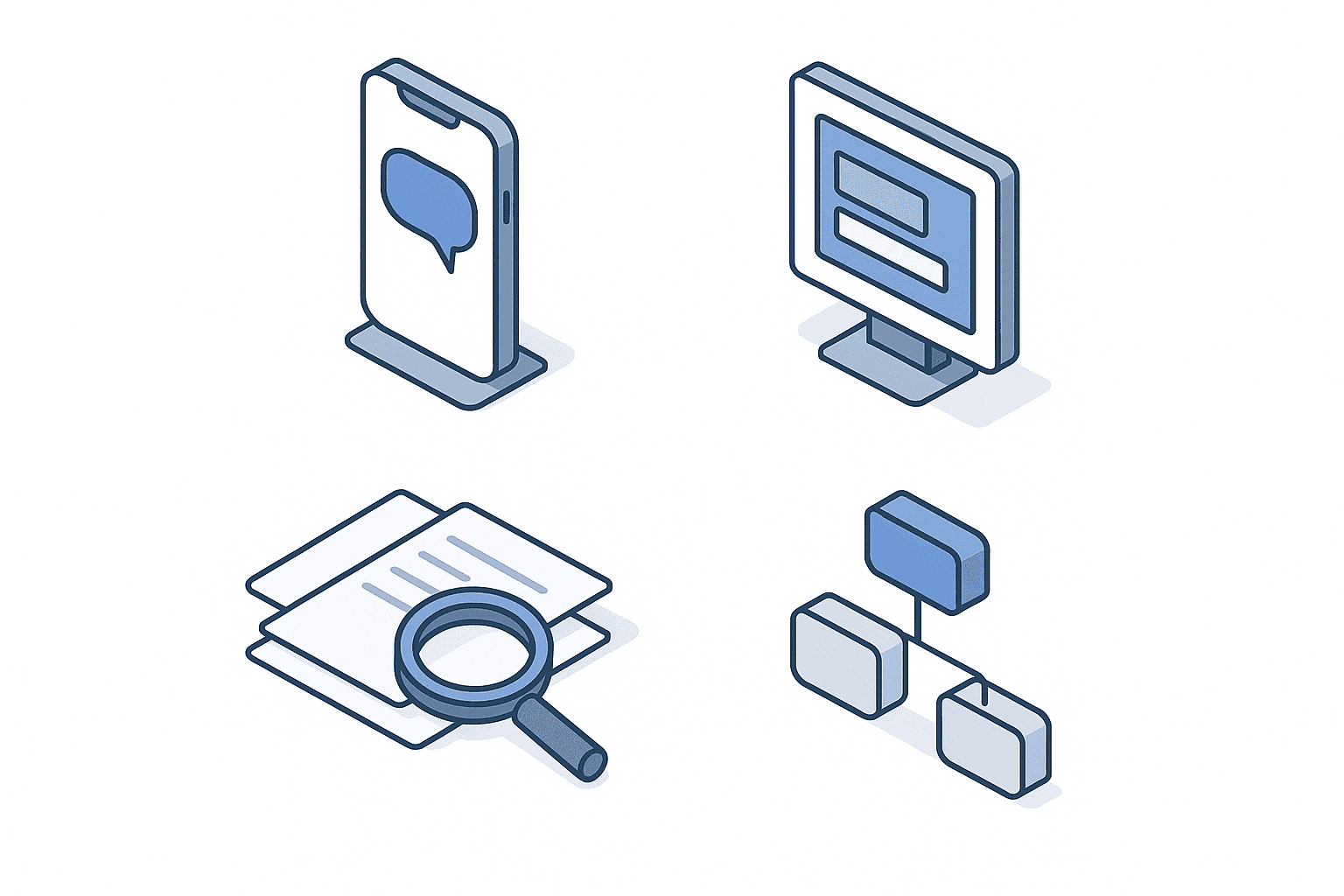
The first thing to check when choosing a chatbot isn’t how rich the feature set is. It’s which channel, and what level of question complexity, that category was designed to handle. That gives us four categories.
| Item | LINE Official Account type | Teams / Copilot Studio type | RAG-based generative AI type | Scenario-based rule-driven FAQ type |
|---|---|---|---|---|
| Main channel | External (customers, partners, distributors) | Internal (employees in an M365 environment) | Either external or internal | Either external or internal |
| Strong at | Simple one-off Q&A, notifications, intake | Routine questions grounded in internal documents | Complex questions spanning multiple documents | Routine FAQs with a limited number of patterns |
| How answers are built | Pre-designed rich menus + simple replies | Summarization and answer generation by generative AI | Document search + generative AI that cites its sources | Pre-built branching flows / FAQ matching |
| Weight of initial investment | Light | Moderate (varies with licensing) | Heavy | Lightest |
| Tolerance for unexpected phrasing | Low (mitigated with a supplementary FAQ function) | Moderate | High | Low |
| Technical maturity | Well established | Practical stage (evolving rapidly as a product) | Practical stage (requires expertise to build and tune) | Well established |
As a practical starting point for thinking about how to choose among the four categories, the approach proposed in a framework for comparing AI chatbots is worth referencing. List roughly 20 inquiries from the past month and sort them into ones a scenario flow can handle, ones an FAQ can cover, and ones that can only be answered by cross-referencing documents. The higher the share of that third group — cross-document questions — the more an investment beyond the RAG-based type pays off. This article layers a second axis onto that sorting exercise: whether the channel is external or internal.
Why look at the channel (external vs. internal) first
The LINE Official Account type is strong for external channels because LINE is already widely used in Thailand, and the barrier to getting a company account added as a friend is low. The Teams / Copilot Studio type, on the other hand, targets employees who are already using an M365 environment daily, which makes it unsuited to general external users. The RAG-based type and the scenario-based type aren’t tied to a particular channel, but that means their fit instead depends on what level of question complexity they’re strong at. When reading the category overview table, check which row — which channel and complexity level — your own inquiries fall into before comparing the columns (categories).
Where the LINE Official Account type fits, and where it doesn’t
A LINE chatbot is the category with the lowest barrier to entry when a company wants an external-facing point of contact. Given how widely LINE is used in Thailand, its biggest advantage is that it lets you consolidate interactions with distributors and business partners inside LINE.
Where it fits
It suits work such as checking shipment status, taking initial quote requests, booking visits, and routing routine inquiries — cases where the range of possible questions is limited and the content of the answer is already decided. With a rich menu and quick replies, a business partner can finish their task just by tapping a menu, which sharply reduces phone calls and one-off emails to staff.
Where it doesn’t fit
It doesn’t suit questions that require technical judgment or that can only be answered by cross-referencing multiple documents. Its tolerance for unexpected phrasing is low, so questions outside the scripted scenarios need to be caught by a supplementary FAQ search feature or escalated to a human. Also, when it’s used as a customer-facing point of contact, getting the response-authority design wrong — how far the bot is allowed to answer on its own — carries the risk that an incorrect answer effectively becomes a promise to the customer. That design (the L1/L2/L3 tiers) is outside the scope of this article; see Response Authority Design for Customer Service Chatbots for the detailed breakdown. It’s something you’ll need once you’ve decided on the LINE type and are working out exactly how far to let it answer automatically.
A cost change worth keeping in mind
For LINE Official Accounts aimed at the Japan domestic market, the additional-message fee moves to a two-tier structure starting October 1, 2026. The first 200,000 messages (JPY 600,000) are billed at JPY 3 per message, and anything beyond that at JPY 2.5 per message; the monthly cost of sending 200,000 messages rises from the current JPY 550,000 (excl. tax) to JPY 600,000 (excl. tax) after the revision. This is the pricing structure for the Japan domestic plan, and the pricing for running a LINE Official Account in Thailand needs to be checked separately with LINE Thailand — but it’s worth keeping in mind, when weighing the LINE type as an external channel, that message-metered plans can have their entire fee structure revised depending on send volume. Basing a comparison purely on high-volume sending assumptions risks having those assumptions change a few years down the line.
Where the Teams / Copilot Studio type fits, and where it doesn’t
The Teams / Copilot Studio type is designed as an internal channel for employees who are already using a Microsoft 365 environment. Copilot Studio’s prepaid plan costs JPY 29,985 per month for 25,000 Copilot credits, with a pay-as-you-go option also available.
Where it fits
It suits routine internal inquiries that stay entirely within the M365 environment — things like how to file an expense report, checking work rules, or how to operate an internal system. Since employees are already using Teams and Outlook daily, there’s no need to teach them a new app, which keeps the training cost of rollout low. In addition, for employees who already hold an M365 Copilot license and use an agent inside Copilot, Teams, or SharePoint, there’s a mechanism where usage within fair-use limits doesn’t consume paid credits. For companies that have already rolled out M365 Copilot, that works in favor of keeping operating costs down.
Where it doesn’t fit
It’s unsuited to a point of contact for general external users. It isn’t designed for customers or distributor staff who don’t hold an M365 account. And even for internal use, if the knowledge base isn’t organized and you try to use it for complex cross-document questions, answer accuracy won’t be stable.
A note on timing your rollout
Creating classic agents inside the Teams app itself will be retired on June 30, 2026. It was originally announced as ending April 1, 2026, and the schedule was later revised. After retirement, operations from the Teams app will simply be redirected automatically to the Copilot Studio web experience, and it won’t affect how existing agents behave — but if you’re building a new agent from scratch, it’s less rework to plan from the start around building it directly in the Copilot Studio web experience. What to actually build, and how, once you’ve picked a category, is covered in How to Roll Out a Chatbot.
Where the RAG-based generative AI chatbot type fits, and where it doesn’t
The RAG-based generative AI type is a category — usable for either external or internal audiences — that searches internal documents and technical materials and has a generative AI compose an answer grounded in that content. Of the four categories, it carries the heaviest initial investment and needs the most expertise to build, but it can also handle the widest range of questions.
Where it fits
It suits departments where a large share of questions can only be answered by cross-referencing multiple documents — drawings, work standards, spec-change history, and the like. As the selection framework above suggests, the higher the share of “can only be answered by cross-referencing documents” among the past month’s inquiries, the more an investment in the RAG-based type pays off. Being able to show the basis for an answer — its source — is also a real advantage for work like quality and technical documentation, where you’re accountable for explaining why a given answer is correct.
Enterprise use of generative AI is spreading in Thailand. Google Cloud announced the Thailand launch of Gemini Enterprise on July 23, 2026; reported use cases include Minor Hotels building an AI foundation for personalized guest experiences, Bitazza cutting the time to produce financial reports from roughly a year to three months using BigQuery, and Wisesight cutting social-listening analysis work from two days to 30 minutes. These figures are all self-reported by the companies involved and haven’t been independently audited, which is worth keeping in mind, but they’re a useful indicator of the trend of Thai companies starting to use generative AI tools as core operational infrastructure.
Where it doesn’t fit
It doesn’t suit work where the target documents aren’t well organized, or where the material is mostly draft-stage information that changes frequently before being finalized. If the knowledge base is left stale, it can confidently cite a source while still giving a wrong answer — a pitfall specific to the RAG-based type. For internal use, version control and freshness of that knowledge base is what determines whether the rollout succeeds. For more detail, see Version Management for Internal Helpdesk Knowledge Bases — worth checking alongside this if you’re considering the RAG-based type for an internal helpdesk.
Where the scenario-based rule-driven FAQ bot type fits, and where it doesn’t
The scenario-based rule-driven FAQ bot type answers through pre-designed branching flows or FAQ matching. Technically, it’s the most established of the four categories, and it carries the lightest initial investment.
Where it fits
It suits routine FAQs where the range of possible questions is small and the content stays stable over long periods — things like checking leave policy, explaining benefits, or referencing internal rules. Because the branching logic is simple, internal staff can update the flow without specialist knowledge, which also keeps it from becoming dependent on one person.
Where it doesn’t fit
It’s extremely weak against questions phrased in unexpected ways, or questions that can only be answered by cross-referencing multiple documents. Since a scenario-based bot can barely handle anything outside its pre-defined branches, as the target work’s question patterns grow more numerous or complex, the cost of maintaining those branches balloons quickly. What that mismatch actually costs in concrete terms is shown later, in the model factory estimate.
Comparing the four categories — initial cost, operating cost, best-fit use cases, and considerations under Thailand’s PDPA

Here we line up the four categories by initial cost, annual operating cost, best-fit use case, poor-fit use case, and considerations under Thailand’s PDPA. All figures are the model factory’s own estimates; actual quotes vary case by case.
| Item | LINE Official Account type | Teams / Copilot Studio type | RAG-based generative AI type | Scenario-based rule-driven FAQ type |
|---|---|---|---|---|
| Initial cost (model factory estimate, THB) | 200,000 | 320,000 | 550,000 | 130,000 |
| Annual operating cost (model factory estimate, THB) | 140,000 | 90,000 (assumes an existing M365 Copilot license) | 260,000 | 90,000 |
| Best-fit use case | Routine external inquiries (shipment status, quote checks, booking requests, etc.) | Internal helpdesk, routine questions from staff who work in M365 daily | Departments with many cross-document questions — technical documents, drawings, spec-change history | Internal routine FAQs with few, stable question patterns |
| Poor-fit use case | Complex technical judgment calls, cross-document questions, internal-only information sharing | A point of contact for general external users, complex questions against a disorganized knowledge base | Target documents that aren’t organized, or work centered on draft-stage information that changes often | Work with many unexpected phrasings or cross-document questions |
| Considerations under Thailand’s PDPA | Names, phone numbers, and similar personal data flow easily through chat, so storage location and access-rights design need attention | Can build on the existing governance of the M365 tenant, but data storage region settings need to be checked | Knowledge bases easily end up mixing in personal data or a partner’s confidential information; depending on the model provider, cross-border transfer terms for training data must be confirmed | Data exchanged is routine and limited in scope, so of the four categories this carries the lowest design risk |
As this table shows, the category with the smallest initial cost isn’t always the better choice. The scenario-based type has the lightest initial cost of the four, but the moment the target work becomes centered on cross-document questions, its return on investment collapses. The next chapter shows this in concrete numbers using the model factory estimate.
This article won’t go deep into the cost structure itself — the breakdown of initial build cost, integration cost, monthly SaaS fees, infrastructure cost, and how each layer is derived. If you want a more precise estimate of the effective cost per inquiry by category, see Breaking Down Chatbot Costs. That article estimates, on the assumption of 2,000 inquiries per month and a manual-handling cost of 40 THB per inquiry, an effective cost per contained inquiry of 26.21 THB for a LINE Official Account + scripted FAQ setup, 25.37 THB for a Copilot Studio setup, and 49.71 THB for an in-house, action-executing setup. Its assumptions (cost per inquiry, inquiry volume, channel) differ from this article’s model factory, so the figures shouldn’t be added together directly — but the pattern that “unit cost varies sharply by category” holds true across both.
Model factory estimate and sensitivity analysis

Now we apply the comparison table above to the model factory using actual figures. We line up a “matched case,” where each of the four categories is applied to the use case it’s actually suited for, against a “mismatched case,” where the category is applied to the wrong use case, and finish with one sensitivity analysis showing what happens when an assumption breaks down.
The matched case (all four categories applied to their intended use case)
| Category | Target use case | Monthly target volume | Containment rate | Initial cost (THB) | Annual operating cost (THB) | Net benefit (THB) | Payback period |
|---|---|---|---|---|---|---|---|
| LINE Official Account type | External shipment-status / quote inquiries | 700 | 45% | 200,000 | 140,000 | 49,000 | 4.08 years |
| Teams / Copilot Studio type | Internal helpdesk | 450 | 55% | 320,000 | 90,000 | 58,500 | 5.47 years |
| RAG-based generative AI type | Cross-document quality/technical search | 400 | 60% | 550,000 | 260,000 | 64,000 | 8.59 years |
| Scenario-based FAQ type | Internal simple FAQ | 380 | 50% | 130,000 | 90,000 | 24,000 | 5.42 years |
Here’s the basis for the LINE Official Account type’s numbers. Assume the chatbot contains 45% of the 700 monthly target inquiries — 315 per month, or 3,780 per year. The annual savings are 3,780 inquiries x 50 THB (the cost of one manually handled inquiry), or 189,000 THB. Subtracting the 200,000 THB initial cost and 140,000 THB annual operating cost gives a net benefit of 49,000 THB, and a payback period of 200,000 THB / 49,000 THB = 4.08 years.
The RAG-based generative AI type has a different character of calculation from the other three. Its annual savings add avoided rework, scrapped defective parts, and customer-facing costs from misread specifications — estimated at four incidents per year at 45,000 THB each, for a total of 180,000 THB — on top of the time saved from manual handling (2,880 inquiries x 50 THB = 144,000 THB). Combined savings come to 324,000 THB; subtracting the 550,000 THB initial cost and 260,000 THB annual operating cost gives a net benefit of 64,000 THB and a payback period of 8.59 years. Because the RAG-based type carries a heavier initial investment, its payback period is longer than the other categories — but that also shows it only pencils out as an investment once you include value that time savings alone can’t explain, namely avoided quality incidents.
In all four categories, as long as the category is matched to the target work, the investment pays off. Still, the payback periods range from 4.08 to 8.59 years, which points to an obvious but easily overlooked fact: even when the category is right, the heavier the initial cost, the longer it takes to pay back.
The mismatched case (applying the scenario-based type to cross-document technical search)
Here we estimate what happens if a company picks the scenario-based type purely because it has the lightest initial cost, and applies it to “cross-document quality/technical search” — a use case the RAG-based type is actually suited for.
| Item | Value |
|---|---|
| Target use case | Cross-document quality/technical search (400/month) |
| Containment rate | 8% (only the subset of questions a simple keyword match can catch) |
| Annual contained volume | 384 |
| Annual savings | 19,200 THB (384 x 50 THB) |
| Initial cost | 280,000 THB (needs far more branches than a typical scenario-based build, which raises the cost) |
| Annual operating cost | 180,000 THB (maintenance effort rises as branches multiply) |
| Net benefit | -160,800 THB (permanently negative) |
| Payback period | Never pays back |
Because a scenario-based bot can barely handle anything outside its pre-defined branches, applying it to work centered on cross-document questions drops its containment rate to just 8%. On top of that, forcing it to handle complex questions by adding more branches pushes the initial cost up to 280,000 THB — higher than a normal scenario-based build (130,000 THB) — and the annual operating cost rises to 180,000 THB as those branches need constant maintenance. Against 19,200 THB in savings, operating cost alone runs to 180,000 THB, so net benefit stays permanently negative and the investment can’t be justified in the first place. This contrast shows exactly how risky it is to choose a category on initial cost alone.
Sensitivity analysis — what happens if an assumption breaks down
Among the matched cases, the LINE Official Account type paid back the fastest. Let’s check its sensitivity to a broken assumption.
| Case | Broken assumption | Annual savings (THB) | Net benefit (THB) | Payback period |
|---|---|---|---|---|
| Baseline | 10 minutes per inquiry (50 THB/inquiry), as assumed | 189,000 | 49,000 | 4.08 years |
| Sensitivity case | Handling-time estimate was too generous — actual time is 6 minutes (30 THB/inquiry) | 113,400 | -26,600 | Never pays back |
If the LINE Official Account type’s actual inquiries skew toward lighter, more routine questions and the real handling time turns out to be closer to 6 minutes than the assumed 10 minutes, the cost per inquiry drops from 50 THB to 30 THB. Annual savings shrink from 189,000 THB to 113,400 THB, and after subtracting the 140,000 THB annual operating cost, net benefit falls to -26,600 THB. Even the category with the fastest payback and the “safest” look on paper won’t turn a profit if your estimate of the per-inquiry handling cost is too generous. This sensitivity analysis is a reminder to measure how long your own manual handling actually takes before you settle on a category.
How to decide what to tackle first
What these estimates show is that you shouldn’t rank categories by initial cost alone. The scenario-based type has the lightest initial cost of the four, but if it doesn’t match the question characteristics of the target work — routine or cross-document — the investment itself can’t be justified. What should drive your rollout order isn’t the price tag of a category on its own, but whether your own inquiries are routine or cross-document, and external or internal. Once you’ve matched the right category to that profile, you can decide simply by swapping the numbers in this article’s estimate tables for your own.
What to keep in mind when choosing a chatbot in Thailand
When a Japanese-owned factory in Thailand is evaluating a chatbot, there are several places where carrying over assumptions from Japan doesn’t quite fit. This isn’t a technical issue — it’s about regulation and operations.
Thailand’s PDPA still has no AI-specific guidance
Enforcement of Thailand’s PDPA (Personal Data Protection Act) has been getting stricter every year. As of August 2025, cumulative fines across multiple cases exceed 21.5 million baht, and the maximum fine per violation is 5 million baht. Companies are required to report a data breach within 72 hours. At the same time, within the primary sources this article drew on, no AI- or chatbot-specific guidance has been issued yet — the general PDPA rules that already exist apply instead.
That might look like a looser standard, but it should be read the opposite way. Precisely because there’s no dedicated guideline yet, it’s on you to compare, category by category, how data crosses borders and where it’s stored. As shown in the four-category comparison table, the LINE type raises the issue of personal data moving through chat messages, the Teams type raises the issue of the M365 tenant’s data storage region, and the RAG-based type raises the issue of confidential information mixing into the knowledge base and the cross-border transfer terms for training data. Rather than waiting for a dedicated guideline before addressing it, comparing these differences at the category-selection stage avoids rework later on.
LINE’s pricing structure differs between Japan and Thailand
For LINE Official Accounts aimed at the Japan domestic market, the additional-message fee moves to a two-tier structure starting October 1, 2026. The first 200,000 messages (JPY 600,000) are billed at JPY 3 per message, and anything beyond that at JPY 2.5 per message; the monthly cost of sending 200,000 messages rises from the current JPY 550,000 (excl. tax) to JPY 600,000 (excl. tax) after the revision. This is the Japan domestic plan structure, and the pricing for running a LINE Official Account in Thailand needs to be checked separately with LINE Thailand. Still, it’s worth keeping in mind — in Thailand too — that message-metered services can have their entire fee structure revised over time depending on send volume.
Getting it adopted after rollout is a separate problem
As noted at the top of this article, eight out of ten managers in Thailand encourage AI-driven work redesign, but only two out of ten teams have turned that into a standardized workflow. Getting the category selection right doesn’t guarantee a company won’t stumble at the stage of actually embedding it into daily operations. Once you’ve picked a category, the next thing to work out is the actual rollout process and multilingual design, which is covered in How to Roll Out a Chatbot and Design for Multiple Languages — worth referencing once your category is settled.
Summary — start from choosing the category
To sum up this article’s conclusion: a chatbot isn’t something you judge by which product you pick. What determines your return on investment is checking whether your own inquiries are external or internal, routine or cross-document, and then applying the category that fits.
In the model factory estimate, applying the LINE Official Account type to external shipment-status/quote inquiries paid back a 200,000 THB investment in 4.08 years; applying the Teams / Copilot Studio type to the internal helpdesk paid back a 320,000 THB investment in 5.47 years; applying the RAG-based generative AI type to cross-document quality/technical search paid back a 550,000 THB investment in 8.59 years; and applying the scenario-based type to simple internal FAQs paid back a 130,000 THB investment in 5.42 years. As long as the category matches the work, all four pencil out as investments.
On the other hand, in the mismatched case where the scenario-based type was applied to technical document cross-search — a use case it isn’t suited for — the initial cost of 280,000 THB looked far lighter than the 550,000 THB initial cost of the RAG-based generative AI type that actually fits that use case, and yet net benefit stayed permanently negative, so the investment couldn’t be justified at all. Cheaper isn’t automatically better.
The sensitivity analysis further showed that even the LINE Official Account type — the fastest to pay back — turns net-negative if the real handling time is shorter than assumed. It isn’t just whether the category is correct; how accurately you’ve estimated your own handling cost also shapes the investment decision. With that in mind, there are three things worth checking before you start: first, whether your inquiries are external- or internal-facing; second, whether the question patterns are routine or cross-document; and third, how long your own manual handling actually takes. Once you have those three answers, you can decide which category to start with simply by substituting your own numbers into this article’s comparison tables.
On consulting us while you’re still deciding
Which of the four categories your own inquiries fall into — or whether the work is even a fit for a chatbot in the first place — isn’t something product brochures alone can settle. It takes actually looking at your real inquiry data together. TOMAS TECH supports AI and DX rollouts for Japanese-owned factories in Thailand, and we’re happy to talk even at the stage where you’re not yet sure which category fits your company. It’s also fine if all you want is to see what this article’s comparison table looks like once your own inquiry data is plugged in. Feel free to reach out via our contact page.
Frequently asked questions (FAQ)
When comparing chatbots, what should I look at first?
Don’t start with a product’s feature list or star ratings. First check where your own inquiries fall along two axes: whether they’re external- or internal-facing, and whether the question pattern is routine or something that can only be answered by cross-referencing documents. Once those two axes are set, which of the four types — LINE Official Account, Teams / Copilot Studio, RAG-based generative AI, or scenario-based rule-driven FAQ bot — fits you narrows down automatically. A practical way to do this is to list about 20 inquiries from the past month and sort them into ones a scenario flow can handle, ones an FAQ can cover, and ones that can only be answered by cross-referencing documents.
At what scale does a LINE chatbot make sense for a business?
It’s less about company size and more about whether there’s already a culture of using LINE with external partners and customers. LINE has high penetration in Thailand, so any company with routine exchanges with distributors or customers — checking shipment status, taking initial quote requests, and the like — is worth considering it, regardless of headcount. In the model factory estimate, assuming roughly 700 target inquiries per month gave an initial cost of 200,000 THB and a payback period of 4.08 years. If your inquiry volume is too low, the savings may not justify the initial cost, so it’s worth first getting a clear read on your own monthly inquiry volume.
How much does chatbot development cost vary by category?
In the model factory estimate, the initial cost ranged from roughly 130,000 THB for the scenario-based type — the lightest — up to roughly 200,000 THB for the LINE Official Account type, roughly 320,000 THB for the Teams / Copilot Studio type, and roughly 550,000 THB for the RAG-based generative AI type, the heaviest. Annual operating cost also varies in character by category — the Teams / Copilot Studio type in particular swings a lot depending on whether you already hold an M365 Copilot license. What this article wants to stress, though, is less the size of the initial cost itself and more whether that cost fits your own inquiry characteristics. Choosing a cheaper category doesn’t pay off if it doesn’t match the work. For a more detailed breakdown of the effective cost per inquiry, see Breaking Down Chatbot Costs.
What should I check when reading a chatbot case study?
Most case studies describe what was implemented and how much impact it had, but they often don’t say which channel (external or internal) and what level of question complexity that company applied the category to. Before mapping a case study onto your own company, check whether that company’s inquiry characteristics match yours. RAG-based case studies in particular can vary hugely in outcome depending on how well the target documents were organized, so it’s worth distinguishing whether a case succeeded “because the documents were well organized” or “because the category itself was superior.”
Should the chatbot used internally and the one used externally be the same category?
Trying to cover both with a single category usually creates friction on one side or the other. The LINE Official Account type is strong as an external channel but isn’t suited to managing internal employee needs. The Teams / Copilot Studio type is strong for employees in an M365 environment but isn’t something general external users can use. The RAG-based generative AI type and the scenario-based type aren’t tied to a channel, but even so, you still need to design in, from the start, a difference in response authority — answering more conservatively for external users and going further for internal ones. Response-authority design for external use is covered in Response Authority Design for Customer Service Chatbots, and internal knowledge management is covered in Version Management for Internal Helpdesk Knowledge Bases.
References
- LINE Official Account October 2026 pricing change — LINE-SM — confirmed as of August 2026
- Copilot Studio pricing plans — Microsoft — confirmed as of August 2026
- Retirement of classic agent creation in Teams for Copilot Studio (MC1315217) — Microsoft 365 Message Center Archive — confirmed as of August 2026
- A framework for comparing four AI chatbot approaches — beekle — confirmed as of August 2026
- UOB Business Outlook Study 2026 (Thailand H1) — UOB Group — confirmed as of August 2026
- Microsoft Work Trend Index 2026 (Thailand edition) — Microsoft News Source Asia — confirmed as of August 2026
- Google Cloud Gemini Enterprise’s Thailand rollout — Relevant Audience — confirmed as of August 2026
- Status of PDPA enforcement in Thailand — Moore GSIA — confirmed as of August 2026
- Breaking Down Chatbot Costs (our article) — TOMAS TECH — confirmed as of August 2026


