


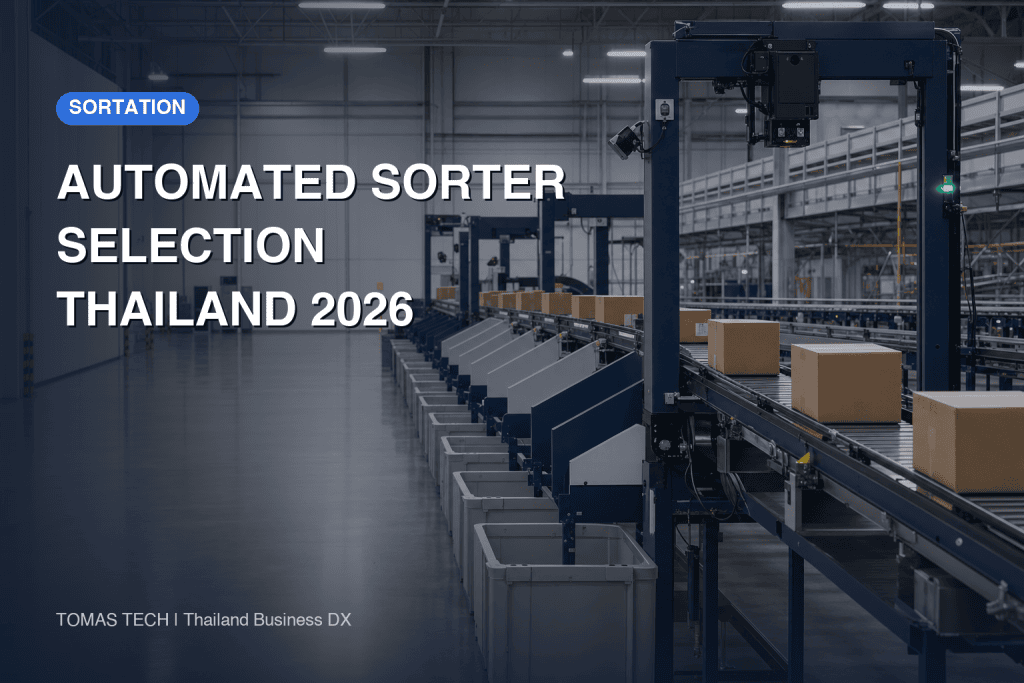
Selecting an automated sortation system starts with the actual items, destinations and peak-hour flow, not a catalogue’s maximum rate. This guide takes a factory or distribution-centre buyer in Thailand from the load-unit definition through sorter technologies, induction, identification, exceptions, quotations and FAT/SAT. Numerical examples illustrate a method; they are not a supplier’s guaranteed performance.
This guide addresses selection of the physical sorting equipment: load compatibility, induction and chute layout, sustained rate, the RFQ scope and acceptance tests. For the separate question of how GS1 identifiers and system events record each sort, see our automatic sortation and traceability guide. Align the equipment and event specifications at their interfaces.
Define the unit to be sorted before selecting a sorter
A claim of 3,000 items per hour means little until “item” is defined. Is it a finished product, inner pack, carton, returnable tote or flexible envelope? Sorting unpacked products by type differs from routing packed cartons by destination. Permitted impact, label location and discharge design differ. If a carton contains several products, determine which system binds the carton identifier to its contents.
Collect real samples in three groups: typical, smallest and largest, and exceptions. Include heavy boxes, thin items, unstable bases, reflective film, black packaging, soft bags and damaged labels. Identify which cannot be handled in standard mode. A planned exception route or a standard container may be cheaper and safer than forcing every unusual item through the machine. Record the proportion of exceptions rather than hiding them in a generic “other” category.
Distinguish logical destinations from physical chutes. One hundred destinations assigned to ten chutes at different times is a different project from one hundred simultaneously active chutes. Define chute-full sensing, container exchange and the response to a wrong discharge. This turns equipment selection into a testable operating design.
Size the system from time-series arrivals, not the daily average
Dividing daily units by shift hours conceals the peak. A site processing 24,000 units in eight hours averages 3,000 per hour; if 5,000 arrive during the hour before dispatch cutoff, the average-rate machine cannot clear that hour unless an adequate buffer absorbs the surge. Conversely, buying for an instantaneous extreme as if it ran all day can oversize the investment. Put hourly and shift-level history alongside cutoff times and growth scenarios.
Start with peak units divided by minutes actually available for sorting. Exclude planned breaks, changeovers, cleaning, startup and routine container exchanges. Then measure retries, rejects, full chutes and uneven upstream arrivals. Ask suppliers to distinguish a theoretical mechanism rate, a conditional rated rate and a sustained rate with your specified mix. Put the definitions and test duration in the RFQ.
Use multiple days that include month-end, product changes, campaigns and holiday effects. A new site without history should supply low, base and high scenarios with assumptions stated. Separate the capacity routinely required from space and interfaces reserved for later expansion.
Shortlist sorter types against item and destination constraints
Sorting can use a diverted conveyor, a shoe moving laterally across slats, a cross-belt carrier or a tilting tray. Dematic describes a sliding-shoe mechanism and a cross-belt system in which induction, item tracking and off-load decisions are connected. BEUMER describes cross-belt and tilt-tray families; Interroll describes cross-belt sorters. These sources explain mechanisms; they do not establish a universal ranking between vendors.
| Candidate | Initial fit question | Physical trial to request |
|---|---|---|
| Divert conveyor or pusher | Few destinations and consistent load units? | Orientation, impact and downstream accumulation |
| Sliding shoe | Repeated carton diversion to multiple sides? | Base, side surface, fragility and divert angle |
| Cross-belt | Many item types and destinations on individual carriers? | Induction position, soft-item stability and cleaning |
| Tilt-tray | Items stable on a tray? | Sliding, centre of gravity and drop height |
Do not infer sustained throughput from the technology name. Length, carrier pitch, speed, number of induction points, destination distribution and control logic change the result. Require a rate demonstrated with your samples and destination pattern. Where flexible bags or unstable bases are common, include the manual-exception workload in the commercial comparison.

Treat induction as a system in its own right
A fast sorter cannot compensate for two items arriving together, labels facing away from the reader or irregular gaps. Break induction into collection, orientation, singulation, gapping, identification, destination assignment and transfer to a carrier. Manual loading, automatic feeding and multiple merging lines each require different equipment. Matching nominal conveyor speeds alone does not guarantee a usable gap.
At 3,600 units an hour, the average arrival interval is one second. That does not mean every unit arrives exactly one second after the last. Bursts need a temporary buffer or a stop signal to upstream equipment. Operator staffing, reorientation, double-feed prevention and read performance all affect sustained induction. The worker’s reach into the loading point must be addressed in the risk assessment.
Specify the moment at which a tracked identity becomes definite. The association between the scanner result, the photoelectric detection event and the carrier ID must not shift by one position. Simulate a double feed, an empty carrier, a no-read and a missing sensor event; document which item the controls isolate. Deferring that logic to commissioning invites schedule and quality problems.
Separate barcode reading from destination master data
GS1 explains that barcodes can encode identifiers for products, logistics units and places. In logistics environments, the choice of GS1-128, ITF-14 or another symbol depends on the application. An SSCC identifies a logistics unit and can link its movement to electronic messages. A valid code, however, does not itself decide the chute. Name the WMS, ERP, MES or sort controller that owns the routing table and specify what happens for an unknown code or an unavailable master.
Read performance depends on print quality, placement, orientation, movement, light, reflection and line speed. GS1’s verification guidance addresses symbol quality and data integrity. During a physical trial, run labelled typical and difficult samples and retain each failed read and reason. No label, a readable label absent from the master and multiple readable labels are distinct problems with different owners.
Vision may supplement a barcode, but define its task and pass criteria first. If it infers product type from appearance, test visually similar products, dirt, packaging changes and lighting conditions. Define a confidence threshold, human review path and downstream check. Improving label application and master data may be simpler than introducing image classification.

Quarantine items whose destination is uncertain
Sortation quality includes what happens when a read fails, a master lookup times out, a chute is full, a discharge misses or communications fail. Route uncertain items to a dedicated reject point with a reason code. An operator checks the physical item and code before reinduction. Define a full-reject condition, because an unattended reject stream becomes a storage and safety problem.
A discharge command alone is not proof of delivery. Depending on the traceability requirement, use a chute-entry sensor, full sensor or container ID to record the observed outcome. More sensors also mean more maintenance points, so choose event granularity from the cost of a missort. State in one sentence what event counts as “sort complete.”
In a Thai plant, bilingual operating instructions are useful only if both languages refer to the same event and destination ID. Include alarm wording and screen language in SAT, rather than treating them as cosmetic details.
Derive chute count from simultaneous use
Physical chute count follows active destinations, volume per destination and container-exchange time. Sharing a chute between low-volume destinations requires a clear changeover that prevents residue from the previous assignment. The time spent switching may erase the expected space saving.
Plot hourly volume by destination and allocate it to the proposed chute map. A heavily loaded far-end chute or a hard-to-reach container can block the line before the sorter reaches its theoretical total rate. If using simulation, include short bursts and container exchanges. A model is a conditional forecast, not a replacement for physical trials and SAT.
Calculate a sustained-rate requirement: worked example
Assume 4,200 units must enter during a peak 60-minute window, and 5% end up in reject handling. In this example, the reject branch shares the induction section, so that section must handle all 4,200 units. Counting only successfully sorted units would understate its load. If rejects are diverted before the sorter, calculate capacity separately on each side of the branch. If routine exchanges leave 54 minutes of actual feeding time, the required running average is 4,200 ÷ 54 × 60, approximately 4,667 units per hour. This is a starting point, not a rated specification with burst, spacing and safety allowances.
A catalogue rate of 6,000 per hour for a single standard carton at uniform spacing does not prove that the candidate meets this example. Compare vendors using the same physical mix, destination profile, reading conditions, container exchanges and continuous test duration. Report a momentary peak separately from the number sustained throughout the required period.
The complete line is limited by its upstream feed and downstream collection. If the feed supplies only 4,000 per hour, buying a 6,000-per-hour sorter does not raise end-to-end output. Our separate conveyor design guide discusses the surrounding transport layout.
Compare a complete installed cost, not a machine-only price
There is no dependable universal entry price. Technology, chutes, induction, site constraints, controls, guarding and commissioning scope vary. Break quotations into sorter, feed conveyor, readers, chutes and containers, controls, WMS interface, electrical and pneumatic work, installation, commissioning, training, spare parts, warranty and service. Identify included work and change-order triggers.
For a Thai site, ask about import versus local supply, lead time, local technicians, spare-part availability, Thai-language training and displays. Put currency assumptions on the same date. Thailand’s BOI publishes automation-related measures, but eligibility and deadlines must be checked against the current terms for the specific project. Do not book an incentive as guaranteed savings.
For payback, record sorting labour, rework, misshipment handling, maintenance, electricity and consumables separately. Avoid counting both headcount savings and overtime reduction for the same hours. Redeployed staff create capacity but may not reduce cash expenditure. Test payback under a low-volume scenario as well as the base case.
Put physical samples, signals, exceptions and tests into the RFQ
Send a sample set and an item file with dimensions, weights, packaging, label positions, hourly arrivals, destination mix, maximum simultaneous destinations and code types. Include floor plan, ceiling clearance, floor load, service access, power, network and dust conditions. Mark unresolved facts as unresolved rather than letting each bidder invent different assumptions.
Define sender, receiver, response deadline and failure behaviour for feed permission, stop, emergency stop, routing lookup, timeout, discharge confirmation, no-read, chute-full and retry. Specify manual-operation permissions and data-retention requirements where relevant. Have logistics, production, maintenance, IT, quality and EHS sign off their boundaries.
A testable requirement names a load mix, arrival pattern, destination map, run duration and measurable pass criteria. “High speed” and “high accuracy” alone do not. Set thresholds from your service and quality needs, not a generic figure copied from another project.
Use a common response sheet for all bidders
Ask each bidder to mark every requirement as compliant, conditional or unavailable, and write the condition, added cost and test method. “Can handle the smallest carton” might mean adding a tray, slowing the sorter or requiring a fixed orientation. The condition changes economics. Keep deviations in one register and close them before ordering.
Define expansion as a construction and control condition
“Expandable” should state how many chutes or induction points can be added, where they fit, whether power and PLC capacity remain, and how long installation would stop operations. Distinguish the expense of buying capacity now from reserving a physical route for later. More logical destinations may only require assignment changes, whereas more simultaneously active destinations may need hardware. State which growth case the forecast means.

Carry the same failure modes through FAT and SAT
Factory Acceptance Testing checks assembly, controls and major sensor responses at the supplier’s site. Site Acceptance Testing includes the actual upstream equipment, building, network and operating staff. Bring FAT findings into SAT and add the conditions that the factory could not reproduce.
Test small, large and typical items, plus damaged labels, double feeds, skewed items, full chutes, communications timeouts and restart after power loss. Agree on safe ways to simulate faults. Record expected destination, stop state, display, event log and recovery step. Clearing a jam requires an energy-isolation procedure, not simply pressing an emergency stop. OSHA describes unexpected startup or release of stored energy during servicing; this is informative safety guidance, not a statement of Thai legal requirements. Apply the site’s local legal and company standards.
Every test record needs an ID, date, sample, induction order, target, actual result, downtime, cause and retest. Conditional acceptance should name the open item, owner, deadline and retest date. Agree how early-life failures are handled after commercial start.
Monitor distinct performance ratios after go-live
Track successful induction, successful reading, correct discharge and rejects separately. Fix each denominator in the operating standard. A single “sort success rate” can conceal a feed problem as a scanner problem. Where there is no independent check of the destination, a favourable number may be misleading.
Classify downtime as mechanism failure, jam, read problem, full chute, absent upstream supply, downstream collection delay or network failure. This separates machine availability from end-to-end line performance. Follow restoration time, repeated faults and spare-part use. Cleaning optics and replacing wear parts are part of maintaining rated performance. Ask who in Thailand can respond, with what parts, within the agreed period.
Review the surrounding process as well. Standard packaging and feed rules may reduce load. Our in-plant logistics guide addresses reducing movement itself; the roller conveyor selection guide addresses one related equipment choice.
Plan for product, destination and software changes
A new carton needs more than a size check: revisit label position, base, friction, centre of gravity and fragility, and rerun the relevant samples. A new destination changes master data, chute assignment, display name, reject logic and container identification. Changing only one layer can create missorts while every machine part works correctly. Keep a short change request and its test result.
Version the WMS routing codes, PLC tables and operator displays together. Preserve configurations for rollback. Retest behaviour when the master is unavailable: stop, reject or pass already routed items according to an agreed quality and safety decision.
Train staff in normal feeding, no-read, suspected missort, container exchange, jam clearance and restart. A reset accessible to everyone is not a substitute for clearing the cause safely. Separate permissions and retain training records. During the first operating weeks, compare the actual mix, no-read causes and full-chute periods with the bid assumptions; update operating rules after each controlled adjustment.
Frequently asked questions about automated sorter selection
What does an automated sortation system cost?
Price depends on technology and scope. Put peak rate, item mix, destinations and interfaces into a common RFQ, then compare complete installed prices. Do not confuse a sorter-only quotation with feeding, reading, chutes, integration and service included. Build an investment ceiling from measured current work and a conservative benefit case.
Cross-belt or sliding shoe: which is better?
Neither name determines the answer. Submit the same items and destination pattern to both bidders. Compare bases, soft-item share, permitted impact, induction and chute arrangements. Run real samples continuously and record reading, discharging and exceptions.
At what volume should sorting be automated?
There is no universal cutoff. Peak concentration, destinations, missort cost, staffing, future mix and interfaces govern the case. Measure manual hours and errors first; compare packaging and labelling improvements and guided manual sorting before sizing equipment.
What happens when a barcode cannot be read?
Keep the item out of ordinary destination chutes, retain a distinct reason code, and direct it to an attended reject point. Separate missing, damaged, multiple and unknown codes from master or communication failures. Set a full-reject condition and a reinduction procedure.
What must FAT and SAT prove?
The agreed load mix and destination pattern must achieve the sustained end-to-end requirement, while specified exceptions fail safely. FAT proves basic controls and components; SAT adds actual feed, network, container exchange and staff practices. Agree on duration, measurements and acceptance thresholds before testing.
Summary
The practical order is to define the load unit, measure peak arrivals and destination distribution, design induction and identification, specify discharge and exceptions, then compare sorter types against the same test. Catalogue maximum rate is only one data point. A common RFQ and physical FAT/SAT reduce both oversizing and underperformance.
Even if your Thai site has not yet assembled a full sample set or hourly record, you can contact TOMAS TECH to organise the selection criteria. It is reasonable to discuss induction, identification and acceptance tests before choosing a sorter type.
References
- Dematic, Crossbelt Sortation System
- Dematic, Sortation Solutions / Sliding Shoe Sorter
- Interroll, Sorters
- BEUMER Group, Warehouse Sortation Systems
- GS1, Barcodes
- GS1, Logistic Label Guideline
- GS1, Barcode Verification
- ISO, ISO 12100:2010 — Machinery risk assessment and risk reduction principles.
- OSHA, Control of Hazardous Energy
- Thailand BOI, Investment Promotion Guide 2026


