



A screw left untightened, a connector only half-seated, a part never fitted, a label never applied. These are the missed steps that assembly step verification AI, a system that finds them from camera footage, is meant to catch. On a manual assembly line, a single missed step that escapes to the customer can leave you carrying an 8D report, 100% sorting and, in some cases, rework costs at the customer’s site. Fixtures, sensors and torque tool counts prevent most misses, but some stations remain that physical poka-yoke simply cannot reach, and that is where this kind of system comes onto the table.
This article makes one argument. Whether assembly step verification AI succeeds is decided not by model accuracy but by three things: (1) defining up front, for each station, observable evidence that the step has actually been completed; (2) designing what happens when a miss is detected (a warning or an interlock, and who releases it and how); and (3) measuring missed detections and false alarms within takt time during acceptance testing by deliberately skipping steps. AI is not a replacement for physical poka-yoke. It fills the gaps in the process that physical poka-yoke cannot cover. And because it films operators, Thailand’s Personal Data Protection Act (PDPA) and buy-in from the shop floor need to be built into the design from day one.
Below, for production engineering managers, quality assurance managers and plant managers at Japanese-affiliated automotive parts, electronic components, wire harness and home appliance assembly plants in Thailand (and ASEAN) who need to assemble the facts for an internal decision, we walk through how to choose target stations, how to define completion evidence and compare methods, how to design the post-detection response, the product options, system architecture, PDPA issues, a model cost and benefit estimate, RFP items, FAT/SAT test design and issues specific to Thailand and ASEAN. Note that the counts, unit costs, amounts, detection rates and payback periods for the model plant in this article are all placeholder figures set for this article. They are not industry averages, survey results or manufacturer prices.
Why missing step detection matters on Thai assembly lines now
In the second half of 2026, the numbers surrounding Thai manufacturing point in different directions.
According to Capital.com, the Federation of Thai Industries (FTI) reported that Thailand produced 124,646 vehicles in August 2026, up 10.93% year on year. Domestic sales in the same month rose 25.59% year on year, while exports fell 2.04%. The FTI, however, forecasts full-year 2026 vehicle production to fall 3.33% year on year. Its previous forecast was a 3% increase, and the reason given for lowering the outlook was a decline in exports caused by fighting in the Middle East. Monthly output may be rising, but the full-year outlook gives no grounds for optimism.
Exports are being led by electronics. According to Nation Thailand, Thailand’s Ministry of Commerce announced that total exports in August 2026 were USD 34.62 billion, up 24.3% year on year, and exports of industrial products including computers, ICs and printed circuit boards rose 27.1%. The same article, however, says that exports of automobiles and parts declined. The bigger the swings in orders, the more model changeovers, temporary helpers and new-hire ramp-ups a plant goes through. These are exactly the conditions under which missed steps tend to occur.
Manual work will not disappear any time soon either. A 2020 IndustryWeek article cited a survey of more than 100 manufacturing leaders conducted by Drishti, a US action recognition vendor, and A.T. Kearney, reporting that human line workers perform 72% of the tasks in factories. Because a vendor was involved in the survey, the figure should be read with some caution.
On the policy side, according to an analysis by the law firm Tilleke & Gibbins, BOI Notification No. 4/2569, published in the Royal Gazette on March 31, 2026, provides, for existing and new projects in general automobile manufacturing and PHEV/HEV manufacturing, an exemption from import duty on machinery and a 50% corporate income tax exemption (for 3 years) on investment in automation and robotic systems. In addition, according to a press release from the APO (Asian Productivity Organization), the “National AI Roadmap for the Sustainable Productivity of Industries in Thailand” was handed over to the Ministry of Industry in Bangkok on August 27, 2026, and the ministry’s deputy permanent secretary cited real-time quality inspection as an example use of AI.
On the standards side, IATF 16949, the quality management standard for the automotive industry, treats error-proofing (poka-yoke) as a requirement. As discussed in a later section, what matters is that the requirement goes beyond installing a device to testing that the device works, keeping records and deciding in advance how to respond when it fails (as summarized in an explanatory article).
What is assembly step verification AI: how it differs from physical poka-yoke and visual inspection AI
The phrase “detecting missed steps with AI” tends to be used for systems of quite different character. Much of the reason implementation discussions go in circles is that this distinction is not made.
1. Physical poka-yoke
These are mechanisms such as fixture shapes that prevent incorrect assembly, sensors that confirm a part is present, and torque tools whose tightening count must reach the specified number before the next step can proceed. Their strength is that the principle is simple and they rarely miss. The types and cost ranges of physical poka-yoke, and how to decide on adopting it in a Thai plant, are covered in “Poka-Yoke Devices 2026 — Types, Costs and Thai Plant Rollout“. Before considering assembly step verification AI, the right order is to first check whether any stations can be covered by these means.
2. Visual inspection AI (defect detection AI)
This photographs finished or intermediate products and finds scratches, chips, foreign matter, missing parts and the like from the “result”. It is usually discussed in the context of automating visual inspection. It can find misses that leave a trace in the result, but it struggles with “misses that barely change the appearance”, such as an under-tightened screw or a connector that looks inserted but has not reached its lock.
3. Assembly step verification AI (work procedure verification AI)
This looks at the “process” of the work. It judges whether a hand reached into the parts bin, whether a part was placed in the specified position, whether a tool was used and whether the sequence was followed, by combining camera footage with, where needed, signals such as tool completion signals. Depending on the product, some use motion recognition that estimates a person’s skeleton or hand positions.
The three are not in competition. A realistic layering is to cover with physical poka-yoke the stations it can cover, catch with visual inspection the misses that leave a trace in the result, and fill the remaining “misses you cannot see without watching the process” with assembly step verification AI. In other words, think of manual assembly error prevention as a combination of these three layers.
Ultralytics, which published an implementation guide on vision AI for assembly verification in July 2026, states that model quality cannot make up for evidence the camera does not capture. The point is that evaluating assembly step verification AI starts not with comparing models but with asking “what must be visible to say the step is complete”.
Taking stock of missed steps: which stations to start with
We do not recommend fitting cameras to every station at once. Completion evidence, camera placement and how to stop the line differ from station to station, so expanding all at once tends to leave mediocre accuracy and vague operating rules at every station.
Cross-check three registers
The raw material is three records that most plants already have.
- Escape register (customer complaints): missed steps found at the customer, and the costs of 8D, sorting, transport and penalties.
- Final inspection and outgoing inspection defect records: missed steps found inside the plant and reworked. These show trends by station.
- In-process defect and near-miss records: misses noticed and corrected by operators or team leaders. These show at which stations a step “almost” got missed.
If you re-sort these three by station name and type of miss (part not fitted, not tightened, not inserted, not applied, wrong sequence), the stations with the most occurrences and the largest losses stand out.
First decide whether physical poka-yoke can prevent it
For each station that stands out, first decide whether physical poka-yoke can prevent the miss. If a torque tool’s tightening count can stop untightened screws, that comes before a camera. It is realistic to narrow the targets for assembly step verification AI to stations such as the following.
- Stations where the type and location of parts change by part number, making it hard to prepare fixtures or sensors for each part number
- Stations where the sequence itself matters (for example, fitting one part first prevents a later part from going in)
- Work such as harness routing, where the shape is not fixed and physical detection is difficult
- Stations where physical poka-yoke was installed in the past but practices of removing or bypassing it persist
Human error is not only a “people problem”
If missed steps are dismissed as “operator carelessness”, countermeasures lean toward training and reminders. A study using HFACS, a human factors analysis method (Torres et al., 2022), analyzed bracket misinstallation in complex manual assembly at an aircraft manufacturing facility and identified 34 contributing factors. Of these, 56% were at the operator and work environment level, and 44% were at the level of organizational influences and supervision. Examples of operator-level factors included “no tool providing tracking and immediate feedback during task execution”, “work instructions using low-resolution 2D images”, “limitations of human visual inspection” and “mental fatigue”.
This is a single aerospace case study and does not represent an industry average. Even so, the fact that “no mechanism to flag a miss on the spot” appears among the factors captures the purpose of assembly step verification AI well. Efforts to make the work instructions themselves easier to understand are covered in “Work Instruction Video AI: Multilingual Video Manuals and Payback in Thai Factories 2026“. Detection mechanisms and better work instructions are countermeasures that work in combination.
How to define completion evidence: comparing methods for assembly step verification AI
Once the target stations are decided, define for each station observable evidence that lets you say the step is complete. This is the heart of assembly step verification AI design.
Four types of evidence
Evidence of task completion falls broadly into four types.
| Method | What it looks at | Strengths | Weaknesses | Suited stations |
|---|---|---|---|---|
| Part presence detection | Whether a part is in the specified position (object detection) | The result remains in the image, so the basis for the judgment is easy to explain. OK/NG photos can serve as evidence | Cannot see a part hidden by a hand or other parts. Weak with reflections and parts of similar color | Parts visible after fitting, such as brackets, clips and labels |
| Hand motion recognition | Movement of hands, arms or skeleton, and the step sequence | Can watch tasks whose result is hard to see, and whether the sequence is followed | “Performing the motion” is not the same as “the task being correctly completed”. Affected by each operator’s movement habits | Tasks where sequence matters, routing, confirmation actions |
| Tool signal integration | Completion signal and count from the tightening tool | Tightening completion can be confirmed from the tool’s signal. Often more reliable than images | The tool signal alone may not tell which screw hole was tightened | Screw tightening, fastening that requires torque control |
| Picking confirmation | Whether the hand reached into the correct parts bin | Stops mix-ups of wrong part numbers before the part is fitted | Cannot tell whether the picked part was actually fitted | High-mix stations with many part types |
Few stations are adequately covered by just one of these. For screw tightening, for example, one possible combination is to confirm “how many times it was tightened” with the tool’s completion signal and supplement it with the camera for “where the tool touched”. Picking confirmation works against part mix-ups, but whether the picked part was then left unfitted needs to be checked separately with part presence detection.
Example station × completion evidence matrix
Taking a 6-station manual assembly line as an example, we list which evidence serves as primary and which as supporting at each station. “Primary” marks the main evidence, “Support” marks supporting evidence, and “-” means not used at that station.
| Station | Part presence | Hand motion | Tool signal | Picking confirmation |
|---|---|---|---|---|
| 1. Bracket installation | Primary | – | – | Support |
| 2. Connector insertion | Support | Primary | – | – |
| 3. Tightening 4 screws | – | Support | Primary | – |
| 4. Harness clip routing | Primary | Support | – | – |
| 5. Label application | Primary | – | – | Support |
| 6. Final check | – | Primary | – | – |
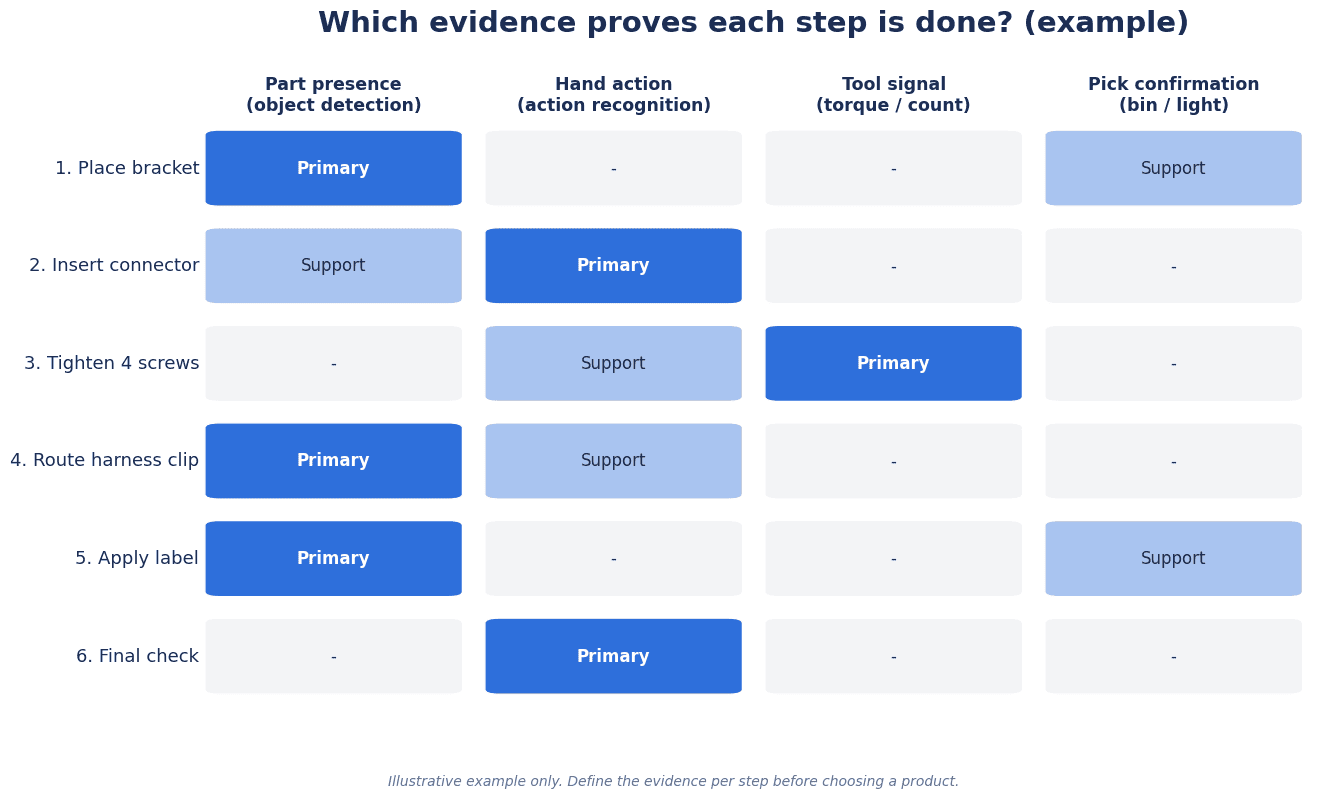
Figure: Example station × completion evidence matrix for a 6-station manual assembly line (Primary = main evidence, Support = supporting evidence, – = not used). The combination of stations and evidence is one example.
Building this matrix makes the choice of methods concrete. For bracket installation and label application, part presence after fitting can serve as the main evidence, with picking confirmation added as support when part or label types differ by part number. For tightening 4 screws, the tool’s completion signal is the main evidence to confirm “were 4 tightenings done”, with hand motion as support to see “did the tool touch 4 locations”. For harness clip routing, part presence checks whether the clips are held in the specified positions, and hand motion supplements the routing sequence.
The hard ones are connector insertion and the final check. A half-seated connector looks inserted but the mating is incomplete, so it can be difficult to judge from a top-down image alone. The matrix uses hand motion (the insert-and-push motion) as the main evidence, but even so, “a pushing motion” is not the same as “mating completed”. If it can be confirmed by physical means such as a mating check fixture or a continuity test, it is safer to prioritize those and position AI as supporting. The final check is similar. You can observe that “a checking motion was performed”, but not that “the result of the check was correct”. If AI watches the final check, limiting its purpose to “whether the check step itself was skipped” narrows the gap between expectations and actual capability.
What to write down before training
The Ultralytics guide says that before training, part movement, cycle time, working distance, depth variation, reflections, occlusion and vibration should be documented. Writing these out in a table for each station makes conversations with vendors concrete. On lighting, the same guide summarizes that diffuse light suppresses glare on reflective surfaces, backlighting makes silhouettes and gaps clear, and strobe lighting reduces motion blur. It also notes that multiple cameras help against occlusion but add burden for calibration, synchronization, compute resources, maintenance and data management. Camera and lighting selection itself is covered in detail in “Industrial Camera Selection for Thai Factories: FAT/SAT Guide” and “AI Visual Inspection Lighting Selection: Reflective Parts to FAT and SAT“.
Designing what happens after detection: warnings, interlocks, rework and release authority
Merely “finding” a missed step does not stop it. Unless you decide what happens on detection and who does what, you end up with a warning sounding while the work moves on. This is as important as the choice of method.
Decide the response levels
The response on detection can be thought of in roughly the following levels.
- Display and warning: show the missed step on a monitor and alert with sound or a stack light. This assumes the operator corrects it on the spot.
- Andon (notification to the team leader or line supervisor): call the team leader under conditions such as repeated misses at the same station, or proceeding after ignoring a warning.
- Next-station interlock: physically stop the work, for example by not releasing the next station’s fixture or not advancing the conveyor until the judgment is OK.
- Workpiece quarantine: tag workpieces that leave the station with an uncorrected miss so that they are always stopped at a downstream station or final inspection.
Which level applies to which station is decided by balancing the size of the loss from a miss against the frequency of false alarms. Applying interlocks while false alarms are still frequent makes the line stop often, and the shop floor will want to remove the system. Leaving it at warnings only means they get ignored precisely when things are busy. One option is a phased approach: run the PoC with warnings and andon, and switch to interlocks once the false alarm rate settles within the level agreed in the contract.
Rework and release procedures
If you apply interlocks, always define the release procedure.
- Who can release: if operators can release it themselves, false alarms and real misses get released in the same way. Separate authority, for example by restricting release to team leaders and above or authenticating with an ID card.
- Reason for release: record a selected reason such as “miss corrected”, “false alarm” or “could not judge” so that false alarm trends can be analyzed later.
- Rework: if the miss was real, decide how far back the work must go to be redone and re-judged.
The Ultralytics guide recommends a “stable event contract” between vision judgment and control that includes the result, reason, timestamp, station and model version, and cautions against sending raw model output directly into safety or motion control logic without going through a validated application layer. If the interlock is implemented in PLC logic and the AI judgment is positioned as one of its inputs, updates on the AI side are less likely to have unexpected effects on the control side.
Aligning with the IATF 16949 approach
On clause 10.2.4 (error-proofing) of IATF 16949:2016, an explanatory article by Advisera summarizes requirements along the following lines: have a documented process for determining the use of appropriate error-proofing methodologies; document the details of the adopted method in the process risk analysis (such as PFMEA) and the test frequency in the control plan; include testing of error-proofing device failure or simulated failure; maintain records; and have a reaction plan for when an error-proofing device fails. Because the original text of the standard is paid, here we only introduce the summary from the explanatory article. Please confirm the exact requirements against the original standard and your certification body’s interpretation.
If you treat assembly step verification AI as a means of error-proofing, then in line with this summary you need to design from the start: reflecting it in the PFMEA, stating the test frequency in the control plan, daily simulated tests (such as a start-of-shift check that deliberately skips a step to confirm the line stops), and fallback measures when a camera or inference device fails (such as switching to 100% visual checks). Note also that in its July 2026 Stakeholder Communiqué, the IATF announced plans for the second edition of IATF 16949, with publication scheduled for mid-2027. The communiqué also states explicitly that the timeline is indicative and subject to change.
Product and approach options
Assembly step verification AI products fall broadly into three directions. The functions and results of the products listed below are all descriptions by the manufacturers or distributors (vendor claims), not figures verified by third parties. This article also does not recommend any particular product.
1. Products specialized in monitoring assembly work (motion recognition and procedure checking)
- Retrocausal “Assembly Copilot” (US): According to the company, AI tracks the work while giving work instructions and warns of work errors with sound and on screen. It runs on ordinary webcams or PoE/GigE cameras and a Windows PC, can be deployed “within hours” after labeling one cycle, and offers no-code integration with PLCs and smart torque wrenches via OPC UA. As a deployment case at Siemens, it cites a 10% improvement in first-pass yield, a 60% reduction in quality issues and a 44% reduction in training time (the same figures also appear in a 2020 Siemens partner blog).
- Invisible AI (US): According to the company, lightweight cameras record every cycle at every station, fully on-premises without using the cloud, and deviations from the process are tracked per cycle with video.
- Drishti (US): According to a 2020 IndustryWeek article, it is a system that recognizes human actions from video, was adopted at DENSO’s North American operations, and DENSO required accuracy above 99% to earn operators’ trust. Note that this is an old article from 2020.
- Marubun / Murata Manufacturing / RUTILEA “Process Work Monitoring System Using Edge AI Cameras”: Marubun announced the start of sales on February 10, 2026. According to the announcement, it combines a dedicated edge AI camera made by Murata Manufacturing with AI software from RUTILEA, estimating the positional relationship between a person’s skeleton and tools to instantly detect and notify procedure errors and missed steps. It also highlights no-code work-flow setup and processing completed entirely within the plant’s local environment.
- Canon Marketing Japan “Careless Mistake Prevention Service”: According to the company, a network camera films the operator’s hands, and tool identification plus analysis of hand and arm movements automatically detects omissions and errors, notifying monitors and line supervisors immediately. Pricing is not published.
2. Products centered on part and step judgment
- Bossard SmartCamera (Switzerland): According to the company, it detects whether a hand reached into the correct parts bin, whether a part was placed, whether a step was skipped, whether the correct tool was used, whether a cable was connected to the specified socket, part counts and so on, and it offers an interlock that locks and releases steps based on the OK/NG judgment, plus recording of OK/NG photos for each step.
- OKI “Visual Anomaly Judgment System”: In a 2021 announcement, the company said the system analyzes video with its AI edge computer “AE2100”, and that a trial at its Honjo plant brought missed work errors to zero and cut overall process work time by 15%.
- Fujitsu Actlyzer extension: In a 2021 announcement, the company said it uses 3D skeleton recognition and deep learning to distinguish work elements from video, detecting work with an accuracy of 90% or higher at the Yamanashi plant of Fujitsu I-Network Systems. As background to the development, it cited the burden of data preparation: manually segmenting 20 minutes of video could previously take more than an hour.
3. General-purpose vision and in-house or system integrator builds
This direction has the company itself or a system integrator (SIer) assemble general-purpose image processing equipment and AI models to fit the process. For example, in April 2026 Cognex announced the In-Sight 6900 Vision Controller, which carries NVIDIA Jetson and can process at the edge without an external PC with up to 157 TOPS of AI performance. However, the press release does not mention assembly verification use and the product leans toward visual inspection. Choosing general-purpose vision widens the scope you must build yourselves: motion recognition, step sequence management, PLC integration and record keeping.
At the R&D stage, NEC announced in August 2025 a technology that uses a vision language model to recognize work actions from a text description of the work alone, without prior training on site footage, and says it aims for practical use by fiscal 2026 (a plan).
How to choose
In the matrix built in the completion evidence section, if a station’s main evidence leans toward “part presence”, products centered on part judgment or general-purpose vision are candidates. If many stations rely on “hand motion” as the main evidence, products specialized in motion recognition become candidates. In either case, it is safer to always ask, about accuracy or effect figures in a proposal, “at which station, under which conditions and on how many cases was this evaluated”, and not to use figures without stated evaluation conditions as comparison material. The difference from motion analysis AI, whose main purpose is measuring work time, is covered in “AI Motion Analysis Implementation: Automated Time Study and Acceptance Tests in Thai Factories“. Some products can also measure work time with the same camera, but note that if the purpose differs, what you measure in acceptance testing differs too.
System architecture for an AI camera assembly line and integration with existing equipment
Assembly step verification AI is not complete with just cameras and AI. Only when it is connected to the PLC, andon, tools and MES does it become a system that stops misses and keeps records. A typical architecture is shown in the figure.
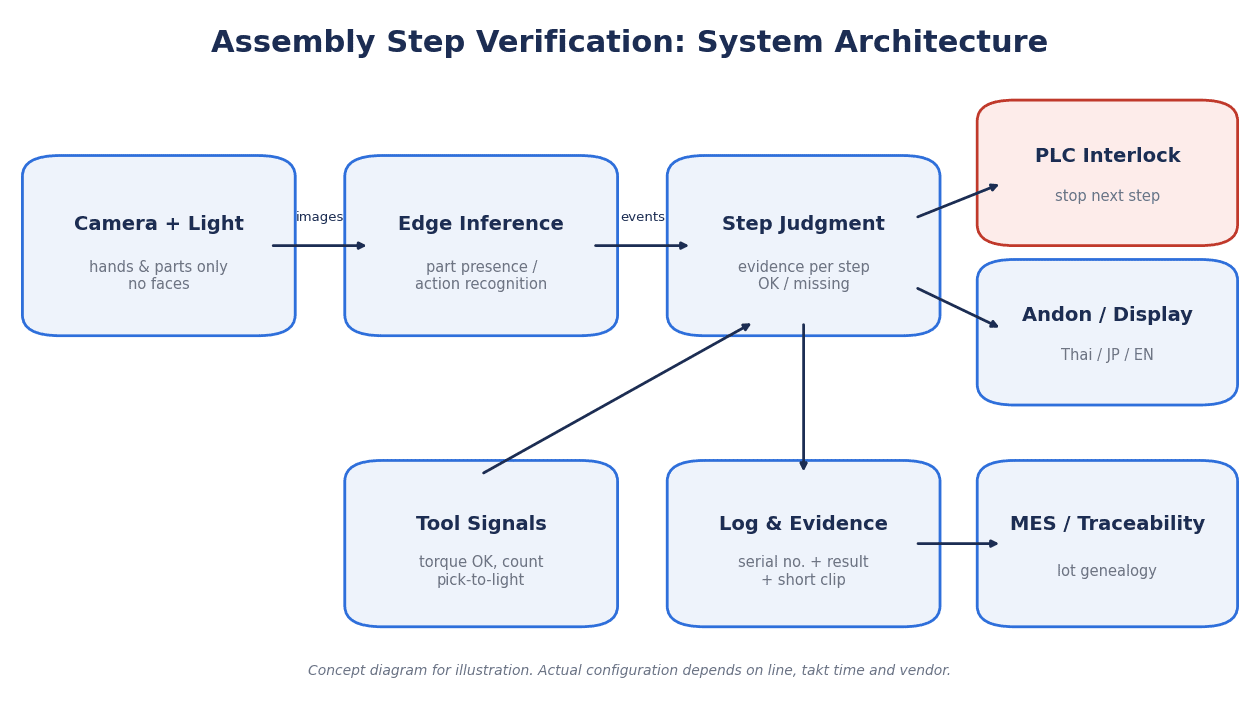
Figure: Example system architecture for assembly step verification AI. Camera footage is inferred at the edge, and the step judgment result is passed to the PLC interlock and andon. Tightening tool completion signals also feed into the step judgment, and judgment logs are sent to the MES.
Issues by component
- Cameras and lighting: the basic approach is to film the hands from directly above or diagonally above the working position. Check occlusion by hands and tools, reflective parts and lighting variation on the actual station before the PoC. Limiting the field of view to the hands is also important from a privacy standpoint.
- Edge inference: processing footage inside the plant avoids network latency and keeps footage from leaving the site. Among the products listed in the product and approach section, Marubun / Murata Manufacturing / RUTILEA, Invisible AI, Bossard and others describe in-plant or on-device processing as a feature (all vendor claims). RFPs and PoC approaches for edge AI are covered in “Edge AI Factory Deployment 2026: RFP, 90-Day PoC and Acceptance“.
- Step judgment: the layer that combines camera judgments, tool completion signals and picking signals to decide, for each station, “complete”, “missed” or “unable to judge”. It is important to define how “unable to judge” (camera blocked, lights out and so on) is handled separately from both OK and NG.
- PLC interlock and andon: pass the step judgment result to the PLC in the event contract format mentioned in the post-detection design section, and run the interlock and andon in PLC logic.
- Tool signals: receive completion signals and counts from the tightening tool controller. Available signals and communication methods vary by model, so inventory your existing tools and their communication specifications first.
- Logs and MES: the Ultralytics guide says you should record the work order number, model or rule version, result, and evidence to the extent the retention policy allows. Linking these to the MES by serial number or lot lets you trace back, in a customer complaint, “what was judged at that station for that unit”.
Decide first how much time the judgment can take
If a judgment takes too long, the operator moves on to the next workpiece and correction is delayed. Work backward from the station’s takt and the operator’s movements to determine how much time can be spent from image capture through inference to handover to the PLC, and agree on it in the contract. The Ultralytics guide does not give a numerical latency target either. Rather than applying a generic figure, you need to decide it for your own process.
Filming operators: PDPA and labor relations issues
Assembly step verification AI films operators’ hands and, in some cases, their upper bodies. Because footage can constitute personal data, compliance with Thailand’s Personal Data Protection Act (PDPA) and buy-in from the shop floor need to be built into the design from the start. The following is a summary of public information and is not legal advice. For individual decisions, please consult a Thai legal professional.
What public information tells us about the PDPA
A 2026 newspaper column by an author from the Faculty of Law at Prince of Songkla University (published in Krungthep Turakij / Bangkok Biz News) summarizes CCTV use as follows. Personal use within a household may be exempt, but businesses and institutions cannot claim the personal-use exemption. If “legitimate interest” is the legal basis, it must be shown that the interest outweighs the impact on privacy. People being filmed must be notified, and the notice should show the camera locations, the purpose of processing, the data subject’s rights and the controller’s contact details. Access to footage must be restricted, and recordings no longer needed must be deleted. Please note that this is a column by a university law faculty author and does not quote any official guideline of the Personal Data Protection Committee (PDPC).
As for the PDPC, according to Tilleke & Gibbins, a public hearing on draft sector-specific PDPA guidelines was held in April 2026, including a chapter on CCTV and access control. However, it covers housing estates and condominiums (visitor management, biometric data, license plate recognition and so on) and is not guidance specific to filming employees in the workplace. As of this writing, a final version has not been published.
Penalties include administrative fines of 500,000 to 5,000,000 baht and criminal penalties of up to 6 months’ imprisonment, a fine of up to 1,000,000 baht, or both, and company directors and others are said to be potentially liable; civil liability includes punitive damages capped at twice the actual damages (the main provisions took effect on May 27, 2020). According to Hogan Lovells, the PDPC announced 8 administrative fines across 5 cases on August 1, 2025; for example, an IT products retailer was fined a total of 7,000,000 baht for multiple violations, namely inadequate security measures and failure to report a breach, and a cosmetics company was fined 2,500,000 baht. All of these were security failure or breach cases, not CCTV or employee monitoring cases, but enforcement is actually taking place.
Turning it into design
Translating the summary of public information into system design items gives, for example, the following.
- Limit the field of view to the hands: film only the top of the workbench and the hands, with an angle that does not capture faces. Where faces would be captured, consider automatic blurring. A 2022 article reported that Retrocausal has implemented automatic face blurring and encryption.
- State the purpose and notify: make the purpose clear, for example “detection of missed steps and product traceability”, and post and explain the camera locations, purpose, rights and contact details in a language operators can read.
- Decide retention periods and access rights: decide whether to keep the footage itself or only the judgment results and OK/NG still images. Balance the period needed for traceability against keeping the privacy impact small, and limit who can view it.
- Do not use it for individual evaluation: documenting as an operating rule, and agreeing between management and labor, that records of missed steps will not be used for individual operators’ performance reviews or discipline makes it easier to gain buy-in from the shop floor.
If you have business with the EU
If you export products to the EU or are headquartered in the EU, it may be worth checking the EU AI Act for reference (whether it applies to a Thai plant’s internal systems requires case-by-case confirmation, and we do not make a definitive statement here). According to the legislation website, Article 5(1)(f) prohibits the use of AI systems that infer the emotions of natural persons in the workplace (with exceptions for medical or safety purposes). Missing step detection does not need emotion inference, so such functions should be kept out. Annex III, point 4(b), classifies as high-risk AI systems that, among other things, monitor and evaluate the performance and behavior of persons in work relationships, so a design in which missing step detection is used for individual evaluation or monitoring could raise the question of falling under it (whether it does depends on the design and how it is used, and we do not make a definitive statement here). In addition, according to Hunton Andrews Kurth, Regulation (EU) 2026/1744 (Digital Omnibus on AI) entered into force on July 27, 2026, and the application date of obligations for stand-alone high-risk AI under Annex III was postponed to December 2, 2027.
Model cost and benefit estimate (placeholder figures)
What follows is a model estimate to show how much the benefit depends on the assumptions. All figures below are placeholders set for this article. They are not industry averages, survey results or manufacturer prices. In particular, the AI in-process detection rate is not “a value AI can achieve”; it is a value to be replaced by actual measurements from the PoC and the “deliberate skip test” described later.
Model plant assumptions
The model plant covers only one manual assembly line (6 stations), not the whole plant. The currency is Thai baht (THB). There is only one baseline for comparison: “current state = 1,000 missed steps occur per year, of which 975 are found at final inspection and reworked, and 25 escape to the customer”.
| Item | Value | Calculation |
|---|---|---|
| Annual missed steps on the target line (current) | 1,000 | Placeholder |
| Of which found at final inspection and reworked | 975 | Placeholder |
| Of which escape to the customer | 25 | 1,000 – 975 |
| Loss per escape (sorting, 8D response, transport, penalties; excludes rework cost) | 40,000 THB | Placeholder |
| Difference between rework cost when found at final inspection and cost of immediate in-process correction | 250 THB/case | Placeholder |
| AI in-process detection rate (mid case) | 80% | Placeholder. Assumed to apply at the same rate to both escapes and final-inspection finds |
| (1) Reduction in escapes | 20 cases → 800,000 THB/year | 25×80%=20, 20×40,000 |
| (2) Reduction in rework cost | 780 cases → 195,000 THB/year | 975×80%=780, 780×250 |
| Total annual benefit | 995,000 THB/year | (1)+(2) |
| Initial cost (cameras, lighting, edge devices, PLC integration, training data preparation, PoC) | 1,800,000 THB | Placeholder |
| Annual operating cost (maintenance, licenses, retraining, adding part numbers, operating labor) | 395,000 THB/year | Placeholder |
| Annual net benefit | 600,000 THB/year | 995,000 – 395,000 |
| Simple payback period | 3.0 years | 1,800,000÷600,000 |
(1) and (2) are not double-counted. (1) is the group of 25 cases that were escaping to the customer, and (2) is the group of 975 cases that were being found at final inspection, so the populations are different. Also, the loss per escape does not include rework cost. Including rework cost in (1) as well would overlap with the logic of (2).
How the payback period moves when the detection rate changes
This is the sensitivity when only the AI in-process detection rate is changed to 40%, 60% and 80%, with all other assumptions fixed.
| In-process detection rate | (1) Reduction in escapes | (2) Reduction in rework cost | Annual benefit ((1)+(2)) | Annual net benefit | Simple payback period |
|---|---|---|---|---|---|
| 40% | 10 cases, 400,000 THB | 390 cases, 97,500 THB | 497,500 THB | 102,500 THB | approx. 17.6 years |
| 60% | 15 cases, 600,000 THB | 585 cases, 146,250 THB | 746,250 THB | 351,250 THB | approx. 5.1 years |
| 80% | 20 cases, 800,000 THB | 780 cases, 195,000 THB | 995,000 THB | 600,000 THB | 3.0 years |
In the 40% case, (1) is 10 cases × 40,000 THB = 400,000 THB and (2) is 390 cases × 250 THB = 97,500 THB, for a total of 497,500 THB; subtracting the annual operating cost of 395,000 THB leaves a net benefit of 102,500 THB, and payback is 1,800,000÷102,500, or approx. 17.6 years. In the 60% case, the total is 746,250 THB, the net benefit is 351,250 THB, and payback is 1,800,000÷351,250, or approx. 5.1 years.
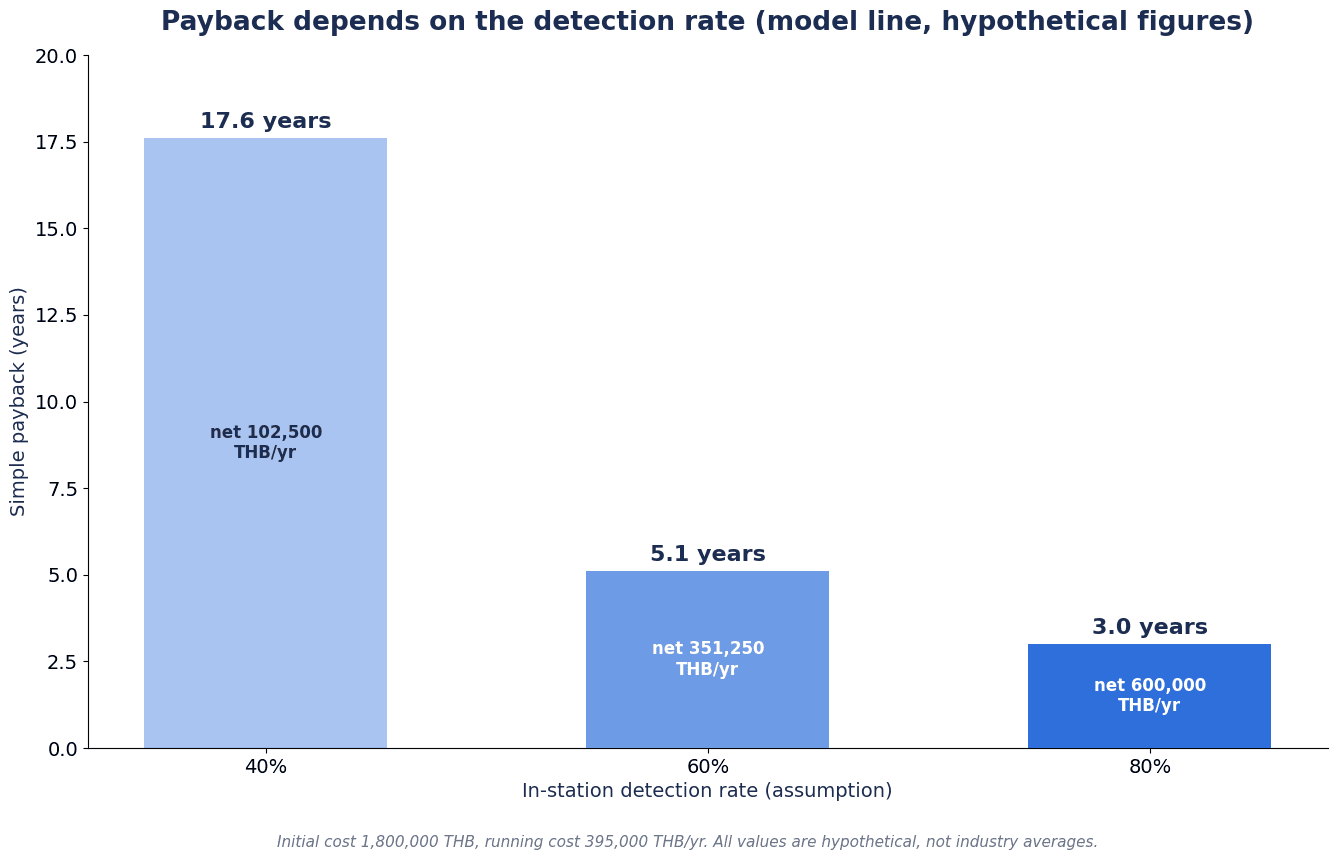
Figure: Sensitivity of the model estimate. Simple payback period when the AI in-process detection rate is set to 40%, 60% and 80% (approx. 17.6 years, approx. 5.1 years and 3.0 years; all placeholder figures).
Just a drop in the detection rate from 80% to 60% stretches the payback period from 3.0 years to approx. 5.1 years, and at 40% it reaches approx. 17.6 years, at which point the investment makes little sense. Because the annual operating cost is fixed, the net benefit shrinks sharply as the benefit gets smaller. Another takeaway is that most of the benefit comes from (1), the reduction in escapes. In the mid case, 800,000 THB of the 995,000 THB comes from (1). Because the number of escapes and the loss per escape vary greatly from plant to plant, recalculating your own figures from the escape register mentioned in the stock-taking section is the starting point of the estimate.
What this estimate leaves out
The following elements are intentionally excluded from the estimate.
- Cost of false alarms: the downtime and checking labor when the work was correct but was judged as a miss and the line was stopped. The more false alarms, the more the benefit is eroded by this amount. The impact is especially large at stations with interlocks.
- Reduction in final inspection staff: even if misses can be stopped in-process, final inspection cannot necessarily be reduced right away. Given agreements with customers and the fact that final inspection also covers other defects, including this in the benefit tends to overestimate it.
- Operator training effect: flagging misses immediately may help operators learn faster, but this is hard to separate from the effects of other initiatives, and including it tends to lead to double counting.
The purpose of the estimate is not to decide on the investment from this table. It is to learn which assumptions move the payback period most and to decide what should be measured in the PoC. Part of the investment may qualify for BOI measures if the conditions are met, but eligible industries and requirements need to be confirmed case by case.
What to include in an RFP for assembly step verification AI
In an RFP for implementing assembly step verification AI, it is more important to write in the definition of completion evidence, the post-detection response and the verification method than to have the vendor commit to model accuracy as a single number. We recommend including at least the following 12 items.
| No. | Item | Example content |
|---|---|---|
| 1 | Scope | Target lines, stations, part numbers and operator shifts. Also state explicitly the stations and part numbers out of scope |
| 2 | Completion evidence per station | Attach the station × evidence matrix (primary and supporting evidence) and require judgments in line with it |
| 3 | Judgment output | The 3 categories “complete”, “missed” and “unable to judge”, and how each is displayed and notified |
| 4 | Post-detection response | Which of warning, andon, interlock and workpiece quarantine applies to which station, and from which phase |
| 5 | Release authority and rework | Who can release, authentication method, release reason options, rework and re-judgment procedures |
| 6 | Judgment time | Target time from task completion to judgment. Agree in the contract on a value worked back from the station’s takt |
| 7 | Definitions of missed detection and false alarm rates | What counts as a missed detection or false alarm, acceptable range, number of cases and period used for evaluation. Agree the figures in the contract |
| 8 | Integration with existing equipment | Connection specifications for the PLC, andon, tightening tools and MES; event fields (result, reason, time, station, model version) |
| 9 | Field of view and privacy | Field of view, an angle that does not capture faces or blurring, retention periods for footage and still images, access rights, processing location (in-plant or external) |
| 10 | Adding part numbers and retraining | Procedures when adding part numbers or changing processes, who does the work, lead time, cost, approval and rollback methods for model updates |
| 11 | Response to failures and daily checks | Fallback measures when a camera or inference device fails, method for the start-of-shift simulated test, record format |
| 12 | Maintenance, training and language | Maintenance scope and response time, screens and training materials in Thai, English, Japanese and other languages, local support structure |
If a vendor’s proposal includes accuracy figures, always ask “at which station, under which conditions and on how many tasks was this evaluated”. An evaluation on footage shot under tidy conditions and an evaluation on a mass production line where the lighting changes, operators rotate and part numbers switch mean different things. Define item 7, the missed detection and false alarm rates, not as figures the vendor presents in general terms but as values measured on your own stations using your own patterns of missed steps.
What to check in FAT/SAT: designing the deliberate skip test
What acceptance testing confirms is “does it stop when a step is missed, and not stop when nothing is missed, in line with the agreed completion evidence”. The core of this is a test that runs work with steps deliberately skipped (a seeded defect test). Design it as follows for FAT (tests in the vendor’s environment or before shipment from the factory) and SAT (tests after installation on the mass production line at site).
Build test patterns
For each station in the matrix, write out the possible patterns of missed steps and turn each into a test pattern. For the 6-station example, they might look like this.
- Bracket installation: bracket not fitted / bracket of the wrong part number fitted / fitted but out of position
- Connector insertion: not inserted / inserted partway and not pushed home (half-seated)
- Tightening 4 screws: only one screw left untightened / all 4 left only finger-tight / the same hole tightened twice, skipping one location
- Harness clip routing: one clip not fastened / routing sequence swapped
- Label application: not applied / label of the wrong part number applied / applied off the specified position
- Final check: workpiece sent on without performing the checking motion
Also run correctly assembled workpieces (workpieces with no missed steps). Measuring missed detections requires workpieces with misses, and measuring false alarms requires workpieces without them.
How to think about the number of cases
Prepare enough test cases to judge against the acceptable range agreed in the contract. The smaller the acceptable range for missed detections, the more workpieces with misses you need to run to confirm it. Even if a test of a handful of cases shows “zero missed detections”, that does not prove the system meets a tight acceptable range. Agree with the vendor in advance, together with the acceptable range and without applying generic case counts, how many cases to run per pattern, how many correct workpieces to run, and what those numbers allow you to conclude.
If operators know “the next one is a skip test”, their movements may differ from normal. Having only the test personnel know which cycle will be skipped, and mixing these into the normal flow of work, lets you measure under conditions close to mass production.
Record missed detections and false alarms
For each test case, record the test number, station, miss pattern (or correct workpiece), AI judgment (complete / missed / unable to judge) and time to judgment, the response that actually occurred (warning, andon, interlock) and the release record, part number, lighting conditions, operator, time and model version.
A miss pattern judged “complete” is a missed detection, and a correct workpiece judged “missed” is a false alarm. Count “unable to judge” separately from both, and record under which conditions it occurred. A station with many “unable to judge” results is a sign that camera position or lighting needs to be reviewed. For handling false alarms, the approach in “AI Visual Inspection False Rejects: Thresholds and Acceptance“, which deals with over-detection and missed detection in visual inspection AI, is also a useful reference.
Conditions for confirming repeatability
Even if a system passes FAT, conditions change on the mass production line. In SAT, repeat the same test patterns while varying at least the following conditions.
- Part number changeover: test with the target part numbers (or representative part numbers), and also check that the previous part number’s judgment does not carry over into the cycles immediately after changeover.
- Lighting: test under conditions that can occur on site, such as day and night shifts, times when outside light comes in, and some lights burned out.
- Operator rotation: test with experienced operators, new hires, helpers and operators of different handedness to see whether movement habits affect the judgment.
Division between FAT and SAT
| Phase | Check item | Method | Pass criterion |
|---|---|---|---|
| FAT | Judgment logic | Run the test patterns and correct workpieces for each station and see whether judgment categories come out as defined | Within the acceptable range for missed detections and false alarms agreed in the contract |
| FAT | Event format | Check the event fields passed to the PLC (result, reason, time, station, model version) | All specified fields are output without omission |
| FAT | Judgment time | Measure the time from task completion to judgment | Within the time agreed in the contract |
| SAT | Deliberate skip test (mass production conditions) | Mix workpieces with misses into the normal flow of work | Within the acceptable range for missed detections and false alarms agreed in the contract |
| SAT | Repeatability | Repeat the same tests while varying part number changeover, lighting and operator rotation | Stays within the acceptable range even when conditions change |
| SAT | Interlock and release | Confirm that the next station stops when a miss is detected and can only be released with the defined authority | Stops as defined and release records are kept |
| SAT | Behavior on failure | Create “unable to judge” or failure states, for example by blocking a camera or stopping an inference device | Switches to the defined fallback and does not pass as OK |
| SAT | Record integration | Confirm that judgment results and release records are kept in the MES linked to part number, serial and lot | Recorded without gaps and searchable afterward |
Another option is to write a phased acceptance into the contract: place an operational test after SAT that tracks both missed detections and false alarms in mass production for a set period, and put interlocks into full operation only after the agreed criteria are met there. The deliberate skip test is not just for acceptance; in line with the IATF 16949 approach, it continues as a daily simulated test, such as a start-of-shift check. Building the acceptance test patterns so they can be reused directly as the daily check format reduces operating effort.
Issues specific to Thailand and ASEAN
Multilingual displays and operator turnover
In Thai plants, operators from neighboring countries may work on the same line. Design warning screens to communicate through graphics and color rather than text, and where text is used, provide languages operators can read. The same applies to PDPA notices. On sites with high turnover and many helpers, misses tend to occur with new hires and helpers, and with motion recognition methods, new operators’ movement habits can increase false alarms. This is why operator rotation is included as a test condition in SAT.
Many part numbers
In plants running many part numbers on the same line, each new part number requires creating training data, updating the matrix and redoing tests. This is why adding part numbers is included in the annual operating cost of the model estimate. Decide the procedure and cost up front in RFP item 10.
Lighting, dust and heat
In buildings where outside light changes with the time of day, at stations with heavy dust or oil mist, and in hot environments, dirty lenses, lighting changes and equipment heat affect judgments. Define cleaning frequency and responsibility, and the installation location and cooling of edge devices, as part of the maintenance scope.
Wages and staffing
Thailand’s daily minimum wage became 337 to 400 baht (previously 330 to 370 baht) under a revision effective January 1, 2025. Calculations that recover an AI investment purely through “reducing headcount” rarely hold up, and as the model estimate showed, it is realistic to think of the benefit of assembly step verification AI mainly in terms of reducing escapes and rework. The APO press release also notes that Thailand’s labor productivity growth averaged only 2.1% over 2015 to 2023 (4.8% over 2010 to 2015), and that population aging is constraining labor force growth.
BOI measures and national direction
Under the BOI Notification No. 4/2569 mentioned earlier, the exemption expands to 100% if at least 30% of the total machinery value is related to or supports the domestic automation machinery industry; the minimum investment is 1,000,000 baht (excluding land and working capital), and the application deadline is the end of 2027. The eligible categories are general automobile manufacturing and PHEV/HEV manufacturing, so electronic components and home appliance plants need to check individually whether they qualify. According to the BOI, 132 smart and sustainable manufacturing projects worth USD 516.8 million (17 billion baht) were approved in the first half of 2026. The National AI Roadmap also sets recommended targets for the Ministry of Industry, such as AI adoption by 2030 of 60% or more among large enterprises and 40% or more among SMEs in key sectors. These are targets, not results.
Support structure
For overseas products, check whether Thai-language support is available locally, how quickly someone can arrive on site in case of a failure, and who updates the model and where. Write the maintenance scope and response time concretely in RFP item 12.
Frequently asked questions
What can assembly error proofing vision do on a manufacturing line?
For detecting missed steps in assembly, it can judge whether a part is in the specified position, whether a hand reached into the correct parts bin, whether a tool was used, whether the step sequence was followed and so on. Depending on the product, motion recognition that estimates a person’s skeleton or hand positions is also used. However, model quality cannot make up for evidence the camera does not capture. For misses that barely change the appearance, such as a half-seated connector, it is safer to combine it with physical inspection.
Does an AI camera on the assembly line amount to monitoring operators?
It depends on the design. Limiting the field of view to the hands with an angle that does not capture faces, limiting the purpose to “detection of missed steps and traceability” and notifying operators, restricting retention periods and who can view the data, and agreeing between management and labor not to use the records for individual performance reviews are design choices that make it less likely to be perceived as surveillance. The Thai PDPA issues are summarized in the body of this article, but this is not legal advice, so please consult a professional for individual decisions.
How is defect detection AI different from missing step detection?
Defect detection AI (visual inspection AI) photographs finished or intermediate products to find scratches or missing parts that remain in the result. Missing step detection AI watches the process of the work to confirm part fitting, tool use, step sequence and so on. The difference is that misses that leave little trace in the result, such as insufficient tightening or a half-seated connector, are hard to catch without a system that watches the process or tool signals. The two are not in competition and are used in combination.
How much does it cost to implement assembly step verification AI?
There is no reliable figure that can be given as a general price. Even among published products, many have undisclosed pricing or are quoted individually. In this article’s model estimate, we set an initial cost of 1,800,000 THB and an annual operating cost of 395,000 THB for one line with 6 stations, but these are placeholder figures. Costs vary greatly with the number of stations, number of cameras, scope of integration and number of part numbers, so we recommend narrowing the target stations before requesting quotes.
Can vision poka-yoke be rolled out alongside automated visual inspection?
In some cases the same cameras and edge devices can be shared. For example, at a label application station, a configuration in which the same camera checks label presence and reads the print is conceivable. However, the purpose of automating visual inspection is judging the result, while the purpose of missing step detection is confirming the process, and what is measured in acceptance testing also differs. Defining completion criteria and test patterns separately for each purpose makes it less likely that the performance of either becomes vague.
Summary
Implementing assembly step verification AI by starting with a comparison of model accuracy tends to produce a system that the shop floor does not use. First take stock of missed steps using the three registers (escapes, final inspection and in-process), and narrow the targets to stations that physical poka-yoke cannot protect. For each station, define observable evidence that the step is complete as a combination of part presence, hand motion, tool signals and picking confirmation. Decide whether a detection ends with a warning or stops the line with an interlock, and who releases it and how. Setting this order makes it clear what to buy and what you need to decide yourselves.
The cost-effectiveness swings widely with the detection rate assumption. In the model estimate (placeholder figures), lowering the detection rate from 80% to 40% stretched the payback period from 3.0 years to approx. 17.6 years. That is exactly why acceptance testing runs work with steps deliberately skipped and measures missed detections, false alarms and “unable to judge” results under mass production conditions: part number changeovers, lighting and operator rotation. And because operators are filmed, rules on field of view, notification, retention periods and not using records for individual evaluation are built into the design from the start.
At TOMAS TECH, we help Thai plants build missed step detection systems tailored to their processes and equipment. You are welcome to consult us even before methods or products have been decided, for example at the stage of organizing your missed step registers and taking stock of target stations. Please contact us via this form.
References
- Capital.com: Thailand’s car production in August 2026 (September 28, 2026)
- Nation Thailand: Thailand’s exports in August 2026 (September 25, 2026)
- Tilleke & Gibbins: New BOI measures for automotive and HEV/PHEV manufacturing (April 21, 2026)
- Thailand BOI: AI and tech investment inflows and the national semiconductor strategy (August 27, 2026)
- APO: Thailand’s National AI Roadmap (August 28, 2026)
- Tilleke & Gibbins: Revision of Thailand’s minimum wage (January 2, 2025)
- Ultralytics: Computer vision for assembly verification and error-proofing (July 23, 2026)
- IndustryWeek: AI-based action recognition technology (February 26, 2020)
- Retrocausal: Official website
- Siemens Digital Industries Software Blog: Analyzing manual assembly processes with video (December 22, 2020)
- Built In Seattle: Retrocausal funding (March 16, 2022)
- Invisible AI: Official website
- Bossard: SmartCamera product page
- Marubun: Launch of the Process Work Monitoring System Using Edge AI Cameras (February 10, 2026, in Japanese)
- Canon Marketing Japan: Careless Mistake Prevention Service (in Japanese)
- Cloud Watch: NEC’s work action recognition AI that needs no prior training (August 28, 2025, in Japanese)
- Fujitsu: AI technology that automatically distinguishes work tasks in video (February 18, 2021)
- Cloud Watch: OKI’s Visual Anomaly Judgment System (June 1, 2021, in Japanese)
- Kyodo News PR Wire: Announcement of the Cognex In-Sight Vision Controller (April 28, 2026)
- AHFE Open Access: Analysis of assembly errors using HFACS (2022)
- Krungthep Turakij (Bangkok Biz News): CCTV use and the PDPA (2026 column, in Thai)
- Tilleke & Gibbins: Public hearing on draft PDPA guidelines (April 9, 2026)
- Tilleke & Gibbins: The PDPA and requirements for employers (December 24, 2019)
- Hogan Lovells: Thailand ramps up data protection enforcement (August 11, 2025)
- artificialintelligenceact.eu: EU AI Act Article 5
- artificialintelligenceact.eu: EU AI Act Annex III
- Hunton Andrews Kurth: Digital Omnibus on AI enters into force (July 28, 2026)
- Advisera: Establishing an error-proofing process according to IATF 16949 (October 11, 2017)
- IATF: Stakeholder Communiqué SC-2026-005 (IATF 16949 2nd edition, July 2026)


