


“The lamp is on. Nobody is coming.” Walk any Japanese-owned plant in Thailand about six months after an andon system goes live and you will hear some version of that sentence. The hardware is not broken. What is broken is the set of rules behind it — which color means what, how many minutes a condition may sit before it is escalated, and who has actually promised to walk over. This article treats andon not as a purchase of light towers but as the design of what a signal means, and it puts numbers against the difference. Using a model plant in Thailand, we compare what happens to payback when the rule-design work is included in the project and what happens when it is quietly cut out of the quotation.
What an andon system is | color rules and the basics of production line visibility
An andon system shows the state of a production line through color and display, and alerts the people around it the moment something goes wrong. The word comes from the Japanese term for a paper lantern, and the practice spread through the Toyota Production System together with a specific idea — that when something is abnormal, a person stops the machine, and the fact that it stopped is visible to everyone at a glance. English-speaking factories kept the original word, and andon is now treated as one of the standard techniques of visual management.
Mechanically there are only three elements. Activation, meaning who raises a color and on what trigger. Display, meaning what is shown and from where it can be seen. Response, meaning who goes to the line and within how many minutes. The hardware menu has grown a great deal — stack lights, large overhead boards, pull cords, push buttons, tablets, and automatic detection straight from the equipment — but those three elements have not changed.

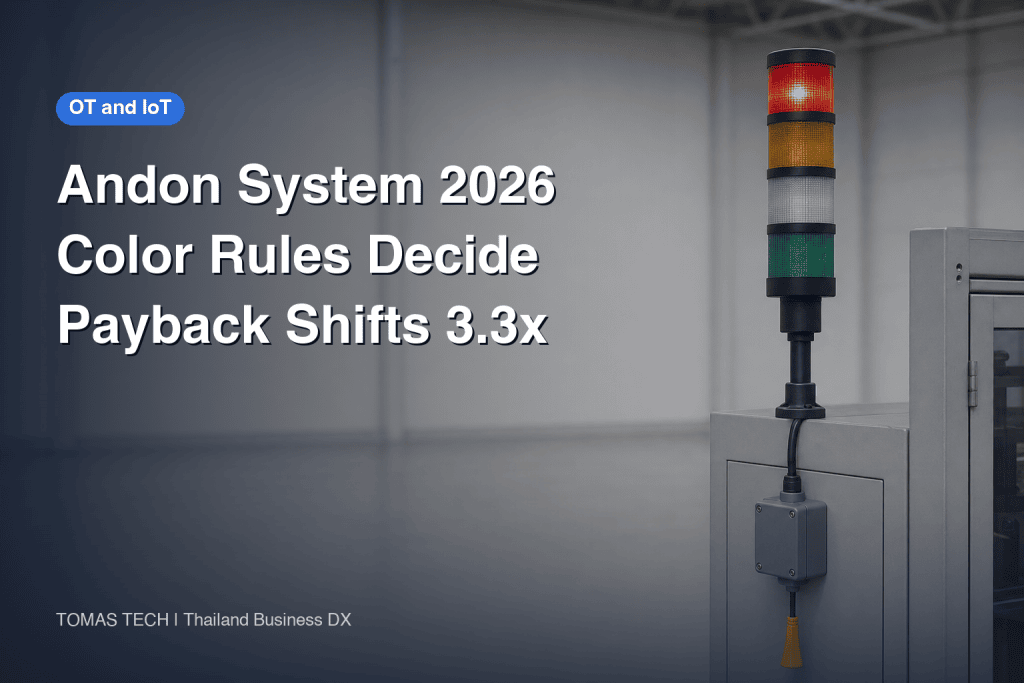
Color schemes differ from plant to plant. The common base is three colors, green, yellow and red, often extended to a four-color set by adding white. Green means running normally. Yellow means attention required, such as a consumable approaching replacement or material running low. Red means an abnormality or a stopped line. Where white is used, it is usually assigned to quality checks in progress or work waiting for inspection. The three-color explanation is set out in Andon on Wikipedia, while the four-color scheme that includes white is described by WingArc1st in its guide to making production lines visible with andon.
You cannot stop there, though. A list of colors on its own does not make an andon system work. What the floor actually needs is a single table like the one below.
| Color | Meaning | What triggers it | First responder | Response commitment |
|---|---|---|---|---|
| Green | Running normally | Default state when no other color is showing | None | None |
| White | Quality check in progress, awaiting inspection | Operator is unsure of a judgment | Quality staff | Within 15 minutes |
| Yellow | Attention required, support requested | Material level, consumable due for replacement, drop in pace | Line leader | Within 5 minutes |
| Red | Abnormality, line stopped | Equipment stop, safety event, yellow standing for 15 minutes | Line leader and maintenance | Immediately |
Most plants have the first two columns of that table. The third column onward — what raises the color, who responds, and how quickly — never makes it onto paper before the system goes live. And those three columns are precisely what decides whether an andon system delivers anything.
The value of visibility itself is well documented. The WingArc1st article cited above describes Toyota Motor East Japan making shop-floor status visible in combination with digitizing paper forms, Toyo Seikan making several processes visible together and running them with fewer people, and Fujitsu I-Network Systems reducing a permanently staffed position from three operators to two. What all three have in common is not the display hardware. It is that the organization decided in advance how it would react to the information being displayed. The same article lists two operating essentials — establishing a single set of rules across the company and making sure everyone knows them, and installing displays where they are genuinely visible. Installation position is an engineering item. Writing the rules and getting them understood is not something you can buy from a contractor.
Why an andon system that is only lamps stops being used within six months
Andon systems that fall out of use within a few months fail in remarkably consistent ways, and hardware failure is not one of them. There are five patterns.
The first is when the boundary between yellow and red differs from person to person. One operator raises red at the first hint of trouble; another shows nothing until the line has actually stopped. The activation data that management sees is then not a picture of the line — it is a picture of operator temperament. Once the data stops being credible, management stops looking at it. Once management stops looking, the floor stops raising colors.
The second is when nobody comes. One experience of raising yellow and waiting 20 minutes with no response is enough to stop an operator raising it again, because raising it achieved nothing. What is at work here is not laziness on the responder’s side. It is that no one ever decided who goes when yellow appears. Everybody’s job is nobody’s job, as the old line has it.
The third is when raising a color gets you scolded. An operator who is asked “why did you stop the line?” after raising red will reach the same conclusion. An andon system is, at its origin, a mechanism for handing the authority to stop to the operator. Hand out the hardware without handing over the authority, and what the operator has been given is a button that reports on themselves.
The fourth is when the colors multiply. Blue, purple and various flashing patterns get added with the best of intentions, and the floor now needs a moment to remember what each one means. A signal that cannot be read in one second is not functioning as a signal. In practice around four colors works, and five is the ceiling.
The fifth is when nothing is recorded. Without an activation history, no one can answer the question “what caused the most yellows last month?” If that question cannot be answered, improvement ideas do not surface, and a mechanism that does not lead to improvement is one that everyone eventually stops caring about.
It is worth separating healthy decline from unhealthy decline at this point. The implementation guide How to Implement an Andon System reports activation frequency converging from roughly 45 to 60 times a day in the early period down to roughly 20 to 30 times a day once the system is stable. That is a decline caused by real problems being eliminated, and it is healthy. The problem case is when frequency falls while defects and stoppages do not. In that case what is falling is not problems but reporting. Getting into the habit of reading the activation history side by side with defect rate and downtime keeps the two apart.
Line the five patterns up again and it becomes clear that none of them has anything to do with the specification of the display hardware. Defining boundaries, naming responders, granting authority, constraining the number of colors, recording history — every one of them sits on the rules side. That is why the success of an andon system is decided not by the catalog specification of the lamp but by whether budget was allocated to the process of designing the rules.
What an andon system covers | designing meaning and designing delivery are different jobs
Discuss andon for long enough and someone will ask how it differs from a system that pushes alerts to a smartwatch or a phone. The two have different purposes, and blending them leaves both half-finished.
A notification system is solving a delivery problem. When something goes wrong, how do you reliably get the information to people who are not on the floor — maintenance, production engineering, the night-shift manager, headquarters in Japan? The design work is about how you build the detection layer, the delivery layer and the record layer. We cover that in detail in our article on designing an equipment alert notification system, so if you are at the stage of evaluating the notification mechanism itself, start there.
An andon system is solving a meaning problem. Can the people who are physically present understand the situation the instant they turn around? They have about one second to read it. That is why the number of colors has to be small, and why the mapping from color to response has to be coarse enough to memorize.
| Aspect | Andon system, designing meaning | Notification system, designing delivery |
|---|---|---|
| Problem being solved | Can everyone present read the situation in one second | Does it reliably reach people who are not on the floor |
| Primary audience | Operators on the line, line leaders, managers passing by | Maintenance, production engineering, night-shift managers, remote management |
| Main design objects | Number of colors, activation criteria, escalation timing, named responders | Detection conditions, redundant delivery paths, read receipts and retries, retained history |
| Main measures | Time to start of response, quality of activations covering false alarms and misses | Delivery rate, time to open, alert fatigue from over-notifying |
| How failure shows up | Nobody raises a color, nobody comes | So many alerts that everyone mutes them |
In practice you use both, and the order matters. First fix the colors and the criteria so that meaning is shared inside the plant. Then connect the outside world to it, so that a color standing for a defined period is pushed beyond the floor. Do not do it the other way round. Push a high volume of signals with undefined meaning to remote recipients and they will be ignoring the notifications within days. The escalation rule you set in the rule-design layer — yellow standing for 15 minutes becomes red — can be used directly as the trigger condition for the notification system. Rule design is the foundation the notification project stands on as well.
Andon system cost breakdown | five layers
Now to cost. What follows is a model estimate for a Japanese-owned plant in Thailand, and every figure is an assumed value for that model plant. The premises are 20 production lines and 250 operating days a year.

The cost of deploying an andon system breaks into the following five layers.
| Layer | What it covers | Amount (THB) | Share |
|---|---|---|---|
| Layer 1 | Display hardware, stack lights and large display boards | 480,000 | 33.3% |
| Layer 2 | Activation devices, pull cords, buttons, some automatic sensor detection | 220,000 | 15.3% |
| Layer 3 | Wiring and communications | 300,000 | 20.8% |
| Layer 4 | Rule design, color scheme design, escalation criteria | 260,000 | 18.1% |
| Layer 5 | Training, adoption, integration of the activation history record | 180,000 | 12.5% |
| Total | 1,440,000 | 100% |
Layers 1 to 3 appear on every vendor’s quotation without fail. They exist as objects, they can be counted, and they can be compared by model number. Put the job out to competitive bidding and the outcome is decided on the price of those three layers.
The problem is layer 4. It accounts for 260,000 THB of the 1,440,000 THB total, a share of 18.1%, and yet it appears on almost no quotation. There are three reasons.
The first is that the deliverable is not physical. What layer 4 produces is paper — a definition of each color, a list of activation criteria, escalation timing rules, and a table of who is responsible for responding. At acceptance, paper looks like work but it does not look like a thing. It becomes the first target in any price negotiation.
The second is that the effort is hard to estimate in advance. Aligning the meaning of colors across a line with 10 processes is a completely different exercise from doing it across a line with 30. If each area already has its own informal call-for-help conventions, the work starts with taking an inventory of them. Putting unpredictable effort into a fixed-price quotation inflates the headline number, so the market as a whole has optimized toward leaving it out and looking cheaper.
The third is that the buyer’s specification never asked for it. If the specification says “20 stack lights, 20 button sets, 2 display boards”, the quotation comes back saying exactly that. What is not written down does not get priced. The biggest single reason layer 4 disappears is, in fact, on the buying side.
Layer 5, training and adoption, gets similar treatment, though it usually survives as one day of “operating instructions”. Operating instructions are not what is needed. What is needed is time — including the line-leader level — to share when yellow gets raised, who arrives when red gets raised, and the promise that nobody gets scolded for raising it. This has exactly the same shape as the layered cost structure we describe in our article on the five-layer cost breakdown of a factory IoT deployment. Buy only the layers you can see, and you lose the benefit in the layers you cannot.
Comparing payback | what happens when the rule-design layer is skipped
Here is what skipping layer 4 does, expressed as an estimate. Every premise is an assumed value for the model plant.

The premises, restated. A plant in Thailand, 20 production lines, 250 operating days a year. Escalation events that need an andon response occur at a rate of 4 per line per day. At 20 lines multiplied by 250 days multiplied by 4 events, that is 20,000 events a year. The opportunity cost of an hour of response time is set at 700 baht.
Scenario A | deploying with the rule-design layer included
The investment is the 1,440,000 THB total from the table above, with 260,000 THB allocated to layer 4 and 180,000 THB to layer 5.
There are two benefit streams.
A1 is the reduction in response time. Because the meaning of each color and the associated response time are unambiguous, operators raise colors without hesitating and responders move without hesitating. Assume the start of response comes 4 minutes earlier on average per event. At 20,000 events a year multiplied by 4 minutes divided by 60 minutes multiplied by 700 baht, that is about 933,000 THB.
A2 is the reduction in quality defects. Take the rework and scrap cost attributable to late detection as 900,000 THB a year, and assume that using white properly to mark quality checks in progress, together with clear criteria for escalating to red, removes 35% of it. That is 315,000 THB.
Total annual benefit is 1,248,000 THB. Annual running cost is 129,600 THB, equal to 9% of the investment, covering software maintenance for the display boards and communication charges. An andon system on its own carries neither a cloud platform nor a large sensor population, so this ratio sits below what a full production monitoring system would show. Net annual benefit is therefore 1,118,400 THB, giving a payback of roughly 1.29 years, or about 15.5 months.
Scenario B | skipping rule design and minimizing training
This is the “let us start cheap” decision — layer 4 taken to zero and layer 5 compressed to a minimal 70,000 THB. Layers 1 to 3 are unchanged, so the investment is 1,070,000 THB, which is 25.7% less than Scenario A.
| Layer | Scenario A (THB) | Scenario B (THB) |
|---|---|---|
| Layer 1 display hardware | 480,000 | 480,000 |
| Layer 2 activation devices | 220,000 | 220,000 |
| Layer 3 wiring and communications | 300,000 | 300,000 |
| Layer 4 rule design | 260,000 | 0 |
| Layer 5 training and adoption | 180,000 | 70,000 |
| Total | 1,440,000 | 1,070,000 |
The benefits look like this. B1 is again the reduction in response time, but because the meaning of the colors and the expected response times stay vague, assume only 25% of the benefit assumed in Scenario A materializes. That is 25% of 933,000 THB, or about 233,200 THB. B2 is the quality benefit, and on the same logic only 15% materializes, or about 47,200 THB. Total 280,400 THB.
Annual running cost comes to just 28,900 THB, because there is no display board software and no integration of the activation history — only communication charges and replacement parts. The low running cost is real. But that cheapness is the flip side of keeping no records. Net annual benefit is 251,500 THB, and payback is roughly 4.25 years, or about 51.1 months.
The heart of the comparison
Put the two side by side and this is the crux of the article.
| Item | Scenario A | Scenario B |
|---|---|---|
| Investment (THB) | 1,440,000 | 1,070,000 |
| Annual benefit (THB) | 1,248,000 | 280,400 |
| Annual running cost (THB) | 129,600 | 28,900 |
| Net annual benefit (THB) | 1,118,400 | 251,500 |
| Payback (years) | 1.29 | 4.25 |
| Payback (months) | 15.5 | 51.1 |
| Cumulative net benefit over 5 years (THB) | 4,152,000 | 187,500 |
The investment in B is only 25.7% lower. Yet payback moves from 1.29 years in A to 4.25 years in B — roughly 3.3 times longer.
Over five years the gap widens further. Scenario A accumulates 1,118,400 THB multiplied by 5 years, less the 1,440,000 THB investment, for 4,152,000 THB. Scenario B accumulates 251,500 THB multiplied by 5 years, less 1,070,000 THB, for 187,500 THB. Both are simple totals with no discount rate applied, and what they show is that after five years Scenario B has done little more than pay back its own investment.
There is one conclusion to draw. Buying only lamps and buttons and handing them to the floor without deciding the rules is not the cheapest option available. It is the most expensive one. Holding the initial investment down from 1,440,000 THB to 1,070,000 THB turns a five-year cumulative net benefit of 4,152,000 THB into 187,500 THB. What was held down was a slice of the spending. What was lost was most of the benefit.
Note that this estimate is not a comparison of whether to deploy an andon system. It is a comparison of how to deploy one. Reducing the underlying structure of stoppages — in particular the way short stoppages accumulate and eat into utilization — is often faster to attack from the measurement side. For the breakdown into availability, performance and quality rate, see our article on tackling minor stoppages and the structure of OEE. An andon system is one of the means by which you move those measures.
Sensitivity analysis | what moves the payback period is not the display hardware
The 4 minutes saved per event assumed in Scenario A is exactly that, an assumption. So it is worth checking whether the conclusion survives if the assumption is wrong. Here the quality benefit A2 of 315,000 THB is held fixed and only A1 is varied, because the quality benefit depends on the detection mechanism and is driven by factors separate from how much response time is saved.
| Minutes saved per event | A1 (THB) | Total benefit (THB) | Payback (years) |
|---|---|---|---|
| 2 minutes | 467,000 | 782,000 | 2.21 |
| 3 minutes | 700,000 | 1,015,000 | 1.63 |
| 4 minutes (base case) | 933,000 | 1,248,000 | 1.29 |
| 5 minutes | 1,167,000 | 1,482,000 | 1.06 |
The investment of 1,440,000 THB and the annual running cost of 129,600 THB are identical across all four rows.
Two things can be read from it.
The first is that the case holds on the pessimistic side. Even if only 2 minutes of improvement materialize, payback is 2.21 years. Over five years the investment is recovered and the benefit keeps running afterwards. The decision to deploy with layer 4 included does not break under fairly pessimistic assumptions.
The second is the real point. What moves in this table is not the brightness of the lamp, the resolution of the board, or the communications protocol. The only thing being varied is how many minutes earlier the response actually starts. And what determines that number of minutes is whether the person who sees the color can decide their next action without hesitating — in other words, how unambiguously the rules read.
Put differently, the lever on payback sits in layer 4, not layer 1. Upgrading the layer 1 display hardware to a more expensive model does not increase the number of minutes saved, so it does not improve payback. It only increases the investment, which makes payback worse. Work on layer 4 and take the saving from 2 minutes to 4 minutes, on the other hand, and payback contracts sharply from 2.21 years to 1.29 years. When you are deciding how to allocate the budget, this table is the answer.
For reference, there are reports from outside Thailand pointing in the same direction. They are case values whose underlying conditions are not published, however, so do not add them to the THB-denominated model estimate above. The Lean 6 Sigma Hub implementation guide cited earlier reports an automotive parts manufacturer improving its defect rate from 3.2% to 0.9%, its problem detection time from 18 minutes to 2 minutes, and its monthly correction cost from 47,000 US dollars to 14,000 US dollars. Note which variable is contracting there — problem detection time. It belongs to the same family of variables as the time to start of response that our sensitivity analysis varies, and both are set by operating rules rather than by hardware specification. The direction is consistent with our estimate, but the currency and the premises are different, so avoid copying those figures straight into your own capital request.
Deploying an andon system in a Thai plant
Four points require a different judgment in Thailand than they would in Japan.
The first is labor cost. Thailand’s minimum wage remains in the range of 337 baht to 400 baht per day as of 2026, but that does not mean “stationing a person to watch the line is cheap”. Put someone there to watch, and watching is all they can do. The economics of an andon system come less from removing monitoring headcount than from making sure the line leaders and maintenance staff you already employ never have to wonder where to go. The Fujitsu I-Network Systems case cited earlier, where a permanently staffed position went from three operators to two, is what happens when visibility removes the necessity for the assignment in the first place.
The second is the multinational shop floor. In Thai plants it is common for Thai operators to work the same line as workers from Myanmar, Cambodia and Laos, with Japanese staff in management. Where languages are mixed, written instructions always thin out somewhere. Color crosses language, so an andon system is inherently a strong tool in this environment. It is only strong, however, when the colors read the same way for everyone. If the meaning of a color varies from person to person, the mix of languages simply deepens the misunderstanding. The more multilingual the floor, the more layer 4 pays.
The third is where the production cycle sits. The Manufacturing Production Index (MPI) published by Thailand’s Office of Industrial Economics (OIE) stood at 94.99 in June 2026, down 5.64% from the previous month and down 3.10% from the same month a year earlier. This is not an expansion phase. Which is exactly why investment aimed at improving the response of the lines you already have — recovering yield and utilization — tends to clear internal approval more easily than building new lines to add capacity. Our estimate is built on investment in 20 existing lines rather than new construction for precisely this reason.
The fourth is the incentive regime. Through 2025 and 2026 the Thailand Board of Investment (BOI) has expanded incentives for the EEC, green industry and digital industry. Measures include corporate income tax exemption for up to 13 years and exemption from import duty on machinery and equipment, and capital expenditure relating to production efficiency and automation can fall within scope. Layers 1 to 3 of an andon system are physical equipment, so they may qualify. For the overall picture of the regime, see the complete 2026 guide to Thailand BOI investment incentives. The point to watch is that incentives only bite on the layers that consist of things. Layer 4 rule design and layer 5 training are difficult to treat as capital equipment for tax purposes, so any attempt to maximize the incentive creates an unconscious pull toward cutting layer 4. What this article’s estimate shows is that resisting that pull is worth money.
Radio frequency and power regulations for wireless inside the plant, and the choice between wired and wireless, are outside the scope of this article. Those belong to layer 3 communications design, and we have set them out in our article on the practical side of factory IoT deployment.
How to roll out an andon system
Get the order right and deploying an andon system is not a difficult engineering project. Five steps.
Step 1 is taking an inventory of the color rules you already have. Most plants already have some convention for calling for help — raising a hand, going to find the line leader, using an internal phone, a patrol light fitted to one particular machine. Write these out process by process and identify every place where the same event is handled differently in different areas. The inconsistencies you find here are the workload of layer 4.
Step 2 is measuring response time as it stands today. Capture the baseline before the andon system goes in. Record the time from an abnormality occurring to the responder arriving at the line, over several weeks, by hand if necessary. Those numbers are the baseline against which you will later verify the benefit. Without them, the strongest post-deployment statement available is “it feels faster”. As the sensitivity analysis shows, those few minutes are what determines payback, so choosing not to measure comes close to abandoning the investment decision itself.
Step 3 is designing the number of colors and the escalation criteria. Keep it to around four colors. For each color, decide the activation trigger, the responsibility of the first responder, the committed time to start responding, and how many minutes it may stand before it is raised to the next color. That escalation rule gets reused downstream, so write the timing in minutes and do not leave it vague. Put the result on paper, at a size that can be posted on the floor.
Step 4 is selecting the display hardware and activation devices. The point is to select after step 3 is complete. Once the colors are fixed, the number of tiers you need is fixed. Once the responders are named, the audience for each board and its installation position are fixed. Reverse the order and you end up writing rules to fit the number of tiers on the hardware you already bought, which produces colors with no meaning. Product roundups such as Best Andon Systems for Manufacturing exist as a starting point, but the deployment benefit figures listed in guides of this kind are frequently sourced from vendors’ own published claims, so use them only as an entry point to the selection process.
Step 5 is training, adoption, and integrating the activation history into your records. This is not an operating tutorial, it is practice at making judgments. The efficient format is to take a handful of events that actually happened and have the line-leader group argue out whether each one is yellow or red. At the same time, management states explicitly, as a rule, that nobody will be reprimanded for raising red. For the record integration, capturing the time, color, process and duration of each activation is enough.
As a guide to duration, the Lean 6 Sigma Hub implementation guide cited earlier sets a pilot period of 4 to 6 weeks for a scope of one line, 8 workstations and 12 operators. Rather than rolling out to every line at once, the realistic approach is to run the rules on one line first, correct the color definitions, and then expand.
Frequently asked questions
What is an andon system?
It is a mechanism that shows the state of a production line through color and display and alerts the people around it when something goes wrong. The name comes from the Japanese word for a paper lantern, and the practice spread through the Toyota Production System. It consists of three elements — activation, meaning who raises a color; display, meaning what is shown and from where; and response, meaning who goes and within how long. The display hardware is only the visible part. What actually determines the benefit is the set of rules defining what each color means and what response has been promised.
How much does an andon system cost?
In the model estimate used in this article, a plant with 20 production lines totals 1,440,000 THB. The breakdown is 480,000 THB for display hardware, 220,000 THB for activation devices, 300,000 THB for wiring and communications, 260,000 THB for rule design, and 180,000 THB for training and adoption. Most quotations cover only the first three layers, and the 260,000 THB of rule design and 180,000 THB of training and adoption never appear as line items. How you secure those two is the practical question.
What is the difference between an andon system and a notification system?
An andon system creates a state in which people who are physically present can read the meaning in one second. A notification system reliably delivers information to people who are not present. Their design objects and their success measures are both different. In practice you use both, but the safe order is to fix the meaning of the colors and the escalation criteria with andon first, then wire those criteria in as the trigger conditions for notifications. Push a high volume of signals with undefined meaning to remote recipients and they will be ignoring the notifications within days.
How many colors should an andon system use?
Around four is normal — green, yellow, white and red. The standard assignment is green for running normally, yellow for attention required or support requested, white for a quality check in progress, and red for an abnormality or a stop. The more colors you add, the longer the floor needs to recall what each one means, so in practice five is the ceiling. What matters is not the number of colors but whether, for each one, you have decided what raises it, who responds, and after how many minutes it escalates to the next color.
Can an andon system be retrofitted to existing equipment?
Yes. If you limit activation to human action through pull cords or buttons, no modification to the equipment is required. If you want automatic detection from the equipment, the effort depends on whether the existing control panel has spare contacts, or whether a production monitoring system is already in place. If you are phasing the work, the efficient path is to run the rules with manual activation first, accumulate activation history, and then replace only the high-frequency events with automatic detection.
Summary
An andon system stops being used within six months not because of the performance of the lamp, but because nobody designed the rules — which color means what, how many minutes a condition may stand before it is escalated, and who has promised to respond. Quotations reach as far as lamps, buttons and wiring, and then drop the rule-design layer 4 and the adoption training of layer 5.
In the model estimate, payback with layers 4 and 5 included was 1.29 years, and payback without them was 4.25 years. The difference in investment is only 25.7%, yet the payback period stretches by roughly 3.3 times. Measured as cumulative net benefit over five years, the two come to 4,152,000 THB and 187,500 THB, with the latter doing little more than recovering its own investment. And what the sensitivity analysis showed is that the thing creating that gap is not the specification of the display hardware but a single variable — how many minutes earlier the response actually starts.
The hardware can be identical, and the outcome will still differ depending on whether you invested in the process of deciding meaning. The first thing to open when you start evaluating an andon system is not the display hardware catalog. It is a blank sheet on which to write the definition of each color.
We are happy to talk at the evaluation stage, before anything has been decided. The same goes if display hardware is already installed but nobody uses it, if you want to revisit your color rules, or if you would like an outside opinion on whether a cost breakdown you have been given is reasonable. We can discuss all of it against the realities of running a plant in Thailand, so please reach us through the Contact us page whenever it suits you.
References
- WingArc1st — Making production lines visible with andon View the article
- Wikipedia — Andon in production management View the article
- Lean 6 Sigma Hub — How to Implement an Andon System (published 10 July 2026) View the article
- MMC — Best Andon Systems for Manufacturing 2026 Guide View the article
- The Office of Industrial Economics, Thailand — Manufacturing Production Index MPI View the statistics
- CareerLink Asia — Complete guide to Thailand BOI investment incentives 2026 View the article


