


As high-mix, low-volume production and labor shortages collide on factory floors across Thailand, interest in AI production planning is rising fast. Scheduling that depends on one veteran planner’s gut feel is a fragile, single-point-of-failure approach, and it tends to react too slowly when demand shifts. This article walks through what AI production planning actually means, why 2026 is the moment it matters, the hard numbers behind the results, how to roll it out, what it costs, and the mistakes companies most often make — written for executives, plant managers, and IT leads at Japanese-affiliated manufacturers operating in Thailand and across ASEAN.
What Is AI Production Planning? Untangling APS, Demand Forecasting, Generative AI, and Agentic AI
“AI production planning” gets used as a catch-all term, but it actually bundles together several distinct technologies. Before evaluating any solution, it helps to understand how these pieces differ.
APS (Advanced Planning and Scheduling) systems combine demand information with supply-side constraints — equipment capacity, staffing, material inventory — to optimize everything from long-range production plans down to detailed job sequencing on the shop floor. APS was originally built around mathematical optimization logic, but a growing number of vendors are now embedding AI and machine learning capabilities. According to a 2024 survey by the Industrial Internet Consortium, more than 68 percent of APS vendors have already built in AI/ML features, and this has cut planning cycle time by roughly 42 percent.
Demand forecasting AI learns from historical order data, seasonal patterns, and market signals to statistically predict future demand. It typically feeds into APS as an input, and the more accurate the forecast, the more accurate the resulting production plan.
Generative AI supports planners through a natural-language interface, helping them revise and simulate plans conversationally. Ask it something like “show me next week’s load on line A process,” and it can summarize the current schedule or propose alternatives — the technology behind what’s often called “touchless planning.”
Agentic AI goes a step further: it continuously monitors changing conditions, such as demand swings or supply delays, and autonomously drafts a response — an alternate supplier, a resequenced production order — before a human signs off. In practice today, this still runs on a human-in-the-loop model, where the AI proposes and a person makes the final call; rushing toward full automation is not recommended at this stage.
Digital twins recreate a factory’s lines, equipment, and inventory status in a virtual environment, letting teams simulate the impact of a planning change before it touches the real floor. Testing an AI-generated plan in the digital twin first helps catch problems before they become costly rework.
These five elements are not independent products — most solutions layer demand forecasting AI, generative AI, agentic AI, and digital twins on top of an APS foundation. The way to avoid wasted effort is to first pin down which of these elements actually maps to your own pain points before shopping for a product.
Traditional ERP and MRP (material requirements planning) systems already handle some production planning functions, but they’re mostly built to calculate what quantity to order and when — they don’t fully account for finer-grained constraints like equipment capacity, staffing limits, or changeover sequencing. AI production planning differs by generating realistic plans that account for multiple constraints simultaneously, at speed, and by letting teams rebuild the plan quickly when demand shifts. When comparing products, it helps to separate the question of whether your real problem is forecast accuracy or the fact that planning itself depends too heavily on one person’s know-how — that distinction makes it much easier to prioritize which features you actually need.
Why AI Production Planning Matters Now, in 2026
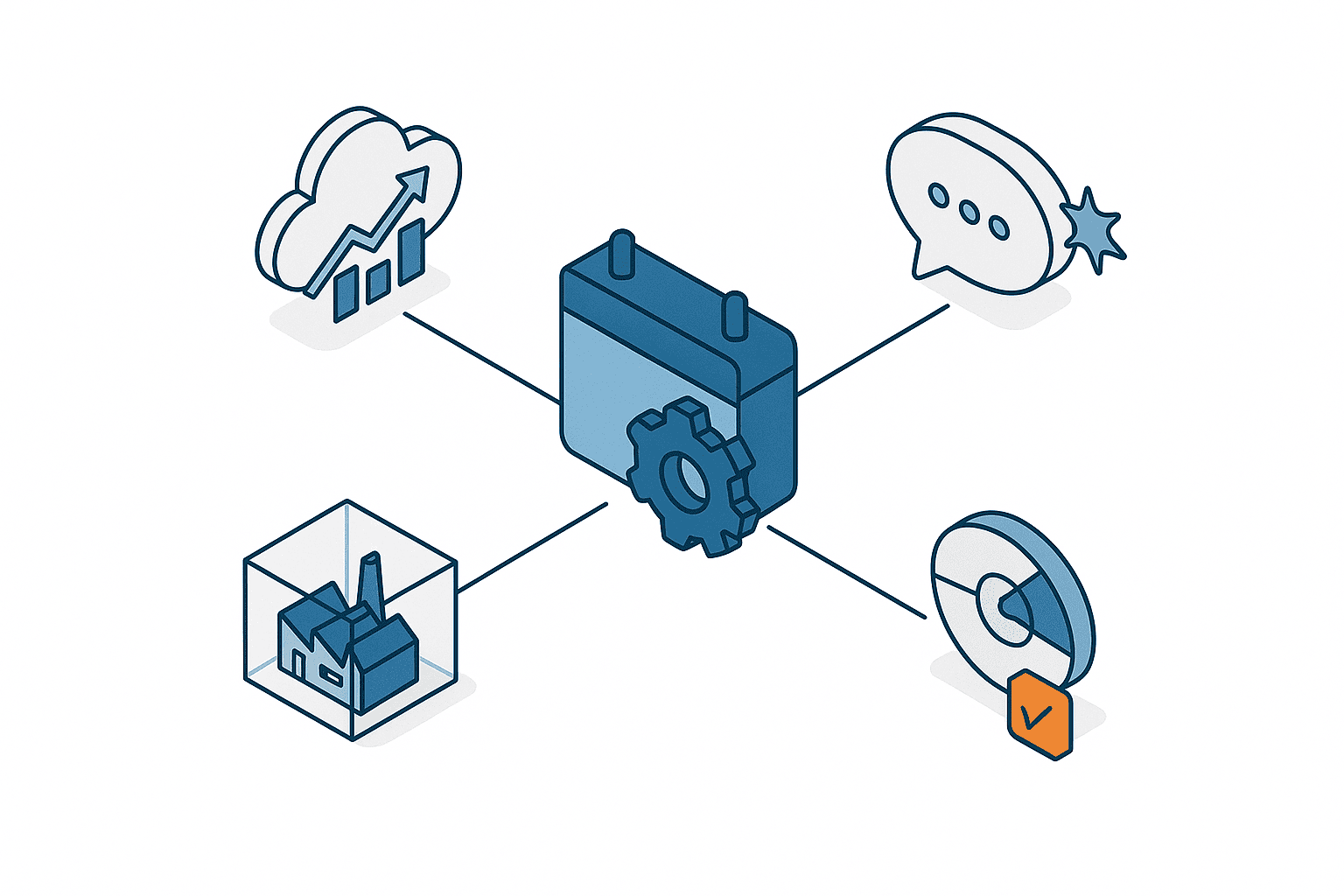
Three forces are converging to accelerate investment in AI production planning: market momentum, corporate investment priorities, and labor conditions specific to Thailand.
Start with market size. The global production planning and scheduling software market is set to grow from USD 3.91 billion in 2025 to USD 4.24 billion in 2026, a compound annual growth rate (CAGR) of 8.7 percent, reaching an estimated USD 5.97 billion by 2030. This isn’t a short-lived trend — it’s a multi-year investment category.
Corporate spending priorities reflect the same shift. In Deloitte’s 2025 Smart Manufacturing Survey of 600 respondent companies, 35 percent of manufacturers ranked “advanced production scheduling” among their top two investment priorities. Upgrading production planning is now being treated as a board-level priority alongside capital equipment and hiring.
For Japanese-affiliated manufacturers based in Thailand, there’s an additional and more urgent driver: labor shortages and the retirement of skilled staff. Veteran schedulers who have carried a factory’s production planning for years are reaching retirement age, and training their successors takes time. In high-mix, low-volume environments with large numbers of SKUs, the theoretical number of possible combinations becomes too large to work through manually or in Excel, leaving planners dependent on tacit judgment and experience. AI production planning is drawing interest precisely because it addresses this “black box” risk in planning.
Separately, Thailand’s Board of Investment (BOI) is reportedly considering expanded incentives for smart factories, AI adoption, and automation in 2026, including possible tax benefits tied to Industry 4.0 capital investment. Eligibility and conditions for these programs change frequently, so any company evaluating this angle should confirm applicability with its own tax and legal advisors before counting on it.
On the factory floor in Thailand, local staff — not just Japanese expatriates — increasingly own the day-to-day planning function, which makes standardizing and systematizing that work more important than ever. Moving from planning based on individual intuition to planning grounded in reproducible data builds a factory operation that can withstand future changes in staffing.
With market growth, corporate investment priorities, and Thailand’s labor shortage all converging in 2026, this is a strong window to evaluate AI production planning. If you’re already revisiting your broader production management setup, it’s worth reading Production Management System RFP 2026 — Why Quotes Split 3.0x, which explains how clarifying the scope of AI production planning at the requirements stage makes it much easier to compare quotes and reach a decision later.
The Results — Quantified Gains and a Real Factory Case Study
The impact of AI production planning shows up both in cross-industry benchmark studies and in real factory deployments. Manual planning tends to lean on whatever a planner happens to remember and how they’re feeling that day, so plan quality can vary widely between people even when they start from the same constraints. AI production planning’s real strength is that it evens out this variability while dramatically speeding up the planning process itself.
According to McKinsey’s Industry 4.0 benchmarks, smart manufacturing initiatives that include AI adoption have delivered a 30 to 50 percent reduction in downtime, a 10 to 30 percent increase in throughput, a 15 to 30 percent gain in labor productivity, and demand forecast accuracy as high as 85 percent. These figures aren’t from a single company — they’re aggregated across many organizations.
The World Economic Forum’s Global Lighthouse Network shows even stronger results. Across its 2024–2025 cohort, AI initiatives overall delivered a 40 percent gain in labor productivity and a 48 percent cut in lead time. Companies that followed the Lighthouse playbook saw return on investment (ROI) of 2 to 3 times within three years, and 4 to 5 times within five years — suggesting these gains compound over multiple years rather than being a one-time bump.
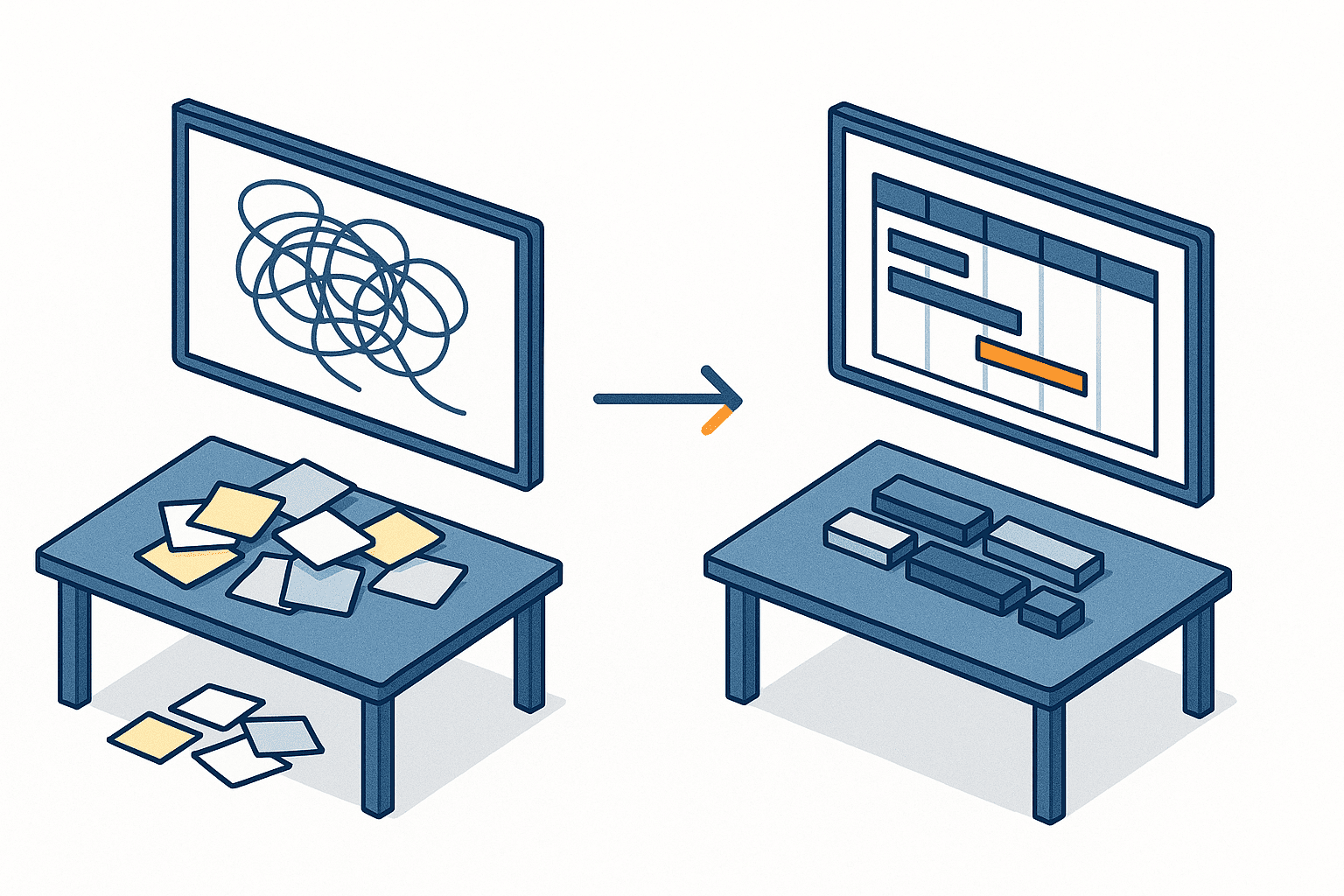
Beyond these global benchmarks, a real-world case from Japan is instructive. At one metal processing factory, on-time delivery improved from 85 percent to 95 percent within three months of adopting AI-based production planning. Daily time spent building the schedule dropped by 50 minutes, and the number of monthly changeovers fell by about 15 percent. That same factory had been wrestling with the same issues many Thai factories face today — the combinatorial complexity of high-mix, low-volume production and the risk of losing institutional knowledge as veteran schedulers retire. Seeing AI production planning deliver both faster scheduling and fewer changeover losses at once makes this case particularly relevant.
The results are summarized below.
| Metric | Improvement | Source |
|---|---|---|
| Downtime | 30 to 50 percent reduction | McKinsey Industry 4.0 benchmarks |
| Throughput | 10 to 30 percent increase | McKinsey Industry 4.0 benchmarks |
| Labor productivity (Lighthouse) | 40 percent increase | WEF Global Lighthouse Network |
| Lead time | 48 percent reduction | WEF Global Lighthouse Network |
| On-time delivery (Japan metal processing case) | 85 percent to 95 percent (3 months) | Productivity improvement blog case study |
The wide ranges reflect differences in industry, production style, and scope of rollout. The most reliable approach is to benchmark against a case closest to your own production style (high-mix low-volume versus low-mix high-volume, for example) and agree internally on a realistic target before you start, so the post-launch evaluation doesn’t drift.
The metal processing case’s time savings deserve a closer look. Fifty minutes a day sounds modest, but it adds up to roughly 20 hours a month and around 240 hours a year. Freeing up that much of a veteran scheduler’s time lets them focus on the things AI can’t replace — handling sudden design changes, responding to urgent orders, or mentoring the next generation of planners. The 15 percent drop in changeovers matters too, beyond the utilization gain — fewer changeovers also means fewer opportunities for the quality issues that tend to crop up during a changeover.
For a closer look at which kinds of AI adoption are actually delivering results on the shop floor, see Shop Floor AI Use Cases | The 4 Data Types That Predict Success for concrete patterns worth checking against your own operation.
How to Roll It Out — A 3-Month Roadmap for AI Production Planning
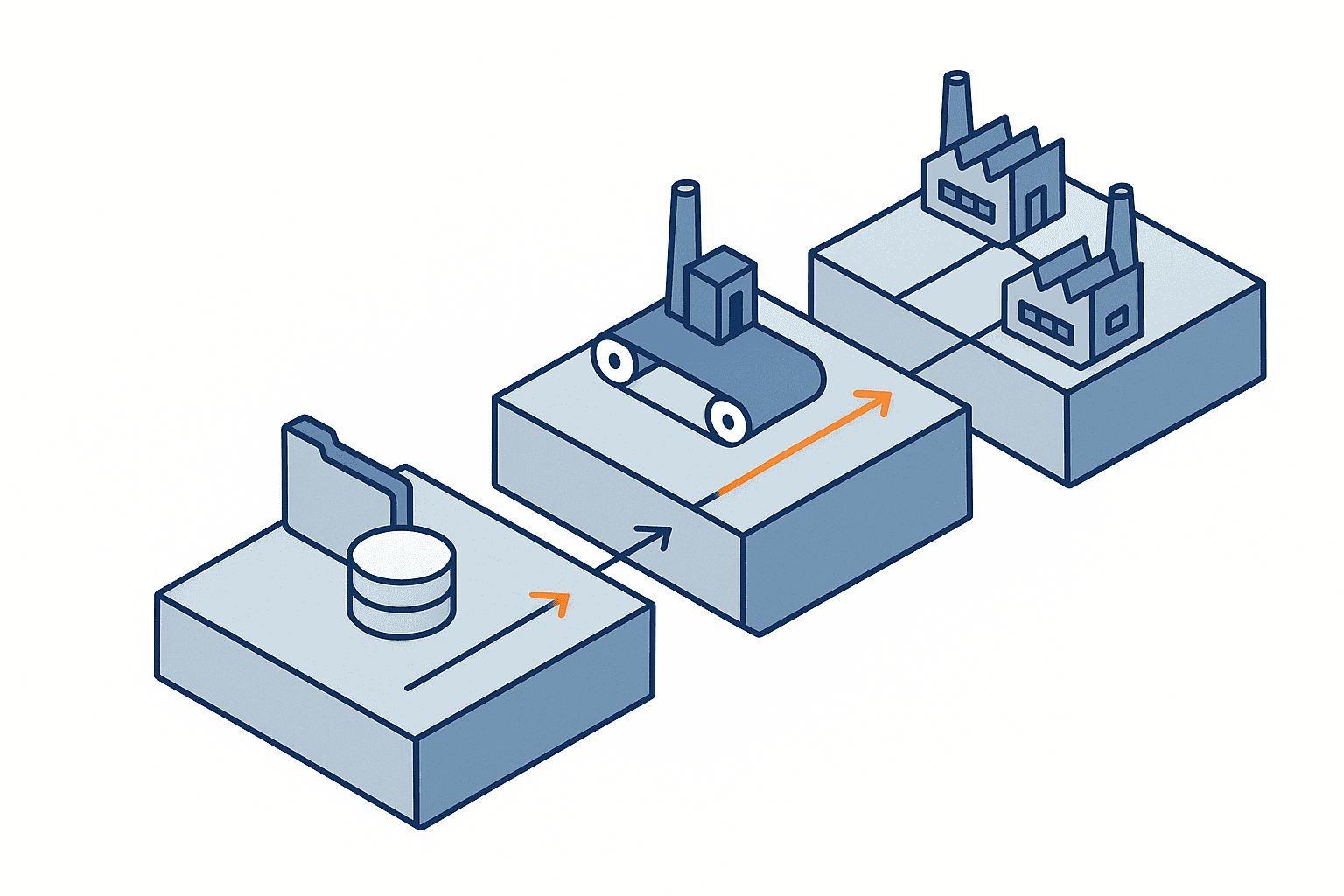
The standard approach to rolling out AI production planning isn’t a big-bang launch across every line — it’s staged. The pattern most common in Japanese deployments is a three-month sequence: one month of data preparation, one month piloting on a single line, and one month of full rollout.
Month one is data preparation. This means organizing historical order records, equipment capacity data, material inventory, and standard process times into a format the AI can learn from and calculate against. In practice, this step usually takes the longest, and the granularity and completeness of the data heavily shapes the accuracy of everything downstream. At Thailand-based sites, it’s common for this data to be scattered across the local ERP, MES, and Excel ledgers, so it’s worth building extra time into the schedule for this data inventory work.
Month two is a single-line pilot. Before rolling out company-wide, pick one representative line or process and actually run the AI-generated plan in production. This is the stage to gather feedback from operators and planners on the shop floor and validate how accurate and usable the AI’s suggestions really are. It’s also the period where the organization builds a practical sense of how far to trust the AI’s proposals, operating on a human-in-the-loop basis where a person gives final approval.
Month three is full rollout. Using what was learned in the pilot, the system is extended to other lines and processes in sequence, while the team documents operating rules and runs internal training. Rollout isn’t the end of the project — it shifts into an ongoing phase where the AI’s forecasting model and planning logic are continually revisited as demand and product mix evolve. Planning for this ongoing phase from the start helps prevent the gradual accuracy drift that can otherwise creep in after launch.
Japanese-affiliated companies in Thailand following this three-month pattern need to account for a few local factors. Decide early whether the system’s screens and alerts need to support Thai, English, and Japanese for local staff. If integration with a local production management system or MES is required, the project will likely need to involve a local systems integrator, meaning the team can’t be run entirely by a vendor based in Japan. Building out this multi-party project structure takes time that should be planned separately from the three-month rollout itself.
What It Costs — Initial Investment and Running Costs for AI Production Planning
The cost of AI production planning varies significantly depending on scope (a single line versus company-wide), whether it needs to integrate with existing systems, and how much custom development is involved. As a reference point, typical figures in Japan fall into the following ranges.
| Item | Typical cost | Notes |
|---|---|---|
| Initial investment (production planning and scheduling) | JPY 5 million to 20 million | Includes custom development and integration with existing systems |
| Demand forecasting AI (monthly operating cost) | JPY 100,000 to 500,000 per month | Varies with forecasting model scale and data volume |
| PoC (proof of concept) | JPY 500,000 to 3 million | Typically runs 2 to 3 months |
These figures are calculated in Japanese yen, and we’ve kept them in yen here rather than converting to another currency, to avoid introducing exchange-rate distortion.
Applying these Japan benchmarks directly to a Thailand site takes some caution. Costs for working with a local systems integrator, additional development for multilingual support (Thai, English, Japanese), and adapting operating rules to local business practices can push the total above the Japan-domestic range. On the other hand, if a production management platform like PEGASUS is already running at the site, adding AI capability as an add-on can bring the initial investment down compared with building everything from scratch. Either way, when comparing quotes it’s essential to confirm exactly what falls inside the custom development scope and whether ongoing retraining and maintenance costs are already included.
Rather than committing to a full rollout straight from the PoC stage, a more risk-controlled approach is to run a small-scale PoC first to confirm fit with your own data and likely results, then make the full investment decision afterward. Depending on what the PoC reveals, it also becomes easier to narrow or expand the intended scope before committing further budget.
Common Pitfalls — Four Ways AI Production Planning Projects Stumble
AI production planning projects tend to run into trouble because of how they’re run, more than because of the underlying technology. Here are four recurring failure patterns worth knowing in advance.
- Launching without a clear objective or problem definition. Starting a project on the vague hope that “adding AI will improve something” tends to create a mismatch between what the shop floor actually needs and what the AI is good at, leading to a “this isn’t what we expected” verdict after launch. It helps to agree on quantitative goals up front — how much you want on-time delivery to improve, or how much planning time you want to cut.
- Underestimating data preparation effort. Of the three-month sequence described above, data preparation is consistently the longest step. Underestimating it pushes back the start of the pilot and throws off the entire project timeline. This is especially common at Thailand-based sites, where order history and equipment data are often scattered across multiple systems and Excel ledgers, and the data inventory alone can take longer than expected.
- Failing to bring the shop floor along, which undermines adoption. Swapping in a new system without involving planners and line leaders in the process often means the floor simply doesn’t trust the AI’s suggestions and quietly reverts to the old Excel-based workflow. Gathering shop-floor input from the pilot stage onward, and making the AI’s reasoning visible, is the more reliable path to building the trust that adoption depends on.
- Focusing only on upfront cost and overlooking ongoing operating and retraining costs. Demand forecasting AI and APS aren’t a one-time install — the model needs continual retraining as demand shifts and equipment changes. Making the decision based on initial investment alone leads to unplanned costs once the system is in operation. When gathering quotes, it’s worth comparing total cost of ownership across several years of maintenance and retraining, not just the sticker price.
All four of these are process problems, not technology problems. Which also means they’re avoidable — clarify the objective, budget enough time for data preparation, and involve the shop floor as you go, in stages. When using generative AI or agentic AI, keeping a human-in-the-loop for final decisions lets a company expand its use of AI safely while keeping the shop floor’s confidence intact.
Frequently Asked Questions (FAQ)
What is AI production planning?
It’s an umbrella term for a set of technologies that support building and adjusting production plans — APS, which optimizes across demand and supply constraints; demand forecasting AI; generative AI, which helps revise plans through natural-language conversation; agentic AI, which monitors conditions and proposes responses; and digital twins, which let teams test plans before committing them. It isn’t a single product — the key is figuring out which of these elements actually addresses your own problem. Compared with planning built on Excel and one person’s experience, the biggest difference is the ability to weigh multiple constraints simultaneously and rebuild a plan quickly.
How much does AI production planning cost?
In Japan, typical figures run from JPY 5 million to 20 million for initial investment, JPY 100,000 to 500,000 per month for demand forecasting AI operation, and JPY 500,000 to 3 million for a 2- to 3-month PoC. At a Thailand site, costs for working with a local systems integrator and multilingual development can shift these figures. When comparing quotes, it’s worth looking beyond the initial investment to include maintenance and retraining costs after go-live.
Can AI also be used for inventory optimization?
Yes. Inventory optimization AI, which uses demand forecasts to calculate appropriate stock levels and reorder timing, is closely linked to AI production planning. The more accurate the production plan, the more efficiently material and work-in-progress inventory levels can be set. Production planning and inventory optimization are often evaluated as separate systems, but building both on the same demand forecast data makes it much easier to keep them aligned.
How does AI help with process improvement?
Simulating the impact of a planning change inside a digital twin lets teams test process improvement ideas without ever stopping the actual line. Agentic AI can also continuously monitor daily operating data to flag bottleneck processes or inefficient changeovers, speeding up the improvement cycle itself. Continuous monitoring also tends to catch small inefficiencies that periodic manual process reviews often miss.
Key Takeaways
AI production planning brings together APS, demand forecasting AI, generative AI, agentic AI, and digital twins, and the market is growing at more than 8.7 percent a year. Benchmarks from McKinsey and the WEF Global Lighthouse Network show concrete results — a 30 to 50 percent cut in downtime and a 48 percent reduction in lead time, among others — and real-world cases in Japan confirm gains in on-time delivery and planning time. The standard rollout follows a three-month pattern of data preparation, pilot, and full rollout, and success depends on clarifying objectives and bringing the shop floor along at every stage. At sites in Thailand, it’s worth keeping an eye on working with a local systems integrator, multilingual support, and the direction of future BOI incentive programs while choosing a rollout approach that fits your own production style.
The right way to roll out AI production planning varies a great deal depending on industry, production style, and existing systems. Whether you’re still working out whether your challenge is closer to demand forecasting accuracy or an APS gap, or you just want to talk through PoC scope, feel free to reach out early in your evaluation. Get in touch with our team to start the conversation.
References
- Data on APS vendors’ AI/ML adoption rate and planning cycle time reduction, from the Industrial Internet Consortium (2024), is compiled in DecisionBrain’s statistics roundup.
- The global market size and CAGR outlook for production planning and scheduling software appears in Research and Markets’ report summary.
- Investment priority data from Deloitte’s 2025 Smart Manufacturing Survey (n=600) is cited within DecisionBrain’s article referenced above.
- McKinsey’s Industry 4.0 benchmarks for downtime, throughput, labor productivity, and forecast accuracy are also referenced in DecisionBrain’s article.
- Data on the WEF Global Lighthouse Network’s labor productivity, lead time, and ROI figures is likewise compiled in DecisionBrain’s article.
- The Japan metal processing factory case study covering on-time delivery, planning time, and changeover frequency is introduced in this productivity improvement blog post.
- Typical initial investment, monthly costs, PoC pricing, and an analysis of common rollout failures for AI production planning are covered in this J-AIX journal article.
- Trends in “touchless planning” through generative and agentic AI, along with digital twin adoption, are discussed in this e-mumi Inc. media article.
- Direction on Thailand BOI’s incentive programs for smart factories, AI adoption, and automation is covered in this Pertama Partners overview; confidence in this particular item is moderate, so confirm actual applicability with an advisor.


