


“Which one governs, the Thai original or the Japanese translation?” In the contracting practice of Japanese-owned companies running factories in Thailand, that single question is often enough to bring a discussion to a halt. Factory and warehouse leases, supplier agreements and BOI-related memoranda all move in parallel in Japanese, Thai and English, while the only dedicated legal staff sit at head office back in Japan. This article sets out what AI contract review can and cannot do, alongside the contract risks that are specific to running a plant in Thailand.
Why contracts outgrow the people reading them at Japanese-owned plants in Thailand
The contracts handled by a legal department in Japan and the contracts handled by a manufacturing subsidiary in Thailand differ in volume, in type and in character. At head office, master trading agreements and service agreements written in Japanese are read by people who do legal work for a living. The documents circulating at a Thai site look more like this.
- Factory and warehouse leases signed with industrial estate operators or landowners
- Purchase agreements with local suppliers and subcontracting agreements for outsourced processing
- Equipment procurement and expansion contracts tied to incentive conditions from the Thailand Board of Investment (BOI)
- Service agreements for staffing, security, cleaning and waste disposal
- Technical assistance and licence agreements with the Japanese parent company
Among these, contracts with local companies tend to arrive as a three-layer structure. The Thai text is the original, an English version is attached for reference, and a Japanese summary is produced for internal explanation. Nothing guarantees that the three versions say the same thing. And the person reading the whole bundle is usually the administration manager or the purchasing manager, doing it on top of a full-time job.
There is a second factor, which is how late contracts actually get read. In factory operations, a contract is checked once at signing and then sits in a filing cabinet. The moment it surfaces again is a lease renewal, a BOI report, or a dispute with a counterparty. Only then does someone start hunting for “what does this clause say” and discover that the Japanese and Thai versions do not match. That time lag is exactly what makes contract risk at a Thai site hard to see early and expensive to fix late.
Adding headcount does not neatly solve it either. Stationing a Japan-qualified lawyer at a Thai site is not realistic, and sending every document to a local law firm becomes costly fast. The practical settlement is “have outside counsel look at the contracts that seem important, and have our own staff read the rest.” AI contract review starts precisely from that pile of “the rest”, as a way of running a first mechanical screen over it.
One thing to settle before any of this. When you use an AI tool at an overseas site, the question of which account and which legal entity holds the subscription comes before the question of price. Whether the Japanese parent’s contract can simply be used locally, or whether the Thai entity needs its own, is not a budget issue. We covered that in ChatGPT Enterprise Rollout 2026 — the decision is the contracting entity, not the plan, and it is worth reading before you start shortlisting tools.
What AI contract review actually does — the core features unpacked
An AI contract review tool takes a contract file, flags risks clause by clause, and proposes revised wording. According to the category information compiled by ITreview, products in this space share a common set of core features: risk detection, automatic generation of revised wording, version comparison, support for English-language contracts, compliance checking and workflow management. Let us take them one at a time and ask what each means from a factory’s point of view.
Risk detection and automatic redline suggestions
Risk detection sits at the centre. Feed in a contract and the tool marks clauses that could work against you, clauses that ought to be there but are missing, and clauses whose wording is vague enough to be read two ways. What matters is that it does not merely colour the text. It gives a reason why something is a risk, together with alternative wording for fixing it.
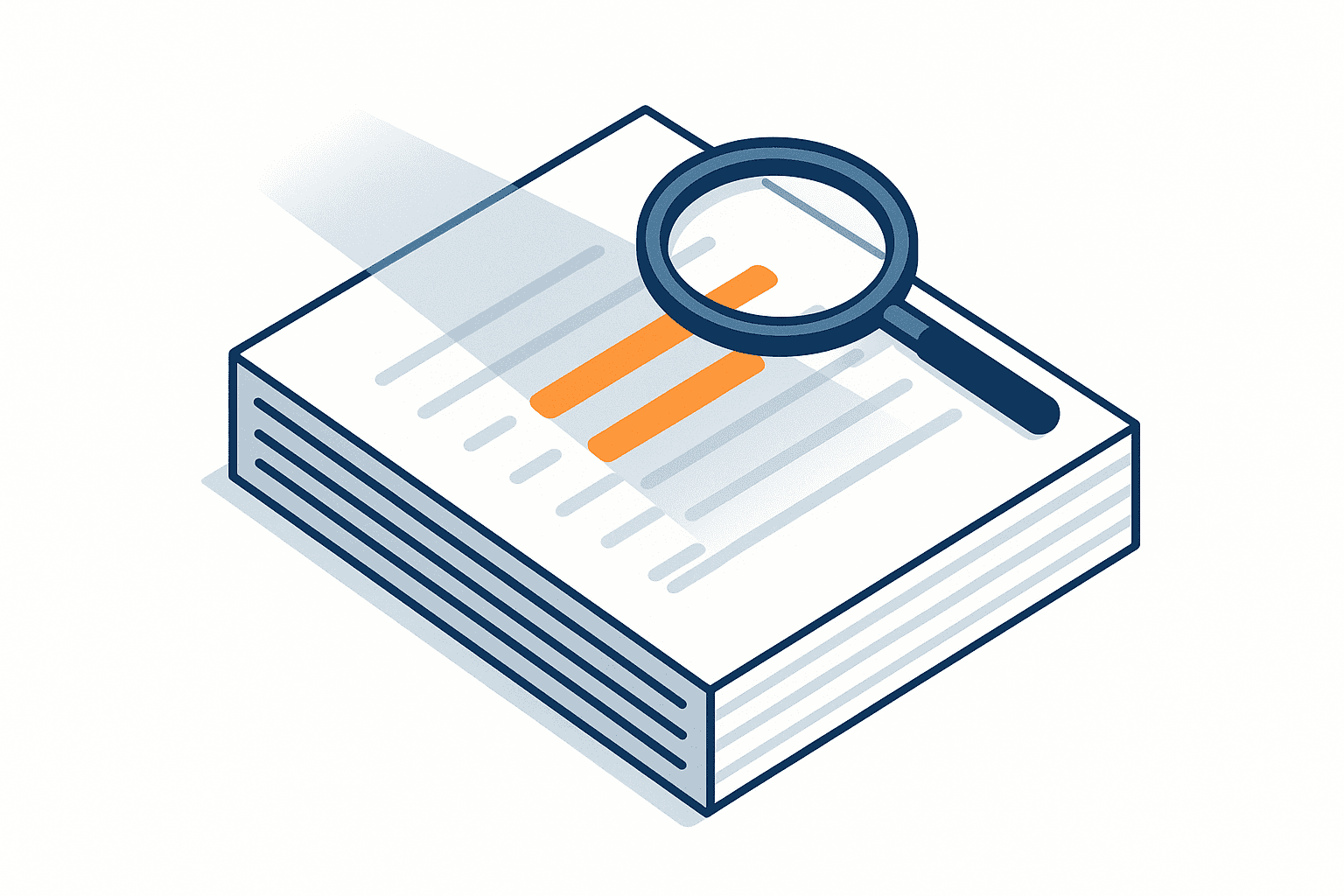
In a factory setting, the typical findings are omissions. A purchase agreement has an acceptance clause but no acceptance period. There is no cap on damages. The force majeure clause does not list flooding among the triggering events. Flood risk is a real and practical issue in Thai industrial estates, yet contracts lifted straight from a head office template often carry no trace of that concern. When a human reads a document, errors in what is written are catchable, but the absence of something that was never written is not. That gap is where a machine is genuinely strong.
Version comparison and compliance checking
Version comparison earns its keep on contracts that go back and forth several times. It shows, clause by clause, what changed between the version you sent and the version that came back. Compliance checking tests the document against relevant regulations and against your own contracting standards. Register your internal rules once, and departures from rules such as “disputes shall be settled by arbitration” or “liability shall not exceed the contract value” get picked up automatically.
English-language contracts and workflow management
Support for English-language contracts is particularly important at a Thai site. English is frequently the working language for contracts with local companies, and a tool that only handles Japanese is of no use. Workflow management moves the whole cycle of request, approval, execution and storage onto a system, leaving a record of who approved what and when. It sounds unglamorous, but it is what stops an overseas site’s contracts from existing only inside one person’s mailbox.
How far has AI contract review adoption actually gone
There is survey data on how widely this has spread. A report on generative AI published by LegalOn Technologies (fieldwork by Cross Marketing Inc., conducted from 21 to 26 February 2025, covering 500 people involved in corporate legal work) found that more than 60% of respondents said they were using generative AI.
The interesting part of that survey is the breakdown of what they use it for. The largest single use was “contract review and drafting support” at 44%. In other words, contract review is the leading application of generative AI inside corporate legal functions. ChatGPT (OpenAI) was the most-used service at roughly 70%, and the most common year for starting to use these tools was 2024, at 51%.
Two things follow from that set of numbers. First, contract review is not a theoretical use case; it is what practitioners actually chose. Second, most companies came in through a general-purpose chat tool rather than a specialist one. The second point leads straight into the next question.
Market size is worth a glance too. According to the overview of the legal artificial intelligence market published by Global Information, the legal AI market is projected at USD 4.59 billion (45.9 hundred million) in 2025, rising to USD 5.59 billion (55.9 hundred million) in 2026 and reaching USD 12.49 billion (124.9 hundred million) by 2030, at a compound annual growth rate of 22.3%. These are estimates, but they do indicate that this is not a passing fashion and that products will keep arriving. For a buyer, that means assuming several years of product churn and feature additions, and weighing how easily you could switch tools later.
Can a general-purpose AI chat do the job instead
Paste a contract into a general-purpose assistant like ChatGPT, ask it to point out the risks, and you will get a plausible-looking answer. The survey above confirms that ChatGPT is the most-used service, at roughly 70%. Does that make purpose-built tools unnecessary? No.
Based on the comparison LegalOn Technologies sets out on its own site, general-purpose AI chat performs worse than dedicated contract review tools at tasks such as detecting missing clauses. The reason is structural. A general chat is good at answering questions about the text placed in front of it, but systematically identifying “the clause that should exist and does not appear in this text” requires holding a standard clause structure for each contract type as a reference point. Dedicated tools build that reference into the product. A general chat depends on whatever the prompt happens to say that day.
The other practical problem is reproducibility. Give the same contract to two people, or change the prompt, and the findings will not line up. Contract review is a function whose value depends on being judged by the same standard regardless of who is holding the file, so that variation is not a small matter. On top of that, whether highly confidential contracts may be pasted into a general-purpose service at all is a separate information-management decision.
Where contract version control goes wrong
In real review practice, the most common accident is not misreading a clause. It is losing track of which version is current.
Here is a route that plays out constantly at Thai sites. An English draft arrives from a local supplier. Purchasing summarises it in Japanese and sends the summary to head office. Legal in Japan comments on the Japanese summary. Purchasing translates those comments back into English and sends them to the supplier. The supplier revises both the Thai and the English versions and returns them. By that point the original exists in three languages, the comments were written against a summary rather than a text, and nobody can say which version the revisions were applied to.
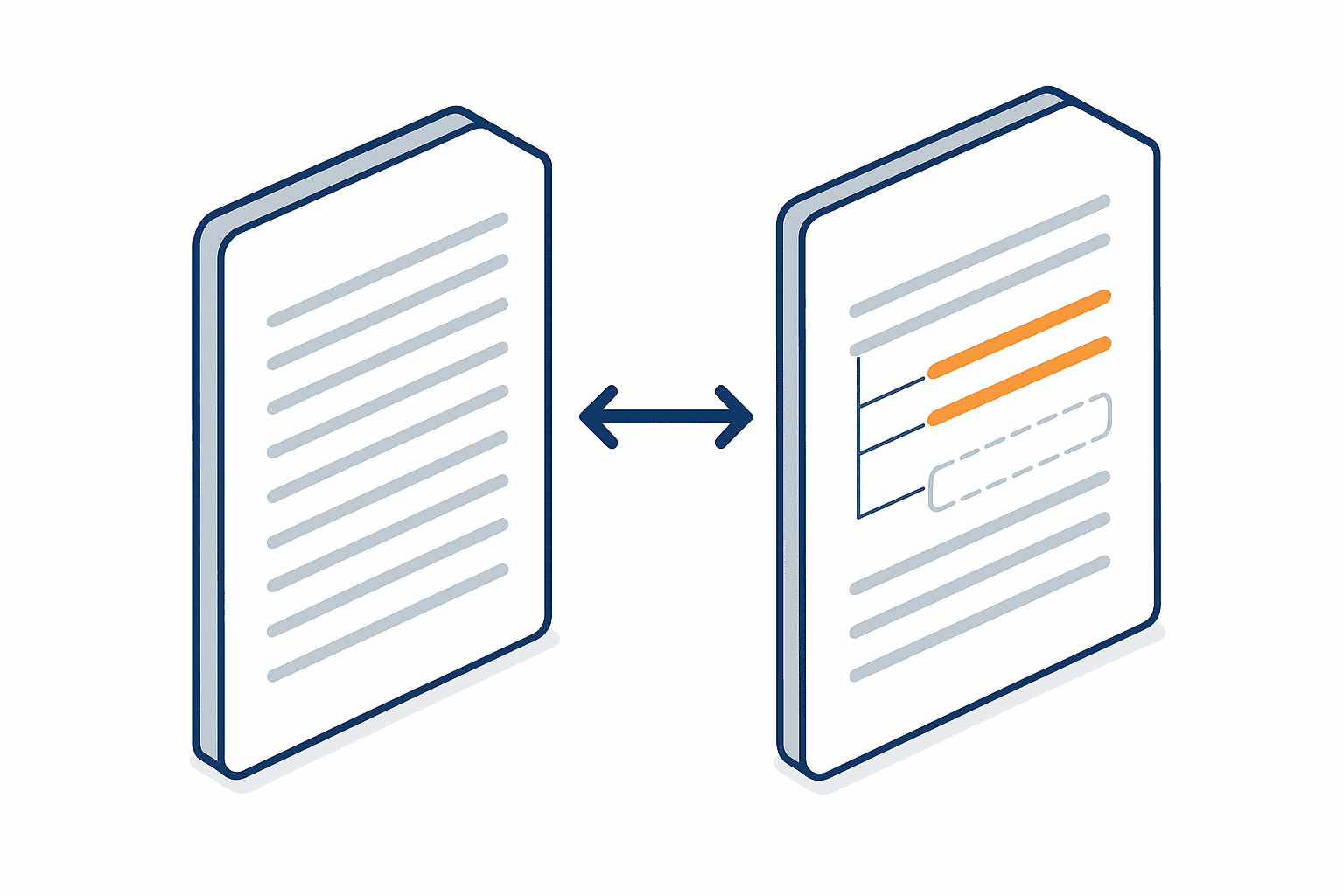
Version comparison hands part of that route to a machine. It lines up the previous version against the current one and shows which clauses were added, deleted or changed. What people miss is never the conspicuous change to a number. It is the small rewrite where “may” becomes “shall” and a right quietly turns into an obligation. Presented as a diff, at least it stops being invisible.
That said, once the machine has produced the diff, deciding whether a change is acceptable is a human job. Blur that line and the automation stalls. We look at how to separate processing from judgement in RPA and Generative AI Integration 2026 — automation stalls where judgement is mixed in. Contract review is a textbook case of a workflow that needs the processing handed to the machine and the judgement kept with people.
Major contract review AI tools — who is on the list
Combining the domestic products named in ITreview’s category information with the tools that come up in overseas commentary gives the following picture. Detailed feature differences should be confirmed against each vendor’s own materials; the point here is simply to see who is in the field.
| Tool | Vendor | Listing source |
|---|---|---|
| LeCHECK | Risee Inc. | Listed in the Japan category |
| OLGA | GVA TECH | Listed in the Japan category |
| CloudSign | Bengo4.com | Listed in the Japan category |
| BoostDraft | BoostDraft | Listed in the Japan category |
| LAWGUE | FRAIM | Listed in the Japan category |
| Cloud Legal | a23s | Listed in the Japan category |
| LegalOn | LegalOn Technologies | Cited as an overseas tool |
| Juro | Juro | Cited as an overseas tool |
| Kira | Kira | Cited as an overseas tool |
The “listing source” column records which of our sources named the tool. It is not a statement about where the vendor is headquartered. LegalOn Technologies, which offers LegalOn, is a Japanese company, but it appears here as an overseas example because that is where the source listed it.
This list is not a ranking. Some products are built specifically for contract review; others are primarily electronic signature or drafting platforms that added review capability, and they start from different places. If the tool is going to be used at a Thai site, the comparison can be organised along these lines.
| Comparison axis | What to check | What it means at a Thai site |
|---|---|---|
| Supported languages | Can it handle English contracts as well as Japanese | English tends to be the working language with local counterparties |
| Coverage of contract types | Does it hold templates for leases, purchasing, outsourcing and similar | Factory operations lean heavily on contracts other than master trading agreements |
| Governing law assumed | Which country’s law the built-in standards are based on | Contracts governed by Thai law may fall outside those standards |
| Data handling | Is the contract you upload used for training | Local commercial terms are highly confidential |
| Storage and search | Can executed contracts be searched | Renewals and reporting require pulling up past contracts |
| Approval records | Does it retain who approved what and when | Dual approval by head office and the local site can be traced |
Of these six axes, the governing law assumption is the one most often overlooked when a Japanese product is deployed at an overseas site. Most Japanese contract review tools carry standard clause structures built on Japanese law. Feed them a contract governed by Thai law and there will be places where the reference standard simply does not fit. Accepting that limit, and separating the issues the tool can catch from the issues it cannot, has to be part of the operating design from the start.
The trap in Thai factory and warehouse leases — Section 538
Of all the contract risks specific to running a factory in Thailand, the one with the largest financial impact, and the hardest to spot with Japanese instincts, is the restriction on the term of a real property lease.

Under Section 538 of the Thai Civil and Commercial Code, a lease of immovable property for a term exceeding three years is legally enforceable only for three years unless it is registered. In plain terms, you can sign a ten-year lease, both parties can be entirely comfortable with it, and if the lease was never registered, only the first three years are legally enforceable.
Consider what that means for a plant. A factory where you installed equipment, obtained certifications and hired a workforce can be told by the landlord in year four that the lease has legally come to an end. In practice, most of the time both parties simply carry on. But if the landlord’s ownership changes hands, if the land is sold, or if the point is used as leverage in a rent increase negotiation, the card you thought you were holding turns out to have no legal backing.
There are two directions for dealing with this. One is to register any lease with a term longer than three years. The other, where registration is difficult, is to obtain an explicit commitment from the landlord regarding extension. If you are planning long-term operations, whether registration is possible belongs on the agenda during contract negotiation, not afterwards.
How BOI investment calculation interlocks with the 3-year rule
What makes this harder is that the three-year rule meshes with the BOI incentive scheme. In BOI investment promotion, only lease agreements with a term exceeding three years may be included in the calculation of the investment amount.
That creates a contradiction. Keep the lease term within three years to avoid the Section 538 problem, and the lease value cannot be counted toward the BOI investment amount, which may leave you short of the incentives you were counting on. Go the other way and sign a lease longer than three years so it counts, and unless you register it, or at least arrange something equivalent, the contract itself loses legal force after three years.
So a single variable, the term of the lease, is simultaneously deciding a question of legal enforceability and a question of tax incentives. That connection is invisible if you only read the clause in front of you; it only becomes meaningful when checked against the BOI application conditions. An AI contract review tool can mechanically extract whether the term exceeds three years and whether a registration clause exists, but working out what that does to your BOI incentives is human work. Settling that division of labour up front is the important part.
BOI incentive conditions and how they reach into contracts
A few background facts about the BOI scheme itself have direct consequences for contracting. According to the guide published by the BOI, approval is granted at the level of the individual project rather than the company, and the incentives differ by industry. If one legal entity holds several projects, conditions attach to each of them separately.
On amounts and procedure, the guide sets out the following.
- The minimum investment is 1,000,000 baht or more, excluding land costs and working capital
- At least one quarter of the registered capital must be paid up before the promotion certificate is issued
- Operations must in principle begin within 36 months of the promotion certificate being issued
- BOI projects carry audit and periodic reporting obligations
These conditions map directly onto the dates and amounts inside your contracts. Because operations must begin within 36 months, the delivery clause in an equipment supply contract, the definition of installation and commissioning completion, and the allocation of responsibility for delay stop being purely commercial questions and become questions about keeping your incentives. If delivery slips repeatedly and start-up misses the deadline, the consequences do not stay between the contracting parties.
The same logic applies to the exclusion of land costs and working capital. Since some spending counts toward the investment amount and some does not, how a cost is characterised in the contract changes the calculation. If you are introducing AI contract checking, extracting BOI-relevant dates and amounts is an excellent first use case. Extraction is what machines do well, and judgement stays with people, which is exactly the split this work requires.
PDPA and contracts — how to review personal data clauses
Thailand’s Personal Data Protection Act (PDPA) came fully into force in June 2022. It is understood to be modelled on GDPR and to share many of its principles, including consent as the basis for processing, guaranteed rights for data subjects, and safeguards for cross-border transfers.
Personal data moves through factory operations in more places than people expect. Employee HR records, entry and exit logs, health check results, contact details for counterparty staff, CCTV footage. How all of it is handled shows up as clauses inside staffing agreements, security service contracts, system maintenance agreements and cloud service terms.
From a contract review standpoint, the points to check are broadly these.
- Where personal data is passed to a contractor, whether the scope and purpose of processing are stated explicitly
- Where a cross-border transfer occurs, whether that is disclosed and whether safeguards are specified
- Whether there is an obligation to return or delete data on termination
- Whether there is a breach notification obligation, and whether it carries a deadline
- Whether subcontracting is permitted, and whether subcontractors are bound by equivalent obligations
In an M&A context, commentary stresses the importance of checking how personal data is handled inside contracts during due diligence. That is not advice limited to acquisitions. Taking an inventory of your existing contracts and checking horizontally for personal data clauses is one of the situations where AI contract review pays for itself fastest. Pull every clause that mentions personal data out of the contracts you already hold, then tabulate whether the required elements are present. Done by hand it is a real workload; the extraction half of it can be compressed dramatically.
Contract types where AI review helps in Thai factory operations
Pulling the discussion together by contract type, the table below pairs the main issues with the parts an AI review tool tends to catch.
| Contract type | Main issues | What AI review catches readily |
|---|---|---|
| Factory and warehouse leases | Term and registration, renewal conditions, restoration | Extracting the term, presence of a registration clause, missing renewal provisions |
| Purchase agreements with suppliers | Acceptance, quality warranty, liability cap, force majeure | Missing acceptance period, no stated liability cap, force majeure trigger events |
| Subcontracting for outsourced processing | Title to supplied materials, responsibility for defects, subcontracting | Presence of a title clause, provisions on whether subcontracting is allowed |
| Equipment supply contracts | Delivery dates, installation and commissioning, responsibility for delay | Extracting dates, presence of a liquidated damages clause |
| Service agreements | Handling of personal data, subcontracting, treatment on termination | Presence of personal data clauses, missing data deletion obligations |
| Technical assistance with head office | Basis for calculating fees, ownership of intellectual property | Presence of IP clauses, whether the fee calculation method is stated |
Read down the table and a pattern emerges. What AI review delivers is the level of “present or absent” and “what does it say”. Turn that around, and if the machine takes over checks at that level, people get their time back for the question that matters, which is whether the terms are acceptable. The value of a contract review AI tool is not that it replaces judgement. It is that it does the preparation that judgement depends on.
How to roll out AI contract review
Here is a practical order of operations.
First, narrow the scope. Try to cover every contract in the company at once and you will stall on designing the operating rules alone. At a Thai site, the realistic starting point is purchase agreements and service agreements, where volume is high and the documents are relatively standardised. Leases and BOI-related contracts are few in number but highly individual and financially significant, so treat them separately from day one as a category that always gets human scrutiny on top of the AI pass.
Second, take an inventory of existing contracts. The fastest payback comes not from reviewing new contracts but from a full sweep of the ones already signed. Build a list of what exists, where, when each renewal date falls and which agreements contain personal data clauses. That exercise has value in itself, and it doubles as a test of how well the tool can actually read your contracts.
Third, write down your own standards. Compliance checking needs a definition of what counts as a deviation. Which governing law do you want, litigation or arbitration for dispute resolution, where do you set the liability cap. This is the work of documenting decisions that have until now lived in the experience of individual staff. If adopting a tool becomes the occasion for finally codifying your internal standards, that alone is a result.
Fourth, decide the split between people and machines. You cannot forward AI findings to a counterparty as they stand. Someone has to decide which points go on the negotiating table and which ones you accept. Who makes that call, and whether the approver changes with the value or the type of contract, needs settling in advance. Skip it and work grinds to a halt in front of a long list of machine-generated findings.
Fifth, redesign the role of outside specialists. Bringing in AI does not remove the need for lawyers; it changes what you ask them. Because the machine covers the presence of clauses and formal defects, you can concentrate specialist time on questions that require judgement, such as whether a term is valid under Thai law or whether it conflicts with BOI conditions. The real benefit is not spending less. It is getting more important questions answered for the same spend.
Three pitfalls to watch during rollout
The first is over-expecting Thai language support. Most Japanese contract review tools assume Japanese and English, and they will not necessarily read a Thai-language contract accurately. Where the Thai text is the governing original, deciding on the basis of the AI’s output alone is dangerous. In practice this becomes a two-stage arrangement, running AI review on the English version and verifying consistency with the Thai original separately.
The second is handling confidential information. Contracts are dense with transaction prices, supply terms and technical details that must not leave the company. Whether uploaded data is used for training, which servers hold it, and whether the arrangement is sound under Thailand’s PDPA all need to be confirmed before deployment. The more widespread the habit of pasting contracts into a general-purpose chat tool has become in your organisation, the more urgently this needs settling.
The third is treating AI output as the final answer. An AI contract review tool produces findings, but there is no guarantee those findings are correct, and the absence of a finding is not evidence that nothing is wrong. It is a first-pass screen, and final responsibility rests with whoever signs. Write that assumption into your operating rules, or accountability becomes fuzzy the moment something goes wrong.
Frequently asked questions
How much does AI contract review cost
Pricing models vary enough between products that no single benchmark is meaningful. You will find usage-based pricing tied to contract volume, per-seat licensing and feature-level add-ons, and products that bundle drafting support or electronic signature may not price the review capability separately at all. When comparing, worry less about the headline figure and more about what the total looks like when modelled against your expected annual contract volume, and whether access from an overseas site adds cost. Ask each vendor directly.
Can AI contract review handle contracts in languages other than Japanese
Support for English-language contracts is one of the core features common to products in this category, so it is fair to assume most of them handle English. Languages such as Thai and Vietnamese are a different matter, with both availability and accuracy varying widely by product. If a Thai site is the intended user, check supported languages first and design an operating flow that keeps human verification in place for Thai-language originals.
Does AI contract checking replace review by a lawyer
It does not. What AI does well is extracting the presence or absence of clauses and formal defects, searching across multiple contracts, and presenting differences between versions. Whether a clause is valid under Thai law, or whether it conflicts with BOI conditions or local regulation, is specialist territory. The sensible arrangement is to run a first screen with AI and then concentrate specialist consultation on the issues it surfaces, which is the better answer on both cost and quality.
What should I compare when choosing a contract review AI tool
As the comparison table above sets out, the six basic axes are supported languages, coverage of contract types, the governing law assumed, data handling, storage and search, and approval records. For overseas use, the governing law assumption and data handling carry more weight than they would in Japan. How far a standard built on Japanese law holds up against a contract governed by Thai law, and where uploaded contracts are stored, are things to verify during the trial using your own real documents.
How long does an AI contract review rollout take
The timeline is driven by scope. Limit yourself to specific contract types and start with an inventory of existing agreements, and you can run the trial and the operating rules in parallel. Start from a position where none of your contracting standards have ever been written down, and the effort of building those standards will dominate. Assume that articulating your own decision criteria takes longer than configuring the tool, and your estimates will hold up better.
Conclusion
Contracting practice for a Japanese-owned company operating a factory in Thailand runs on different assumptions from head office. Japanese, Thai and English sit side by side, the contract types reach well beyond master trading agreements into leases and BOI-related documents, and the number of people available to read them is small. Under those conditions, a policy of having humans read every contract closely simply does not survive contact with reality.
AI contract review answers that situation by taking over the mechanical checks, the presence of clauses and the differences between versions. The survey finding that “contract review and drafting support” is the single largest application of generative AI in corporate legal work, at 44%, shows that practitioners have already made this choice. But general-purpose chat tools are reported to fall short of dedicated products at tasks such as detecting missing clauses, so what you choose changes what you get.
And the issues specific to Thailand do not close with a machine alone. The three-year limit under Section 538 of the Civil and Commercial Code and the BOI rule that counts only leases with terms exceeding three years toward the investment amount are connected in a way no single clause reveals. Leave extraction to the machine and keep judgement with people. Drawing that line first is the condition for a rollout that works.
Where to start tidying up your own contracts, and which tool fits the reality of your site, depends on how many contracts you hold and of what kind. TOMAS TECH advises Japanese manufacturers with operations in Thailand on digitalising back-office work, including the groundwork before any tool is chosen. If you are still exploring options, that is perfectly fine — feel free to get in touch here and we can start by simply hearing where things stand.
References
- Generative AI Usage Survey Report — LegalOn Technologies
- Artificial Intelligence in Legal Global Market Report — Global Information
- AI Contract Check Tool Category Overview — ITreview
- AI Contract Review Software — LegalOn Technologies
- Points to Note on Factory and Warehouse Leases in Thailand — ThaiBiz
- A Guide to the Board of Investment — Thailand Board of Investment
- What Is Thailand’s Personal Data Protection Act (PDPA) — Kuno Yasunari CPA Office


