


Administrative departments at Japanese manufacturers in Thailand often have no dedicated legal staff. NDAs, master purchase agreements, factory lease agreements, supplier terms and conditions. Contracts drafted in both English and Thai pile up on the desk of an expatriate manager whose working language is Japanese. We are increasingly asked whether generative AI can take over that first pass. This article sets out how to run AI contract review safely at a Thailand site, what to hand to AI and what to keep with your own people and your lawyer, and the IT design and cost structure that hold the whole thing together.
Why Thailand-based sites are looking at AI contract review now
Even in Japan, generative AI at work is moving beyond the stage of being an experiment inside one specific department. In the Corporate Survey on Generative AI conducted by Teikoku Databank in March 2026 and published on 14 May 2026, 34.5% of the 10,312 companies that gave valid responses were using generative AI in their operations. By company size, that was 46.5% for large companies, 32.4% for small and medium companies and 28.0% for micro companies, which means roughly one in three SMEs is already using it in some form. Among the companies using it, 86.7% reported a real effect, made up of 25.2% who said it had a substantial effect and 61.5% who said it had some effect.
The same survey reports use cases for contract checking coming from small and medium manufacturers. In other words, contract review is not a topic reserved for large companies with a legal department. It is an area where sites with no dedicated specialist are already pointing generative AI.
Meanwhile, the ranking of concerns those companies raised doubles neatly as a requirements list for your rollout design.
| Concern | Share of responses | What it implies for design |
|---|---|---|
| Accuracy of information | 50.4% | The process must stop AI output being used as a final judgment |
| Shortage of skilled people and know-how | 41.3% | Templatise usage so it does not depend on one person |
| Which tasks AI should be used for | 40.0% | Draw the line on target documents and prohibited uses in a policy |
| Risk of information leakage | 33.5% | Storage location and access rights are a precondition |
| Rules on where responsibility sits when something goes wrong | 25.5% | Decide in writing who gives final approval |
Legal functions outside Japan are further ahead. According to reporting based on the Thomson Reuters 2026 AI in Professional Services Report, organisation-wide adoption of generative AI tools in legal departments and law firms rose from 14% in early 2024 to 43% by mid-2026, and adoption is approaching 100% at large firms and large legal departments. The same report notes that fewer than 20% of organisations actually measure return on investment. Adoption has moved; the ability to explain the benefit in numbers has not.
For a Thailand site starting now, that gap is actually helpful. You do not need to chase an industry average. You can start from two numbers you already own: how many contracts you handle, and how much you currently pay outside counsel.
What AI contract review can and cannot do
The features people mean by AI contract review vary by tool, but they broadly fall within the same range. Japanese legal tech tools such as LegalForce, LAWGUE and LeCHECK are built around automatic detection of risk clauses, suggested revision wording, checks for inconsistent terminology and internal contradictions, comparison against your own standards, similar contract search and deadline management, and by 2026 they are becoming standard equipment in legal departments. If you use a general-purpose generative AI instead, the work you are trying to get done is the same.
| Work AI can take on | Concrete output | What a human must pick up |
|---|---|---|
| Clause extraction and classification | A map of termination, indemnity, governing law, jurisdiction and similar clauses | Visual check for clauses that are missing entirely |
| Difference against your own standards | A list of points that deviate from your template | A management call on whether the deviation is acceptable |
| Inconsistency and contradiction flags | Inconsistent terms, mismatched amounts and dates | Checking each flag back against the original text |
| Comparing the two language versions | Candidate passages where the English and Thai versions diverge in meaning | Confirming legal equivalence of meaning |
| Summary of issues | A list of points to settle before signing | Adding the issues that are missing |
| Deadline and renewal extraction | Auto-renewal clauses, notice deadlines | Registering them in the ledger and owning the follow-up |
Conversely, there are three things you must never delegate to AI contract review. The first is the legal judgment of whether a clause is valid or void. The second is the business judgment of whether to sign the contract at all. The third is the forecast of who would win if the matter turned into a dispute. All three are easy to hand over precisely because the output comes back in fluent, confident prose.
TOMAS TECH is not a law firm. We are not in a position to judge whether a contract is legally sound, and this article does not substitute for that judgment. What we can provide is the IT side that makes AI review workable: designing where the data is stored and who may access it, integrating with your existing contract management system, building the multilingual processing foundation that handles Thai and English together, and shaping operations to meet data protection requirements including the PDPA. Whether you may sign a given contract must always be confirmed with a Thai-qualified lawyer. That boundary is not a disclaimer bolted on at the end; it is the design principle behind the workflow described in the rest of this article.
The bilingual English-Thai contract and the governing language trap

Many contracts signed in Thailand carry an English version and a Thai version side by side. The clause you must always look for is the governing language clause, sometimes called the prevailing language clause. It sets out which language version prevails when the versions of a multilingual contract diverge, and it is standard practice in international contracting.
The problem arises when the contract names the Thai version as the prevailing one and the foreign party has only read the English. In that situation the risk remains that the party signed without fully understanding what it agreed to. The approval memo sent to head office in Japan carries a summary of the English version, the discussion happens in Japanese, and the text that actually has legal force is the Thai one.
| How the prevailing language is set | What it means in practice | How to handle it in AI review |
|---|---|---|
| The Thai version prevails | Reading only the English version does not mean you have grasped the legal content | Feed the Thai version as the source text and extract differences against the English |
| The English version prevails | The Thai version sits as a reference translation | Treat the English as the source text and use translation drift in the Thai version as a negotiating point |
| No prevailing language is set | Resolving a divergence becomes case-dependent | Surface every difference between the two versions and consider adding a clause before signing |
NDAs follow the same pattern. Thai courts generally respect and enforce NDAs under the Civil and Commercial Code where the content is fair and reasonable. However, Thai law has no single statute that expressly governs NDAs, so enforceability can depend on the individual case. An English-only NDA may still be enforced, but preparing both a Thai and an English version is recommended in order to avoid divergent interpretation.
This is exactly where AI earns its place. Cross-checking a two-language contract by hand takes a long time, and at a site with no Japanese staff member who reads Thai it is effectively impossible. Have generative AI read both versions and list the passages where the meaning appears to diverge, and you can at least narrow down, on your own, which parts to put in front of a lawyer. As long as you hold to the premise that AI produces candidate differences, not an answer on whether those differences matter legally, this use is safe.
What Thai contract law tells us must not be handed to AI
It is worth looking at why legal judgment must not be handed to AI, starting from the structure of Thai contract law itself. Under the Thai Civil and Commercial Code there are four requirements for a contract to be validly formed: the parties must have legal capacity, there must be a declaration of intention that reflects genuine intent, the purpose must be lawful, possible to perform and not contrary to public order or good morals, and where the law prescribes a form, that form such as writing or registration must be observed.
Almost none of these can be judged mechanically from the wording of the document alone. Legal capacity and the genuineness of a declaration of intention depend on facts that sit outside the contract. Generative AI can only read text, so in principle it does not have enough to work with.
There is also the distinction between an act that is void and one that is voidable. A void act is void retroactively, whereas a voidable act is valid from the outset and remains effective until the party the law protects avoids it, with incapacity, fraud and duress as typical grounds. The two lead to opposite conclusions, yet both get summarised in the same flat sentence: this clause is problematic. The granularity of the summary does not match the weight of the decision.
On top of that, Thailand has the Unfair Contract Terms Act B.E. 2540, enacted in 1997. It lets the court examine clauses that impose an excessive burden on one party or that are unfairly advantageous, and give them effect only so far as is fair and reasonable. It applies to standard form terms, online terms of service and one-sided lease agreements among others. In other words, what the contract says will not necessarily stand. The more faithfully a reader sticks to the literal text, and AI sticks to it very closely, the weaker it is in this territory, where something is written down but may not hold.
| Issue | What AI can produce | What must be confirmed with a lawyer |
|---|---|---|
| Requirements for a valid contract | Whether clauses on formal requirements exist | Whether the requirements are actually met |
| Void versus voidable | Where the potentially relevant clauses sit | Which of the two applies, and with what effect |
| Application of the Unfair Contract Terms Act | Extraction of clauses that look one-sided | Whether they would survive judicial review |
| Governing language clause | Differences in wording between the two versions | Whether a difference is a difference in legal meaning |
The right-hand column of that table can be used directly as the output format for AI review. Have AI fill only the left column and hand the sheet over with the right column blank. Structured that way, you prevent the accident where a staff member reads AI output as a conclusion.
What hallucination cases teach about using AI output unverified
Hallucination, where generative AI invents case law or statutory provisions that do not exist, surfaced with real consequences during 2026. All of the following are cases involving court filings.
In Nebraska in February 2026, 57 of the 63 citations in a filing were defective, and 20 of those were fictitious cases. The state Supreme Court imposed a suspension from practice in April 2026 and ordered a disciplinary investigation. In Oregon in April 2026, in litigation over control of a winery, two lawyers were ordered to pay a combined USD 110,000 in sanctions and attorney fees, because the filing contained 15 fictitious citations and 8 fabricated quotations. In Mississippi in June 2026, counsel on both sides submitted AI-derived fictitious citations, and a federal judge suspended two lead attorneys from practice in that district for two years and halted the trial itself. As of May 2026, roughly 1,490 court decisions worldwide were being tracked as AI hallucination related, more than 1,000 of them in the United States.
The caveat matters here. Every one of these is a court filing case, not a case about internal contract review work. Court filings and an internal first-pass check differ both in the standard of accuracy demanded and in how long an error takes to surface. Reading these across to your own contract review and concluding that AI is too dangerous to use is not an accurate reading of the evidence.
That said, the lesson this run of cases carries into internal review is clear. Generative AI can output something that does not exist in an entirely plausible format, and the appearance of the output gives you no way to separate the correct parts from the invented ones. So on the system side, you must never build a process that pipes unverified AI output into a setting that has legal effect.
Concretely, embed the following three things in the process. First, require AI output to carry the referenced clause number and the relevant passage of the original text alongside every point, so staff can return to the source. Second, put any point where AI cannot show its basis into a separate “needs verification” bucket, kept apart from the main list of findings. Third, decide that output referring to external statutes or case law is simply not accepted internally, because what contract review needs is a reading of the document in front of you, not a commentary on the law. That third point amounts to removing the source of hallucination from the business requirements side.
Five IT design decisions to make before you feed contracts to AI
Now to the IT side. Whether AI contract review succeeds is decided less by model performance than by how you build everything around it. At a minimum, settle these five points before you start operating.
First, where the data is stored. Make it explicit where three things live: the original contract, the converted text you feed to AI, and the findings AI returns. If they end up on personal devices or in chat history, nobody can retrieve them later. A workable pattern is a folder per contract on company-managed storage, with the AI input and output kept in the same place.
Second, access rights. Contracts are the classic document class where even internal readership should be narrowed. Split viewing rights by contract type, so that lease agreements go to general affairs, master purchase agreements to procurement and employment-related documents to HR. The key point is that the AI tool’s access must never be broader than the permissions on the underlying storage. Once that breaks, you are in the same state as having designed no permissions at all.
Third, logs and audit trails. Which contract, when, by whom, into which AI. Without that record you cannot reconstruct events after a problem. Recall that 25.5% of companies in the survey cited above named rules on where responsibility sits when something goes wrong as a concern. Writing the rule is not enough; you need a record that shows afterwards that the rule was followed.
Fourth, integration with the existing contract management system. At most sites, contracts run on a shared folder plus a spreadsheet ledger. If you build AI review as a separate thing outside that, the ledger and the AI output become double bookkeeping and the tool falls out of use within six months. Include writing the AI review date and the number of findings back into the existing ledger as part of the design.
Fifth, the multilingual processing foundation. At a Thailand site, Japanese, English and Thai all flow at once. Contracts in Thai and English, internal discussion in Japanese, reporting to head office in Japanese is the usual configuration. The quality of transcription and OCR before anything reaches AI, the handling of Thai character encoding, and the decision whether to insert a translation step all feed straight through into output quality. This foundation matters well beyond contracts, across the site’s entire use of generative AI.
These five items map onto the four cost layers covered in the next section as follows.
| IT design item | Corresponding cost layer |
|---|---|
| Where the data is stored | Layer 2, the data layer |
| Access rights | Layer 2, the data layer |
| Logs and audit trails | Layer 1, the platform layer |
| Integration with the existing contract management system | Layer 3, the processing layer |
| Multilingual processing foundation | Layer 3, the processing layer |
Layer 4 covers operations themselves, such as training staff and running the review function, so it does not pair one to one with an individual IT design item in this table. The layer definitions in the next section explain it in full.
On building the environment, our guide to a secure generative AI environment covers storage location and tenant design. On writing the internal policy, how to draft a generative AI usage policy gives worked examples of drawing the line on target documents and prohibited uses.
Data protection and operational design under the PDPA
A contract is not a document that contains only commercial terms. It carries the names and titles of signatories, contact details for the responsible staff, and in some cases personal addresses or identity card numbers. It therefore has to be treated as a document containing personal data, which raises points to check from the perspective of Thailand’s PDPA, the Personal Data Protection Act.
The following are the items IT should close out at design time. Whether each one applies depends on your own contracts and how your business actually operates, so confirm the final position with a lawyer.
| Item to check | What to decide concretely |
|---|---|
| Identifying the data in scope | Which fields in a contract constitute personal data |
| Location of processing | In which country’s servers the AI processing takes place |
| Cross-border transfer | Whether the setup sends data abroad and, if so, on what basis |
| Retention period | When the intermediate data passed to AI is deleted |
| Use for training | Whether the contract states that input data is not used to train the model |
| Vendor management | Whether the agreement with the AI vendor sets out the scope of processing |
| Handling access requests | Whether you can locate the relevant data if a data subject makes a request |
The item most often overlooked in practice is the retention period. Sites commonly have a defined retention period for the original contract but none for the extracted text created to feed AI or for the list of findings AI returned. A configuration where intermediate data accumulates indefinitely widens your exposure over time no matter how carefully you designed permissions.
The other item to nail down at contracting stage is use for training. A contract sets out your negotiated terms and transaction prices, so the impact of it leaking goes well beyond the personal data angle. Confirm in the written agreement with the vendor that input data will not be used for training. This is exactly the kind of contract that itself needs reviewing.
Estimating the cost in four layers

Now the money. Splitting the cost of AI contract review into the following four layers makes both estimating and cost-cutting discussions easier. All amounts below are whole numbers in Thai Baht and are TOMAS TECH’s own illustrative estimate. Read them as a worked example with stated assumptions, not as external statistics.
| Layer | What it includes | What this layer buys you |
|---|---|---|
| Layer 1, platform | AI usage environment, tenant configuration, logging platform | Accountability, backed by a record that survives |
| Layer 2, data | Contract storage design, permission design, tidying and OCR of existing documents | Less time spent searching, and control over who can read what |
| Layer 3, processing | Multilingual processing, findings templates, integration with the existing ledger | Shorter elapsed time per first-pass check |
| Layer 4, operations | Staff training, running the review function, a budgeted allowance for outside counsel checks | Fewer wrong calls, and fewer external review requests |
It matters that all four layers carry an effect. A layer with no effect attached to it always gets cut during internal approval. Layer 4 in particular looks like an easy line to trim, being training and review structure, but cutting it means external review requests do not fall, and that removes the single largest benefit item in the estimate below.
Three scenarios with stated assumptions
| Item | Scenario A, small | Scenario B, standard | Scenario C, extended |
|---|---|---|---|
| Nature of the site | Representative office | One factory in Thailand | Thailand plus several ASEAN sites |
| Headcount | 30 | 200 | 600 |
| New contracts per month | 10 | 30 | 80 |
| Of which bilingual English and Thai | 5 | 15 | 35 |
| Dedicated legal staff | None | None | 1 |
| External review requests per year | 36 | 96 | 240 |
| Rework incidents per year | 1 | 4 | 10 |
The costs are as follows.
| Layer | A initial | A monthly | B initial | B monthly | C initial | C monthly |
|---|---|---|---|---|---|---|
| Layer 1, platform | 40,000 | 6,000 | 90,000 | 12,000 | 150,000 | 22,000 |
| Layer 2, data | 40,000 | 3,000 | 120,000 | 6,000 | 280,000 | 14,000 |
| Layer 3, processing | 60,000 | 4,000 | 180,000 | 9,000 | 420,000 | 20,000 |
| Layer 4, operations | 30,000 | 9,000 | 60,000 | 18,000 | 140,000 | 34,000 |
| Total | 170,000 | 22,000 | 450,000 | 45,000 | 990,000 | 90,000 |
Amounts are in THB.
Assumptions on the benefit side
The benefit is built up from three items. We assume an hourly cost of 600 THB for administrative staff, an external lawyer review fee of 12,000 THB per external review, and a loss of 40,000 THB per rework incident caused by a missed contract term. A first-pass check is assumed to take 2.5 hours per contract before AI and 1.5 hours after, a saving of 1.0 hour per contract. We assume half of the annual external review requests in the assumptions table above can be replaced by the internal first-pass check. For rework, we assume all of the annual incidents in that table are prevented.
Everything is built up on an annual basis. For scenario B, the workload saving is 30 contracts per month times 1.0 hour times 600 THB across 12 months, giving 216,000 THB per year; the external review saving is 48 reviews, half of the 96 per year, times 12,000 THB, giving 576,000 THB per year; and the rework saving is 4 incidents per year times 40,000 THB, giving 160,000 THB per year. Note that the bilingual English and Thai count in the assumptions table indicates how demanding the first-pass check is and does not feed directly into these three calculations.
The benefit breakdown is as follows. Amounts are in THB.
| Benefit item | A per year | B per year | C per year |
|---|---|---|---|
| Reduced first-pass check workload | 72,000 | 216,000 | 576,000 |
| Reduced external review requests | 216,000 | 576,000 | 1,440,000 |
| Reduced rework | 40,000 | 160,000 | 400,000 |
| Total | 328,000 | 952,000 | 2,416,000 |
The overall position is as follows. Amounts are in THB, except the payback row, which is in months.
| Position | A | B | C |
|---|---|---|---|
| First-year cost | 434,000 | 990,000 | 2,070,000 |
| Annual benefit | 328,000 | 952,000 | 2,416,000 |
| First-year position | -106,000 | -38,000 | 346,000 |
| Annual position from year two | 64,000 | 412,000 | 1,336,000 |
| Payback on the initial investment | 31.9 months | 13.1 months | 8.9 months |
Three things stand out. First, at the size of scenario A, a standalone rollout takes more than two and a half years to pay back. At that size it is more realistic to add contract review as a use case on top of an existing secure generative AI environment rather than building a dedicated one, which compresses the initial cost of layers 1 and 2. Second, scenario B roughly breaks even in year one and starts producing from year two. Third, in every scenario the largest benefit item is the reduction in external review requests, not the workload saving. Internal approval discussions tend to talk about workload, but the money is being moved by something else.
Sensitivity analysis
Look separately at which benefit item is affected when an assumption turns out to be wrong. The important thing here is not to apply a single coefficient uniformly across every benefit. Different drivers hit different items. The analysis below is for scenario B.
| Driver | Benefit items affected | Items not affected | Annual benefit | Payback |
|---|---|---|---|---|
| As assumed | – | – | 952,000 | 13.1 months |
| External review replaced at one quarter instead of one half | Reduced external review requests only | Workload saving, rework saving | 664,000 | 43.5 months |
| Time saved is 0.5 hour instead of 1.0 hour | Workload saving only | External review saving, rework saving | 844,000 | 17.8 months |
| Contract volume at 70% of assumption | Workload saving and external review saving | Rework saving | 714,400 | 31.0 months |
The rework saving is held flat in the fourth row, contract volume at 70% of assumption, because we assume the frequency of a serious oversight depends on the type of contract rather than on total contract volume. Applying 0.7 there as well would stretch the payback further, but that would be an artefact of how the assumption was set rather than a number that came out of the business. Uniform application of that kind is exactly what a sensitivity analysis should not do.
The second row is the most important line in the table. Whether you can genuinely reduce external review requests is what separates a 13.1 month payback from a 43.5 month one. And what decides that is not the accuracy of the AI but an operational condition: whether anyone internally is in a position to say that a given contract does not need to go to a lawyer. That is precisely why layer 4, operations, must not be cut.
A review workflow that always ends in human confirmation
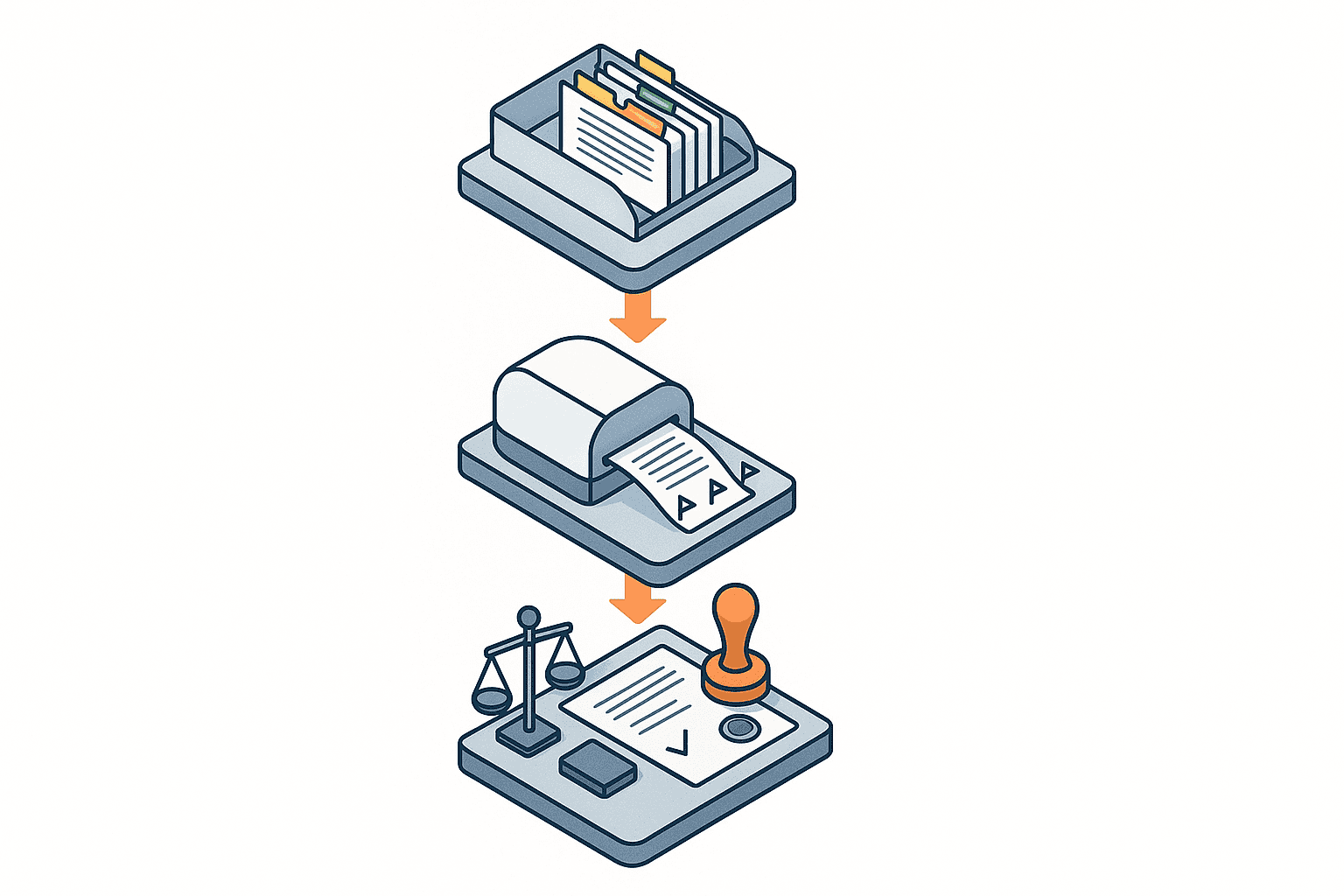
Now to turn all of this into a process that actually runs. There are four stages, and AI appears in stage 2 only.
Matching the structure in the figure above, here is where responsibility sits at each stage.
| Stage | Owner | Concrete work | What is handed on |
|---|---|---|---|
| 1 Intake and classification | Administration | Determine contract type, check the governing language clause, register in the ledger | The original and the classification |
| 2 AI first-pass check | AI | Clause extraction, differences against internal standards, candidate differences between the English and Thai versions, deadline extraction | A list of findings with supporting references |
| 3 Internal review | Administration and the business unit | Check findings against the original text, separate out the points needing a business decision | A list of issues to raise with the lawyer |
| 4 Lawyer confirmation and signing | Outside counsel and the approver | Legal judgment, finalising amendments, approval to sign | Signed contract and ledger update |
The critical point in this process is that the output of stage 2 is a list of findings, not a conclusion. Do not build any route that connects AI output directly to stage 4. In system terms, the safest configuration is one where stage 4 cannot be reached until the stage 3 owner has ticked the stage 2 output as checked.
Stage 3 has a second role: narrowing the issues you take to the lawyer. Throwing the whole contract over the wall costs both money and time, but asking about three specific issues gets you an answer faster for the same fee. The reason reduced external review requests was the largest benefit item in the previous section is not that you stop asking, but that the way you ask changes.
Stage 1 classification deserves the same respect. Unless the governing language clause is checked here, stage 2 has no basis for deciding which language version to feed AI as the source text. Feeding the English version as the source when the Thai version actually prevails is a mix-up that can only be prevented at the very start of the process.
There is also the question of whether to build the capability to run this process in-house or to hand it to a partner. Our thinking on in-house AI capability sets out the criteria.
A 90-day rollout plan
Finally, how to get from kick-off to live operation. Given the nature of contracts, you cannot go company-wide from a standing start. Narrowing the scope is the reliable route.
| Period | What to do | Test for completion |
|---|---|---|
| Days 1 to 30 | Select the contract types in scope, survey the reality of governing language clauses, design storage and access rights, add the section to internal policy | Target documents and prohibited uses are documented |
| Days 31 to 60 | Build the environment, tidy and OCR existing contracts, create findings templates, trial with two staff | 10 contracts processed end to end, with every finding traceable back to the original text |
| Days 61 to 90 | Integrate with the existing ledger, agree the issue format for lawyer confirmation, extend the contract types in scope, start log operations | The ledger records the AI review date and the number of findings |
The most time-consuming part of the first 30 days is the survey of governing language clauses. It means opening each contract you hold one by one and recording in the ledger which language version it says prevails. It is unglamorous work, but skip it and everything downstream has to be redone.
For contract types, starting with NDAs is the standard move. There are many of them, their clause structure is formulaic and the time to signature is short, so the trial cycles quickly. Contracts with large values and high individuality, such as factory leases or joint venture agreements, are poor candidates for the first round.
Frequently asked questions
What is AI contract review?
It is the general term for a mechanism that automatically extracts contract clauses and presents candidate deviations from your own standards and passages that may carry risk. It may use a dedicated legal tech tool, or a general-purpose generative AI given your internal standards. Either way, what comes out is a set of candidate points to check, not a legal conclusion.
Can AI review contracts written in Thai?
Feeding Thai documents to AI is certainly possible. However, where the contract PDF is a scanned image, OCR quality drives the output, and mishandling Thai character encoding corrupts the content at the point of ingestion. That is why the multilingual processing foundation has to be designed. Note also that where the Thai version is the prevailing language, the Thai version has to be the source text you feed to AI.
How much does it cost to implement?
This article splits the cost into four layers, platform, data, processing and operations, and presents an illustrative estimate for one factory in Thailand with 200 staff and 30 contracts per month of 450,000 THB initial and 45,000 THB per month. That is a worked example with stated assumptions; the real figure depends on what you already have in place and how many contracts you handle. If a secure generative AI environment already exists, the initial cost of layers 1 and 2 compresses substantially.
Does this mean we no longer need a lawyer?
No. What AI review changes is how many matters you take to your lawyer and how you ask. Instead of handing over the whole contract, you ask about the specific issues you narrowed down internally. The final decision on whether you may sign must always be confirmed with a Thai-qualified lawyer. TOMAS TECH is not a law firm and cannot provide that judgment itself.
Is it safe from an information leakage standpoint to feed contracts to generative AI?
That depends on how you do it. Pasting text into a consumer chat service from a personal device leaves you with neither a record nor permission control. Instead, create a storage location per contract on company-managed storage, use AI under an agreement stating that input data is not used for training, and keep logs of who fed what and when. Because contracts also contain personal data on signatories and staff, you additionally need to settle retention periods and the treatment of cross-border transfer from a PDPA perspective.
At what contract volume does the investment pay off?
In the estimate in this article, payback on the initial investment takes about 13 months at 30 contracts per month and about 32 months at 10 per month. At around 10 per month it is more realistic to add the use case to an existing generative AI environment than to stand up a dedicated one for contract review. That said, what most strongly drives the payback period is not volume but whether you can genuinely reduce external review requests.
Can it integrate with our existing contract management system?
If your site manages contracts with a shared folder and a spreadsheet ledger, we recommend including the write-back of AI review results into that ledger as part of the design. If you already run a dedicated contract management system, check in advance whether write-back via API or file integration is possible. Running AI review separately with no integration turns into double bookkeeping and falls out of use quickly.
Summary
Here are the key points for introducing AI contract review at a Thailand site. What you can hand to AI is clause extraction, detection of differences against your own standards and listing of candidate divergences between the English and Thai versions; the judgment on legal validity and the decision on whether to sign stay with your people and your lawyer. Put the governing language check at the very start of the process and decide which language version AI reads as the source text. On the IT side, settle five items first: storage location, access rights, logs, integration with the existing ledger, and the multilingual processing foundation. Estimate cost across four layers, platform, data, processing and operations, and note that not cutting the operations layer is what determines your payback period. And never build a route in your systems that pipes unverified AI output into a setting that carries legal effect.
We are happy to talk even at the earliest stage of your review. Starting from simply mapping which languages your Thailand site’s contracts arrive in and at what volume is perfectly fine. Working from your existing file server and contract ledger, we can look together at where the line between AI and human should sit and how much IT design that implies. To get in touch, please use our contact page.
References
- Corporate Survey on Generative AI, March 2026 – Teikoku Databank
- Agentic AI oversight challenges – Thomson Reuters
- Contract for Sale of Goods under Thai law – EKSIAM Corporate Law
- Governing Language Clause – Aaron Hall
- Prevailing Language clause samples – Law Insider
- Non-disclosure agreement in Thailand – Rippling
- NDA agreements in Thailand – Thai Law Online
- AI hallucination legal cases – GC AI


