


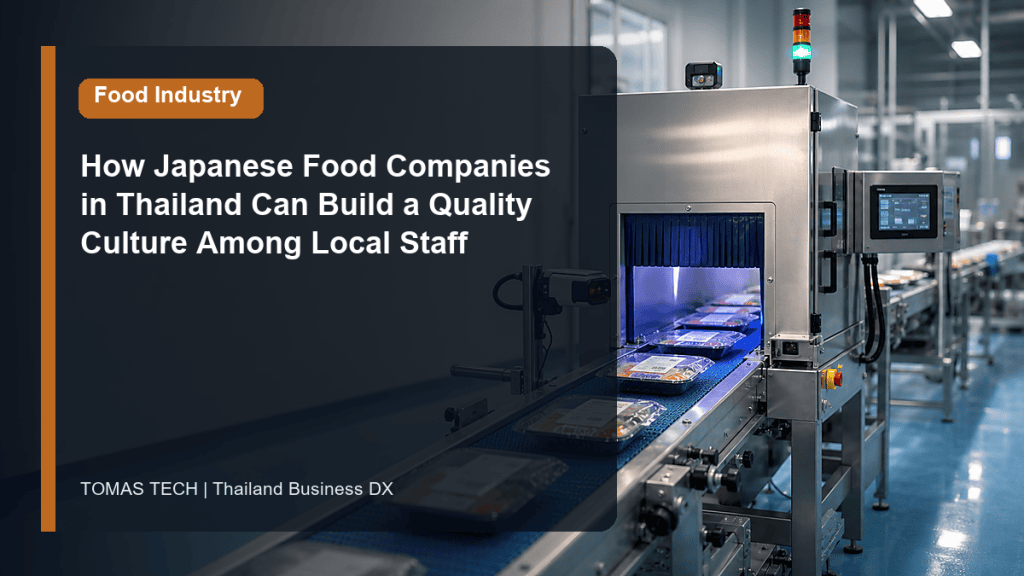
Target Audience: Executives, site managers, and factory managers of Japanese companies operating food factories, processing facilities, and distribution centers in Thailand, as well as those responsible for quality assurance, production management, and administrative departments. This article is written for those who face challenges such as: “Local staff don’t follow quality rules consistently,” “Temperature records and lot management depend too heavily on individual employees,” or “We’re struggling to replicate Japanese quality standards on the Thai shop floor.”
Most Japanese food companies operating in Thailand eventually hit this wall. You brought quality manuals from Japan. You conducted training repeatedly. Yet when you walk the floor, temperature records have gaps. Lot numbers are hand-written and incomplete. Inspection criteria vary from person to person. The moment Japanese staff look away, the rules begin to erode — gradually but persistently. This is not simply a problem of “local staff lacking motivation” or “cultural differences.” The root cause is the absence of a system that makes quality sustainable.
The business environment in 2026 makes this problem more acute. The World Bank maintains a cautious outlook on Thailand’s growth, and logistics and energy costs remain stubbornly high. In an environment where organic revenue growth alone cannot protect margins, quality complaints and food loss translate directly into profit erosion. At the same time, BOI (Thailand Board of Investment) continues to encourage investment in automation, AI, data analytics, and enterprise management IT — meaning investments in “quality visibility” can potentially qualify for BOI incentives.
This article outlines practical steps for embedding a quality culture in Thai food manufacturing operations. We cover why manuals and training alone are insufficient, practical approaches to visualizing quality, temperature, lot, and yield data to reduce losses and risk, common pitfalls and how to avoid them, and how to leverage BOI — all grounded in shop-floor reality. This is not DX as a trend; it is a practical, feet-on-the-ground approach to actually moving the numbers on the floor.
Why Manuals and Training Alone Cannot Embed a Quality Culture
The first thing most Japanese food companies try is translating their Japanese manuals into local languages, distributing them to local staff, and conducting regular training. This is not wrong. But it is not enough to embed a quality culture. There are three reasons why.
First, manuals document “the ideal procedure” without conveying “why it matters.” If staff are told to log temperatures whenever a deviation occurs but never truly understand “why this temperature range is critical” or “what happens if it is exceeded,” they will skip the step when things get busy. You cannot turn rules into habits for staff who have not internalized the purpose of food safety.
Second, there is no mechanism to make compliance — or non-compliance — visible. Paper records are rarely reviewed after they are written, making omissions and after-the-fact entries common. Deviations pass unnoticed into the next process. In an environment where following the rules earns no recognition and breaking them is never surfaced in real time, habits do not take root.
Third, the culture focuses on finding fault when something goes wrong. If staff consistently face blame when a temperature deviation is discovered, they learn to hide problems. The foundation of a quality culture is “surfacing problems early rather than concealing them.” That requires a structure in which reporting a problem is valued. No matter how excellent your manual, it cannot function on a shop floor where psychological safety is absent.
In other words, embedding a quality culture requires more than manuals and training — it requires three additional elements: visibility, immediate feedback, and a system that rewards reporting. All three are achieved through digital management of quality, temperature, lot, and yield data.
The Mechanism by Which “Quality Visibility” Changes the Shop Floor
Quality visibility does not simply mean displaying numbers on a dashboard. It means making real-time what is happening on the floor and ensuring that information connects directly to corrective actions and decision-making. When this design is in place, shop-floor behavior changes.
For example, in a factory where temperature management is automated via sensors and tablets, the task of “recording” disappears. Staff are freed from the burden of data entry; when a deviation occurs, an alert is triggered instantly and both the responsible operator and the manager are notified simultaneously. What matters here is that the staff member who receives the alert experiences “let’s fix this together” rather than “you’re getting in trouble.” The culture in which surfacing problems is “evidence of doing your job” grows from that repeated experience.
The same dynamic applies to lot management. When lot numbers are linked end-to-end — from raw material receipt through manufacturing, packaging, and shipment — using QR codes or barcodes, the scope of a recall can be narrowed to the relevant lot in minutes when a complaint arrives. Critically, this is not just for Japanese staff: it matters that local line leaders can operate the system themselves to identify the affected range. Local staff taking ownership of traceability is the hallmark of a quality culture that has truly taken root.
Temperature Management: Protecting the Most Critical Point in a Food Factory Through Digital Means
In a food factory, temperature management is the cornerstone of quality and safety. The control points are numerous: refrigerated and frozen warehouse temperatures, heating and cooling temperatures during manufacturing, and temperatures throughout transport. Managing all of these with paper and manual labor will inevitably create gaps.
The first step in digital temperature management is automated recording via IoT sensors. Sensors with communication capability are installed on warehouse, refrigerated display, and in-process thermometers, and data is accumulated in the cloud. Data entry labor drops to zero, and 24/7, 365-day monitoring becomes possible. Once recording is automated, staff can shift from “the job of recording” to “the job of responding to anomalies.”
The next critical element is the design of deviation alerts. Decide in advance who will be notified, and how, when temperatures exceed upper or lower limits. Building in notifications to the factory manager’s smartphone makes it harder for the shop floor to conceal problems while simultaneously allowing managers to stay informed without being physically present. In Thai factories, Japanese managers are often unable to walk the floor frequently, making remote monitoring especially valuable.
Furthermore, linking temperature history to shipping records and customer complaints allows you to demonstrate, in the event of an incident, that “this product lot was maintained at appropriate temperatures from manufacturing through shipment.” This is directly useful for HACCP audits by export destinations and for obtaining food safety certifications. Digital temperature management is not a cost — it is an investment in the power to prove quality.
Lot Management: Turning Traceability Into a Shop-Floor Asset
Lot management in a food factory has a direct bearing on minimizing damage when a problem occurs. When incidents such as foreign material contamination, allergen contamination, or expiration date mislabeling arise, the speed at which the recall scope can be narrowed determines the magnitude of the loss. With a handwritten ledger, tracing which manufacturing lot raw material A entered and which customers received it can take several hours to half a day. A digital lot management system reduces this to minutes.
The critical point is not to treat lot management as something that is “completed within the factory walls.” Register the supplier’s lot number at raw material receipt, record blending and compounding at the time of manufacture in the system, link packaging and labels to the lot, and record the shipping destination and date. Full-chain digitization is traceability in the true sense of the word.
A common challenge in getting local staff to adopt lot management is resistance to “one more step — scanning a barcode.” The most effective way to overcome this is not to explain “why” first but to create the experience “this makes our work easier” first. Once staff have experienced even a single incident where lot management data allowed them to respond to a complaint quickly, their perception shifts. The turning point in adoption is the moment a floor leader feels, “I’m glad we have this system.”
Yield and Waste “Cost Accounting”: Turning Food Loss Into a Management Number
Food loss in a food factory is simultaneously a waste problem and a cost-of-goods problem. A single 1% improvement in manufacturing yield can change annual raw material costs by millions of yen. Yet in many factories, yield and waste figures exist in a state of “known on the shop floor but never reported to management.”
One reason is the high burden of recording and aggregating waste data. Compiling monthly paper waste records, converting them to cost, and reporting to management is a task that gets deferred in most operations. When digitization allows waste records to be automatically aggregated by process in real time — so that “how much loss is coming out of this process this month” is visible at a glance — management attention rises sharply.
Reflecting yield in cost of goods requires integration between the production results system and the inventory management system. How much of which raw material went into which product, and how much was actually scrapped? When these figures are aggregated automatically, it becomes possible to calculate “how much profit can be protected by reducing waste.” This becomes the most compelling number when explaining quality improvement investments to headquarters in Japan.
Food loss reduction is also gaining importance from an ESG and sustainability perspective. As major supermarkets and export customers apply increasingly stringent environmental requirements to suppliers, factories that can present waste volumes and waste rates in hard numbers earn greater trust from their business partners. As a measure that simultaneously achieves cost reduction and environmental responsibility, the digitization of yield management is a high-priority investment.
Paperless Quality Records Reduce the Burden on the Shop Floor
Food factories generate an enormous volume of quality records every day: inbound inspection records, production records, temperature records, cleaning records, pre-shipment inspection records. As long as these are managed on paper, the labor of recording, the space required for storage, the time spent searching, and the man-hours for audit responses continue to accumulate. And the greatest problem is that paper records cannot prevent falsification or after-the-fact entries.
Digitizing forms (going paperless) resolves this problem at its root. By entering data directly on the shop floor using tablet devices, timestamps are automatically attached to records, making after-the-fact entry difficult. Photographs can be attached, preserving the basis for visual inspections. Record data is stored in the cloud, enabling instant search and output of records for any time period or process during an audit response.
A common mistake when rolling out form digitization to local staff is trying to digitize all forms at once. If the number of input fields is too large, users give up before they become proficient. The successful pattern is to start with a single process and a single type of form, build the experience of “this is more convenient than paper,” and then expand. Simply displaying the input interface in Thai and allowing selections from dropdown menus dramatically reduces omissions and incorrect entries.
Resistance from veteran staff who feel “more comfortable with paper” is also an initial barrier. Here, the key to driving change across the team is for managers to use the terminals proactively and to share success stories such as “having this record data let us answer the audit” or “this form helped us resolve the complaint.”
| Quality Control Area | Challenges with Paper / Manual Methods | Improvements Through Digitization |
|---|---|---|
| Temperature Records | Missed entries, after-the-fact recording, deviations not discovered until the following day or later | Automated sensor recording, immediate alerts, remote monitoring |
| Lot Management | Ledgers are fragmented; identifying the relevant lot during a complaint takes hours | Centralized management from receipt to shipment; narrowing down in minutes |
| Yield and Waste Records | Monthly aggregation only; slow reporting to management | Automated daily aggregation by process; immediate reflection in cost of goods |
| Inspection Records (Inbound, Outbound, In-Process) | Paper storage; significant man-hours required to search records during audits | Cloud storage, timestamps, photo attachments, instant search |
| Cleaning and Sanitation Records | No mechanism to verify that tasks were actually completed | Checklist format, completion confirmation, approval workflow |
Developing Local Line Leaders Is the Key to a Quality Culture
The single most important key to embedding a quality culture on the shop floor is developing leaders from among the local staff. As long as Japanese staff are the primary drivers of quality management, quality will waver the moment they step away. Only when local line leaders make quality decisions independently and can explain them to their teams does a quality culture become “the organization’s culture.”
In developing local leaders, what matters most is “creating a success experience” before “imparting knowledge.” When a digital system is introduced, have local leaders learn to use it first and entrust them with rolling it out to their teams. Let them be present when the traceability system is used to resolve a complaint. Create opportunities for them to bring improvement proposals based on yield data to management. Accumulating these experiences builds the awareness that “quality management is our work.”
An important consideration on Thai shop floors is communication built on flat relationships. The Japanese concept of “Ho-Ren-So” (report, inform, consult) does not always resonate with Thai staff immediately. For “speak up immediately when there is a problem” to become habitual, it must be reinforced by repeated experiences in which speaking up is rewarded. Publicly recognizing staff who report small problems early, and actually incorporating improvement suggestions into the line — these accumulated actions foster a culture of reporting.
Communication gaps between Japanese and Thai staff are not just a matter of language. When quality standards and acceptable tolerances are “not shared as numbers,” inconsistent judgments result. Using a digital system, standard values can be configured in the system and deviation determinations automated. This shifts the conversation from “is this judgment correct?” to “the system’s configured standard made this determination” — creating an objective shared reference that reduces communication friction.
Connecting Inventory Management and Quality Management: Practical Steps to Prevent Waste Losses
For food companies, inventory management and quality management are inseparable. Inventory without proper expiration date management leads directly to expired-product waste. If FIFO (first-in, first-out) rules are not consistently followed, old inventory gets buried in the back; by the time it is discovered, the only option is disposal.
An inventory management system can dramatically reduce these losses. Register expiration dates and quantities at receipt, deduct at the time of shipment or use, and trigger alerts when inventory is approaching its expiration date. This is a simple mechanism, but attempting to do it with paper ledgers requires considerable daily effort for stocktaking, data entry, and verification. When the system is digitized, “which raw materials are approaching their expiration date today” can be confirmed instantly and reflected in production planning.
The same applies to packaging materials and secondary supplies. Excessive ordering leads to increased storage costs; stockouts cause production stoppages; and expired or storage-degraded items must be discarded. All of these are preventable losses through inventory visibility. In Thai factories, some items are sourced from distant suppliers with long procurement lead times. When inventory data is visible in real time, order timing becomes more precise, reducing both inventory costs and waste losses.
Linking inventory management and quality management, and further integrating them with accounting (cost management), significantly improves the quality of management decision-making. When a mechanism automatically books waste costs and loss costs, “how much profit has been reduced by food loss this month” becomes visible as a financial figure. This is what transforms headquarters reporting from “intuition” to “hard numbers.”
Building a 3-Year Payback Scenario: A Practical Guide to Headquarter Presentations
Even when shop-floor challenges are clear, many implementations stall because they cannot clear the hurdle of explaining the investment to headquarters in Japan. Qualitative explanations such as “it will be more convenient” or “quality will improve” are not enough for Japanese headquarters to approve a budget. What is needed is a numerical scenario showing payback within three years.
The following summarizes the types of numbers useful for building an investment payback scenario for a quality and inventory management system in a food factory.
First, waste loss reduction. Multiply current monthly waste volume (in raw material cost terms) by the improvement rate to get the annual savings figure. For example, if monthly waste loss of 500,000 yen is reduced by 15%, the annual improvement is 900,000 yen. Next, quality complaint reduction. Complaint response involves product recall costs, labor costs, and reputational damage. Estimating the target reduction rate in complaint volume and the associated costs produces a quantifiable figure. Additionally, management labor savings. Converting the time currently spent on temperature records, lot management, form creation, and audit responses into hourly-wage terms reveals the reduction impact of digitization.
Show the total annual savings as a multiple of system implementation and operating costs. If a three-year payback appears achievable, headquarters will find it much easier to approve the investment. The key is building the numerical rationale from actual shop-floor data. Recording your current waste volumes, complaint counts, and management time now is what accelerates investment decision-making.
Incorporating BOI Incentives Into Quality Investments
Thailand BOI (Board of Investment) encourages investment in automation, AI, data analytics, and enterprise management IT; eligible equipment and machinery may qualify for corporate tax exemptions or reductions and import duty exemptions. Quality management systems, inventory management systems, IoT sensors, and form digitization tools may fall within eligible investment categories in certain cases.
To make effective use of BOI incentives, it is important to incorporate BOI into the design phase rather than after the investment plan is finalized. Confirming upfront “what can be applied for under BOI for this investment” and organizing eligible investment items before drawing up the business plan can significantly reduce the effective investment cost.
Since applications require specialized knowledge, it is advisable to work with an accounting firm or consultant experienced in BOI applications. That said, avoid making the overall plan entirely dependent on obtaining BOI incentives; the prudent approach is to plan with a stance of “payback accelerates if BOI incentives are secured.” Rather than scaling up investment beyond your means because incentives are available, it is more aligned with the realities of Thai food factories to start small at a unit where results can be confirmed on the shop floor, recover costs reliably, and then expand horizontally.
Common Failure Patterns and How to Avoid Them
When quality management systems or form digitization projects fail to take root on the shop floor, there are recurring patterns. The following summarizes several typical failures and their countermeasures.
Failure 1: Trying to change every process at once
Attempting to digitize all forms simultaneously and launch the system across all processes at once will overwhelm the shop floor and may actually halt operations. The right approach is to start with a single process, a single form, or a single warehouse, build conviction that “this works,” and then expand.
Failure 2: Training staff on the system but not creating occasions to use it
Even if training covers system operation, if there are no occasions to use it in daily work, it is quickly forgotten. The key to adoption is to clearly define “what we will achieve by using this system” and to create early experiences in which using the system makes floor work easier.
Failure 3: Treating local staff as nothing more than “users”
When system implementation is driven entirely by Japanese staff, with local staff cast purely as “those who use it,” ownership does not develop. It is essential to create a cycle in which local leaders read the data, the local team generates improvement proposals, and the local team evaluates the results after implementation.
Failure 4: Focusing first on “whose fault is it” when a problem occurs
If blame is assigned to the responsible employee first when a temperature deviation or lot recording error occurs, problem reporting stops. A culture in which “why did it happen?” and “how do we prevent recurrence?” are discussed first must be deliberately cultivated. This is a management challenge that systems alone cannot solve.
Failure 5: Treating headquarters reports as a cosmetic exercise
Pasting a dashboard screenshot from the system into a monthly report and simply saying “we have digitized” will not sustain headquarters’ interest. Continuously presenting changes in waste volume, complaint counts, and management man-hours as hard numbers is what sustains ongoing investment.
| Checkpoint | Our Company’s Status |
|---|---|
| Are temperature records automatically and immediately captured via sensors or tablets? | □ Completed □ Partially □ Not yet |
| Are lot numbers digitally managed end-to-end from receipt to shipment? | □ Completed □ Partially □ Not yet |
| Is waste volume and yield aggregated and reported daily by process? | □ Completed □ Partially □ Not yet |
| Are quality forms (inspection, cleaning, inbound) entered digitally via tablet? | □ Completed □ Partially □ Not yet |
| Is there an inventory system that automatically manages expiration dates and FIFO? | □ Completed □ Partially □ Not yet |
| Can local line leaders read quality data independently and generate improvement proposals? | □ Completed □ Partially □ Not yet |
| When a problem occurs, is there a culture in which the responsible person reports immediately without concealment? | □ Completed □ Partially □ Not yet |
| Are waste loss and complaint costs quantified and communicated to headquarters in numerical terms? | □ Completed □ Partially □ Not yet |
Phased Implementation: Starting with One Process, One Form, One Warehouse
Digitizing quality management does not require changing everything at once. On the contrary, starting small, confirming results, and then expanding is the golden rule for avoiding failure. The following outlines a practical phased implementation framework for Thai food factories.
Step 1: Identify the single most painful point
Frequent complaints due to temperature deviations, waste losses concentrated in a particular process, lot management that consumes excessive time during complaint response — identify the single biggest pain point on the floor. Investment targeted there is more likely to produce visible results and easier to gain floor-level buy-in.
Step 2: Confirm on a small scale
For the selected pain point, deploy a minimal system and operate it for three months. For temperature management, install sensors in one warehouse. For lot management, digitize just one product line. For form digitization, start with one type of inspection record. Starting small keeps floor resistance low and makes it easier to verify results.
Step 3: Demonstrate the impact in numbers
After three months of operation, confirm changes in waste volume, complaint counts, and management man-hours in numerical terms. These numbers become the basis for internal horizontal expansion and reporting to headquarters. Concrete results such as “temperature deviation complaints from Warehouse A dropped to zero” or “lot identification time was reduced from half a day to 15 minutes” strongly support the next investment approval.
Step 4: Advance horizontal expansion and deeper integration simultaneously
Once results are confirmed, expand the same approach to other warehouses, processes, and sites. At the same time, pursue “deeper integration” — connecting temperature management to inventory management, connecting lot management to accounting. When local leaders gained proficiency in Step 1, this expansion moves dramatically faster.
TOMAS TECH’s Perspective
TOMAS TECH supports Japanese manufacturers and food companies in Thailand and ASEAN with inventory management, shop-floor digitization, and operations management. We share a perspective gained from direct shop-floor experience on how to embed a quality culture.
The inventory management system “PEGASUS” handles inventory management, lot management, expiration date management, and FIFO management for food factories. By connecting raw material receipt registration, manufacturing disbursement, and finished goods shipment within the system, full traceability is achieved — knowing when, which raw material was used in which product and delivered to which customer. The system also supports rapid narrowing of recall scope when complaints arise and automatic aggregation of waste costs, contributing to both food loss reduction and quality risk management.
For form digitization, we utilize “i-Reporter.” The system enables direct data entry on the shop floor using tablet devices, allowing quality forms such as temperature records, inspection records, cleaning records, and inbound inspection records to go paperless. Features include Thai-language display, photo attachments, automatic timestamp recording, and approval workflow configuration — and the shop-floor feedback that “this is easier than paper” reinforces adoption.
Operations management systems and smartwatch systems are used to grasp the real-time status of production lines and equipment. By linking quality problem occurrences with operational status, correlations such as “quality complaints increased around the time this equipment started to deteriorate” can be identified, enabling an integrated approach to preventive maintenance and quality management.
A defining characteristic of TOMAS TECH’s approach is the small start of “one process, one form, one warehouse.” Rather than changing everything from the outset, we begin at the single point where results are most visible, establish a three-month payback outlook, embed the approach with the local team, and then expand horizontally. For explanations to Japanese headquarters, we support the planning phase to ensure that payback over three years, risk reduction, quality improvement, and management time savings can be presented in numbers — not just convenience. Please contact us here to discuss your needs.
Conclusion
Embedding a quality culture in Japanese food companies in Thailand reaches its limit with manuals and training alone. What is needed is a system that visualizes quality, temperature, lot, and yield data and connects that visibility directly to immediate feedback and corrective action. When this system is in place, shop-floor staff find it easier to internalize “protecting quality is our job.”
The 2026 business environment is one in which it is difficult to protect margins on revenue growth alone. Reducing “the small losses that accumulate every day” — waste losses, quality complaints, and management labor — becomes the front line of profit defense. And investments that reduce these losses can qualify for BOI support, making them a choice with genuine practical payoff.
The key is not to try to build the perfect system all at once. Start with one process, one form, one warehouse; confirm results after three months; embed the approach with the local team; then expand. A small, steady, shop-floor-rooted approach is the path to truly embedding a quality culture in Thai food factories.
References
- World Bank Thailand
- Thailand BOI (Board of Investment)
- JETRO Thailand
- Ministry of Economy, Trade and Industry — Manufacturing White Paper 2025
- S&P Global PMI
Related Articles
- The Era of Cold Chain as a Profit Driver: Turning Temperature Data into Customer Value in Food Logistics
- Preparing for High-Mix Low-Volume Production in Thailand’s Food Industry: System Design for Linking Production Planning and Inventory Management
- Turning “Visibility” into Real Improvement at Food Factories: Root Cause Analysis of Line Stoppages and Quality Defects
- DX for Food Export Companies in Thailand: Building Quality Traceability and Delivery Reliability