


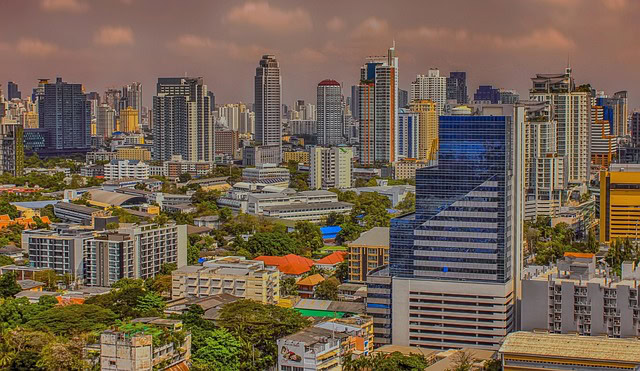
Thailand is attracting attention as an expansion destination—especially for manufacturing—because of its geographic position in ASEAN, its proximity to China and India, and its network of FTAs. With corporate tax at 20%, abundant labor, and relatively low minimum wages, it offers strong cost competitiveness.
Furthermore, by using the BOI (Thailand Board of Investment) system, you can greatly reduce your entry costs through corporate income tax exemptions, customs duty exemptions, relaxed restrictions on foreign investment, and other benefits.
In this article, we organize and explain, for companies considering entering Thailand, the outline of support systems and key usage points, the actual application procedures and cautions, and the concrete steps from establishing a local entity to setting up an operational base.
Why Thailand Expansion Is Drawing Attention Now
Recently, with economic recovery after COVID, geographical advantages of ASEAN have been re‐evaluated. By expanding into Thailand, one gains access not just to a single market, but to a broad market of about 2.3 billion people through RCEP. The high convenience of trade serves as strong support for companies expanding manufacturing bases or new businessesThailand is central in ASEAN
- Population: about 66
- Labor force: about 40
- Minimum wage: around 400 THB/day
- Normal corporate income tax rate: 20%
- Close to China and India; aiming to be a manufacturing hub in Southeast Asia. As above, Thailand is rich in population and labor, and functions as a manufacturing hub close to China and India. Its inexpensive labor and the 20% level for corporate tax are major attractions for optimizing costs.
What Support Systems Should Be Considered When Expanding into Thailand?
To succeed in expansion into Thailand, combining the BOI system and various subsidy systems is essential. Below is an explanation of their outlines and key usage points.
What is the BOI System (Tax & Non-Tax Incentives)
The “BOI (Thailand Board of Investment) system” offers not only large corporate tax exemptions, but also the benefit that import duties on machinery and equipment become zero. Using these incentives means initial investment to enter Thailand can be greatly reduced.
- Corporate tax exemption: Exemptions allowed for up to 50-100% of invested capital, for a maximum of 3 years.
- Import duty exemption: Full exemption on customs duties for machinery and equipment for manufacturing, making it easier to build state-of-the-art production lines.
- 100% foreign investment & land acquisition permission: Even Japanese companies can establish Thai entities with 100% foreign ownership; thresholds for acquiring land are lowered.
- Relaxation of work permit requirements: Some requirements for issuing work permits are relaxed, providing advantages in human resources acquisition.
To obtain these benefits, precise preparation of application documents and accurate presentation of employment plans and capital‐investment plans are indispensable. In particular, a review period of 2-3 months is expected until obtaining the BOI Promotional Certificate, so early start is required.
Possibility of Combining with Subsidy Programs
While the BOI system alone is effective, cost reduction and promotion of DX (digital transformation) can be balanced by combining with national subsidy programs such as manufacturing subsidies or IT adoption subsidies
- The manufacturing subsidy supports investments in automation robots, MES, energy management systems etc., up to ¥40 million.
- The IT adoption subsidy (up to ¥4.5 million) supports the introduction of production management systems, etc.
When introducing latest production equipment, ideally use subsidies for part of it and cover the rest using BOI incentives. If you also use the IT subsidy for production management systems, you can accelerate DX like production line visualization or remote monitoring.
Every scheme has eligibility conditions. For example, BOI land acquisition privileges require meeting criteria such as paid-up capital and number of employees; if personnel plans are not fixed in advance, you may miss out on incentives. Also, subsidy programs have detailed formats for business plans and timing of calls, so asking specialists to assist with application documents is wise.
Practical Steps from Setting Up a Local Company to Establishing an Operating Base
In Thailand expansion, it is important to proceed smoothly with all steps from establishing a local entity to the BOI application and start up of the base. Let’s prepare according to the following flow.
Choose a form for the Thai company
The first decision when starting a company in Thailand is what form it will take:
- Whether to be a joint venture
- Or a wholly foreign-owned entity
- When using BOI’s IBC (International Business Center), if you meet requirements of “investment amount at least 1,000,000 THB, paid-up capital at least 10,000,000 THB, and at least 10 employees,” you can apply simultaneously for BOI privileges and non-tax benefits.
IBC offers one-stop support covering wide support like commercial registration, work permit arrangements etc. First satisfy these requirements and internally discuss which form best fits your company strategy.
Commercial registration (DBD) and BOI preliminary consultation
Once you decide the corporate form, proceed with commercial registration at the Department of Business Development (DBD). The required documents include articles of incorporation, proof of paid-up capital, list of directors, etc.
After registration, file for a “preliminary consultation” with BOI. Here you present your business plan and equipment investment plan, and receive guidelines up to the formal application.
Because obtaining the BOI Promotional Certificate typically takes about 2-3 months, you need to allow about eight weeks from documents submission to certificate issuance.
It is recommended to schedule with margin.
Firming up personnel & equipment plans
To receive BOI benefits, the personnel plan and equipment plan are key. Work permit (WP) requirements are that “one foreign worker per each 2 million THB of paid-up capital” is a baseline, but BOI incentives may relax this.
Also, permission to acquire land is generally not possible without BOI incentives. Foreigners (including corporations) are usually prohibited from land ownership, but with BOI Promotional Certificate, land ownership becomes possible regardless of foreign capital ratio.
Therefore, from the initial phase make your capital allocation and employment plan concrete, so as to prepare for BOI review.
Subsidy Systems Usable in Manufacturing Start-ups & TOMASTECH’s Areas of Support
For setting up a manufacturing base in Thailand, it is essential to pair subsidy schemes that support introduction of modern equipment with expert implementation support. Here we explain representative subsidy schemes usable by manufacturers, and the roles TOMASTECH plays.
Equipment & Systems Eligible for Subsidies
In subsidy programs aimed at Japanese SMEs, such as manufacturing subsidies or IT adoption subsidies, the following automation / DX related equipment are particularly emphasized.
- Automation robots or industrial robots
- MES (Manufacturing Execution System)
- Energy management systems
- Cloud-based production management tools
These equipments, when combined with BOI import duty exemptions, can greatly reduce cost burden.
Scope of Support Provided by TOMASTECH
Simply applying for subsidies is often where many stumble, due to differences in local requirements or document preparation methods. TOMASTECH supports your company’s Thailand expansion with the following steps.
- Consolidation of system compliance requirements: make matrices of BOI and subsidy conditions, ensure consistency with investment plan and employment plan.
- System design + RFP creation: define the requirements of the whole system including subsidized equipment, prepare procurement specification (RFP) for Thai design firms.
- Review and submission support of application documents: polish business plan and technical explanation documents which vary by system, and submit them.
- On-site implementation support: from equipment installation to commissioning tests to internal training, working closely with partner companies in Thailand.
- Preparation of follow-up reports: collect necessary data for performance reporting after subsidy/grant issuance, prepare reports comprehensively to eliminate risk of fund recovery.
Advancing equipment investment and DX simultaneously requires combining knowledge of subsidy schemes with know-how of technical and organizational operations locally. TOMASTECH offers “whole support” from scheme selection to on-site implementation, strongly backing your company’s expansion into Thailand.
Common Challenges and Failure Examples with Thailand Expansion
Thailand expansion has great opportunity, but if you misunderstand system eligibility or misalign with local partners, many plans do not proceed as intended. Below are particularly common “pitfalls” and representative failure examples.
Misunderstanding about the system (BOI ≠ all incentives automatically)
Many firms assume “BOI certification = all incentive measures will be unconditionally applied.” But in fact, there are requirements such as:
- Land acquisition requirements: even with BOI incentives, land ownership requires meeting certain criteria like paid-up capital, number of employees.
- Applying for projects not eligible: if you apply without confirming whether your business is in a restricted or regulated sector for foreign capital, missing requirements will lead to document deficiencies and long delays in review.
If you proceed with land contracts without confirming these, the permit may not be granted later and the deal could be nullified.
There is a case where a company applied BOI for introduction of part-processing equipment for auto parts, but because it was found to be a “non-eligible business,” they were forced into 3+ months of document corrections.
Always check in advance land acquisition rules & whether the business is in the BOI-eligible category.
Differences in recognition with local companies / mismatch in equipment specifications
If specification confirmation with local partners is neglected, the machinery planned may not fit actual conditions, requiring additional modifications or reorders.
- Equipment excluded from subsidy: planned robot introduction intended to be covered by subsidy but specs did not match those of the public call (the subsidy category), resulting in own cost burden.
- Contract disputes: translations between English and Thai in contracts had errors, leading to prolonged negotiations about warranty coverage
There was a project implementing an MES package in which cloud operation vs on-premises assumptions differed, forcing payment of an extra USD 100,000 in licensing costs.
Examples include: equipment spec being excluded from BOI/subsidy, contract issues, language barriers causing miscommunication. In each phase—procedure, contract, technical requirements—bringing in specialists helps prevent unexpected delays or extra costs.
TOMASTECH’s “Full Support for Thailand Expansion”
Success in expanding into Thailand requires not only understanding the systems, but seamless support from design through execution. TOMASTECH provides the following three services in one-stop fashion aligned to your launch plan.
1. From system design at the very start
In the early stage of expansion planning, organize the requirements of the BOI and subsidy schemes.
- Plan schedule taking into account timing when applying for schemes
- Design the optimal scheme incorporating paid-up capital and employment plan
“By clearing requirements early, you can utilize incentive measures immediately after company establishment.”
2. Matrixing equipment/system requirements
View the production line as a whole and define system configuration with BOI certification in mind.
- Combinations of automation robots, MES, energy management tools
- Preparation of procurement specification (RFP) that will be given to Thai design firms
By fixing specifications during the planning phase, you greatly reduce rework later.
3. Support for implementation and stabilization on site
From installation to startup testing and training, provide thorough on-site support.
- Multilingual technical documentation (Japanese / English / Thai)
- Training curricula for staff and report preparation
Set up a system so that site staff can operate with confidence and sustainable growth is realized.
Frequently Asked Questions About Expanding into Thailand
What are common mistakes in screening during examination?
In BOI and subsidy reviews, document submission mistakes often stem from misrecognizing requirements. For example, when applying without meeting land-acquisition or equipment spec criteria, additional materials are requested and examinations are delayed. Also, skipping preliminary consultation and submitting without confirming fine details of the call specification increases risk of rejection due to requirement mismatches.
What is the order of procedures when using both subsidy and BOI?
First, conduct preliminary consultation at the BOI window and acquire the Promotional Certificate. Next, based on that certificate, conduct the subsidy preliminary consultation and then submit formal application documents. Finally, after equipment installation and reporting phases, you maximize the benefits of both systems.
What is the approximate schedule for applications?
BOI preliminary consultation takes about two weeks; application to Promotional Certificate issuance takes around eight weeks. For subsidies, preliminary consultation is 1-2 weeks, plus document review and on-site investigation of about 8-12 weeks. Overall, from preparation to grant, it’s safe to plan for about 6-9 months.
Conclusion: The Key to Success Is Considering Institutional, Technical, and On-site Execution End-to-End
To lead your Thailand expansion to success, it is not enough to simply combine BOI system and subsidies. Designing the following series of flows in a consistent, integrated manner is what ultimately determines whether your expansion to Thailand succeeds.
- Identify the right timing for scheme application
- Fix technical design to minimize rework
- Support through to on-site implementation in detail
By using BOI incentives and subsidy benefits together, you can significantly suppress initial investment costs. On the other hand, if you do not prepare paid-up capital or employment plan ahead, you may get caught by unexpected document corrections or examination delays.
It’s important to firm up system requirement-compliant equipment like automation robots or MES systems from the specification definition stage. This allows you to avoid specification mismatches and additional costs when coordinating with local partners. Finally, by supporting everything from site commissioning to staff training and follow-up report preparation, you ensure technology transfer and organizational embedding. TOMASTECH supports from planning and design through on-site execution and training, helping lead your company’s Thailand expansion to tangible results.


