


When a factory cleans up its asset register, someone must photograph and transcribe the nameplates on motors, pumps, machines and control panels. A factory equipment nameplate AI OCR project can reduce transcription work, but reading characters is only one part of the job. The implementation must handle inaccessible plates, lookalike characters, conflicts with existing records and several plates on one machine. This guide explains how a plant in Thailand can design capture, human approval, CMMS integration, procurement requirements and FAT/SAT.
Define the scope of equipment nameplate AI OCR
The input is a photograph; the deliverable is a trustworthy link between the physical item and an asset record. A plate may show manufacturer, model, serial number, ratings, supply and year. Its layout varies, and some items have no serial number. Embossing, stamping, laser marking, adhesive labels and 2D codes need different capture conditions. Divide the project into practical groups, such as motor and pump plates, control-panel plates and internal asset stickers. Specify the fields needed from each.
An internal asset ID, a manufacturer’s serial number, a model and a product code have different purposes. Keep the internal asset ID as the key connecting maintenance plans, work orders, spare parts and history. Never replace it automatically with the OCR result. GS1 describes GIAI as an identifier for individual assets, but a conventional factory nameplate does not necessarily carry a GIAI. Even where an external identifier exists, the plant needs a mapping to its internal ID. The GS1 GIAI summary explains a way to identify individual assets uniquely.
Formalize exceptions: “cannot photograph”, “unreadable” and “no plate”. A plate behind guarding, under insulation or badly corroded should be referred to an authorized inspection, manufacturer documentation or later recapture, not filled in by guessing. If the goal is a stocktake, matching existing IDs dominates. If the goal is commissioning new assets, approval before creation and duplicate prevention dominate.
Map plate fields to the asset register
Separate fields visible on the plate from fields required by the register. Location, maintenance owner and commissioning date usually cannot be inferred from the plate alone. Save the OCR output as an observed value alongside the confirmed register value. Retain the source image, capture time, operator, candidate asset ID, raw text by field, approver, confirmed value and reason for change. This lets a reviewer trace disagreements later.
| Field | Reading issue | Register treatment |
|---|---|---|
| Manufacturer | Abbreviations, old company names and brands | Map to an approved manufacturer code |
| Model | Hyphens, spaces and suffixes can indicate a real variant | Keep raw and normalized forms |
| Serial number | 0/O, 1/I and 5/S are easy to confuse | Require a person to inspect the image |
| Voltage and current | Unit, phase, frequency and ranges matter | Preserve the unit and operating context |
| Internal asset ID | Often absent from the manufacturer’s plate | Match the plant label, location and record |
| Capture location | Indoor GPS may be unreliable | Use building, line and machine from the work order |
One photograph can include the motor, pump and inverter plates. Correct OCR on the motor is still a data error if its serial number is written to the pump record. Make the capture app ask for parent asset, child component and plate type. The operator should see exactly which record will receive the evidence.
Design image quality as a process step
Reflective metal, oil, curved plates, confined spaces, dim light, tilted cameras, vibration and worn letters all affect photographs. Google’s Enterprise Document OCR describes quality indicators such as blur, darkness, tiny text and glare. Its documentation supports adding an image-quality gate to the workflow; it does not mean the service has been selected for this plant. See Google Cloud’s OCR quality documentation. Microsoft’s Read model documentation likewise recommends a clear photograph or scan.
Capture one overview image showing the item’s physical context and one near-front close-up of the plate. The overview reduces asset mix-ups; the close-up supports OCR. Ask for recapture when the image is blurred, glared, cropped, excessively tilted or too small. Flash may increase glare, so allow a changed lighting angle or diffused light. Existing permit-to-work and machine-safety rules take precedence over photographic convenience.
Do not specify a phone camera only by megapixels. Character height in the captured image, working distance, compression and hand movement matter. The pilot set must contain small lettering, reflective surfaces, oil contamination, aged stamps, night-shift conditions and narrow access. Record the proportion requiring recapture. Perfect office samples are not a credible SAT data set.

Do not write raw OCR output directly to CMMS
Separate capture, quality screening, OCR, field extraction, format validation, candidate matching, human confirmation and register update. OCR reads text; field extraction determines which characters are manufacturer, model or serial; asset matching determines which physical item the values describe. A single aggregate “accuracy” number hides which stage failed.
Manufacturer-specific model patterns and rating ranges can catch anomalies. They must not silently change an ambiguous O into 0 in a serial number. Show the candidate and its evidence, enlarge the relevant part of the source image and require approval for important fields. Amazon Textract best practices recommend treating confidence scores according to the sensitivity of the use case and routing uncertain output to closer human review. A single threshold for all fields is inappropriate.
Match candidates using the plant label, location, manufacturer, model, serial and parent-child relationship. A unique candidate can still be wrong after a component replacement or at another site. Give reviewers four explicit choices: update an existing record, add a child component, create a new asset or hold for investigation. Never auto-approve several plausible candidates. Retain previous values, the effective date and the reason for change after approval.
What to specify in the RFP
Define the equipment, capture conditions, required output, exceptions and write conditions for external systems. Characterize the plates by material, marking method, lighting, phone type and network access, as well as by manufacturer and model. Ask vendors to return the original image, raw and normalized field values, field confidence, candidate asset ID, approval state and register-update result. This makes bids comparable.
Put image-to-asset linkage, duplicate prevention, review of critical fields, audit logs, safe retry and approval before register updates in the mandatory section. Optional functions may include barcode/2D-code reading, offline capture, manufacturer dictionaries and translated UI. Make offline capture mandatory if the work area needs it. In a Thai-English-Japanese workplace, check search and notification language as well as the interface. Preserve model strings and manufacturer names in their original form.
Clarify boundaries among the capture app, OCR service, extraction logic, CMMS/ERP adapter and support team. Specify image storage location and retention, deletion, access rights, transport and storage protection, and audit-log export. A nameplate image may have little personal information, while an application that stores operator names or precise locations needs additional review. Assess legal requirements against the actual data and contract.
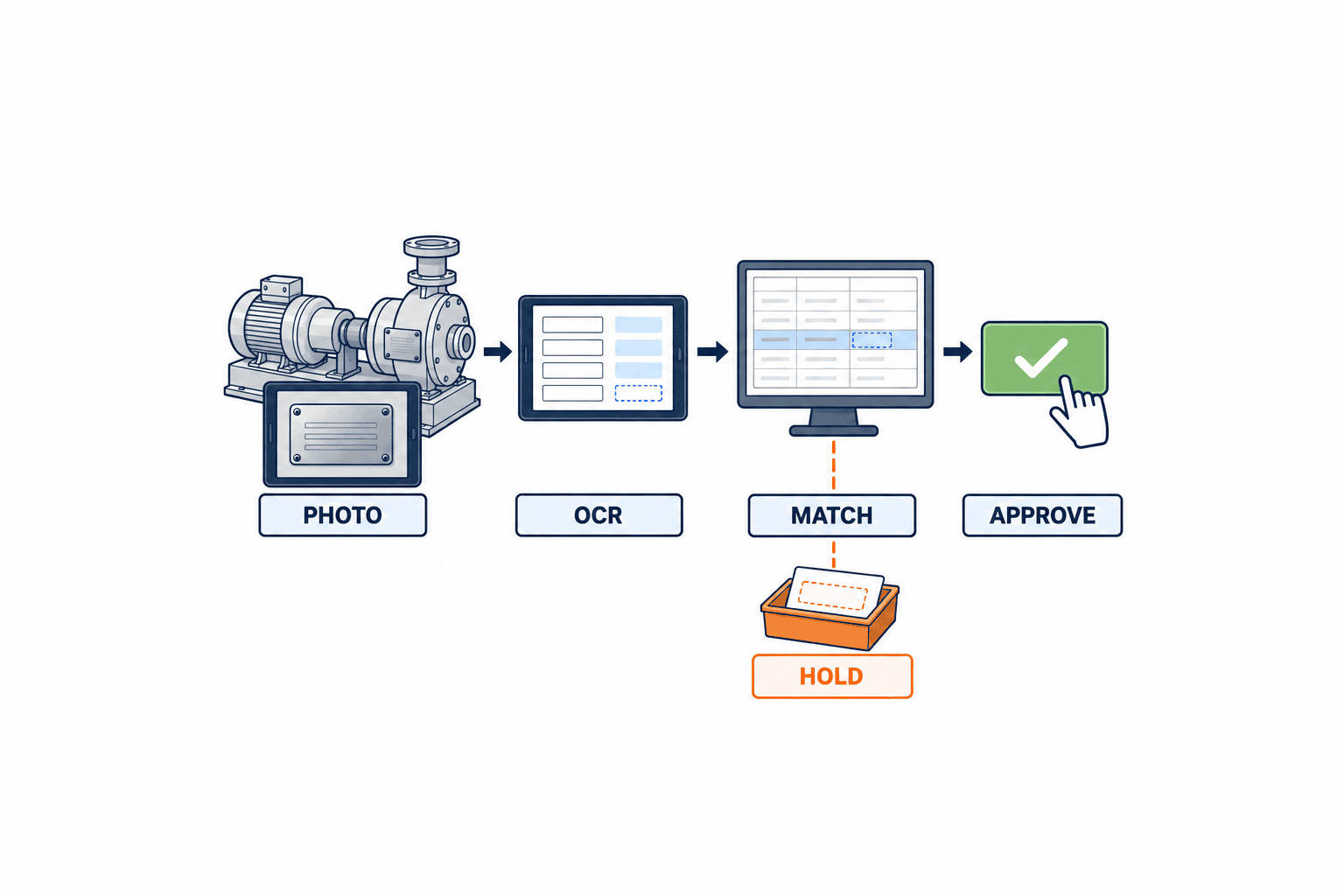
Measure end-to-end performance in FAT and SAT
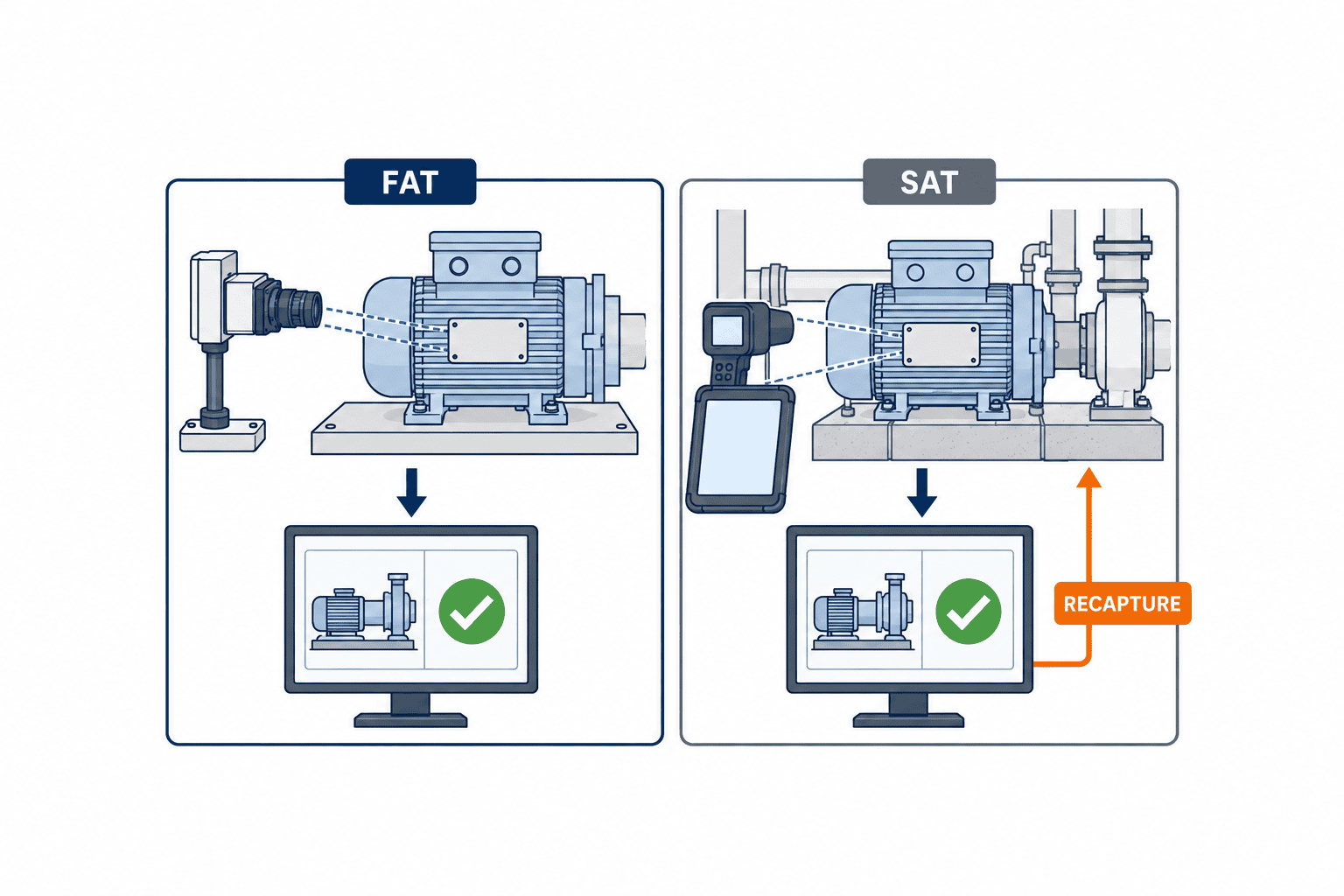
FAT should use specified predeployment data; SAT should use real plant conditions. Reusing the same clean images for both misses lighting, workflow and connectivity failures. Stratify test images by equipment, manufacturer, plate material, operator, shift and lighting. Separate tuning images from final evaluation images and have a human verify the ground truth against the physical item. Existing register values can themselves be wrong.
Measure at least four outcomes: share of required plates successfully captured; raw-text accuracy by field; correct match to internal asset ID; and error rate in approved values actually written to the register. Also measure recapture, hold, duplicate creation, processing time and unsent offline records. Error consequences differ. A wrong voltage or serial can matter more than a manufacturer spelling variation. Decide in advance which fields can never be auto-confirmed.
| Checkpoint | Acceptance evidence | If it fails |
|---|---|---|
| Capture | Asset list and overview/close-up pair | Record reason and reschedule |
| Extraction | Image crop and transcription for critical fields | Recapture or human correction |
| Matching | Candidate ID and supporting evidence | Hold if candidates conflict |
| Approval | Reviewer, timestamp and before/after values | Block unapproved write |
| Integration | CMMS result, failure log and retry ID | Retry without duplicate update |
Do not borrow a published generic OCR accuracy figure for acceptance. Set targets using your own photo mix and tolerance for wrong records. A high transcription score can coexist with poor asset matching. A hold queue may lower the headline automation rate while preventing unsafe writes. NIST’s AI RMF Core emphasizes context-aware measurement, human oversight and reassessment during operation. In this project, test the entire capture-to-confirmation process.
Handle replacement, relocation and register integration
When a motor is replaced, decide whether the pump’s parent asset ID remains and the motor becomes a new child record, or whether another register rule applies. A relocation changes location without changing the plate. Repair and return may retain a serial but change the maintenance event history. OCR cannot infer the meaning of those events from the photograph.
Separate create and update API operations, and use an idempotency identifier so a retry cannot create a second record. Show unsent work on the mobile device during network outages. Re-running OCR must not silently overwrite a previously approved value. If required CMMS fields are missing, hold the job. If the adapter reports failure, show a pending-retry state. Confirm completion by reading the destination record, not merely by showing an app success message.
ISO 55001:2024 sets requirements for an asset management system; it does not prescribe a particular OCR method or nameplate field list. The practical aim here is to explain which asset was confirmed, when, by whom and on what evidence throughout its lifecycle. Images and change history support that aim.
Calculate return after recapture and review
Comparing only hand-keying time with OCR time exaggerates the benefit. Include travel, PPE, capture, recapture, review, candidate matching, approval and exception handling. Compare the current and proposed process on the same asset sample and record distributions, not just a mean from easy plates.
One transparent calculation is annual volume × net hours saved per case × hourly labor rate − annual operating cost, with implementation cost shown separately. Convert minutes to hours by dividing by 60 before multiplying by an hourly rate. Net time is after added recapture and review. For illustration only, 1,000 cases × three net minutes equals 50 hours per year; this is arithmetic, not a performance claim. A small site may not recover the software cost through labor savings alone. Better asset records may prevent missing history and duplicate registrations, but monetize that benefit only where actual correction or reinspection records support it.
Compare extending an existing CMMS mobile feature, building a small capture-and-approval app, and connecting a dedicated OCR service. Include setup, devices, OCR consumption, image retention, integration changes, maintenance, model-change retesting and training in TCO. A price per image is not the full price of a confirmed asset record.
Run a small pilot before rollout
Start with two or three equipment types in one area, where internal IDs and physical labels can be checked. Define the required fields, capture authorization, storage policy and ground-truth reviewer before collecting photographs. Include glare, wear, curvature, confined spaces, multiple plates and absent serials. Freeze success criteria and human-review rules before testing.
Test the capture journey at the machine. Can the worker select the asset from a work order? Does the app prevent a photo being attached to the adjacent machine? Is the recapture reason clear? Can unsent work be found after a connection loss? The reviewer needs the original image and current CMMS value side by side. Translating the UI for Thai staff is useful; translating an OEM model code is not.
After CMMS integration, test approved, held, returned, duplicate-candidate and communication-failure cases. Trace from the registered asset to its image and approval record, then from the image back to its destination record. In operation, reassess new manufacturer layouts and changing OCR behavior. Maintenance and IT should jointly approve dictionary changes and periodically inspect error patterns.
Assign responsibility after go-live
Asset data changes whenever equipment is received, replaced, moved, sold or scrapped. Specify who takes the picture, who checks the plate and who approves the ID mapping. Maintenance can own physical evidence, IT can own interfaces and access, and the register owner can own field definitions and duplicate rules. A vendor can tune OCR, but cannot decide whether a replacement component should inherit a plant asset’s history without plant context.
Track coverage, recapture, age of held cases, correction count for critical fields, wrong-ID matches and approval-to-update time. A higher hold rate may reflect safer segregation of difficult plates; a high auto-approval rate is no success if it creates later corrections. Classify defects as blur, glare, missing text, dictionary gap, candidate mismatch or outdated register entry. The category points to whether capture guidance, OCR or master data should change.
Define deletion and reprocessing procedures. If the wrong machine’s image was attached, keep an auditable reversal of any affected value. Run a fixed test image set before changing a model or dictionary and compare critical-field error and hold rates. Treat a new manufacturer layout as a new test group. Include change control in the support agreement.
Example: registering a pump unit
Consider a pump unit managed as a parent asset, with pump, motor and inverter as child components. The worker first selects the parent asset from a maintenance work order and captures an overview. Next the worker selects the motor child and photographs its plate. OCR proposes manufacturer, model, serial, power, voltage and frequency. If dirt hides the final serial character, the worker records “unreadable” rather than guessing. Maintenance obtains another image or compares purchasing documents with the physical item. The old confirmed value remains until evidence resolves the number.
The worker then photographs the pump body. Even if the motor plate appears in the same frame, the app shows that the current target is the pump. If the model matches the existing record but the serial differs, the reviewer checks replacement history. A documented replacement supports ending the old component’s effective period and starting a new one. Without that evidence the case remains on hold. AI can find a discrepancy; it cannot determine from the image alone whether the cause is OCR error, an outdated register, component replacement or the wrong target.
For a new line, attach plate photos to commissioning evidence and compare model and rating with the approved specification before creating the initial maintenance record. A difference may require a purchasing or engineering change approval, rather than another OCR run. For older lines without reliable commissioning records, mark separately what was verified from the physical plate and what came from a document.
Minimum data and change-history design
Avoid a single free-text field per image. At minimum, model a capture event, original image, plate type, extracted fields, asset candidate, approval event and register-update event. The capture event records who selected which asset and when. An extracted field keeps its raw string, unit, image position, candidate and confirmed value. Approval records what a person checked. The integration event records which request changed which CMMS record.
This structure separates “the model read correctly but the adjacent asset ID was selected” from “the plate was matched correctly but the CMMS write failed” and “the old register serial was wrong”. Without the intermediate evidence, the team cannot decide whether to change capture guidance, matching logic, API retry or master data. Keep raw, normalized and confirmed forms separately. Normalization improves search but a hyphen or suffix can distinguish a real product variant. Do not confuse manufacture date on a plate with commissioning date in the register.
A recapture should add a new event instead of overwriting the first image. The reviewer should identify which image supported approval. If a plate is later replaced, preserve effective periods so current records lead to the current plate while historical maintenance entries can still lead to the plate seen at that time.
FAQ: equipment nameplate AI OCR
Can OCR alone complete the asset register?
No. Location, owner, hierarchy, replacement and commissioning dates need other records and approval. Preserve OCR as observed evidence and confirm it against the physical item and existing register. Paper inspection readings are a separate problem covered in our equipment inspection sheet AI OCR guide.
Can it read reflective or curved plates?
Sometimes. Changing the light angle, capturing overview and close-up images, image-quality screening and recapture may help. Do not ask AI to certify characters that no one can see. Include real reflective, worn and confined-space samples in FAT/SAT, with a hold route for unreadable plates.
What drives cost?
Equipment volume, plate variation, devices, storage, OCR calls, extraction tuning, CMMS integration, approval screens and support. Subtract recapture and human review from time saved. Use pilot observations before extrapolating to the whole plant.
Must this be launched with AI maintenance planning?
No. Reliable ID-to-asset mapping is a sound first step. It improves the input to later prioritization, as discussed in our maintenance inspection planning AI guide.
Summary
Factory equipment nameplate AI OCR is an asset-information workflow, not merely an image-to-text feature. Define capture quality, retain raw evidence, match internal IDs, require approval and confirm CMMS writes. Test wrong-asset links and incorrect updates alongside recognition accuracy. Begin with a small group of machines and include difficult plates and hold cases.
TOMAS TECH can help assess your Thai plant’s register and CMMS, define capture scope and review OCR, approval and integration options. Even if you are still deciding which equipment or fields to include, you can contact us with your current situation.


