


Selecting an industrial slip ring is more than checking whether electricity passes while a machine turns. A rotary table, winder or robot axis may need power, sensor signals and industrial Ethernet at the same time. Electrical ratings, network integrity, mounting geometry, environment and service access then interact. This guide helps engineering and maintenance teams in Thailand turn those requirements into a comparable RFP, FAT, SAT and replacement plan.
Start with the rotating interface
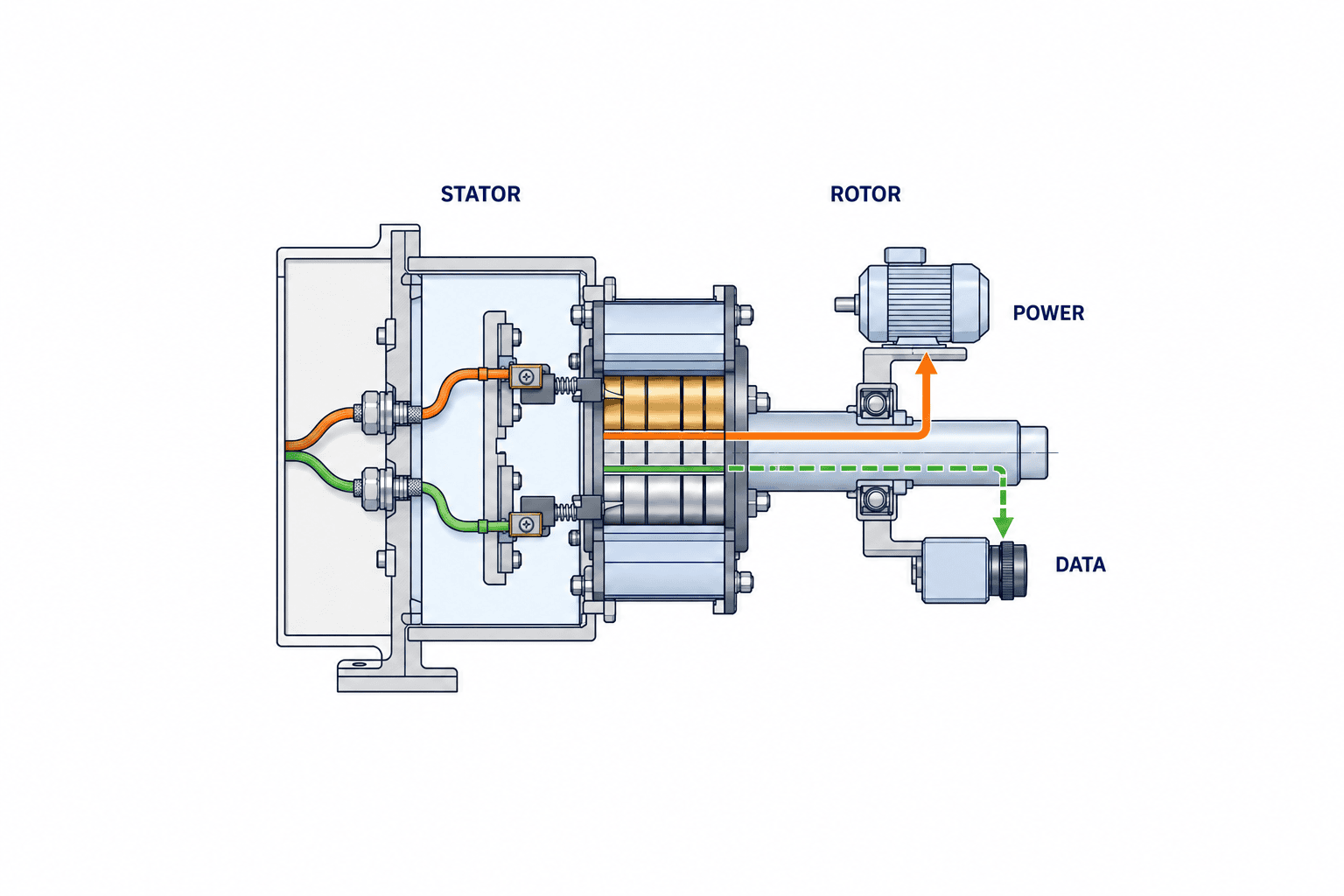
A slip ring transfers power and electrical signals between stationary and rotating parts through sliding contacts. Moog describes a rotating ring and a stationary brush or wiper; SCHLEIFRING shows configurations that can also combine data and, with separate rotary joints, media. Treat the device as a complete machine interface rather than an isolated component.[1][2]
Draw one line between the stationary and rotating sides. List everything that crosses it: power, protective earth, digital and analog I/O, encoder signals, Ethernet, optical channels, air or liquid. Do not reduce a motor supply and a camera connection to one count of “circuits.” Merely having continuity does not establish that a transmission line meets its network requirements.
Decide whether the motion is continuous or limited to an angle. A suitably routed flexible cable may work for limited motion. Continuous turns make cable winding a constraint. Document travel angle, acceleration, reversals, operating hours, bend limits and service access before deciding on a slip ring.
Separate continuous, peak and fault-related loads
For every power circuit, state AC or DC, voltage, continuous current, start or acceleration peak, simultaneous load, duty cycle, permitted voltage drop and protection arrangement. Clarify whether a quoted current is per circuit or for the whole assembly. A published rating belongs to the exact model and configuration. SCHLEIFRING, for example, publishes an MIA assembly with power circuits and a 100Base-TX module; its values must not be copied to another configuration without checking the configuration code and drawing.[3]
Temperature is part of the specification. The catalog environment may differ from an enclosure beside a motor or heater. Ask the manufacturer for derating and mounting conditions when necessary. Define measurement points and operating states for FAT; agree numerical limits for the chosen model, wiring and method instead of inventing universal limits.
Distinguish continuity from usable signals
A 24 V input, low-level analog signal, encoder and Ethernet link have different failure modes. For analog signals, assess noise against the measurement error budget. For encoders, examine missing counts during acceleration and reversal. For communication, examine frames, errors and reconnection. Meridian Laboratory explains that the instantaneous contact resistance of a traditional brushed slip ring can vary as it rotates, affecting analog voltage readings.[4]
| Circuit | Information for the RFP | Acceptance evidence |
|---|---|---|
| Power | AC/DC, voltage, continuous and peak current, protection | Temperature, voltage drop and protective earth at representative load |
| Digital/analog | Voltage, range, channel count and error tolerance | State changes and measurement drift while turning |
| Encoder | Interface, frequency, polarity and allowable loss | Count agreement through acceleration and reversal |
| Ethernet | Physical layer, speed, ports, cable, connector, protocol | Traffic and reconnection tests in operating states |
| Optical/media | Fiber type or fluid, channels, pressure and flow | Appropriate loss or leakage test |
This table ties each requirement to a test. It is not a wish list of maximum specifications. Installed PLCs and drives usually determine the practical interface. For network architecture around the rotating point, see our industrial network design guide.
What “Ethernet capable slip ring” must mean
An offer that says only “Ethernet compatible” is incomplete. Specify 10/100/1000BASE-T as applicable, port count, RJ45 or M12, pinout, shielding and cable route. State the actual protocol, such as PROFINET, EtherCAT or EtherNet/IP, if used. Ask the supplier to identify the exact model and configuration that supports the entire combination at the required speed and operating condition.
Moog names insertion loss, return loss and crosstalk as important Ethernet slip-ring parameters. They affect signal quality and ultimately bit error performance; a continuity test cannot replace a transmission test. Moog also shows combinations of data, power and signal, but availability of a combination is not a guarantee for every machine condition.[5][6]
SCHLEIFRING presents modular power, signal and data units. Stemmann-Technik describes contact-plate technology for LAN, fieldbus, Ethernet and power, while its gold-wire technology has a PROFINET option.[11] Meridian Laboratory states that M-Series protocol support depends on sufficient circuits and appropriate wiring. These manufacturer statements show why the exact technology and assembly must be confirmed; “any slip ring passes Ethernet” is an unsafe assumption.[2][7][8]
Combining power and data in one housing
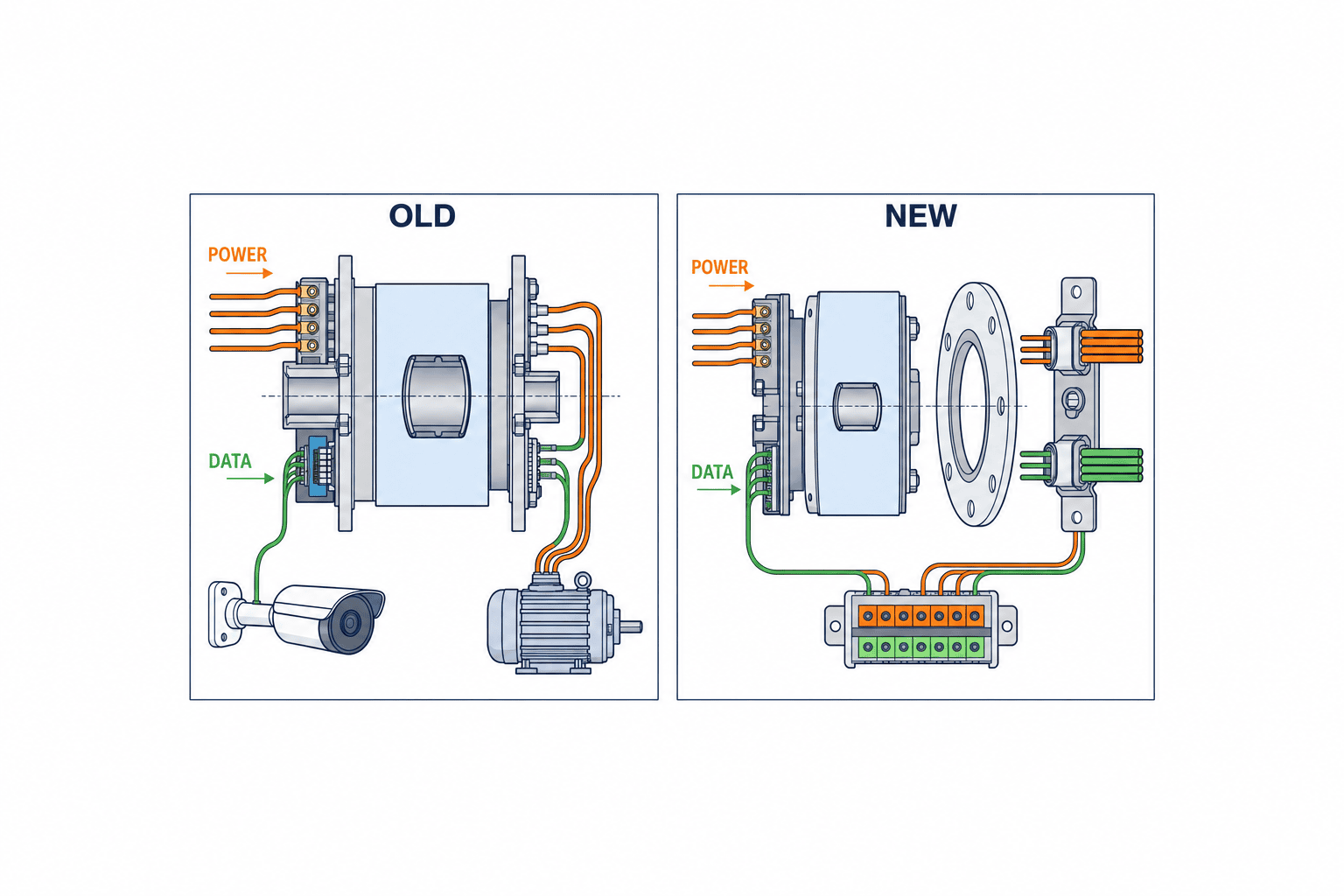
An integrated unit can simplify mounting and cabling. It also makes separation, insulation, shielding, earthing and cable termination important at both product and machine level. Test communication while the actual power load and inverter operate. Provide a wiring diagram from the cabinet to the rotating interface and from that interface to the endpoint. A standalone bench test cannot reproduce every interaction in the installed machine.
Do not accept a link LED as the sole result. Record traffic, errors and reconnection during stop, acceleration, rated speed, reversal and changing electrical load. Capture switch and PLC logs where possible. This also gives maintenance a baseline for future faults.
Keep optical and contactless options in the comparison
An electrical contact is not the only way to carry data across rotation. A fiber-optic rotary joint, contactless data system or separate power and data paths may fit better. SCHLEIFRING presents optical rotary joints as contactless and insensitive to electromagnetic interference. Optical data still requires a separate solution for electrical power. Compare required bandwidth, allowed loss, installed cable, mechanical space, service method and lifetime cost instead of assuming one technology always wins.[2]
Translate the rotating power and signal path into mechanical requirements
A perfect electrical schedule is useless if the assembly does not fit. Decide between through-bore and end-of-shaft mounting. Show what is fixed to the rotor and stator. Check outer diameter, length, clear bore, flange, mounting orientation, allowed misalignment, torque, cable exit, bend radius and guards. Provide strain relief so the cable does not twist or load the contact assembly.
State maximum speed as well as average speed, acceleration, reversals, turns per day, continuous operating time and dwell. Service-life figures are model and duty dependent. A “maintenance-free” description on one series must not be applied to every product: SCHLEIFRING publishes such claims for particular MIA items, while its service material explains the value of maintenance for other slip rings.[2][9]
Record temperature, humidity, washdown, dust, oil mist, chemicals, vibration, impact, welding or inverter noise, and whether the mounting is indoors or outdoors. Verify the full installed assembly, including cable exits and connection boxes, against the required ingress protection. Food, pharmaceutical or hazardous-area applications need their own material, cleaning and certification checks.
Build a compatibility matrix before replacement
Replacing a slip ring on an existing machine is more than matching diameter. Collect the old nameplate, drawings, terminal numbers, cable colors, power and data separation, earthing, fixing points, rotation direction and fault history. Before dismantling an obsolete unit, photograph terminals, connectors, cable exits and mounting surfaces. Save communication logs and temperatures where possible.
| Item | Existing condition | Evidence required for replacement |
|---|---|---|
| Mechanics | Dimensions, bolt pattern, direction, fixed side | Approved drawing, 3D data, mounting instruction |
| Electrical | Circuit ratings, terminals, protective earth | Circuit schedule, wiring and inspection report |
| Network | Speed, port, protocol and connector | Exact configuration and traffic test |
| Environment | Heat, dust, water, chemicals, vibration | Rating for the quoted model |
| Service | Inspection and replacement time | Manual, spare list and support contact |
Mark every cell “same,” “changed” or “unconfirmed.” An empty cell hides a procurement decision. If a torque sensor shares the axis, coordinate its mounting and signal path at the same time; our rotating torque sensor selection guide helps with shaft alignment and acceptance.
Link slip ring RFP, FAT and SAT in one specification
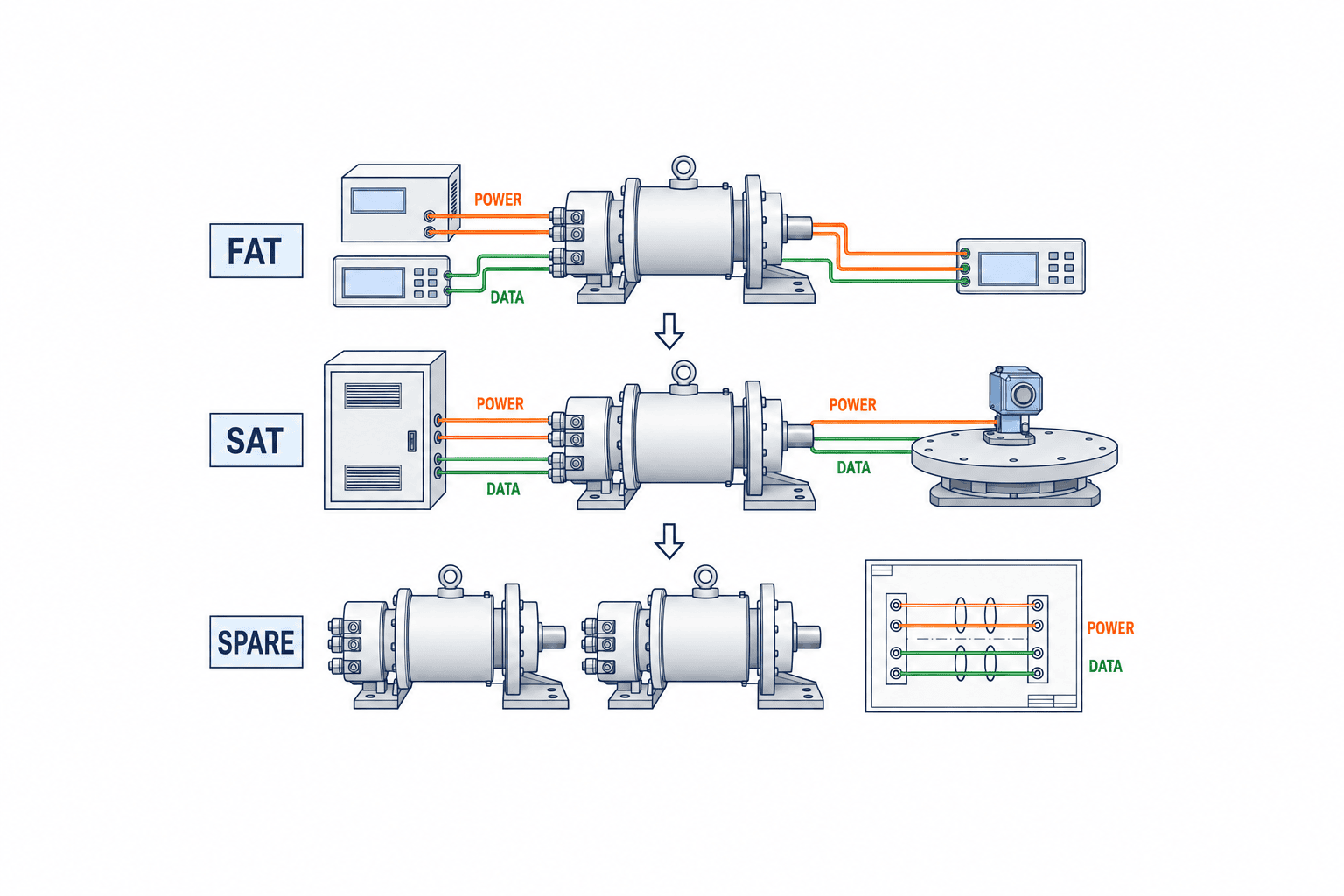
Ambiguous quotation language often becomes a dispute at acceptance. Map each RFP requirement to a deliverable, test method, acceptance limit and owner. Set limits from machine requirements and the supplier’s guaranteed values. FAT checks the supplied assembly before shipment; SAT checks its performance after installation with the actual machine, cables, inverter, earthing, heat and control logic.
What the RFP should contain
Provide the rotating-boundary diagram, circuit schedule, protocol and topology, mechanical drawing, environmental and safety requirements, quantities and spare parts, required documents and FAT/SAT witness scope. Ask for exact model and configuration, compliance and deviations, datasheet and drawing, terminal and cable schedules, inspection scope, warranty, spare strategy and local service scope. Confirm lead time and Thai support or stock directly with the commercial contact; do not assume availability.
Ask “Which exact configuration meets this duty, under what conditions, and how will it be verified?” For Ethernet, request physical-layer and cable details plus available measurements of insertion loss, return loss and crosstalk during rotation. Agree any application-level protocol test. Moog’s parameters explain the engineering reason, but the supplier must provide values and evidence for the offered product.[5]
FAT sequence
Verify model, serial number, drawing revision, circuit schedule and connectors first. Then perform agreed continuity, insulation, protective-earth, rotation-torque and visual checks. Test power under representative load and record temperature and voltage drop. Test general signals, analog measurement, encoder and Ethernet. For integrated products, repeat communication while power circuits carry their expected load. Include stop, start, steady speed, peak required speed and reversal where specified.
For Ethernet, define endpoint devices, traffic, duration, rotational state, load, error counts, retries, link drops and recovery time before testing. Distinguish a manufacturer’s transmission-line measurement from the machine application test. If a bit-error-rate test is required, agree instruments, duration, traffic and the statistical meaning of the pass limit. A brief observation without errors is not a universal guarantee.
SAT under installed conditions
Confirm the assembly matches approved drawings before energizing. Check guards, stator retention, strain relief, terminal tightening and protective earth under the installation procedure. Do not open, lubricate or clean the unit contrary to the manufacturer’s manual. Start unloaded, check motion and abnormal sound, then introduce power, signals and communication in stages. Test normal operation and changing loads.
Record traffic along the installed path, including cabinet wiring, switch, PLC and rotating endpoint. Compare FAT and SAT where conditions match, and document site-specific effects separately. When a fault occurs, record angle, load, time, alarms and connected devices together. If Thai, Japanese and English teams share acceptance, use a common item number, revision and sign-off sheet.
| Stage | Decision | Record |
|---|---|---|
| RFP | Requirement and permitted deviation | Boundary drawing, circuit list, compliance matrix |
| Design approval | Model, fit, wiring, test conditions | Approved drawing, configuration, procedures |
| FAT | Supplied unit’s performance | Serial-linked inspection and traffic records |
| SAT | Installed machine function | Installation photos, loaded logs, punch list |
| Handover | Sustainable maintenance | As-built drawing, spares, instructions, contacts |
Plan slip ring replacement and maintenance at purchase
Contact designs and service intervals vary. Meridian Laboratory describes brush and ring wear, and how the resulting dust can affect contact resistance in traditional brushed units; SCHLEIFRING distinguishes maintenance-free products from units whose instructions call for maintenance. Base replacement planning on the exact manual, actual rotations, temperature, contact condition, voltage drop and traffic errors. Do not copy a lifetime figure from another model.[4][9]
The service plan should define safe isolation, who inspects which point, cleaning or lubrication permissions, spare configuration and storage, and a repeat SAT after change-out. A spare on the shelf is not enough if its terminal map or configuration code is obsolete. Keep serial number, drawing revision, cable length and connector details with the spare. SCHLEIFRING lists repair, modernization, documentation and spares as service activities; ask the supplier which of these apply to your purchase and location.[10]
After replacement, repeat the representative load and network tests from initial acceptance. If the root cause was cable restraint, shaft eccentricity or cabinet noise, a new slip ring alone may not solve it. The more costly the shutdown, the more useful a pre-change fault record and a post-change SAT become.
Compare total implementation cost
Compare assembly price together with mounting changes, cable and connectors, tests, spare parts, service and downtime. A cheaper item can cost more if it forces a longer shutdown or special wiring. A premium feature also has no value if the machine does not need it. Compare mandatory fit, verifiable evidence, installation and service on one sheet. A claim of “fully compliant” without the exact configuration, approved drawings and test evidence remains unverified. For responsibility boundaries across a larger project, see our FA system integration procurement guide.
Interview the site and maintain an evidence column
Speak to production about batch or continuous duty, reversals and washdown; to electrical engineering about protection, inverter and earthing; to controls about PLC protocol and logs; and to maintenance about access, allowed stoppage and night-shift response. Separate known facts from pending decisions in the RFP. Have all bidders price the same assumptions.
In the comparison matrix, keep each quoted value beside its evidence: model datasheet, approved drawing, written supplier reply or “not supplied.” Separate mandatory safety, circuit, speed and fit requirements from optional expansion. Do not score an unsubstantiated “yes” as compliance.
For later diagnosis, decide where stationary-side and rotating-side logs can be taken. Correlate fault time with machine alarms, angle and current load. This helps distinguish the contact from a cable, connector, switch or endpoint. Agree who provides logs, who responds first and whether repair is on site or by return shipment.
Make FAT and SAT records comparable
A result reading only “network good” or “temperature acceptable” cannot be reused after a failure. Record configuration code, serial number, drawing revision, speed, direction, electrical load, test duration, ambient temperature, endpoints, cable, observed values, decision and corrective action on one line. For a network test, include the switches between endpoints. Save instrument names and settings so the test can be repeated after replacement. Include startup, acceleration, reversal and load changes where duty warrants them. Preserve intermittent faults with timestamp, log and operating state. Agree beforehand whether a deviation means conditional acceptance or mandatory retest.
A practical case is “Ethernet traffic under changing power load.” The condition column identifies motor mode, speed, wiring and traffic. The observation column records link loss, errors, retries and alarms. The decision uses the machine’s permitted outage and recovery, agreed with the supplier; it must not copy an arbitrary number from an article. Use the same form at FAT and SAT, adding site-specific cabinet wiring and inverter conditions at SAT.
Define safety and discipline boundaries
A slip ring’s ability to carry a signal does not establish that a machine safety function is valid. When an interlock or safety stop crosses the interface, the machine safety engineer must assess suitability and failure behavior. State safety circuits, diagnostics and stop state in the RFP, then document the split between component supplier and system integrator. Assign alignment, stator retention, cable restraint and guarding to mechanical engineering; wiring, protective earth and overcurrent protection to electrical; network configuration and abnormal behavior to controls; and inspection and spares to maintenance. Link final mechanical and electrical drawing revisions.
Hand over to the Thai site for actual stoppage windows
An English manual in a folder is not enough for night-shift response. Provide a concise Thai first-check procedure showing what to observe, which logs to save, when to stop and whom to contact. Restrict electrical measurements and enclosure opening to authorized people following maker instructions. Include photos of terminals, rotor/stator identification and spare location. Break the planned stoppage into cooling, isolation, guard removal, replacement, wiring check, retest and restart. Confirm night or weekend response, loan units and Thai stock with the seller; global websites do not establish local availability.
Control the spare by configuration, not model name alone
The spare register should include configuration code, terminal-map revision, cable length, connector orientation, mounting parts and inspection record as well as model and serial. Units in one series may have different power circuits or Ethernet ports. Recheck the spare after machine modifications, and inspect its packaging, storage and accessories. A fault report should include time, speed, angle, direction, load, alarm and preceding changes. Use the same form after replacement to show whether the symptom disappeared or returned under a different condition.
Frequently asked questions
Does “Ethernet capable” automatically mean EtherCAT or PROFINET works?
No. Confirm the offered assembly’s physical layer, rate, port layout, wiring and protocol test conditions. Manufacturers publish options for several protocols, but support is configuration specific. Verify the machine’s cycle and safety-related behavior in FAT and SAT.[2][7][8]
Can power and signals share one slip ring?
They can when the manufacturer designs and guarantees that combination. Verify insulation, earthing, temperature and communication under power load. Compare a separated architecture when it improves fit or maintainability.
What drawings should the slip ring RFP include first?
Supply the stationary/rotating boundary, circuit schedule, mounting drawing and wiring/earthing drawing. Add speed, environment, cable exit and FAT/SAT acceptance requirements. Without these, the quote and test plan may describe different products.
How should replacement timing be set?
Use the exact model’s maintenance instructions and actual rotation count, contact condition, temperature, voltage drop, signal quality and network logs. Prepare the spare and repeat-test plan before a critical production shutdown.[4][9][10]
Summary
Industrial slip ring selection starts by listing everything crossing the rotating interface, then overlays mechanical and environmental requirements and tests each candidate against evidence for its exact configuration. Ethernet needs transmission and application testing as well as continuity. Connecting RFP requirements to FAT, SAT and service documentation produces a machine interface that can be maintained in a Thai factory.
If your rotary table or winder needs power and network data across the same interface, share a boundary diagram or photos of the existing unit with TOMAS TECH. We can discuss the requirements and RFP while the design is still open.
Sources
[1] Moog, Slip Ring FAQs.
[2] SCHLEIFRING, Industrial slip rings.
[3] SCHLEIFRING, MIA power and Ethernet example.
[4] Meridian Laboratory, The Importance of Contact Resistance in Slip Rings.
[5] Moog, Ethernet & High Definition Slip Rings.
[6] Moog, Specifying an Ethernet Slip Ring.
[7] Stemmann-Technik, Contact plate-system.
[8] Meridian Laboratory, ROTOCON M-Series product specification.
[9] SCHLEIFRING, FAQs.
[10] SCHLEIFRING, Service.


