


When a manufacturer considers AI for permit-to-work (PTW) documents, the useful first task is checking a draft permit against its evidence before a person issues it. AI can flag missing or conflicting equipment IDs, isolation and lockout/tagout (LOTO) records, hazards and controls, work area and time, authorized people, and shift handover, with links to the source documents. An authorized person must still inspect the workplace, verify the physical controls, explain the risks, and issue and sign the permit. This guide sets out the scope, data, testing, RFP questions, and implementation sequence for a plant considering that narrow use case.
Define the responsibility boundary before choosing AI
A PTW is a communication and control process for higher-risk work: what will be done, where and when, by whom, and under which controls. The UK Health and Safety Executive (HSE) says a responsible person should assess the work and check safety at each stage, and workers sign to show they understand the risks and precautions. HSE also warns that issuing a permit alone does not make a job safe. Its PTW guidance is useful design guidance, not a statement of Thai law. A plant in Thailand must confirm applicable local law, site rules, and customer requirements with its safety specialists.
AI’s role here is to compare what the draft and approved reference records *say*, then place evidence-linked findings in a human review queue. An AI “clear” result cannot prove that power has been isolated, pressure released, the correct valve locked, a gas test remains valid, or every worker understands the task. Those are physical and procedural checks for competent people under the site’s PTW process. The AI service should have no permission to issue, approve, extend, cancel, or sign a permit, release a plant for work, or operate equipment.
This is a different stage from AI drafting of maintenance work orders. A work order organizes the planned maintenance activity; a PTW governs the controls and the authorized decision before work starts. A factory shift handover system is related, yet each open permit needs its own status, isolation state, remaining work, and accountable person. The quality of prose generation alone does not measure the quality of this cross-check.
Choose a bounded first use case
Start where an existing paper or electronic PTW process already works but issuers spend time comparing drafts with other records. Examples include pump disassembly during a shutdown, maintenance inside an electrical panel, opening a line, hot work, or tank cleaning. These tasks involve different hazards, so pilot one class of work at one site with its existing issuer and approval flow. Replacing every paper form or standardizing every factory at once confounds process redesign with the effect of AI.
Inputs can include the draft permit, work-order ID, asset register, isolation plan, LOTO record, task risk assessment, area drawing, related permits, personnel and qualification records, and shift handover. The output is a finding list, not an approved permit. Each finding should be classed as missing, conflicting, expired, requiring human review, or source unavailable. Show the field, comparison record, document version and location, assigned reviewer, and disposition. If a source cannot be retrieved, mark it unavailable instead of assuming that an unobserved control is safe.
Keep physical isolation, verification of zero energy, atmospheric testing, fire watch, rescue readiness, final competence decisions, issuer signatures, and restoration authorization outside AI’s authority. If the plant later changes its PTW process, the safety owner must manage that change and train workers. HSE explicitly asks organizations moving to electronic permits to assess changeover risks, interface design, and PTW training, rather than software training alone.
Cross-check six fields with explicit match rules
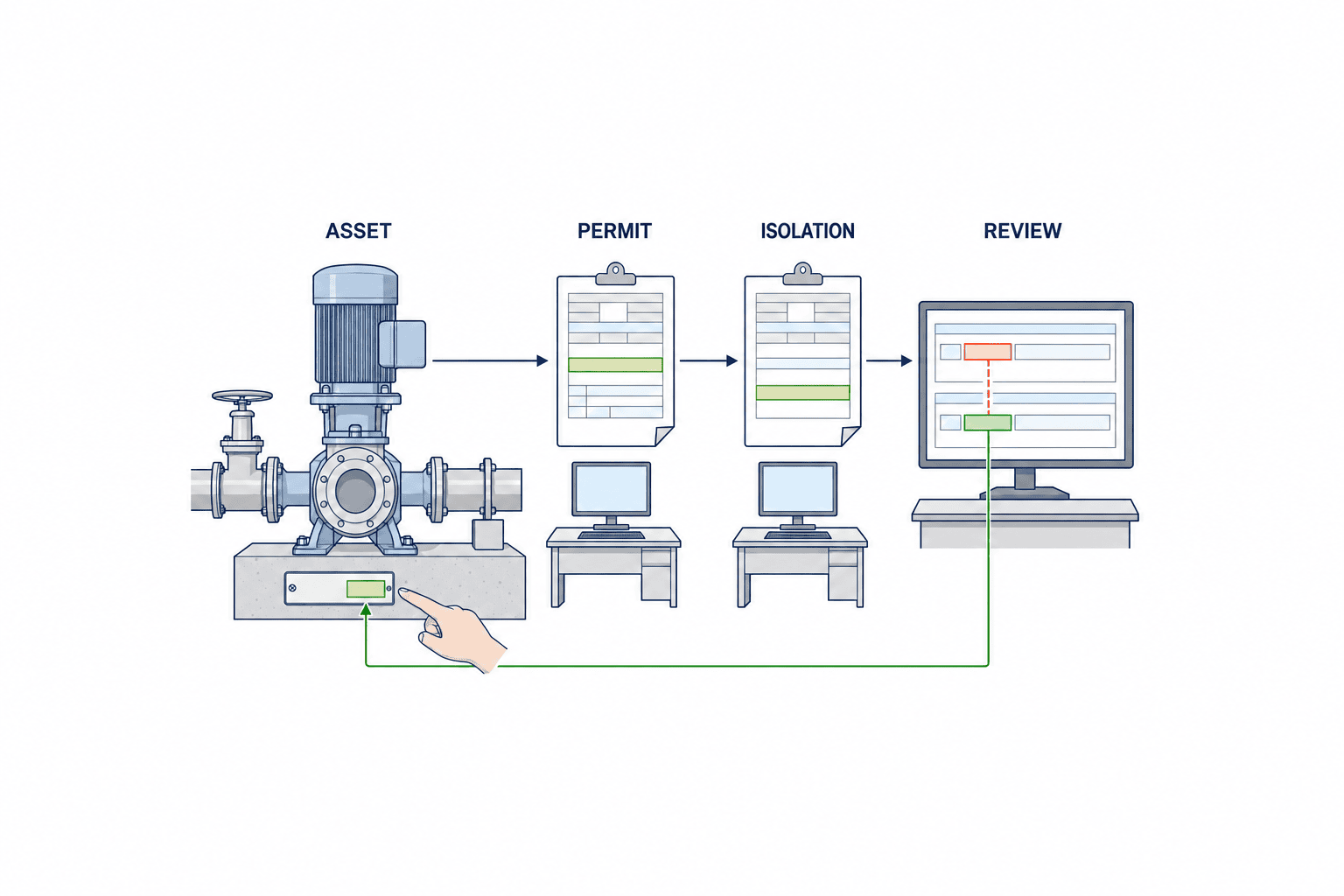
| Check | Draft permit data | Evidence and stop condition |
|---|---|---|
| Asset and scope | Equipment ID, system, task and entry limits | Asset register, work order, field tag; a similar name is not a match |
| Isolation and LOTO | Energy sources, isolation points, locks, actor, verification | Isolation plan and record; missing proof, wrong asset, unknown state require review |
| Hazards and controls | Task-specific hazards, controls and additional permits | Risk assessment and procedure; boilerplate alone needs review |
| Place and time | Area, start/end, concurrent work | Area plan, schedule, related permits; clashes go to the issuer |
| People and authority | Supervisor, issuer, attendants, valid competencies | Personnel and authorization register; ambiguous names or expired records are not auto-approved |
| Shift handover | Open work, maintained isolation, next owner | Handover record; ownership gaps or expired permit require a new human decision |
The equipment ID is a first gate. If the draft says pump P-201A and the isolation sheet says P-201B, AI must not infer that they are interchangeable because they share a line. Use parent-child asset relationships, tag-change history, and drawing versions, and allow a proposed equivalence only where the site’s approved rule supports it. OCR confusion such as “2O1” versus “201” should display the original image rather than pass through fuzzy matching. If the asset is missing from the register, correct the master data or inspect the field tag first.
For isolation, separate a written “LOTO completed” statement from the physical fact of completed isolation. US OSHA 29 CFR 1910.147 describes identifying energy, shutting down and isolating equipment, applying devices, addressing stored energy, and verifying isolation before work. It is a US rule, not Thai law. AI can compare record IDs, asset, revision, time, and named personnel. It cannot perform the physical verification of isolation or absence of voltage or pressure. A scanned signature cannot establish that an action actually took place.
Controls must address the particular task. Opening a line can require evaluation of residual liquid, pressure, temperature, chemistry, inflow, and drainage. Hot work can require attention to combustibles, sparks, ventilation, and fire watch. Confined-space entry can require atmosphere, entry and attendant arrangements, rescue, and communications. US OSHA 29 CFR 1910.146(f) specifies contents for a US permit-required confined-space entry permit, including location, purpose, duration, people, hazards, isolation measures, test results, and rescue contacts. It is a reference example, not a universal template or Thai legal requirement. The site’s safety team must define checks for each task class.
Time and place require comparison across permits. Welding next to solvent cleaning, a blocked emergency route, or two tasks relying on the same isolation point cannot be resolved by reading one form. HSE emphasizes links between related permits, simultaneous or interdependent activities, and communication between maintenance and other groups. AI can identify a candidate clash; the area manager and issuers determine the work sequence and controls.
For people, a name in a training database is not enough. The site’s authorization matrix must identify who may issue the specific permit, apply locks, monitor entry, conduct gas tests, or act as fire watch. Contractors, duplicate names, transfers, absence, expiry, and approved delegates complicate the match. AI should flag a discrepancy and never invent permission missing from the authoritative register.
Work crossing a shift needs a fresh check of the permit validity and work condition. Do not assume that the lock owner, equipment state, and hazards remain unchanged because the same job continues. Review remaining work, unfinished controls, maintained isolation, entrants, changed conditions, and the incoming responsible person. Where site rules require reissue, AI cannot extend a permit. HSE highlights leaving unfinished work safe and providing clear instructions to the next shift.
Implement rules first, then semantic checks
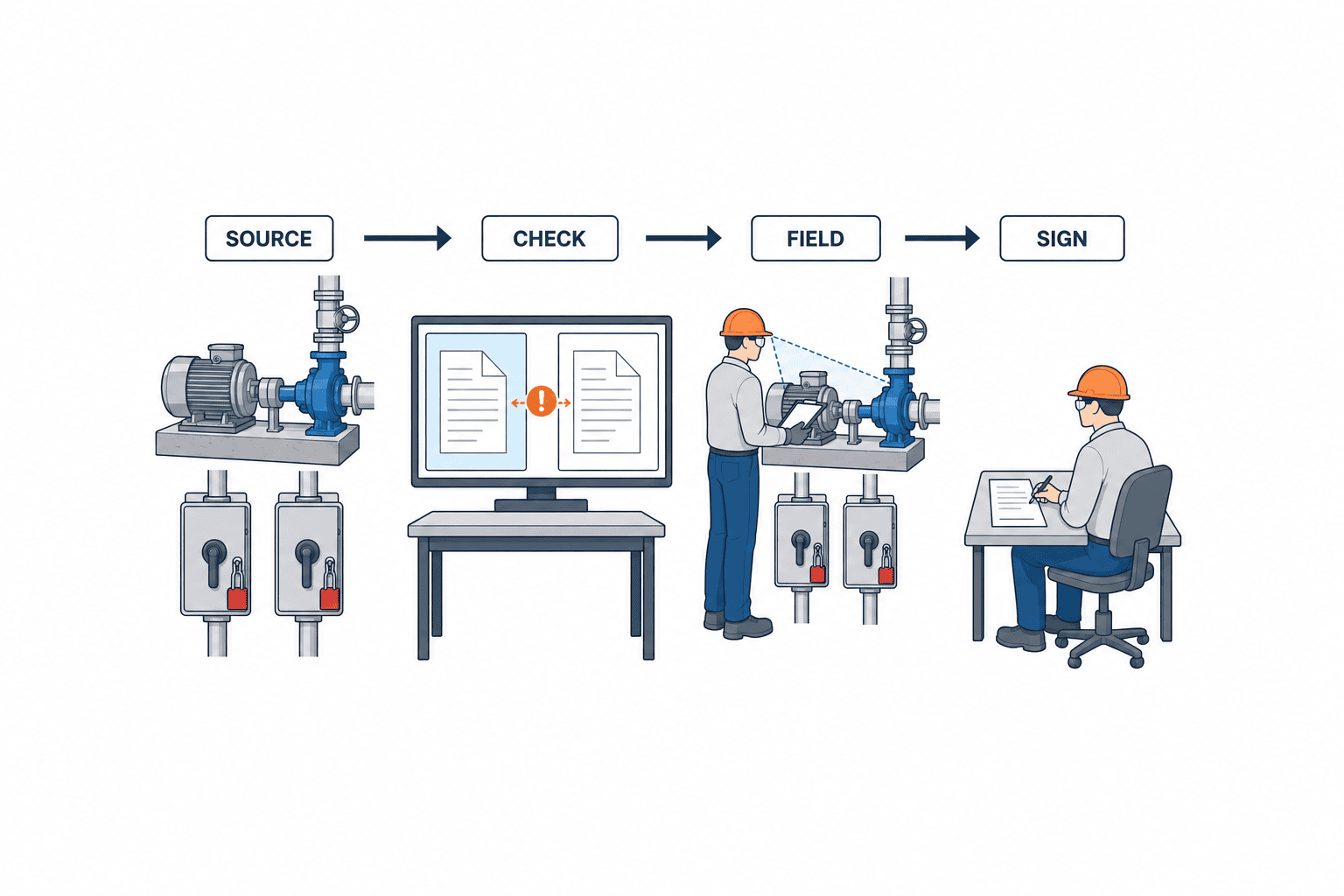
First, inspect required fields without changing the PTW process: asset, location, task class, validity period, person, and evidence ID. Deterministic rules can do this without generative AI and provide a measurable baseline. Second, join the asset and isolation systems by stable IDs and compare numbers, versions, dates, and states. Third, add semantic checks between free-text task descriptions, hazard assessments, and controls. Generative AI may help with that third stage; it should not replace exact checks with vague similarity.
Every finding needs an excerpt from the draft, an excerpt from the comparison record, a reason, and, when relevant, a reason why no decision was possible. “Permit P-201A; isolation sheet P-201B; verify the equipment ID” should open the two originals at the cited fields with their versions. A retrieved file is not valid evidence if its effective date or version is wrong. If the cited span does not contain the asserted fact, treat the answer as defective rather than persuasive.
Only approved sources should enter the comparison. Contractor attachments and permits can contain instructions irrelevant to the AI system, including malicious text that asks it to skip a check. Keep document content separate from system instructions. Establish access, storage, retention, and model-provider rules for personal, contractor, and sensitive asset information. NIST’s AI Risk Management Framework Core offers a framework for managing and measuring AI risk; citing it does not certify a product as compliant.
Design status labels carefully. Avoid a green “work allowed” badge for an AI result. Distinguish not reviewed, source missing, attention required, reviewed by a person, and permit issued. AI’s document-check state and the issuer’s signed state must be separate data. Critical items still need human review when the model reports high confidence. The issuer’s field inspection, physical checks, and briefing follow the document cross-check.
A hypothetical example of missing and conflicting evidence
The numbers and identifiers in this example are hypothetical; they are not an accident statistic, product benchmark, or legal threshold. A draft for pump P-201A says mechanical maintenance from 10:00 to 14:00. Its isolation sheet names P-201B and the previous night’s lock owner. The hazard assessment says only “isolate electricity,” with no discussion of residual pressure in the inlet pipe. A second draft proposes hot work in the same area from 11:00.
AI should produce four findings: asset mismatch, isolation evidence not linked to the current work and people, no located assessment of residual pressure, and a candidate simultaneous-work clash. It should not silently change P-201B to P-201A. Either document may be wrong. The issuer checks the field tag and drawings, determines the correction, and records the new source version.
Closure criteria matter. An asset finding closes when an authorized person checks the physical tag, register, and isolation sheet and records the corrected reference. A pressure finding closes when the site-required assessment and control are recorded. The issuers of concurrent permits coordinate any time or area change. “AI rechecked: OK” alone is not evidence of physical safety.
False alarms need analysis too. A register may retain an old asset name, a contractor’s competency may live in another system, or a handover may be completed but not synchronized. Record which source was correct and why the rule failed; decide whether to change the rule, master data, or interface. Simply deleting the alert loses learning.
Data, integration, and audit trail
Useful keys include permit ID, work-order ID, equipment ID, area ID, isolation-plan ID, related-permit IDs, personnel ID, document revision, and creation and update times. The systems need not all be copied into one database, but a controlled mapping is needed when they name the same job differently. Keep the versions used for each comparison. If a source changes, invalidate the old result and run the check again.
For paper permits, do not assume full-page OCR is the starting point. Pilot stable, high-impact fields such as equipment ID, permit class, time window, signatures, and isolation-record number. Test real scan quality, handwriting, stamps, and Thai–English forms. An unreadable field should show the source image for human review, not an invented value. A signature image’s presence is separate from proof that the signer performed the proper check.
Where an electronic PTW system exists, preserve its approval flow and return findings and source links through a limited integration. A read-only batch import may support a proof of concept, but measure update delays and incident traceability before production. Verify through API permissions, not only the user interface, that AI cannot write “issued,” change an isolation record, or control plant equipment.
Audit logs should retain input versions, consulted sources, rule/model version, findings, reviewer actions, and issuer decisions. Restrict personnel records by role. Plan backup and outage procedures so a restored old permit is never displayed as currently valid. A system outage must lead to the site’s defined manual process, not an automatic bypass of required checks.
Measure misses, workload, and operational cost
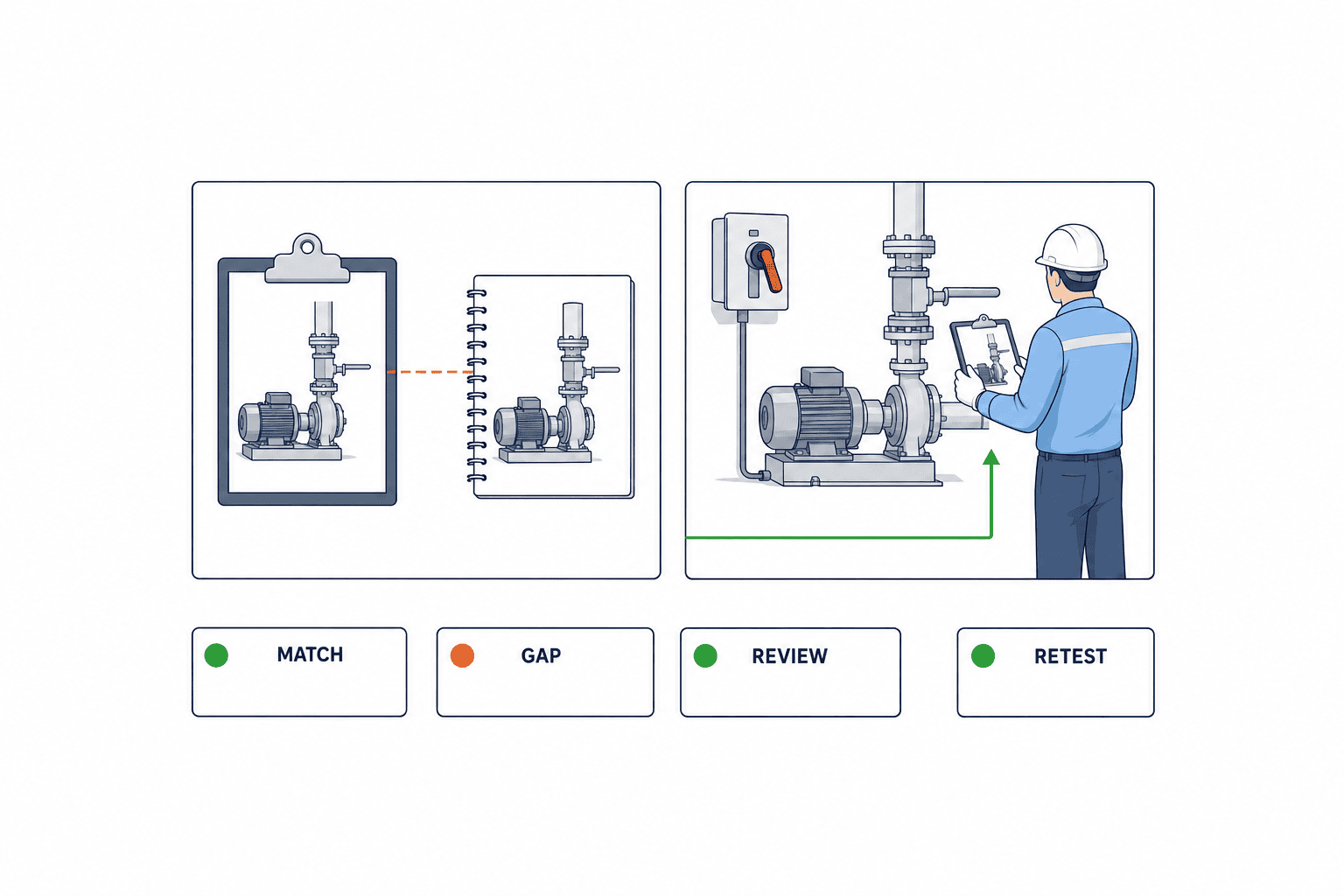
Build a protected evaluation set of past permits. Issuers and safety specialists independently mark what should have been flagged. Measure equipment mismatches, isolation evidence gaps, expired periods, concurrent work, authorization conflicts, and handover gaps separately. Overall accuracy can hide a rare but consequential miss. Track true findings, false negatives, and false positives. Excessive false alarms can make issuers ignore alerts, while lowering a threshold never justifies a promise of zero misses. Human verification remains mandatory.
Monitor review time per permit, time to open evidence, returns for correction, serious defects found in the field, changes after issue, stopped handovers, and version mismatches. Include master-data cleanup, training, review, audit, and model-update costs in the business case. A short pilot cannot establish a reduction in accidents.
For an illustrative hypothetical calculation, suppose there are 200 drafts a month and document comparison drops from 12 to 8 minutes each. The simple difference is 800 minutes per month. This is not measured performance. Do not subtract field verification time from the workflow; account for false alarms and data preparation, compare like task classes, and reject the result if serious misses rise.
Ask precise RFP questions and phase acceptance
Describe the permit types, sources, and findings you want rather than asking a vendor to “automate safety approval.” Demonstrations should cover asset aliases and modification history, mixed paper and electronic permits, multilingual workers, delayed competency updates, simultaneous permits, revised source documents, and failed retrieval. Demand links that open the cited part of the original, and reject unsupported statements.
State permissions and accountability explicitly. AI may read records and create findings; it may not issue, approve, extend, cancel, or sign permits, confirm isolation, or control equipment. The issuer must be able to record a reasoned disposition. An auditor must be able to reconstruct the source and model versions used, and who resolved each finding. The outage plan should return to a defined human workflow.
A practical sequence has four phases: (1) inventory forms and assessments, define owners and stop conditions; (2) run offline tests on de-identified historical cases; (3) use shadow mode alongside normal human review and examine disagreement before relying on AI; (4) operate on a limited task class, verify training and change control, then expand. The site safety owner defines each exit criterion.
Factory acceptance testing should include valid permits and wrong assets, stale versions, missing fields, unauthorized names, overlapping times, missing sources, OCR errors, and hostile instructions embedded in attachments. Site acceptance testing should use actual terminals, network, role permissions, shift changes, and outage handling. A passing demo shows the issuer opening the original evidence, checking the field, and signing under the site’s rules, not merely a warning on a screen.
Compare total cost under the same assumptions: PTW, CMMS, HR, and asset-register integration; paper ingestion; master-data repair; permissions; retention; audit; Thai and English language handling; retesting after model changes; field training; and support. Adding confined-space or hot-work classes creates new sources and test cases, so a simple per-permit price misses major costs.
Make the review screen usable in the field
An issuer should see the draft and comparison record side by side. Selecting an equipment finding should highlight both cited fields and show version and update time. For a hazard finding, show which part of the task description prompted the question. Keep AI explanations short and make original evidence one click away. Prioritize findings by site-defined safety importance, not model confidence alone.
Closing a finding should require a meaningful outcome: source corrected, field checked with a recorded reason, false alert with a recorded reason, or work postponed. A bare “ignore” button destroys traceability. Recheck the corrected permit and show remaining or newly created conflicts. If work time, isolation point, person, or conditions change after issue, return to the site’s change-control procedure. AI can detect a change; only authorized people decide whether work can continue.
Assign operational ownership
Safety owns task classes, checks, severity, stop conditions, and periodic review. Maintenance owns equipment IDs, isolation points, and changes to the asset register. IT owns access, interfaces, logs, backup, and model versions. Issuers own field checks and issue decisions; workers and contractors follow the briefing and permit procedure. “The AI recommended it” is not an accountability model.
Regression-test model or index changes with important past misses and false alarms. Reassess rules after equipment modification, form revision, or competency-policy change. A sudden drop in findings may mean ingestion stopped rather than quality improved. Periodic audit should sample permits with *no* AI findings to search for missed issues.
What changes in a multilingual workplace?
A Thai plant may use Thai PTW forms, English asset registers, and Japanese work instructions. Equipment names, abbreviations, and informal terms vary across languages, so a translated phrase alone should never establish that two assets or hazards are identical. Anchor comparisons on governed IDs, drawing numbers, isolation-point tags, and permit numbers. Display the original and translation together and let the issuer return to ambiguous source wording. A word such as “open” may refer to opening a line or a switch; its context and asset matter.
A warning displayed in a worker’s language does not prove that the worker understood the hazard. The issuer or field supervisor must explain hazards and controls in a language the workers understand and allow questions. AI translation can assist, but technical terms, numbers, and units need review against an approved glossary and version. Test long translated asset names on the actual mobile screens too.
How should checks differ by task class?
A single generic permit form can bury critical checks. Electrical maintenance calls for comparison of asset identity, multiple power feeds, stored energy, work boundaries, and the people responsible for isolation and verification. A generic “distribution board” entry in the register cannot establish that a particular circuit is isolated. Opening a pipe raises upstream and downstream isolation points, the fluid, residual pressure, draining and cleaning records, and links to neighboring lines. AI compares the documents on these points; it does not make physical measurements.
For hot work, check the location, nearby combustibles, spark travel, ventilation, fire watch, and interaction with cleaning or painting. For confined-space work, check the identified space, entrants and attendant, required test records and times, communication, rescue arrangements, and related hot-work permits. This article cannot set acceptable gas readings, test validity periods, or attendant numbers. Authorized people must use applicable local law, site procedures, and task risk assessment. AI should cite the version of the site criterion used.
A task-specific check matrix should say not only *what* is required, but *when*, which record is authoritative, what happens when it is unavailable, and who may decide an exception. If atmospheric-test records are required, the site must define how the space, measurement location and time, tester, and instrument record relate to the permit. AI can report a document gap. A person verifies calibration and whether conditions changed after a test.
How far can simultaneous-work detection go?
Overlapping time and area are useful broad filters, but warning on every pair in one building creates alert fatigue. Combine equipment systems, isolation points, ventilation, material movement, exclusion areas, and use of heat or chemicals to show likely interactions. The area owner still judges whether there is a real conflict: adjacent areas may share pipework, while work in the same mapped area may be physically separated.
Show both permits, their times, hazards, shared equipment or isolation points, and relevant drawings side by side. The issuers decide whether to delay one job, separate areas, or add controls. After coordination, verify that both permits and the work schedule carry the same change. Correcting the time on just one document may remove the screen alert while leaving field communication inconsistent. Closure of a finding can require updates to related permits and handover records.
What if the evidence is unreliable?
A similar permit from last year may describe an obsolete isolation plan after plant modification, line reconfiguration, chemical change, staff change, or procedure revision. A high-ranked search result is not necessarily an authoritative current source. Filter by document type, effective and expiry dates, version, approver, asset, and site. If two applicable sources conflict, AI should report a source conflict rather than choose whichever is convenient.
Treat photographs carefully. An isolation-point photo does not establish the current state if the capture time, asset identity, or later changes are unknown. Computer vision may identify a candidate lock or tag in the image but cannot prove present physical isolation, lock ownership, or required measurements. Keep “photo attached” distinct from “field verified” to avoid false reassurance.
Acceptance scenarios for field deployment
First test a complete, consistent draft. AI should avoid unnecessary warnings, show its source versions, and still leave physical verification to the issuer. Second test missing evidence. An isolation record never created and a record temporarily unavailable due to integration failure need different actions, even though both mean the evidence cannot currently support issue.
Third test plausible conflicts: an asset tag differing by one character, a valid qualification for the wrong task, or work moving into another shift. These cases challenge confident but incorrect matching. Fourth test changes in flight: an asset ID corrected immediately before issue, a work period extended after issue, or extra maintenance added. Verify that old checks are invalidated and the site’s change-control path is used.
Fifth test volume and outage. During a shutdown, several issuers may update related permits at once. Check that stale decisions never appear current. If search or AI is slow, show “checking” rather than imply review has passed. On network loss, the issuer must reach the defined manual procedure and the decision must remain auditable later. Run these scenarios across day and night shifts and both employees and contractors.
Acceptance is more than displaying a warning. Verify that necessary findings cite the correct source, false alerts remain manageable, people can open originals and check the field, and the final permit state is traceable. Actual issuers, maintenance and safety staff should decide readiness with the AI team. Good model metrics do not justify production when accountability at the site is unclear.
What if site conditions change after issue?
Work may overrun, a person may be replaced, another asset may be opened, or hot work may become necessary. Invalidate the old document-check result and compare the revised permit against current evidence. A new AI comparison does not extend the permit. The site’s rules and authorized people decide whether to stop work, cancel, reissue, or approve a change. If a source system is offline, show “isolation record unavailable,” never “matched.” Define an alternate human check and, after reconnection, recheck the latest versions and preserve an audit trail for permits handled during the outage.
Frequently asked questions
Can AI approve a permit to work automatically?
Not within this design. AI flags draft gaps and conflicts with sources. Authorized people verify actual conditions, assess hazards, check physical isolation and atmospheric tests where relevant, brief workers, and issue and sign. HSE cautions that issuing a permit itself does not make work safe.
Does an attached LOTO sheet prove isolation?
No. Matching its equipment, points, actor, time, and version against a draft is document checking. Physical isolation and stored-energy checks are separate tasks for authorized people under site procedures. OSHA 1910.147 is a US reference, not a substitute for Thai law.
Are HSE and OSHA legal requirements for a Thai plant?
They are cited here as UK and US references. Confirm Thai law and site/customer obligations locally. The Thai Ministry of Labour’s English-language OSH law page is a starting point. ISO 45001 describes an occupational health and safety management-system framework; it does not authorize AI to sign permits.
What decides return on investment?
Assess review time, serious misses, false alarms, returns, master-data work, training, outage procedures, and model retesting. Do not claim an accident-rate improvement from a small pilot.
Conclusion
AI cross-checking of manufacturing PTW drafts is a way to find missing and conflicting documentation sooner. It compares asset IDs, isolation and LOTO evidence, hazards and controls, time and area, authority, and handover against versioned sources with citations. Start with a bounded task, test offline and in shadow mode, then trial it on site. The authorized issuer must still check the physical workplace and evidence, approve, and sign.
If your team is considering checks between permits, isolation records, and shift handovers, contact TOMAS TECH while you are defining the first use case. We can help map the existing forms and evidence before any pilot changes the issuer’s responsibilities.
References
- HSE: Permit to work systems — roles, linked permits, handover, and human checks.
- HSE: HSG250 — PTW design, training, monitoring, and review.
- OSHA: 29 CFR 1910.147 — US hazardous-energy rule; not Thai law.
- OSHA: 29 CFR 1910.146 — US permit-required confined-space rule; not Thai law.
- ISO: ISO 45001 — OH&S management-system overview.
- NIST: AI RMF Core — AI risk-management framework.
- Thailand Ministry of Labour: English OSH laws — local legal research starting point.


