


When considering an AI aluminum offcut sorting system, first ask what actually needs sorting. If the alloy and production origin of a cutting remnant are known, preserving that identity for reuse usually comes first. Physical sorting becomes relevant when grades, cast and wrought pieces, or foreign materials have mixed and the resulting stream cannot meet a buyer’s remelting specification. This guide explains the different jobs of RGB vision, X-ray transmission (XRT), and laser-induced breakdown spectroscopy (LIBS), then sets out a practical RFP and auditable FAT/SAT criteria for a Thai manufacturing site.
Reusing identified offcuts and sorting mixed scrap are different jobs
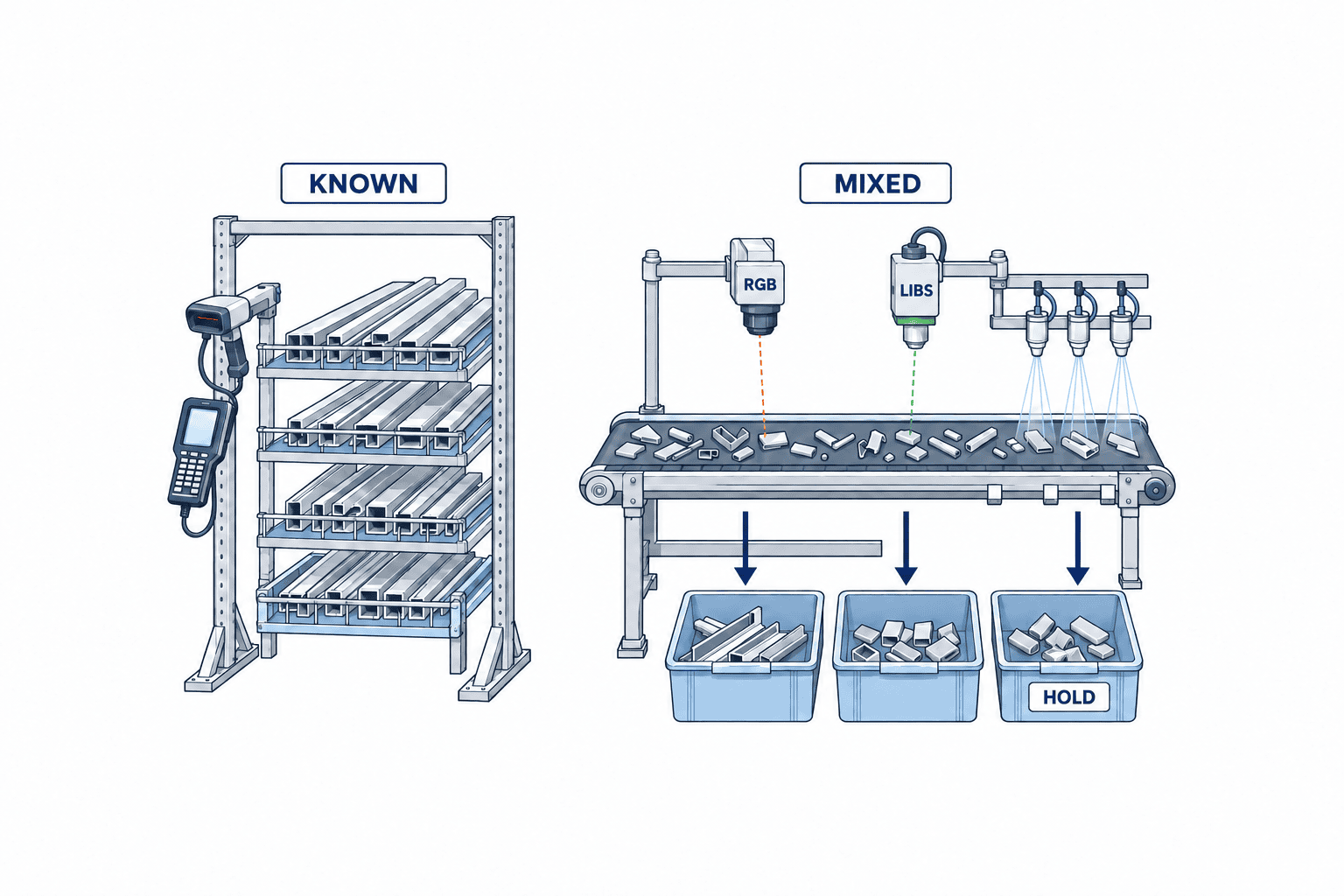
A length of extrusion or piece of sheet left after cutting may be usable on another order. If the plant knows its alloy, procurement lot, dimensions, and origin, it should label the piece, assign a location, and control reservation and reissue. Shredding and mixing that identified material only to identify it again with an expensive sorting machine destroys useful information. Our guide to offcut inventory control covers this known-origin stream.
The subject here is a different stream: mixed aluminum pieces whose source or alloy identity has been lost, or a recovery stream that may contain cast pieces, wrought pieces, and contaminants. A buyer may specify an alloy family, particle size, and limits on iron, copper, silicon, or non-metallic contamination. The US Department of Energy notes that alloy mixing and contamination restrict higher-value use of recovered aluminum and that better sorting and characterization matter. That observation does not mean AI sorting is economically justified at every factory.
Divide material into three streams before requesting machinery: identified offcuts to store and reuse; partly identified material requiring contaminant removal or cast/wrought separation; and genuinely mixed material requiring piece-level analysis. Measure each stream’s weight, size distribution, current disposal value, downgraded sales, and returns. Offcuts, oily machining chips, stamped pieces, and externally returned scrap behave differently. Vendor examples usually concern shredded material on recycling conveyors; their throughput and economics cannot simply be transferred to labeled factory offcuts.
What RGB AI, XRT, and LIBS can actually observe
An RGB camera and image model classify visual characteristics such as shape, edges, color, surface condition, and overlap. TOMRA has published a specific deep-learning application to separate low-alloy cast aluminum from a wrought stream. It works within the material and preparation conditions for which it was developed. A photograph alone does not establish the elemental composition of every visually similar alloy. Paint, oxide, oil, dust, lighting, and geometry can change appearance.
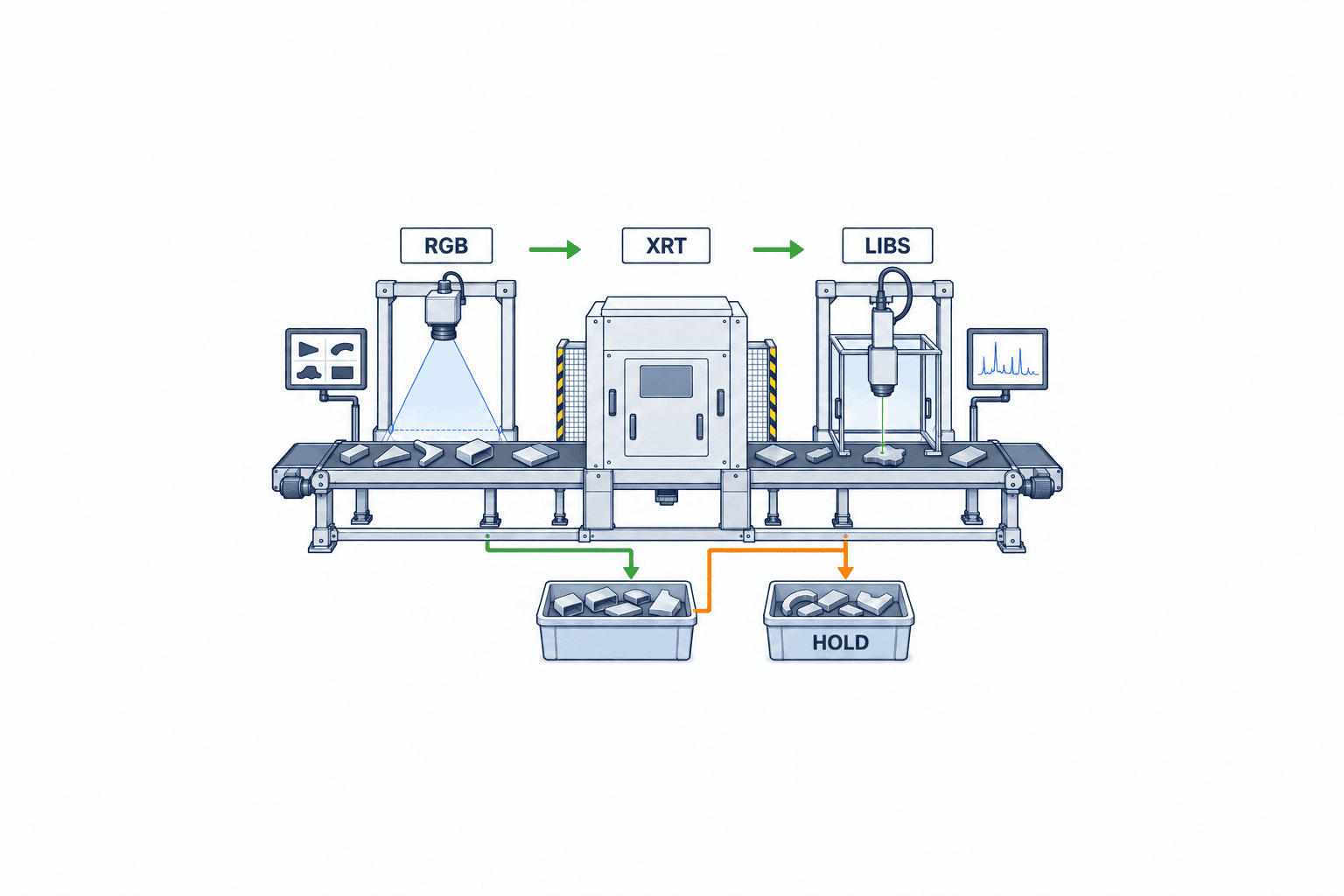
XRT uses X-ray transmission characteristics to separate materials with different effective density or attenuation. It can be useful as an upstream step for separating aluminum from heavier metals or other material in a mixed stream. It is not, by itself, proof that closely related aluminum grades have been distinguished. The machine supplier must explain shielding, interlocks, and the applicable local requirements. TOMRA’s published process places XRT and image-based learning at different stages rather than treating them as interchangeable sensors.
LIBS uses a laser pulse to produce a small plasma on a piece and observes emitted spectral features as evidence about elements. Industrial systems use it to classify aluminum alloy families. STEINERT describes a LIBS sorter for multiple alloy groups; the US DOE’s aluminum industry technology roadmap also discusses color and LIBS approaches to scrap identification and sorting. Surface coating, dirt, piece orientation, laser spot position, and size can affect the measurement. Test with the plant’s own material. Likewise, an AI model for overlapping-object separation, an image model for cast/wrought shape, and a model interpreting spectra have different inputs and failure modes. Ask vendors which sensor supplies the evidence for each promised output, what constitutes an unknown item, and where unknowns are discharged.
Specify the saleable output before specifying the machine
Work backwards from the receiver’s acceptance conditions. An internal remelting operation, a sister foundry, and an external recycler may require different alloy groups and impurity limits. Define the desired outputs—cast, wrought, a particular alloy family, other metals, or non-metallic rejects—and how each will be tested. “Aluminum purity” alone is insufficient. State the mass used as numerator and denominator, the sampling method, analytical method, and lot size for acceptance.
If wrought recovery is the goal, cast contamination may be the key rejection criterion. If 5xxx and 6xxx must be separated, visual recognition may be insufficient and elemental evidence plus reference samples may be necessary. Decide whether each piece needs a precise alloy designation or whether a practical family is sufficient. Excessive granularity adds sensors, air valves, recirculation, manual sorting, and quality testing. A vendor’s advertised purity under its test conditions is not a guarantee that the output satisfies this buyer’s melt recipe.
It may be economical to apply complex sorting only to the high-value portion. Conversely, a small amount of a prohibited contaminant can downgrade an entire lot, making stringent rejection worthwhile. Estimate value and treatment cost by stream instead of assuming every kilogram must pass through the same equipment.
Survey the feed: size, coating, dirt, mix, and peak rate
Record monthly, daily, and hourly input weight; piece-size distribution; shares of sheet, extrusion, and cast material; paint, oil, moisture, or attached plastic; non-aluminum metals; source process; and variation after product changes. Average feed is not enough for a conveyor design. Separate peak feed, operating hours, planned downtime, and periods without feed. Conveyor width and speed must allow pieces to form an adequately separated single layer, not merely match the maximum weight rate on paper.
Use representative test lots, including difficult conditions: visually similar wrong-grade pieces, coated or wet material, thin and thick pieces, overlaps, size extremes, and items near belt edges. Decide in advance which conditions are normal feed and which require pretreatment or manual handling. Clean demonstration samples alone hide exactly the conditions that create site failures.
Known-origin material can be used as labeled ground truth in a trial. Yet if its label can be kept in normal operation, revisit whether it needs automatic sorting at all. Invest in physical classification for streams where provenance is lost or manual separation has a measurable limit.
Engineer the whole sorting line
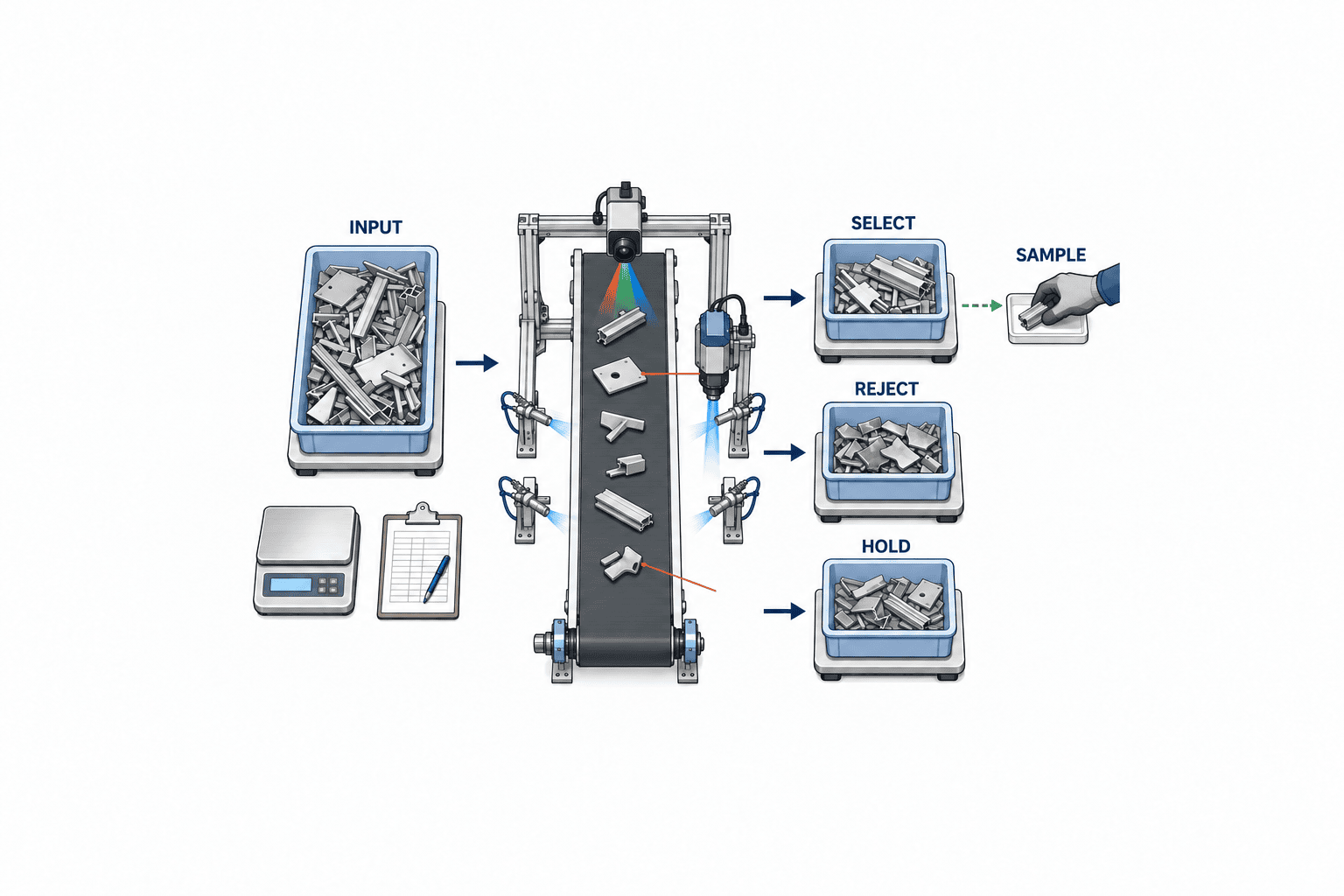
A possible process includes inbound weighing, coarse reject removal, optional size reduction, hopper, feeder, single-layer conveyor, sensors, decision system, pneumatic ejectors, multiple bins, recirculation, and output sampling. This is not a mandatory shopping list. Consistent stamped pieces may not need shredding; large offcuts may exceed the detection or ejection limits of a high-speed sorter.
The timing between detection and physical ejection matters. Distance from sensor to nozzle, belt speed, pressure, ejection width, and spacing between neighboring pieces must agree. An accurate on-screen class still produces contaminated output if the jet moves the wrong piece. STEINERT describes a LIBS process in which a pneumatic pulse separates material after analysis. A FAT must follow material into the correct physical bin, not stop at an image-classification report.
Design a distinct HOLD outlet. Low-confidence predictions, overlap, missing sensor readings, dirty surfaces, unfamiliar alloys, and restart after a fault must not be forced into the accepted product. Define the maximum recirculation count and a final disposition. Otherwise uncertain pieces circulate indefinitely and effective throughput falls. Full-bin detection and interlocks are also part of the process.
Separate model tests from plant acceptance
Image accuracy on isolated photographs is only a diagnostic measure. Feeders can overlap pieces, lenses can become dirty, and air valves can be late. Acceptance must measure the entire route from input lot to output bins. Document the training scope: alloys, coatings, sizes, lighting, speed, and source sites represented. Ask what happens when an unseen component or supplier enters the stream—automatic assignment to a known class or safe diversion to HOLD. Compare model versions on the same retained test lots before updates, and keep a rollback path.
Record operating time, lot, recipe, machine and sensor version, model version, predicted class, confidence or score, discharge destination, alarms, and manual overrides. Retaining every image forever may be unnecessary; set different retention rules for images, spectra, and aggregates based on traceability and retraining needs. A learned visual pattern is not a chemical assay. If the buyer’s specification depends on alloy elements, combine provenance, LIBS or other suitable analysis, and agreed output sampling. Acceptance depends on the output material, not a confidence score.
Measure purity, recovery, and throughput together
Purity is the mass of target material in a selected output divided by the total mass in that output. Recovery is the target material recovered in that output divided by the total target material present in the input. Throughput is input mass processed per unit operating time under stated conditions. Without the denominator and test conditions, words such as “accuracy” or “yield” do not support a supplier comparison.
For a purely illustrative example, suppose 1,000 kg enters with 600 kg target material. One output contains 500 kg, of which 475 kg is target material. Purity is 475/500 = 95%; recovery is 475/600 ≈ 79.2%. The 25 kg of contamination also needs characterization: an allowed near-alloy and a harmful foreign material have different consequences. These numbers are not a product guarantee.
Increasing purity by sending doubtful pieces to HOLD can lower recovery. Relaxing a threshold may improve recovery while reducing purity. Higher speed can increase overlap and ejection interference. Agree on the priority among these measures based on buyer acceptance and required volume. Specify how the input reference composition is established, how much is sampled at each output, whether elemental assays are needed, how recirculated pieces are counted, and whether stops are included in throughput. Test multiple days and report difficult conditions as well as averages.
Write an RFP that permits a fair comparison
Attach a test-feed register to the RFP
“Our aluminum offcuts” is too vague for a quotation. Attach photographs, source process, whether alloy identity is known, size limits, contamination, monthly weight, peak flow, and storage condition for each trial lot. Separate pieces with verified reference alloy from genuinely unidentified feed, and prevent the known answers from being visible to the operating team or model display during a blind trial. Include out-of-scope boundaries such as dripping oily chips, oversized sheets, or bundled material, and state which pretreatment will always be part of normal operations. If samples are specially cleaned or arranged for the trial, record that difference and its labor cost. Version the register alongside the machine specification, since a future product change can alter the feed population.
Provide the output specification, representative feed samples, composition and size variation, coatings and contamination, peak feed, plant space, electrical supply, compressed air, dust extraction, noise constraints, safety requirements, data connection, service location, and project timing. “One AI sorter” leaves pretreatment, sensing, and recirculation undefined. Require suppliers to state excluded materials and conditions.
Compare sensing principles, classes supported, pretreatment, permitted sizes, feed method, number of outlets, HOLD outlet, recipe changeover, model management, traceability, tested purity/recovery/throughput conditions, consumables, utility demand, and local service. RGB learning, XRT, LIBS, and other object-identification methods solve different boundaries. Do not score “AI included” without its sensing and output scope. Run the plant’s representative material as a separate vendor trial, recording any manual presorting, slower feed, or multiple passes.
Include conveyors, dust collection, air supply, floor work, reference assays, operator training, downtime procedures, calibration, software maintenance, spare parts, and product testing in total cost. Estimate value from actual before-and-after offtake terms or the internal melt substitute value. A broad claim that recycled aluminum uses less energy is not itself a cash-flow estimate for this plant.
FAT must challenge the machine and its ejectors
At factory acceptance testing, run representative lots continuously at the agreed rate. Include target, boundary, and foreign material; coated and oily pieces; overlaps; and size extremes. Establish reference composition and input weight before testing, then weigh and analyze each outlet. A camera working over an empty belt or correctly labeling a handful of objects does not establish line performance.
Record purity, recovery, throughput, energy and air consumption, and outlet blockage in normal operation. Challenge full bins, low air pressure, camera contamination, failed laser reading, X-ray protection behavior, loss of communications, model loading failure, and emergency-stop recovery. Safety design and legal compliance must be confirmed by the equipment supplier and qualified site staff. If detection or ejection fails, uncertain material should reach a safe hold path rather than accepted product. Keep the test recipe, model version, photos, sample identities, assay results, weighing slips, and alarm history with the FAT record.
SAT must use Thai-site feed and work practices
Site acceptance testing uses the installed feed route and actual utilities, dust, vibration, surroundings, and handling practice. Include upstream stops, product changeovers, and multiple shifts. Verify that the operator cannot silently run a recipe intended for a different lot. Establish who receives each input lot, weighs each output, approves quality, and releases it to the buyer. If Thai-language instructions and hold labels are needed, verify their meaning at the machine; alloy names, element symbols, recipe IDs, and alarms must be consistent across languages.
If SAT purity or recovery differs from FAT, isolate changes in feed, singulation, lens cleaning, belt speed, nozzle timing, and sampling before blaming the model. A clean FAT lot and an oily SAT lot may indicate different input conditions or insufficient pretreatment. Separate issues that operating practice can correct from those requiring hardware changes.
Four decision gates reduce premature investment
First, establish whether physical sorting is needed after better labeling and storage of known-origin offcuts. Second, secure an actual output specification and measurement method from the buyer or internal melt operation. Third, prove the outcome on representative plant material, balancing every input and output mass including HOLD and recirculation. Fourth, demonstrate sustainable daily ownership of cleaning, calibration, bin changes, sampling, maintenance, and model changes. Decide stop conditions at each gate; a promising visual demo alone should not authorize production investment.
Monitor saleable output after commissioning
Connect output lots to inventory and financial value
Before registering “sorted 5xxx” or “sorted 6xxx” as inventory, quality staff should confirm the outlet’s acceptance test. Do not merge accepted, HOLD, and recirculated lots into one stock balance. Link input lot, sorting run, output bin, weigh ticket, test result, and shipment number so a later customer complaint can be traced to the affected material. Calculate sorting cost against accepted saleable weight, not only input weight; account for air, electricity, consumables, maintenance, analysis, and labor. If buyer requirements change, version the acceptance specification and retest the output before changing an AI threshold. Keep the approving person and first affected lot in the change record.
Track input weight, output weights, sampled purity, recovery, throughput, stops, HOLD rate, recirculation, air and power, and buyer acceptance or downgrade. Classification count alone does not show that more material is saleable. Re-test retained reference lots after a model, recipe, lighting, sensor, supplier, or product change. Keep the ability to return to a known recipe and hold uncertain output. Continue improving source segregation; a sorting machine should not become a reason to mix materials that the factory could keep identified.
The scrap management system guide addresses reasons for scrap generation and disposal records. Linking those records to physical sorting results helps distinguish prevention of scrap from improved recovery quality.
Frequently asked questions
Can an AI camera identify every aluminum alloy?
No. RGB imaging observes appearance, while visually similar alloys can differ in elemental composition. A model may separate cast and wrought pieces within a particular prepared stream, but a buyer’s alloy requirement may call for provenance, elemental analysis such as LIBS, and output sampling.
What determines the cost of an AI aluminum offcut sorter?
Feed rate and particle size, required classes, sensor combination, pretreatment, outlets, recirculation, dust and air systems, testing, service, and installation all affect cost. Request a quotation against a representative feed and output specification rather than borrowing a vendor case’s performance figure.
Can a small Thai factory justify one?
It may be better to retain identity and reuse its own offcuts first. If mixed-material downgrade, manual sorting, or buyer rejection remains material and there is a confirmed buyer for upgraded output, a trial may be justified. Shared equipment or external sorting services are valid comparators.
Conclusion
An AI sorting system is not a universal box that “knows aluminum grades.” Keep known-origin offcuts identified. For genuinely mixed material, choose image AI, XRT, LIBS, or a combination according to the required output. Evaluate the physical line on real feed using purity, recovery, throughput, HOLD behavior, and failures. A clear RFP and pre-agreed FAT/SAT methods make the investment decision traceable to material that a buyer will accept.
If your Thai factory is reviewing both source tracking for offcuts and equipment for mixed scrap, contact TOMAS TECH to discuss input streams, integration, and acceptance criteria while the requirements are still being defined.
Sources
- US DOE: aluminum scrap processing and characterization
- US DOE: aluminum industry technology roadmap
- TOMRA: deep learning for wrought aluminum scrap
- TOMRA: precision AI sorting and aluminum circularity
- STEINERT: intelligent object identifier
- STEINERT: LIBS aluminum alloy sorting
- Fraunhofer: deep-learning metal scrap sorting


