


If you are evaluating AI for comparing supplier quotations in a manufacturing company, the first objective should not be an automatic “cheapest supplier” button. It should be a comparison that uses the same purchasing assumptions for every quote, exposes differences, and lets a buyer return to the source document. A low unit price is not comparable with another offer when its minimum order quantity (MOQ) is twice the current requirement. This guide is written for manufacturers operating in Thailand. It covers document extraction, normalization, exception review, procurement approval, RFP requirements, and FAT/SAT tests. All prices below are illustrative assumptions, not market benchmarks.
What an AI supplier quotation comparison system should decide
The input is a purchasing request or request for quotation (RFQ) and the replies received from several suppliers in email, PDF, spreadsheets or scans. AI can extract differently positioned fields and align them against one requested item, quantity, delivery location and deadline. The buyer and authorized approver still select a supplier under the company’s purchasing rules. A model’s ranking is the output of chosen assumptions and weights; it cannot replace quality approval, supply-risk review or delegated authority.
This boundary matters because a successful OCR demonstration is often mistaken for a usable purchasing decision. A quote may be read perfectly yet still be incomparable because the units, currency, freight, tooling charge, validity date or delivery terms differ. Conversely, asking a model to settle every exception creates orders that nobody can explain. Begin with standard items and a comparison table that explicitly holds exceptions for human review.
The World Bank’s bid-evaluation guidance discusses defining evaluation factors beyond price in the procurement documents. A private factory is not thereby subject to the Bank’s bidding process; the transferable lesson is to define comparison criteria before quotations arrive. For the wider approval process, see our guide to a purchasing management system. For the separate seller-side task of pricing a machining job from a drawing, see AI for machining quotations. This article stays with the buyer’s comparison of incoming supplier offers.
Define “comparable” before introducing AI-OCR
The baseline belongs to the RFQ, not to any supplier’s document. Save the RFQ ID, part number and drawing revision, required quantity, receiving site, required date, currency, quality requirements, and submission deadline. Determine whether each offer matches these requirements before computing a price rank. A different material, thickness, package or split delivery is a conditional offer that purchasing, engineering or quality may need to approve.
Do not match parts by name alone. One item may have an internal part number, a supplier number, an old number and a drawing number. Different items may have deceptively similar names. Prefer identifiers and revision control; when identifiers are missing, present candidate matches for a human decision. GS1’s GTIN can be one matching key for trade items that actually use it. Many drawing-controlled or bespoke factory parts do not have a GTIN, so the drawing revision and technical sign-off remain essential.
Define the cost boundary next. Is the comparison limited to piece price, or does it include packaging, domestic freight, import transport, insurance, duty, installation, initial tooling, inspection, warranty and maintenance? Keep one-time costs separate from quantity-based costs. Show the evaluation quantity, order frequency and exchange-rate date. An omitted charge is “not stated,” never zero by default. A system should not silently invent a number and then label the total final.
Price evaluation and supplier selection are different steps. The former applies documented calculations to comparable conditions. The latter also considers delivery, quality history, concentration risk, approved substitutions, supplier due diligence and payment terms. Avoid wiring the lowest calculated row directly to an automatic purchase-order release.
What AI-OCR must extract from a supplier quote
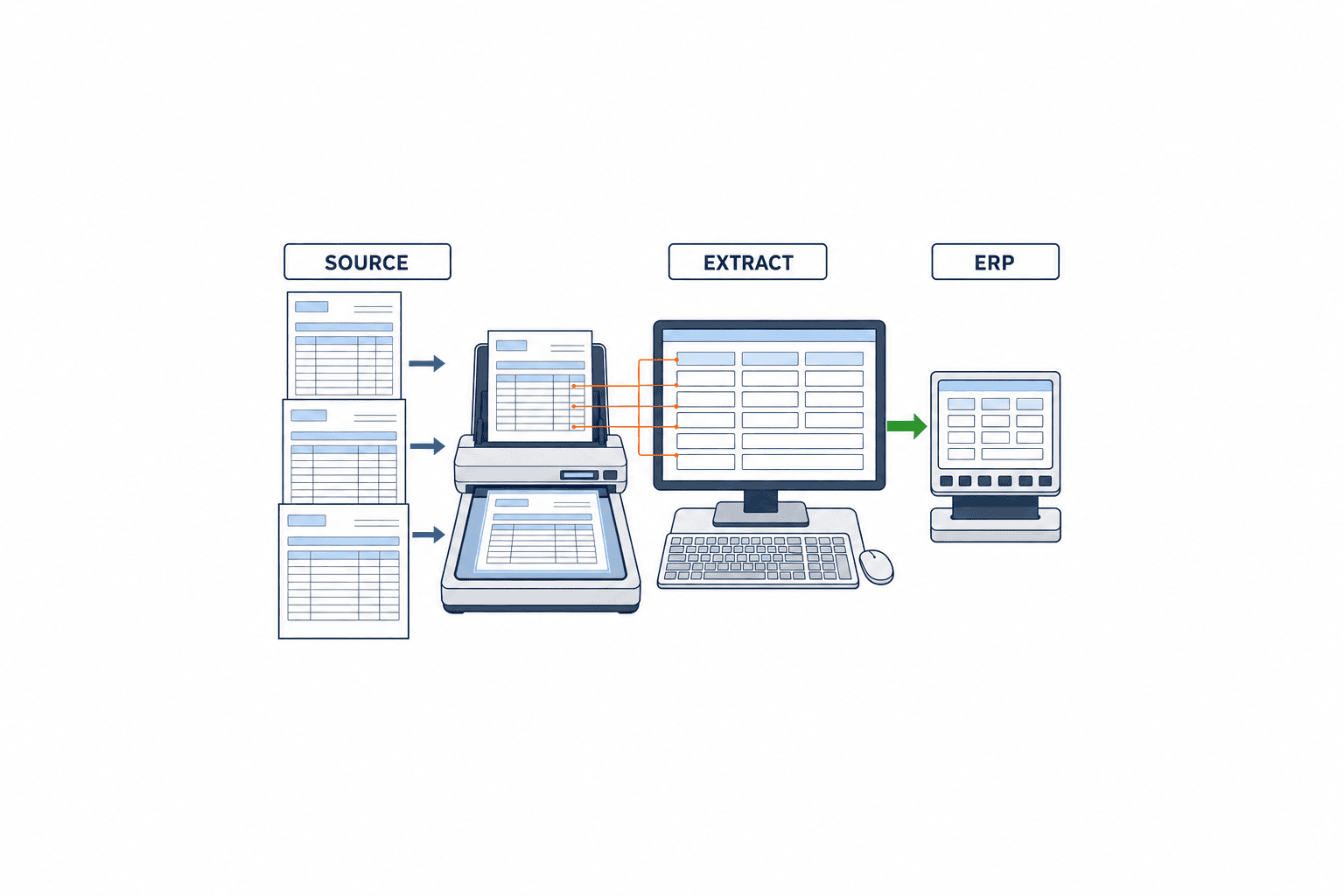
A quote can arrive as a searchable PDF, scanned image, workbook, email body or several attachments. It may have table lines, footnotes, a revision box and separate terms pages. Sending plain PDF text to an LLM is insufficient. Keep each extracted value linked to its original text, page or spreadsheet cell, filename, document hash and receipt time. That evidence allows the buyer to resolve a disputed amount without searching through an inbox.
Microsoft’s Document Intelligence documentation explains confidence estimates for extracted words, key-value pairs, tables and cells, and human review for consequential fields. Google Cloud’s Document AI custom extractor likewise describes field-level confidence and review triggers. A confidence score is a model estimate, not proof that a fact is correct. Test the fields that drive purchasing decisions—part number, quantity, unit, price and delivery date—against the original document.
A practical data dictionary includes quote ID, supplier ID, RFQ ID, part number, drawing revision, line number, unit of measure, quantity, unit price, currency, discount schedule, MOQ, order multiple, delivery place, lead time, promised date, freight, packaging, tooling, tax and duty treatment, payment terms, quote validity, warranty terms and the presence of alternatives. Each field should carry the extracted value, source wording, source location, extraction method, confidence and human correction history. Retain multiple candidates rather than silently choosing one when the source is ambiguous.
“30 days” is a good example. It might mean 30 calendar days after an order, or 30 business days after an advance payment. Extracting the number is not the same as understanding the starting condition. Show its footnote and mark the delivery date unresolved if the starting point is missing. Decimal and thousands separators vary by language and country. A currency symbol that is absent should not be interpreted as THB merely because the factory is in Thailand.
Normalize conditions after extraction
Normalization is the heart of the comparison. A unit of “piece,” “box” or “set” requires a documented conversion before prices can share one column. A delivered price and an ex-works price require the freight component to be made explicit. If unit prices change by volume, apply the tier for the chosen evaluation quantity. If a supplier requires a MOQ or pack multiple, do not multiply its quoted unit price by a quantity it will not sell.
Keep the original and converted currency side by side. Record the exchange-rate source, retrieval date, policy date and rate type. Where a small rate change reverses the ranking, display that sensitivity. If accounting or purchasing policy prescribes a rate, use it; an AI service should not pick an arbitrary web rate. Separate a convenient screen conversion from the rate used for the actual purchase order and accounting entry.
For cross-border purchases, an Incoterms® code must be read with its named place and edition. The ICC’s Incoterms® 2020 rules define how sellers and buyers allocate cost and risk. FOB, CIF and DAP cannot all be treated as “delivered import prices.” If the named place, insurance or import responsibility is unclear, seek clarification. Even when an evaluated landed cost can be computed, retain the formula and assumptions.
Lead time after order, a fixed arrival date and partial deliveries are different commitments. How holidays, transit, customs and receiving inspection enter the comparison depends on the factory’s policy. If an AI model estimates a date, keep that estimate separate from the supplier’s formal commitment. Quality evidence may include a certificate of conformity, first-article approval or product-specific documentation. Link the actual certificate; a bare yes/no cell is insufficient where validity matters.
Worked example: the 92 THB unit price is not necessarily the lowest offer
Assume a hypothetical requirement for 1,000 identical parts at one delivery site. Specifications and quality are assumed equal. Tax and currency conversion are excluded solely to make the method clear. These figures are not a real quotation or a recommended market price.
| Supplier | Unit price | MOQ | Freight | One-time charge | Lead time | Evaluation for 1,000 parts |
|---|---|---|---|---|---|---|
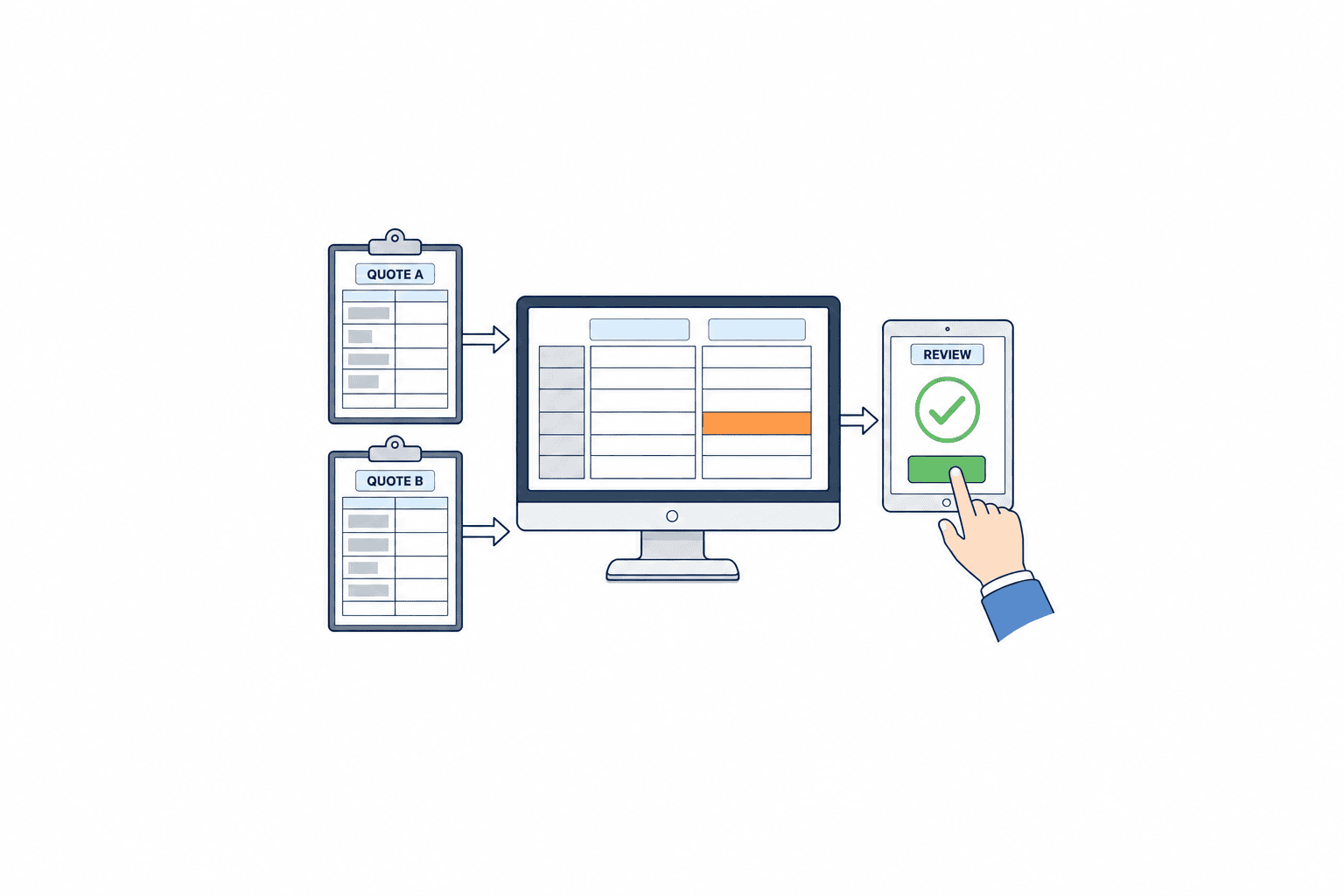
| A | 100 THB/part | 1,000 parts | 3,000 THB/order | 0 | 20 days | 100,000 + 3,000 = 103,000 THB |
| B | 92 THB/part | 2,000 parts | 8,000 THB/order | 5,000 THB | 35 days | MOQ not met. Payable order: 2,000 × 92 + 8,000 + 5,000 = 197,000 THB |
| C | 105 THB/part | 500 parts | Included | 0 | 14 days | 1,000 × 105 = 105,000 THB |
B has the lowest unit price but cannot supply only 1,000 parts under this assumption. Ordering 2,000 leaves an extra 1,000 units whose carrying cost, shelf life and engineering-change risk are not represented by the unit price. A is 2,000 THB below C for the immediate demand, while C promises delivery six days sooner. A production-critical date could change the decision.
Now suppose annual demand is 2,000 units. Ordering 1,000 from A twice costs 206,000 THB if freight is charged each time. One 2,000-unit order from B costs 197,000 THB under the example assumptions. C costs 210,000 THB for 2,000 units. This does not settle the award: tooling treatment in later years, stockholding, cash tied up and delivery risk can change the result. A comparison interface should display the immediate 1,000-unit scenario separately from the annual 2,000-unit scenario and log every changed assumption.
These totals are evaluated examples, not final invoices. Real orders may involve taxes, exchange rates, transport, acceptance inspection, replacements or payment terms. Missing quote details belong in a clarification queue. Never store an illustrative assumption as if the supplier had committed to it.
Three stages of an AI-assisted purchasing decision
First, verify hard matches: RFQ, part number, revision, currency, unit, quantity, validity and destination. Missing or conflicting data produce a “review required” state, not a rank. String similarity is not enough to approve a substitute or successor part. Engineering must review an alternative where fit, function or safety may change.
Second, calculate with explicit rules. Quantity tiers, MOQ, pack multiples, freight, one-time charges, taxes, import terms and authorized exchange rates should be processed by deterministic software once structured inputs have been checked. Do not ask an LLM to perform all arithmetic in prose. If input units do not match, stop the calculation. OpenAI’s Structured Outputs documentation describes fitting model responses to a defined JSON schema. A valid schema helps integration but does not prove that the extracted source was interpreted correctly.
Third, let people evaluate the supplier. Quality history, single-source exposure, business continuity, substitution approval, delivery buffer, warranty and service matter. Show both reasons for and against a recommendation. A model trained on historical purchasing decisions can reproduce an incumbent preference, so reviewers should check whether a qualified new supplier was disadvantaged merely because it lacks history.
Make approval evidence traceable
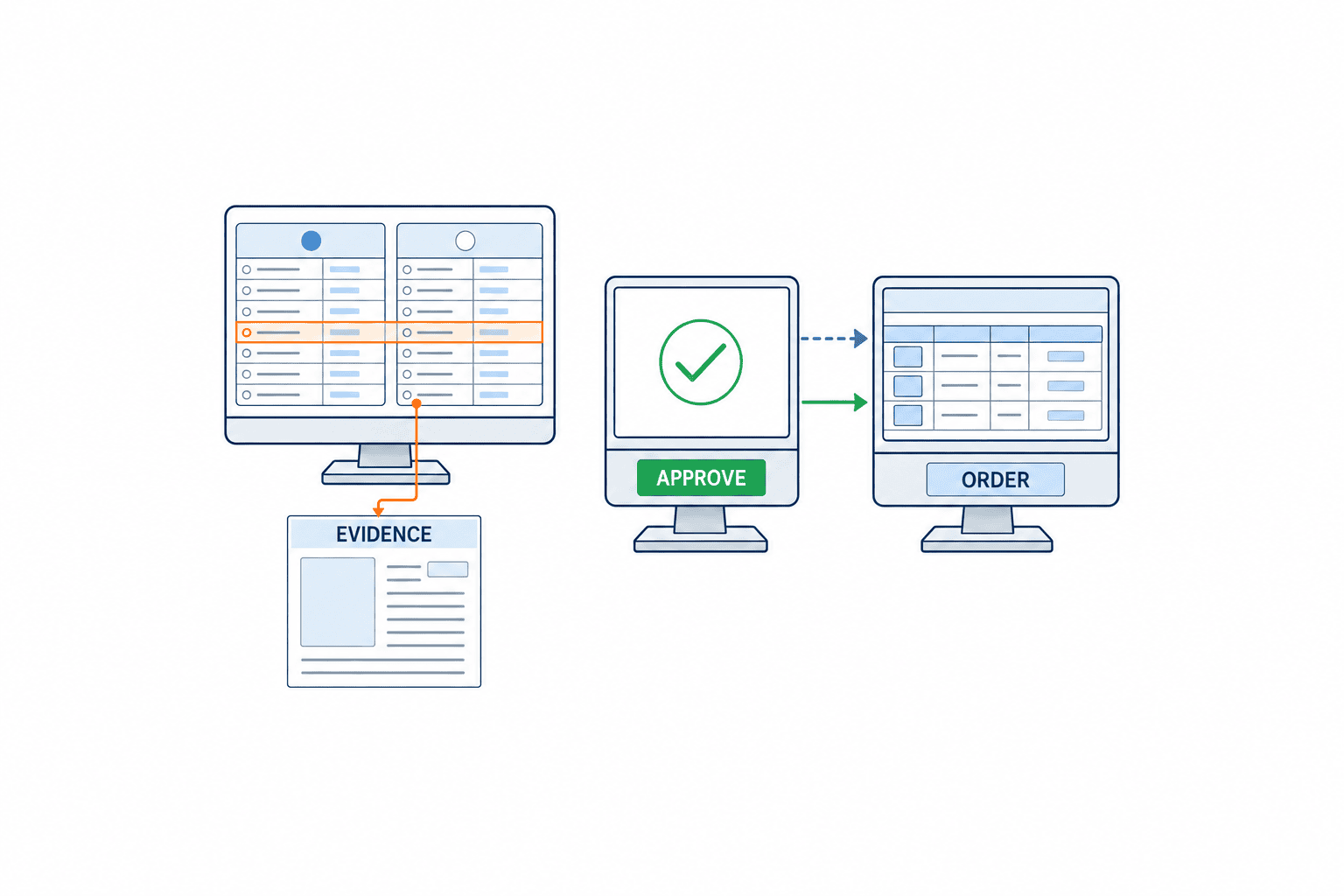
A useful review screen puts RFQ requirements on one side, normalized comparisons in the middle, and the source quotation and correction log on the other side. Every comparison cell should open the original page and line. For a converted unit or cost, show the source phrase, conversion rule and result. A correction records old value, new value, reason, timestamp and actor. Keep “AI suggested,” “buyer checked,” and “approver authorized” as separate states.
Highlight changes in revision, MOQ, lead time, freight responsibility, payment terms and validity as well as price. Collapse unchanged fields so exceptions are visible. An AI-written summary without source links is weak evidence. If a quote revision arrives, invalidate or flag the old summary for renewed review. Preserve old source files in an expired state rather than deleting the history.
Only a reviewed comparison should flow to an ERP purchase requisition or draft order. Carry RFQ ID, quote ID, evaluation version and approval ID into the ERP transaction. Once the ERP issues a purchase-order number, users should still be able to see which quote and conditions were accepted. Direct AI writes that release a final order are an inappropriate first PoC boundary.
Operational details for a Thailand factory
Thai, English and Japanese quotations often coexist. A translated comparison alone can hide conditions in the source language. Put original text beside translation, and keep units, part numbers, payment terms and Incoterms codes untouched. When sourcing is shared with a Vietnam plant, do not blend local currency and freight routes into a single supposed price. Measure extraction quality for each language and send weaker document types to manual review.
Supplier quotes may contain confidential prices, drawings and personal contact details. Define storage location, access control, retention, outbound model data, audit logs and contractual restrictions before using live data. Cloud AI terms differ by service, contract and region; confirm the actual agreement and technical settings in force at deployment. Restrict PoC datasets as carefully as production purchasing information.
Quote revision is a common failure case. A supplier may send a new PDF or spreadsheet before the closing date while the old version stays in the same email thread. Compare quote number, revision, issue date, sender and RFQ, rather than assuming the newest attachment is authoritative. Keep the prior version with an expired flag and switch the active comparison deliberately. Changes after a purchase order is placed require a separate reconciliation with that order.
Set a deadline for clarification as well. If freight is missing from Supplier A’s reply to the same RFQ, the system must not borrow Supplier B’s freight figure to keep ranking. Log the question, reply deadline and responder. Attach the answer as a supplement linked to the original quotation rather than silently overwriting it. When a condition was only discussed by phone, confirm it by email or another reviewable record before resuming evaluation. If no answer arrives, retain the offer with a visible “unanswered” reason for holding it. A colleague taking over the RFQ can then explain why a supplier was excluded from the comparable set.
The comparison should remain useful after award. Connect ordered and delivered quantities, quoted and actual delivery dates, and quoted freight terms and actual invoices to the same quote ID. When they differ, separate an extraction error, missing comparison rule, supplier change and internal order change. If freight was interpreted as included but invoiced separately, inspect the source evidence and improve the next RFQ template or clarification checklist. Do not train a model automatically on every post-order discrepancy; add only corrections that a person has confirmed to the evaluation set. This closes the loop between an explainable award and better future comparisons.
Measure a PoC by prevented bad decisions, not OCR alone
A test set should include clean and tilted scans, multiple currencies and units, price tiers, MOQs, footnote freight, tooling charges, substitutions, expired offers and revisions. A starting pilot might select 30–50 historical quotations across suppliers, languages and part families. This is an illustrative starting set, not a universal sample-size requirement. Actual size depends on variation and risk. Separate development examples from final evaluation examples, and do not change the evaluation set midway to make a score look better.
Track at least five measures: accuracy of business-critical fields; correctness of source-page links; correct holds on non-comparable offers; buyer corrections and review time; and wrong candidates that reached the draft-order stage. Full-text OCR accuracy alone cannot describe purchasing risk. Set human-review triggers separately for part number, price, MOQ and lead time, then measure both bad offers passing through and good offers held unnecessarily. Google Document AI’s evaluation guidance describes the precision–recall trade-off when confidence thresholds change.
Compare the median time from receipt to completed comparison before and after the pilot. Excluding human review time makes an automation benefit look larger than it is. Include document volume, review, ERP integration, model operation and audit retention in total cost. Do not apply generic “percentage saved” claims to your factory without a local baseline.
NIST’s AI Risk Management Framework and generative-AI profile offer a structure for managing risks in context. For quotation comparison, that translates into tests for misreading and misleading recommendations, a route to pause purchasing when anomalies occur, clear logs and a defined human decision owner.
What to put in the RFP
Describe the input and output instead of leading with a model brand. Specify file formats, annual volume, languages, supplier count, part families, required fields, part-master matching, hold rules, approver roles and the ERP handoff boundary. Give vendors the same representative and appropriately protected sample documents. A polished demo invoice does not prove performance on your suppliers’ actual quote formats.
| RFP area | Question to ask | Evidence to request |
|---|---|---|
| Extraction | Can freight, MOQ and validity in footnotes be linked to the relevant line? | Extracted fields with source coordinates |
| Normalization | How are units, tiers, currency and delivery terms converted? | Rules and calculation log |
| Exceptions | What happens with a different revision or missing charge? | Hold screen and notification |
| Approval | Who corrected and who authorized each comparison? | Role matrix and audit history |
| ERP | At what state does a draft order move? | API mapping and retry design |
| Security | Where do prices and drawings travel and reside? | Architecture, contract terms and logs |
| Operations | What happens after format or model changes? | Maintenance and re-evaluation plan |
When comparing vendor prices, align the periods and include setup, per-document charges, AI usage, ERP integration, logging, multilingual configuration and support. Check volume ceilings and a manual fallback for outages. If a vendor claims the AI “chooses the supplier,” ask to see the approval boundary, stop condition and evidence trail.
FAT and SAT cases that must fail safely
In FAT, run the agreed documents through extraction, normalization, ranking, hold, approval and ERP draft output. Confirm that a wrong part number cannot silently match another item; a quote below MOQ does not win on unit price alone; an unknown currency is not converted by guesswork; and an expired offer is not shown as eligible. If any stage fails, no order draft should be created without an explicit exception process. The source document and failure reason must remain available.
SAT uses the Thailand site’s actual email intake, storage permissions, network, ERP master, Thai documents, staff substitution and delegated approvals. A sample that worked at headquarters may fail on local scan quality or supplier layouts. Poor ERP master data is a separate issue with an owner and deadline, not merely a prompt-engineering problem.
Acceptance should focus on preventing consequential errors from reaching purchasing, not just average extraction accuracy. Treat part mismatches, revision errors, unit and decimal errors, MOQ omissions and expired quotes as high-severity test cases. Require them to be held or escalated to human approval. Set numeric thresholds according to the part’s risk rather than copying a universal figure from an article. Prepare expected outputs from the original quotations before the vendor run.
A practical 90-day sequence
In the first month, purchasing, quality and engineering select a stable part family, define comparison rules, gather source quotes and approved comparison sheets, and inspect RFQ IDs, ERP fields and part masters. Decide how to represent missing units or MOQ. Avoid a simultaneous rollout to every supplier and material category.
During the next 30 days, pilot extraction and normalization. Measure schema validity separately from field correctness. Build the source-link, correction and hold screens before polishing the ranked table. Record real buyer review time and classify failures by image quality, extraction, master data, rule logic or authority design.
In the final 30 days, expand cautiously and conduct site acceptance. Test a quote revision, delegated approver, changed supplier term, ERP outage and AI service interruption. Keep human review mandatory at first. Expand automation only after the team sees no high-severity errors reaching order drafts and a genuine reduction in total comparison time. Ninety days is a planning illustration; actual timing depends on data, ERP and authority readiness.
Frequently asked questions
Is AI-OCR alone enough to compare supplier quotations?
No. OCR extracts candidate values. Part and revision matching, units, MOQ, freight, currency, dates and hold rules are separate. A missing cost is not zero, and an incomparable offer should not receive a normal price rank.
Can AI normalization also automate purchase orders?
Technical integration and purchasing authority are separate questions. Start with extraction and difference presentation, then require people to verify sources and exceptions before a draft is passed to ERP. If automatic ordering is later considered, limit eligible parts and values and define explicit stop conditions.
Which quotation differences does AI most often miss?
Footnote MOQs, tier pricing, units, the named place under delivery terms, the lead-time starting point, tooling charges, validity dates and substitution clauses deserve deliberate testing. The active revision must also be verified.
How should we assess the cost of a comparison system?
Compare setup, master-data cleanup, ERP work, human review, multilingual tuning, maintenance and audit retention over the same period. Measure time saved and avoided errors against your own baseline rather than a generic vendor percentage.
What should RFP, FAT and SAT acceptance emphasize?
The RFP should state document variation and hold rules. FAT should verify extraction, arithmetic, source evidence and approval logs. SAT should test local documents, languages, roles and ERP integration. The central requirement is that serious errors in part number, decimal magnitude, revision, MOQ or expiry do not pass silently into an order draft.
Conclusion
AI-assisted supplier quotation comparison is useful when it joins an RFQ baseline, source-backed extraction, condition normalization, explicit holds, human approval and ERP traceability. A defensible comparison explains why offers can be compared and which conditions remain unresolved. Begin with historical quotations from one part family and test the process with the Thailand site’s real documents and approvers.
TOMAS TECH can help map your current quotation documents and ERP boundary, then identify whether to start with AI-OCR, comparison rules or the approval screen. If you are still scoping the project, you can contact us with a sample part family and an outline of your present comparison process.
Sources
- Microsoft Learn: Document Intelligence accuracy and confidence — extraction confidence and review.
- Google Cloud: Document AI custom extractor — custom entities and confidence.
- Google Cloud: Evaluate Document AI performance — thresholds, precision and recall.
- OpenAI: Structured Outputs — schema-constrained outputs.
- World Bank: Evaluating Bids and Proposals — evaluation factors beyond price.
- GS1: System Architecture Document — GTIN identification where applicable.
- ICC: Incoterms® 2020 — cost and risk allocation.
- NIST: AI Risk Management Framework — risk management framework.


